

Around fifteen years ago, I used to deliver the free weekly paper Toons in Ames, Iowa. My old boss Rick Lem sold Toons in 2017, and the new owners shuttered the paper for good in 2020. The last real trace of it is its old Instagram page. When I was still working for Lem, that was pretty much what it looked like in print too: A zine with mostly one-shot, Far Side-style cartoons, some more sequentially-oriented newspaper cartoons, a few political ones, and a couple of inoffensive columns. All powered by good old-fashioned local ads. It was the kind of paper you could pick up and have a nice chuckle for ten or twenty minutes. But is there room for a paper like that in the modern media landscape?
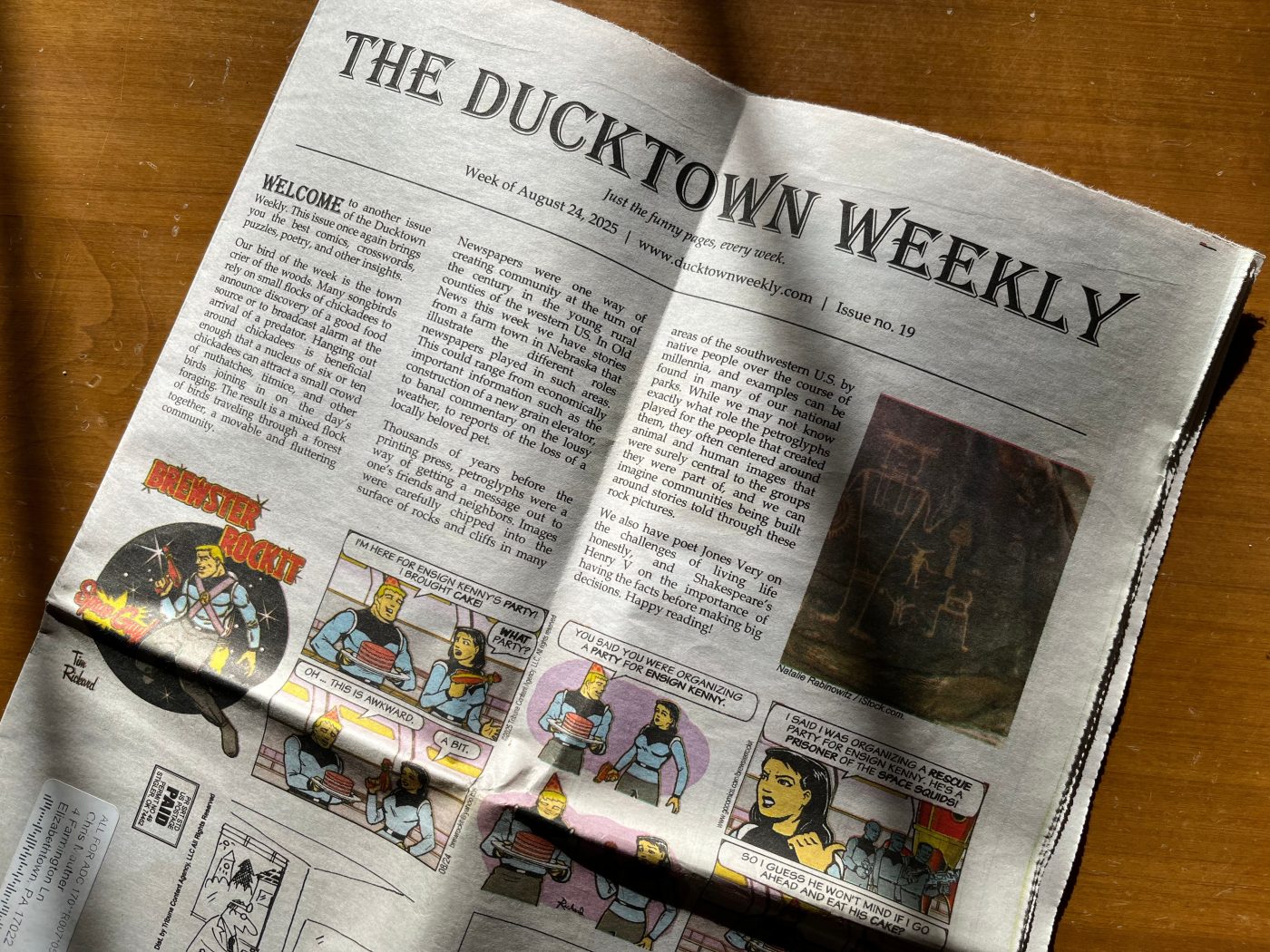
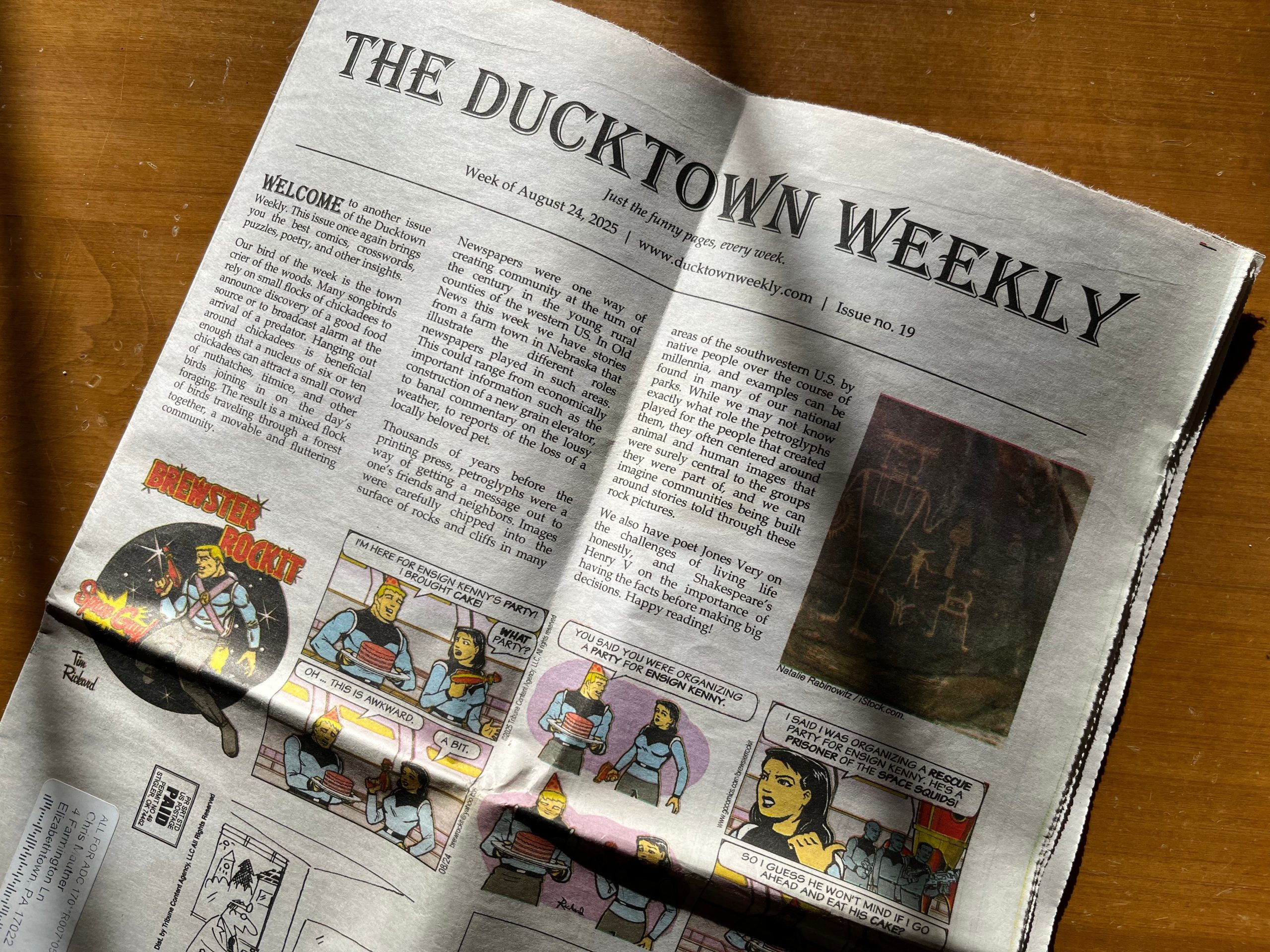
A new print newspaper, the Ducktown Weekly, headquartered in Washington state, is taking a bet on the idea that comics do not actually need to be timely (to the limited extent Toons and other zine-style newspapers like it ever were). When I initially spoke to founder and editor Mark Durbin back in August, he emphasized Facebook advertising and the few hundred free sample issues they sent out per week was their main focus for bringing in new subscribers. At that time, they had 75 subscribers. In a more recent discussion, Durbin told me that they're now up to 180, in the midst of a price drop — $14 a month, $74 for six months, and $138 a year. The rate has been steady, although Durbin tells me they're a fair ways off from breaking even. The target audience, Durbin said, remains as simple as ever: “People who no longer get a daily paper and miss the comics pages.”
Do we really need newspapers, given that get our important daily news from news organizations is now increasingly headquartered on the Internet? That's a problem for the news industry writ large. Newspaper comics, as a historical add-on to newspapers, are in an awkward place to such broader questions of journalism. As Durbin told me, not just the comics, but the various puzzles found in the Ducktown Weekly are “things [subscribers] are likely to miss.”
Thumbing through an issue of the Ducktown Weekly, I found the experience a surprisingly zen one. There's something nice about being able to focus on these little newspaper extras without the distractions of devices or, for that matter, more generally depressing news. Maybe don't take that as too much of a compliment though. Much of the stagnancy that affects regular newspapers still affects the Ducktown Weekly.
I can't exactly pretend to be thrilled to see unkillable dinosaur strips like Garfield and Blondie syndicated in yet another location. Even the “edgier” comics like Pearls Before Swine and Brewster Rockit: Space Guy were edgy fifteen years ago when I saw them in Toons. "We selected comics that we thought would be familiar to folks and things they are likely to miss, as best we could given space and budget considerations,” Durbin said. For what it's worth, they did recently add The Poet by Todd Webb, which is a fairly excellent representation of the calming vibe I described above that feels more modern than stuck in the past.
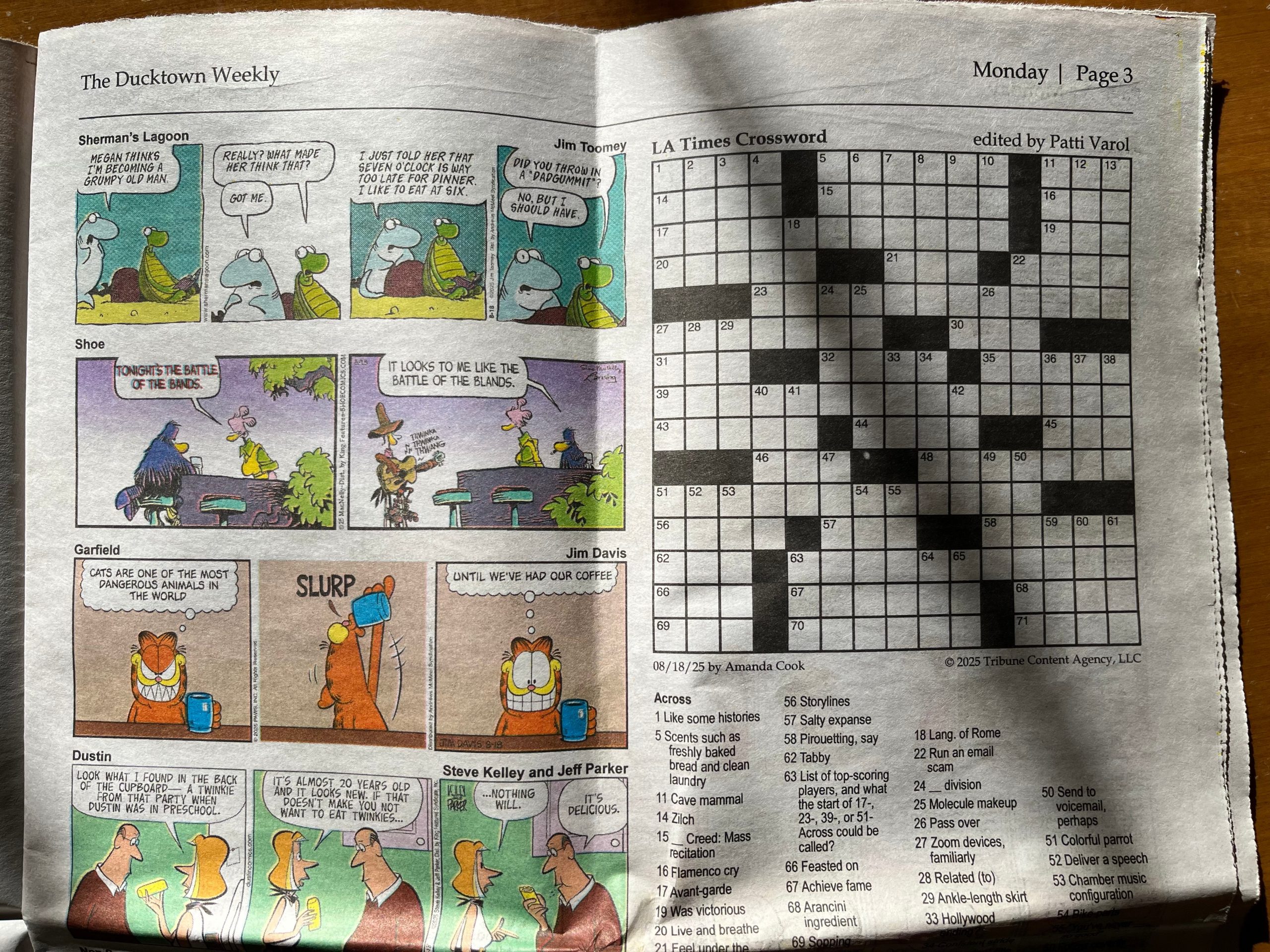
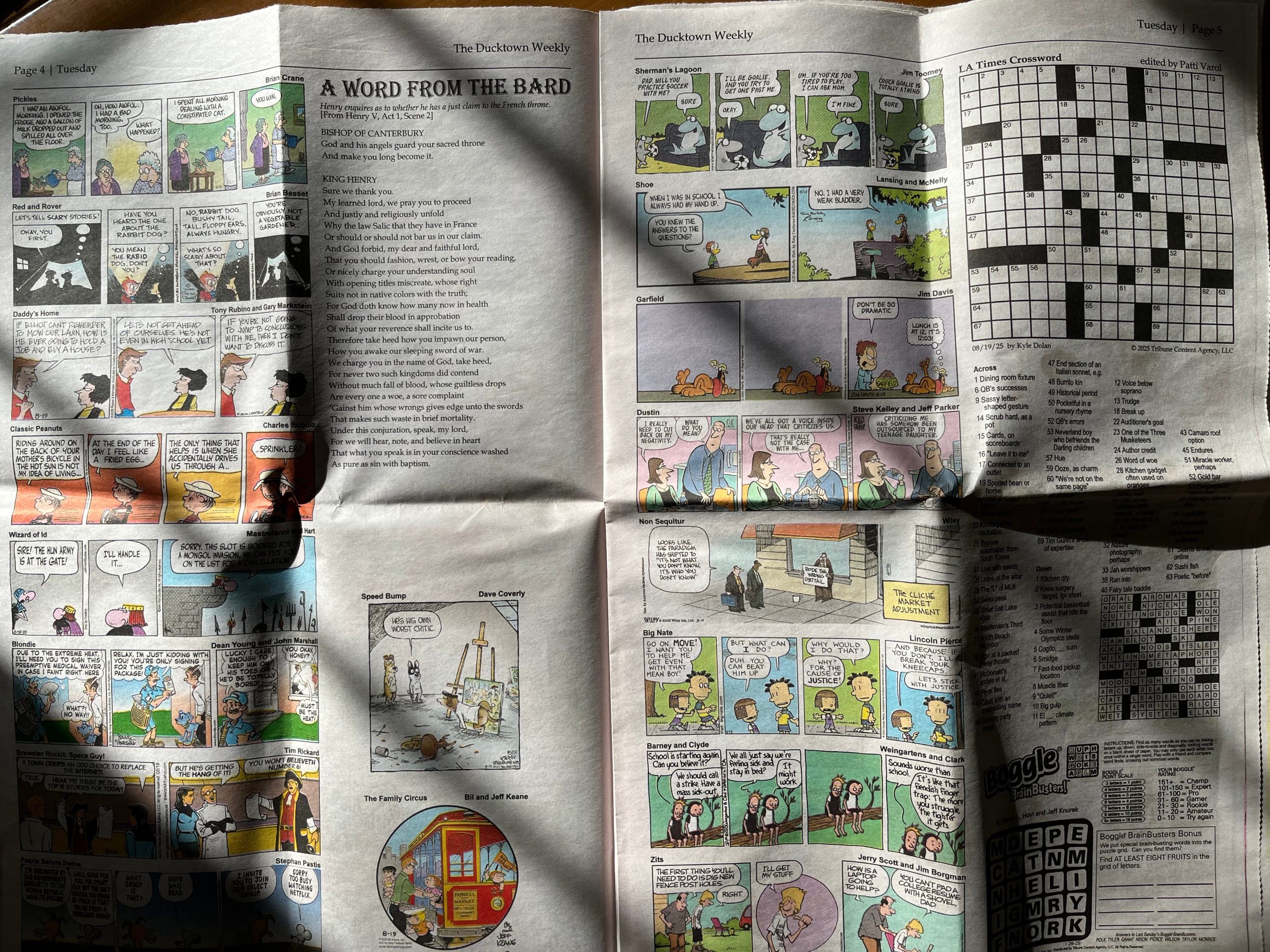
The layout is excellent regardless of what's in it. A full week of syndicated strips like Dustin, Red & Rover and Big Nate are well-paced and displayed, broken up further by bird facts, Shakespeare quotes, and crossword puzzles. None of these things are at all timely, despite the way that they're presented in newsprint, yet the carefully curated experience makes for a bright spot in a day that could otherwise be quite hurried and busy.
There's a very different vibe to trying to complete a crossword puzzle with an actual pencil and paper. Even if a week's worth of crossword puzzles means the answers are just on the next page, it seems to defeat the purpose to rush through the task and just consume all the information as quick as possible rather than to reflect on it. In our current era of instant gratification, something about the nature of even low-quality newsprint is tactile enough to make for a very different experience than manipulating the interface on a phone.
This isn't to understate the value, or lack thereof, regarding the comics themselves. To be fair, I imagine anyone would find some cause to quibble with the specific choices made given space constraints. Still, I found myself wondering whether serial comics with clear continuity like Flash Gordon, or Gil Thorp, or Rex Morgan would read better over a leisurely hour once a week rather than in the daily format.
Even though in most cases I knew what was going to happen in the Ducktown Weekly's comics, the carefully paced nature of the experience was a big draw. Of course, I was mostly just pacing myself, knowing as I did that for $100 for six months of issues, around four dollars for a twenty page newspaper, I felt like I had to get my money's worth. It's a mental hangup that is, admittedly, much easier to get past now that the price has gone down 26%. The Ducktown Weekly is clearly banking a lot on the appeal of nostalgia — quantity of comics is favored over quality, referring to their relatively small size rather than their aesthetic appeal. And the newsprint grade isn't exactly great.
If corners must be cut, that's the place to do them, even though Durbin mentioned to me, ”We don't have current plans to change the lineup, but we've been thinking we'd revisit after polling readers about what they do and don't like.”
The Onion recently relaunched its print edition to a fair amount of surprising success. Yes, strictly speaking, it is easy enough to just read the Onion's satirical website for free. You could, at this moment, dive into Ward Sutton's satire on political cartoonists at large, Stan Kelly, and read the last several weeks work of absurd punchlines in just a few minutes. But the Kelly comics hit different when they're placed next to equally ridiculous editorial essays discussing, say, the idea of public masturbators as a publicly protected group. While the Onion is famous for its headlines, how much of this is because of the Onion, and how much is because, in our online-focused world, all too often it's easy to rush ourselves into not reading anything aside from the headlines (something you're less likely to do with newsprint)?
Then there's The Comics News from Santa Cruz, which offers something of a mix of all these models. They have a much simpler Web 2.0 interface than what most of us are used to on the Internet these days, with options for both print and online subscriptions. The experience is easier online, but harder to savor, which doesn't feel like quite the word to describe modern political comics, most of which are fairly awful.
The Comics News does have bigger comics, though, as well as more newsprint. Five big comics a page, arranged butterfly style. Tthe real highlight though is the News of the Weird, a syndicated feature that you may or may not have seen in another newspaper (it was in my local one as a kid) that discusses strange but true news stories like a woman whose armpits leak milk. A newspaper or zine or hybrid of the two is still more than the sum of its parts — yet another bad Trump caricature hits different when you've just read about flying cars crashing into each other in China.
Whatever their subjective quality, there's no denying that these comics just look and feel better in print. The whole format was designed with print in mind. Comics the world over have evolved in very different directions relative to the United States. The South Korean webtoon model, most notably, is designed principally for scrolling on phones, with big weekly updates to often elaborate, grand narratives. A three-panel Garfield joke simply can't be read the same way. The rhythm is off, if only because reading vertically changes the infinite canvas compared to reading horizontally.
For all these reasons, I suspect that even as it becomes more of a niche, there will still be a place for newspaper comics going forward, mainly because it fits so well in that format. No one really need Peanuts to be reprinted in perpetuity, but simply because it was designed to be read on newsprint, the short little storylines work better in those short bursts than if you were try to read them all in a row online, or in a book. Legacy strips work in this format, not because they're all that exceptional, but because they have that particular rhythm. This being noted, here's to hoping that the Ducktown Weekly takes notice of newer, more dynamic strips by younger authors that could really use the platform. Still, one step at a time. As Durbin told me, “it's a bit of a niche product, so the challenge is getting the word out to the right people.” Comics, whatever format they're printed in, are only as viable as their connection to their readers.
The post Comic strips … in print? A look at <i>The Ducktown Weekly</i> and other ‘zine’-style newspapers appeared first on The Comics Journal.


 Hello, my name is Jack Sparrow. I'm a 50 year old self-employed Pirate from the Caribbean.
No comments:
Post a Comment