

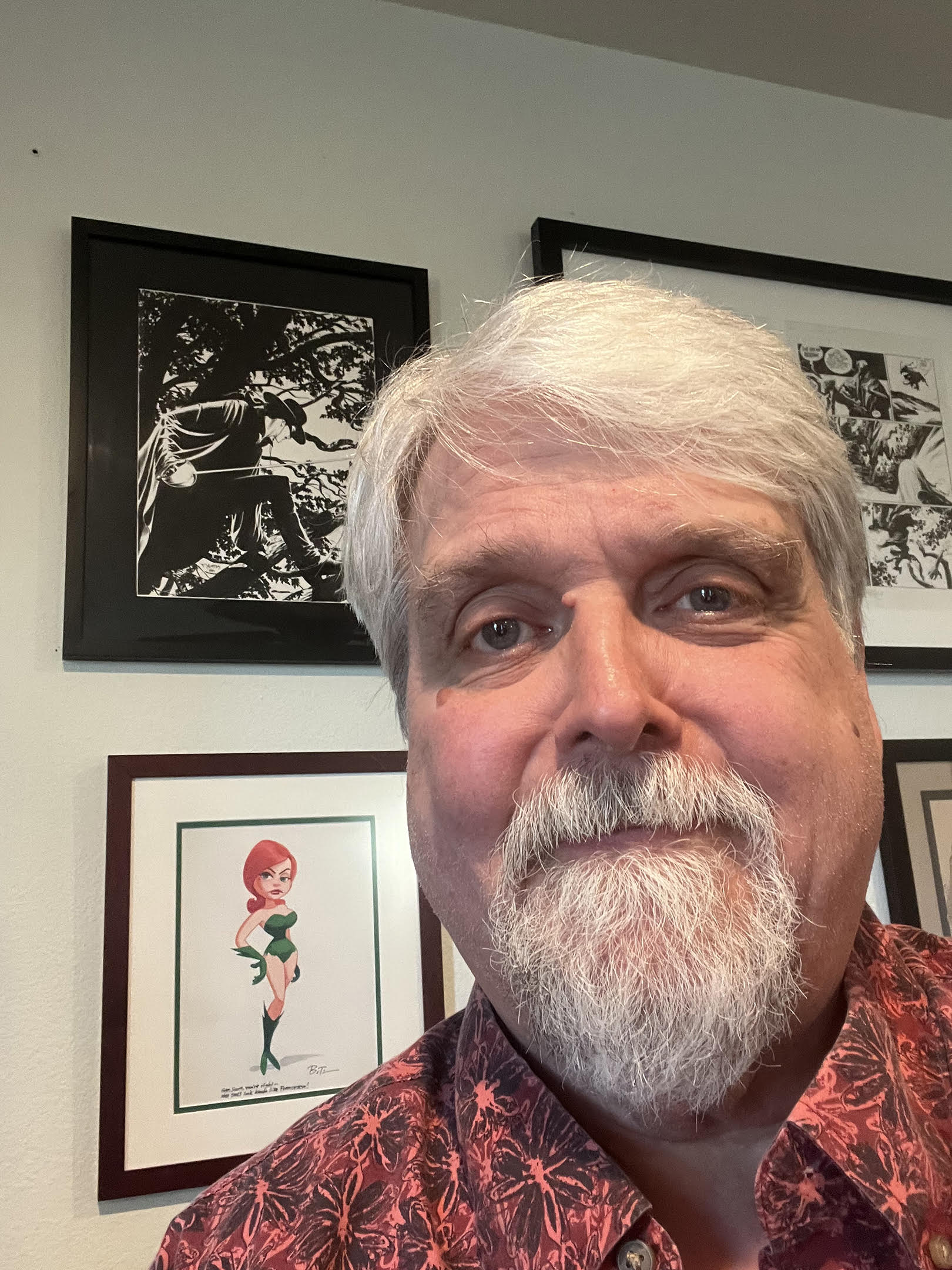
The first time you would have seen Scott Dunbier’s name in the comics press (assuming you’re the sort of person who reads such things), it would have been in the form of a paid advertisement. In the early ‘90s, Dunbier, then a dealer in original comic art, was a staple in the the pages of magazines like the Comics Buyer’s Guide and Comic Shop News, hawking pages by the likes of George Perez and Adam Hughes, and directing readers to his dependable booth at the San Diego Comic Con.
It was because of his connection to those sellers and buyers (chiefly, though by no means exclusively, the artists themselves) that Dunbier was soon to spin his life as a dealer into what would become a three-decade career as one of the most high-profile editors in comics. First, there was WildStorm, where as Editor-in-Chief, Dunbier would oversee a revolution in form and content for turn-of-the-millennium superhero comics, helping to pioneer the “widescreen” aesthetic in titles like Stormwatch and The Authority. He would also be a key player in bringing about Alan Moore’s most enduring contributions to the field in nearly a decade: the Moore-created America’s Best Comics imprint.
Ironically Moore’s big moment coincided with a big moment of WildStorm’s own: a buyout from DC Comics, and Dunbier’s resulting jump to the status of Group Editor over a nominally independent WildStorm within that company. That made him, among other things, something of an unofficial Moore-whisperer at DC, tasked with buffering (and sometimes smoothing over) the notorious rifts between the creator and the corporate powers-that-were. Dunbier would remain with DC until 2008, when he left to become a Special Projects Editor at IDW, a company that had itself been founded by WildStorm veterans in the 1990s.
As much as the monthly comics he spearheaded, Dunbier was — and is — known for particular inclination for high-end collected editions. At DC, there were the glossy, slipcased Absolute Editions, which he created initially to showcase the collected Authority series. Then, at IDW, he debuted what would become his signature product: the Artist’s Edition line, which collected vintage comics in the form of high-resolution scans of the original art pages (whiteout spots and all), and printed at the precise dimensions of the original art boards. This was Dunbier the wiley art dealer coming to the fore again, making use of his connections both above and below-board to assemble seemingly impossible collections of vintage art: Jack Kirby’s New Gods, Gene Colan’s Tomb of Dracula, the E.C. stories of Wally Wood.
And then, in 2024, Scott Dunbier went full circle: leaving IDW with his Artist’s Editions in tow, and forming (along with his wife and business partner Amanda) what he named Act 4 Publishing — its name inspired by what Dunbier sees as the fourth major transition of his professional life. It’s been 18 months since Act 4 was announced at San Diego Comic Con, and its initial slate hasn’t lacked for ambition: Dunbier has so far announced an Artist’s Edition of Steve Ditko’s fabled Amazing Spider-Man issues and a new prestige collection of Darwyn Cooke’s Spirit among other books, and says he’s making plans to move back into the cutthroat world of monthly, 32-page floppies.
So on the day after Christmas this past December, as my home in Brooklyn was piled with snow and Dunbier’s in Los Angeles was pummeled by record rainfall, I sat down with the once and future dealer in comic art to talk about what’s next.
ZACH RABIROFF: I want to start by asking you about what happened about a year ago, when you decided to leave IDW after 14 years. What made you leave when you did?
SCOTT DUNBIER: I was at IDW for a long time. It was my second real job in comics. Before that, I was an art dealer and I worked at WildStorm Productions where I was an editor, and then special projects editor, and then editor-in-chief, and then executive editor. When I left DC, I moved over to IDW. [IDW co-founder] Ted Adams was a great guy to work for. He gave me a tremendous amount of freedom. Eventually though, people get restless, you need to change, and I decided it was time to move on. So 18, maybe 19 months ago, I had been talking to my wife about this, and she was very supportive. She's integral to the new publishing venture. I decided to make the move.
Tell me a little bit about the work that your wife has done, because I think she's probably less familiar to readers than you are. It sounds from everything you've said that she's really the other major player in this new venture.
Amanda handles all the things that I have no interest in. Taking care of bookkeeping, taking care of taxes, taking care of all the details that are the other end of doing business. She doesn't have a career in comics, but we've been married a long time and she's always been incredibly supportive. She has a great appreciation for what I do. I couldn't do it without her. She really is the glue that binds it all together.
When you started to conceptualize Act 4, what was it that you were hoping the company would do? What were the things that you felt at that point you weren't able to do at IDW?
IDW is a great company. They were always very good to me, but as a big company, they also had different ideas of the books I should be doing. There were a couple of roadblocks to books that I wanted to do, and now I can pretty much do whatever I want.
When you talk about the projects that you're able to do now that you weren't able to do before, does that have to do with particular creators, particular types of subject matter, or maybe particular formats?
No, it's more about the bottom line: books that they didn't necessarily think would do well. And to lay all the cards on the table, anything I wanted to do [at IDW], I could eventually do. I wound up eventually doing them, but I'm not a very corporate guy and IDW is becoming more of a corporate place than it used to be. I'll leave it at that.
So on some level it has to do with being willing and able to run a higher level of risk to put out projects that you think are artistically interesting, but maybe not commercially slam dunks.
Yeah, but I don't want to put too much emphasis on that. That was a small part of it. It was just time for me to move on.
You left to form Act 4, the name being a reference to the fourth act of your career. I'm not sure that I actually have the count laid out correctly in my head. Explain to me what the four acts of your career are.
Art Dealing, WildStorm, IDW.
And then this is Act 4. So, who is Act 4? Is it right now you and your wife? Is there anybody else, a staff?
[Gestures toward his home office] This is Act 4 Central right here. We have a warehouse, too, but a small warehouse, 1,000 square feet. Right now it's just my wife and I, and I have some very good support people. I work with Randy Dahlk, who's designed most of my books. There’s Serban Cristescu, another very talented designer who has been doing a lot of other work for me. I work with several different printers that I have good relationships with. My wife says I only work with my friends, which is probably true. The two main printers I use are friends of mine. They either start off as friends, or I become friends with them. Thomas Cho at Trivision, I've worked with them for fifteen years. I work with other people, and we've since become friends.
Because of the nature of what you do, it seems that the quality of that printing process, the physical product that you're producing, is more important for you than it would be for a lot of other publishers.
Oh, yeah. I've had arguments about print quality versus bottom line a number of times.
When we first spoke right after you announced the formation of Act 4, you were still conceptualizing in your own head what this was going to be, what sorts of projects you were doing, what it was going to stand for. Now, 18 months later, do you have a mission statement for what Act 4 is or what you want it to be?
It’s not so much what kind of books I want to do, because I'd like to do a variety. I'll be doing Artist Editions, I'll be doing big, fancy collections of things. I'll be doing new comic books. They're all tied together in my head as long as I feel it's good and that there's quality there.
Like the way an editor's imprint would work at a larger publisher except that you're going to be doing it independently, it sounds to me.
Yeah, I could see that. Maybe what Mark Chiarello did at DC with a number of different things and what I tried to do at WildStorm and at IDW. I do books that I like, that I'd want to have on my bookshelf.
One thing that you have taken with you are the Artist's Editions, which became your signature project while you were at IDW. I'm wondering if we can go back in time a little, and tell me about how the artist's editions came about in the first place.
A lot of credit goes to my former boss at IDW, Ted Adams. I had pitched the idea of doing Artist Editions at WildStorm, and unsurprisingly, they were rejected. WildStorm, at that time, had rejected a lot of different things. If you recall, I did the complete Bloom County Library with Berkeley Breathed. I had pitched that also at WildStorm because at one point someone at DC noticed that the Peanuts collections were doing very well at Fantagraphics, and they asked me to pitch what I thought would be three good strips that would make good books or good libraries. I pitched three ideas: Doonesbury, Pogo, and Bloom County. And they got back to me and said, "We decided we're not going to pursue this. "
Not any of them?
No. When I went over to IDW and I became a special projects editor, Ted and I worked out an agreement where anything IDW did not want to do, I was free to do it on my own. And when I pitched the idea of doing Artist’s Editions, I thought that it was going to be one that Ted was not going to have any interest in doing. They're big, expensive books. They're hard to distribute. They're hard to explain what they are. But I pitched him the idea and he loved it. He said, "Let's definitely try it. "
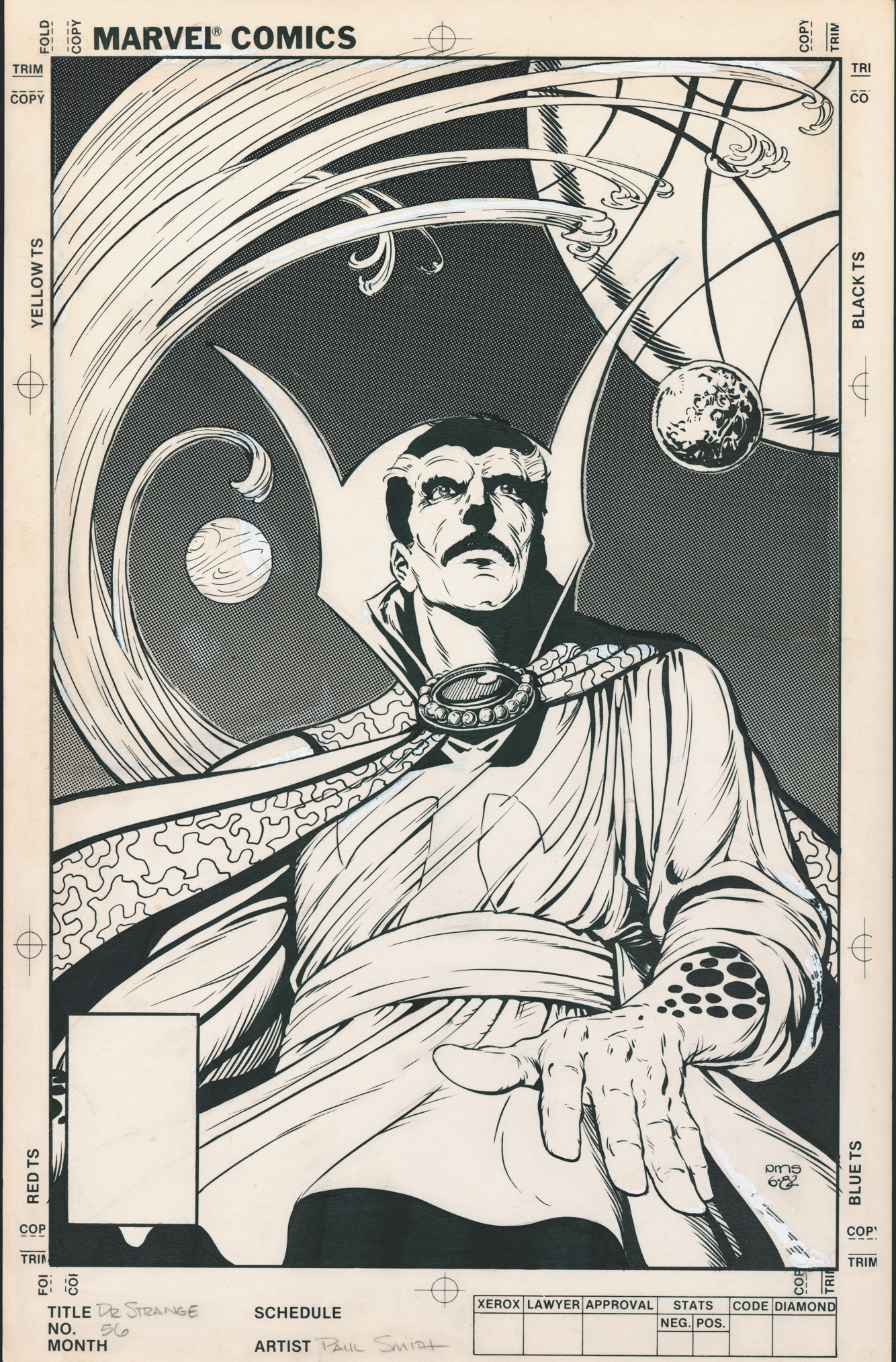
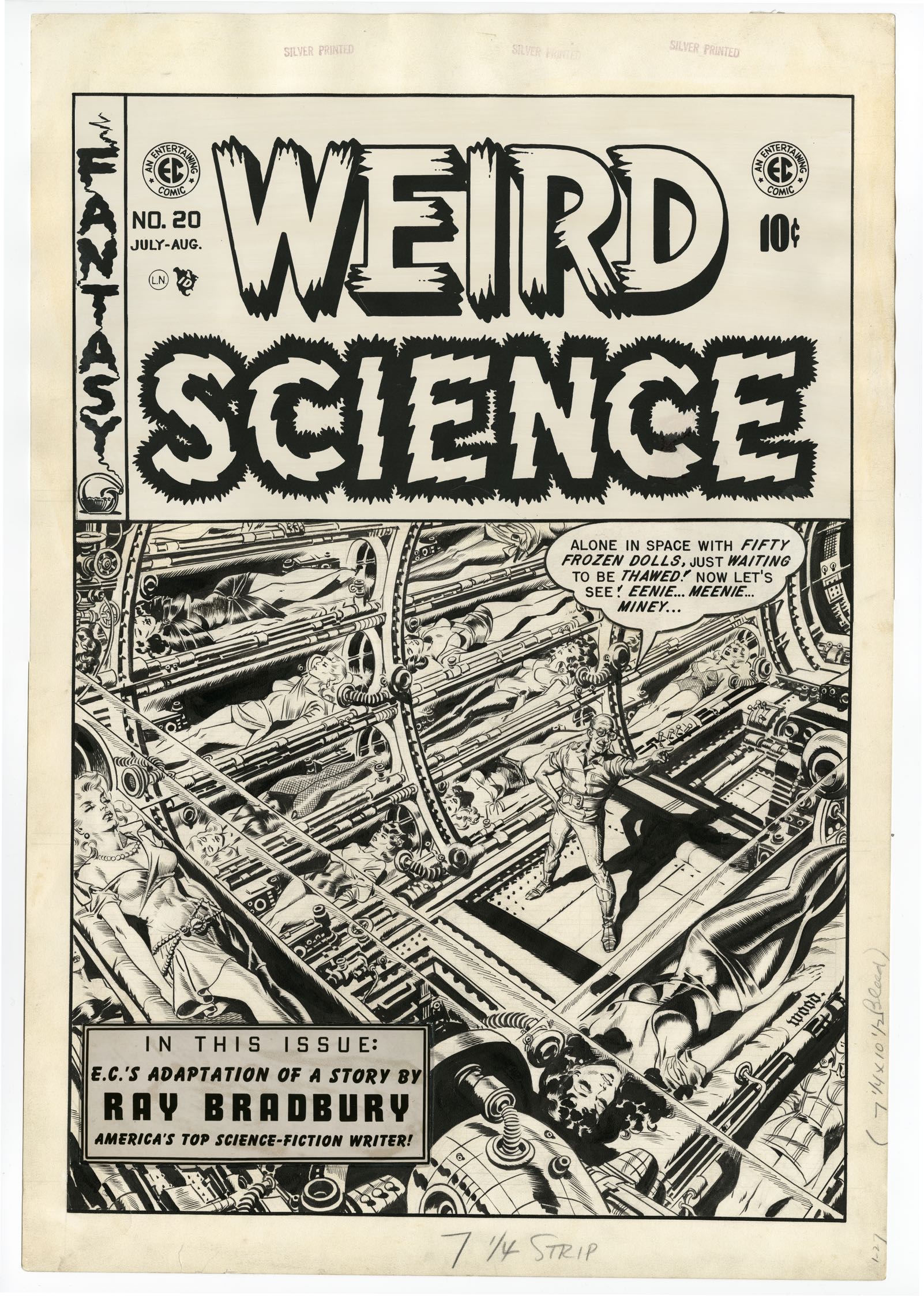
We worked out some details about distribution. The plan was to sell them direct to consumers because they're expensive, but they're also expensive to print. Eventually, with the help of Cliff Biggers, who runs some shops called Dr. No’s (and the former publisher of Comic Shop News) we came up with the idea of giving a courtesy discount to retailers. Not the full discount, but still a discount, because his argument was that retailers would want to buy these books for themselves. It was a much bigger success than we had thought. I think if we didn't make the initial announcement that it wouldn't be available through comic shops, there wouldn't have been the attention that was paid to it. And so because of that, the first Artist’s Edition, Dave Stevens’ The Rocketeer, was really, for an Artist's Edition, a resounding success. It went into a couple of printings. The second book was the first Marvel book we did, which was Walter Simonson's The Mighty Thor. And then after that, maybe six months later — it started off slow, one book and then a year later — the second book was Wally Wood's E.C. stories. That was the first twice-up book, meaning the size of the originals are larger. A regular size Artist's Edition is 12” x 17”. A twice-up Artist's Edition is 15” x 22”.
How much did that change the production process at your end?
For me, it was all the same. I always did all the work on them internally. I didn't do the design work, of course, but I did all the scanning or most of the scanning. As time goes on, sometimes it's more difficult to do all the scanning myself. But at that point, I was doing all the scanning. I was doing it on the twice-up stuff because the art is so big, it needs to be scanned in two pieces, and then I would merge it in Photoshop. If you look at any of the twice-up books, almost every page has been merged in Photoshop. The only exception is there are the occasional pieces that are photographed by professional photographers who are used to working with art.
Walk me through the technical process. Let's say it's the Wally Wood collection. What are the steps that you need to go through in order to assemble that book?
First I need to figure out if the book is even possible, if I can find enough art. In some cases, you have someone like Walter Simonson who saves his art and very rarely sells it. He had all of the art that I'd scanned. Other artists like Eric Powell also had all of the art that was in that book. Other things are different. With E.C. stories, they were all sold years ago by Bill Gaines' agent, Russ Cochran, who did the definitive E.C. collection, the E.C. Library.
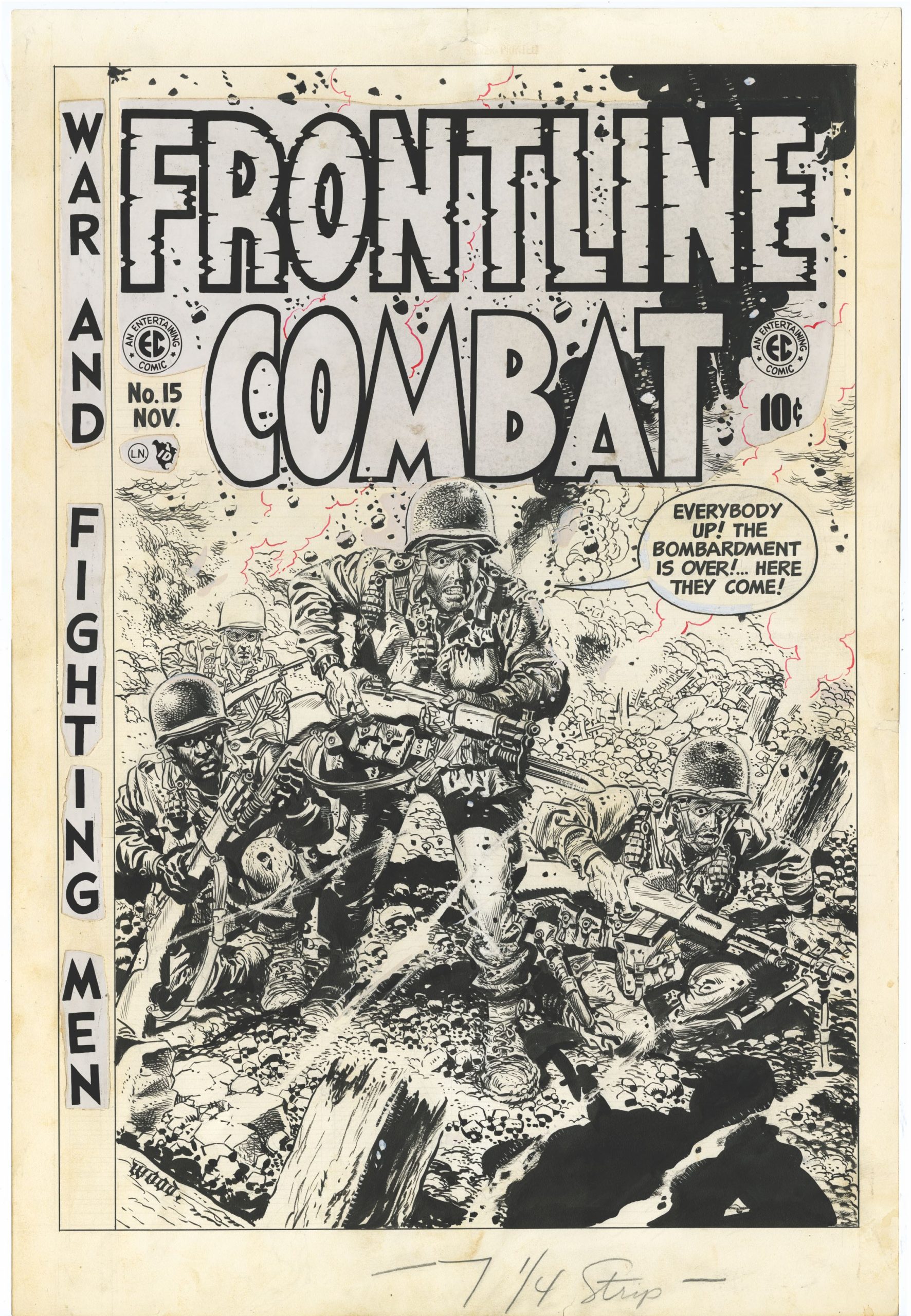
The good news is that because those stories were all between six and eight pages, the vast majority of them are still together. Well, the vast majority of the better ones; the ones that weren't as great have been broken up. Some of the great ones have too, unfortunately, but all of those stories, while they're all in different hands, they're all complete. And so then it's a matter of tracking down the originals. And luckily, since I was an art dealer, I know a lot of collectors and I know a lot of people who have big collections of art. And I also know a lot of art dealers who I'm friendly with. Some are friends of mine going back 40 years because I'm an old bastard and everyone is very helpful. Everybody, with rare exceptions, is very helpful. And the people at Heritage [Auctions] are incredibly helpful. Auction houses like ComicLink and Heritage have vast archives of original art and have been incredibly helpful in getting me scans. The new [edition of the] Wally Wood book is expanded from the original [Artist’s Edition]. The original one had 18 stories. The new one has 29 stories, which is sort of ridiculous. It's too heavy. I really shouldn't have made it that big.
Where did the new stories emerge from? How did those all get on your radar in the ensuing years?
Jim Halperin [at Heritage] had five, so I got scans of those from him. And there were other people. One guy came up to me at a show, the L.A. Comic Art show that's held every six months. A guy came in and he said, "Hey, do you want to scan this? " I said, "Sure.” It was a great story called, “Knights”. Several other people reached out to me and said they had a story. There's a guy in New England who had a beautiful story that's in the book called “You, Rocket”. As I've been doing more and more of these books, the word has gotten out. People reach out to me and they send me queries asking if there's anything in particular I need or can use. So it's gotten easier in that sense to find more obscure art.
When you look back on all of the editions that you've done so far, plus some of the ones that you're working on now, what do you feel has been the most revelatory in looking at these high-quality scans of the original art?
The most rewarding one was probably my last one for IDW, the Neal Adams Artist’ Edition, because Neal Adams was my favorite artist as a kid. And I was able to get so much material for that book. Some of my favorite stuff is in there. There are things that won't mean as much to other people, but there's a seven-page story, the Private Life of Clark Kent, that Adams penciled and inked that is a little throwaway story. Clark Kent doesn't want to use his superpowers to find a missing baby that he's babysitting.
And that's Neal's kid who was the model for that story, right?
That's Zeea. And it has some of the most beautiful inks, I think, that Neal ever did. Then there's actually a second story that is of [Neal’s daughter] Kristine Adams in the Pan story in House of Mystery that's just a gorgeous story. He lovingly renders both of his kids in those two stories. Those are phenomenal jobs. But then also there's an issue of Green Lantern that had seven pages that were lost on a subway, and Neal had to redraw them very quickly. And so rather than have them inked, he just penciled them incredibly tightly. They printed like crap in the comic because it's newsprint, but I was able to find all seven pages and include them in the book. It's just some of Neal's most beautiful work. A 288-page Artist's Edition with five fold-outs. It's pretty insane actually, but that's probably the most gratifying.
When you set your initial lineup for Act 4, how did you choose what went in the initial slate? Were you deliberately looking for a range that would attract an audience or various audiences?
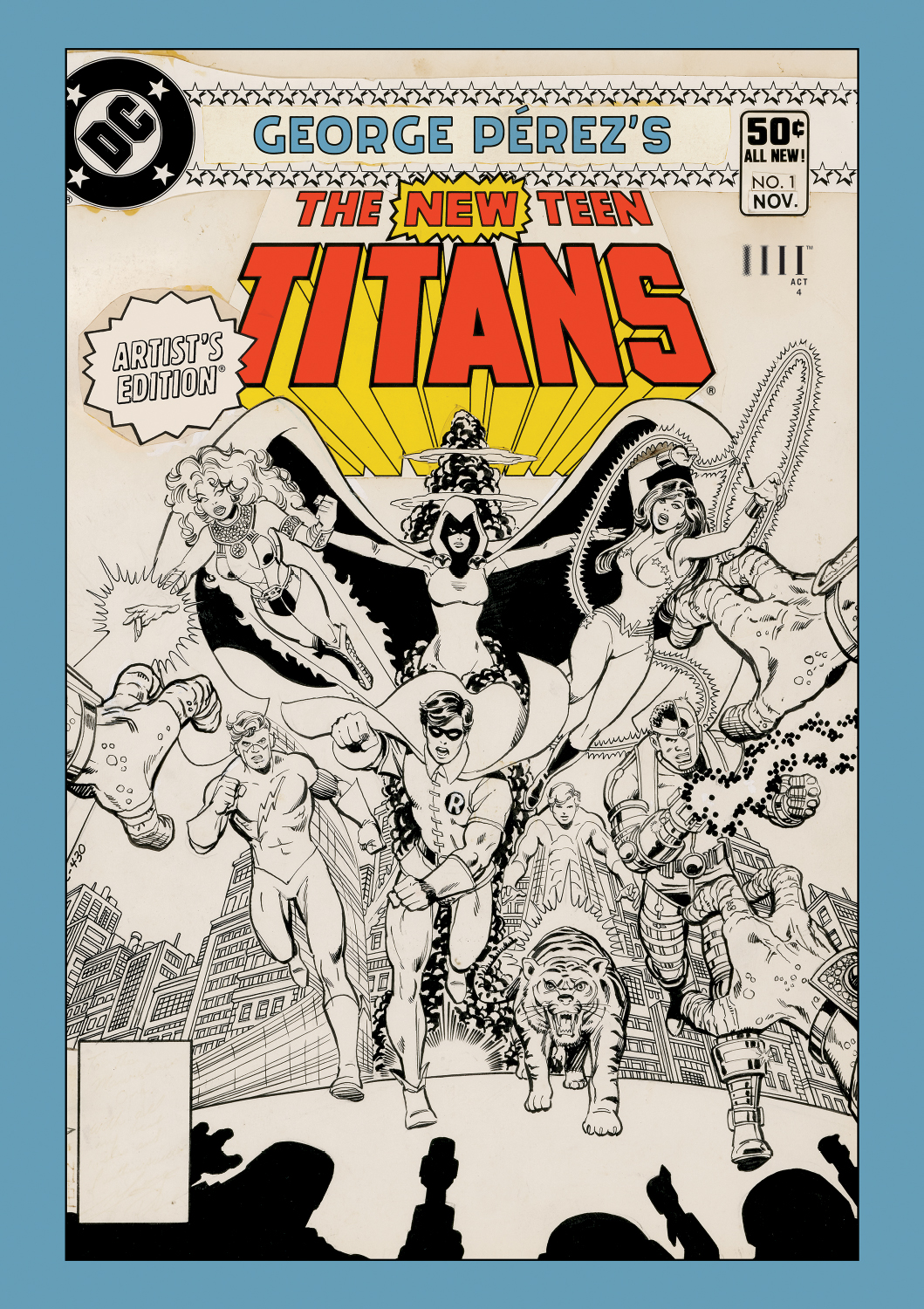
I don't necessarily try to pick what I think is going to be the biggest seller, which is probably not a good idea for running a business, but I try to choose things that I would like. I think I have good taste, and I think that people will find good things in the books that I like. I wanted to work with DC and Marvel, of course, and so we worked out arrangements to do books. The first DC book is Jim Aparo’s DC Classics Artist Edition, which just came out. It had a couple of hiccups along the way, but it's finally in stores as of [late December]. I have a second book coming out from DC in July, which is George Perez's Teen Titans Artist's Edition. And a number of other things: Mike Mignola's Hellboy in Hell volume two, which is a sequel to the one I did at IDW. It has the last half of that series, as well as another 70 or 80 covers and pages from various other things as well.
You say that you don't have too much of an eye on the marketplace, but what does the marketplace look like for this sort of book? Have you seen it change over time? Has it gotten better or worse?
It's a little bit more difficult now than it used to be, because now there are a lot more people who've thrown their hat into the Artist's Edition ring, from Fantagraphics to Graphitti, Dynamite, [Rebellion Press] with Apex Editions. There's a lot of competition, but I still have far and away the most books. It’s kind of a silly number. It's getting close to 100 different books.
Do you think it's your background as an art dealer that gives you a little bit of a leg up on that?
Oh, yeah. And again, a lot of art dealers are good friends of mine and they're very, very helpful.
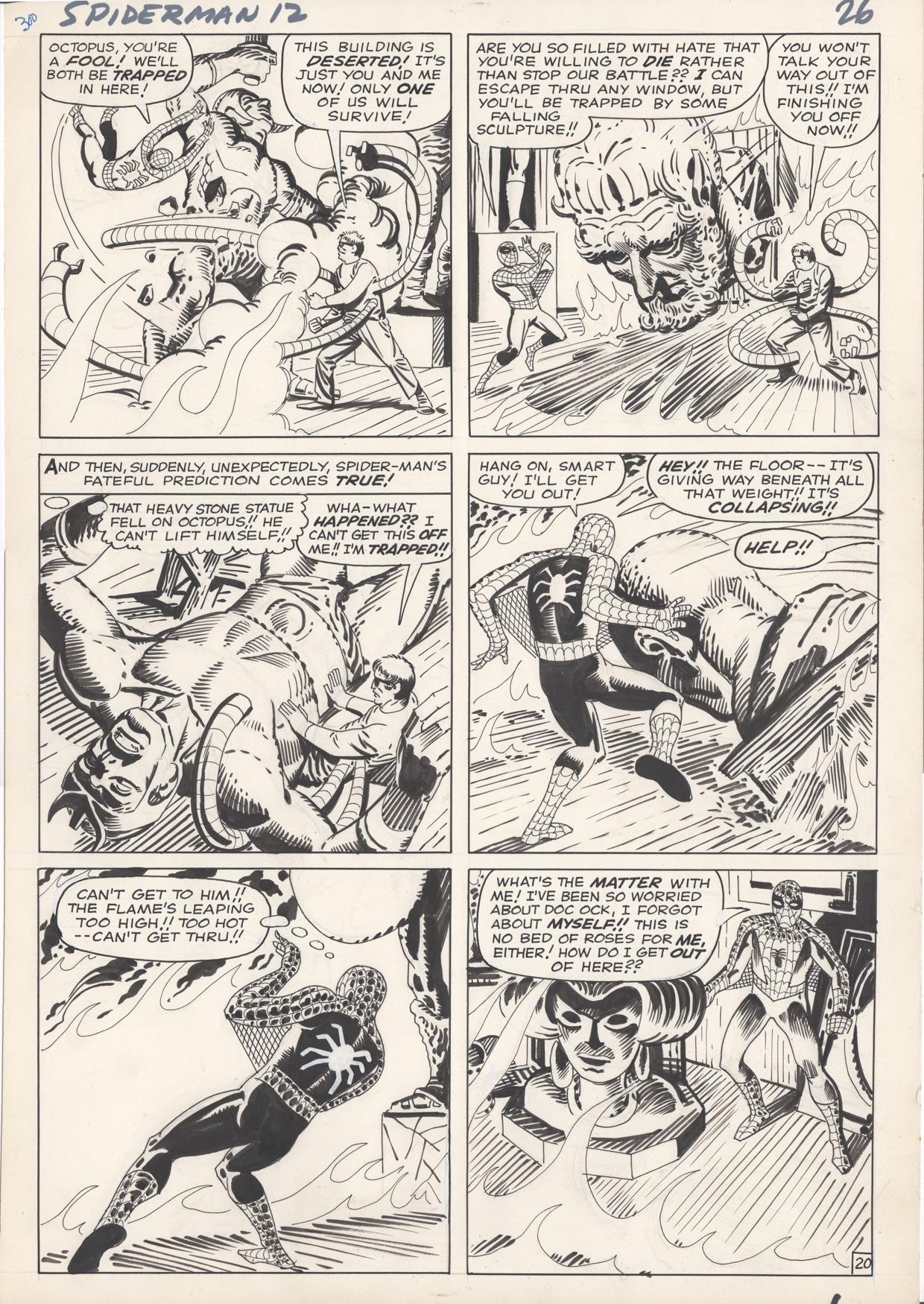
The upcoming Steve Ditko Spider-Man volume is one of the ones that fascinates me the most. I would assume that the Ditko family must have been involved to some extent.
Oh yeah. I've been talking to Mark Ditko, Steve Ditko's nephew, for years. He's the biggest booster of his uncle's work. He had a great relationship with his uncle. They exchanged something close to a hundred letters over the years, Mark told me. So he has not only a great love for his uncle, but also a better insight into Ditko as a man probably than anybody I've met. In this Artist's Edition, Mark wrote the introduction and he also provided a couple of photos of young Mark Ditko with his brother, Steve Ditko, and their Uncle Steve, taken probably in the early to mid '60s. And they're really cool.
Obviously there are not a whole lot of 1960s-era Steve Ditko photos publicly available these days.
Mark sent me a dozen different photos to choose from. I always felt, from my interpretation of reading about him, that Steve Ditko lived sort of the life of a hermit. So I was really happy to learn that Ditko had a thriving family life. That made me feel much better about Ditko and how I had perceived him before that.
For that era of Spider-Man, I would imagine that the process of getting the art must have been more difficult and fraught than it has been for other artists because so much of it was notoriously stolen over the years, and has gone through many different hands. Maybe you can talk a little bit about the process of assembling those pages.
Sure. There are four complete stories in the book. The earliest one is Amazing Fantasy #15, the first story and the origin of Spider-Man that is in the Smithsonian Institution. Those scans came from someone who had gotten scans from the Smithsonian. The other three stories came from collectors, Spider-Man #20, and #26, and #33. Number 33 is arguably the most famous and best story that Ditko did on the Spider-Man run. It has that famous six-page sequence at the beginning where he lifts the machinery off of him as he's thinking about Aunt May and how much she needs him.
There are 176 pages of art [in the collection] and it's a 192-page book. As you say, that art has famously been stolen over the years. Mark Ditko and I came to an arrangement where anything that is provided to me to put in these books— because I'm actually doing two Ditko books, not just one — the estate will consider those pages to be legal.
A little bit of blanket amnesty for the purposes of these books as they come out.
And once the books are done, I'm going to be sending all the scans to the Ditko family, and then they can presumably do whatever they want as long as they receive permission from Marvel.
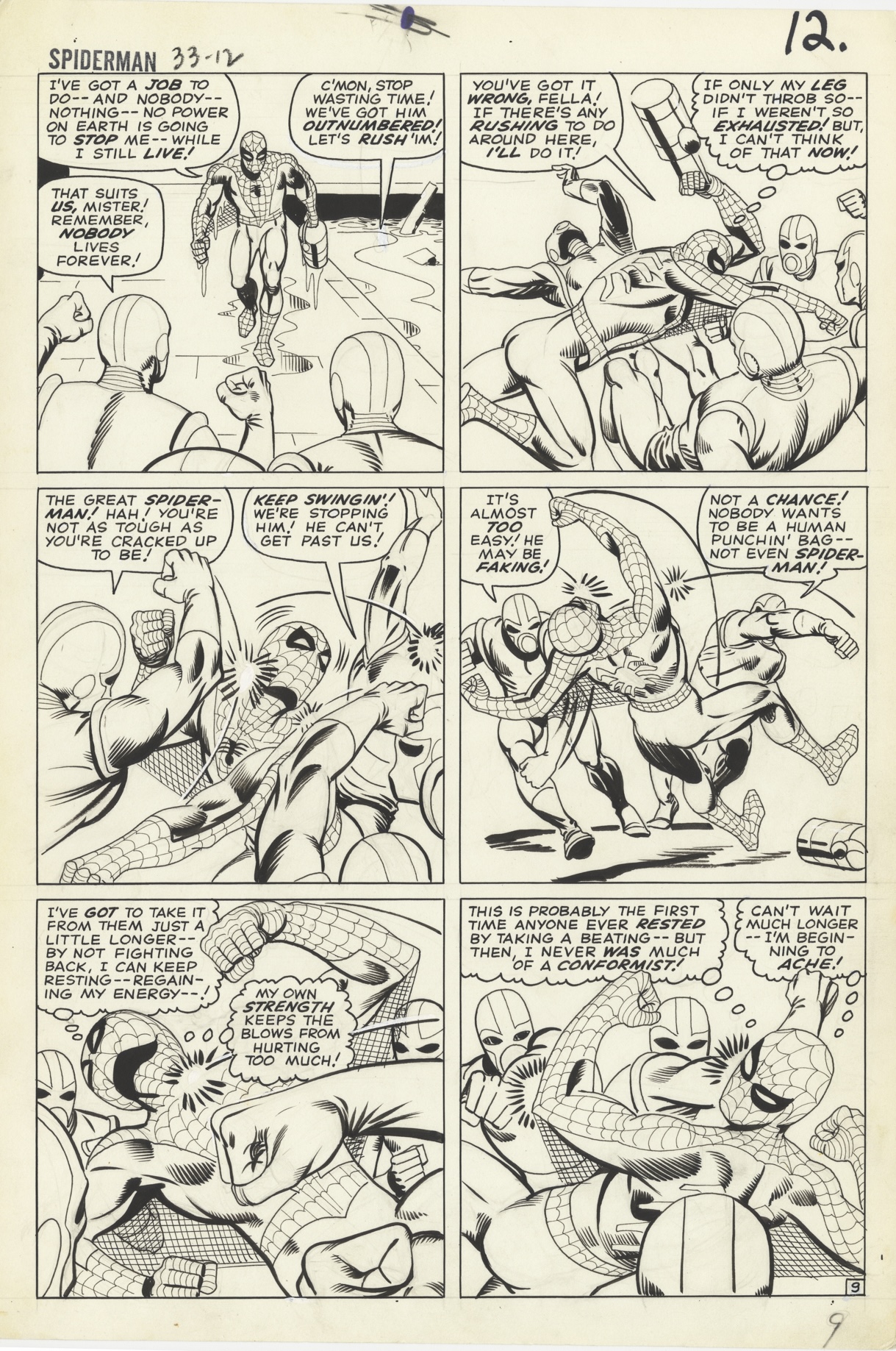 Is there anything about seeing Ditko's art in that original form that readers wouldn't see from the reproductions that are in most reprints of the Spider-Man issues?
I think so. When you can see the way the ink is laid down, and the different gradients and the pencil marks that weren't always erased. I think the most telling stuff is from the 31st issue of The Amazing Spider-Man that exists in pencil form through photocopies that were made back when it was first done. Luckily, they somehow managed to survive. I have a full set of the photocopies. I was originally toying with the idea of putting the entire issue in pencil form in the Artist's Edition, but by then it had been reprinted by Marvel in a smaller book a number of years ago, and I thought it took up too much real estate to put 20 pages devoted to that. I have four pages from issue #31, finished pages, so I put them side by side. On the left side, you have the pencils, and on the right side, you have the inks. I think those four pages are some of the most interesting things in the book. Seeing how very loose the pencils were and how much he actually did in the ink work is very telling to me. It shows a very confident artist.
You spoke about Act 4 potentially getting into contemporary new comics, as well, and you do have some new Walt Simonson's Ragnarok on the schedule now. Do you have any other thoughts about what sort of new books you would want to be putting out?
There are a few different things that I'm exploring. But right now I'm waiting for Walter to produce more of Ragnarok, the fourth series, so we can get that out to comic shops. We're also going to be releasing a collection of his Ragnarok work in what I call the “Connoisseur Edition.” It'll be an oversized hardcover and it will collect all eighteen issues in a slip case. It'll be the same size as the Spirit book that's coming out by Darwyn Cooke in a couple months.
Is your thinking that when you put out these new books, it's going to be in the form of full graphic novels and collected editions rather than the traditional 32-page floppy?
Oh, no. The Connoisseur Edition is going to be the first three series, and that will be released a couple of months before the new comics. The new comics will be 32-page floppies.
So, the traditional periodical issues. Do you feel like the marketplace is still in good shape for that?
Ask me next year.
There have certainly been some convulsions, especially over the past year. What has happened with Diamond, for example. I think everybody's still trying to find their footing now.
That's definitely true. There are some good signs. DC has had some incredible success with the Absolute line. Absolute Batman is selling tremendously well. Hopefully comic shops will thrive, knock wood.
One thing that I have seen that you've been doing is using Kickstarter for some of the newer artists' editions. Does that change the game at all?
It does. There are three books that I've done through crowdfunding, and two have been Kickstarter. One was Zoop. The Zoop one was John Paul Leon’s Winter Men. That was done as a charitable thing for John Paul's family, specifically for his daughter, to pay for her schooling. Tremendous artist. I don't need to tell people what a tragedy it is to lose an artist like that, who was not only a terrific artist, but was truly a wonderful person.
The second one was launched through Kickstarter, and that was Jason Pearson's Body Bags. That also was a charitable thing for Jason's mom. It was put together by me and a good friend of Jason's, Keven Gardner. Keven is the publisher of 12-Gauge Comics. I put together the Artist's Edition, but he did all the Kickstarter stuff. He took care of all that, and he did a fantastic job. It's been in fulfillment for the last couple of weeks, and the last copies are being mailed out next week. I'm really happy with the way that one came out.
The third one is J. Scott Campbell's Danger Girl. That's an interesting case because J. Scott did a series called Wildsiderz that was never finished. That is a really beautiful job. All the art is in pencil. He didn't have it inked; he had it digitally inked. And there were a lot of special effects in that book that overwhelmed the art a little bit. It looked beautiful in its own right, but you couldn't really see the art as I saw it when the pages came in. So what we decided to do — I talked to Skybound — I told them I wanted to do this as an Artist's Edition, I told them about the second book, and they said, "Well, why don't we do it as a Kickstarter?" They've done several Kickstarters, two of which were ridiculously successful. They did a Transformers and a G.I. Joe. One of them did three million. I think the other one did two million. Just crazy, crazy, crazy numbers. So we decided to give it a shot as a Kickstarter.
When you look at everything that you're putting out, I wonder if it sometimes feels to you like you're waging a kind of one-man rear guard action against the march of digital technology, because your books are so much physical objects.
I'm not a fan of AI in any regard. I'm sure it has wonderful technological applications, but when I call up and try to get a prescription filled and I'm stuck with an AI assistant with my local pharmacy, it just drives me nuts. And the idea of the blatant thievery of AI. I've seen sites promoting and showing off what they can do mimicking comic artists. I remember there was one site that had Sergio Aragones' work plagiarized, and several other artists, as well. I don't remember which ones, but it was infuriating.
Art done in the simulated style of Sergio?
Yeah, exactly. I have no gripe against working digitally. I think it's a shame because I am a guy who really loves original art and I love the feel of the paper. I love looking at the ink. So to me, we're losing something, kind of like we've lost something by going digital with lettering. While I understand and have worked with digital letters over the years, a page of art doesn't feel complete to me if it doesn't have the lettering. The art of E.C. Comics wouldn't have been as appealing to me if it didn't have the lettering, because half the fun of an E.C. story is reading it.
But wasn't EC's lettering famously done with the automated process of its time?
Yes and no. The [mechanical] Leroy lettering was used in many cases, but not all. Ben Oda [lettered some], and Wally Wood actually lettered some of his own stories, and he was a great letterer.
He lettered his stuff for Witzend as well. It's a really distinctive style he had.
He did some of the lettering on his Spirit stories, too. Kevin Nowlan's a great letterer. He still letters some of his stuff if he's able to. John Workman still letters all of Walter Simonson’s stuff, but most people have gone digital. Even Todd Klein mostly does digital stuff now, although I think Todd might be retired.
Even John Byrne, with whom you've worked quite a bit, designed a font based on his own hand lettering that he started using digitally for all of his work.
And that's fine. I just miss it, but not to the point where I put it in Artist's Editions. I did that once and it was fine, but I'd rather it was organic. I'm probably just old-fashioned.
I guess in your line of work, you walk a fine line between appreciating and bringing out the best in the physical product and avoiding fetishizing the comics past.
What do you mean by fetishizing?
Well, there's always been a tendency, among comic readers especially, to look toward the past as the Golden Age. It seems like as a contemporary publisher, as somebody who is putting out new things, you have to avoid thinking that everything good was in the past.
I'll tell you something. I can never give you my “top 10 movies ever” because I have to go by decade, and that includes this decade, or I have to go by my favorite Western or my favorite science fiction movie, or my favorite court drama, or my favorite samurai picture, or whatever. I cannot possibly pick my favorite of anything. And I'll never say the best because who am I to say what the best movie or the best anything is? I can only say what my favorite thing is.
I can tell you what The Golden Age is, or at least what it used to be. The Golden Age of comics is when you're 12 years old. It doesn't matter. I've read a lot of old comics. I've read a lot of stuff from the Golden Age of comics, the 1930s and '40s. If we're talking about the Golden Age, I'm going to use the b-word. What I think the best line of comics ever is — I guess it's considered The Golden Age still at the cusp of the Silver Age — is E.C. Comics.
E.C. Comics is the finest line of comics ever made, in my opinion. And while it's a tragedy that they were forced out in 1956, how long could they keep up that level of quality? You have six years that are just phenomenal, just an amazing run. But, to me, the Golden Age of comics is when you're 12 . Now it could be any time because 12-year-olds aren't really reading a lot of comics except for manga. I guess the real golden age for these young folks is going to be manga. My son Sam is a huge manga fan. He devours it, but he's also starting to read more traditional comics. For Christmas, he wanted Absolute Wonder Woman because his friends told him how good it is. And when he's done with it, I'm going to borrow it and read it myself because everyone's saying how wonderful that book is.
To me, we're living in a real golden age and we've lived in a bunch of them. From the mid 1980s onward, there's been such incredible diversity. Actually, the early '80s, because I'll have to go back to the Hernandez Brothers. Going back to the 1970s, you have Imagine… from Mike Friedrich and Star*Reach, which did some wonderful stuff, or the 1960s, with underground stuff. There are so many great periods in comic art. I'm not going to say that anyone is better than the other, but I am going to say that the level of creativity right now is ... almost inspiring. You look at all the different types of things that are being done in the graphic medium. I love it.
Do you have dream projects now that you want to be able to latch onto?
I would love to do something with Richard Corben’s work. He felt that his work would not hold up to the format, which I think is crazy. I would really love to do something with Richard Corben. I have something in mind that hopefully, knock wood, will happen someday. I would love to do something with some manga, especially [Katsuhiro] Otomo’s work. I'd love to do an Akira Artist's Edition.
Is that a new set of connections you'd have to make, to try and secure the rights and the art for that?
Oh, yeah. I tried to do a Moebius Artist's Edition a number of years ago, and unfortunately the family just wasn't interested, which is a tragedy. I mean, Moebius in that format — I mean, Moebius! And I would love to do a Tintin book. I tried to reach out to the Hergé estate, but they never got back to me.
I imagine they would be pretty protective of everything that they publish.
Yeah. But those were the first comics I read as a kid. My mom read them to me when I was three or four, and then I read them on my own. That was my introduction to comics.
Is it as fun for you now as it was thirty years ago to be in this business?
Probably not. It was a different period. That was a magical time for me. And working at WildStorm, especially before DC bought it, that was really something special. We had so many great creators. That's the period that I probably take the most pride in, because before I got to WildStorm … well, I'm going to sound like I'm bragging now and I am, I guess. Before I got there, there was a limited pool of talent. There were some really good artists that were coming up. Jim Lee, who I basically owe my career to for bringing me out there when I had nothing to do with publishing, made me editor-in-chief after a year.
The amount of talent that we had ... Jim would ask me what I thought of this guy or that guy. And I would say, "Well, he's very talented, but we already have one Jim Lee. What we need is somebody else. We need to diversify the talent pool."
He let me go crazy, and I did. The first guy I hired was Adam Hughes to do a miniseries for us. That was beautiful and did very well. We already had Warren Ellis working for us, but I gave Warren a lot of different projects. One of the biggest things I did was bring in Alan Moore to work for us. That was a wonderful experience. We had a great relationship for a good, long period. Mike Heisler, my predecessor, had already bought League of Extraordinary Gentlemen, but I brought in Alan on the ABC line.
That era of WildStorm felt like a moment when the direction of mainstream comics seemed to shift from its trajectory in the mid-’90s. I don't know if you felt that at the time.
I did. There's another story that's going to sound like I'm bragging, and I guess I am. After we were acquired by DC, WildStorm had over 20 Eisner nominations. Just us, not including DC. It would be impossible to win that many Eisners because in the best artist category, we had four nominations, which is sort of ridiculous.
I'll tell you one of my favorite memories of all time: I went up to accept many awards that year. And back then, Will Eisner was handing out the awards himself, up on stage. And the fourth or fifth time I went up that night, Eisner is hunched over and he's getting the award, and he turns around and he sees me, and he goes, "You again?”
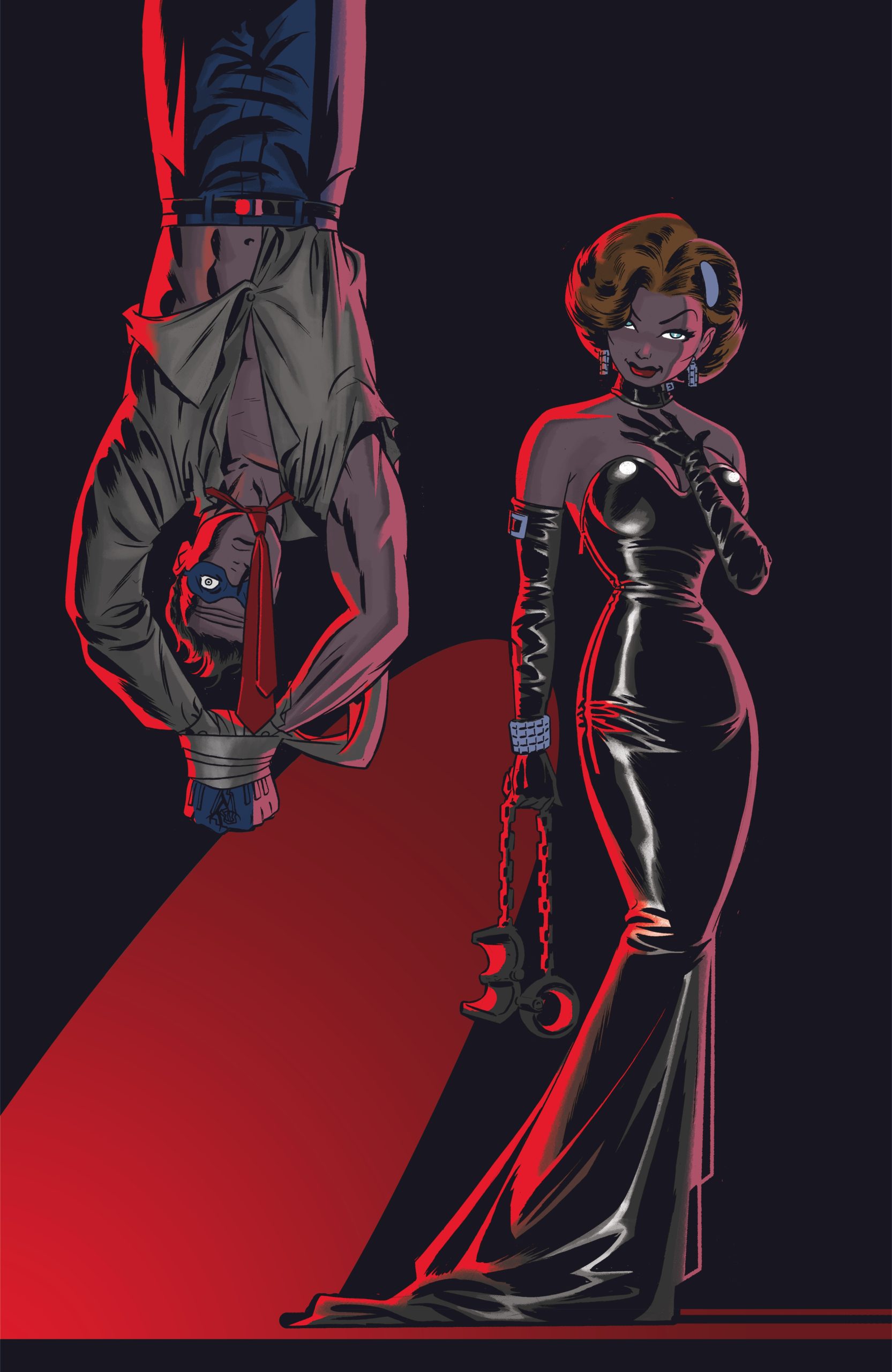
Getting back to your newer projects, I want to ask you about the Darwyn Cooke Complete Spirit Connoisseur Edition.
I was actually the editor on the first eight issues of the Spirit series that Darwyn did, and then I was fired. Darwyn and I worked on the Parker series of graphic novels, and we became very close friends. I was the best man at his wedding. It was really tough when he got sick and then very shortly after, died. I have a great relationship with Darwyn's wife, Marsha. I told her I would like to do a book like this and I asked her how she felt about it. She said she liked it. She likes the [Parker] Martini Editions that we did. Denis Kitchen has been a friend of mine for many years, and he let me do two Spirit Artist's Editions way back when. Oddly, DC had never done a full collection of the Spirit, and then they let it lapse so it reverted back to the Eisner family.
I called up Denis and I told him I'd like to do a book collecting it in its entirety, and he agreed. I then reached out to DC because the first book that Darwyn did was actually a crossover of Batman and the Spirit. I reached out to them about getting the rights to include the crossover inside the book because it's owned by DC and the Eisner estate. We were able to work that out fairly easily. The first complete collection of Darwyn's spirit is going to be in stores in early February. Do you want to hear about the second Steve Ditko book I’m doing?
Why not?
It hasn't really been officially announced yet, and this isn't something that is going to be officially announced for a little while, probably a few months. It'll be called Heroes and Monsters by Steve Ditko Artist Edition, and it will have at least 15 complete monster stories — some really, really great ones. They're all five pages long. There will also be any additional Spider-Man stuff I get. There will be a number of really nice Dr. Strange pieces in it, as well as some Hulk and Iron Man. It's going to come out in 2027, so probably one year after the Amazing Spider-Man book. If anyone has scans of Ditko art that could be included, they can reach out to us at scans@actumberfourpublishing.com
Is there any holy grail for you? Any white whale that you're chasing?
I've been really lucky. I've done so many things that are on my list. I got to do my three favorite comics from when I was 10 or 12 years old: Kamandi by Jack Kirby, Tarzan by Joe Kubert, Walt Simonson's Thor. And then I got to work on Neal Adams. I've done a bunch of EC stuff. I've done seven or eight Jack Kirby books, five Joe Kubert books, including Enemy Ace. There's not a lot on my bucket list that's left, unless it's something that's impossible like Jack Cole's Plastic Man, which just doesn't exist. Otherwise, it’s been a good run so far.
The post From WildStorm to Act 4: An interview with ‘Artist Edition’ mastermind Scott Dunbier appeared first on The Comics Journal.


 Hello, my name is Jack Sparrow. I'm a 50 year old self-employed Pirate from the Caribbean.
No comments:
Post a Comment