

Upon a recent trip to the comic book store whereat I purchased a number of new comic books with varying degrees of quality and tastefulness, I also secured a copy of the most recent issue of G.I. Joe: A Real American Hero, published by Image Comics through the Skybound imprint. Issue #324.
I buy G.I. Joe: A Real American Hero every month, and have since its return to Image two years prior. It hits stands like clockwork, chronicling the continuing adventures of the original G.I. Joe comic book timeline - that is, the same comic book continuity that began in 1982 at Marvel. Forty-four years, it shall be this Spring.
G.I. Joe: A Real American Hero is not to be confused with G.I. Joe, the mainline G.I. Joe comic book currently also published through the Skybound imprint of Image. It’s quite popular, as is Skybound’s concurrent Transformers revival. The only exposure I’ve had to the new generation of either franchise has been the Scarlett limited series I checked out because of my deep respect and admiration for Kelly Thompson. But alas, as it turns out not even the divine Ms Thompson can make me care about Scarlett qua Scarlett.
Because, here’s the crucial part: I don’t really care about G.I. Joe in the capacity of G.I. Joe at all. I grew up with 'Joe on TV but wasn’t allowed to support the military industrial complex, my parents didn’t let me buy war toys or war comics, like G.I. Joe. Transformers were fine because the Transformers were robots, but G.I. Joe looked suspiciously like a military recruitment commercial aimed at children, at least as far as staunchly anti-war boomer parents were concerned.
I wouldn’t really learn different until my twenties. The man to credit with the reappraisal is Tucker Stone - no stranger to these pages! - who wrote about the first dozen or so issues of the original run of G.I. Joe: A Real American Hero, I believe for his Factual Opinion. With the prompting I sat down burned through the Larry Hama run of G.I. Joe, which I am now convinced sits firmly within the Top 10 most important comics Marvel ever published. I’d slot it behind Claremont on X-Men - but honestly not as far behind as you might think - and right ahead of Miller’s Daredevil and Peter David’s Hulk.
Maybe it’s difficult to see, in hindsight, how crucial G.I. Joe was to the company. The original Hama run stood as one of the four pillar runs that defined the course of the publisher’s “Long Bronze Age,” a novel periodization I’m making up right this moment. If you begin with the publication of Giant Size X-Men #1 in 1975 and proceed through the final issue of Peter David’s Incredible Hulk in 1998 you will see the birth, maturation, and hard painful death of a certain idea of the company, midwifed by Shooter, developed by DeFalco, and ran into the ground like a dying animal by Bob Harras.
The trajectory of the company over the course of their Long Bronze can be traced by the ascent of four runs of singular length and influence: Claremont’s X-Men, Hama’s G.I. Joe, Gruenwald’s Captain America, and David’s Hulk. Hama’s contribution isn’t always remembered in the same breath as Claremont’s, perhaps because Marvel didn’t own G.I. Joe. Regardless of who owned the book it was central to the company’s retail profile for a solid decade, shipping 155 issues - thirteen years, more or less, after Claremont’s sixteen, David’s twelve, and Gruenwald’s ten. These particular runs were important precisely because of their sprawling length. Their sustained success made them central to the life of the institution. The four books defined the book’s house style as it developed across the last decades of the twentieth century. It’s arguable that all of them went on too long. The peculiar circumstances surrounding Claremont, Gruenwald, and David’s departures from their respective series would all seem to attest, albeit in different ways, to the principle that the company suffered from its inability to properly manage its most significant creative assets. Each turnover hurt the company in different and far-reaching ways.
Hama seems to sit sideways to this narrative because he wrote G.I. Joe at the sufferance of Hasbro. He served at the pleasure of a foreign monarch, at least as far as Marvel was concerned. The company canceled G.I. Joe it was because the book wasn’t selling and the toy company was doing different things with the brand. There was no reboot in the offing, hence no institutionally traumatic turnover, no blood and angst, no John Byrne waiting in the wings to pick up where he left off a decade previous (as there was for both X-Men post-Claremont and Hulk post-David). Hama had more time to write X-Men comics, that was about the size of it.
In any event, as central as G.I. Joe: A Real American Hero was to Marvel, it was not of Marvel. G.I. Joe belongs to Hasbro. When G.I. Joe returned to comics in 2001 Hama was nowhere to be seen - that was also at Image via Devil’s Due. That series picked up from the original Marvel continuity and ran for the better part of a decade. IDW picked up the license in 2010 and relaunched G.I. Joe: A Real American Hero with Hama at the helm, beginning with an issue #155 1/2 to bring people up to speed and erase the memory of the Devil’s Due era. That apparently worked well enough for Hama to just keep doing it, because he wrote the relaunched series for a full twelve years at IDW, a run that only ended with issue #300 in 2022. At which point it picked right up at Image, continuing the original numbering right where issue #300 left off. I think there may have been a few months in between, that’s all.
I haven’t read all of the IDW period, although I’d check in periodically during its run. I’m assuming it’ll be compiled into huge compendiums at some point in the near future, just as Skybound has done for the Marvel years. I’m enough of a sucker that I do intend to fill in the gap. I read every issue of Cerebus, after all: I clearly lack the common sense the Good Lord gave a termite.
So here we are in 2026 with another new issue of G.I. Joe: A Real American Hero, a series which I dutifully buy and read every month. Is it any good? Not really. I tell you that up front so you don’t think I’m burying the lede. It’s readable. It’s actually compulsively readable, inasmuch as its still a comic book written by Larry Hama. Even when its terrible - and please believe, Hama has written some terrible comics in his time - it’s never actually bad. It reads fine. You could pull a textbook out of the ease with which the comic book actually reads. No flies on Hama.
And no flies on the book’s penciller, Paul Pelletier, with Tony Kordos on inks. I’ve always been quite fond of Pelletier’s work. He outgrew his early tutelage as a Byrne clone quite young, and rather matured over the course of the 2000s. Pelletier counts as one of a number of artists who actually did benefit from Mark Alessi’s mad Crossgen experiment, the closest we’ve ever come as an industry to an actual separatist movement. I kid, but we could see for ourselves that some artists actually thrived when made to keep a more disciplined regimen. That’s just basic common sense.
He drew a lot of not-very-good comics that were nonetheless readable for having his name attached. Geoff Johns’ Aquaman, for example, which sounds like a joke but no, it was actually pretty fun for a few minutes there. Pelletier drew a chunk of it. And he’s drawn a chunk of Hama’s G.I. Joe: A Real American Hero. But while I can certainly tell Pelletier drew this comic, it nevertheless reads like a Larry Hama comic. Just as the preceding #323 issues of G.I. Joe: A Real American Hero have all read like Larry Hama comics.
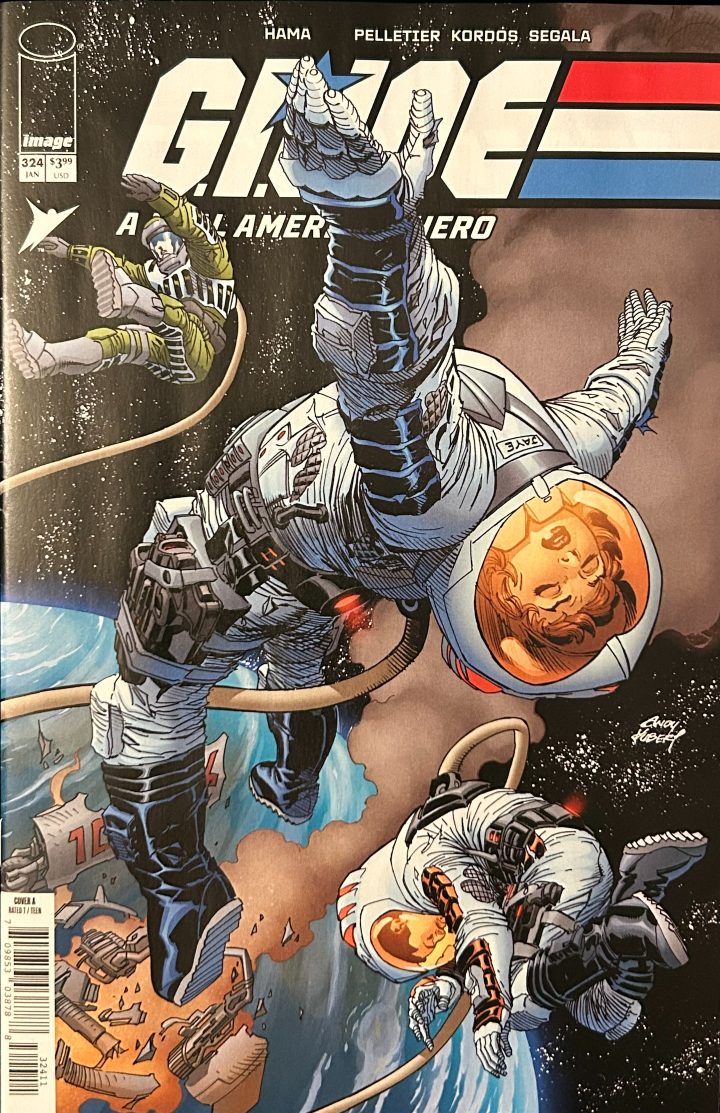
The cover is by Andy Kubert, showing Lady Jaye floating in space, just like Jason Pierce. Andy’s been doing the covers for this volume of the series. He may not have the same fire in his belly as his brother, but he remains as sturdy as you’d expect from the surname.
Hama remains a centrally important figure to the history of the medium before you even count Joe. By far the biggest thing he’s ever done, but by no means the only thing he’s ever done. He’s centrally important to the development of Wolverine. Hama took everything Chris Claremont had done in the first fifteen years of his run of X-Men and built a better solo vehicle for a character who had often, in the first decade and a half of his existence, seemed a guest star in his own solo vehicles. Because that’s how Claremont and everyone who Claremont picked to work with regarded him, as a supporting character who was popular enough to rate some spin-offs.
Hama didn’t start with Wolverine until the character had a few years of his own ongoing under his belt. He picked it up in 1990 with exiting X-Men artist Marc Silvestri, who I even wrote about a couple years back. That’s a remarkable run of comics. Notable that it was Hama who sat down to figure out how to make Wolverine work as a solo character - he was Claremont’s peer, by definition not someone who grew up reading X-Men. He respected what Claremont had done but wasn’t slavish to Claremont’s understanding of the character’s limitations. Clearly Claremont understood Wolverine quite well, but he understood the character’s limitations too well to ever surpass them. The assignment was for Wolverine to work on his own as a solo character. Marvel rather insisted on the point, and Larry Hama was the first person to do it.
Hama knows how to use good artists - frankly, to a remarkable degree. Look at the evidence: he wrote Wolverine monthly alongside G.I. Joe for four years. You can see at a glance: he knew how to write flashy action comics that used the distinctive skills of superstars like Silvestri and Mark Texiera and Dwayne Turner and Adam Kubert to their utmost; and he knew how to get precise, dare I say military discipline out of a stable of rotating pros who could be trusted to draw G.I. Joe the way its supposed to be drawn. He just knows how comic books are supposed to look.
Of course he does! He learned the ropes from Wally Wood and Neal Adams and Jim Shooter. Dude payed attention, and also made a point of not repeating other peoples’ mistakes, a necessary thing when those are your bosses for the first two decades of your life in comics.
He had a whole franchise of his own, half and half with Michael Golden - Bucky O’Hare, a big green space rabbit with a gun who could probably do some business in a post-Rocket Raccoon world. A character that’s never once had a revival, though it's been rumored. Come on, Dynamite, what even do we keep you around for? Make it happen, people.
Hama is directly responsible for, in my humble opinion, one of the best comic book anthologies of all time, the 1980s Savage Tales, an avowed attempt to follow in the steps of Blazing Combat. They only managed eight issues but I recommend tracking down the run. Some of the most beautiful comics Marvel has ever produced. John Severin in almost every issue. Michael Golden and The ‘Nam. It has the most outrageous piece of art Marvel has ever published, in my estimation, an Ernie Chan pinup on the subject of firearms and domestic abuse, in issue #5. The Savage Sisters! I love everything about the magazine, it’s gorgeous.
So gorgeous that Fantagraphics, of all people, has just put out an edition of this series, as part of their Lost Marvels collection. If Fantagraphics has any sense at all they’ll put out a volume of Nth Man, the Ultimate Ninja next. Maybe someone in a position of authority can talk to them about it? Nth Man only lasted eighteen issues but what we got is pretty fantastic. Larry Hama writing, ahem, Snake Eyes vs Dr Manhattan, in every sense of the phrase. It’s Hama’s deliberate rebuttal to Watchmen, absolutely fascinating. Ron Wagner and Fred Fredericks did most of the art, so it reads intentionally a little bit like G.I. Joe even as the story itself leans far more in the way of broad fantasy. Albeit, with strenuously accurate munitions and equipment.
It’s never been reprinted. A completely under the radar cult classic lost masterpiece. Put it alongside the character-defining run on Wolverine, Bucky O’Hare, Orca, and Savage Tales. To say nothing of all the people behind the scenes he mentored during his tenure as editor at Marvel, a legacy of diverse hiring that is still felt to this day. How about this: if he had really wanted to, Larry Hama could have been a great artist. Go back and look at what he drew for Atlas/Seabord - Wulf the Barbarian! Great stuff. There’s another world where Hama just wanted to draw comics, and in that world he’s one of the best to ever do it.
And, yes, he also is responsible for a giant chunk of everything you know and possibly love about G.I. Joe. Of course, G.I. Joe belongs to Hasbro. While Hama’s version of Joe, published monthly by Marvel Comics from 1982 to 1994, may have carried pride of place due to Hama’s driving role in the franchise’s development, he was ultimately still at the whims of a toy company for every moment of the original book’s run. The people who made the toys dictated what the comic book was going to be selling on any given month. That sounds rough, but that was the precise nature of the relationship. A toy commercial made to exceedingly high standards, but you must never forget it was a toy commercial.
And of course, with the benefit of hindsight, its nature as a toy commercial is part of what makes it interesting. Hama was involved in a long game of exquisite corpse with a corporation trying to sell small pieces of plastic to children. The toy company followed what the children thought was cool in the 1980s, which is why the Joe team has a space shuttle, an undercover cop in a Hawaiian shirt, multiple ninjas, a professional wrestler, and a wolf. Hama was responsible for making it all make sense, both in the comics and in the file cards he wrote for the back of the toys, but a great deal of the shape of it was him catching what was being pitched by the staff at Hasbro.
There is a friction to the premise that provides a great deal of charm and spice. Dancing around the edicts of a third party provides a limiting factor that keeps the stories grounded and tied to their period. The original run is a catalogue of 1980s fads, reflected in plastic and newsprint and cartoons some 18-24 months after the fact. The enforced topicality keeps the proceedings honest.
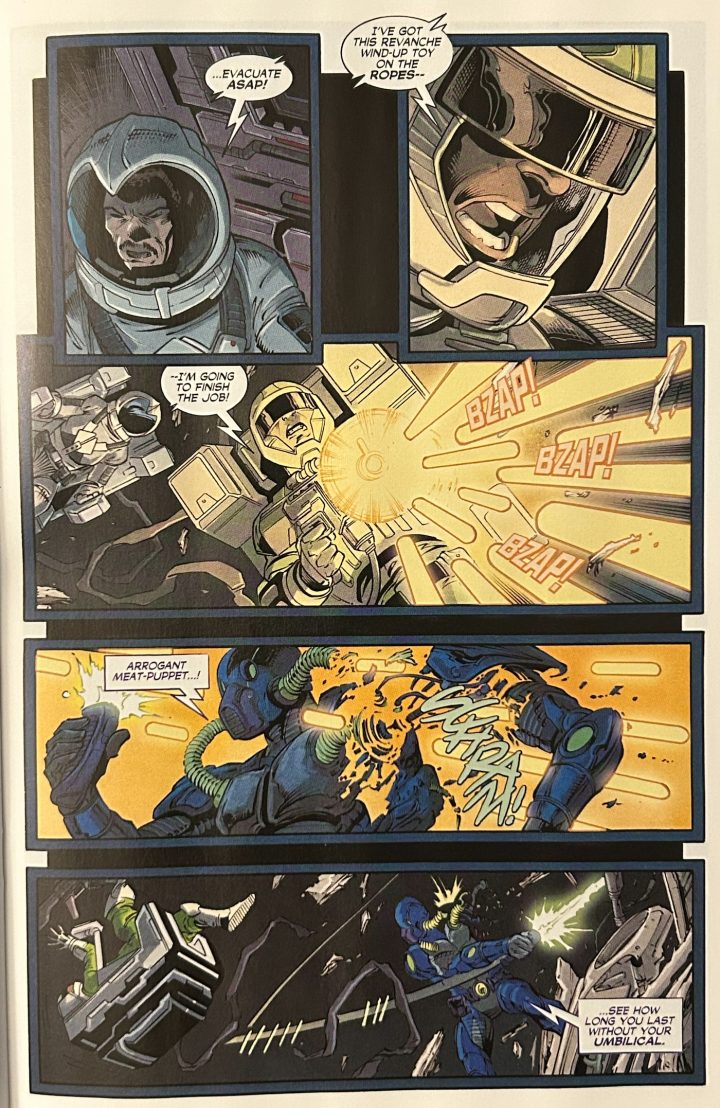
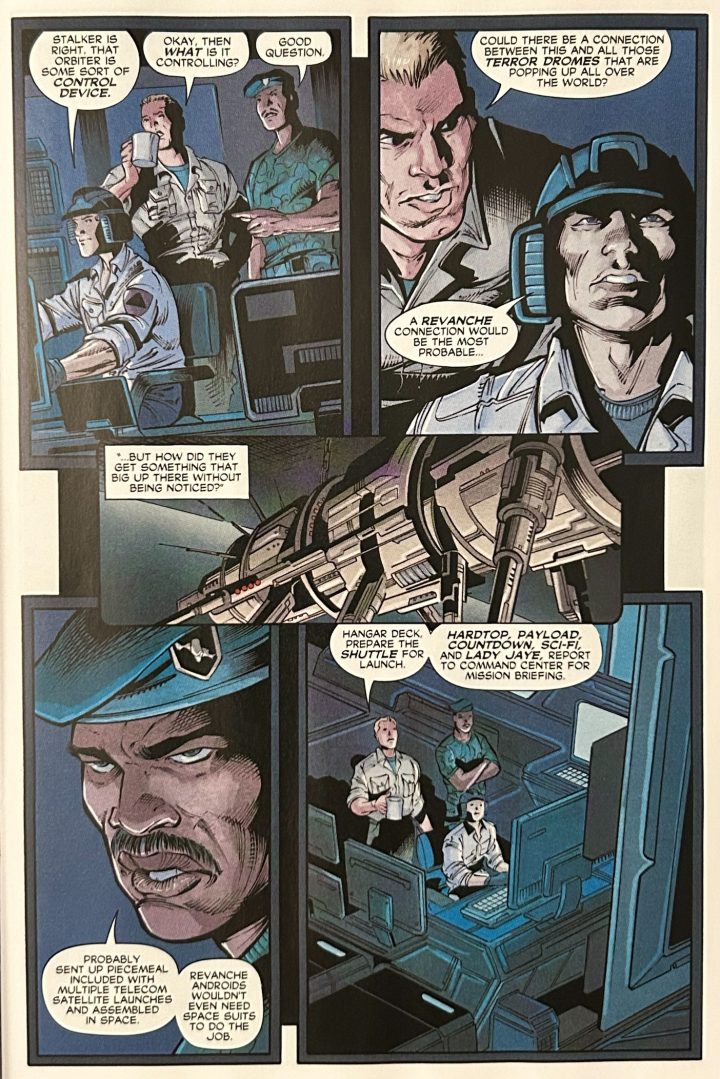
G.I. Joe: A Real American Hero #324 is, in fairness, not an advertisement for toys. It’s about toys, yes, inasmuch as they still make plenty of G.I. Joe toys, and they even continue to make toys of these specific versions of the characters. But they aren’t sending Hama a constant stream of new toy concepts to incorporate into the story. The characters we’re dealing with here are, for the most part, the same characters we’ve been reading about since Reagan was president. This is intentionally a backwater. The other G.I. Joe books have a separate continuity, modernized versions of the characters and their origins. It crosses over with Transformers so you know it’s serious business, boy howdy.
It is a singular virtue of the original Marvel run of G.I. Joe: A Real American Hero that the series took place in our recognizable world. It understood that it was a book about politics in the same way that every military story is ultimately a political story. G.I. Joe is a superhero team in military mufti, the apogee of Bronze Age premise engineering which began life as a Nick Fury pitch before running into a toy company in a dark alley. It was designed to run in perpetuity, which used to mean 50 or 75 or a hundred issues. Here we are forty four years after the fact.
As silly as G.I. Joe could be, it was grounded at every step by Hama’s understanding of the armed forces. In the broadest of terms, appropriate to be given to a small child, but nonetheless committed to taking the military seriously as a profession. That’s how America works: sure, you can make a sustained critique of the size, shape, and velocity of the American military industrial complex, but it’s going to have to come in the form of a toy commercial indistinguishable from a military recruitment ad. I think it’s fair to say in any event that the vast majority of the book’s audience was simply too young to get the nuance of the fact that the Joe team’s worst enemies in the comics are always the suits in Washington. But you don’t get Ostrander’s broadside against Reagan-era realpolitik in Suicide Squad without Hama’s example. Both books share an institutional dryness that aspires to procedural.
The moral of Hama’s G.I. Joe, if you need a takeaway for the run at its best: the civilian-controlled all-volunteer military is a miracle of the modern world and there’s a hot place in hell for politicians who spend those lives cheaply for poorly defined political objectives. As it turns out, however, poorly defined political objectives constitute the bulk of what the military actually fights for. Perhaps there’s resonance here to our current moment, perhaps not, who can say?
G.I. Joe: A Real American Hero #324 is a readable military-themed superhero soap opera that remains also, unfortunately, largely unmoored from the world around it. The original run of G.I. Joe was a book set at the moment of its publication, from Ronald Reagan to Bill Clinton. Iran-Contra was a thing that happened in these books. The Gulf War happened. Even the wars they don’t talk about much, in Central and South America, those wars happened too. Maybe they don’t happen in the same way, or they somehow involve men running around in snake-themed military gear, but they happened.
The present issue isn’t a period piece, but it’s also very much not set in the same present as you or I. On a purely technical level, the “sliding timescale” has tore the guts out of these specific characters, and I don’t know how Hama could ever work around that. The genesis of Hama’s Joe team begins in Vietnam, with Stalker, Snake Eyes, and Storm Shadow on a long-term reconnaissance team together. The bond between those men becomes the core of the sprawling team that comes together across the middle years of the 1980s. That run of comics is a fairy tale of the United States armed forces in the generation after Vietnam, by and about men whose survival in that conflict represents a central defining pillar of their life. That’s not a story you can continue to tell about active duty military personnel, not in 2026. So we go with a variation of the sliding timescale, in such a way that also quite stealthily avoids actually seeming moored to the world of the reader’s present.
Not that anything in the entire world of art appears to actually exist in the present moment. It’s a cultural moment for euphemism. Downright eerie. Hama’s not unique for dodging the subject.
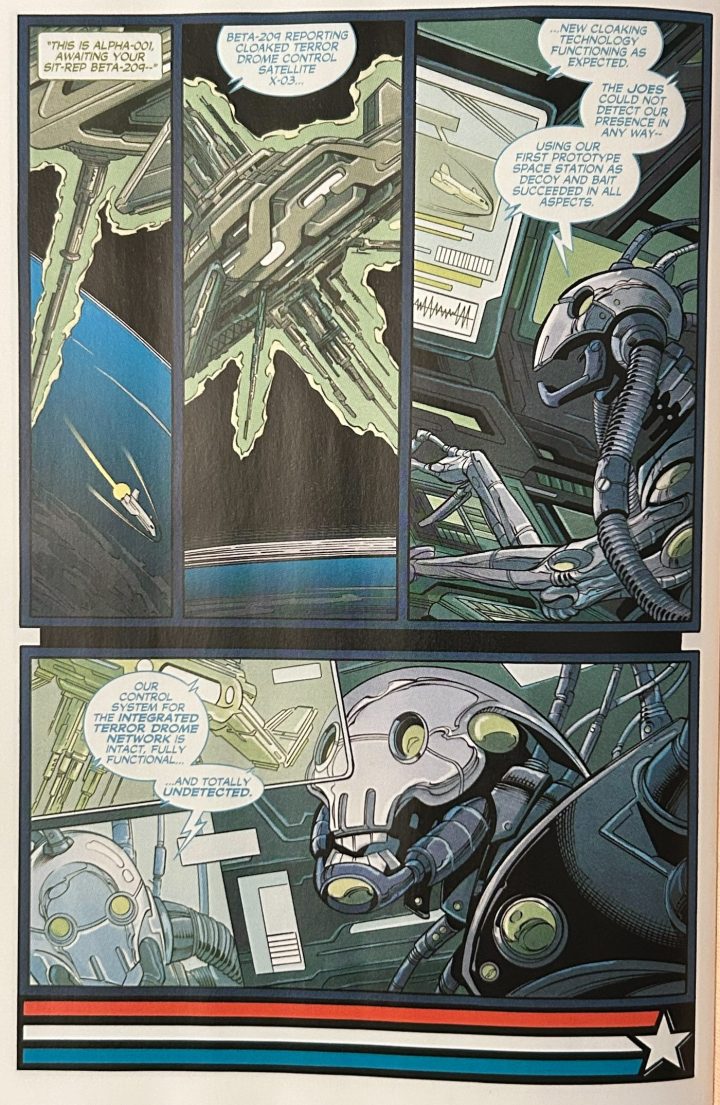
That’s not even to say Hama’s stories aren’t updating with the times. It’s very much a comic with the trappings of the present, in terms of technology and gear. Accordingly, the biggest menace on the board right now is actually a newer villain, a rogue AI named Alpha-001 who seized the reins of Cobra a while back. Destro and Baroness and Cobra Commander are still on the map, but they’re out of the fight for the moment, off having character moments in moody Scottish castles. Cobra Commander is a rather angst-ridden follow, don’t you know. A creature of infinite misery, from way back in that original Marvel run. Such depth these characters have, in Hama’s hands and precisely nowhere else.
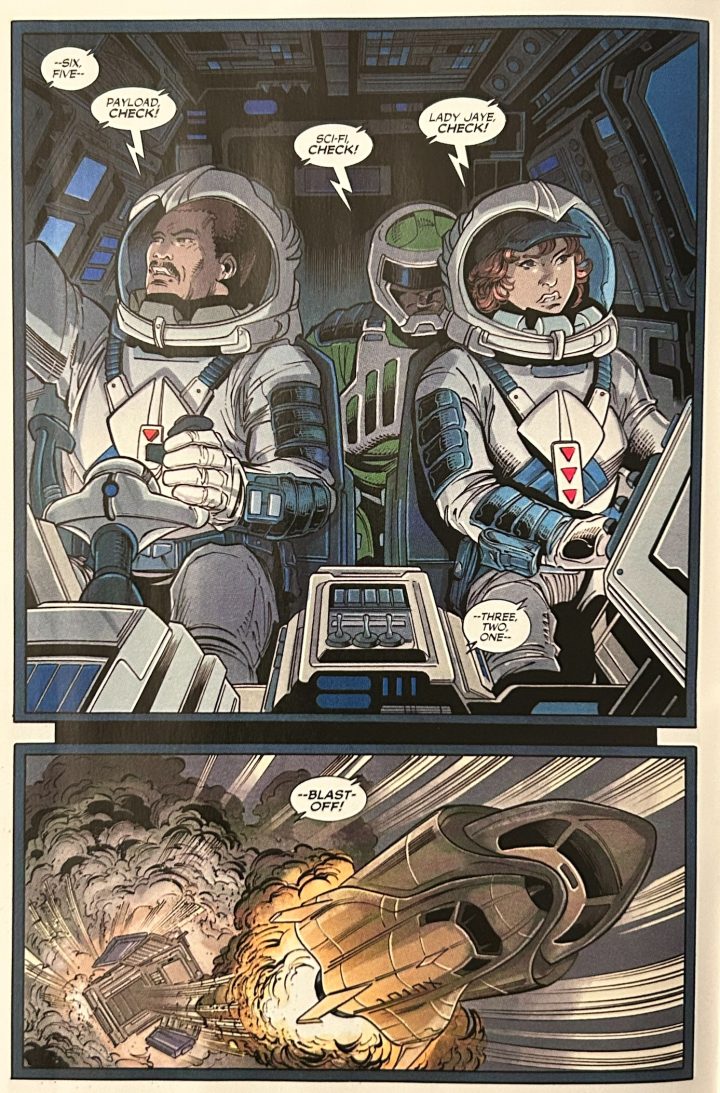
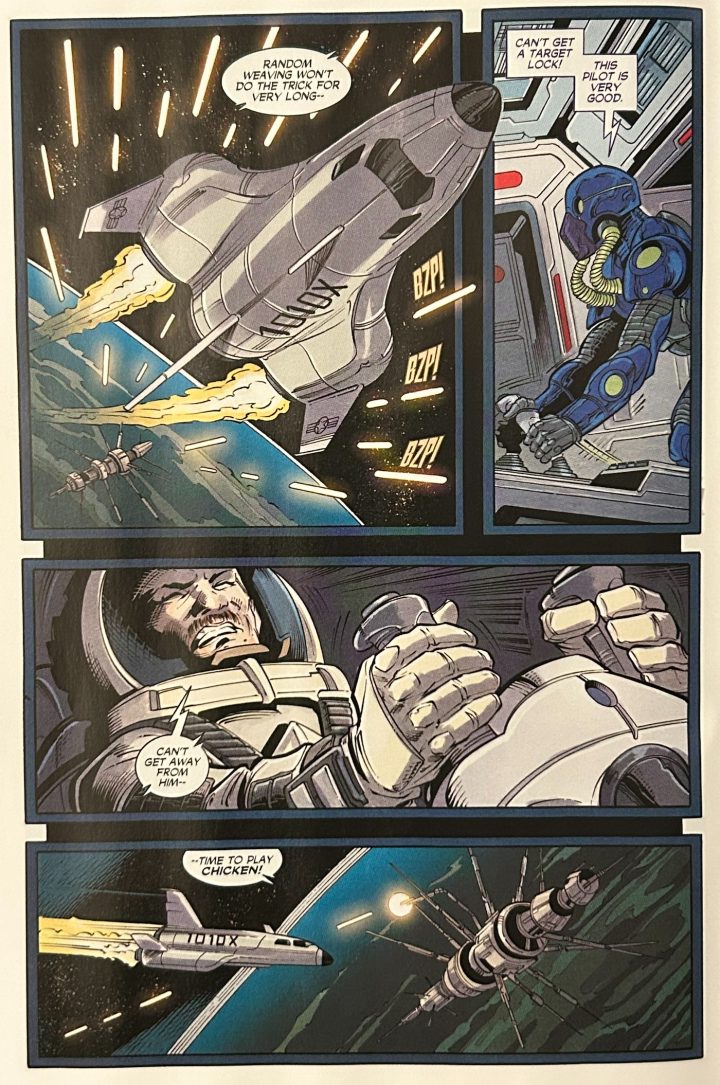
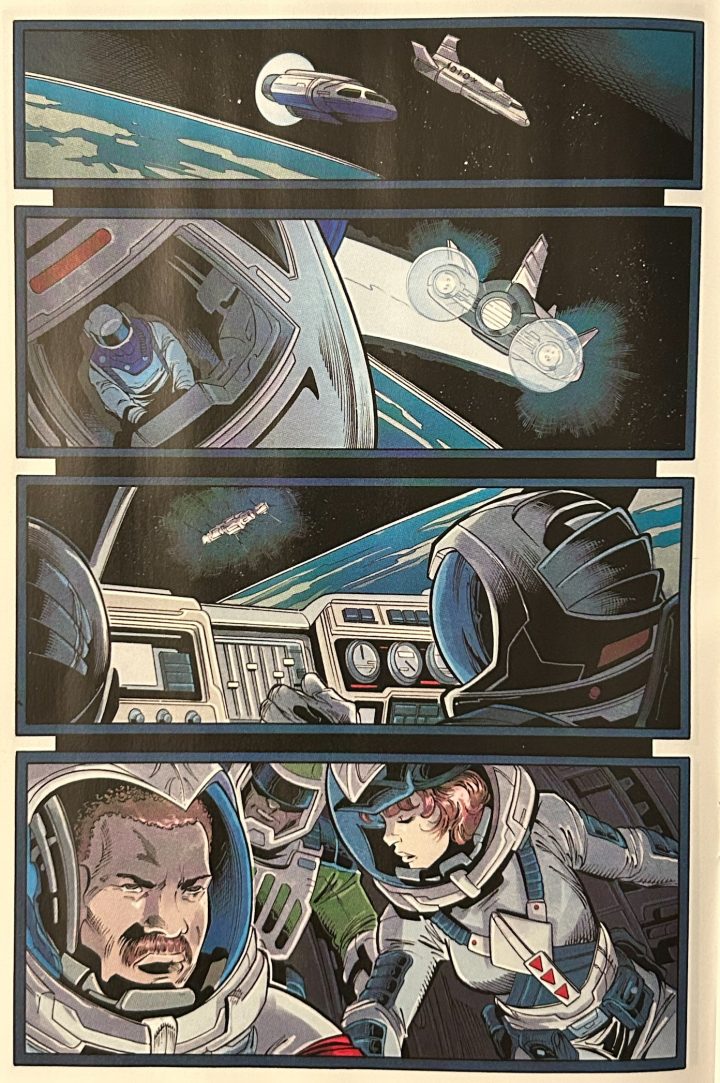
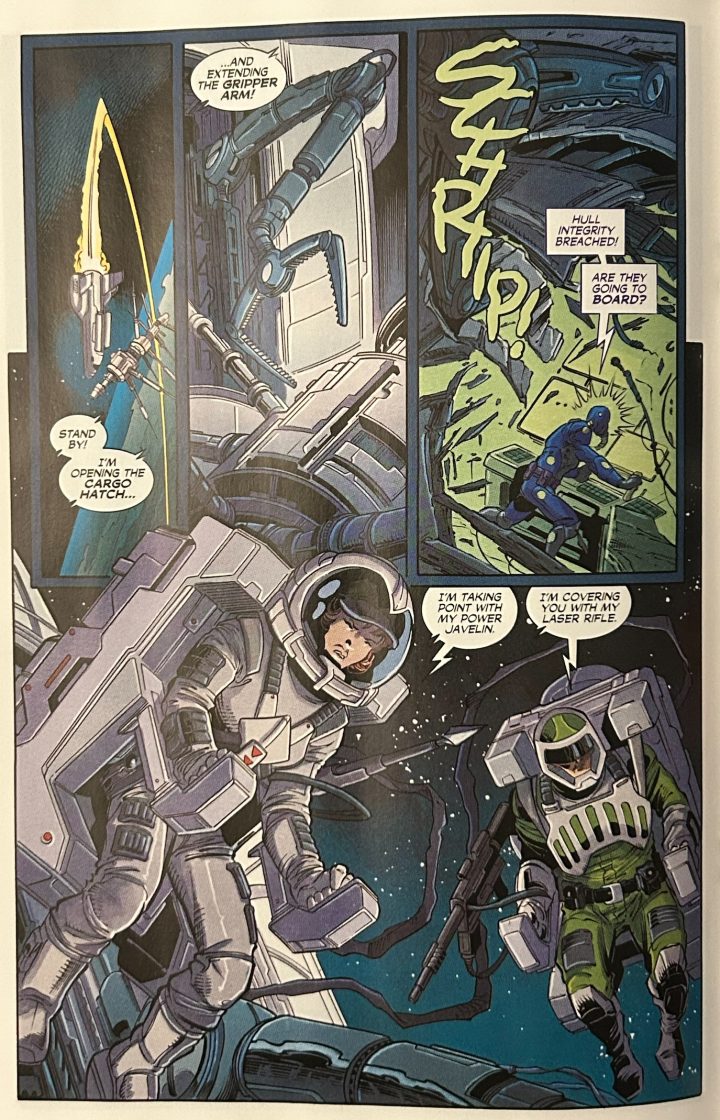
G.I. Joe: A Real American Hero has by now embraced every sci-fi conceit you can think of, barring only actual magic, aliens or super powers. Otherwise, the ninjas have laser swords, Alpha-001 is a hulking robot that looks a little like General Grievous, and half of Cobra was literal shambling zombies for years on end. I think that one was a Doctor Mindbender scheme, but please don’t make me look it up, I beg you. Clones have been a staple since the late 80s. They even still have a space shuttle - perhaps the last operating Space Shuttle, the Defiant. Yes, the same name as Sisko’s ship on Deep Space 9. Don’t look at me like that, I didn’t do it.
Back in the day, of course, Hama put his foot down against the Cobra-La stuff from the G.I. Joe: The Movie, a retcon that would have demolished his own continuity. But otherwise he went along with the plan. He dutifully wrote an issue of the comic to sell the toy Space Shuttle, back in 1987 - issue #65. It sticks out like a sore thumb, but it’s only one issue. Well, the Defiant’s back, here, because the Joes need to go into orbit to destroy a Cobra satellite, which ultimately turns out to have been an intentional feint by Alpha-001. That’s part of the fantasy: of course the nation’s leading team of military specialists would have an astronaut whose job was sitting around and waiting to get the call to ferry ninjas into near-Earth orbit. It happens more often than you’d expect.
And the astronaut’s name? I’m not going to type it, but I know it. Do you know it?
So you can’t say Hama isn’t still putting some thought into matters. Cobra started out as a pyramid scheme by a con-man who built it into a nationalist cult. Oh, gee. That sure sounds familiar. Cobra Commander’s social circle consists of arms dealers, bored aristocrats, mad scientists, and chainsaw bikers. It makes perfect sense that the legacy terrorist sect would be taken over by rogue AI after the inner circle of deranged monarchists fell out with one another for the umpteenth time.
All the same, the stage feels smaller. The connection to the real world is euphemistic.
In a perfect world Larry Hama would be writing Uncle Scrooge. That’s what he’s always wanted to do but it’s never happened. Marvel is even publishing Uncle Scrooge stories now, and they got a former Wolverine writer to do it - it just so happens the former Wolverine writer they chose was Jason Aaron. Funny thing about Uncle Scrooge: dude still packs the seats. He’s currently supporting new comics from Marvel (who just wrapped Jason Aaron’s Earth’s Mightiest Duck miniseries), Dynamite (in Ducktales), and Fantagraphics, who recently resurrected Uncle Scrooge with it’s legacy numbering intact, and excellent graphic design work from Kayla E. That’s three different companies publishing Scrooge material in 2026. Surely one of them can figure out that Hama’s been waiting patiently for his ticket to Duckburg, since at least as far back as when he mentioned it in his Bullpen Bulletins staff profile back in the late 80s.
We all suffer at the whims of the toy companies these days. Gary Groth’s in deep with Disney. C’est la vie. You gotta serve someone.
Hasbro, of course, remains a crucial player in comics without actually publishing comics themselves, as they make both Magic: The Gathering and Dungeons & Dragons. Both product lines are vital to the health of the Direct Market and have been for decades, completely separate from G.I. Joe’s status as a perennial of the comic racks. Hasbro allows Hama’s weird little coelacanth continuity to linger, surely due to his status as the closest thing to an actual physical father that the property has. I’m not the only person still buying it, clearly. While an actual pension might be preferable in both practical and moral terms, that Hasbro maintains what is essentially a sinecure for the man is nonetheless notable. It’s more than most ever get, in this industry.
The comic could be better but I also don’t know if it would be worth the effort to salvage this bespoke timeline, which will probably linger for just as long as Hama continues to write it and not a moment longer. This isn’t the center of gravity for the franchise and it hasn’t been for over thirty years.
So that’s why I buy and read G.I. Joe: A Real American Hero every month, and will continue to do so for the foreseeable future, despite the comic itself rarely sticking to the ribs. There are few people in this industry deserving of the respect of my continued patronage quite as roundly as Larry Hama. For so long as he’s here, I will be too.
The post Half the Battle appeared first on The Comics Journal.


 Hello, my name is Jack Sparrow. I'm a 50 year old self-employed Pirate from the Caribbean.
No comments:
Post a Comment