

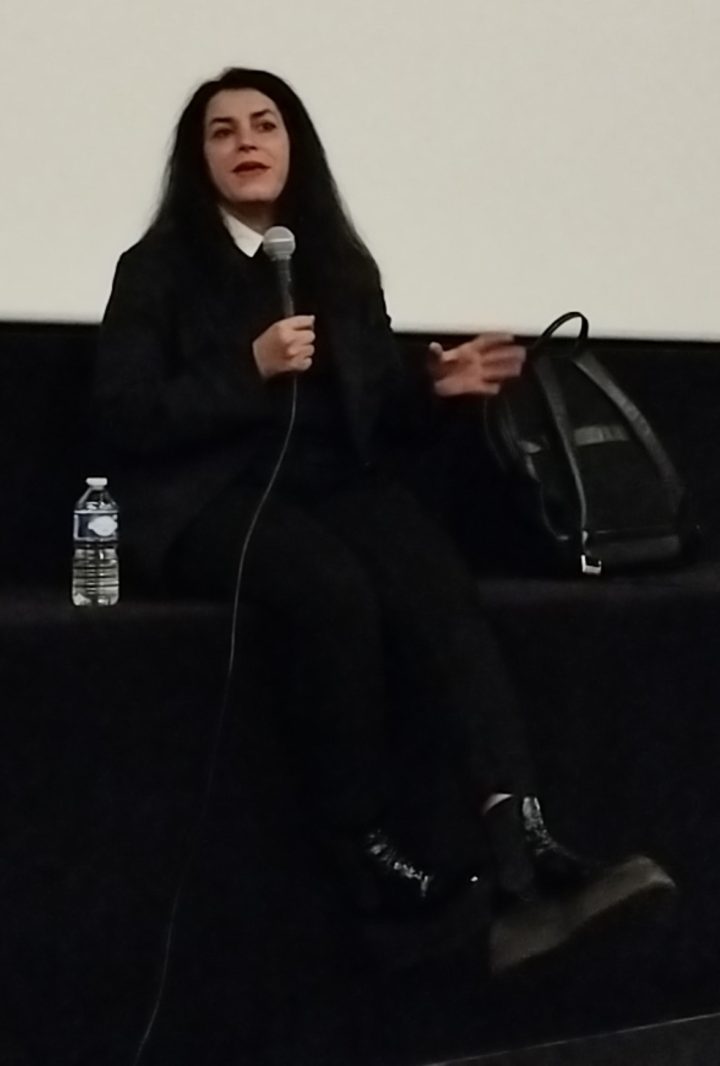
Marjane Satrapi (Marjan Ebrahimi), whose death at 56 was announced June 4, was a highly atypical artist. Her incredible life embraced numerous cultures, languages and traumas. At 12, she was cowering in a basement while bombs fell; at 39, she was on a Hollywood red carpet. Her character was shaped early on by war and repression but it also owed a lot to her lonely adolescence. For 31 years, she was anchored by her husband Carl Mattias Ripa who, on April 8, 2025, died of cancer.
The ideas of freedom Satrapi formed when young directed every choice she made in later life. They drove her decision not to have children, her renunciation of comics amidst global fame and her realization that painting actually pleased her more than making movies. Freedom, she believed, was not something to analyse but something to live. Right up until the end, that's what she did.
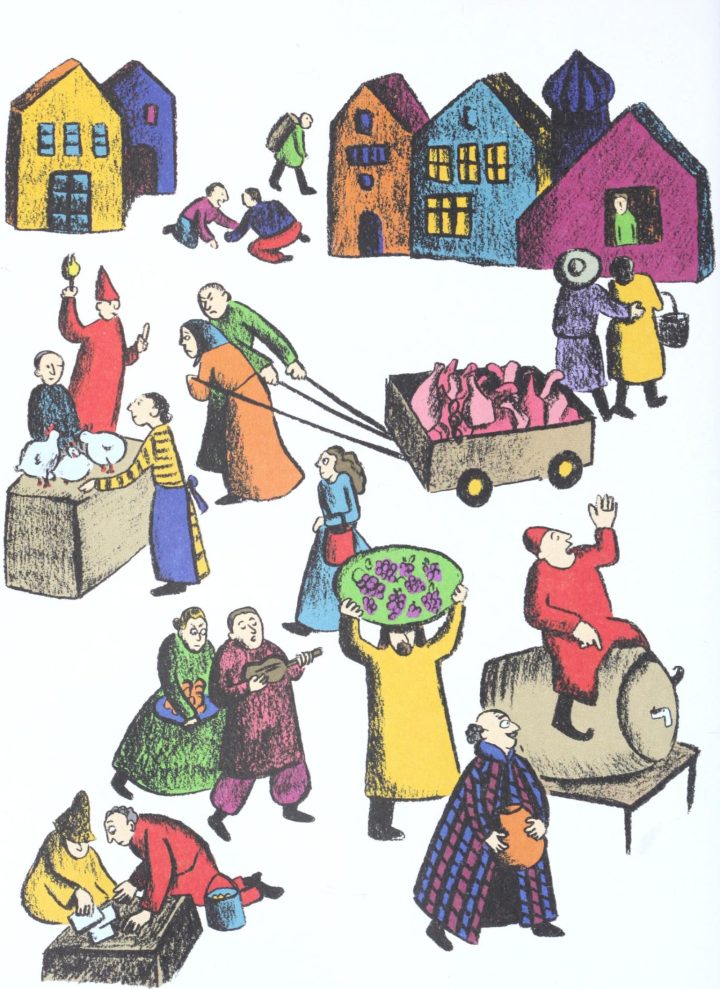
Satrapi had lived in France since 1994; she became a French citizen in 2006. President Macron issued a page-long tribute to her, hailing "a great artist, who transformed her Iranian childhood into a fable filled with timeless truths". Her image remained that of the scofflaw punk so familiar from Persepolis. But, despite her dishevelled hair and biker boots, Marjane Satrapi was exceedingly cultured. She read and spoke not just Farsi, French and English, but also Swedish, German and Italian. She loved classic Persian poets like Saadi, Rūmī and Hafez, but also Pushkin and Dostoevsky (whose novels were her all-time favourites). She adored the art of Balthus, Bruegel and Vallotton – the latter's woodcuts were decisive to her art – and took inspiration from Persian miniatures. But she also heaped praise on Lynda Barry, Art Spiegelman, Blutch, Riad Sattouf, Joe Sacco, Chris Ware and Daniel Clowes. She never called their work, or her own, "graphic novels", often saying, "Don't be ashamed; call them comics ".
Satrapi saw herself as "more on the side of Marx than Freud". ("A believer's brain," she told a radio host, "actually gets more serotonin than that of an atheist. So Marx was right to call religion the people's opium.") While describing herself as "equal parts hyper-solitary and hyper-social", she remained indifferent to social media. ("I'm not someone who wants to live in their past ... if you didn't like someone that much at 20, why would you like them any more decades on?"). She loved Bruce Lee so much she studied karate and, before facing a hard task, liked to play the Sex Pistols.
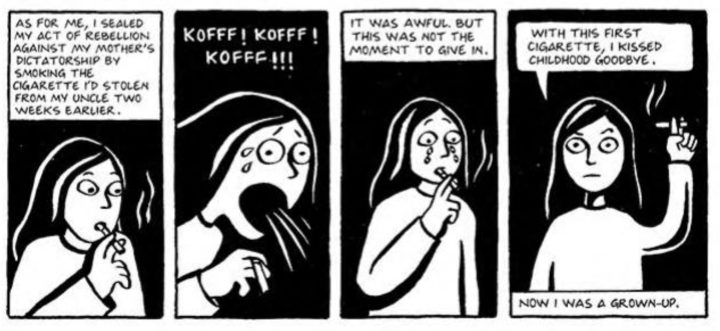
A serious smoker, Satrapi switched between cigarettes: Winstons, Camels and Marlboros. When she worked in America, her dedication to smoking brought reproach. She always met it with fighting words. ("Let me just quote Joe Strummer of The Clash: 'For the entirety of the 20th century, no major work of art has come from the hand of a non-smoker'".)
Those who prized her most were others known for their independence. She had many friends among them, like the cartoonist Coco (Corinne Rey), actress Catherine Deneuve and singer Iggy Pop. In a memorial issue, Libération handed its editorial over to Coco. Known for what the French call "talking cash" – speaking with a flat-out frankness Satrapi shared – Rey wrote in it : "Marjane Satrapi died of a broken heart. She gave her middle finger to the life which snatched away her soulmate. She drew a line under it all, from her talent and Persepolis to all her commitments, her unending combat with the mullahs. That same powerful line had fought for the Iranian people, supported women and stood guard over our right to create. That line defended liberty itself … and she showed us how much it could achieve."
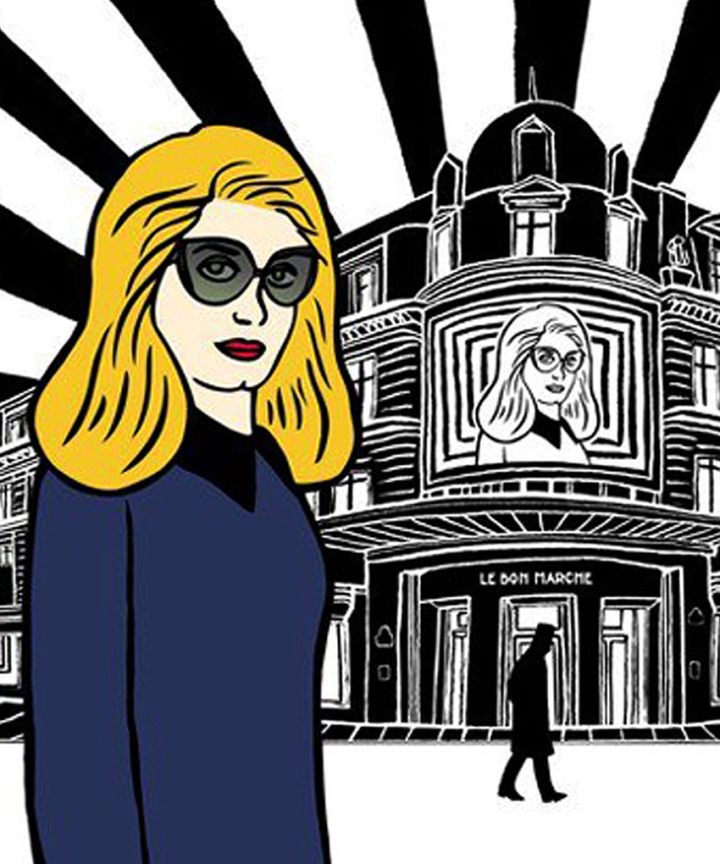
"I loved her enormously," said Catherine Deneuve. "She had a truly uncanny force and vitality, a pyrotechnical store of words and stories. Although it's less well-known, Marjane was also discreet."
Deneuve wasn't wrong. Many in the artist's close circle ("Do I have an inner circle?" she once shot back at a nosy questioner) knew she had been distraught. Nine days after Mattias Ripa's death, a tourist guide in Père Lachaise noticed her husband's grave already had a headstone. On it, Satrapi's own name lay in wait. Wrote one close colleague who tried to offer support, "She simply said her world had ceased making sense."
All her life, that world had overflowed with drama, more than enough to nourish many metiers. Satrapi understood this and she acted on it, tackling numerous roles in succession. She was a storyteller, an activist, a cartoonist, a cineaste, a painter and, in her final years, a philanthropist. In 2007, Satrapi's animation of Persepolis made her a cultural icon. She followed it in 2011 with a more traditional version of her Poulet aux prunes. In 2012, she directed – and, with Ripa, acted in – La bande des Jotas. These films were followed by others : 2014's The Voices, 2019's Radioactive and 2024's Paradis Paris. Three years ago, the French Académie des Beaux-Arts elected her to its cinema section.
Right before her death, Satrapi had completed arrangements for a Mattias and Marjane Ripa-Satrapi Film Foundation. Supported by the pair's income and a range of private parties, this Foundation will bring two young filmmakers – one male, one female – to Paris every year. (Its scholarships are generous : €1500 a month, plus travel and moving expenses.) Satrapi said she wanted "something in the image of myself and Mattias, two foreigners who met in Paris, fell in love and made a life together in this incredible, inspirational city."
Satrapi liked to film in America, she enjoyed working in English and she relished trying different genres. Yet she refused mainstream offers, including those of Disney. "If you're an artist," she told the press, "you already understand how to live with insecurity. If you make yourself into just an industry drone, you'll just lose out on every level."
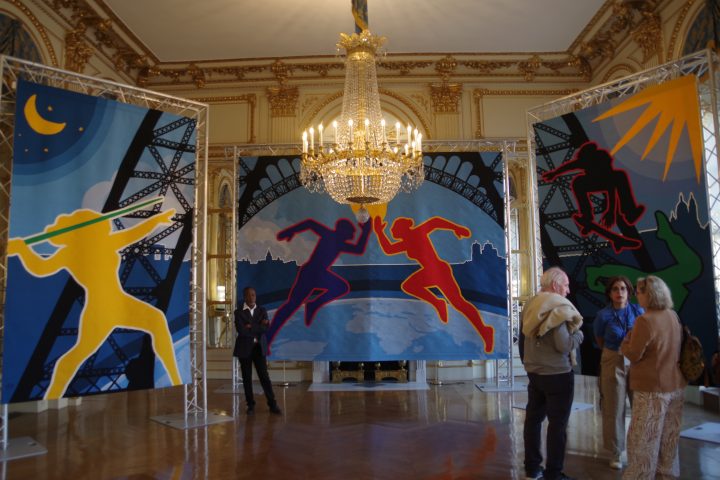
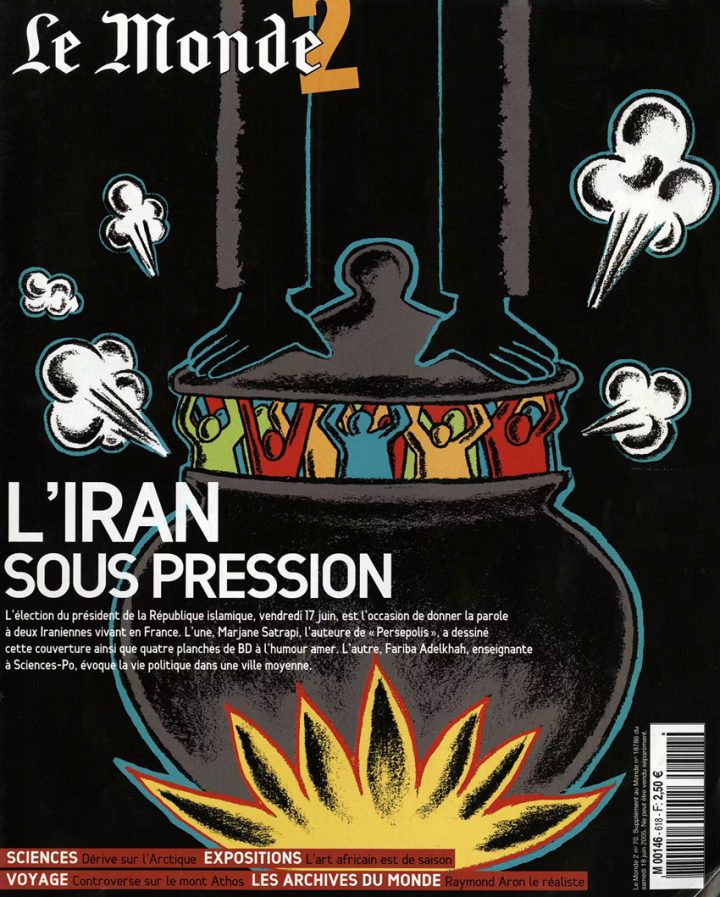
Satrapi forsook comics in 2004, just after completing her trilogy (Persepolis [2000-2003], Broderies ["Embroideries", 2003] and Poulet aux prunes ["Chicken with Plums", 2004]). But she continued to draw for papers around the world. In 2005, she also started a weekly strip in Le Monde's Sunday magazine. For this, she wrote her own bio: "Marjane Satrapi was born into Iran's left-wing haute bourgeoisie, who opposed the Shah. She lives in Paris and remains 100% Iranian. On June 11, the paper published a selection of this work and
Monde staffer Clément Ghys commented, "It's saddening how timely their criticisms seem … how little we have moved on from clichés that oscillate between Scheherazade and the bearded terrorist."
All the jobs Satrapi accepted were jobs she liked and she took them for their challenges. ("What I most like is to feel scared stiff, actually uncertain if I can do a thing.") Among the projects that met her criteria were the art for Iggy Pop's 2009 Preliminaires and a multi-media art gala with Catherine Deneuve and filmmaker Loïc Prigent. In November of 2022, with the help of singer Benjamin Biolay, Satrapi made her first music video. She orchestrated fifty stars to sing "Barayé" ("برای" or "For"), the unofficial hymn of Iran's street revolt. The tune by Shervin Hajiour, compiled from tweets, had leapt from his Instagram into global circulation.
Of all Satrapi's arts, however, painting meant the most. She frequently cited it as the most solitary and the dearest of her pleasures. Her first solo show took place in 2002, at the Centre Pompidou. Others followed in 2007, 2011, 2012, 2013 and 2020. All through the years, she was represented by galleries, first by Paris' Galerie Jérôme de Noirmont and, subsequently, by Galerie François Livinec.
The road to all these accomplishments was tortuous. Raised in Tehran, Satrapi was ten when the revolution exploded. Her Communist uncle, Anushiravan ("Anush") Ibrahimi, told his young niece everything would be fine. Religion, he explained, was just an interim tool – the only means to unite a country where incomes and education varied so widely. Then, in 1980, Iraq invaded. Three years later, for her safety, Satrapi was packed off to school in Austria. She was just fourteen and completely alone.
The four years she endured there were filled with hardships. But they did produce an unexpected bonus. As she told a journalist friend, "That was where I discovered punk and, in my entire life, it's what changed me most – me, the child of a middle-class engineer! At 15, from morning to night, I was constantly sitting around some café. Always dressed in black, always debating suicide. Maybe that's why I now find such joy in life."
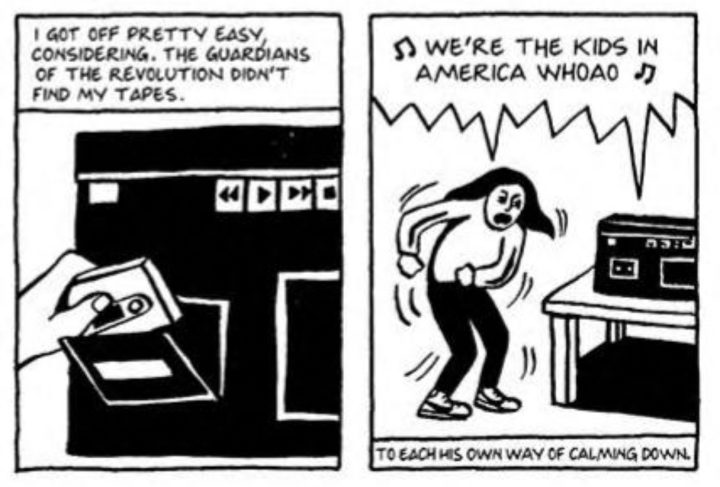
Her homecoming in 1989 brought fresh trials. While her family had supported the revolution, its new regime executed her activist uncle. In 2020, she still recalled every fear. "You just did not, you could not, criticize ... and that same system, those prisons, still exist, it's all still there. So are the Gardiens, the virtue police." Despairing, Satrapi tried twice to end her life. Yet, in the end, she found a place. She discovered the black market, learned about illicit parties and, very carefully, made new friends. At 19, she married a fellow artist and, with him, entered Islamic Azad University. She had high hopes for her subject (visual studies) and did take her degree. But, by 1994, Satrapi was divorced and on a plane to France.
There, she entered Strasbourg's École des Arts Décoratifs, whose illustration course was the country's best. But Satrapi still felt awkward and ill-at-ease, feelings she retained over the next three years. "I couldn't appreciate anyone, nor did they appreciate me."
These years on French soil were also marred by something else: an American film called Not Without My Daughter. For the rest of her life, its victimized wife and her scheming Iranian spouse (a half-Italian, half-Spanish Englishman) would continue to haunt her. Even in recent interviews, it crops up. "Well, you try spending all your time telling people, 'No, I don't eat my rice with cockroaches', 'Yes, we have electricity', 'No, I don't ride camels, that's what I smoke'. After graduation, she moved to Paris.
There, Satrapi's dream of creating children's books went nowhere. Instead, she was once again struggling with alienation and rent in an unknown city. She botched her only interview – as a head hunter – then was fired from the one shop that would hired her. She ended up working for a private detective, taking photos of adulterers as they smooched. Meanwhile her creative plans were swamped by depression. As she told journalist Virginie Bloch-Lainé, "Those years of internal stress had just accumulated. They crystallized and hit me like a wall. It was so all-encompassing I could barely breathe … and it really went on until Persepolis."
Once more, a single bright spot kept her going. This was Atelier Nawak, the small studio she encountered thanks to artist Christophe Blain. There, she met David B (Pierre-François Beauchard). He was part of L'Association, the publishing collective he founded with Jean-Christophe Menu, Matt Konture, Killoffer, Stanislas and Lewis Trondheim. Satrapi was impressed with Beauchard's bold, expressionist work and before long they became friends
A year later, on his first day in Paris, Satrapi met Carl Mattias Ripa. Mattias was Swedish and training to be an economist. She was three years his elder and recently divorced. But, year to the day after they met, the pair married in Sweden.
The day her Satrapi's death was announced, David B recalled those pre-Persepolis days. "She and I used to chat about everything … life and our families and Eastern religions. I couldn't do much to help with her children's books, but I told her she should make something from the stuff she told us and I would take it to the Association."
When Nawak moved to a bigger room on the Place des Vosges, Satrapi went along. But she was daunted by the "Atelier des Vosges". In addition to Blain and Beauchard, its eighty square metres housed Mathieu Sapin, Émile Bravo, Riad Sattouf and Emmanuel Guibert. "All these artists, they just drew like gods; it would take me forty years to approach any such skills! So I just tried to draw as best I could. Slowly, I understood why Pushkin said: 'If you want to speak to the world, talk about your village'."
By now, Beauchard was helping her devise Persepolis. As he remembers it, "I just told her things like 'You should break it down into chapters … start there, tell this'. Above all, I told her to clarify the history, because here in France – in Europe in general – people knew nothing about her country's past. I helped her design the thing and start to draw … and I did present it to the Association." But as critic Marius Chapuis later wrote, "What Satrapi got from David B is evident, but that's very complicated. Certainly he helped her with the story's structure and he influenced how she used those hyper-dense blacks. But they parted on very bad terms."

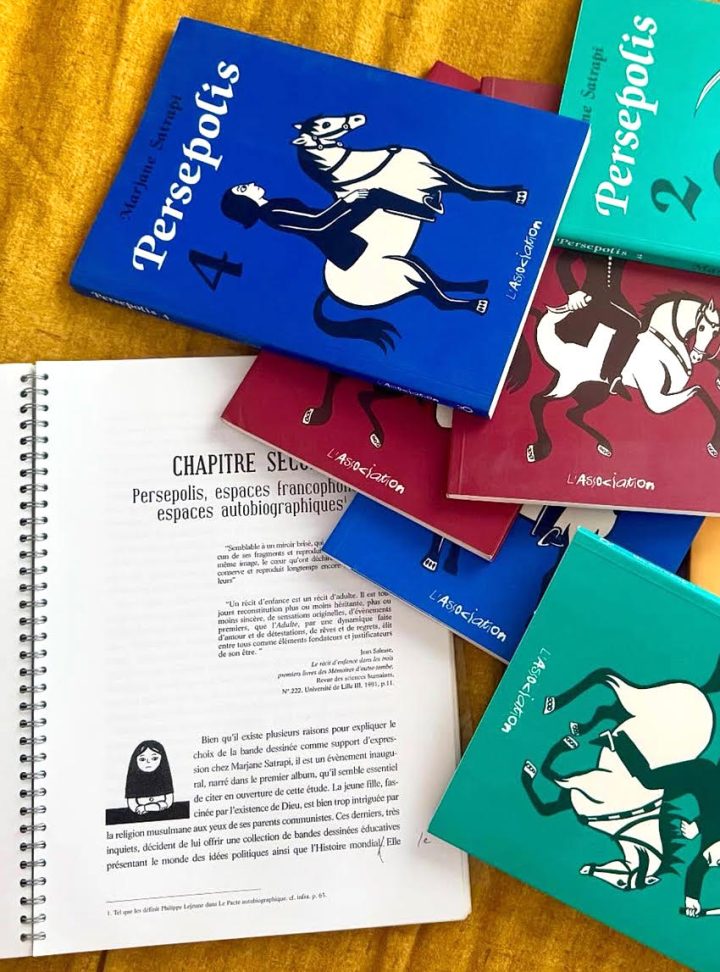
Jean-Christophe Menu became Persepolis' editor. But, like everyone else, he had no idea of its future. "We printed two thousand copies," he wrote. "We never imagined – we couldn't have imagined – selling two million." The funds from those four volumes, published over three years, rescued the Association's finances. Persepolis proved a genuine phenomenon; it became, world-wide, the decade's best-selling comic.
One of its first readers was Stephane Beaujean, later the Artistic Director of Angoulême. Now Editorial Director of Éditions Dupuis, back then Beaujean was working on his dissertation. "The first volume of Persepolis came out and I wanted to talk about some of its pages. So I got in touch with the author who, right away, was perfectly happy to do it. We fell into communicating all the time – and we did so for two whole years. I was working on my thesis, she was working on Persepolis."
"As each new volume appeared," says Beaujean, "not only did she answer my every question; sometimes, she even proofread the texts. She got a lot of laughs from all my theorizing, and she patiently bore my attempts at trendy thinking. When I was finishing up, Marjane was still working on her final volume. But, because I really needed illustrations, she sent me her own papers and galleys. Half my dissertation – over a hundred pages – ended up devoted to Persepolis."
The pair would later meet many times at Angoulême. But, says Beaujean, those early moments counted most. "All week, I've been looking at these old editions and they fill me with tenderness and sadness. Some of the volumes are signed, others were torn apart for the images. I just owe Marjane so much … perhaps even that good grade that changed my life."
Satrapi had a kind of basic fearlessness, the very sort an exile needs. It was, she felt, her family's great legacy – one that, ironically, she owed in part to Iran's police. "The Gardiens were terrifying and I was just as scared as everyone else. They could stop you on a whim. I was arrested for wearing makeup, for wearing red shoes. My red shoes, it seemed, had endangered Islam!"
A single scene in Persepolis, she said, relates her most important lesson. "It's the part where, in order to deflect the Gardiens, I blamed an innocent boy. That scene is true and the boy had really done nothing. Right after it happened, I told my grandmother. I was actually proud of myself – but she was furious with me. I tried telling her there had been no other choice and I can still hear her: 'No other choice? Well, just imagine you're a political prisoner. Rather than denounce your friends, you can kill yourself. Many give their lives like that and we call them honourable. Of course, there are cowards. But … there's always a choice."

Satrapi never forgot the words. "That became a sort of mojo in my life. If I find it truly hard to decide something, I ask myself two questions. One: If I do this, will I end up in prison? Two: If I do this, will it get me killed? If both answers are 'no', well … there's no problem. Choice always exists."
While visceral bravery was something Satrapi learned, she was born with a feeling for comedy. Her understanding of humour was simply built-in. "People everywhere, you know, cry for the same reasons. You cry because you lose a loved one or your lover leaves you or because your friend is suffering. Humour is an abstraction and it has many degrees. There are jokes that only work within a family, jokes that only work in a village, jokes that only work in a nation. And so on and on. But, at the end of the line, voilà – Charlie Chaplin!"
Understanding, she felt, was most fully reached through humour. "The moment I finally make the stranger laugh with me, that's the moment I cease to be an abstraction, cease to be a representative of that myth 'the Middle East'."
Because Persepolis became required reading, Satrapi spoke with students around the world. "What I'm always fighting for," she told one group, "is always humanism; I believe in the same ideas as the French Enlightenment thinkers. They made humans the centre of their attention … which is different from your skin colour or where you come from or your religion. It's something that calls upon your most basic human intelligence, all your sensitivity as a human being."
Satrapi was rarely impressed by modish terms; what always counted most for her was action. "All this talk of the 'global South', all this 'East' and 'West'. Well, the earth is round. So you're always going to be north or south of somebody. Your viewpoint depends on how you situate yourself – on how you choose to see. It's like Rashomon, that great film by Kurosawa. No one in it is lying. They're just in different places, with different points of view."
Asked about artistic independence, Satrapi would say it was a matter of choice. "There's this one thing that, if you accept it, can become your key to liberty: be prepared to live on very modest means. Once you do that, it will set you free. On the other hand, if you always need money, you'll always be doing things you don't want to." She also warned against caring what others thought. "Don't make art to please people, don't use art to be loved. Just get used to the fact people may not like you."
In 2020, Virginie Bloch-Lainé asked Satrapi about her frankness. Over the years, had it helped or hindered her? "A priori," she laughed, "it's a hindrance. Lots of people just find me too brusque, intolerable, too sure of myself. But, in the long term, it's always been an asset. Because, once I've actually said my piece to someone, they know who I am – and they know I won't try to lie about it. I always prefer a frontal assault to deception and pretence … I'd rather have a slap in the face than a stab in the back. Because a knife in the back, that can kill you."
She herself, she admitted, often failed such standards. "I spent years in France before I ever wrote a word … and thank God for it! Because when I first started telling my stories, I was filled with anger. So full I behaved exactly like those who angered me. I too mocked others, I too became a fanatic. But those I mocked had an excuse, because they were ignorant. I didn't have that excuse – which made me worse."
In recent years, quelling this anger was harder. Especially in September of 2022, when a young Kurdish woman, Mahsa Jinâ Amini, fell afoul of those Gardiens in Tehran. Arrested for wearing her veil "in an improper way", Amini was dead three days later. She had spent those days in a coma, thanks to the beating she was given by police. Her death ignited a wave of protest, linked across the world by the words "Woman, Life, Freedom".
Paris publisher Sophie de Sivry – one of Satrapi's friends and founder of the Éditions de l'Iconoclaste – urged the artist to help her mount a graphic response. Satrapi agreed and rapidly rallied a team. She tapped the Iranian political scientist Farid Vahid, ex-war reporter Jean-Pierre Perrin and the historian Abbas Milani (head of Iranian Studies at Stanford University). She then assembled cartoonists from Iran, Europe and north America. Among the names she chose were Lewis Trondheim, Coco, Catel, Winshluss, Paco Roca, Patricia Bolaños, Shabnam Adiban, Joann Sfar and Mana Neyestani.
The result was the graphic album Femme, Vie, Liberté. It was intended, wrote Sivry and Satrapi, "to express what it's like to be twenty in Iran and risk death for the right to be female". While exact, that line undersells and extremely lively book. It's so visually rich – and, often, actually funny – that it's the true successor to Persepolis. Never are its well-planned pages dry or tedious and the whole things has enormous graphic verve. Translated into seventeen languages, there is a free online version in Farsi. In 2025, the book got five fresh chapters.
For Satrapi, this success was bittersweet. For, months before the project debuted, Sophie de Sivry died of cancer.
Last year, the French government proclaimed it was giving Satrapi the Legion d'Honneur. To their surprise, the artist declined it. "I cannot ignore," she wrote, "what I perceive to be a hypocritical French attitude to Iran". She cited a deficit of support for Iranian women and the problems among Iranian visa-seekers. Yet she also made one thing clear: her decision was not a rejection of the French Republic; it was a gesture of solidarity with her people.
That refusal, however, marked an evolution. Satrapi's early years in Iran, she always noted, had been imbued with pro-Occidental views. ("Our class and that society we belonged to, it was very pro-Occidental. We saw Hollywood movies, we ate Big Boys, we went bowling.") She had always viewed this as colonial – but, with time, her comments about it hardened. In 2020, she told French radio, "Democracy is just not a gift you confer through bombs. Or by building McDonald's. It's something any people have to create for themselves."
"That fire in which the whole world is living now," she added, "that whole fire was lit by George W. Bush. As a man, he may be insignificant – but I absolutely deem him a war criminal. Compared to Trump, of course, he's just a cute little chicken. But it always works that way; whenever something worse arrives, people forget the bad things that came before."
Three years later, she was even more blunt. " America's politics are super-imperialist and they have always been. If there's one country in our world ripe for a dictator, it's the USA. When you look at the history of nations, you know, almost every country passes through a trio of stages. They move from savagery to a state of civilization then, eventually, decline into decadence." America, she asserted, had gone "straight from the savagery to decadence."
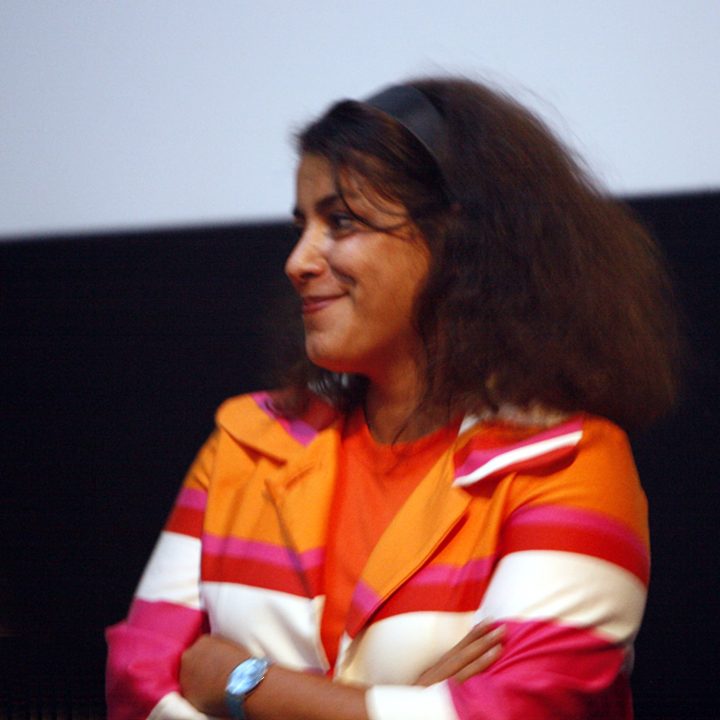
That same year, philosopher Charles Pépin invited Satrapi to a discussion liberty with him. They tackled the central question How do we assert our freedom? At the end of the conversation, which ran almost an hour, Pépin stated his theory. Weren't we free when our acts mirrored our selves in the way an artist's work mirrored the artist?
No, said Satrapi, she saw it differently. "I think we're free only when we can surpass our own convictions. When we can transcend what we believe. When I can accept someone who is not myself and I can embrace him – even though his convictions are opposed to mine. Then maybe I am free. But, in truth, the price we most commonly have to pay for freedom is simpler … it's just solitude. And, for most people, that's where the problem lies. Are you willing to pay that price? I am. Because without danger, without solitude, you will never know real freedom."
No-one could have foretold Satrapi's life. It was too prolific, too volatile, too surprising. Not the least of her talents was turning its adversities into forms that tell us funny, hopeful stories. That meant squaring off against despair and fear. But anyone who thinks Satrapi didn't squeeze every drop of joy out of it simply hasn't read her. They haven't heard her laugh. They don't love their village enough.
There's no better way to remember Marjane Satrapi than a donation to L'Association. The independent house that brought the world "Persepolis" is struggling to keep producing new books. They welcome contributions of any amount.
"Femme, Vie, Liberté" is available in north America both in French and, in English, as Woman, Life, Freedom. It's reviewed here by Kevin Brown.
The post Life, Love, Liberty: The spirit of Marjane Satrapi appeared first on The Comics Journal.


 Hello, my name is Jack Sparrow. I'm a 50 year old self-employed Pirate from the Caribbean.
No comments:
Post a Comment