

For a cartoonist so thoroughly associated with a single, instantly recognizable aesthetic, Seth has seemed remarkably restless in recent years. While his comics, illustration, and book design work have continued to demonstrate Seth’s meticulous excavation of mid-twentieth-century forms of cartooning and visual culture, the past decade has also seen Seth experimenting with other media, from cardboard models and ceramics to puppets, interior design, and bronze sculptures. Such variety suggests an artist eager for the challenge of tinkering with three-dimensional forms to supplement his two-dimensional practice, and recent installments of Palookaville, Seth’s long-running, one-man periodical, have showcased those forms in ways large and small. Palookaville 22 includes photographs of the Crown Barbershop, whose interior, along with a range of combs, business cards, and other branded objects that line its shelves, Seth designed, while Palookaville 24 features a set of photographs that document the making of his short, filmed puppet-play, The Apology of Albert Batch, along with a DVD containing the film itself.
Now Seth has released the latest iteration of Palookaville, which proceeds in roughly similar fashion. The book is divided into three parts: the fifth installment of his ongoing autobiographical series “Nothing Lasts”; a short essay and photo series titled “Living Room Suite,” which details Seth’s commission from the Art Gallery of Guelph for an outdoor bronze sculpture installation comprising a life-sized, blocky set of armchairs, a sofa, and a television; and a ten-part sequence of single-page comics titled “Owen Moore,” which ran in The Walrus in 2015 and is here reprinted along with Seth’s early sketches for the project. As a whole, the book delivers much of what readers have come to expect from Seth, but also a few intriguing indications of where his work might be headed. Like all Seth comics, Palookaville 25 is both brisk and ruminative; each of its three sections moves quickly, yet the book rewards sustained attention, as Seth remains excellent in hitting the reader with incidental moments that deliberately slow things down (“Nothing Lasts”) and in pursuing unexpected detours that offer a fuller account of Seth’s artistic practice outside of comics (“Living Room Suite”). The end result feels like an artist’s book in the best possible sense: playful, self-aware, and unwilling to allow its miscellany to settle into routine.
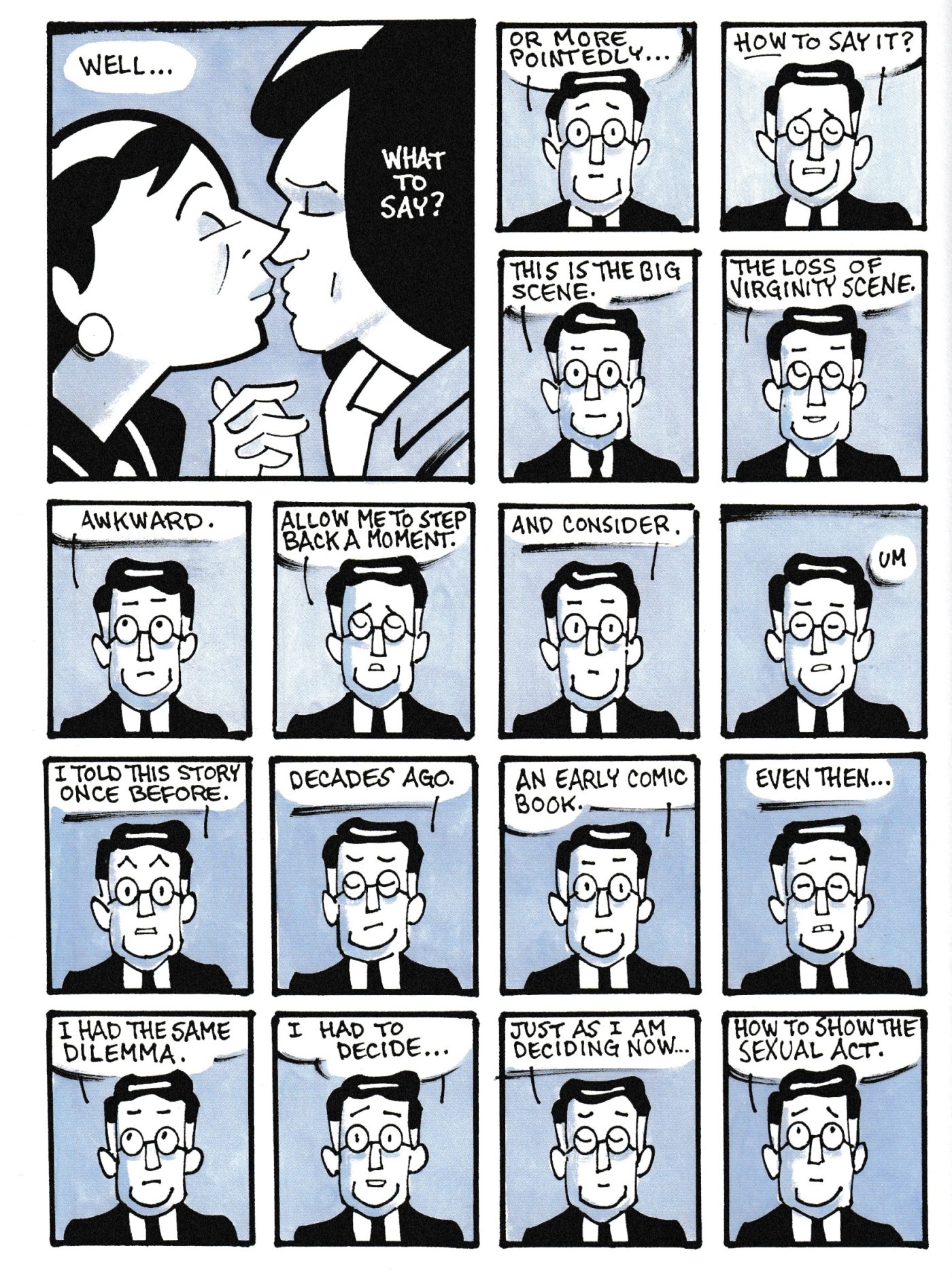
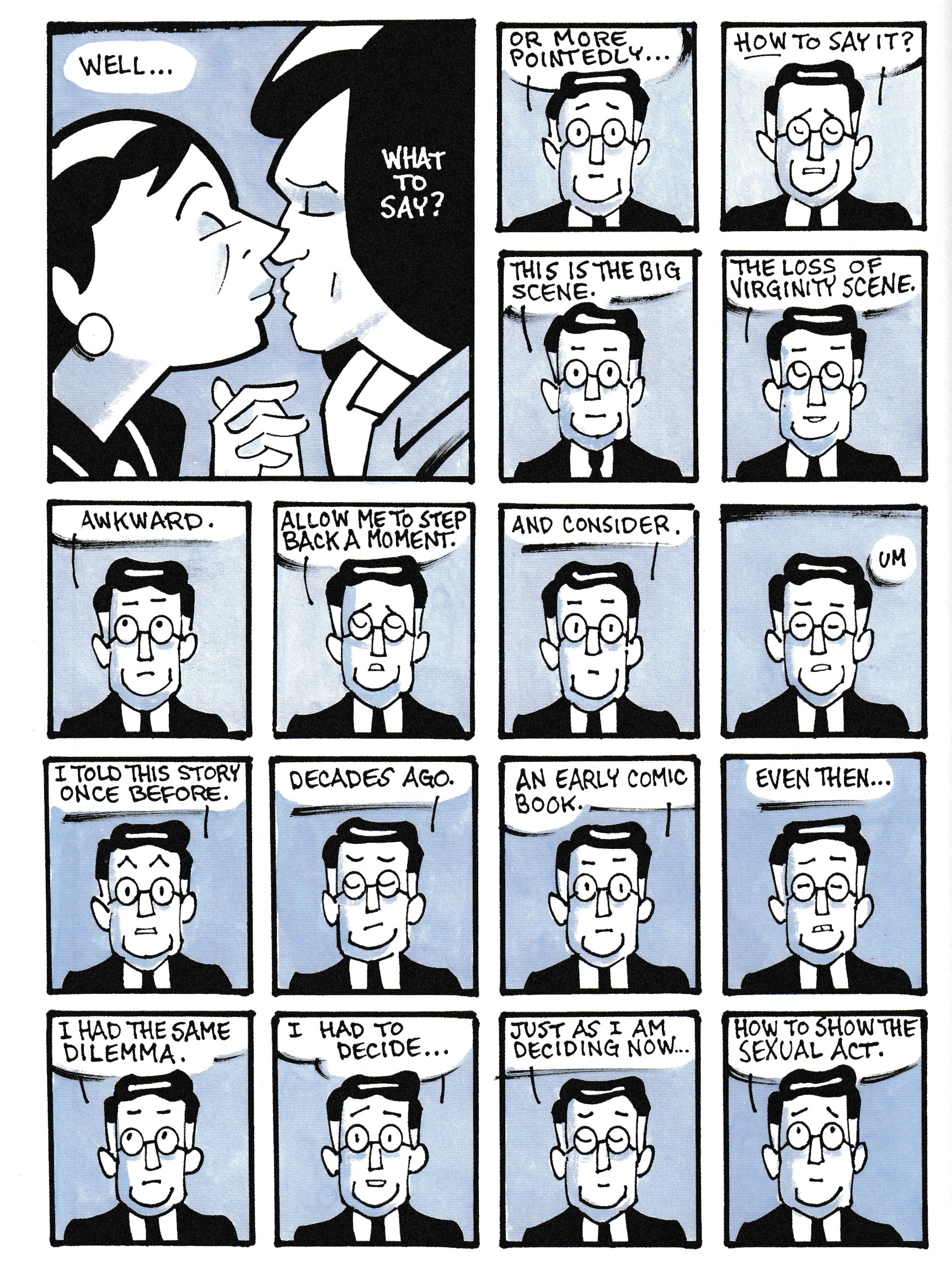
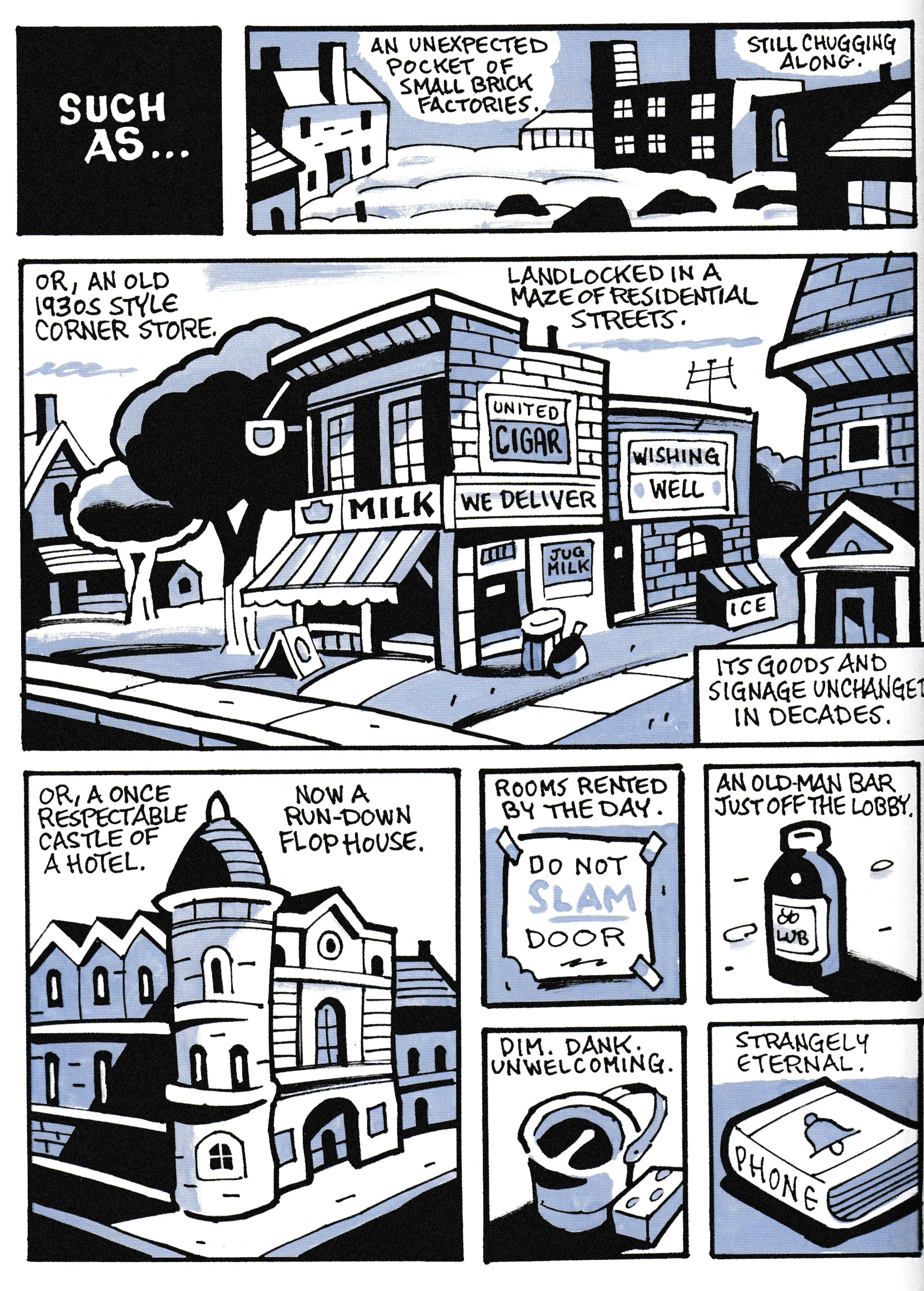
Perhaps the most familiar aspect of Palookaville 25 is Seth’s pitch-perfect use of compression, his ability to squeeze every ounce of feeling he can out of the comics medium’s essential elements, stripped of ornamentation or embellishment. “Nothing Lasts,” for instance, is mainly composed of 4x5 panel grids, each panel filled with a talking head or a character’s face that varies only slightly from panel to panel, or with a single, lonely object isolated from its surroundings. The work’s early pages proceed like a slideshow, snapping from one image to the next and challenging the reader to pause and take stock of each individually, to work against the rhythms of comics narrative that invariably lead the reader to progress more rapidly than they should. Things change when Seth recounts his move to Toronto in 1980, at which point the panels grow larger, opening up their ability to capture larger scenes of unfolding city blocks, bustling crowds, and imposing stone facades as if mirroring the young Seth’s own receptivity to the city. Whereas the two-page spreads formed almost exclusively of 4x5 grids feel purposely precise and claustrophobic — witness the excerpt’s opening pages, where a present-day Seth hems and haws over the ethics of depicting the loss of his virginity, the visual equivalent of clearing his throat — these later pages feel spacious and airy, just as detailed as their predecessors but less worked over, as if the moments they represent flow more easily to mind and require far less explanation.
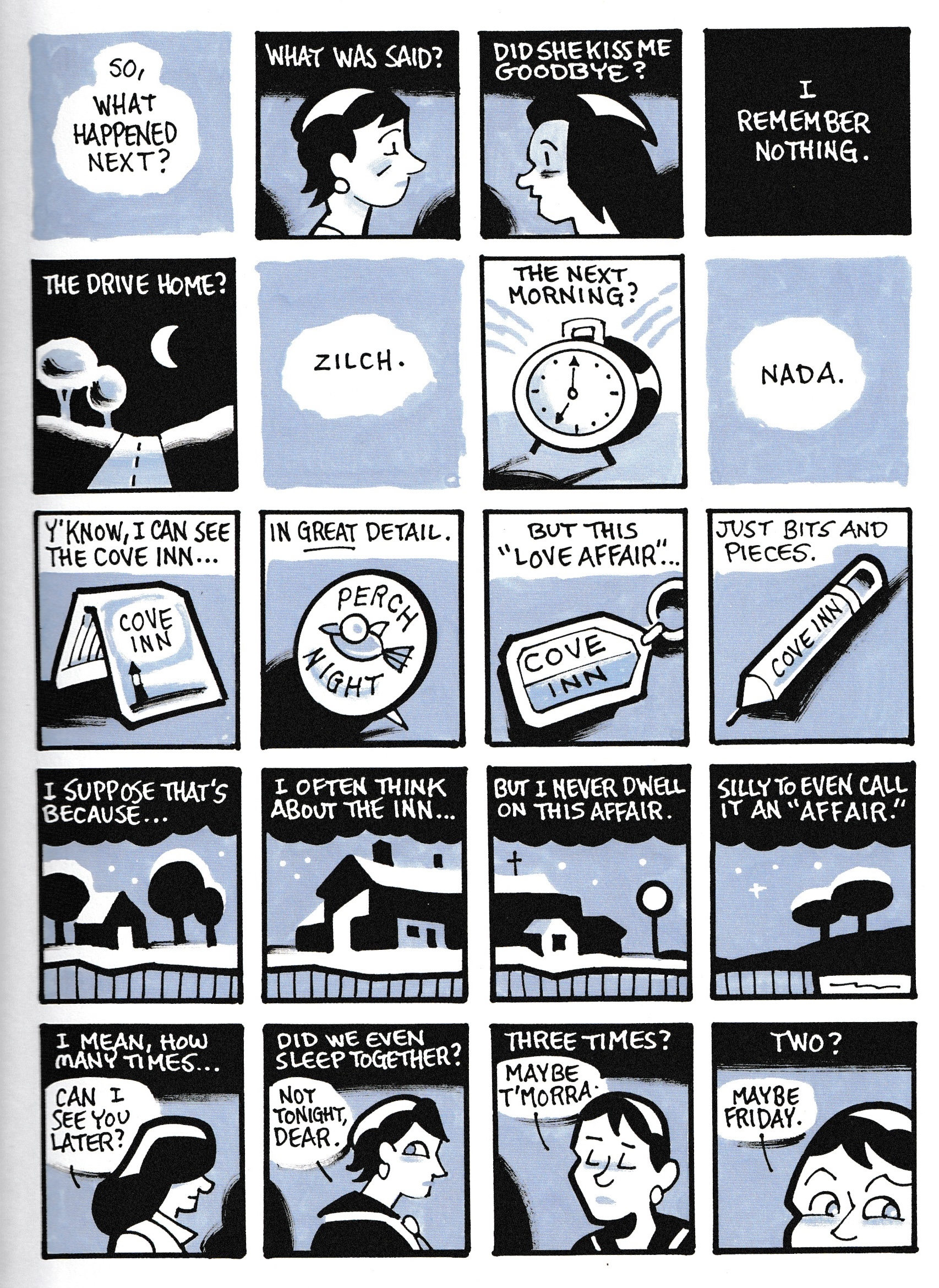
“Explanation” plays an unexpected role in “Nothing Lasts,” as over half of the installment’s pages include at least one footnote clarifying some point of fact or else admitting to Seth’s inability to call to mind the details of a given moment. The effect of these footnotes is curious. On the one hand, they ironically demonstrate how a cartoonist famous for taking the past as the focal point of practically everything he’s produced in his career can find himself forgetting aspects of his own life. In this way, the footnotes reveal how Seth’s commitment to mining the past can be thwarted by the same uncertainty everyone experiences when they try to tell their own life stories; Seth, as always, is fascinated with the past here, but he also shows how it can be inaccessible, resurfacing only in traces that one can sense but never capture, and how deeply it can frustrate as a result. On the other hand, the ubiquity of the footnotes can feel apologetic, even self-lacerating. Seth seems to concede that he should remember these details if he wants to write an autobiography, and the fact that he makes such a point of underlining his difficulties with memory causes one to wonder at his intentions. Is this a way of dramatizing the condition we all face, of remembering without certainty? Or of poking fun at his own reputation as an obsessive chronicler of the past by admitting his fallibility when it comes to autobiography? Finally, is this a hint that the comics medium can’t quite capture what Seth is after, with footnotes offering a painfully necessary supplement to a narrative that can’t find its full expression in a series of panels and word balloons? This episode of “Nothing Lasts” validates all three possibilities, and in so doing reveals Seth working toward a fuller self-reckoning than any he’s previously delivered.
The ambiguity at the core of “Nothing Lasts” also shows why the characterizations of Seth as a nostalgist have never fully captured his range. While it’s fair to say that Seth’s art has solidified into a trademark, perfectly encapsulating the cartooning of midcentury North America, his deliberately anachronistic line is not necessarily nostalgic, nor is that line the only thing Seth offers in Palookaville 25. Indeed, the book is less in mourning for a vanished past than it is in search of a way of engaging with the present. When Seth’s avatar, at the end of the “Nothing Lasts” episode, laments that “as you get older […] you long to talk on and on … about your own life,” even when “nobody wants to indulge you in that,” he voices a frustration that permeates much of Seth’s prior work, from It’s a Good Life, If You Don’t Weaken to Clyde Fans: striking up a dialogue between past and present, in which audiences and artists alike can have a genuine experience of the past within a contemporary moment, is both profoundly meaningful and maddeningly difficult. Establishing such a dialogue is even more apparent a goal in “Living Room Suite,” where, in his brief prefatory essay that recounts the circumstances of the installation, Seth explains that the sculptures are situated near a bus stop, which pleases him, as he hopes commuters will sit on the pieces while they wait. The photographs charting the development of the installation — through which we see miniature cardboard models becoming ceramic models becoming full-sized Styrofoam models becoming finished bronze sculptures — not only speak to Seth’s interest in broadening his metaphorical canvas, but also in broadening his audience. As each model gives way to the next, one witnesses a transformation from Seth’s personalized miniatures — in the essay, he describes the furniture as part of “an inner room,” or “A room somewhere inside the mind or even contained within the body” that “represented a quiet space. Away from time and earthly worries” — to a large-scale work unabashedly designed for the public, an interactive manifestation of past aesthetics that current and future audiences can use as they see fit. Seth, long characterized as absorbed in individual passions, here makes one of his most optimistic attempts at connection in a work that looks outward, not inward.
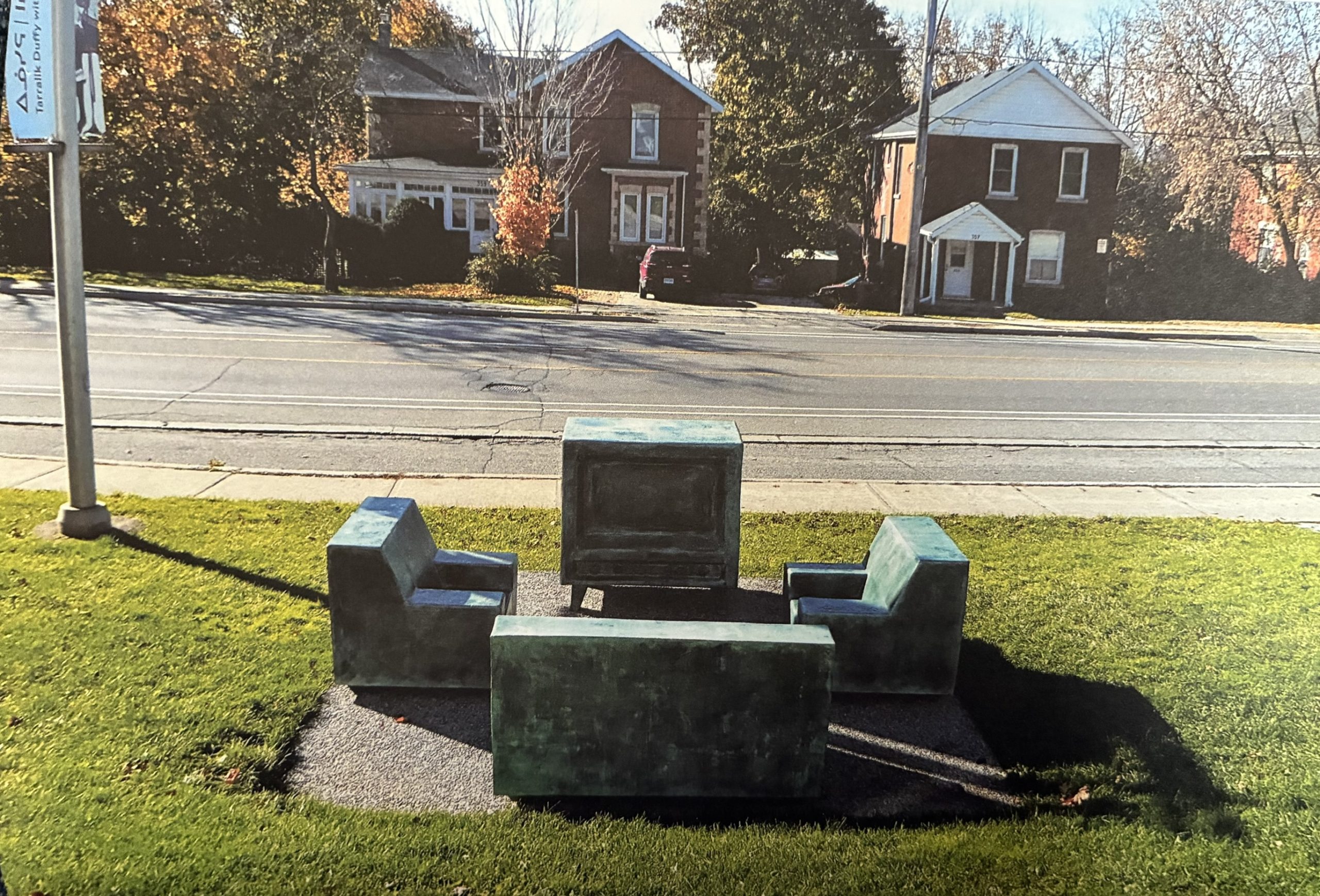
It’s admittedly strange to see Seth’s work against a backdrop of SUVs, a coffee shop, and a maker space studio, all of which are visible in the photographs of the completed installation and in a quick search on Google Maps, where I was delighted to find Living Room Suite sitting tidy and unobtrusive on a bright fall day, its green patina a reminder of the effects of environment on art. That is, of course, how we interact with all of Seth’s work — we read his comics in the present, surrounded by the trappings of twenty-first-century culture — but it’s a fact that Seth’s comics have typically obscured. After all, though “Nothing Lasts” covers Seth’s life in the 1970s and ’80s, it is still rendered in a cartooning style characteristic of earlier periods, and its talking head narrator is dressed, characteristically, in a coat, tie, and fedora reminiscent of those periods. The photographs that comprise “Living Room Suite,” by contrast, rebut the present-day amnesia that Seth’s comics can cultivate. In them we see Seth dressed in his usual, vintage ensemble, but wearing a face mask, since the installation was built at the height of the COVID pandemic. More importantly, we see Seth constructing something meant to interact with the present moment and to last well into the future, when its visual idiom — a boxy television set, midcentury-style chairs — will feel even more remote to those who choose to sit on it and wait for their ride.
This is not to say, however, that Seth’s regular readers will find Palookaville 25 a departure from what has made his work so singular for so long. Seth remains remarkably consistent in his preoccupations, his anxieties, and his moods. But he is also, as many readers have failed to grasp, evolving, even if such evolution can feel uncannily familiar. In “Nothing Lasts,” he tells a story of walking in Toronto one night and passing a small storefront. “A notion came into my head,” he explains: “I thought, ‘in a few minutes, I will be passing the tea room… and I’ll be in the future.” Once he reaches that point, Seth tells us, he “paused and glanced back down the street. Back to where I had stood a moment ago,” where he “almost expected… to see myself still standing there.” From this new vantage point, Seth realizes that he is “now in the future. And that previous Seth … he is now in the past.” The moment, Seth demurs, is “a nothing sort of experience,” yet he also concedes that it animates everything he’s ever done. In a footnote, he remarks that this incident is “one I’ve written of before … somewhere (?),” but as that parenthetical question mark indicates, he no longer remembers its precise location. The answer is Clyde Fans, where the character Simon Matchcard describes this very activity: “Walking down a street I would concentrate and think, ‘I am now in this moment. This is me. In five minutes I will be passing the tea-shop [sic] and I will have travelled forward in time.[’] Then, moments later, when I did pass the tea shop, I would mentally return to that ‘fixed’ moment and try to connect to the person I had been then.”
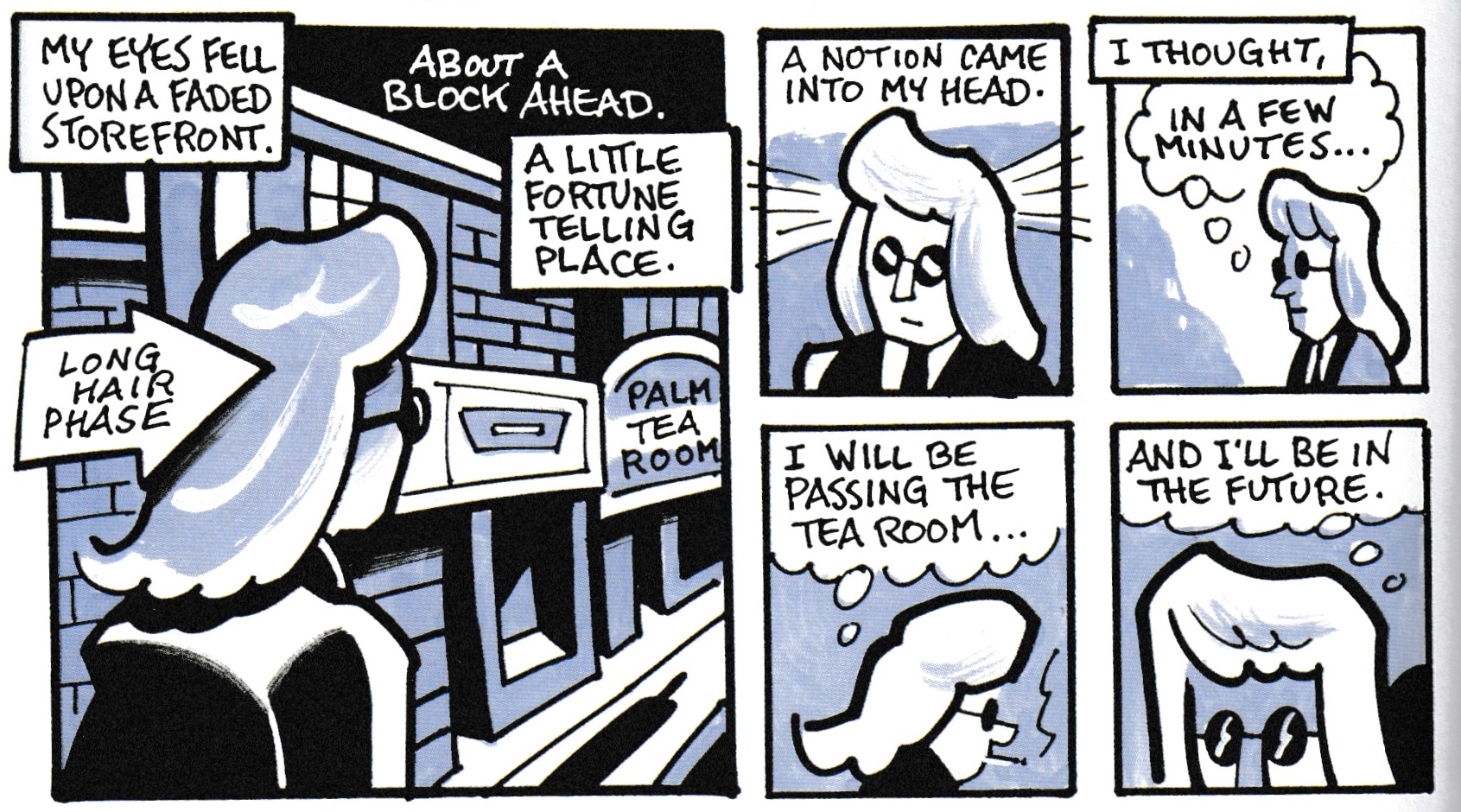
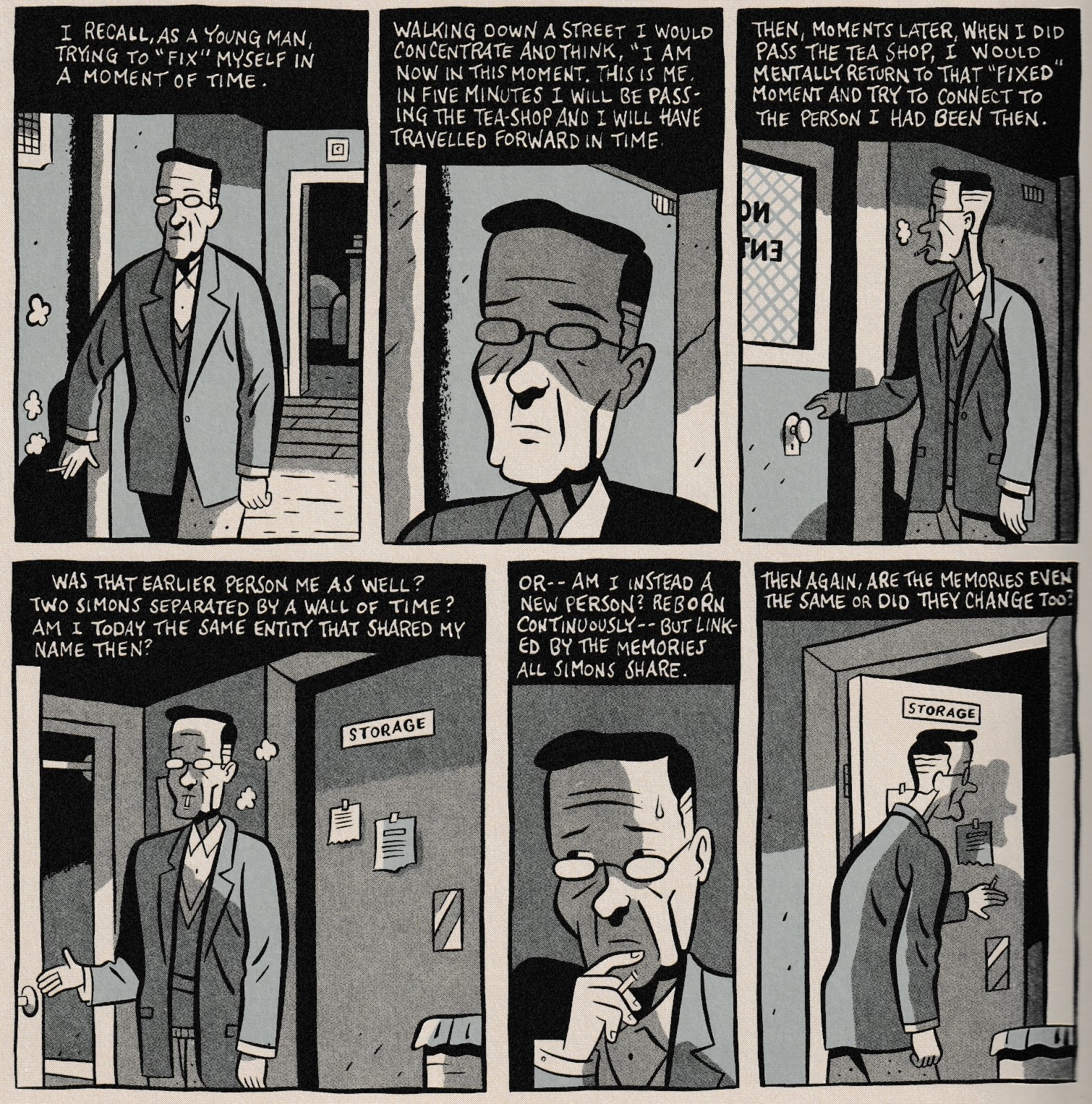
I’ll admit that pointing to this moment in Palookaville 25 as an example of Seth’s artistic evolution might seem counterintuitive. After all, it dramatizes a thought experiment — albeit an experiment centering on temporality and personal change — that Seth argues has fascinated him for over forty years, and one he has depicted in a previous comic. Again, though, the difference lies in the footnote. In “Nothing Lasts,” Seth professes his ignorance of the experiment’s appearance in an earlier work; he is, or claims to be, unsure of when or where he mentioned it, acknowledging that its influence, like that past Seth he attempted to recover after reaching the storefront, has so pervaded his thinking that identifying its unique appearance within individual comics would be a necessarily doomed endeavor. In other words, there are no fixed borders to the past, just overlapping shades of then and now that Seth struggles to communicate.
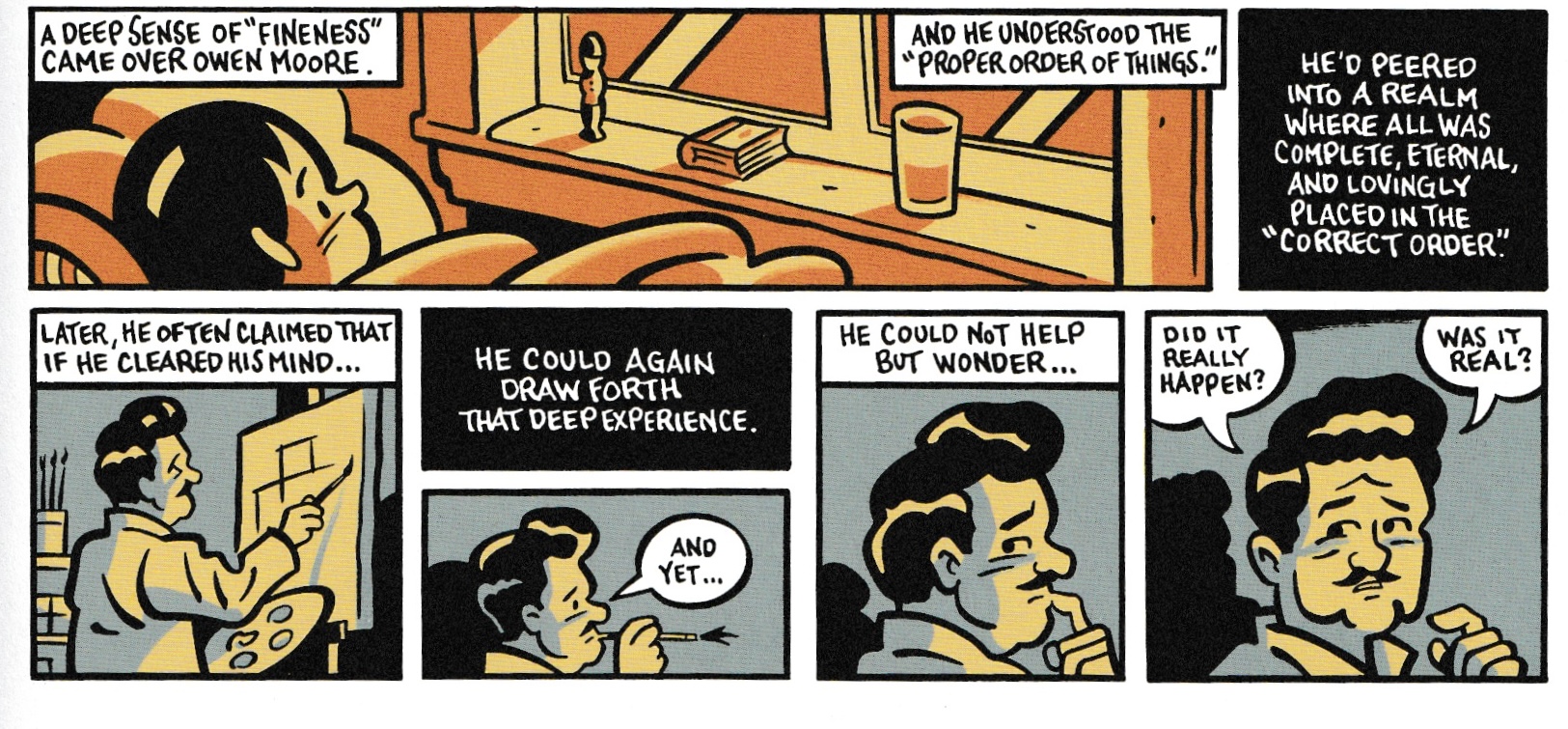
Seth makes much the same point in “Owen Moore,” a sequence of vignettes that recounts the life of a now-forgotten Canadian painter, and the most quintessentially “Seth” piece contained in Palookaville 25. In one episode, Seth depicts Moore as a child lying sick in bed, who suddenly perceives the world around him as both an array of objects “boldly outlined and glowing from within” as well as “a larger, exquisite whole.” In this moment, Moore “understood the ‘proper order of things,’” having “peered into a realm where all was complete, eternal, and lovingly placed in the ‘correct order.’” This might sound like an apropos description of Seth himself — an artist who arranges the world depicted in his comics lovingly, with a clear sense of proportion, line, and contrast, in hopes of constructing an “exquisite whole.” Yet Seth’s footnotes in “Nothing Lasts,” as well as the public art of “Living Room Suite,” reveal something subtly yet demonstrably different — an artist who knows that his arrangements, however lovingly presented, can never be “correct.” They can be used and misused, forgotten and remembered, viewed in isolation or as part of an evolving aesthetic practice. What Palookaville 25 demonstrates, then, is an artist more experimental, more fallible, and more open to possibility than at any point in his career. His critics, and his readers, should take note.
The post Palookaville 25 appeared first on The Comics Journal.


 Hello, my name is Jack Sparrow. I'm a 50 year old self-employed Pirate from the Caribbean.
No comments:
Post a Comment