

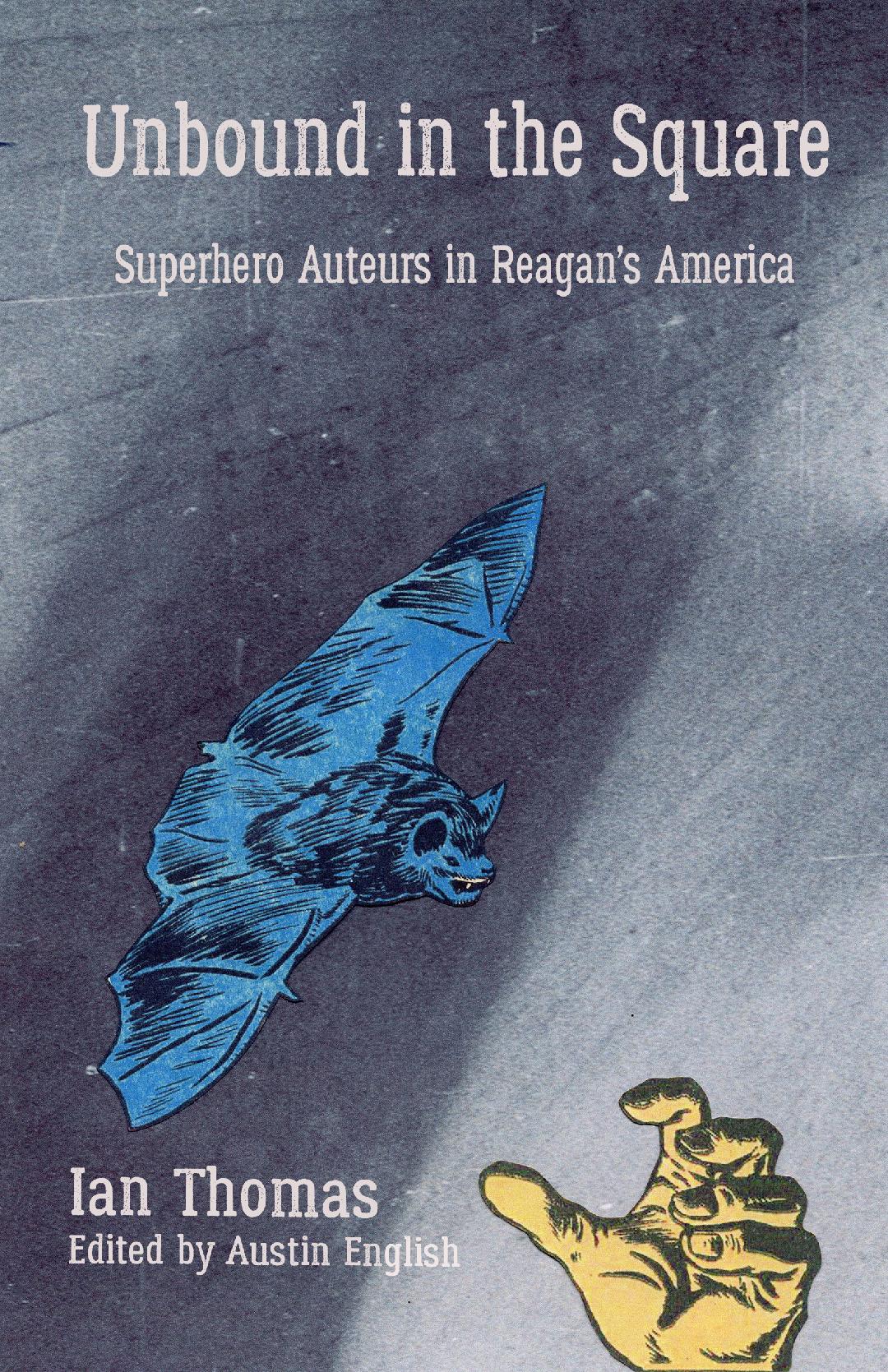
In “Unbound in the Square: Superhero Auteurs in Reagan's America,” critic Ian Thomas explores a lineage of titles from the early days of the squarebound comics format; a design-forward, creator-driven approach to packaging stories as comics moved beyond the newsstand into more upscale markets. “Unbound” begins with a look at the political legacy of Frank Miller’s seminal 1986 work, The Dark Knight Returns. Thomas then explores the landmark story’s influence on one of its successors, The Cult, another gritty, political take on the caped crusader by writer Jim Starlin, artist Bernie Wrightson, and colorist Bill Wray. “Unbound in the Square” culminates with a look at P.O.V., a spiritual sequel to The Cult, repurposed for DC’s competitors at Marvel Comics. “Unbound in the Square” charts a comic book industry in ascent, invigorated by new creative boundaries amid America’s hard turn to the Right. It was edited by Austin English (The Comics Journal, Domino Books) and features a cover by Johnny Damm (I’m A Cop, Technocrat Tales, Riot Comics).
“Unbound in the Square” was written in solidarity with the mission, organizers, and beneficiaries of Asheville Prison Books. 100% of proceeds from their sale of “Unbound in the Square” will benefit their important work.
In their own words:
Asheville Prison Books is a volunteer-run collective which has distributed free literature to people incarcerated in the southeast since 1999, making us the oldest Prison Books Program in the southeast. We currently distribute books to North and South Carolina. Over the last 26 years we have sent tens of thousands of books to incarcerated readers
Incarcerated people send us mail directly to request reading materials. Requests may be general, such as asking for a genre, or very specific, such as certain titles or authors. We have a library of mostly donated books to pull from and try to fulfill the requests as best we can. We then package the books up and mail them out.
We send books to folks who are locked up because it’s a way to reach through the bars and show solidarity with the people trapped behind them. As a project rooted in anti-authoritarian politics, APB rejects the traditional framing of prison as the solution for crime or as a vehicle for rehabilitation; instead, we understand prison as an institution on the front lines of upholding an unjust social and economic order based in large part on white supremacy. Finding ways to connect with, humanize and meet the everyday needs of incarcerated people is a crucial part of building collective power to challenge the legitimacy of this repressive institution.
We also really love books.
Asheville Prison Books is completely volunteer operated. All donations go towards shipping and materials.
Prisoners can write to us at the following address to request books:
Asheville Prison Books Program
c/o Downtown Books and News
67 N. Lexington Ave.
Asheville, NC 28801
Please include your number and let us know about any book restrictions at your facility. We love to receive art as well. Let us know if you’re comfortable with us posting it on our website (and how you’d like to be credited).
“Unbound in the Square” is a full-color, digital-only release. The 68 page chapbook will be available for sale until Oct. 18, 2026, for $5.95, a price-point designed to ensure that every sale, on average, will facilitate a shipment to an incarcerated person.
***
“tarzan of the apes” will never become a Turner Classic Movie. shoddy premise. people find pictures of a man yelling in the woods disgusting. — @dril
In her August 1988 “Publishorial” column, President and Publisher of DC Jenette Kahn used the promotional space to hype the publication of Jim Starlin, Bernie Wrightson, and Bill Wray’s new high-line collaboration: Batman: The Cult. To contextualize what was on offer in the new story, she enlisted Denny O’Neil, longtime DC scribe and Supervising Editor of Batman titles. True to industry form, O’Neil pitched The Cult as more of the last best thing. “In effect, it’s this year’s Dark Knight,” O’Neil said, referring to Batman: The Dark Knight Returns, Frank Miller’s popular and critically acclaimed reimagining from a few years prior. As marketing statements go, it was a good one, encapsulating the company’s ongoing efforts to appeal to a rapidly expanding market as it moved to fill the shelves of direct market stores and win territory in the burgeoning mainstream bookstore space.
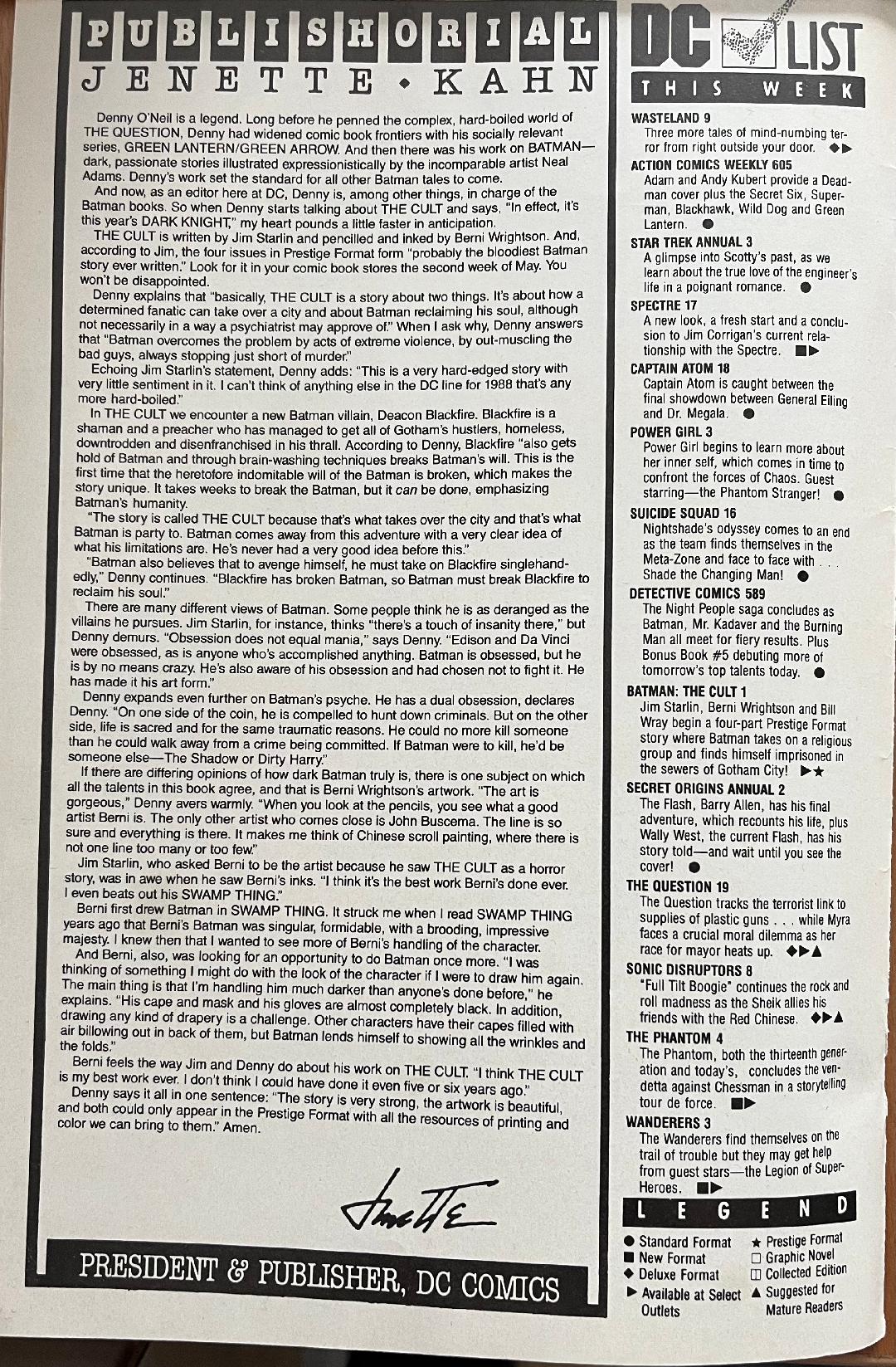
The new title’s first installment — “Book One: Ordeal” — was enumerated in the adjacent column, “DC Checklist This Week,” sandwiched between entries for Detective Comics #589 and Secret Origins Annual #2, both of which featured short summaries of the stories therein and culminated with an indication of their lowly “Standard Format.” The Cult’s description, by contrast, began with attribution to its creative team, announcing it as the beginning of a “four-part Prestige Format story where Batman takes on a religious group and finds himself imprisoned in the sewers of Gotham City!” The listing was punctuated with an indication of its availability at “Select Outlets.” The Prestige Format was DC’s glossy, squarebound tier, which boasted premium paper stock and slick, eye-catching covers. In the case of “Ordeal,” the title logo, the arc of the circular manhole cover, and the municipal lettering of “Gotham City Sewer” are all embossed, drawing the eye to Wrightson’s rendering of Batman’s sinewy hand, gloved in rich black, as he squats to examine the bloody handprints that cover it; a mysterious enticement to the subterranean journey contained therein.
Revisiting Batman: The Cult nearly four decades on in DC’s recently released deluxe hardcover edition, it’s clear that the creative team — Starlin,Wrightson, and Wray — were filling their lungs with the same air that invigorated Miller’s work on the character in The Dark Knight Returns (TDKR) and later in Batman: Year One. Like those works, The Cult introduced tropes and affectations that would be duplicated or riffed upon in subsequent, further-reaching Batman tales.
Yet despite DC’s efforts to market it as such, The Cult never reached the levels of success and acclaim to which Miller’s work would rise. Since the initial publication of TDKR, Miller’s periodic revisitations to the setting have rendered the setting an iconoclastic sub-universe within the DC canon, but subsequent installments have not been nearly as impactful as Miller’s initial foray into its world. None have had the same strength of vision or steadfastness of execution. TDKR is tonally and visually consistent in a way that is rare in any commercial art form. Every panel is sewn tight with intention. While there is no shortage of appraisals of Miller’s seminal work, one need look no further than Miller’s own words to elucidate his goal of locating the essence of the storied caped crusader in the pages of TDKR. In his introduction to The Dark Knight Returns: Tenth Anniversary Edition, published in 1996, Miller spoke to his deeply-considered, character-driven approach:
And there was Batman himself. He was the real boss. As he was quick to assert, Batman has a purpose and personality all his own, a defin- able core. He’s neither petty nor petulant. He’s no whiner; there’s not a trace of self-pity in his soul. He’s smart. He’s noble. And most important, he’s big. His passions are grand. Even his unhappiness is not depressing, but a brooding, Wagnerian torment. And his triumphs are Olympian.
Although it was produced under the editorial supervision of O’Neil and Dick Giordano, TDKR is essentially an auteurist work, albeit one subject to the limits placed on an intellectual property owned by a corporation. Miller was possessed of a vision beyond the scope of mere story and was empowered to execute that vision with a larger degree of freedom than had been previously allowed. At the time of this writing, TDKR’s initial publication in 1986 leaves it just a few years shy of the halfway point in the character’s history, arriving about 47 years after the character made his debut in Detective Comics #27, published in May of 1939, a creation of Bob Kane and Bill Finger. The Cult would not exist without TDKR, nor would the subsequent 40 years of publications that featured the Batman. While TDKR has been given due attention as a milestone of the medium, particularly for its tonal content and mainstream success, even modern analysis of TDKR reads as jaundiced by the wave of hype and publicity on which it arrived to the market. For that reason, and because TDKR’s concerns and execution stand in contrast to — and conversation with — Starlin, Wrightson, and Wray’s The Cult, it is worth examining Miller’s landmark work here.
Prior to TDKR’s conception, Miller, still early in his career and not yet 30, had achieved stardom. But it was stardom of the perennially meager variety on offer by the comics industry. He had already ascended to greater heights than previous generations of creators could have imagined with a fan-favorite run on Daredevil and the release of Ronin, a boldly experimental cyberpunk tale that was initially met with ambivalence but has accrued appreciation in the intervening years. He was climbing, to be sure, but given the nature of the industry in which he had arrived, he was running out of mountain. In the perpetually 29-year-old Bruce Wayne, Miller saw a vitality that he knew he could not imagine in himself for much longer. Encapsulating his approach to the story’s central premise, Miller wrote in the same aforementioned introduction that: “The central notion is to simply move Batman through time, and chronicle his last case. Move him through time, and, just by happenstance, make him once again much older than I am.”
Miller embraced his mission with relish, but to say he was uniquely passionate about the material would be a disservice to those creators that preceded him in interpreting the character and to his contemporaries, many of whom also arrived to the industry by the same avenue of fandom. Miller was uniquely positioned as a creator whose work was in vogue among fans. It just so happened that his creative interests aligned with DC’s commercial interests. He made the most of it. Just a few years earlier, Miller and Steve Gerber pitched a similarly bold revamp of DC’s central characters — Batman, Superman, and Wonder Woman — that failed to materialize.
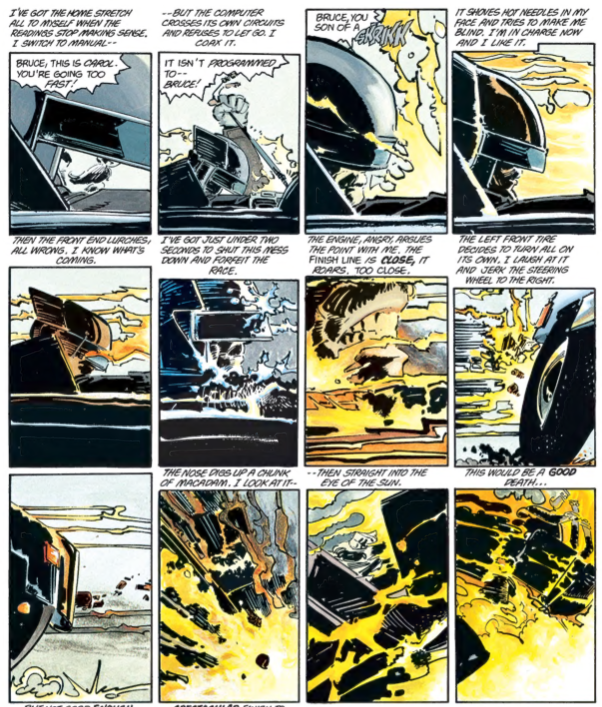
It’s fitting that Miller’s story opens on the retired Bruce Wayne redlining a race car to its destruction. In TDKR, Miller opened the showroom doors, driving off the lot and onto the open road, where he put the pedal to the metal, all with the blessing of the dealership.
As the inaugural title published in the buzzy Prestige Format, initial editions of TDKR were packaged, in both their design and their marketing, in a way that not only flattered the work, but also the reader. In this way, DC hoped to put their comics on equal footing with the more “mature” forms of entertainment that lay beyond the borders of the comic book industry, then perceived by the wider world as juvenile and unserious (or so insiders believed). These squarebound editions could stand on a bookshelf, if only barely. The coveted mainstream exposure TDKR received was, in large part, due to a publicity campaign not afforded to titles deemed less prestigious. DC’s PR efforts paid off in the form of coverage in the pages of upstart entertainment magazine Spin and the more institutional Rolling Stone, along with fandom and industry publications.
Dedicated as they may be, diehards are fickle, finicky, and vocal with their displeasure. Since genre entertainment forms the bedrock of popular culture, the marketing of it is an effort to expand, perpetually, the fan base. Any new material must be sold as though it’s different from everything that came before it, while allowing for the implication that it is also the same as everything that came before it. In its TDKR gambit, DC imagined an expansion of a fan base — a customer base, really — that, at the time, was far more engaged with and captivated by its product than, say, a television consumer who was enamored with a program but would watch something similar in the same time slot if necessary. In courting new readers, the premium packaging proffered hipness, signaled quality, and could be easily understood via prospective readers’ relative familiarity with the character’s concerns and the genre setting. Modern analogs to this strategy can be found in the film studio A24’s model for packaging “elevated horror,” or in the marketing of “prestige television” in the early-aughts; age-old stories, gussied up to reach a new market segment.
At its heart, though, and especially in retrospect, TDKR does not amount to the genre reinvention for which it is so often given credit. Miller’s story here (and most everywhere else in his oeuvre) traffics in archetypes. The bodies may be lumpen with muscle and purple with bruises; the cape and costume weighted with kevlar and fixed by cable and carabiners, but in TDKR, Miller doubles down on the heroic conceits that have powered the superhero genre for decades. He does so by imbuing those conceits with real world pathos and real world violence in an effort to tell the story of a degenerate world saved from itself by a capable and inflexible authority who embodies values thought lost to the past. Miller delivers Batman as redeemer, a man apart and a man above, assured in his conception of what the world needsv—vwhether it consents to his methods or notv—vand determined to live up to his ideals by sacrificing his humanity before his own mortality does it for him.
In this light, TDKR is often pegged as a conservative work. By today’s definition that is a mostly accurate assessment, but only because Conservatism and its even more ideologically incoherent cousin, Libertarianism, have become nearly synonymous in the popular imagination. Even at a theoretical level, Libertarianism reads as picky-choosy doctrine, prioritizing self-interest over social good and asserting that what wider society views as interaction would be better conceived of as transaction. Reduced to an elevator pitch, Libertarianism espouses individualism, self-governance, and self-determination. In practice, though, it seems to find its greatest resonance among those who see virtue in contrarianism, who value property rights (and the rights of property owners) over just about any other kind of rights, and who see martyrdom — and, thus, virtue — in being a done-wrong-by customer. It’s a tired point, but it isn’t too much of a stretch to find the characteristics of Libertarianism in an absurdly wealthy white man who hunts those whom — by his own estimation and decree — violate the social contract.
In a 2015 Vulture interview, Miller copped to an affinity for the politics of Libertarianism, albeit with asterisks and qualifiers, signaling, perhaps, that his commitment to the tenets of the philosophy was relative, rather than absolute. In the same interview, he also offered the admission that he voted for Hillary Clinton. One must wonder if these values were nominally formulated at the time of TDKR’s initial publication. It’s hard to surmise. The contemporary conception of the already slippery Libertarian dogma entered the modern parlance of politics as part of the Tea Party movement of the late-aughts, but its moral absolutist underpinnings can be found in much of the genre material on which Miller would have been raised. Regardless, if the favorable reception to TDKR was any indicator, Miller was hardly alone. It was in the air. Consequent to the political and ethical morass that characterized America’s cultural contemporaneity, readers yearned for moral certainty and a disambiguation of political complexities.
As both artists and audiences reckoned with decades of government scandal and social unrest, Miller imported into TDKR the senses of irony, disillusionment, and cynicism that were part and parcel to pop culture — cinema, television, music and literature — of the era. On both page and screen, the generation dubbed the Me Generation by “New Journalism” pioneer Tom Wolfe was taking stock of the wins and losses of its cultural project, the Sixties, and coming to terms with the impossible compromises required to square the ideological values of their youth with their desires for professional and domestic fulfillment. The resultant malaise found them flailing (and largely failing) to cobble together a value system that would allow them to honor their morals, while achieving a measure of more traditional success at home and at work. Miller was part of this cohort, also known as Baby Boomers, in his age and seemingly in his disposition and was thus well-suited to weigh in.
This flavor of middle-class ennui was mined for comedy and drama in films like Albert Brooks’s Lost in America, Lawrence Kasdan’s The Big Chill, and (future Batman Forever and Batman and Robin Director) Joel Schumacher’s St. Elmo’s Fire. Whatever concerns or misgivings characters in these works may have brought to their respective narratives, they were generally upwardly mobile and given to success, reifying their capabilities and the legitimacy of their goals. This is not to say that hot-button topics, domestic or otherwise, were being acknowledged for the first time, but that every generation has their own concerns and their own approaches to exploring those concerns. While this did not amount to a decisive shift in pop culture, exactly, it did constitute a broadening of tonal range to include what were considered new extremes, new interstices, and new conceptions of story resolution.
As the conflicts between and among generations, socioeconomic cohorts, and political groups commingled and collided, they also grew more pronounced when projected through the lenses of increasingly prevalent and prolific media. Among audiences, the appetite for more risky, starkly-rendered, and questioning registers of storytelling ripened. The mounting scandals of the '70s and '80s extended those concerns and their expression into more emotional registers. Early in 1986, Oliver Stone debuted Salvador, a war drama set amid the Salvadoran Civil War, in which a jaded and embattled photojournalist learns that the United States is backing the right-wing Salvadoran government against the incursion of left-wing guerrillas. Salvador would be nominated for two Academy Awards that year. Similar strains of government paranoia, critiques of ascendant pop psychology, and domestic confusion can be found in TDKR.
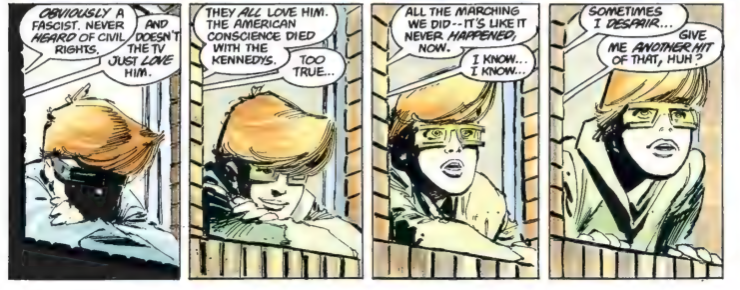
The Cold War, climate emergency, and rising crime rates were all anathema to long-held notions of American safety and prosperity. In his conception of Batman, Miller repudiated his generation’s self-centered neuroses and denials of responsibility in the face of these very real existential threats. Batman’s gaze finds these hypocrisies in every corner of Gotham City, from its halls of power to its grimy alleyways. After she is saved by the recently un-retired Batman, Carrie Kelly, soon to take up the Robin mantle, gazes dreamily out of her apartment window. Her parents are never shown. They are absent from view but for their words. They bemoan Batman’s return, dismissing him as a fascist. “They all love him. The American conscience died with the Kennedys,” they complain as they ostensibly share a joint. “All the marching we did — it’s like it never happened now.”
And in TDKR it all works. The hardboiled tenor Miller found in the pages of Daredevil and the European and Manga-inspired qualities he instilled in Ronin congealed into something that felt altogether new. In retrospect, Miller was delivering not only a story but a proof of concept, essentially arguing there was not just an appetite for creator-driven stories, but creators could be the reason for readers to turn up.
Miller made a compelling case, thanks in no small part to the creative team enlisted to support him. Though comics are collaborative by their nature, there is often a tension in the way creativity congeals as each artist rushes instinctively toward their own proclivities and battles their own bugbears. TDKR is a rarity in the way the constituent artisans complement one another so fully. Lynn Varley’s bravura coloring — gouache on blue lines — emphasizes the world’s illumination in Batman’s presence. Her colors, coupled with Klaus Janson’s gritty but precise inks, are what drives Miller’s vision home. The dramatic shadows long associated with the character come and go under their aegis, but the gothic underpinnings are put to rest almost entirely. Miller conceives of the character as a brass-knuckled pugilist and that conception is bolstered by Varley in shades of vivid blue, electric yellow, and bright gray laid flat and pure. Along with emphasizing qualities that bolster the ideals at the heart of the Batman concept, Varley also succeeds at capturing the muddy banalities of a stagnant culture, wallowing in its worst excesses. Coupled with the effervescent, crackling tones of a freshly-minted Robin, the conceit of Batman and his trusty sidekick shifts from candle in the wind, holding the line, to probing searchlight; old-guard defense to intergenerational counter-revolutionary offense.
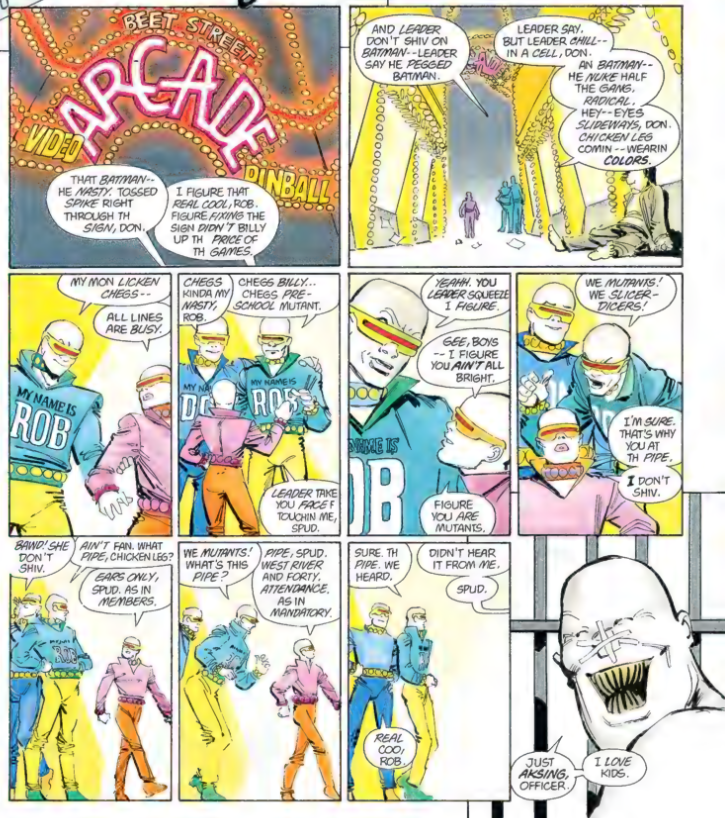
As much as TDKR is a response to the history of the superhero genre, Miller’s story also aspires to reflect the dangerous and dilapidated New York City to which he arrived from his childhood dwelling of Montpelier, Vermont, a decade earlier in 1976. His depiction was in keeping with a common sentiment. Miller’s Gotham City was one and the same with the contemporary New York City, where Mayor Koch railed against “wilding” youth running amok on city streets and Bernie Goetz became a folk hero and cause célèbre after shooting four African-American teens on the subway. To this end, Gotham institutions like Crime Alley borrow from the lurid neon of 42nd Street and Arkham Asylum, cynically re-dubbed “Arkham Home for the Emotionally Troubled” is awash in the queasy fluorescence of Bellevue.
Since its initial publication, America’s embrace of neoliberal policies have only diminished the daylight between conservative and liberal readings of TDKR. Austerity, deregulation, corruption, and empire are values that have long been shared by both ruling parties in their decades-long race to the right. From a domestic standpoint, the intervening years have been marked by an ever-shrinking social safety net, increasingly lax consumer protections, and a general hostility toward labor organizing. From a policy standpoint, there are far fewer barriers between business interests and the politicians who enact the permissive legislation for which those industries lobby. The victory of Citizens United in 2010, for example, upended the orthodoxy of campaign finance, granting exponentially greater influence and privacy to wealthy political donors seeking to influence policy. As for statecraft, our “forever wars” have been waged on increasingly incoherent grounds, mired by increasingly incoherent or unattainable goals, and increasingly fought by private contractors not subject to the same level of scrutiny by which the military operates, all to the benefit of the military-industrial complex, which commands an ever-increasing portion of government budgets. The ubiquity of these policies has brought reality closer to the stark extremities that genre storytelling often seeks to depict, but has also proven an immiserating force for just about everyone but the top 1% of society.
In most of Miller’s work, but especially in TDKR, he is uninterested in how politics are iterated from the perspective of ideology. Rather, his interest is in the way politics congeal to bolster (or fail to bolster) notions of goodness. He never satisfactorily defines the qualities of a hero. Those qualities are for the hero to decide, but not to explain. By Miller’s lights, even if Batman is fascist in his methodology, he is excused by his unerring judgment. He is a hero because he is right and he is right because he is the hero. He is, therefore, beholden only to his own standards, which conveniently smooths any lapses in judgment or perceived character deficiencies.
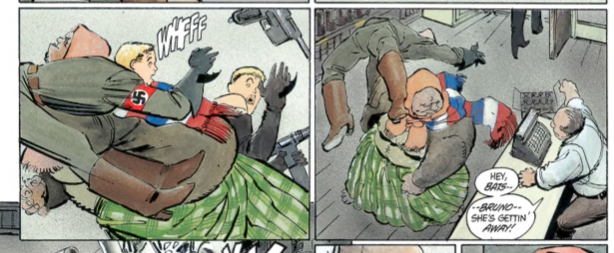
At a blush, this is standard superhero fare, but Miller mined new depths of pathos and expressed it in stranger ways than had previously been conceived, illustrating the extremes to which Batman would go in the name of his mission. Miller delivered Batman as hero, but also Batman as weirdo. Nobody expected, for example, to see Batman in drag, disguised as an old, bedraggled woman, but the mission Miller gave him in TDKR took Batman to that place.
Miller does not editorialize what Batman’s visitations upon these new territories may mean for the character, but in failing to remark upon them, he prioritizes the tone of the story over his duties as a storyteller. It is in these moments where Miller’s skill is outstripped by his ambition, though they illustrate that Miller’s desire is to canonize Batman, not humanize him.
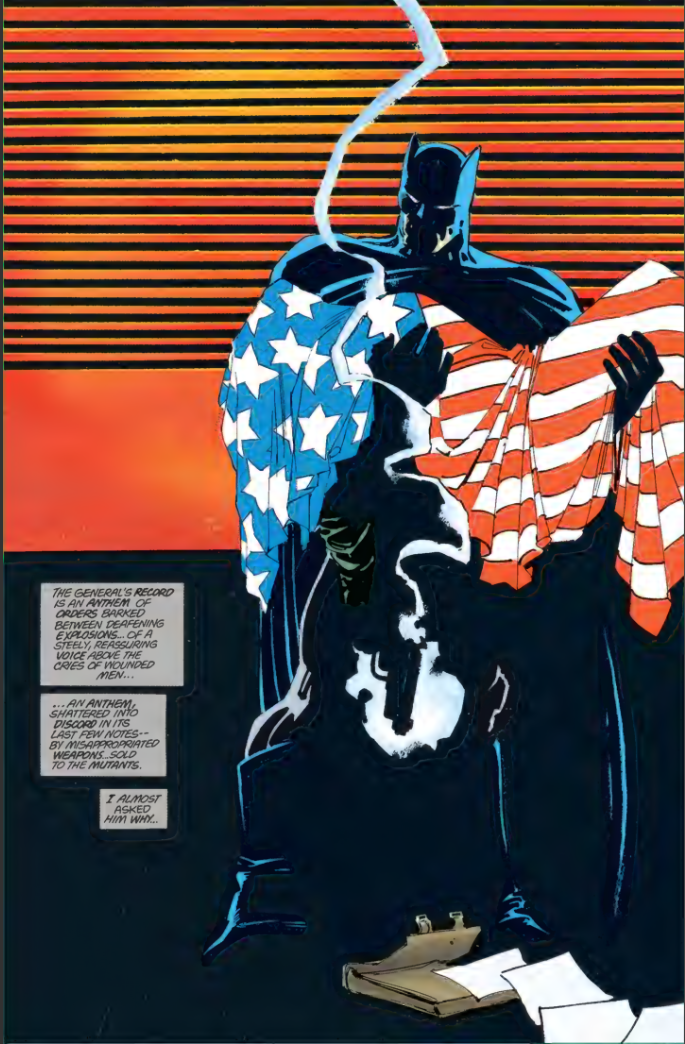
In one of several splash pages meant to evoke Batman’s larger-than-life status and distill the story’s elevated stakes, Batman laments the suicide of a disgraced General who fell prey to temptation and, for personal enrichment, sold weapons to the Mutant gang terrorizing Gotham. Batman cradles the body of the corrupt career serviceman, who is draped in an American flag save for a limp arm holding a smoking gun. On its own, the image speaks volumes to TDKR’s themes of disillusionment, but in the captions is a condemnation. Batman is not mourning the loss of the man, but the ruination of what the man stood for: “[A]n anthem, shattered into discord in its last few notes.”
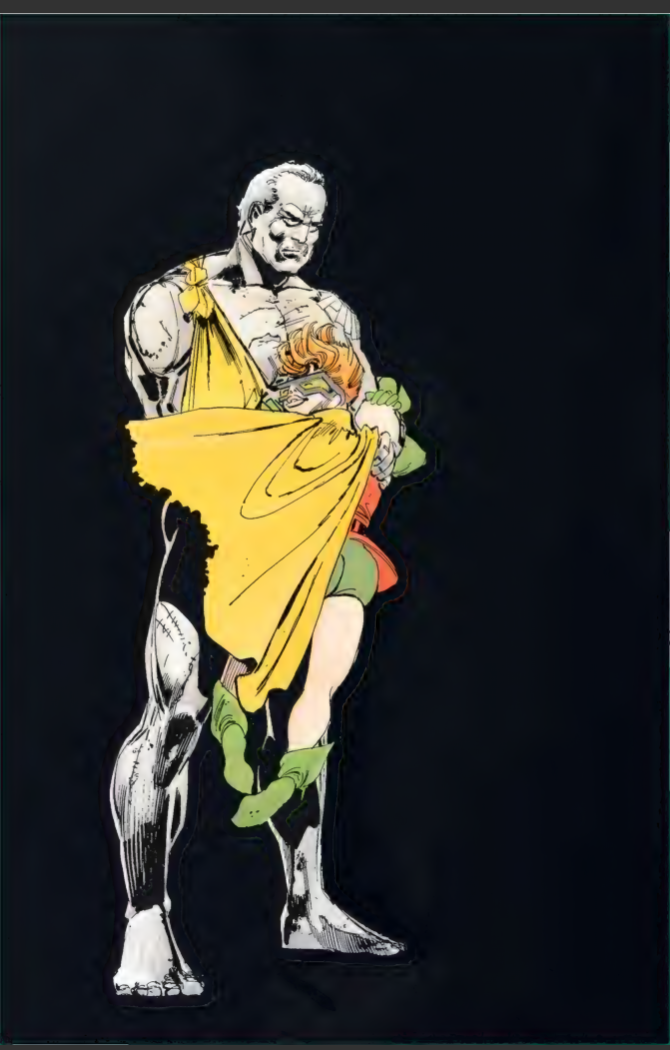
Later in the story, Miller presents a counterpoint to his earlier lamentation. Rather than Batman, Miller depicts his alter-ego, Bruce Wayne. Wayne’s hair is white with age and his body is scarred by battle. He is nude, ashen, except for a sling of bright yellow, which Carrie Kelly, his new Robin, has fashioned from a strip of her cape after his pitched battle with the Mutants’ leader. Carrie Kelly’s small figure is swallowed up by Wayne’s hulking form. Her torn cape faces the reader, displaying the piece of herself that she has given to her new mentor. In her cherubic smile, Miller conveys relief, admiration, and gratitude. Wayne’s countenance, though, is inscrutable, frustratingly opaque. Does it bear paternal pride? The stirrings of an awakened sense of romance? Miller denies the reader any insightful monologue; a nod perhaps to Wayne’s lack of fixity when he isn’t cloaked in the cape and cowl that grants him access to his truest self. But the sparsely composed image of an embattled old man holding (or being held by) a vital teen girl is so distinctive and puzzling that it feels elemental to Miller’s conception of Wayne in TDKR. Whether he is grieving his bygone glory days or hopeful for what the future may bring is not for the reader to know, not for the reader to understand. Miller’s Batman is beyond understanding and above reproach.
The story’s eponymous first installment closes on Batman’s defeat of Harvey Dent, better known as Two-Face. Following a successful facial re- construction and a failed rehabilitation, Dent, newly released from Arkham, lays siege to Gotham’s Twin Towers, threatening their demolition if a ransom isn’t paid. “The price is five million dollars. I would have made it two, but I’ve got bills to pay,” Dent says in one of Miller’s irreverent rebukes of the funny-book silliness that governed prior iterations of the character. Given philanthropist and Batman alter-ego Bruce Wayne’s sponsorship of Dent’s treatment, the resolution is anticlimactic. It’s a moment that marks the end of Wayne’s duality and his abandonment of the liberal notion that he can do world-changing good with his wealth.
Rather than exploring the failure of Wayne’s belief in redemption, Miller instead foregrounds the action and showcases his updated approach to Batman’s timeworn fighting methodology, firmly staking the claim that Batman’s battle is innate, not intellectual. The opposition is external to him, personified in the foes that constitute his rogue’s gallery. Dent’s fate is forgotten almost entirely for the remainder of the story and any exploration of duality is relegated to the conflict between Batman and his best-known, most-hated foe, the Joker. But if this is true, what is to be made of the new generation of enemies? If his intellectual equals are the villains that followed him to this future — Two-Face, the Joker — what does it mean that the Mutant leader, one of the new threats to Gotham — racially coded in his vernacular and physical depiction — is never given a name and is defeated in the muck of sewer runoff? What does it mean that the rest of the Mutant gang are rendered in dress and disposition to be virtually indistinguishable from one another?
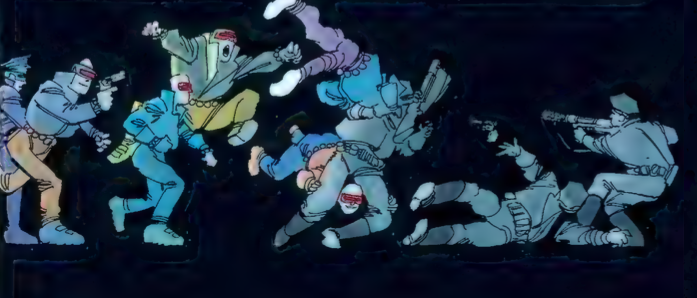
Every character in TDKR exists to be blinded by Batman’s righteousness or reflect his light. That he drags the rest of the world along with him in his quest — projecting onto the world his values — is to the world’s benefit. In this way, Miller’s Batman embodies the purported triumph of reason, logic, and will, over an illogical, hypocritical world. These values form the bedrock of the superhero concept. By today’s measure, the Batman of TDKR is a creature produced entirely by self-conception, closer to John Galt, the objectivist protagonist of Ayn Rand’s Atlas Shrugged, than the stoic John Wayne analog Miller sought to depict.
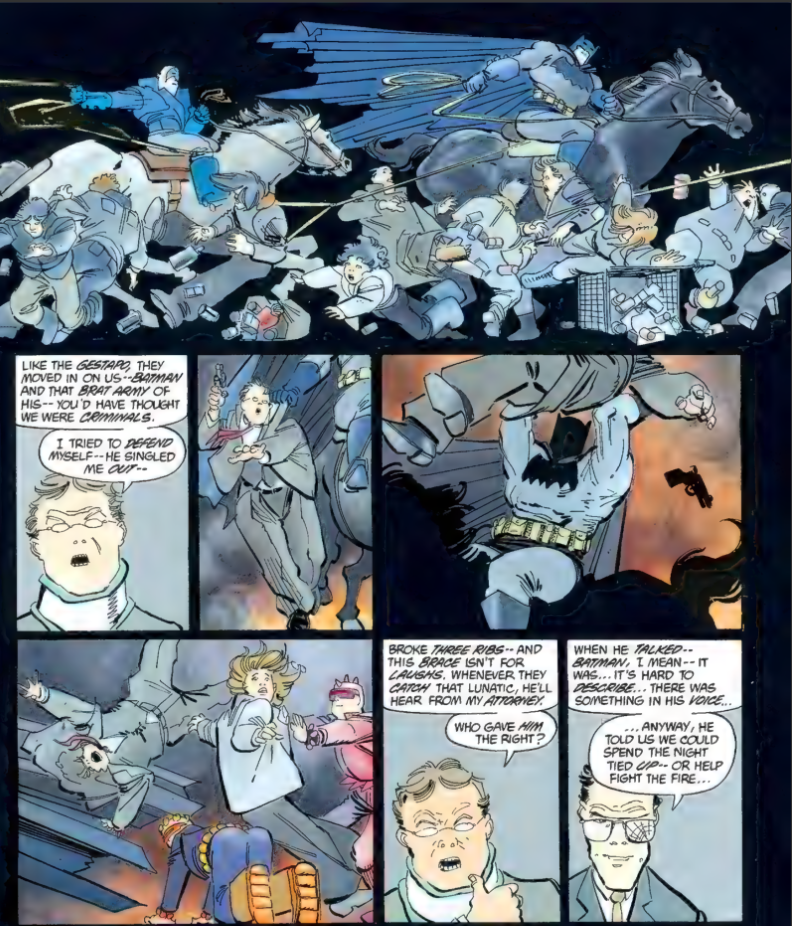
Miller’s subsequent visits to the Dark Knight Universe, as it was dubbed for the third installment, 2015’s The Master Race, have further codified the triumph of Batman’s will, cementing his conception of Batman as a deft social engineer, possessed of a vision, a cunning, and an intellect that elevates him ever closer in stature to the super-powered peers to whom he divulges the harsh and necessary truths that spurn them to their harsh and necessary action. In the writing, Miller’s work has tended increasingly toward maudlin machismo, so reactionary to the nuances and gradations of modern life as to be libidinal, lizard-brained. These qualities were nascent in Daredevil and deployed more assuredly in TDKR — “This is the weapon of the enemy. We do not need it. We will not use it.” — although they found their fullest expression in Sin City, ostensibly the closest iteration of the crime comics Miller came to New York City to write. In these venues, dialogue is rendered as tone poetry that hews to a sing-song binary. Good and Evil. Right and wrong. Miller doesn’t write dumb guys. Miller writes simple guys who are clever and focused to the point of their alienation from the world around them, fully committed to their tasks in body and soul.
Comics were a subculture at the time TDKR was brought to market. Some of the characters were familiar to the wider world, but the concerns and identities of creators were a non-factor almost entirely. And while TDKR’s success may have read as unexpected to outside observers, it was a long time coming. Miller’s effort arrived along with the work of a coterie of generational cohorts too numerous to name in full, but which includes Steve Englehart, Steve Gerber, Bill Mantlo, Marv Wolfman, and, of course, Jim Starlin and Bernie Wrightson, many of whom shared the creative and political concerns of progenitors such as Dennis O’Neil, Archie Goodwin, and Neal Adams, who coached Miller in his early efforts.
Many of these creators entered the industry by way of the big two, but the nascent direct market (and the attendant fandom) gave them a venue for their creator-owned work. That success facilitated hard-won (though meager) profit-sharing schemes. In short, industry developments conspired to reveal to creators their own worth and the salability of their own names in marketing the comics they helped to make. Thus, Howard Chaykin’s authorship was a selling point for his reboot of The Shadow. Likewise, Alan Moore’s writing of Watchmen was instrumental in that title’s marketing, and so on.
But for all the newfound respectability TDKR brought to the medium, the efforts made in its promotion can, in some respects, be read as apologia for the levity and ostensible triviality of the work that preceded it. TDKR, in its attempt to get at the essence of the character, and especially in its success, did much to enshrine the industry’s requirement for constant reinvention. Counterintuitively, it also made explicit that fan response, as measured by sales, was one of the few reliable metrics driving the canonization of novel, creator-imbued aspects of longstanding characters. Although Miller proffered a totalizing vision of the character, the nature of the American comic book industry precludes definitiveness, demanding in its stead fodder to fill the pipeline and keep customers coming back for more.
The distinctive tone of TDKR — along with many of its plot points and characterizations — would eventually serve as a guidepost for Christopher Nolan’s moody film trilogy as well as Zack Snyder’s rough and tumble contributions to the DC cinematic universe. But in the nearer term to TDKR’s publication (and closer to DC’s bottom line), it was proof that Batman’s audience held an appetite for creator-driven riffing upon the various tropes, traditions, and affectations associated with the character. The Killing Joke, Alan Moore’s tremendously popular one-shot, initially published in March of 1988, was a beneficiary of this tonal permissiveness, as were the long-running anthology series Legends of the Dark Knight, the non-canon Elseworlds line, and all the “bold reimaginings” subsequent to TDKR, whether on page, screen, or game console. These iterations of the Batman concept were not nearly as impactful as Miller’s, primarily because they did not seek to elevate the material as much as they sought to emulate either TDKR’s success or its tonal novelty. They were crowd pleasers, though, and checked important editorial boxes in an industry that was heating up quickly. Namely, they were manageable, achievable, and could be farmed out for asynchronous production.
The Cult arrived at a time when a repeat of TDKR’s massive success seemed possible to DC’s editors and managers, but they had not yet worked out the narrative formula, nor the kinks in marketing and production. Though they, too, attempted to replicate TDKR’s success, Starlin, Wrightson, and Wray’s The Cult also reads as a response to Miller’s zeitgeist-y approach. If Miller sought to legitimize the medium to an unfamiliar public by elevating the presentation, The Cult made the case in its more conventional execution that comics, for all their sensational bombast, were just fine the way they were.
The post Excerpt: <i>Unbound in the Square</i>: “Hunt the Dark Knight” appeared first on The Comics Journal.


 Hello, my name is Jack Sparrow. I'm a 50 year old self-employed Pirate from the Caribbean.
No comments:
Post a Comment