

So how about Dave Chisholm? What’s he up to, anyway?
I went back to check to see if anyone else on the site had written about Dave Chisholm. Turns out someone did, in fact, provide a write-up of the first issue of Chisholm’s sci-fi series Canopus, in April of 2020. And. who wrote about that first issue of Canopus? Well, as it turns out, it was me.
Dear reader, I promise you: I do not remember writing that review, and yet surely I did. That’s what five years does to a body. Especially these five years, I think you’ll all agree. What a time to be alive.
And yet, somehow, in the midst of the chaos of our times, Dave Chisholm managed to carve himself a nice little career. In 2020 I rather liked what he could do. It was a slight work, as I recall, purposefully a bit spartan. In hindsight, Canopus was a story created by someone teaching themselves how to make a larger narrative, and wisely starting with a formal challenge: draw a lonely astronaut walking around a barren planet. An artistic challenge to exercise the fundamentals along a more straitened axis.
Things have become less straitened for Chisholm - on the contrary. He’s become quite ambitious. The proof sits before us in the form of a recently compiled six issue limited series from Mad Cave Studios, one of the newer publishers sprouted to prominence in the scrum of the last decade. Primarily a creature of the Direct Market, a small outfit grown capable of interesting things. It’s an argument for the Direct Market, being able to support a small ecosystem of interesting work that exists primarily because the outlet could amortize costs for producing a halfway decent comic book story. There’s still a demand for those, apparently, or at least enough to grow a book like Spectrum.
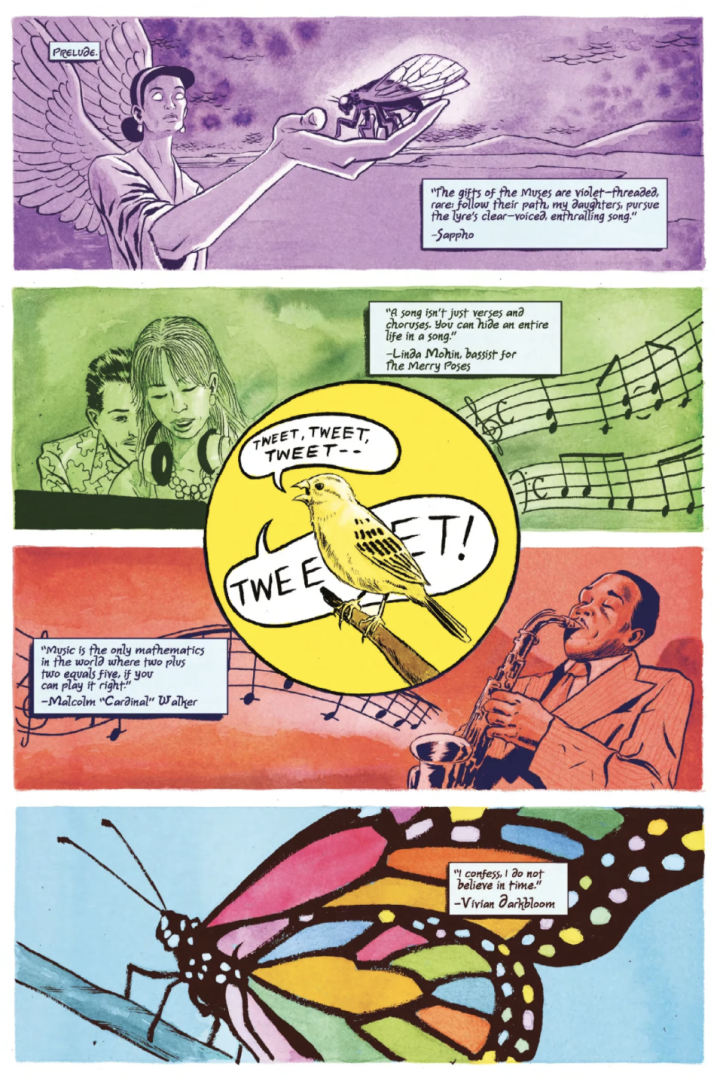
There are two names above the fold here, Rick Quinn and Dave Chisholm. There are also three names listed for the production side, James B. Emmett as Editor, David Reyes as Graphic Designer, and Camilo Sánchez on Production. This is a gorgeous book, from start to finish, we’re putting that on the table up-front. A book like this doesn’t exist in this confident form without a supporting crew to shepherd the process. The Graphic Designer is doing a lot of work here, they deserve their laurels. This is an impressive visual achievement, and that doesn’t just pop into being without a crew of professionals behind the scenes.
Of the two names above the fold, Rick Quinn is the one I’m unfamiliar with. Someone who built a career using Kickstarter to distribute, a sign of the times that nonetheless points to the two distribution systems bolstering one another. I don’t see most work published on Kickstarter because I’ve been against using the platform as widespread distribution for years, thought it was going to bite us on the ass. I own that: clearly the battle has been lost on so many levels. It’s just part of the landscape now, at least until we’re all washing dishes for a living.
It’s all proof of the fact that there’s a lot of stuff happening in comics that isn’t necessarily evident from any kind of global view. The Direct Market still seems to linger as the backbone for a lot of it, despite being a shambling half-dead thing. It’s been that way for the entirety of my adult life, and I am much older now than I was when that was first true.
I appreciate the effort taken to make Spectrum a rewarding experience in periodical. The pamphlets look interesting in your hands: colorful, well designed, ambitious. The kind of series that knows how to use a Graphic Designer to good effect. Likely anyone feeling compelled to track it down after reading this will almost certainly encounter the work in collection, that’s life. The book still looks great, but they put the effort into the floppies, it must be noted.
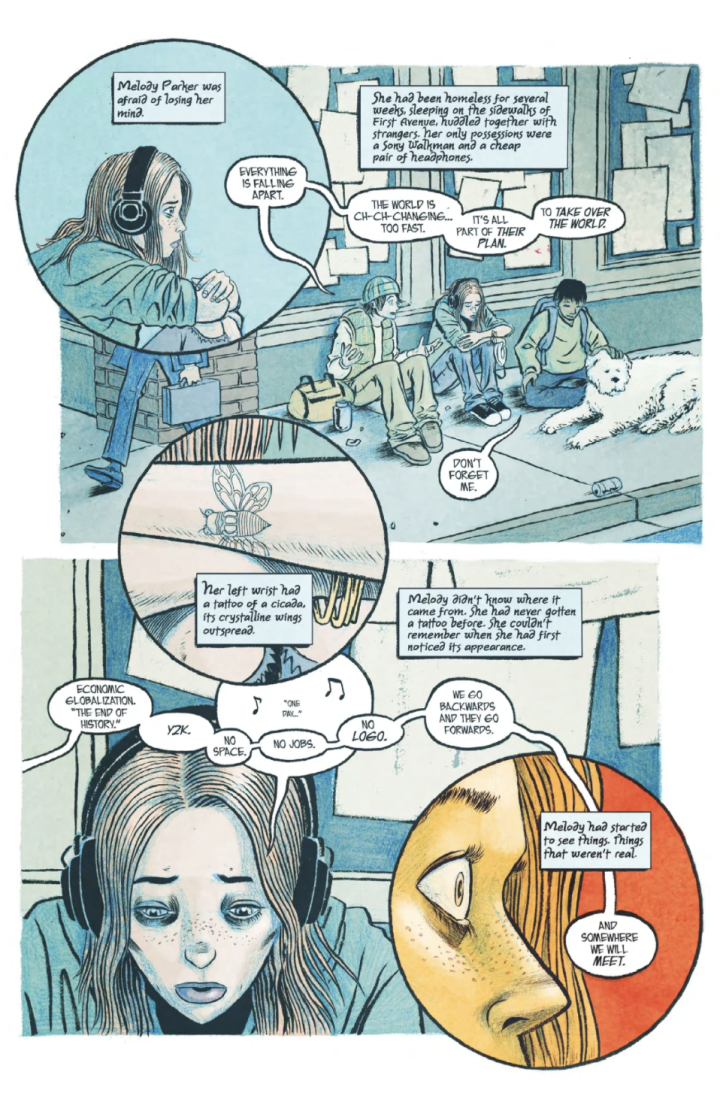
In any event, it’s Chisholm who comes off as the dominant voice, simply because he’s drawing every page. A labor-intensive effort. He built up to it, alongside and after the intentionally spartan exercise of Canopus, with a series of ambitious jazz-oriented projects - 2020’s Chasin’ the Bird (with Peter Markowski), 2022’s Enter the Blue, and 2023’s Miles Davis and the Search for Sound. All three original graphic novels produced for Z2, a strange presence in comics inasmuch as that while narrowly focused on music-related titles, they nevertheless publish an impressively wide range of material under that remit. Check out the contributor list for their illustrated “Weird Al” anthology. I’m not going to tell you who’s in it. Just go look. Trust me. Surprise yourself. They put out a Bobby Digital comic book! Do you know how much I would have loved a Bobby Digital comic in 1998? Even if it were terrible? Especially if it were terrible?
So, yes, another side story in comics. Z2 put out three graphics novels about jazz in the space of three years by a talented man with a great deal of discipline. Because - lest you think, oh, ok, this Dave Chisholm guy, he’s a workaholic. I get it . . .
Oh, friend, my friend - I adjure you, hear me. I didn’t know any of this in 2020, when I tread Canopus. But I know it now: he already has a Doctorate, in Jazz trumpet, from Eastman. He teaches, as in, he teaches music. And comics too. I believe he even has a child. Can you believe that? He’s got a toddler. He drew this comic with an infant in the house.
Dave Chisholm got into comics as a second career because he needed a challenge. How do we sit with that, fam? Huh. What a world.
Dave Chisholm starts strong at the end of the last decade and increases in both capability and capacity in short order following a sequence of of concentrated tasks. Clearly he feels a strong connection to music. He has apparent discipline from having already mastered a high-level artistic task in a completely different field. He knows how to draw better today than he did in 2020, by a large margin. You can tell he sits down every day and puts in the work. You can see the strength of his grip on the colored pencil. Confident work.
Chisholm got my attention a second time, after having promptly forgotten his name, on TikTok, a platform I attempted to use for a couple years before cutting my losses. A dreadful instantiation. Chisholm used the platform well, I thought, in a time when I struggled to find comics material that held my interest. He promotes himself well, which is a big part of the challenge. He’s an educator and that appears to color everything he does to some respect.
There’s so much effort on display, and so much talent, that you almost forgive the story. It’s not even a bad story, mind, it’s just - you know. It’s a story about how much the two primary creators love music. It’s about the history of twentieth century music in a way that makes it sound like a magnetically inviting place, from the blues and jazz through Radiohead and Fiona Apple. It’s just a big ol’ love letter to the power of rock & roll, fam.
Ah, yes, yes. Well, you know. We’ve all been there. You’ll get through it.
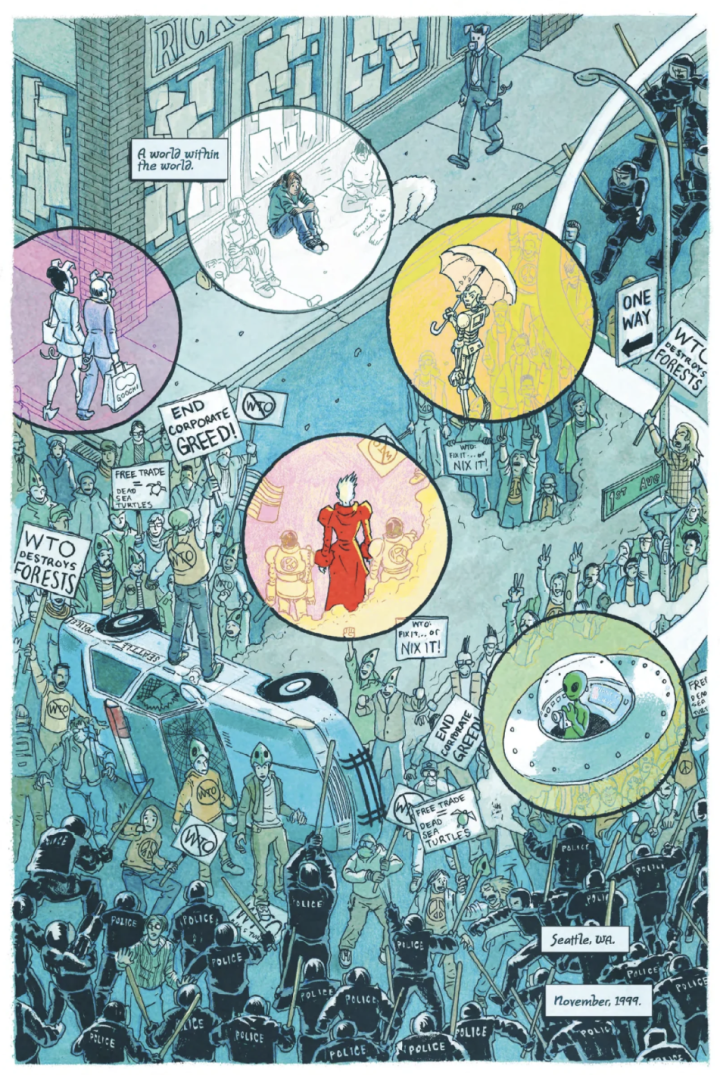
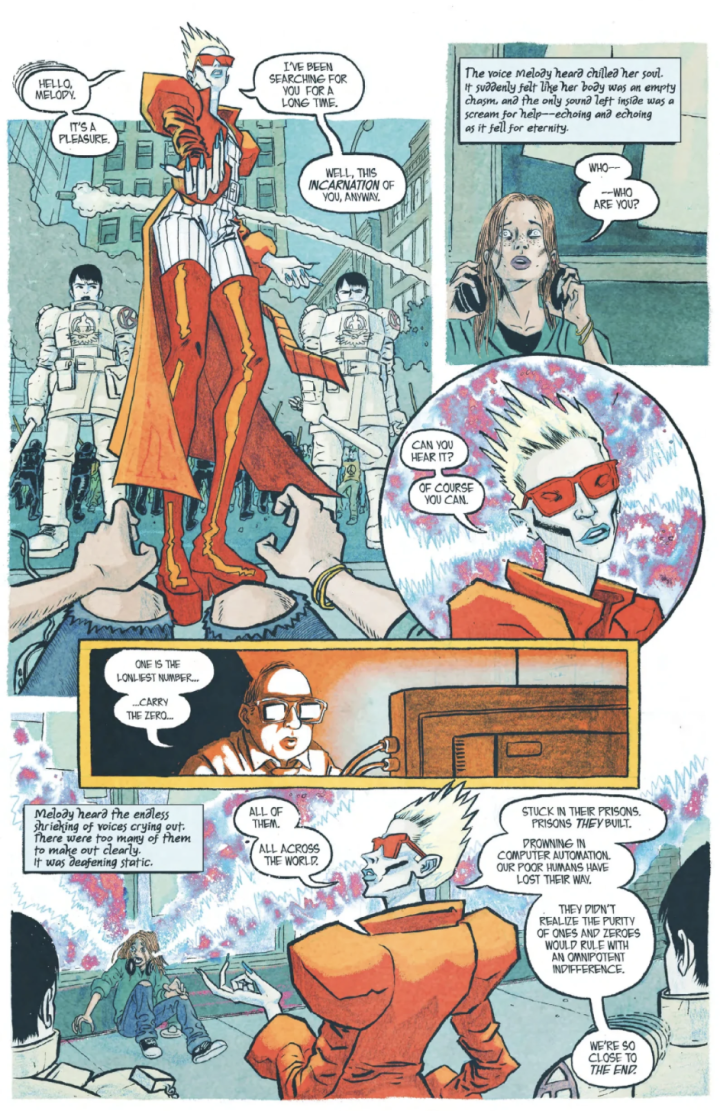
Is it pitched maybe for a younger readership? Feels that way. So I can only be so mean to a comic that, unambiguously, is going to hit with any kids who can find it and appreciate the jumbled music history lesson. It’s filled with young characters searching for missing parent figures and running from an anomalous multiversal menace, some kind of invincible square against which only our band of cosmic misfits might prevail. It’s based on the recorded pop culture of the twentieth century (with a bit of a spillover), which remains relevant in many circles. Posits the premiere of Kid A as being the last act of the twentieth century, which, sure. People hyperventilated about it at the time. Children, we didn’t know what trouble was.
The funny thing is that people do still listen to music. Kids today listen to a lot of different shit, because it’s all right there in a little box in their hands. Not every kid, certainly, but enough. “Enough” adds up to a lot when the barrier to entry for, say, Radiohead or Fiona Apple of Miles Davis or Charlie Parker is searching on your phone. Not everything about the future is unremittingly terrible. Vertigo was built on British creators talking about bands their vast majority of their American readers had never heard of, didn’t hurt them any, so there’s ample historic precedent there.
Like many comics, and much of pop culture at large, Spectrum bears the scars of a youthful obeisance to Grant Morrison. There’s been a lot of water under the bridge these last thirty five years, but those first two major works especially - Doom Patrol and The Invisibles - well, those stuck around. Hell, even I wrote about their Doom Patrol (part one, part two), a few years back. My problem with Morrison is that I dropped Invisibles two months in and I didn’t finish it until I was literally in my thirties, out of embarrassment. That’s not the ideal audience for the work, no. So I lost that elemental connection with them that a lot of other people have. Honestly, folks: Invisibles didn’t make a whole lot of sense to me. Maybe I’d like it better the second time through.
But it clearly hit, outside and away from my wariness, and with a lot of people. And especially with people who’d already bonded with Doom Patrol. Is there an older gentleman in a suit conducting the whole rescue project in Spectrum, from a mixing board? I mean, yes. There we are. Influence on our sleeve. It’s how Gerard Way gets by, after all - they never hid their debt to Morrison, because that would have been impossible. We’d have laughed and had a jolly time. Likewise, Spectrum is a book that structurally, thematically, and stylistically could not exist without the immediate precedent of what Morrison did for DC comics across the 90s.
In fairness to Quinn & Chisholm, that’s actually a fine artistic challenge. Getting at the pith of those stories, a visually distinct and artistically demanding milieu - no small thing. Chisholm’s art practice appears committed to some form of challenge, and I can’t gainsay that. He’s coming from a place of genuine enthusiasm, which is the most important ingredient. Does that sound cornball? Well, it’s true.
Let’s pop open the second chapter for a microcosm, so you can see the blessing and the curse of the series at once. The issue focuses on Ada Latimer, one of our central heroes, sucked into a maelstrom of magic doings through a family connection. Her father, mostly absent through her life, left behind a storage unit full of old records - a veritable archive of twentieth century music, scavenged over a long life by a musically polyglot professional bassist. She gets even with pops by taking the records and starting a record store.
The issue begins with a visit to the record store, and a set piece with a dove loose in the store. After a page of the dove running rampant -it’s an excellent, ambitious layout featuring real people in action, chasing the bird out of the shop. Only, when they bird escapes, Ada sees: it was just a paper bag.
Ooooh, a certain percentage of you just pricked up your ears at that. Then Ada goes for a walk down the street with her boyfriend and they pass the cover of Eliot Smith’s Figure 8, placing them within a very specific radius of Los Angeles. I’ve been there, and maybe you have too. It’s that kind of story, filled with - scratch that. It’s would be more accurate to say the story is constructed from these kind of references, built on two lifetimes’ love of pop music across many genres.
Only, I should probably also say, this is the kind of story where Fiona Apple is called Maggie Orange. The whole system is interpolated along those lines. Radiohead is Papa Legba, no more a deep cut reference than Maggie Orange, but about as grating in high dosage. There’s a lot of it, after all, with so many important artist shifted by gender or race, important familiar touchstones like Television or Jeff Buckley twisted just slightly to fit into the series’ fictionalized vision of the last century.
It makes me wince, because there’s a part of my brain that wants to track down every reference, to see what’s being pulled. Because I see enough to know there’s even more I don’t know because I’m not as conversant on the life stories of certain artists. If I think the guy sings like a cat, I’m going to move on with my life. Anyway. This is a rat’s nest of music history, shifted and reflected just enough as to allow for fictionalization. And the reason for that is practical, freeing the comic to use musicians as characters in the unfolding action, and to quoting from their oeuvres.
What’s that, you say? My last posted review was of a Jason book about David Bowie flying a spaceship? Well, you know. Different kinds of books do different kinds of things. Jason didn’t have Bowie singing the words to “Starman” on panel, either. And Quinn & Chisholm use lyrics here.
It’s a serious accomplishment for both primaries, which looks on the face of it like a back-breaking amount of work. There are gratifying setpieces throughout. Chisholm pushes himself, artistically, and that’s an excellent thing to see. We’re so used to, you know, the opposite. Seeing someone who gets up early in the morning so he can become a better artist? Not such a bad thing.
With that in mind, it must also be said: you’re a smart guy, Chisholm. This? For you, this is table stakes. If you want to draw this well? You can do better, now that you’ve got the Morrison pastiche out of your system. You don’t want to end up like poor Gerard Way, do you? A cautionary tale if ever there was.
This isn’t the first time anyone has tried to rewrite the Invisibles and it won’t be the last. If that sounds reductive, well, Spectrum is an ambitious work, from ambitious men. The story succeeds in what it sets out to do, which tells me they still have room to grow. My recommendation, at least to Chisholm: keep working with different writers. Hell, you’re fast enough, do some work for hire. Keep learning new ways to draw the comic. Because you’re already good at what you do. But that you’ve gotten so much better so quickly tells me that you can go much further still, should you decide to push yourself.
So, yes: Spectrum. Rick Quinn and Dave Chisholm. Give it a flip-through if you see it in the store. Pass it down to a precocious niece. Like I say, this Chisholm guy. He knows how to draw.
The post Spectrum appeared first on The Comics Journal.


 Hello, my name is Jack Sparrow. I'm a 50 year old self-employed Pirate from the Caribbean.
No comments:
Post a Comment