

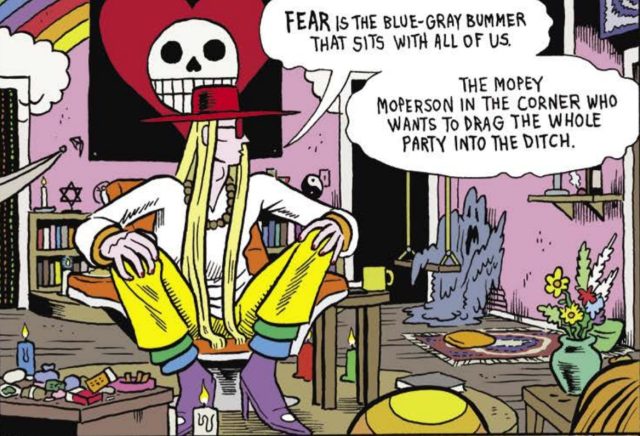
“Here in the rainbow temple, we work to eliminate as much brown-gray as possible. We want hyper, vibrating pinks and yellows and acid greens and sexy purples. We want fun and sunshine and glory. Lazing about and heroin nights and so much more. God, how good it’s gotten in this world, how easy to sink into pleasure and fantasy. You need hardly come up for air. I enjoy fucking people in their mouths, pussies and assholes. I enjoy getting fucked in my mouth and asshole. The world is full of whimsy and wonder, friends.”
So says cult-leader Cali shortly before leading a band of acolytes on a homicidal home invasion in Annihilator: Rainbow of Death #1, a comic from writer-artist Josh Simmons.

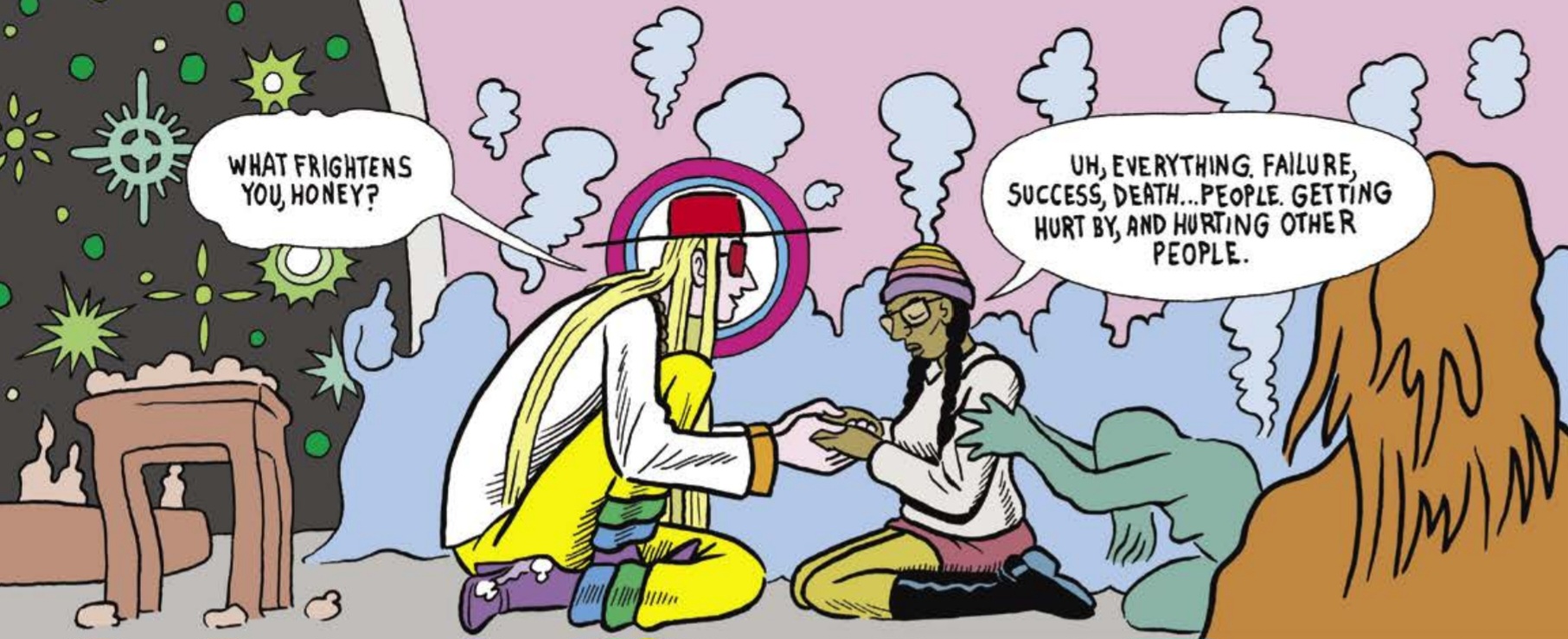
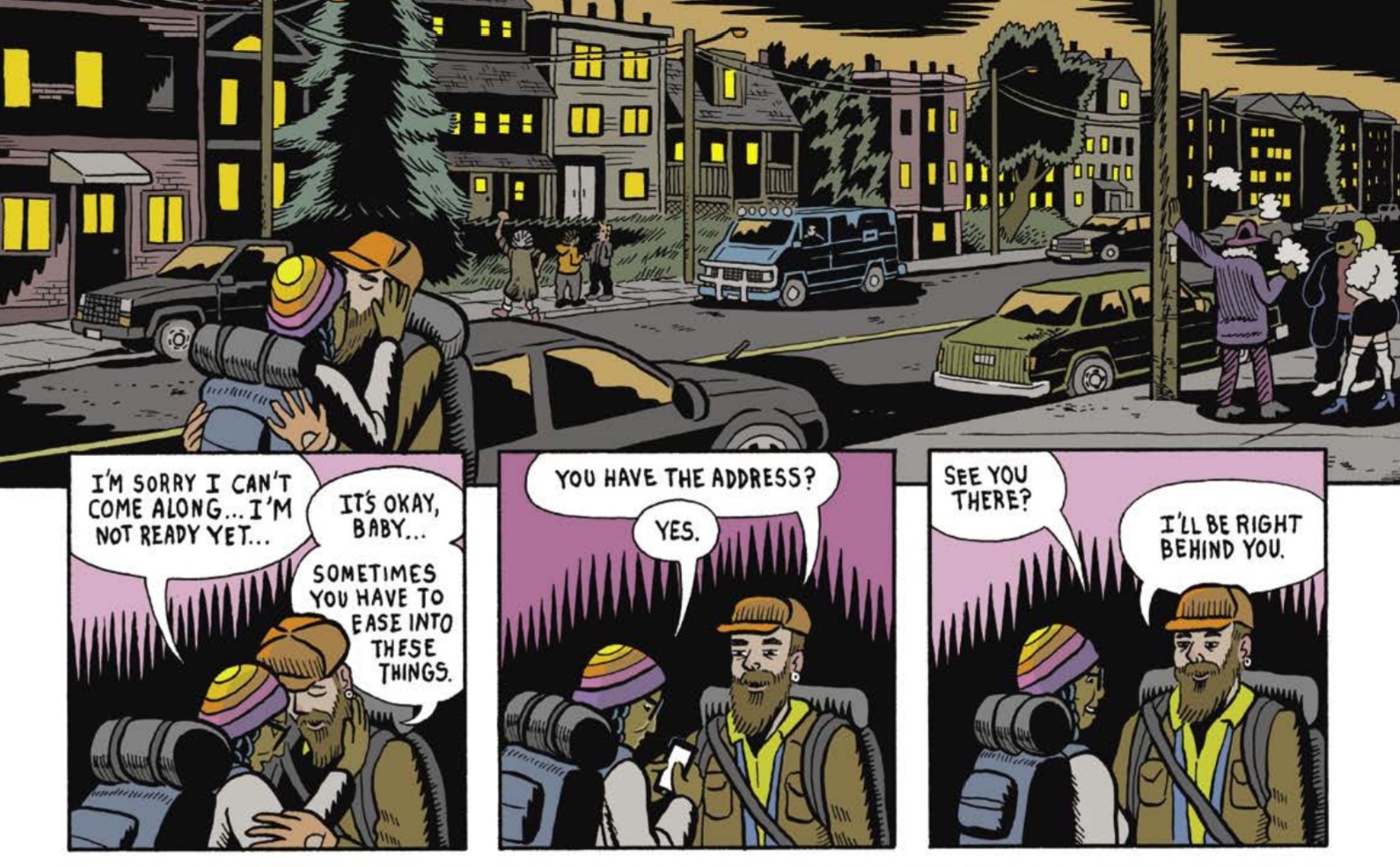
The cliche has it that the murders committed by the Manson Family at the end of the sixties marked the death of the flower child dream. In Annihilator, though, the bloodlust and fanaticism of Manson is the beating heart of the counterculture. We follow backpacker Honey as she traipses through a grim, grey urban milieu and arrives at a dilapidated Gothic mansion, where she glimpses the bright, colourful flowers of a hippy van poking out from beneath a drab covering. Inside, the cracked walls and bare floorboards of the mansion have been daubed in rainbow paint. Gathered in the central room is a vibrant band of free spirits, carving out their realm of brightness and rainbows beneath the bleak overworld.
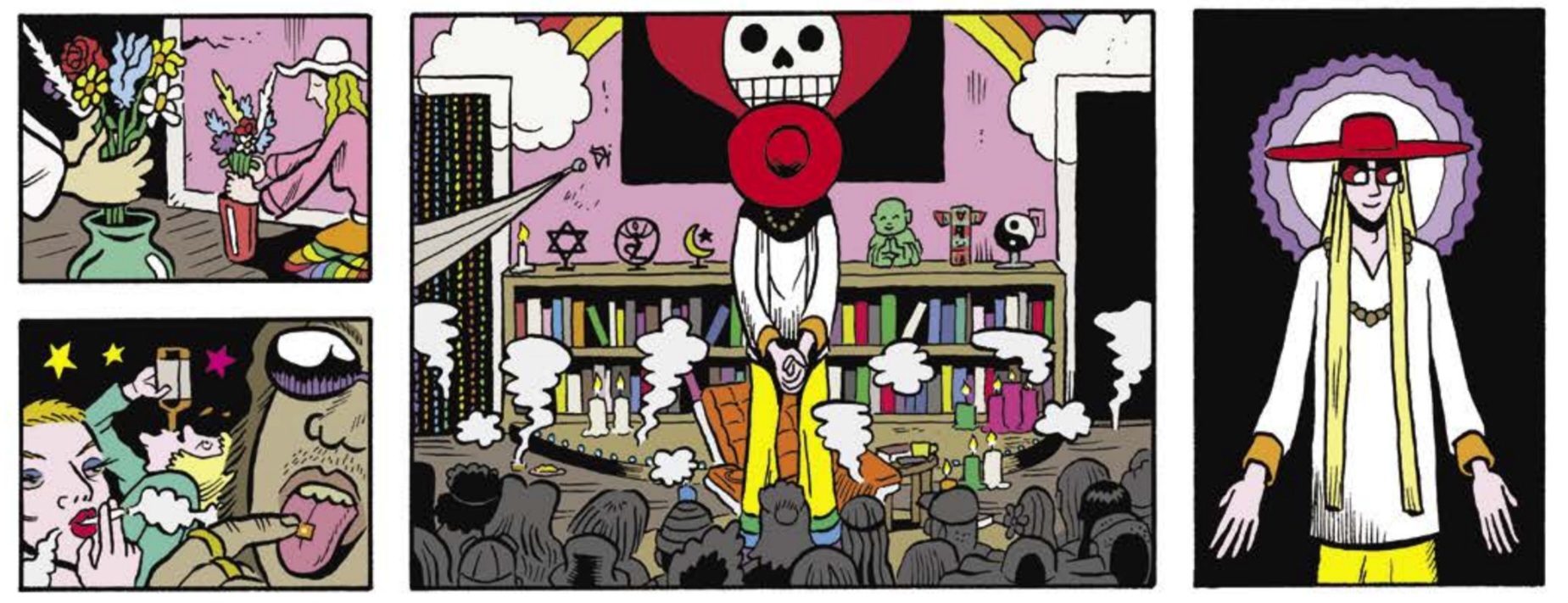
To be accepted, Honey must provide three tokens. One, drugs. Two, flowers. The third is presently being obtained by her boyfriend, and it involves murder.
All of this may seem esoteric fare for what is, ostensibly, a parody of Punisher comics. But the first issue of Annihilator shows no urge to dwell on its nominal antihero, who receives a fast-forwarded introduction before we meet Honey and Cali. In the space of three pages, we see the gun-toting vigilante as he goes Itchy and Scratchy on gangster ass; provides grim-and-gritty narration over a crime-ridden landscape; and describes his own over-the-top origin story (the Punisher had his wife and kids killed by gangsters; the Annihilator has his entire extended family, down to the third cousins, wiped out by America-hating terrorists). Only in the last three pages does the Annihilator return, the bulk of his comic being spent with the homicide-hippies.
Annihilator is playfully ironic in how it mashes together its component parts, with a parody of the Punisher – a character who debuted in 1974 and came of age during the era of eighties-nineties action movies – pitted against foes still living in the sixties. When the Annihilator narrates his personal history, he admits that he can no longer remember which war (or wars, even) he fought in, reflecting how the Punisher’s backstory has shifted from Vietnam to Iraq to the fictional “Siancong” over the years. He is able to follow the doings of Cali’s cult by following a trail of clues on the dark web, as though the late sixties and the twenty-first century are occurring simultaneously. But then, this is little different from the anachronisms that naturally occur when a never-aging superhero character is allowed to carry on decade after decade.
The references to the dark web are not the only times where our present epoch can be glimpsed within Josh Simmons’s throwback-fest. Consider the character of Cali, who, despite leading the Manson-like cult, looks absolutely nothing like the bushy-bearded, alpha-male Charles Manson. Instead, we are confronted with an androgynous figure: long, blonde hair; red lips; nail polish; high heels; and, in one sequence, a bulging, oversized erection. At no point in the issue is Cali referred to by a gendered pronoun. In short, Cali looks like nothing so much as a they/them, one of those bogeypersons of the contemporary right, notorious enough to have become slogan-fodder in pro-Trump campaign propaganda. The sixties were a decade in which the Beatles’ mop-tops were seen as pushing gender boundaries; Cali, though, is a character who would fit in with the Zizians of the 2020s at least as much as the Manson Family.
 But this is not to say that the narrative, even under its layers of irony, fits into any sort of straightforward MAGA-vs-woke parable. Tamerlane, Cali’s Lennon-esque harbinger, wears jewelry showing a set of five symbols: a pentagram; a crucifix; a peace sign; a yin-and-yang; and a swastika, the last of which is easy to miss on a first read-through yet still visible in multiple panels. At the very end of the comic, presented like a pin-up page, is an illustration of a partly-nude Honey (an olive-skinned, ethnically-ambiguous character) lying on a rug surrounded by assorted artifacts of the hippy cult, which include framed portraits of Jesus and Hitler. All this is entirely true to the spirit of the swastika-tattooed Charles Manson, whose ideology blended Messianic fantasies with racial paranoia.
Simmons’s artistic style is an appropriate fit for such an out-of-time comic. Resolutely hand-drawn, it has its roots deep in the underground comic tradition; we can readily imagine the same sort of material being read, or even drawn, by Cali’s cult members. The backgrounds are crafted with care, grimy streets and Gothic suburbias sprawling across the cartoon landscapes. The figures are drawn in a deliberately naive manner, looking flat on the outside but containing plenty of life inside – that is, until one of the homicidal characters decides to hack them up and let everything spill out.
The opening action scene comprises six panels of free-flowing blood. A man is shot in the face, causing worm-like strands of brain to fly from a gaping exit wound; three people spray blood as they are machine-gunned; two more have their throats slit, while a pair of nude corpses dangle from hooks in the background; still another gangster has his face stamped on and his crotch shot to bits simultaneously; finally, the page itself breaks apart with a “KRAK!” as the Annihilator punishes the fourth wall.
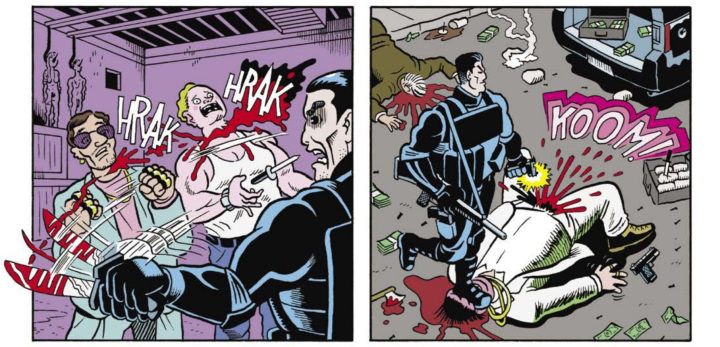 Yet Annihilator is far from the visceral cartoon gorefest promised by this first salvo. Indeed, at the heart of the issue is a lengthy lecture. A lecture rooted in beat poetry, as befits one given by Cali and Tamerlane; and an illustrated lecture, as befits one drawn by Josh Simmons.
“We live large off the swollen underbelly of the fabulous beast: America”, says Cali, and provides a visual aid by drinking the blood from the swollen body of a partly-glimpsed red-white-blue beast. “Like great emperor tick-kings. Ticks get such a bad rap, but what else is there in this world but blood, of one kind or another, to consume… the blood of knowledge, the blood of life.”
Elsewhere, stoned onlookers see Tamerlane anally penetrating a spectral Grim Reaper. “You gotta fuck Death in the ass, man,” he says. “Nothing freaks a person out more than the weird shit-hole between their lower cheeks and the fact that they’re going to die. You thumb your nose at death every time you fuck a loved one in the ass. The most fully one can embrace life is to enjoy the anus.” The dialogue here seems to be derived from a notorious line in Andy Warhol’s Frankenstein: “To know death, Otto, you have to fuck life in the gallbladder.” One more chemical for the pop-cultural bong.
All of this is just the first of a projected three-issue miniseries. A typical Punisher run could only dream of a debut as provocative as Annihilator: Rainbow of Death.
The post Annihilator: Rainbow of Death #1 appeared first on The Comics Journal.


 Hello, my name is Jack Sparrow. I'm a 50 year old self-employed Pirate from the Caribbean.
No comments:
Post a Comment