

Grant Morrison has been extensively interviewed over the years, often through the spectacle of their most visible works like All-Star Superman, Batman, JLA, and New X-Men. They are perhaps most widely known for their magically infused optimism, yet, despite their unceasing belief in the best of humanity, they have never shied away from examining our darker natures. What follows is an inquiry into how a libertine urge for transcendence looks when confronted with the gravity of aging, entropy, and disgust.
This conversation centers on The Invisibles (1994-2000) and The Filth (2002-2003), which I read as a deliberately paired set. The former is an expansive, ecstatic, and future-facing epic, while the latter is a compressed and claustrophobic tale orientated toward breakdown and idiocy. The Invisibles is Morrison’s most explicit articulation of his magical and political worldview, but The Filth revisits many of the same concerns from another emotional and bodily register. Together, the two graphic novels suggest a more complete exploration of the human psyche, as the inevitable comedown after revelation and a test of whether belief systems designed to liberate can survive proximity to the abject. These two projects explore magical practice, narrative medicine, authorship, and the limits of optimism as a sustaining philosophy. The conversation is an examination, not a decoding, of Morrison’s belief system and how it functions under historical, biological, and personal pressures.
GABRIEL KENNEDY: The Invisibles is an iconic comic book. It was like an Illuminatus! Trilogy (Robert Anton Wilson and Robert Shea’s mind-bending novel) for the turn of the millennium. Another comic of yours that I really enjoy was The Filth, can we talk about that series?
GRANT MORRISON: If The Invisibles was my Illuminatus! then The Filth was my Masks of the Illuminati. It’s a shorter piece but it’s really dense. It takes the themes explored in The Invisibles but goes into them in a different way. I love The Filth. It’s the favorite thing I’ve ever done with the artist Chris Weston. It just hit on every level. It came after The Invisibles, which dealt with the ‘90s and was this big explosive optimistic futuristic progressive story. It was aimed at teenagers and is something to get you vibed up when you're young. I was lucky enough because I hit forty and I was having a great time because I’d just met Kristine (Grant’s wife). We were running about having a mad time around the world. It was all very fun, which meant that I could go to the dark places without any fear. That’s what The Filth was. I thought that I go could into all the things that are terrifying, things like aging and sickness and death. Losing your animal. Losing your friends. The plan was to turn it all into fun, to make a joke out of it, but it would be a joke that I hoped would be therapeutic. The idea was to take all the shit of the world and turn it into an inoculation. That was the idea. If I could take all this horrible stuff and turn it into the sugar that makes the medicine go down, give people a hit of all this terrible stuff of the 21st century: the porn addiction, the violence, the cruelty, the stupidity, and put it in this one story as a hit or a shot, then I did it. That was the notion. So that I could inoculate my readers against the 21st century. I still advise readers to go read The Filth if you want to be inoculated against the 21st century. I love it because it goes to dark places, but it finds beauty the darker it goes. I also loved it because I was on the journey myself. It’s just getting deeper and deeper and you're standing there with the shit on your hands and what do you do with it? Spread it on your flowers.
From reading the two different series back-to-back, it feels like The Invisibles is the ecstatic high and The Filth is the morning after.
Yeah, it’s the come down after the MDMA. The Filth is quite funny, and I did that deliberately. It’s super surreal. There’s even a giant sperm in it. It was deliberately designed to be one like one of those old Irwin Alen shows, Voyage to the Bottom of the Sea or Lost in Space, where every week there’s a new monster. But the monsters in this were really just personifications of everything I saw going wrong in culture at the start of the 21st century. A lot has been born out of the deleterious effects of porn and the online world, which we’re now seeing in younger kids who’ve been quite bizarrely effected by all that and are quite weird because of it.
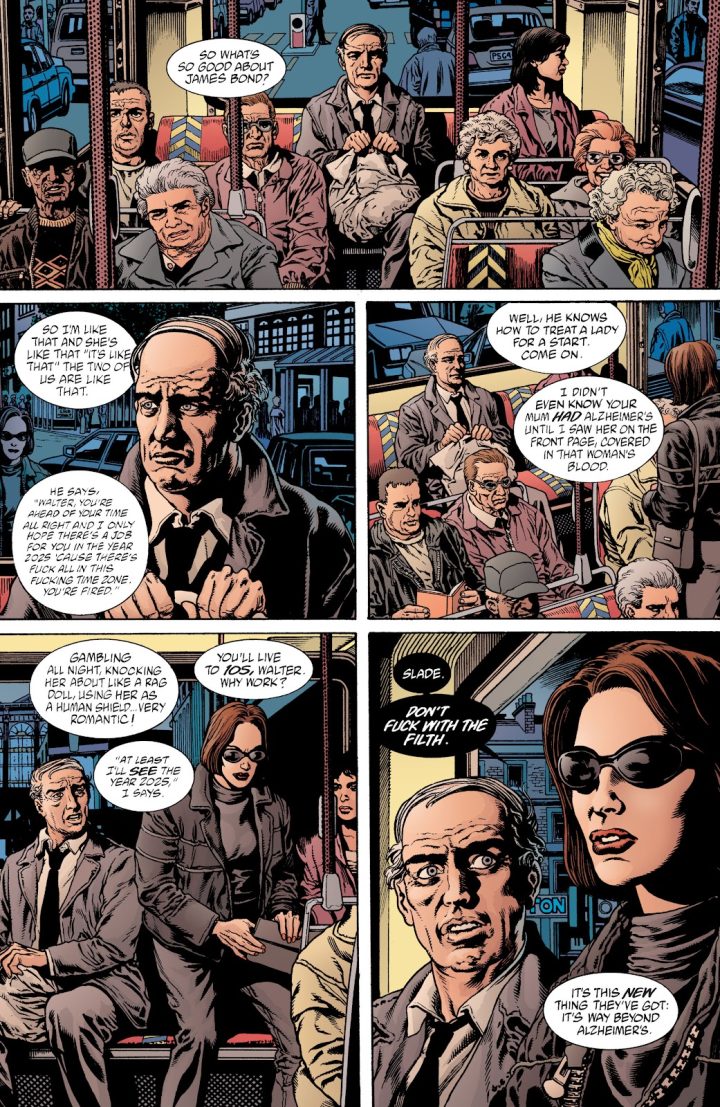
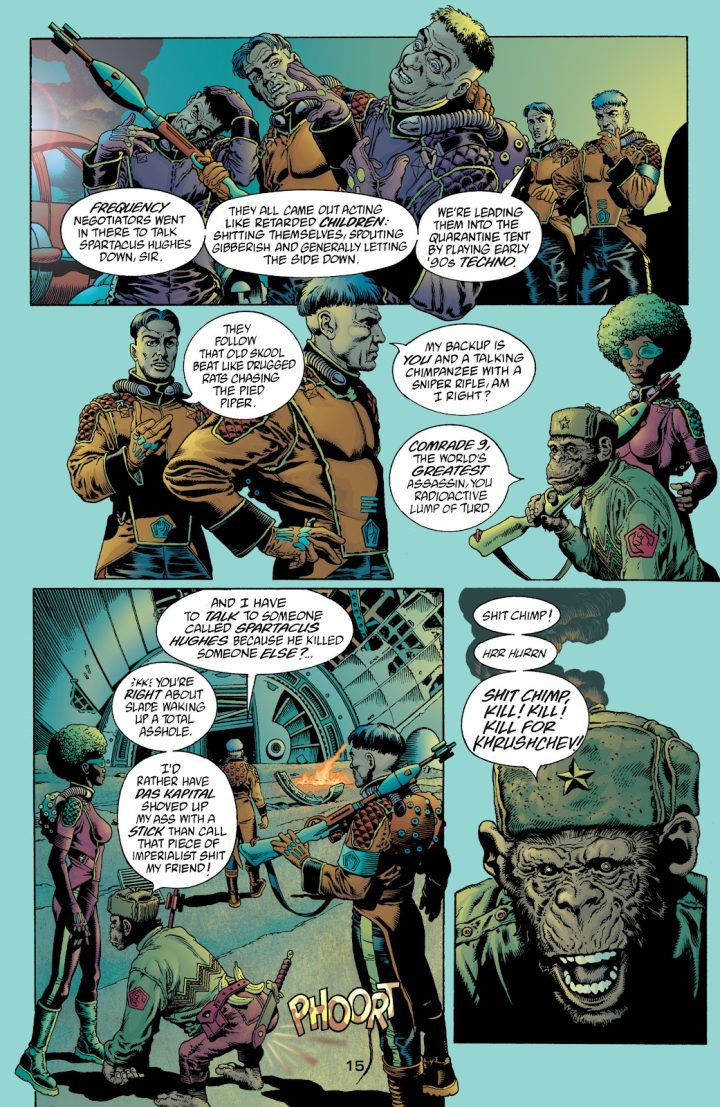
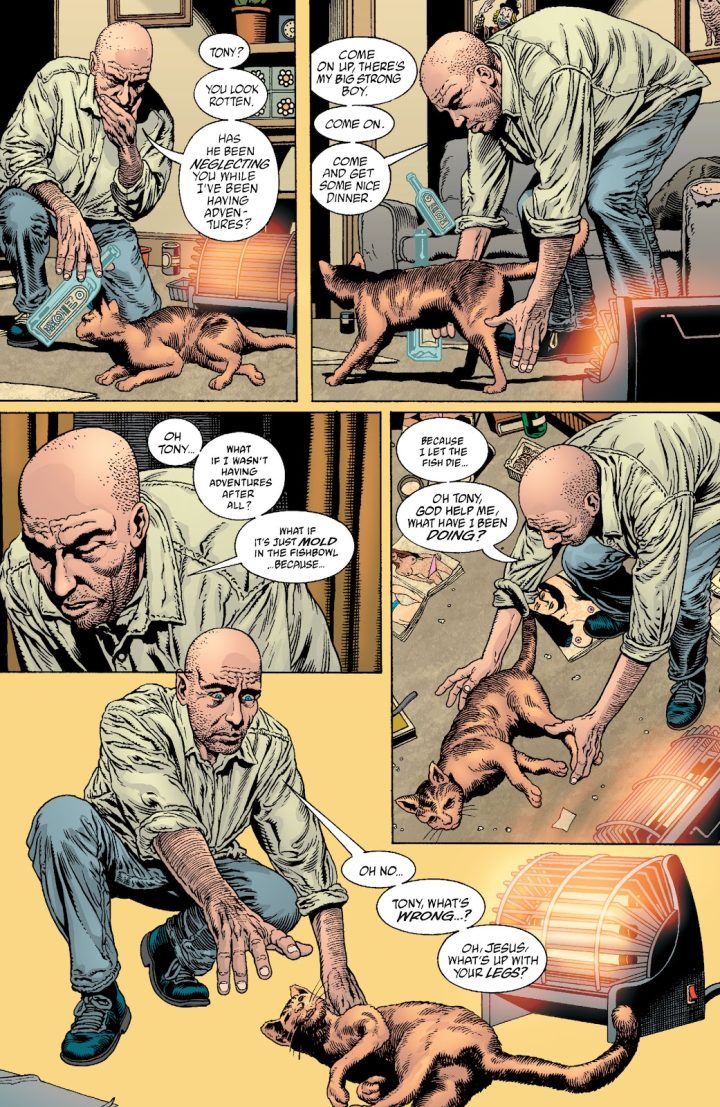
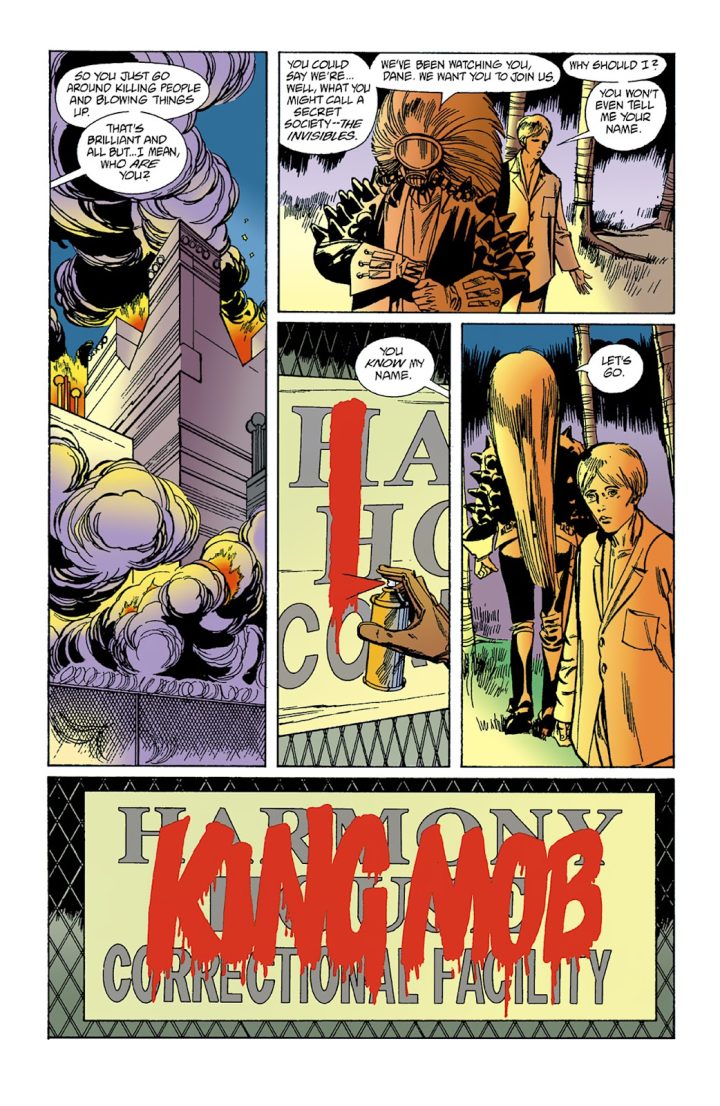
There are many concepts and tropes that you dive into in The Filth. But what is almost most interesting was your choice of Greg Feely as a protagonist, because he is on the opposite end of the spectrum as King Mob, the kick ass character from The Invisibles.
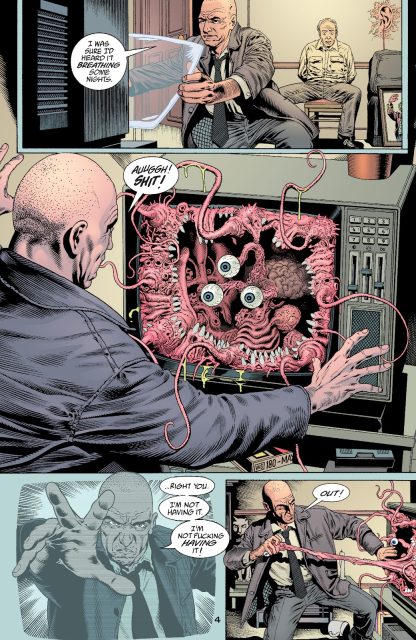
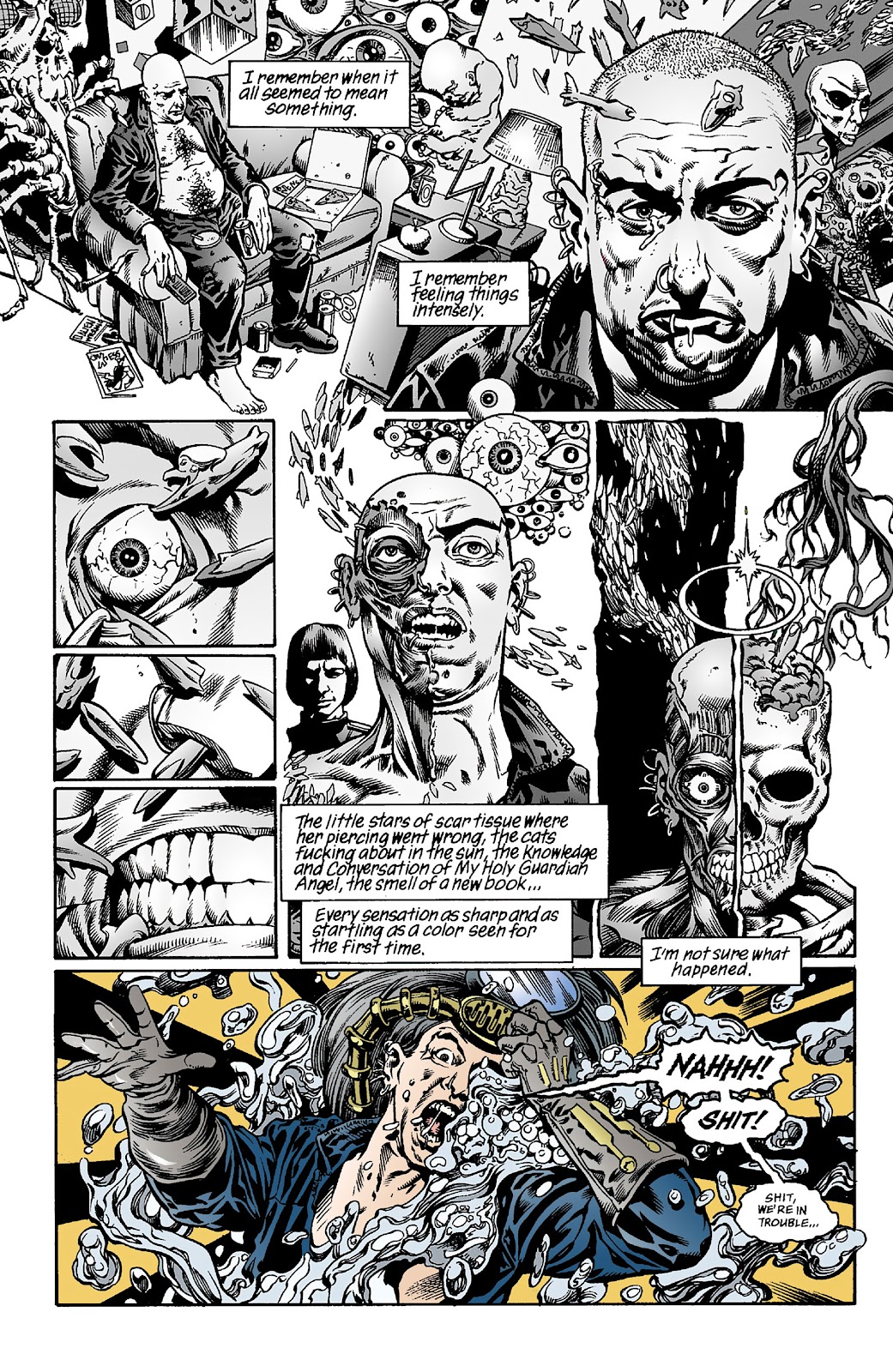
I think you can see Feely as King Mob. I wanted of it to be like the two shows Patrick McGoohan did, Secret Agent Man or how its known in Britain, Dangerman, and The Prisoner. The Prisoner is this super cool psychedelic spy show to end them all, but it’s like a sequel to Dangerman because the character he plays in The Prisoner, even though he’s only known as “No. 6,” it’s kind of the spy John Drake from Dangerman. So, I wanted that relationship between The Invisibles and The Filth as well. Suddenly this could be King Mob. Lost in the Qlippoth, lost in an identity and suddenly it’s that life. And there’s even a little bit in The Invisibles when King Mob’s being effected by the magic mirror that the bad guys are using, the kind of psychic poison. He sees himself and he looks like Greg Feely. Chris Weston drew the sequence in The Invisibles. It’s King Mob sitting. He’s overweight sitting there with a beer in his hand just watching TV and the TV just has a huge eye watching him back. There are pipes coming out his head funneling away all his thoughts. The Filth grew out of that one picture. Here’s King Mob, fucked. After the battle has been lost and he’s just sitting there watching TV.
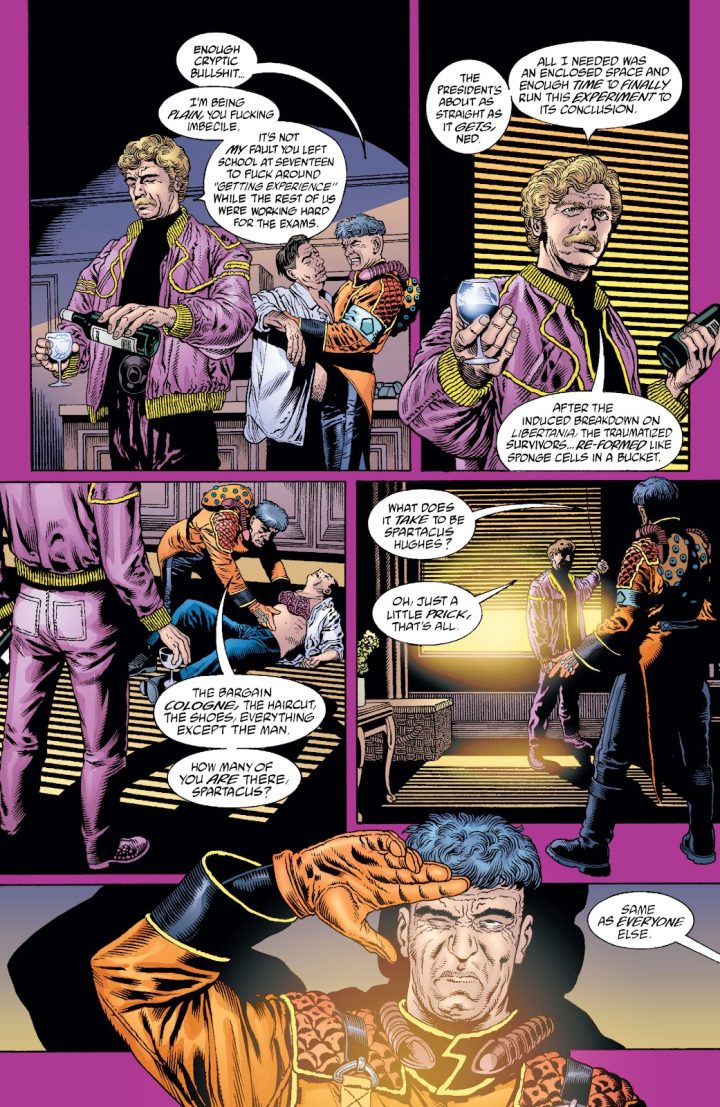
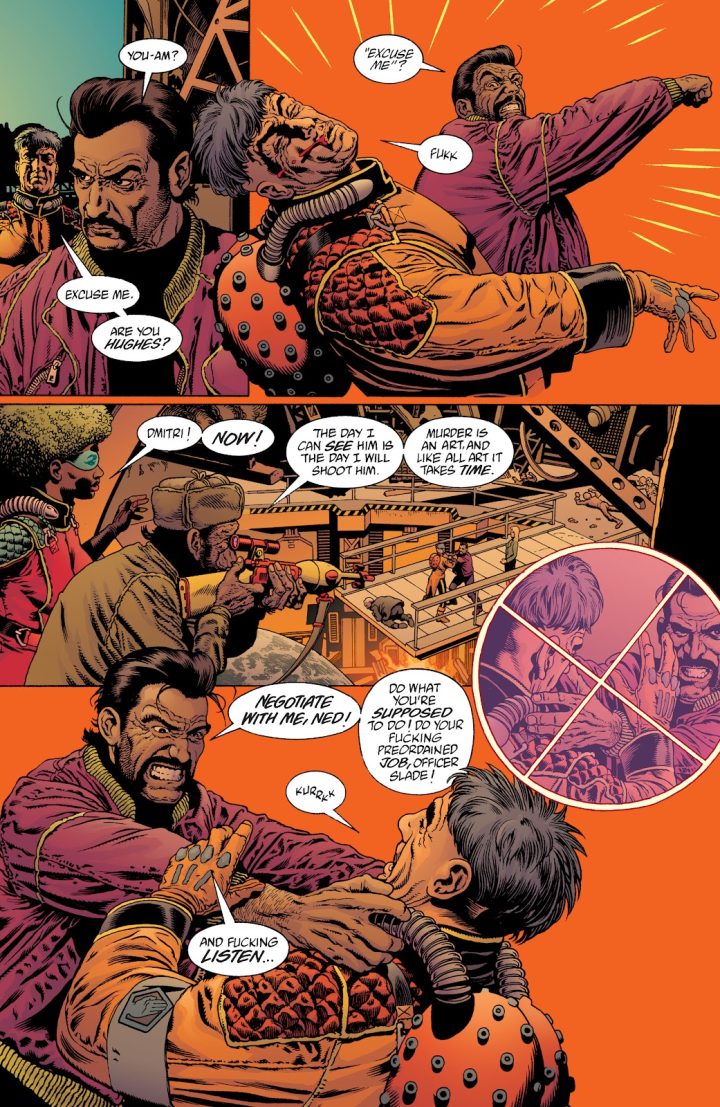
Another character who stands out from The Filth is Spartacus Hughes, the shapeshifter body hopping rogue agent. To give a little backstory, Greg Feely is lost in an identity but he’s part of a secret organization called the Hand aka The Filth. The Hand’s roll is to keep society on the path towards status Q. Am I getting that right?
Yes, The Hand, and the say to themselves, “We are the hand that wipes the ass of the world.” They are the garbage men of the world. They go about in secret, and they get rid of all the shit that might affect the running of the world. They are keeping everything on the straight and narrow and on the level.
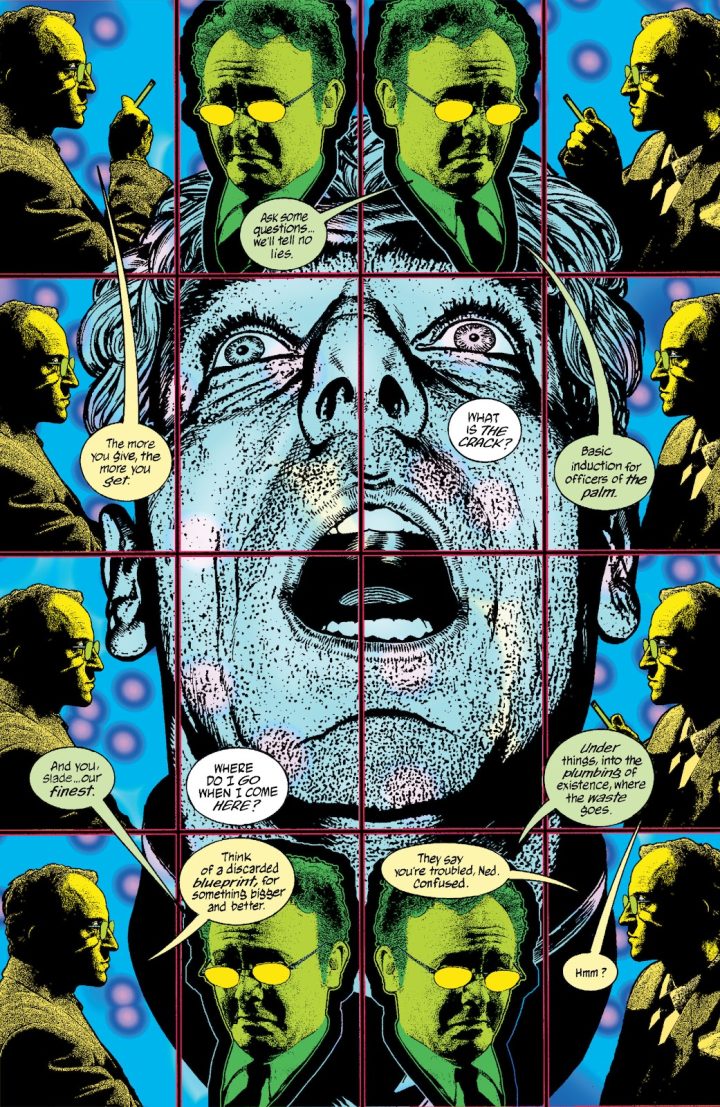
The whole idea originally was to do a metaphor of biology. I was really into the immune system and the immune system is comprised of these five different types of cells. So, you have hunter-killer cells, you have T-cells, and the macrophages and those things. The Hand organization was based on that with each branch being based on different types of cell. Greg Feely, within the Hand organization, is part of the Palm and the Palm are the good guys. They are the negotiators. The palm is an open-handed gesture. The Fist are the fighters, and the Horns is the Occult division. Ned Slade is a negotiator which makes him a helper t-cell, and the Horns and Fist are the hunter-killer cells. I wanted to turn my whole immune system into this spy-fi organization. Give it a voice and start talking to all this stuff going on in my own body. The idea being that my body was the republic of the story and I figured that if I could talk to my own immune system through these characters, I could form my own relationship with it so that I could stay healthy. I had all these magical ideas of how I could talk to my own immune system. Then as things played out, I learned about Mitochondria, the mother cell that developed 3.5 billion years ago. It’s the first living cell and it’s been dividing ever since. Therefore, every single living thing contains a version of the original mother cell.
It's dividing in every single living thing on the planet. I began to think that wouldn’t the Mitochondria fill the space for what we like to call a soul. Mitochondria is a physical entity that exists inside all of us, but its immortal. It is the progenitor for life on earth. I imagine if you are billions of years old and you’re distributed through every single life form on earth; you probably have some kind of consciousness. I figured that the sense of the in-dwelling immortal self, is the experience of the mitochondria and what it thinks of its own existence. And every part of all living beings have a connection to this eternal thing.
When I was doing The Filth there were physical explanations for everything. That’s when my magical system really flowered for me. Because I began to understand that magic is really only real if it can be played down here in the material world. Magic has to work in Malkuth. You can do magic in Yesod. You can go to the astral plane and hang out with any god you want, but unless you bring it back that’s all it is, just the imagination. You have to write a book or you’ve got to do something with that. If you don’t do it, it’s worthless. For me, there was that understanding that everything about magic should also be explicable in the material universe. That is what The Filth gave me. That’s when I began to really understand how magic works. How it effects consciousness and how it’s purely physical as well as having all these other dimensions like the astral, the mental, the psychic, the spiritual whichever, all the way up to non-dual consciousness. That’s what The Filth gave me. The absolute connection to the dirt, and the ooze, and the mess, and the things that die, but are actually expressions of an immortal intelligence.
That sounds like an interesting branch of Narrative Medicine, the study of giving a story to one’s illness in order to help heal it. But you’ve extended the equation to cover absolutely everything, which sounds wild.
Yeah, it just gives you a dialogue and to have that dialogue with things is important. The universe likes to dance so you have got to dance and if you dance it dances back. It’s always good to form a dialogue because then once the universe starts dancing with you and weird things start happening, interesting coincidences, synchronicities then you know how to move.
You are forwarding a method for the magic of writing and imagination by creating the conversation through character dialogue on the page, which can help with personal resolution into the text.
Yeah, and you can set a narrative and that was my idea with the Hyper-Sigil. You could put a desire or a notion into a narrative and that would allow it to come into conflict with anti-narratives and the way stories work. Suddenly good guy meets the bad guy, suddenly you have the time limit, where something’s gotta happen. If you apply that magic to something, you have a really different set-up that’s a much more multi-dimensional view of things.
How did your approach differ in your writing The Invisibles and The Filth?
The Invisibles was longer obvious, it lasted six years. It was like a diary. I was doing all that stuff, and I was changing quite rapidly in those years. I went from one version of myself to something quite different. That comic was way more upbeat. The ‘90-s were great. I had a brilliant time. I was having a lot of fun traveling and doing a lot of cool shit. It’s all in there. That vibe is in there. It’s got a fizzing quality to it and there’s a real optimism and an upbeat feel. I still want to believe that optimism is the fundamental quality of the universe. It’s just that we get hit with all this other crap. So, The Filth was a way of looking at that crap. And I could only do that comic because I was having a good time in my life.
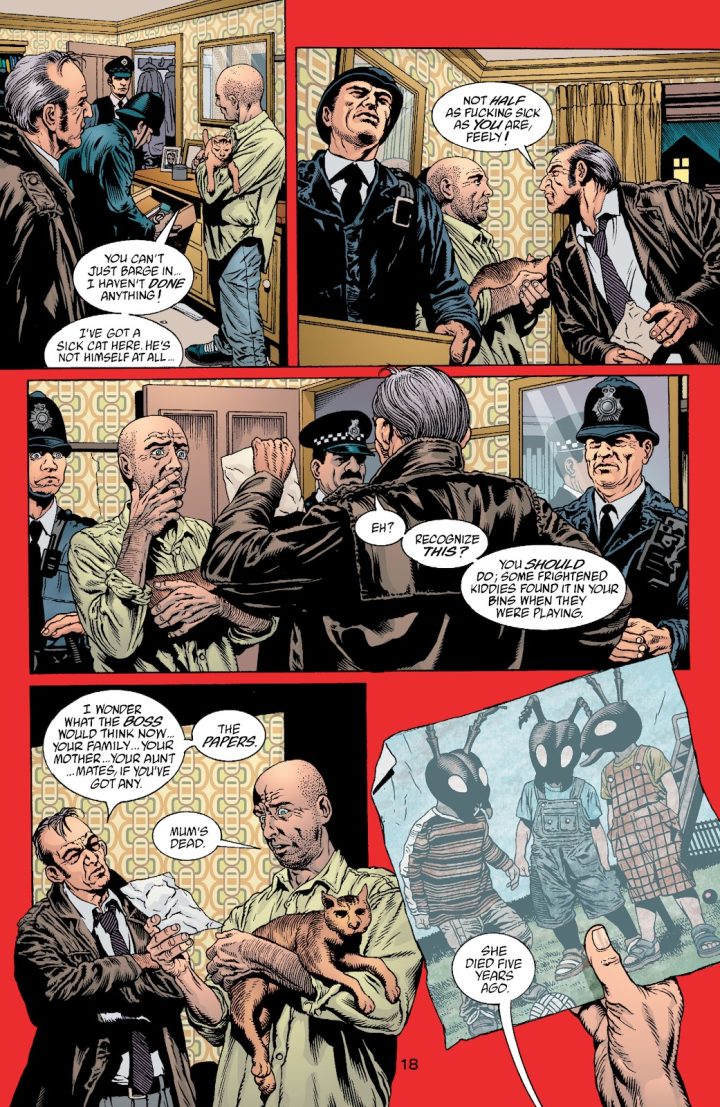
But my Dad had just died, so that was difficult. My cat was dying just like the cat in the story, which was hardcore. I thought I could look at this stuff because everything was going so well. So, I exposed myself to all these horrible things. I read about death and working in mortuaries. I was looking at a bunch of porn online and just the seedy crappy nature of that stuff. I was absorbing a lot of it, and it was brining me down. That’s why The Filth is funny. It’s kind of Pythonesque. Because I thought that the only way to deal with that toxic material was to take the piss out of it. Not get caught up in it and the comedy provided that distance. Where everything is stupid and everybody’s desires are just stupid and small and backwards. There’s this sense of not being caught in the Filth of it. But I was getting close, a closeness to stuff that was giving me the creeps and weirding me out. Looking at mortality. Looking at the dark side of stuff. Looking at what people really do to each other rather than what I want them to be in The Invisibles.
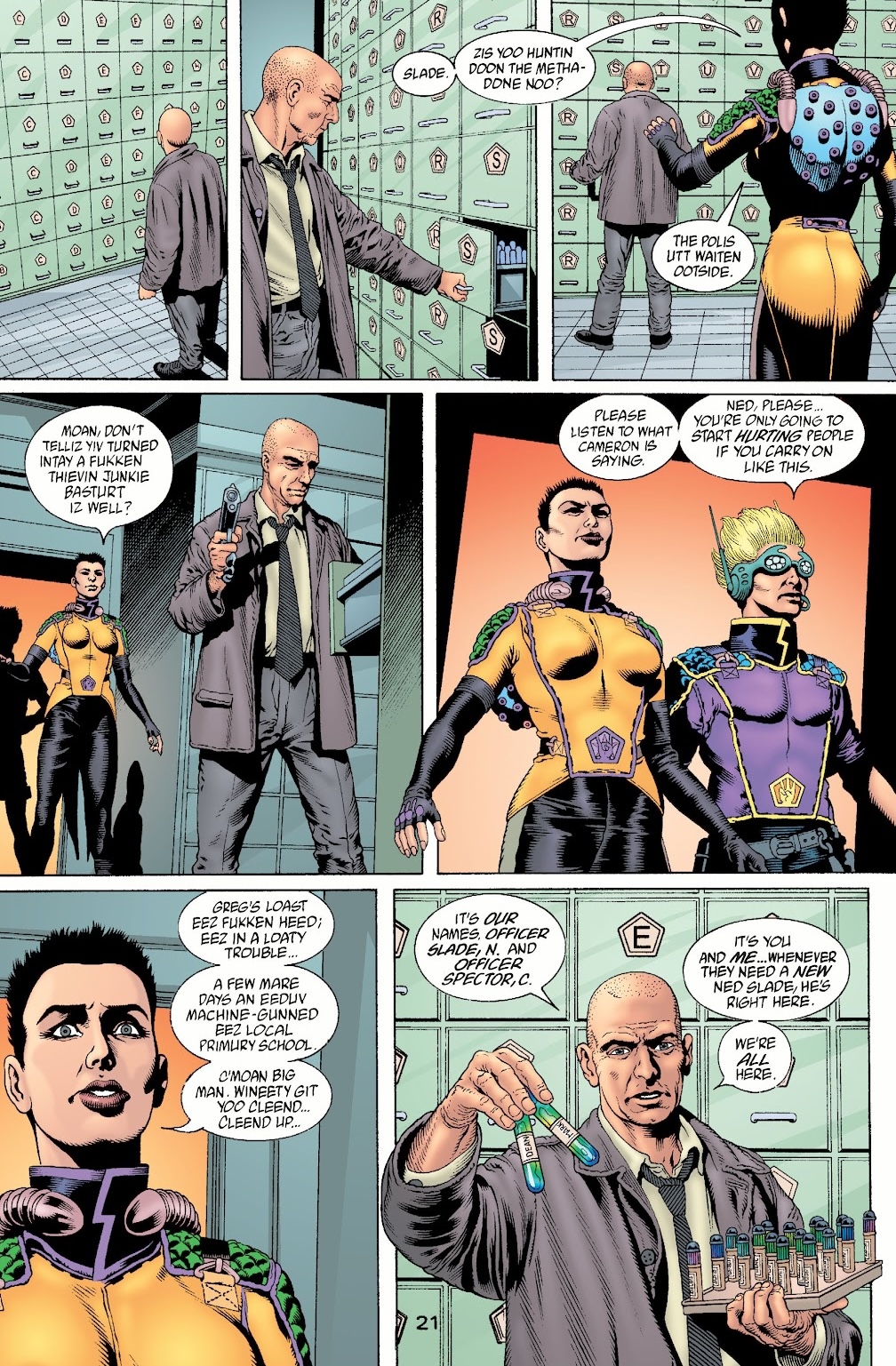
The character Spartacus Hughes epitomizes what you’re talking about. He’s like this mix between Epstein and Steve Bannon, living on some yacht trying to impregnate thousands of young women.
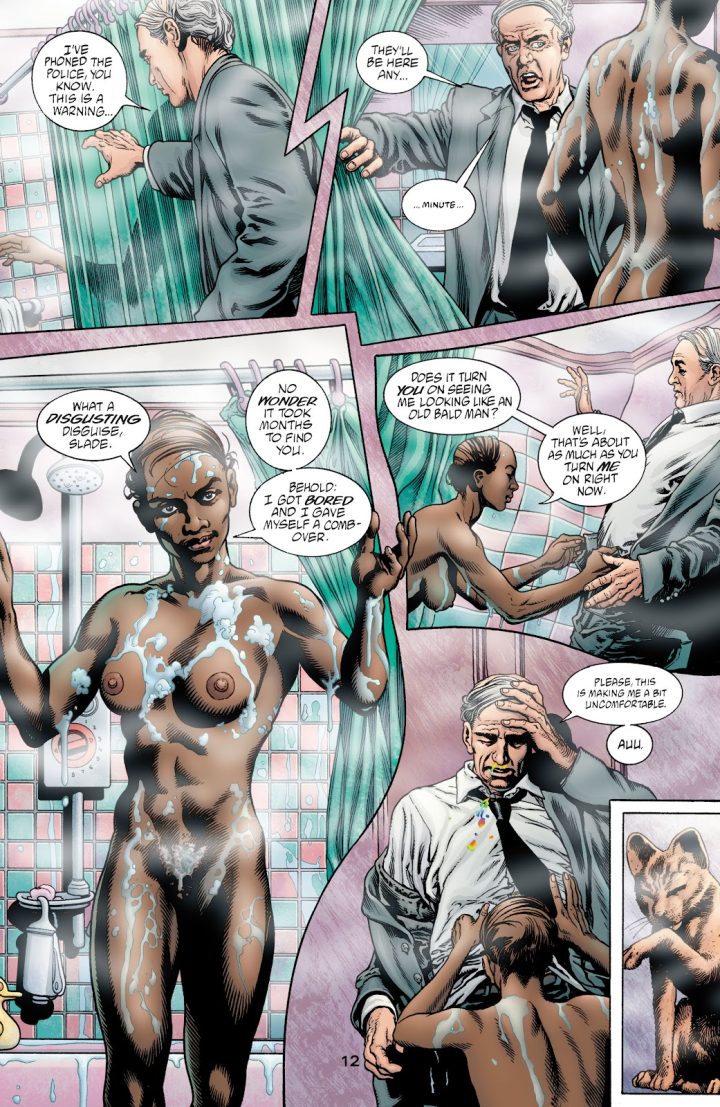
Spartacus Hughes was the idea of a viral man. It seemed like a really good spy notion. As you say, Greg Feely in the story seems like this normal guy with a sick cat. Then when we discover that no he’s not, he’s actually a para-persona, which is a fake personality that you inject. He’s really Ned Slade who is this big-time negotiator tough guy from the Hand, or so they tell him. This notion of the personality itself being viral being transmissible. I thought if Ned Slade was the alleged para-persona what happens to the rogue para-persona? Who gets out and who can replicate itself through lots of bodies so that’s what Spartacus Hughes became. So whenever you see him, he’s a different guy each time because the personality is a virus and its moved on to a new host. He’s a great character. I loved him. He’s a bastard. It's just the way a virus would look at us.
One line I like from The Filth is the one about how much of your thoughts are not really your own.
Grant: We are composed of bacteria. Much of our body mass is bacteria. They outnumber us. In The Filth it says, “How much of your is their thought? Can you be sure?” When you feel depressed, bad things come into your head. You put yourself down. You see yourself in a bad light. Is that them talking? Or is that really them? Again, it goes back to The Invisibles, issue two, when King Mob’s disguised and he’s up in a box just shouting at the passersby “When was the last time you had a thought that wasn’t put there by them?” And I think that’s a really important question for us all.
Yeah. There’s been scientific research linking air pollution with violence in teenagers.
Yeah, and microplastics and the effects of that stuff. Everyone’s riddled with that. Again, we’re under a lot of influences and in a lot of cases they’re invisible influences. They’re not understood. They’re not only physical influences. They’re psychological influences. Weird cultural influences that people are barely aware of that cause all types of things. The West has a mental health crisis, particularly in young people and I think that’s part of all this as well. I think the mental health crisis is an outgrowth of an obsession with individuality, an obsession with isolation, an obsession with simulation and synthetic things, and its naturally messing people up. However, it doesn’t get understood in that way. People tend to think there are very simple explanations for these things when it’s not that simple. It’s not just that they’re watching bad shit on the internet, it’s like the entire culture is coming at you from every direction and a lot it is toxic.
I love how you ground your magical research in biology and seek explanations for these spooky happenings within science. If magic is a result of biology, can practicing magic affect our biology?
Yeah, but again it’s a very obvious thing. If you sit down, you sit and meditate and align your chakras and do all that stuff. But if you just sit there and do just that you're gonna end up getting a back slope. The participation in the universe has to be on all levels for it to be really exciting and for it to work.
I use the Kabbalistic Tree of Life because it’s a useful map for how magical consciousness develops. Start in the material world, then go up into the world of the imagination, the astral plane, which is infinite. Inside your skull anything can happen. You can pack universes in there. Then you go up to Hod, which is the realm of language and communication. That’s where reason and math and all the languages and the ways that we’ve formed the world into codes and ciphers and notions into structures and patterns. Then you go over to Netzach, which is emotions, and that’s the whole entire realm of emotions. Those initial parts of the Tree of Life have to be balanced before you start really becoming a magician. But it all does work, and it all has to work. If it doesn’t work in the material world you can just get lost. You see a lot of these magicians who wonder about with their big capes on and their rings and their staffs and their trying to be that guy. They are caught up in the image of the Magician, which is a Hod level. The notion of image and performance and presentation. You’ll see people caught there. Or you’ll see people caught up in the Yesod, where their magic is happening all up in their head. And that’s fine if you are a writer or a musician or someone who can then bring it out of your head, but unless you can bring it down it’s just not functioning. Magic has got to have the physical component. It has to work. And yeah, you can tune your biology. We know this. You can tune it with Tibetan or Indian methods of vocalizations and there’s Chakra meditations. But as I say, you also have to go out running or walking or do tai chi or martial arts or yoga, something that brings it into the physical. If you want to magic up your body, train and eat the best food to make it as optimum a physical friend. And that’s magic. That would be the magic of the physical. Then do the same for your head. At the same time, develop your imagination and creativity, develop your reasoning by reading and understanding. While also at the same developing your emotions and your empathy and your understanding of people at that level. And you go up higher on the Tree of Life, moving towards a Non-Dual consciousness, which is a God Intelligence where all divisions collapse into unity, as they say. However, even up there, that highest of states also has to have a correlation in the physical world. And you’ll feel better. Things will happen. Once you reach Hod in the Tree of Life you develop charisma and it’s like being Jesus. You can talk to people and send them to war or make them dance or make them into artists just by talking to them the right way.
Aleister Crowley, the British occultist and founder of Thelema, said that connecting a person to their Knowledge and Conversation of their Holy Guardian Angel was his life’s mission. Does that ever inform your work? Do you have similar desire that your work will inspire people to move towards their highest selves?
Well, all of my magic has been reflected in the work I’ve done. As I’ve gone through the magician’s path on the Tree of Life, the lightning zigzag that hits every sephiroth, every sphere, on the Tree of Life. I’ve got work for all of them. The work for me that was in the Holy Guardian Angel space was The Invisibles. The Holy Guardian Angel is the central Sun for yourself. The HGA, everyone has their take on it, but I think it’s a future self. When you are a little kid before the age of three, you don’t have self-consciousness, so they say. I remember shit before the age of three, but by and large we don’t have major self-conscious awareness before the age of three. Kids of that age cannot see perspective. They don’t have self-awareness. But interestingly at the age of three, kids have imaginary friends. It’s at that age when imaginary friends start to appear. For me, the imaginary friend is the voice that appears in your head. You’re suddenly aware that you have an internal dialogue. But because you’ve never heard it or paid attention to it before, it sounds like someone else’s voice talking in your head. For a while it can be seen as an independent being and you can put it on one of your toys. It becomes a thing, and you can have real conversations. It starts to seem like a real entity. Then slowly it disappears, and you wonder where it’s gone. What happened to it? All that happened was that it became integrated into our psyche. It’s around so often that it becomes normalized, and it just becomes part of your own personality. I think the Holy Guardian Angel, and it can appear spontaneously, or you can do the Crowley Bornless Ritual and make it appear, but the Holy Guardian Angel is that. It’s the next stage of consciousness above the one you’re at. It’s the magician consciousness. And it comes on and it feels like an alien contact. It’s so unusual. It’s a perspective that is five dimensional and you’ve never experienced it before. And it comes on like you’ve been abducted by aliens or touched by Angels or raped by demons if you happened to be in a bad state of mind. But that’s what happens. It feels like its outside external force, so novel and you’ve never experienced it before.
That’s my take on what the Holy Guardian Angel is. It’s your future self after becoming integrated with the Holy Guardian Angel. Crowley and the Thelemites say that the Angel abandons you when you have to cross the abyss. For me, that means that the Angel has become fully integrated. That’s why you are naked and alone because you are the Angel. It’s not there to protect you anymore because you are it and you have to face the abyss as your future self. That’s my take. It’s not something that happens initially. For me it didn’t happen until 1994, when I did Crowley’s Bornless Ritual and it descended on to me. When I got the Kathmandu the whole then just came in. However, that came after months of doing rituals.
It is recognizable specifically because you have a vision of Christ and you understand Christ. If you haven’t had this vision of Christ, then you know you’ve not had the Holy Guardian Angel experience.
Did you work a program how Crowley calls for, invoking deities like Nuit and Thoth, and did you work that up like he says to?
I was very punk about magic. I was influenced by the Chaos magicians in Leeds. Ray Sherwin and Peter Carroll’s stuff was the first stuff I discovered. I came at it from that side. The William Burroughs, slightly mental, end of magic, which, for me, was quite punk. It was like diving into the jungle. I was a very skeptical kid. Nothing interesting like that had ever happened to me. And I was like, “This guy says do this this and this and it will work.” And it did work. That was all it took, and I did more and more of it, but I wasn’t following Crowley. My uncle Billy gave me Crowley’s books, but I found them difficult to read. I preferred the Chaos Magicians works because they were contemporary. That was where I was getting it from, and they were borrowing from everywhere. I’d pick up a book about Mexican magic, or Vodou, or Celtic stuff. I was bringing it in from everywhere. And I realized later that what magic is really all about is changing consciousness. All these different methods are just ways of changing consciousness and getting you to a state where it feels like a God is in the room or a Demon is in the room. I studied just a thousand different methods of doing it and realized that underlying it was all the same thing. These were all just like art styles or approaches like Surrealism or Impressionism. Those are the different forms of magic but it’s all magic underneath. It’s just art. It’s just the expression of something that’s quite simple underneath.
A magician shouldn’t reveal their tricks but…
No, I think they should, honestly. Reveal everything because that makes it even more magical then.
Ok, then. You speak about this eclectic, esoteric magical bushido you have quilted together over your life. If I can ask about your process. Did you, as Crowley intones, invoke often? And if you did, what sort of deities did you invoke, those from the Mexican tradition? Loa from Vodou?
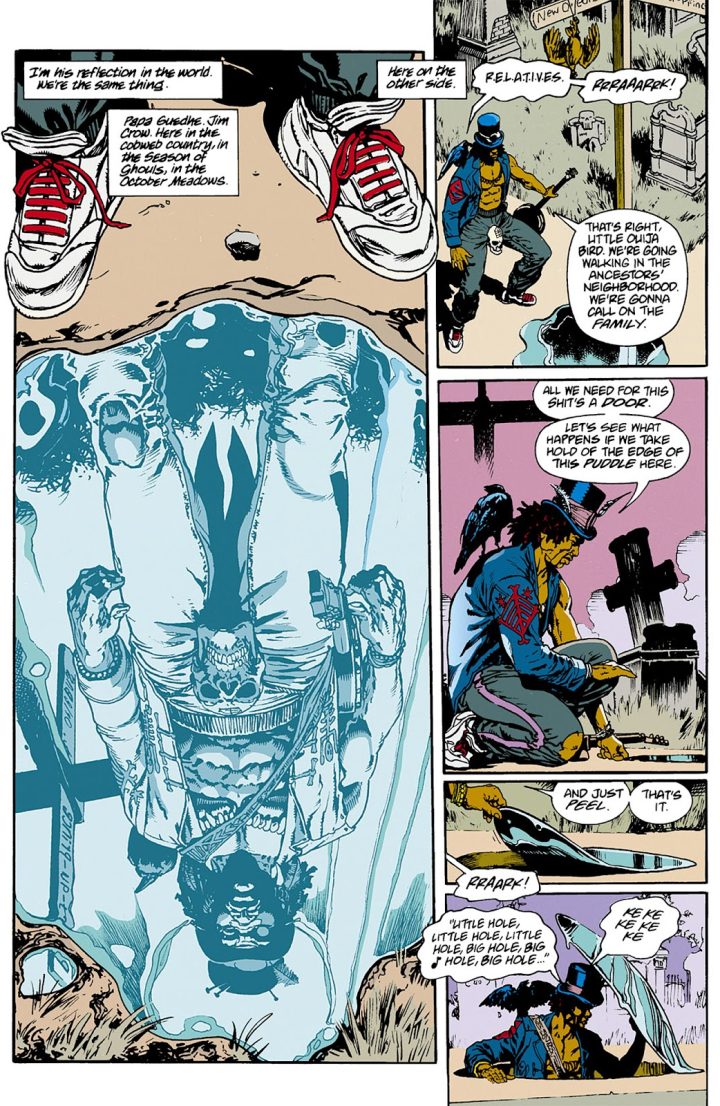
Yeah, I made contact with the Vodou Loa Papa Gede, or Baron Samedi. I got on really well with Papa Gede. That’s why he went into The Invisibles and the Jim Crow character became an avatar of Papa Gede. However, that led me into some dark stuff with the Scorpions. The Vodou Scorpion lore. So, I backed out then. I was also doing a lot with Shiva and Ganesh. Ganesh is still my patron God. I invoked a lot of Indian and Tibetan deities. I would go for things that seemed really intense. I did a lot of summoning demons and had a lot of mad arguments with demons. Demons were fun but they leave you feeling filthy. They like to argue, use logic, and disassemble. I was summoning all the time. I summoned John Lennon, Jack Kirby’s Metron from New Gods, and the Flash from the comics. But Flash and Metron were just avatars of Mercury or Hermes or Ganesh which are Gods of communication. All you are doing is summoning a state of mind, a state of consciousness. And that state of consciousness can be embodied by anything. You can summon up the god of speed and communication and you get Sonic the Hedgehog or Speedy Gonzales and if those forms talk to you better than Hermes, or Ganesh, or Ogma from the Celts, work with them.
And were you working these invocations with the Lesser Key of Solomon Goetia, in terms of summoning these demons?
It was totally free form. It was Shamanic. The one I did was Crowley’s Bornless Ritual, but I tended not to follow rituals to the letter. I figured out the basis of them and I’d create my own. I’d just open the doors, call them in and see what happened.
But you would work within a structure, using Lesser Banishing Rituals and Closing Rituals, right?
I would do banishing and stuff. However, there were a lot of times where I wouldn’t even banish at the end. I just kept the atmosphere and then I would write. I’d put stuff in stories and that seemed to do the banishing for me. I didn’t do a formal banish for like ten years of doing magic. People probably say, “That’s why you’re insane!” But I’m not, I’m radiantly sane.
The post Grant Morrison’s Unbounded Summoning Possibilities: The Filth, The Invisibles, and moving towards a Non-Dual consciousness appeared first on The Comics Journal.


 Hello, my name is Jack Sparrow. I'm a 50 year old self-employed Pirate from the Caribbean.
No comments:
Post a Comment