

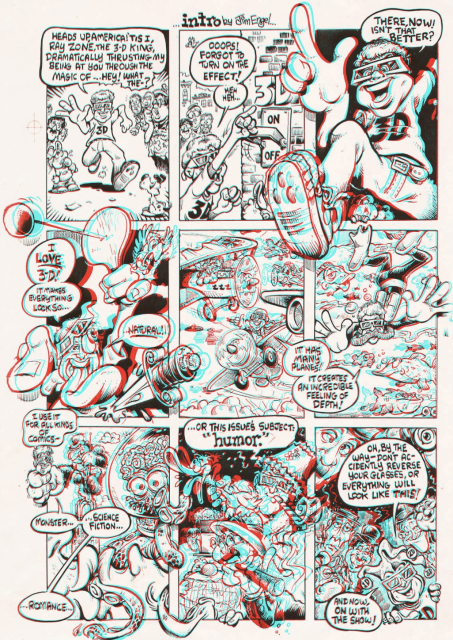
I had to get my right eye taken out about two months ago. Cancer. It happened so fast. I woke up with foggy vision in mid August and within four weeks an oncologist told me the eye had to go.
I never even got to cry about losing my eye. I was too scared it would flood my bandages. After my surgery, I lay upright in the dark and tried to find peace in knowing that I would not be totally blind. And beyond this, gratitude for what I got to experience with two whole eyes. Cozy in that circle was my time with 3D comics; it’s a process that requires an eye for each visual channel, red and blue. All I have is the left, and what’s left is red.
My grandma Eva first gave me 3D, if only in black and white. She swatted my hands away from her stereoscope on more than one occasion. She was right to do it, I came from a generation of cartoon explosions and it was just old wood and lenses and wire. There were little cards with dual vistas of the Mississippi that become one magical image when focused just right.
The View-Master was the stereoscope in its final form. This was a toy made of nearly indestructible plastic: grab it, click it, toss it. It had one simple trigger and followed the same mechanical principle of a revolver. The View-Master gave me technicolor vistas of The Town of Bedrock and Fantasia, all bright as breakfast cereal. There was no going back.
In grade school we learned about 3D movies in spits and spats, a format that had long since died out. We’d see pictures from the 50's of people wearing what looked like sunglasses in the dark, their heads tilted in unison, a lost cult that I longed to join.
3D comics were as close as I could get. I spent seventh grade raiding basements and thrift stores, depending on where I ended up after school. The scant encounters with these comics turned them into holy relics when they did come along. There was a Simpsons Illustrated 3D Annual in 1992. It didn't just have 3D stories inside, but the ads themselves were in three dimensions. It was madness. Somebody had made me give a shit about an ad for Butterfinger (view selected interiors and ads from the Annual here).
There were heretics in those days. 90's companies like Valiant used buzzwords like "prismatic" and "chromadepth" to make the format seem fresh and hip. But their glasses had clear lenses in them. Clear. I already had clear glasses on my face. True 3D is a means of escape. It's about wearing cardboard frames with colored cellophane panels. If you look like one of the bad guys from Back to the Future, you're doing it right.
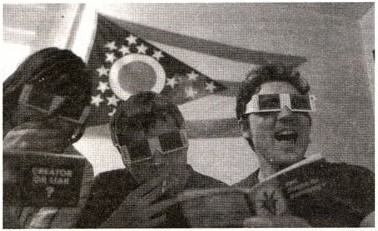
3D crept into other parts of my life. I was in a turd-rock band in college. We didn't call ourselves that, but that's what we were. The band was called The Stapler, and we sounded a little bit like Dinosaur Jr., but more like if Dinosaur Jr. had gotten brain damage from eating tin foil. We put out an album and the local arts magazine wanted our picture, so I showed up with 3D glasses for all of us. I had to.
I later strayed from my vows, tried to grow up. After college, I was lost. In the back room part-time jobs, scrubbing pans or learning an artichoke fold, you can get further from yourself; an apron or a name tag can be the heaviest thing you ever put on. I drifted back to comic shops for a fix.
You get more refined as you age with comics, whether you like it or not. You get tired of trends, a hot writer, or the seventeenth reboot of a hero. You may start to take comfort in the reliable past, and this is natural. In my situation, I became king of the dollar bin. I had to learn to love what was in there. We're talking a lot of Kamandi and Ditko Starman. I was in a basement shop called Discount Paperback when a torn copy of Will Eisner's 3D Classics featuring The Spirit came to me. One ratty comic from Kitchen Sink and I was zapped, zooted, tooty-fruited.
The Spirit was always good. But in proper 3D, I was prone to the hand of Will. No longer was I just a grease dog out for rent. I was in the shadows of the sewers with Eisner. I was on rooftops and billboards with Eisner. I was getting sucker punched with Eisner. I wanted to be closer to this impossible ghost of a man, and to be nearer to his work. That is what the best 3D will always do for you.
To celebrate the end of my stereo vision, here are the 3D comics that you absolutely need to read.
Cadillacs and Dinosaurs 3-D:
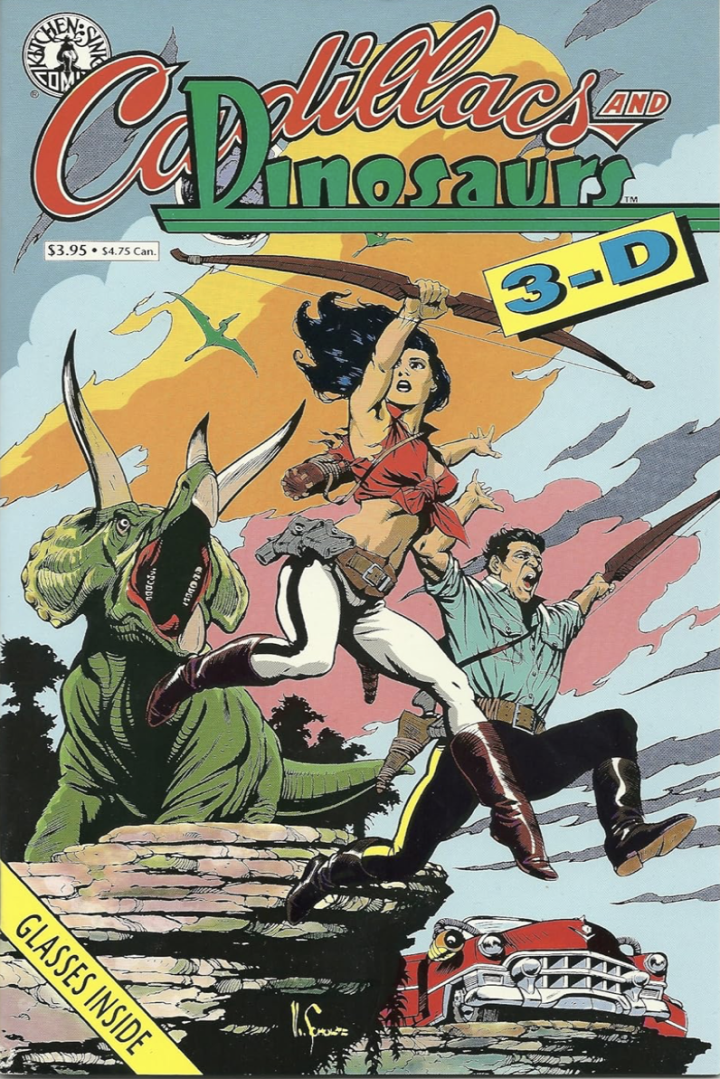
The line work of artist Mark Schultz is meticulous, which is why the guy only puts out a new book once every three to five years. Schultz came up in the school of Frazetta, with a sense of composition steeped in slick action, thick hips and vast landscapes. The inks have real reft here: every leaf and shadow in the jungle canopy are given life by the conversion process. The 3D rendering is flawless, down to flashes of dinosaur teeth and flying drops of water. It's quality fantasy from cover to cover.
I once gave my only copy of this to a composer who was visiting from Taiwan, knowing there's no way he'd find anything like this back home. It usually goes for $10 a pop.
Battle for a Three-Dimensional World:
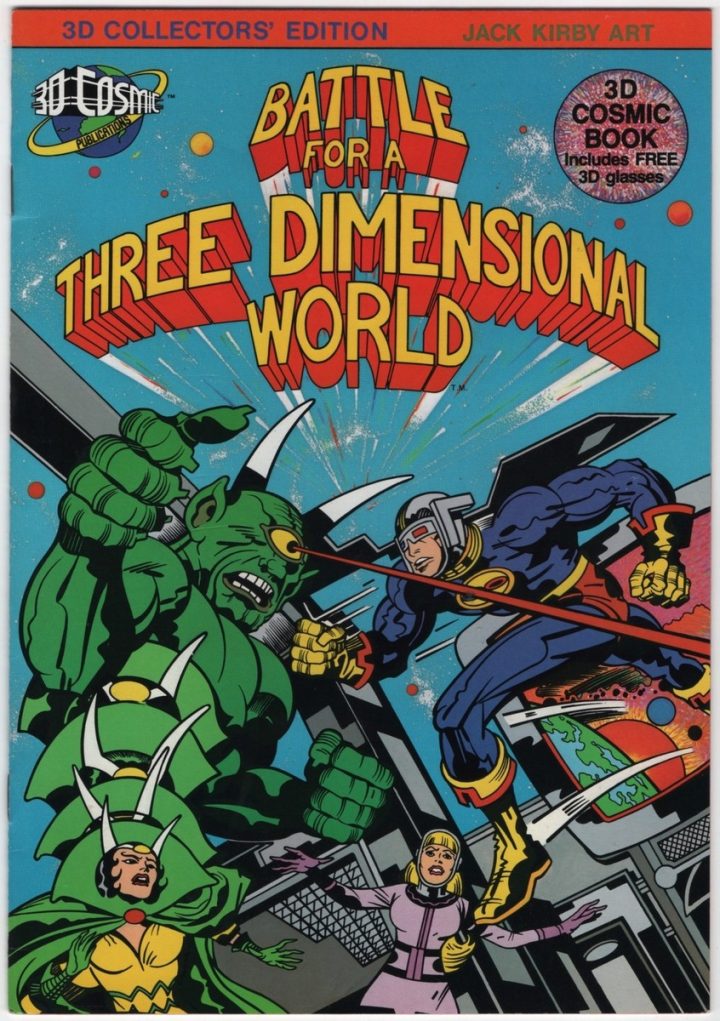
Yes, you've seen Jack Kirby's work before! And YES, you still need to see his cosmic wonders in 3D. The man who perfected the splash panel has square-jawed gods leap from the page. And the main bad guy is….a cyclops, who can only enjoy visuals on a flat plain. Oh, okay Jack! Nasty.
This was co-designed by Ray Zone, the grand master who went on to revolutionize the 3D process in the 80's and 90's. The book was basically created to be sold to school libraries and is a wonderful primer for young weirdos and artists in your life.
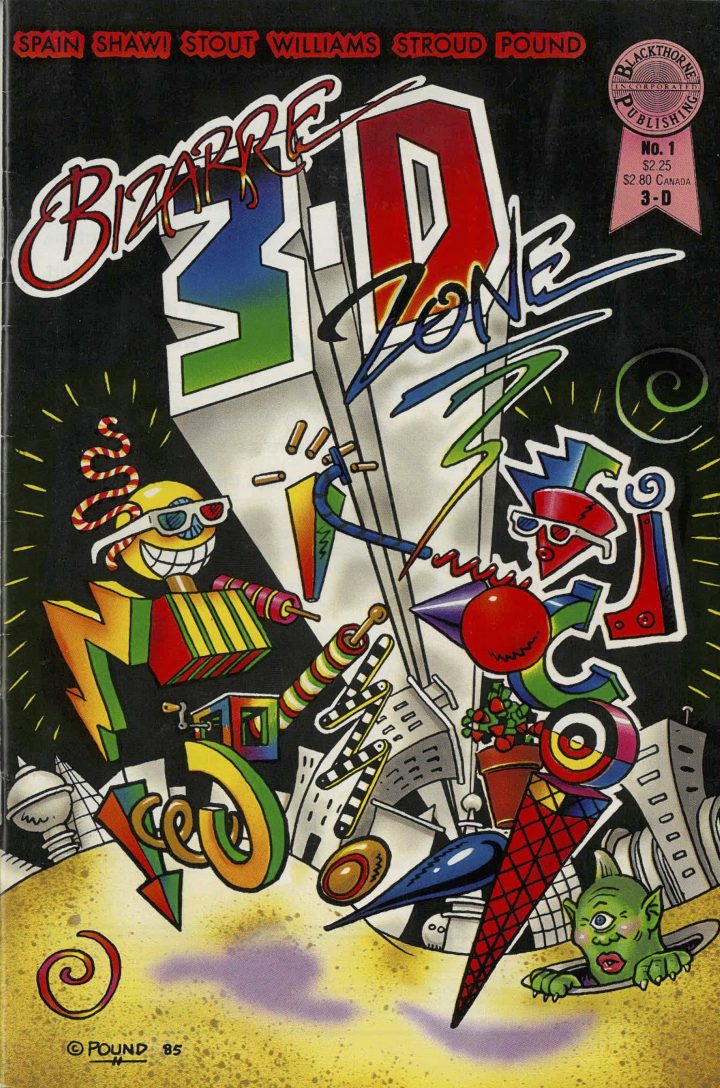
Bizarre 3-D Zone:
Given how far along things have come with legalization of marijuana, I guess now is the part where I can endorse that you legally, responsibly enjoy the fuck out of this book. Put on some Beefheart or Sabbath, pop up some corn and get your skull blown out by indie legends like William Stout, Scott Shaw and Robert Williams. This is the anthology comic that convinced my old roommate that he was ready to take acid. And it's cheap!
Bizarre 3-D Zone was put out by Blackthorne, an indie publisher who released a full line of 3D books in the late 80's. Highlights from the series include Paul Chadwick's Salimba and the Rocky & Bullwinkle titles. There were some stinkers along the way, but the company poured years of labor into the genre and should be given way more formal credit for doing so.
The Weird Tales of Basil Wolverton:
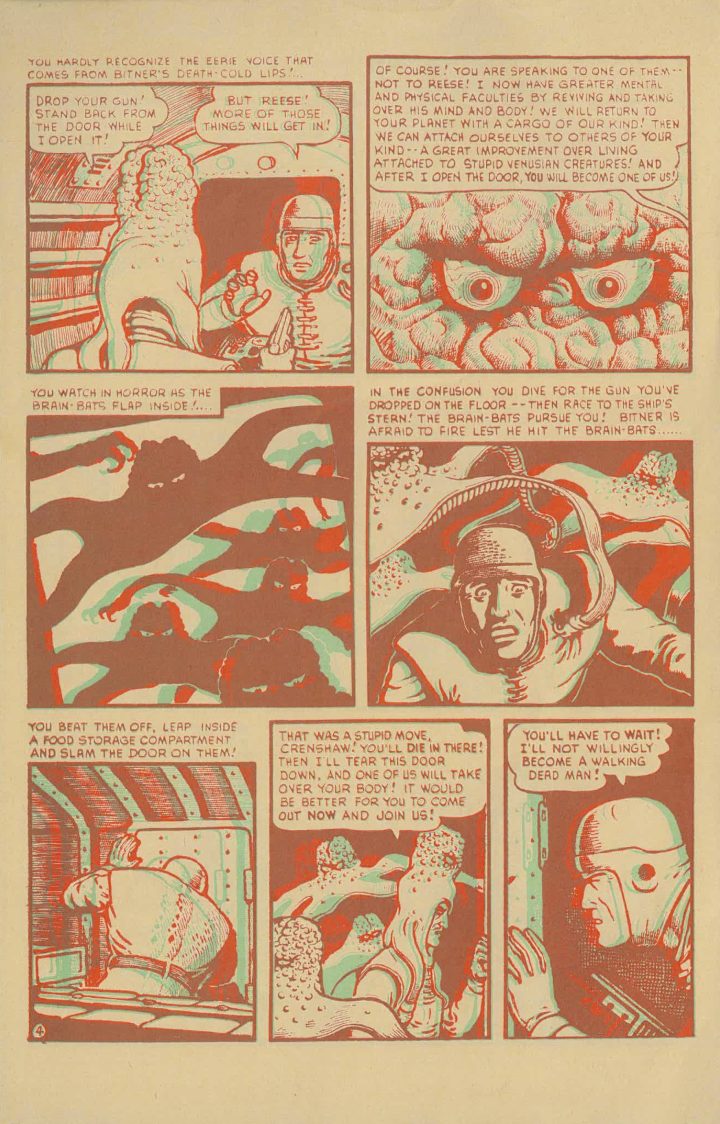
Basil Wolverton, one of the preeminent freakout artists of the 60's, sketching psychedelic covers for PLOP! and MAD Magazine in their peak years. In old-timey days prior, Wolverton cranked out pulp hits like The Brain Bats of Venus, which is legit horrifying. Even more shocking is that it came out in 1952, juuust before the Comics Code Authority dropped and made everything lame. Top notch science fiction from one of the old wizards of weird.
Madman 3D Special:
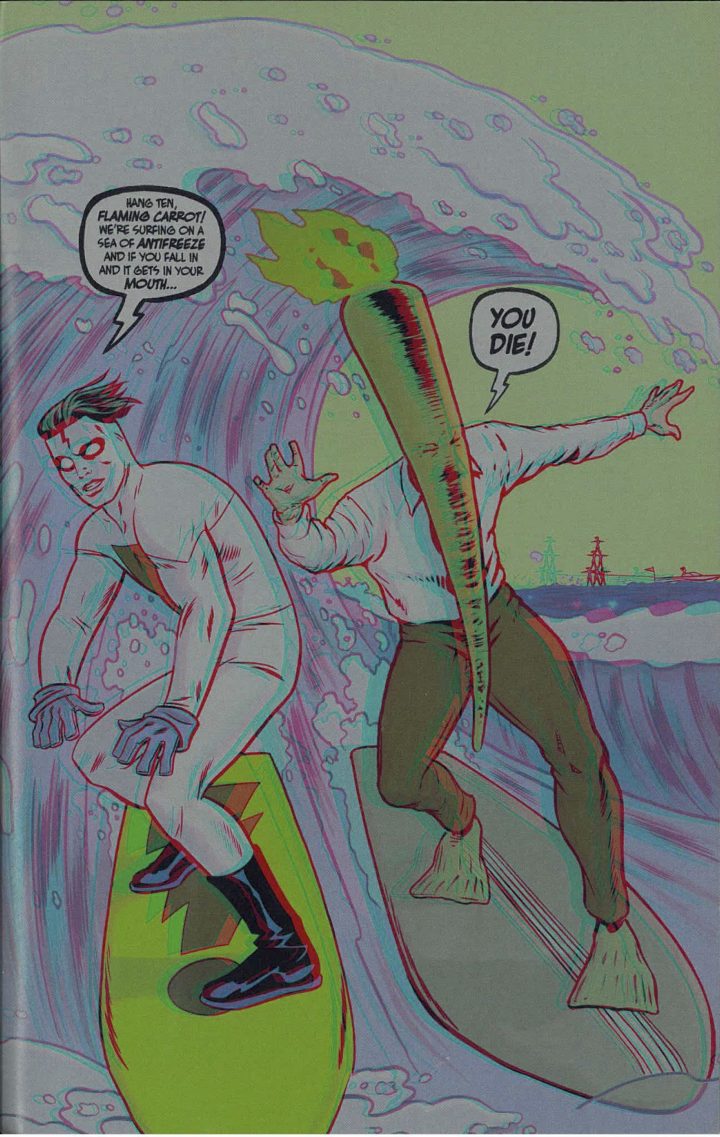
Try to imagine if John Waters and Missy Elliott threw you a surprise birthday party and it was sponsored by Krispy Kreme. This is what it feels like to read Madman for the first time. Doesn’t matter if you start with Dark Horse Legend run, the inky Tundra books, or the vastly underrated crossover with Superman. They’re all pop tarts in your hand. Madman is one of the best times you can have reading comic books.
This one tends to be listed on the pricier side, but for good reason. At a sturdy 80 pages, this digest bursts with the kinetic fun that honors the legacy of Frank Einstein and his family. Christian LeBlanc turns in stellar conversion work here, following in the footsteps of the aforementioned Ray Zone.
Stinkers to Avoid:
I once pulled an issue of Fabulous Furry Freak Brothers 3D from a long box at a convention, my hands shaking. In its raw form, Gilbert Shelton's vision of gonzo hippie America is a powerful ride, loaded with quaaludes, nose powder and flop sweat. This had to be a masterpiece. I opened it in the car before I drove home and shrieked. The printers botched the 3D design and what should have been explosive doodles were just a muddy mess. Sadly the same happened with the Aardvark-Vanaheim 3D special (sic: A-V in 3D) from 1984; it could have been glorious, but the flimsy paper and cheap ink made it unreadable with or without special glasses. There was Flaming Carrot art in that. You can't do that to Flaming Carrot.
________________
3D print has been lumped in with novelties like glow-in-the-dark, invisible ink and scratch and sniff. It has always been kept closer to bubblegum than to Baudelaire. But there’s more to this than a gimmick; we need to embrace this format in how it brings us closer to the comics that we love.
You can find these books if you’re willing to dig. If there’s a lack of 3D in your town, I recommend Mile High Comics for their online holiday sales; their backstock is vast and their staff are kind.
Losing my eye still has me stunned. By the time the bandages come off and the stitches are out, you can get used to not crying. But when I was able to get around, I went out back and fetched these books out of the garage. And damned if I didn't cry for my paper friends, forever blurry in red and blue.
You, my friend, can still focus on such things. Any 3D book will do. It's trash transcendence, but even a plastic journey into the soul is still one worth taking.
Lee Keeler is a writer and educator living in Northeast Los Angeles.
The post What’s Left is Red: A Farewell to 3D Comics appeared first on The Comics Journal.


 Hello, my name is Jack Sparrow. I'm a 50 year old self-employed Pirate from the Caribbean.
No comments:
Post a Comment