

Like Charles Schulz, Will Eisner, or Jules Feiffer before him, the idea of retirement never seems to have occurred to Bill Griffith. At the age of 82, he continues to work on the daily Zippy strip, which remains as fresh and unique as ever after more than four decades, and has still found time to complete this, his fourth hugely entertaining graphic biography in the space of a decade. Quite where he finds the energy is anybody’s guess, but after almost sixty years in the business, he shows no signs of slowing down anytime soon.
Photographic Memory is a delightfully unconventional portrait of his great-grandfather, William Henry Jackson, a pioneer of American photography whose work helped shape the nation’s identity in the aftermath of the Civil War. The pictures he took as official photographer for the U.S. Geological and Geographical Survey of the Territories in the 1870s formed an iconic document of the western expansion of the United States and the growth of the railroad, while his breathtaking images of Yellowstone (including the first ever photograph of Old Faithful) were instrumental in establishing it as the first National Park in 1872.
Jackson’s life story would be a gift for any biographer. Apart from his career as a photographer, he was also a painter, writer, illustrator, and explorer, and the father of the American picture postcard. He witnessed the Battle of Gettysburg as a 19-year-old Union soldier, rode the Oregon Trail as a bullwhacker when he was 23, and had traveled much of the world by the time he turned 50. A major influence on Ansel Adams, his work has featured in a dozen exhibitions at New York City’s Museum of Modern Art, and more than 50,000 of his glass plate negatives are now preserved in the Library of Congress. And yet, while postcards of his work sold in the millions, he reaped few of the rewards, and by the time he reached his 90s was living in a hotel, surviving on a Civil War pension, and still taking illustration commissions to make ends meet. Oh, and as if all that wasn’t enough, he was also the great-great nephew of Samuel Wilson, the original Uncle Sam.
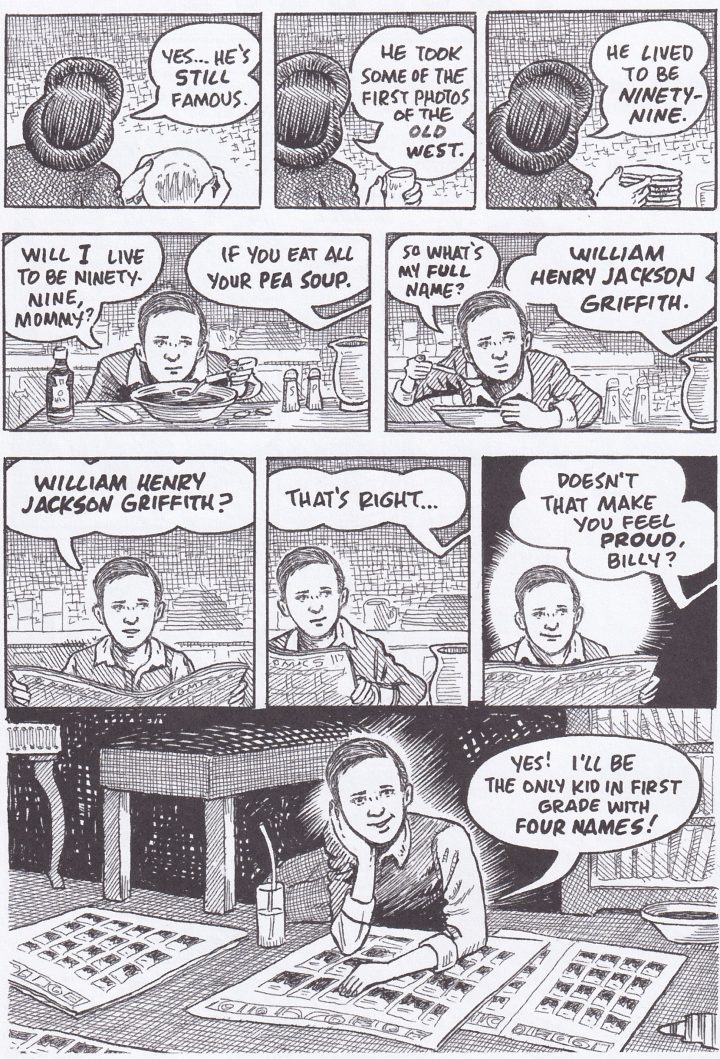
For Griffith, however, there’s obviously a more personal connection. Although he never met his illustrious forebear, the great man’s shadow loomed large over his life from an early age, not least because he was named directly in his honor (William Henry Jackson Griffith being his full name). Today, having had a lifetime to contemplate his career and reputation, the picture he paints is that of a complex and even contradictory character, conservative in some ways, but utterly unorthodox in others. An adventurer, artist, free spirit, and a bit of a hustler, he could also be distant and self-absorbed, and wasn’t immune to the kind of casual racism characteristic of his era. As Griffith puts it, he was “an unconventional man whose life was, nevertheless, defined by certain conventions.”
And yet, with over two dozen books already devoted to his life and work, including five earlier biographies, one has to wonder if there’s anything left to be said about Jackson. In a way, though, it doesn’t really matter. As his three previous books have made clear, biography for Griffith isn’t simply a way of examining a specific subject in objectively historical terms, but also a means of delving into his own past and exploring the things that have obsessed or influenced him over the years. Invisible Ink (2015) recounted his mother’s affair with the cartoonist Lawrence Lariar while simultaneously unpicking his family’s fraught relationship with his father. Nobody’s Fool (2019) told the story of Schlitzie the Pinhead, one of the formative influences on the development of Zippy. And Three Rocks (2023) was a heartfelt tribute to Ernie Bushmiller, creator of Nancy, whose work has long been a touchstone for Griffith, its title drawn from a recurring mantra that’s been a key ingredient of his strips for decades.
So, while Photographic Memory has everything you could want from a straightforward biography - an engrossing narrative backed up by solid research and a compelling evocation of time and place - it’s also punctuated with idiosyncratic touches that make it something else entirely. As in his earlier books (and, of course, the Zippy strip itself), Griffith pops up intermittently as both narrator and character, an active participant in the story he’s telling, while a complex web of self-referential strands links each book in the series to the others, and to his broader work as a whole. From muffler men and circus side shows to vintage diners and Paris in the 1890s, there’s always some familiar detail lurking in the background to remind attentive readers that they’re wandering through his own particular psychic landscape. There’s even a veiled reference to Bushmiller’s ‘three rocks’ in there if you’re really looking for it.
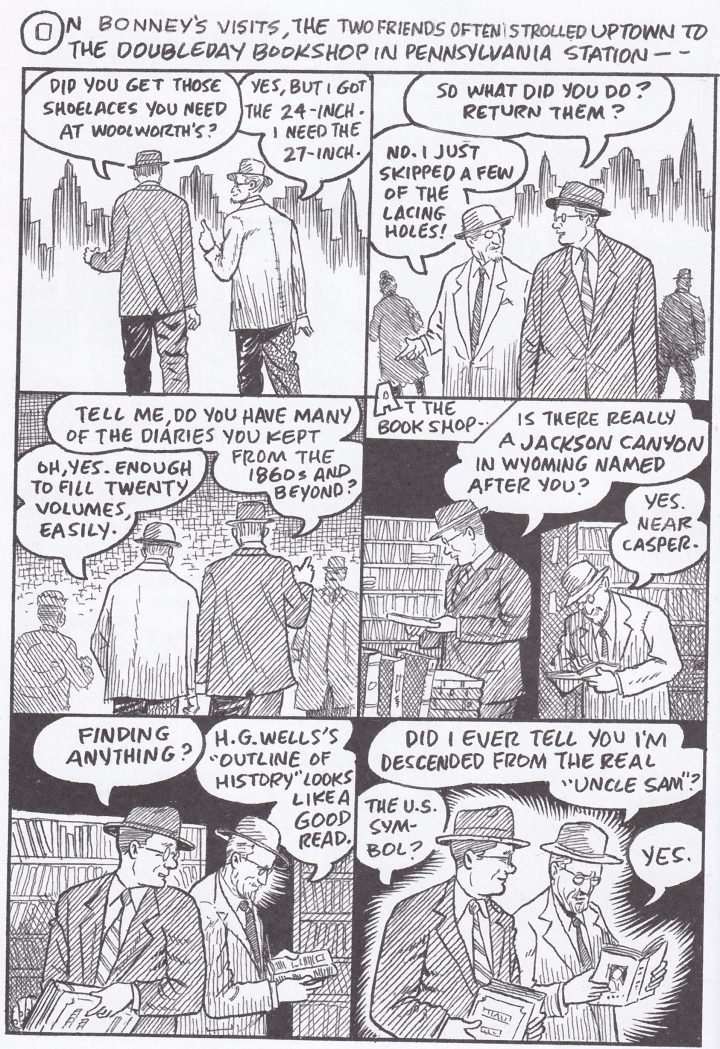
Much of the book is based on a lengthy account written by Jackson’s friend Elwood P. Bonney, detailing their many meetings during the 1930s and ‘40s, which Griffith uses (along with his diaries and many other sources) to mould an intimate and quietly revealing portrait of his great-grandfather. He doesn’t just recount Jackson’s life story, but allows him to tell much of it himself, following the pair as they wander around Manhattan, shopping for shoelaces, eating lunch at the automat, and enjoying a quick afternoon ‘snorter’ back at his hotel. Indeed, Griffith takes as much pleasure in relishing the minutiae of his daily routine (getting up, making breakfast, settling down to work) as he does the more celebrated or sensational aspects of his career. And, while such details might seem mundane and superfluous in a regular biography, here they feel absolutely right, forming an essential part of the character he constructs for his subject.
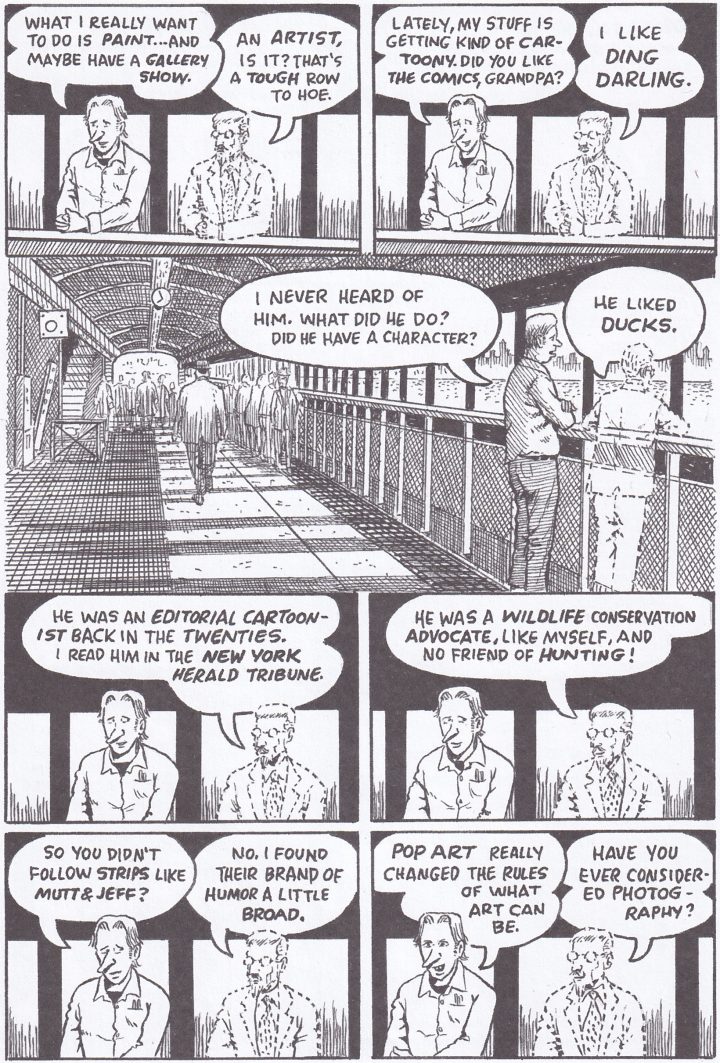
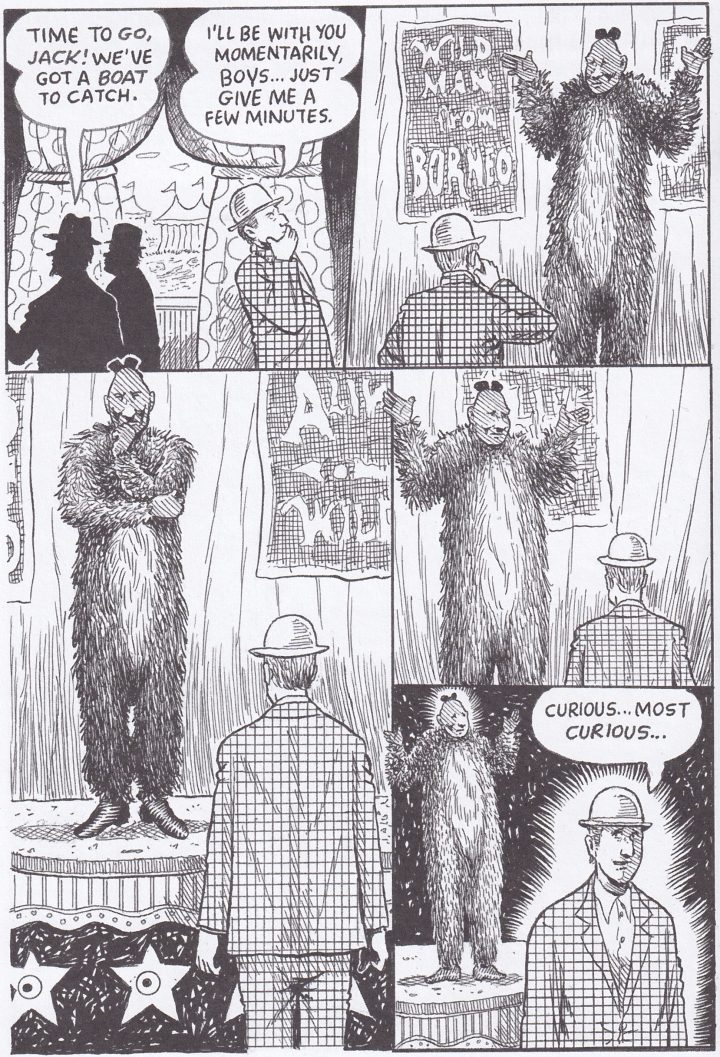
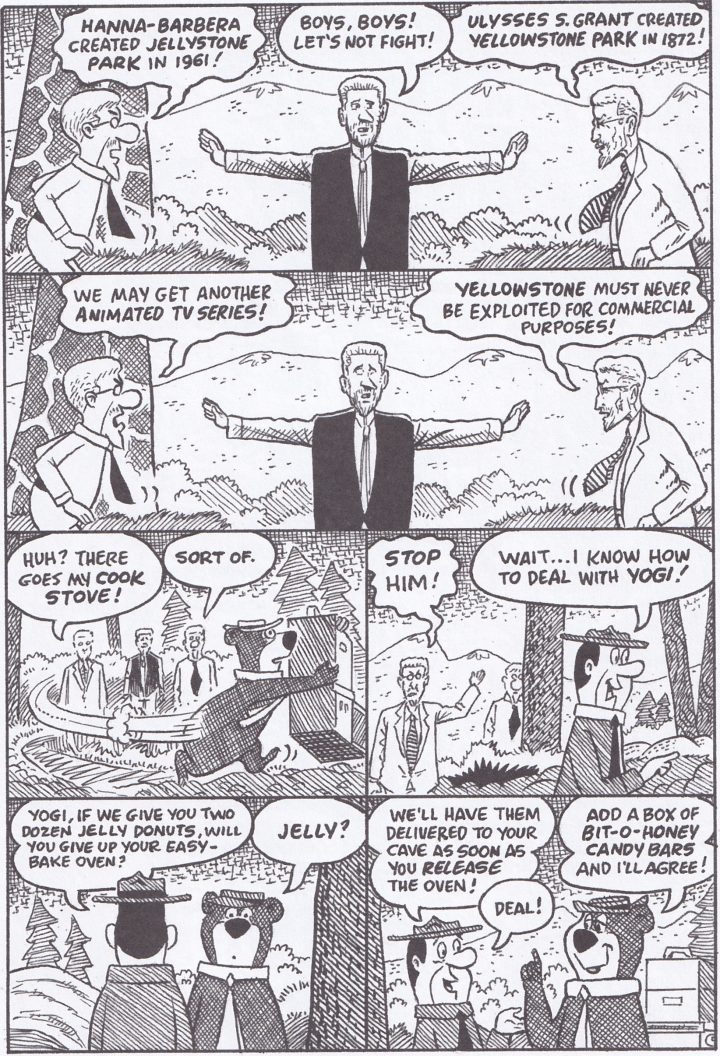
Elsewhere, however, he indulges in flagrantly fictional or fantastical passages that more traditional biographers would avoid like the plague. At one point he folds time itself, allowing author and subject to bump into each other on the Hoboken Ferry two decades after the latter’s death, while the epilogue brings them both face-to-face with a certain smarter-than-average cartoon bear who, Griffith concludes, would never have existed if his great-grandfather hadn’t made Yellowstone so famous (which is a reasonable point, actually). He even conjures an imaginary, and oddly poignant, encounter between Jackson and Zip The What-Is-It, a 19th-century carnival performer, and another influence on Zippy, whose real name was also (as any reader of Nobody’s Fool will recall) ... William. Henry. Jackson.
This isn’t meant as a criticism, however. It’s precisely this playful, self-reflexive take on biography that has made all Griffith’s recent books so enjoyable, especially for long-term readers attuned to the recurring themes and motifs he’s established over the past half-century. Nor does it detract from the ambitious scope of the book, which uses Jackson’s life as a springboard for a series of digressions on topics as varied as the history of the stereoscope, the ancient Anasazi people of Mesa Verde, and notorious French cabaret performer Joseph Pujol (‘Le Pétomane’), who could play La Marseillaise through an ocarina inserted in his anus.
Griffith’s style, which he once described as “a combination of Will Elder and Reginald Marsh,” has remained largely unchanged for the past thirty years. Cool, precise, and detailed, he animates every page with an expert eye for period detail, from the storefronts, cars, and diners of mid-century New York to the steamboats and dust-ridden frontier towns of the 1860s. Throughout the book, he seamlessly integrates his great-grandfather’s photographs into the narrative, from his earliest pictures of the American West to fascinating images of Korea, India, and Siberia taken during a world tour in 1895, all skilfully re-created in pen and ink. Avoiding any attempt at analysis, he lets them speak for themselves, offering readers a brief glimpse into the astonishing scope of his work.
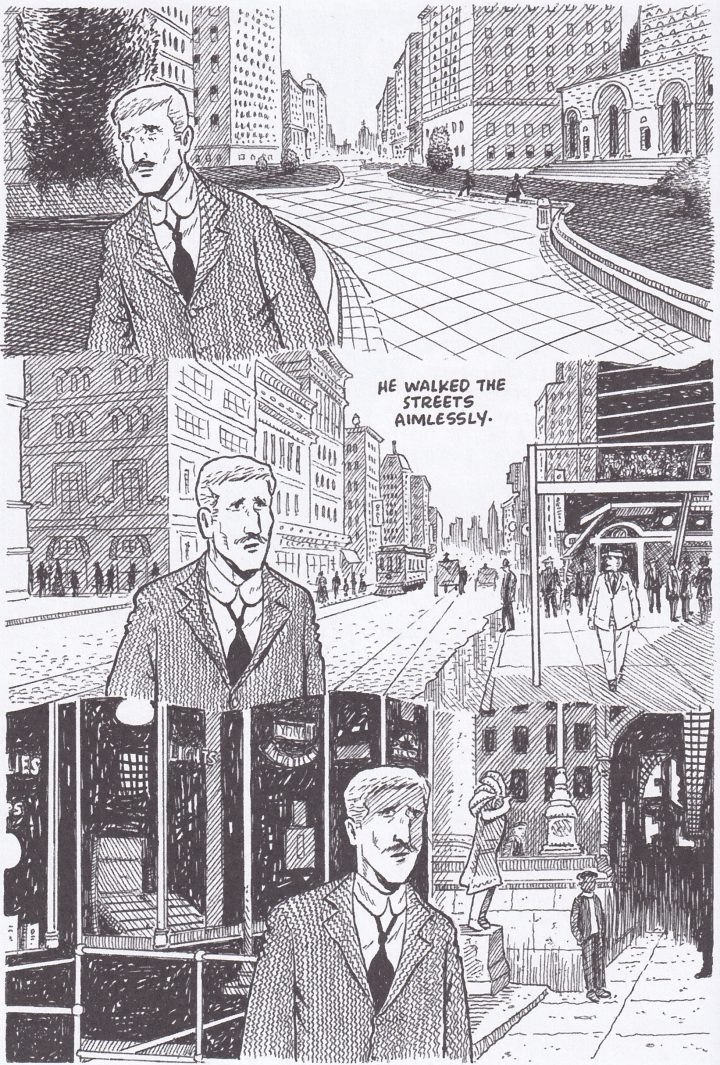
To his credit, Griffith doesn’t back away from difficult topics, devoting an entire chapter to Jackson’s role in encouraging the western expansion and the devastating effect this had on indigenous peoples. While his images played a pivotal role in popularising the West as a place of vast natural beauty and “picturesque” natives, they also helped open it up to tourism and settlement, which ultimately led to the decimation of native populations and their displacement from ancestral homelands. “I had to give grandpa a hard look,” he says at one point, cringing at the prejudiced, derogatory way Jackson wrote in his diaries about the natives he photographed.
For the most part, however, Photographic Memory is a deeply affectionate appraisal, and Griffith clearly has great admiration for this extraordinary man after whom he was named. As early photos of Jackson attest, the two even shared a distinct familial resemblance, which is subtly referenced here. When they meet at the end of the book (Griffith in his 80s, Jackson a decade older, both bearded and gaunt, with similar heads of white slicked back hair), the pair could almost be brothers. And finally, Griffith recounts an uncanny (but entirely real) moment when, glancing at a photograph Jackson took at Steeplechase Park in 1904, he finds a small detail that seems to prefigure the entire course of his own career. It’s a touching scene, forging a link between the two men across more than a century, and prompting a simple, but heartfelt, “Thank you, Grandpa!”
It’s hard to know what serious scholars of American photography might make of such a personal and idiosyncratic account of a figure like Jackson (let alone the concluding argument that he was directly responsible for the creation of Yogi Bear). But again, it doesn’t really matter. At the end of the day, this is a work that will appeal more to fans of the nation’s favorite Pinhead than the man who took the first photo of Old Faithful. Throughout the book, Griffith presents his great-grandfather as a modest man, eternally dissatisfied with any attempts at recounting his past, especially when they tried to exaggerate his achievements. “I just hope the truth will have the last word on my fleeting name,” he says to Bonney at one point. Photographic Memory might not be the last word on this remarkable figure, and probably doesn’t contain the whole truth about him. But, as a unique portrait of a true American original, it: surely contains a sort of truth. And perhaps that’s enough for now.
The post Photographic Memory: William Henry Jackson and The American West appeared first on The Comics Journal.


 Hello, my name is Jack Sparrow. I'm a 50 year old self-employed Pirate from the Caribbean.
No comments:
Post a Comment