


If I, as a reader, have one reading kryptonite, it is a short story collection. I struggle deeply with them, and will freely admit that it is a weakness of character, intellect, and perhaps even spirit. I wish I had a more intellectually driven reason for this — I would like to say that most authors struggle to build out cohesive collections which justify their existence as a single body, or that I have some high-minded notion of the novel as the superior medium of literature, but that would be a lie. Many of the short story collections I have tried and failed to complete are by writers whose artistic and intellectual merits far exceed my own, and who, I’m sure, do an excellent job with their collections. Instead I am afflicted by a wandering mind and attention, which, despite its constant bombardment by short form media and content, really needs a longer more singular work to latch onto in order to stay focused. Perhaps one day I may train my mind through some kind of ascetic, Batman-esque process.
But I have yet to transform myself into an avid short story reader, meaning me and the bookseller, editor, and cartoonist behind the new collection The Woodchipper Joe Ollman could not be more different kinds of readers. In the introduction, Ollman writes, “Short story collections can be a hard sell. But I love short stories. From the time I was a kid, Saki, O. Henry, Guy de Maupassant, Shirley Jackson — these were my lives. Especially the twist ending! My God, I loved the twist ending. … But, you know, things change. Eventually I embraced endings where almost nothing happens. Anti-twist endings really.”
Ollman is a fixture of the vibrant Canadian comics scene, having published several well received books including Fictional Father (Drawn & Quarterly, 2021), and This Will All End in Tears (Insomniac Press, 2007). His contemporaries include such titans as Seth, Kate Beaton, and Michael DeForge. Ollman also was the first cartoonist ever to be nominated for Canada’s Governor General’s Award, the country’s highest honor, whose nominees and winners include Rachek Cusk, Michael Ondaatje, and Margaret Atwood. Despite all of these accolades, the fact remains that I can list on one hand the number of short story collections I remember enjoying reading,1 and Ollman’s book faced an uphill battle with me as its audience.
Canadian indie comics, especially the work published by Drawn & Quarterly, has a rather rich history of quiet, understated stories in which “almost nothing happens,” the kind of short story you might read in a copy of The New Yorker. I have a real soft spot in my heart for such stories (I recently read and loved Seth’s masterpiece Clyde Fans, a work so mundanely still in its subject matter that I would be hard pressed to tell you any single defining piece of “ACTION!” that happens in it) so I was excited to crack open The Woodchipper.

While Ollman’s latest collection holds true to the thesis of writing stories in which almost nothing happens in the end, there’s much more action in each story than you might find in the work of other cartoonists of the school of inaction such as Harvey Pekar, or Adrian Tomine. The stories in The Woodchipper are a mix of uproarious comedy, neurotic drama, and depression. Each story, with the exception of the last entry, follows the foibles of a mundane protagonist as they cope with an extraordinary inciting incident (a renter found shot at a bed and breakfast, a near-fatal miss with a woodchipper, etc.). Ollman cranks the anxieties, insecurities, and neuroses of his characters high enough to put you on edge, but never so high that he loses his stories’ verisimilitude.
Ollman’s art style, scratchy and brightly colored, depicts his characters with the kind of quotidian ugliness that occurs when you look at a high-definition closeup of a person’s face. His style is an abject mix that's compellingly human in its normalcy, and repulsively ugly in its humanness. Sweat pours from pores, and snot drips from noses as people get worked up in the daily intensities of life. These are intimate portraits of people, but the intimacy is off-putting, like when a stranger sits too close to you at a bus stop. This eerie and unexpected closeness to Ollman’s characters sets The Woodchipper apart from his contemporaries, whose emotionally intricate portrayals of everyday people can feel cozy. Ollman’s work is also distinct from the works of someone like Tomine or Pekar because they make no claim to memoir, autofiction, or journalism. Instead, Ollman’s stories are unabashed fiction that don't tread into the world of sci-fi or fantasy.
While the tone of each story is similar, Ollman’s protagonists and their trials are distinct enough from each other to make the book a page-turner. Each inciting incident is gripping and novel enough in its own right that you forget Ollman’s initial warning that nothing will happen in the end, and instead find yourself on the edge of your seat, wondering what strange or horrible thing will happen next.
Ollman is also a loyal devotee of the nine-panel grid, which he uses for every page of The Woodchipper. While standardized grids often create a normal standardized rhythm, lending comics a calm tone, Ollman’s grids have the effect of ratcheting up the tension of each of his stories. His neurotic, panicky characters become trapped in the prison bars of his nine panel arrays, boxed in even as they become more and more frantic, as in “Nestled All Snug,” in which a woman gets trapped in the employee bathroom of the bookstore she works in.
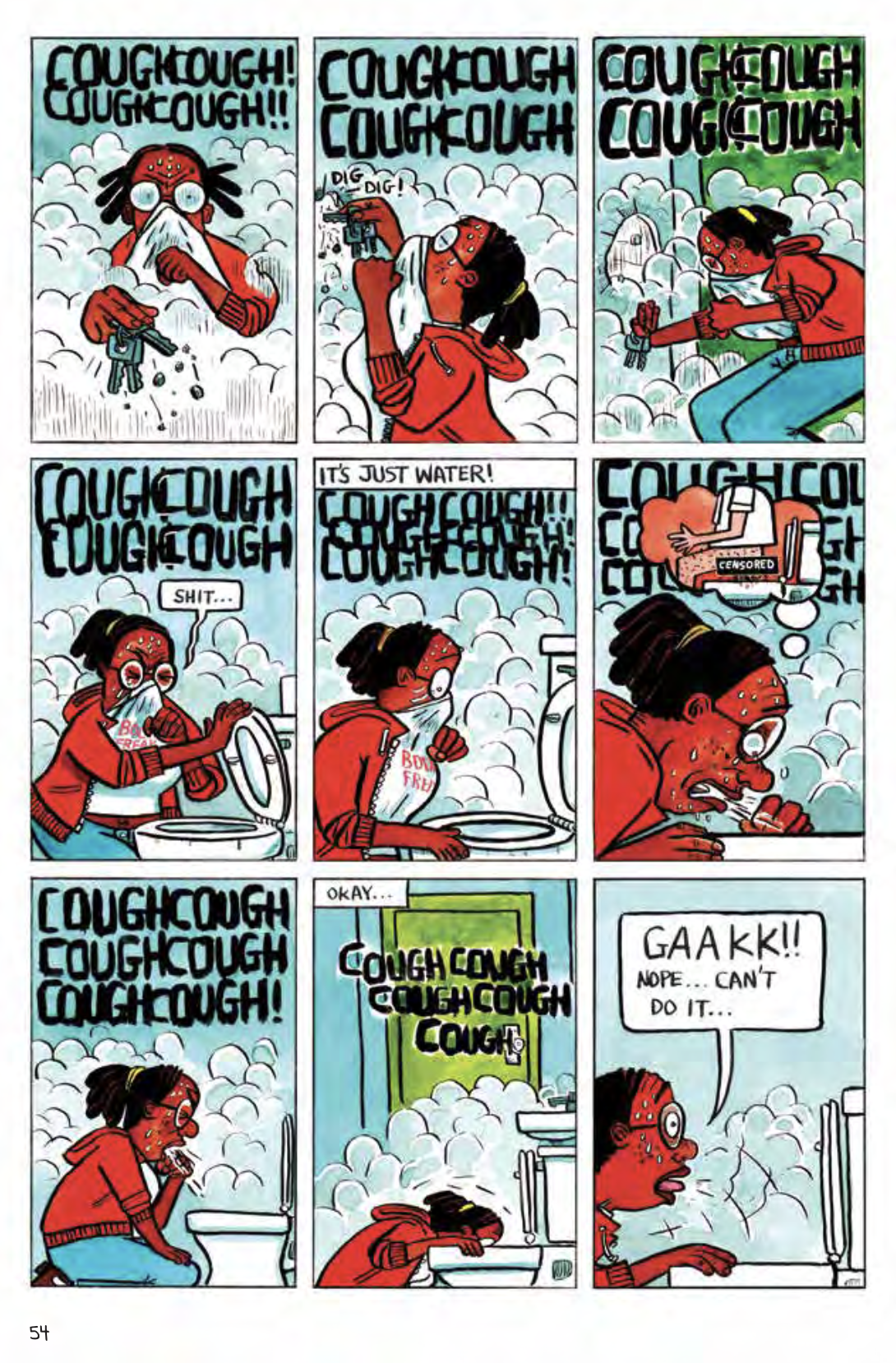
Ollman’s lettering, which is often unruly, crams the page, overlapping and scrunching to fit within the confines of the panels. They compete for space with his characters, their dialogue, and the suffocating drywall which clouds the space of the employee restroom. In other stories, characters’ worries build in unwieldily large captions which force characters to slump or slouch so that their bodies can fit in the awkwardly shrunken frame.
It is easy to assume that the graphic design aspects of cartooning (the cartography of the panel, the design of the lettering, etc.) exist outside of the sphere of a comic character’s influence or perception, that characters are not aware that they exist in nine-panel grids, or that their lettering boxes them in tighter and tighter. If we consider the two as having an influential relationship, it is often one in which character influences design, not vice versa. An angry character’s word balloon might be spiky, while a disgusted character’s might ooze and drip. Ollman’s willingness to notably change his characters’ morphology to accommodate his layouts suggests that this relationship is mutual, the influence going both ways. In The Woodchipper the page itself is a hostile environment for its characters.
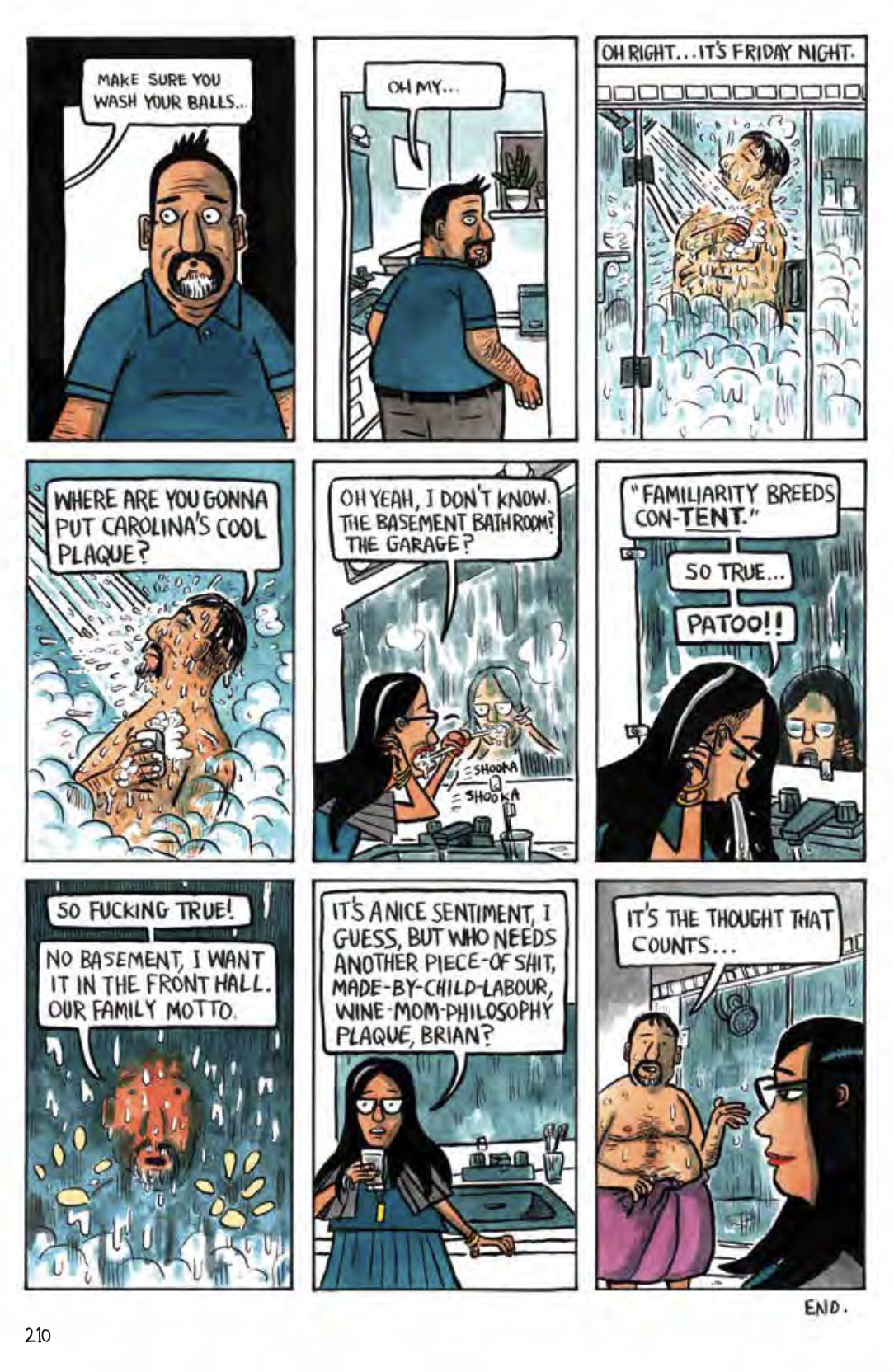
Anxiety is the ruling tone in most of the stories in this collection, and for the most part Ollman is able to keep his premises odd and fresh enough that the sentiment rarely becomes overwhelming or monotonous, though the collection could have benefited from Ollman exercising more emotional range. The final story, titled “The Thought That Counts” is a much quieter, more emotionally mature story. It follows Brian, a middle-aged father, as he plays host and dutiful spouse to his film professor wife Kaye, who is celebrating her birthday with a college faculty party at their home. The story still hums with a similar anxiety to all the others, Brian is concerned about his weight gain, his sex life with Kaye, and his seething loathing for all her pretentious coworkers, but the anxiety is subdued. Where the worries and fears in “Nestled All Snug” or “The Woodchipper” are of existential importance to their protagonists, the final installment is more stable. Despite his concerns, the most powerful emotion in Brian’s head turns out to be love of his family.
The story's (and the collection’s) final page depicts a sweet, if quotidian moment of easy intimacy between Brian and Kaye as they prepare for bed in their now quiet home. Despite its harrowing emotional milieu, The Woodchipper is an essentially optimistic book. If nothing really happens when you’re expecting disaster, you have found a pretty happy ending.
The post The Woodchipper appeared first on The Comics Journal.


 Hello, my name is Jack Sparrow. I'm a 50 year old self-employed Pirate from the Caribbean.
No comments:
Post a Comment