

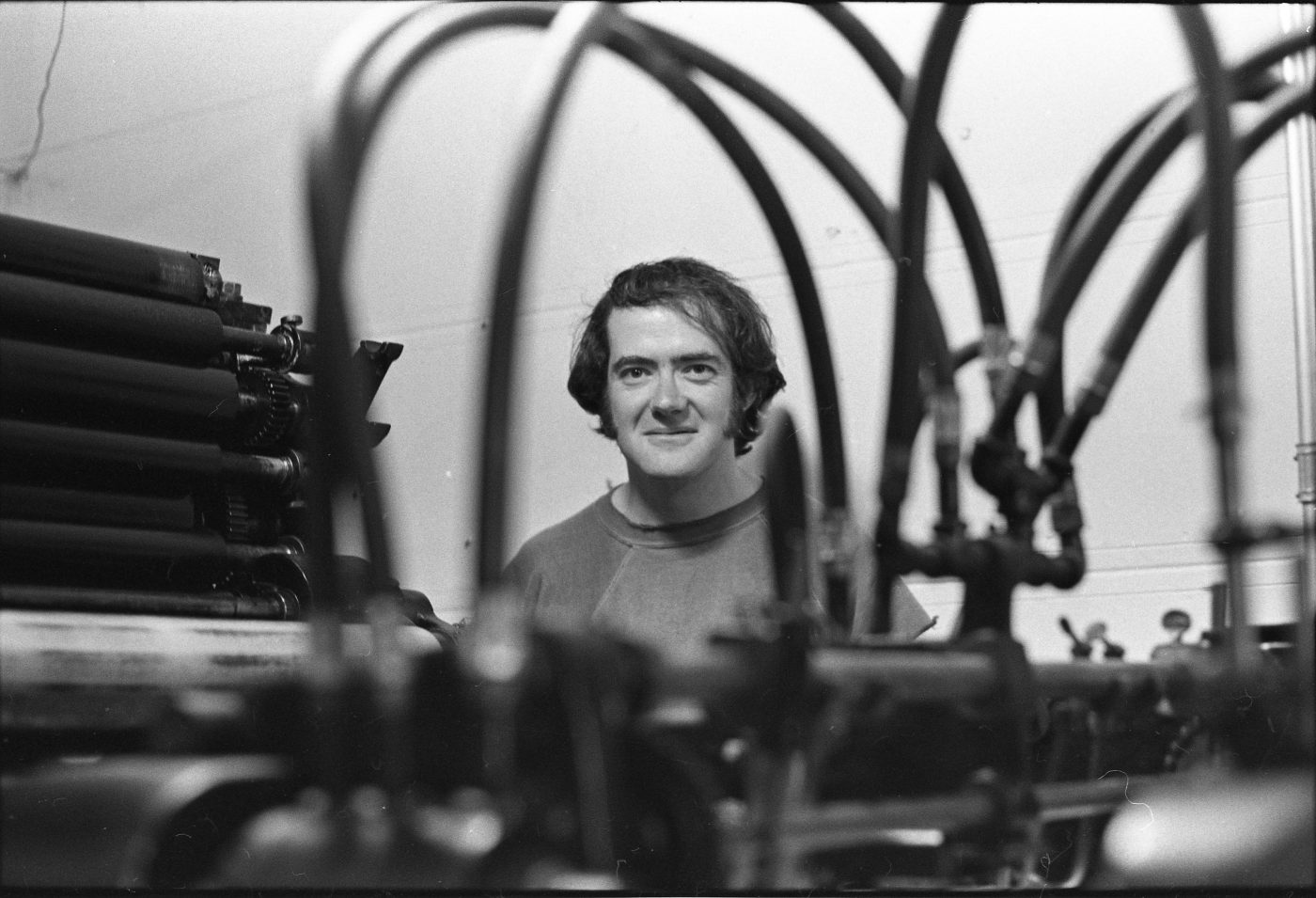
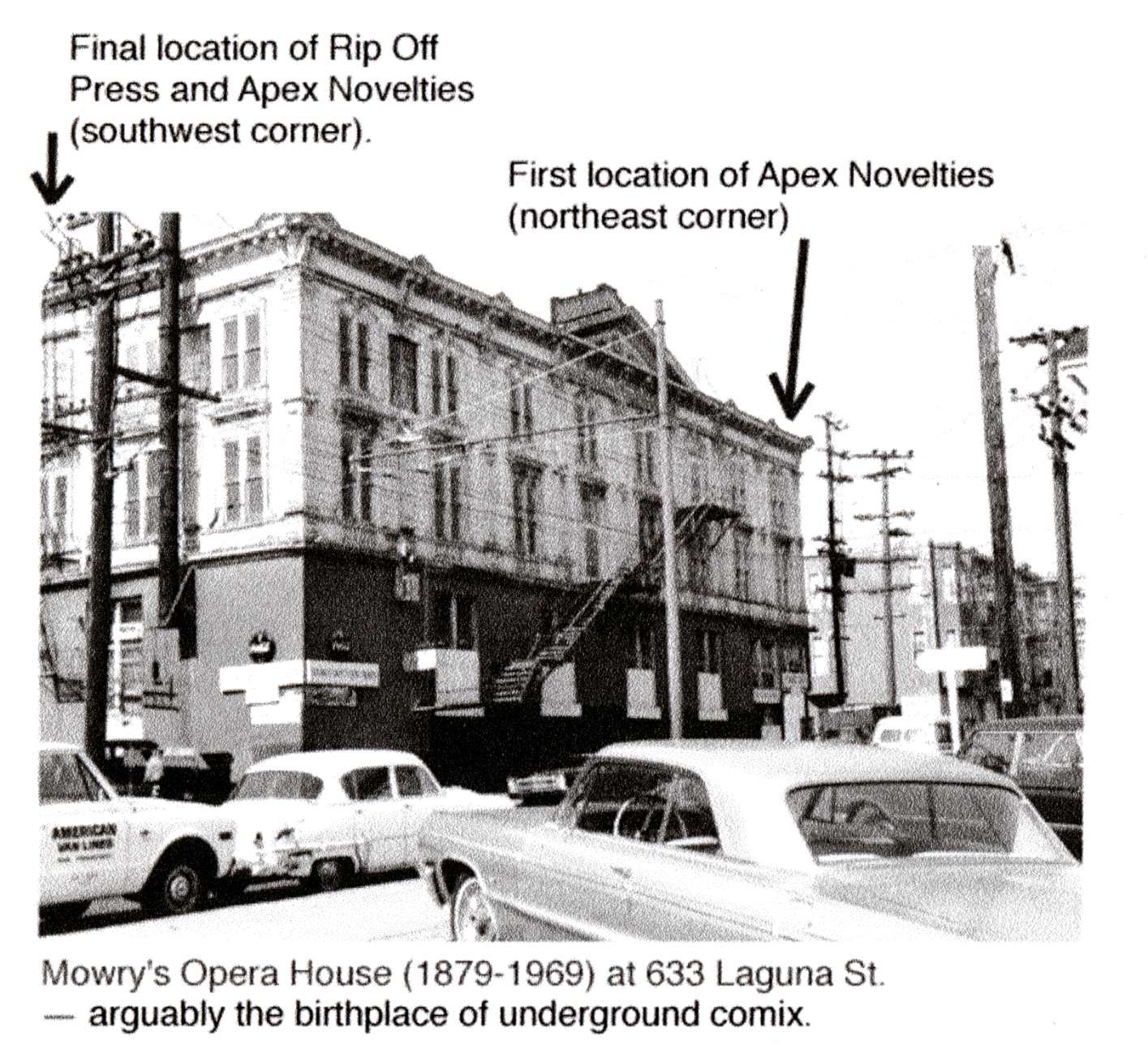
Don Donahue was one of the background characters during the construction of underground comix way back when. Everyone knows he was the publisher of Zap Comix #1 but lost the contract for subsequent issues of Zap to Print Mint. He had a small printing press that he bought from beat poet Charles Plymell but it didn’t cut the mustard when someone ordered 100,000 copies. “I tried to learn how to be a printer, which I did, but not really soon enough,” he once confessed. Nevertheless, he continued to be a strong influence on the comix movement.He also published and distributed Snatch Comics and Jiz and Cunt at his print shop in the loft of old Mowry’s Opera House in the Fillmore District. Street vendors would come to him to buy them by the dozens and resell them for much more at Fisherman’s Wharf and North Beach and other tourist spots until a fire put him out of business in 1969. Snatch got busted in Berkeley and went to trial.
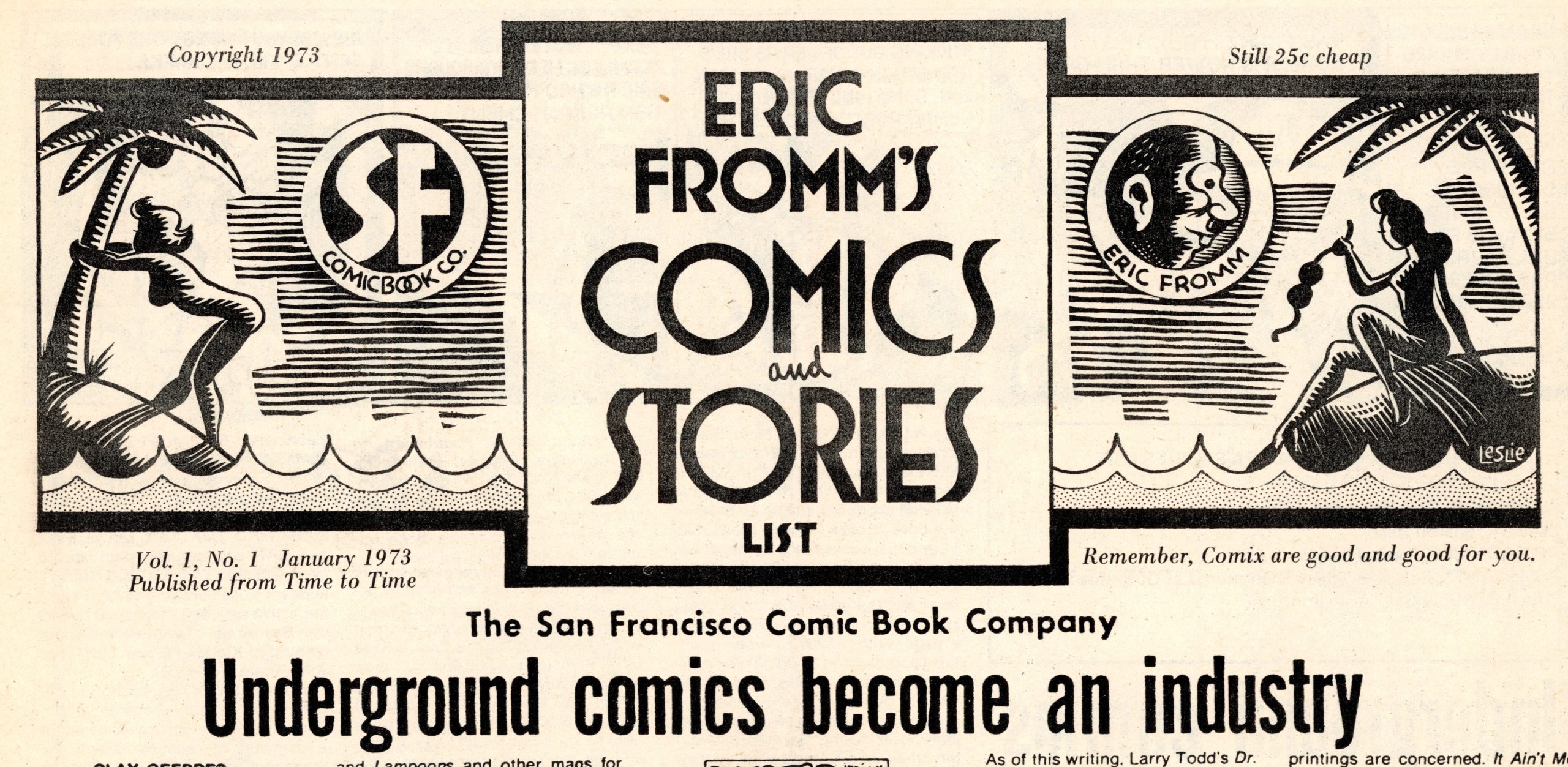
He then became a counterculture printer for hire, working for a variety of clients on a larger press in the basement of Good Times Collective. When I first went to the San Francisco Comic Book Company in 1972 and met Gary Arlington, he sent me to a storefront around the corner on Valencia. It was the clandestine headquarters of Eric Fromm’s mail order catalog. All the display windows were covered over with brown paper and the door was locked. Don Donahue answered my knock and welcomed me in. He’d gotten a heads-up call from Gary.
It was a big place with several impressive looking printing presses. The biggest one had tubes all over it. He shut it off and we sat down to talk. I taped and photographed him for an hour while he filled me in on a lot of the holes in my underground comix research. When we were done, I asked him if he had any of the Plymell Zaps for sale. He pulled out a big box full of them and I asked him how much he was selling them for. He said ten bucks, but I wasn’t sure I had that much to my name. If I’d known I would have written a check for 30 copies right then and there and hoped I could cover it in a few days before it bounced. Instead, I was inwardly scoffing to myself at his price. A fifty-cent comic book? Who would pay ten bucks of a copy of Zap?
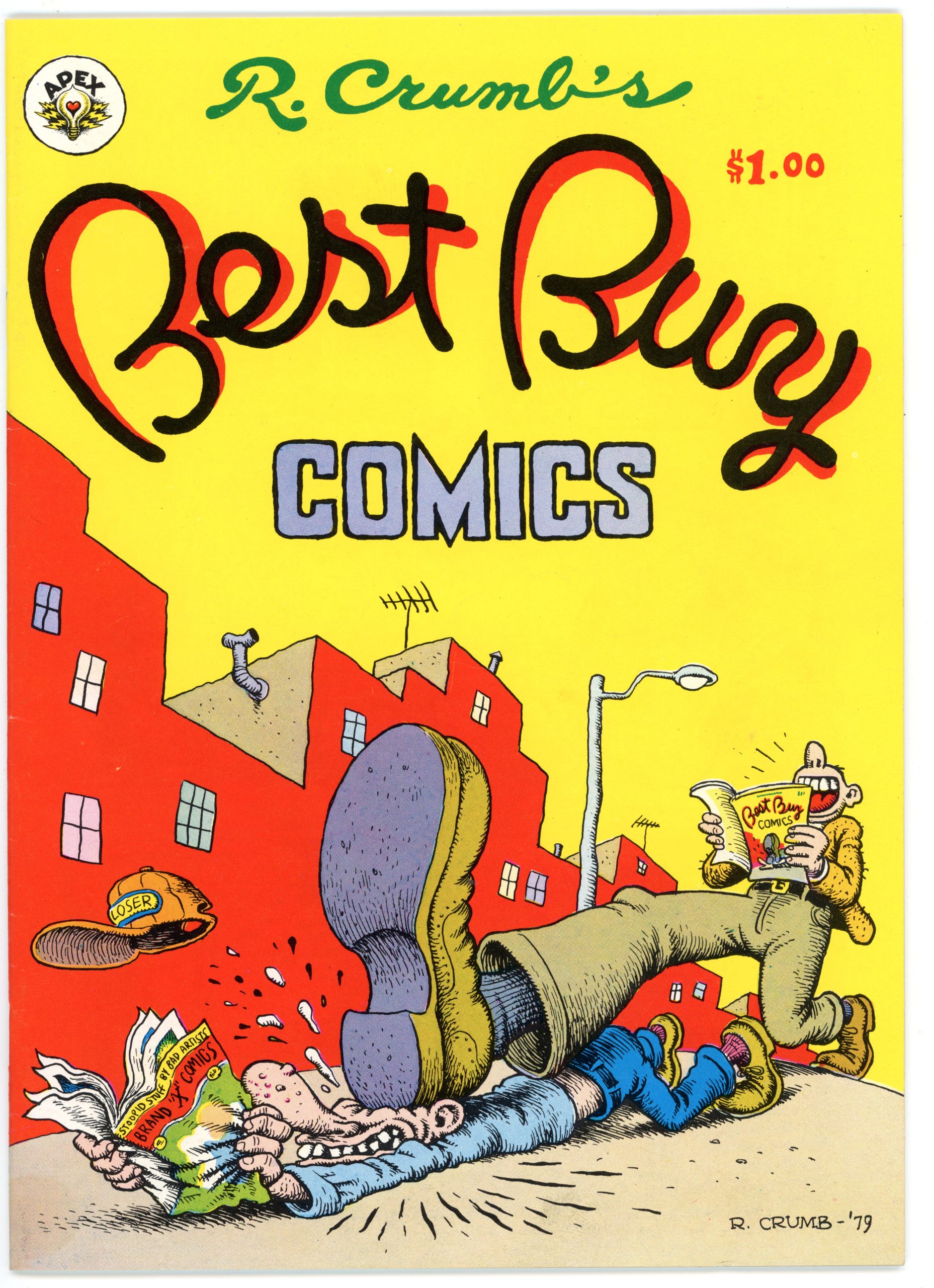
He became less of a printer and more of a publisher over time, one who was very selective about the comic books and cartoonists he worked with. He published Your Hytone Comics, Black and White Comics, Best Buy Comics, Ace Hole Midget Detective, Funny Aminals, Trots and Bonnie, and co-edited the Apex Treasury of Underground Comics. There were many more along the way but his last publishing venture was a limited edition of silkscreened posters he made in the 1990s.
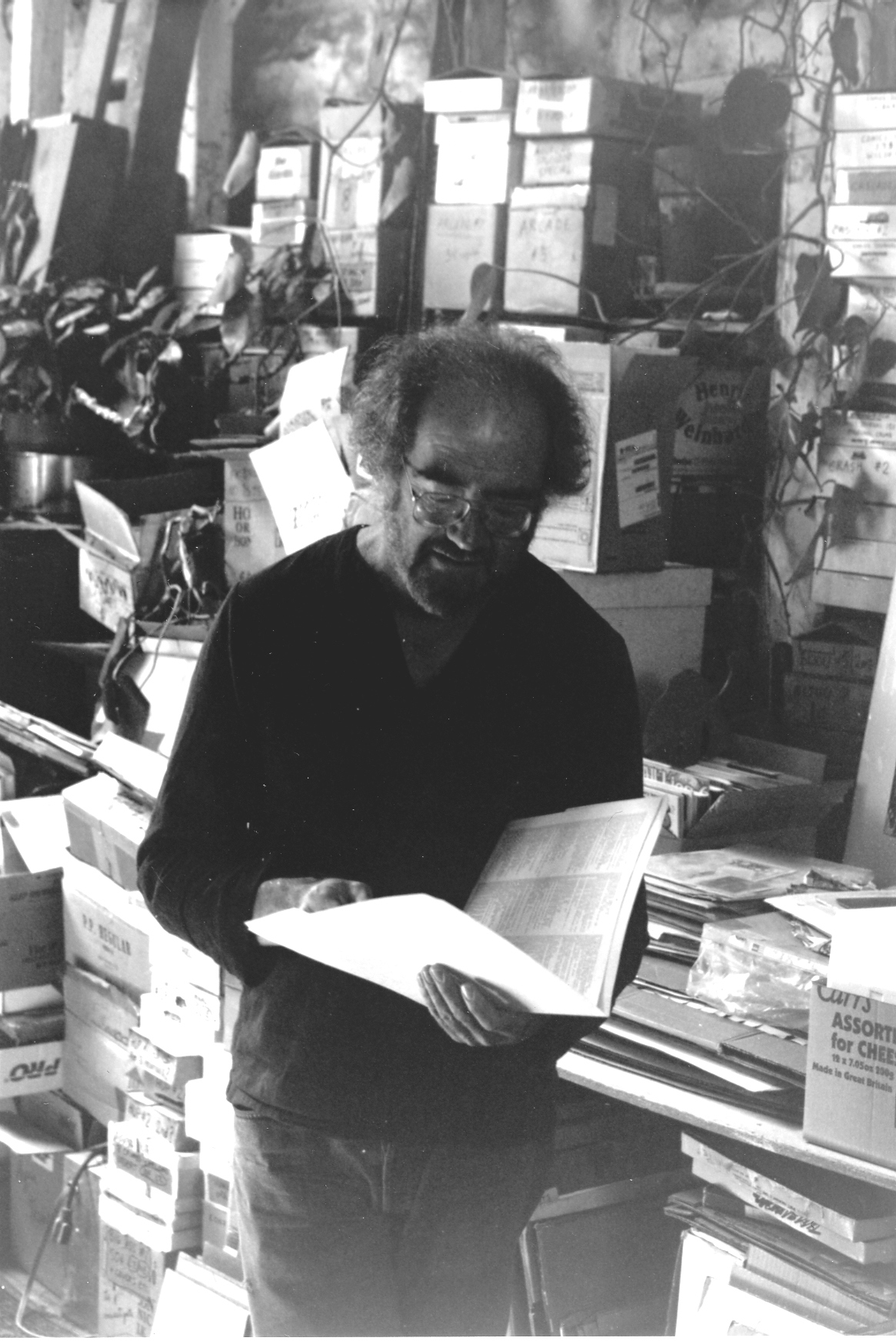
Donahue moved his operation to Berkeley’s Dakin Warehouse in the 1980s, where he lived and worked and became a dealer of rare comix and counterculture ephemera. He advertised his wares through a series of four-or five-page mail order catalogues which were sent to an exclusive and eager list of clients. He was the person widows called when they wanted to sell their late husband’s counterculture comics and tabloids. He was a treasure trove for serious collectors, and the primary source of first-hand information for comic historians like me. I still have a few more questions I waited too long to ask him.
The last time I saw Don Donahue was on Sept. 16, 1998, at his warehouse hideaway. I scheduled an interview with him when I was in town, and S. Clay Wilson came along with me for the ride. We dropped his girlfriend Becky off at UC Berkeley and then went to Don’s place on Adeline Street, near Stewart. There was a half-finished mural on the warehouse wall. We rang a bell on a string, Ernie came down to let us in, and we walked up to the third floor and through a room full of pinball machines and toys to Don’s office in the back.
The spacious room was a crowded repository of relics from the Age of Aquarius. Alphabetically labeled cardboard boxes were stacked against the walls and arrayed on industrial shelves … Cascade, Cheech Wizard, Class War Comix, Collected Trashman, Cornfed, Cunt … catalogued and ready to be shipped across the world. Ivy grew through sunlit gaps in the crumbling brick and mortar exterior wall. Don sat behind a battle-scarred desk looking a bit like a medieval monk in the scroll room of a monastery.
“Last year at this time this whole place was packed to the ceiling with boxes,” he said with a grin. “Every day was Christmas for a year. I still haven’t gone through it all.” He bought Bob Sidebottom’s entire underground collection and was in the process of re-selling it piece by piece to his mail-order clients.
Wilson was in his paranoid period about pictures, so he told my wife Ginny not to take any photographs that day. We sat around Donahue’s desk and I asked questions while Wilson egged him on for better answers.
PATRICK ROSENKRANZ: Wilson and I were talking on the way over here about key dates for the first Zap.
DON DONAHUE : February 25, 1968, was the day we started selling them. The printing process took quite a while.
S. CLAY WILSON: I had the portfolio and I went to Plymell’s house. I met you there, right?
DONAHUE: At Plymell’s, then we went over to Crumb’s.
WILSON: When I came in the door, clankety-clack, clankety-clack, pages of Zap, pages of Zap.
DONAHUE: That involved the story about how I let the covers run off onto the floor. That’s one of the more colorful stories.
WILSON: That’s what you were doing when I came in, holding a bottle of brandy and watching the press.
Have you read this? It’s titled Zap’s First Printer on Robert Crumb by Charles Plymell. He gives you a nice credit. He says ‘Knowing all the complications that vex an experienced printer, I looked with sympathy at that chaotic scene, but he excelled in chaos. It served him well. A true Man of the Comix.’
DONAHUE: That was marvelous. Where can I get a copy of that?
Here, have mine.
WILSON: Plymell used to go to orgies.
DONAHUE: He had orgies in his place there.
WILSON: Ink-smeared strumpets.
DONAHUE: I never got invited to any of those orgies. It’s probably just as well. Can you imagine sitting around with …
WILSON: “They probably weren’t sitting. He was in pretty good shape then. He wasn’t the rumpled satyr he is today.”
Donahue told us about the time in 1963 when he “fell in with some bad company” and used the last of his National Merit Scholarship money to score some weed in Tijuana. They got busted as soon as they crossed back over the border. It was the same day that President Kennedy got shot.
“We scored a kilo of grass from a cab driver and drove back across the border and got arrested. It all happened very quickly. We got it over with very fast," he said. "So, the next morning we were in the San Diego country jail listening to all the Kennedy stuff on the radio. I spent two and a half weeks there in the county jail before I got bailed out.”
He also recounted the emergence of the underground press from his perspective as a typesetter at the Berkeley Barb.
DONAHUE: Max [Scherr] hired me away from the Berkeley Post for less money, but it was less work too and it was more glamorous and he let me drink on the job.”
Sounds ideal. Women came with the job, too, and the latest batch of Owsley or whatever?
DONAHUE: Yeah, the Barb was a magnet for young runaways. When Max started putting out the Barb, nobody paid any attention. Max was this old commie, this old leftie, putting out this little paper. Nobody gave a shit about it, except the other old lefties or the young lefties, the red diaper babies. Very shortly, history started catching up with him. All kinds of protests happened about the Vietnam War and Max had this paper that became the organ for this. Suddenly Max had a great thing going.
Donahue did the math and saw how profitable an underground newspaper could be. Scherr fired Donahue for being a bad influence when he told the rest of the staff about it. Don decided to publish something of his own so he could get rich like Max, and sought out an artist he admired, Robert Ronnie Branaman. They put together a tabloid sized art newspaper called ˆ It might have made money if he’d been able to funnel them into the hippie street vendor distribution network all over the Bay Area, but the printer Howard Quinn took at closer look at them when the job was done and decided they were obscene. He had them all destroyed except for the half dozen copies Donahue snatched off the pallet.
DONAHUE: Branaman was a big hero of mine. He was this Beatnik artist, one of the first people to paint pictures and draw stuff on LSD when hardy anyone had heard about LSD yet. Branaman did sort of draw cartoons, but they were like no cartoons that you had ever seen before. They didn’t make too much sense. I wanted to put out something by Branaman. He lived up on Potrero and had a ménage. He was the prototype. He was one of the people who created the image that the hippies copied.
WILSON: Copied? It was happening everywhere man.
DONAHUE: No, he’d been looking like that for a long time and acting like that and doing those things for quite a long time. He suggested I get in touch with a printer friend of his for advice and that was [Charles] Plymell. I went over and saw Plymell and then the week after that probably, because things happened so fast in those days, I picked up a tabloid, it was the East Village Other and saw something by Crumb, who I assumed was this guy living in New York. The first time I saw anything by Crumb I thought he must be an old man, because that’s the way it looked. He was this crazed old guy. Maybe he’d been drawing for comic books back in the ‘20s or ’30s and he went berserk or something. Plymell had seen something by Crumb in Yarrowstalks. Yarrowstalks was the first underground thing that published Crumb.
Wilson lit up another joint but Don declined. We spent a few more hours discussing his career, his relationship with Dori Seda, and the time the cops confiscated the human head that he got from a friend of Wilson in trade for an eight-legged pig. The Berkeley Drug Task Force took it away and wouldn’t give it back. Then Don played a song on the piano for us that he’d written, “Bedtime Is Never Too Soon When Your Sweetheart’s the Man in the Moon.”
Wilson negotiated the purchase of a pile of Pork and Barbarian Women comic books with Donahue, who quoted collector’s value but Wilson wanted cover price. They eventually came to agreeable terms and we said goodbye and left.
I drove my station wagon across the Bay Bridge and Wilson was being uncharacteristically quiet. Finally, he spoke up.
“That was a golden moment back there with Don,” he said, looking at me intently to see if I realized it as well.
“It was,” I agreed. He seemed satisfied with my answer and offered me one of his Barbarian Women comics.
In more recent years, I spoke to Don on the phone and exchanged emails with him, but I’ll remember him best in that setting where I last laid eyes on him, eccentric and individualistic to the end. He was never someone who needed a parade held for his accomplishments. He worked quietly and steadily over many years to publish work that he considered worthy of his efforts. After the underground movement peaked, he filled another role as the go-to guy for artifacts and information, and in this way left his legacy spread out across the world.
Donald Richard Donahue, May 18, 1942 to Oct. 27, 2010.
The post The last time I saw Don Donahue appeared first on The Comics Journal.


 Hello, my name is Jack Sparrow. I'm a 50 year old self-employed Pirate from the Caribbean.
No comments:
Post a Comment