

America loves a fad, and American capitalism causes any craze to be commodified. Mania has been monetized many times over the past century. Everything from Davy Crockett to Elvis to the lambada has given those in search of a quick profit impetus to they flood the marketplace with cash-in trinkets, media and food. One of the most common manifestations is the imitation of a successful person, place or object.
When Mad (the comic, not the later magazine) hit the newsstands in 1952, it was an experiment — a way for editor-writer Harvey Kurtzman to increase his paycheck. Its first three issues are uncertain meanders: shaggy-dog stories that parody the publisher EC Comics’ penchant for surprise-endings. With artwork by Jack Davis, Wally Wood and Will Elder, Mad’s early phase brought out the manic, obsessive side of each cartoonist’s skills. The vital ingredient — salient satires of popular culture — broke through with issue 4’s “Superduperman!” It was the first of a series of pungent break-downs of the flimsy premises, false promises and ironies just under the surface of mass media sensations.
Once Kurtzman struck parody pay dirt, a swelter of Mad imitations flooded the market, just as EC’s horror titles inspired a wave of oft-bizarre copycats. Most of these faux-Mads failed to get the gist of Kurtzman’s wit. It wasn’t the same to have characters make goofy faces and wild gestures; nor was it enough to crowd the backgrounds with detritus — some humorous, much laden with poor puns and flubbed references. Mad was cool, calm and collected, though its artists exaggerated and mutated the source material. Its copycats were like nervous uncles at a family reunion, hoping that: a) their comb-over will fool everyone; and b) that if they tell enough jokes, people will like them.
This is a motif of the American cash-in: make it look like the real deal, but lose all the aspects that make the original worthwhile. These faux-Mads have been analyzed, reprinted and discussed, as if that might make them legit. Two notable examples of this Mad fad have recently been collected in quality hardcovers. Part of Fantagraphics’ EC Library, My Gun is the Jury collects all stories from EC’s own Mad rip-off, Panic, illustrated by Jack Davis and Wally Wood. And the latest volume in FB’s revival of 1950s comics by pre-Marvel Atlas, Snafu reproduces the three-issue run of Stan Lee’s take on the magazine version of Mad. Both volumes have their moments — to a surprising degree — but more often show the “funny uncle” mode of pop satire. The two books, in tandem, suggest some battle of the bands-style showdown for fake Mads.
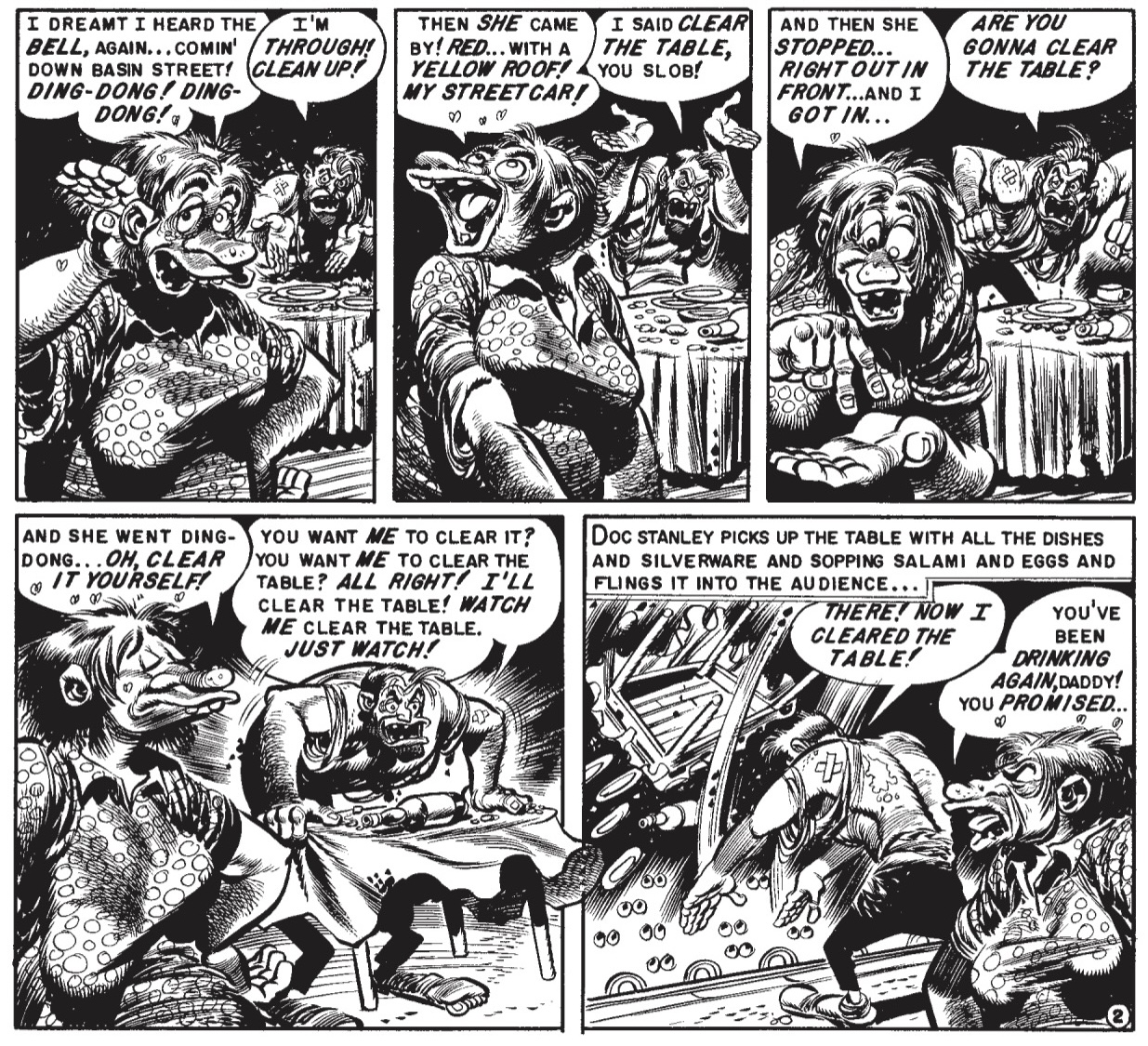
Panic was Al Feldstein’s hey-I-can-do-this-too version; it ran for 12 issues and lasted into the dawn of the Comics Code. Kurtzman folded the comic-book Mad just ahead of the Code and relaunched it as a black-and-white, 64-page magazine with a July 1955 cover-date. Kurtzman sought to minimize the comics content and mimicked the slick modern layouts of newsstand magazines. Though well-illustrated, text was the driver of Mad v2, and its aim was a more sophisticated variant on the college humor magazines that, in part, inspired it. It was soon a success, but before the ink was wet on the first issue, Stan Lee and his staff were at work on their less clever, more street-wise Snafu.
Panic, despite its retinue of EC’s artists, failed to equal the comic-book Mad, just as editor Feldstein’s tenure on the magazine version, after Kurtzman walked due to his unpractical and reckless demands, never hit the heights of his predecessor. Al Feldstein couldn’t write humor with the same poise and lacerating wit. Its writing and art mug more than amuse, and Feldstein’s editorial command appears to be “make it look funny,” without the internal logic — the connection of ideas and images–that make the Kurtzman versions succeed, and which inspired the future of comic books and satire in America.
The absence of Panic’s other star artists — Will Elder in particular — makes this volume curious reading. It looks like the comic-book Mad but it isn’t. The guidance that Kurtzman gave his artists is absent. Thus, Jack Davis is reduced to drawing “funny” rather than with the genuine wit that distinguishes his work for Kurtzman. The genial Davis, hard-working and easy-going, did as told. Kurtzman pushed him past his safe zone and got inspired work that continues to dazzle. Davis’ frenetic efforts on the Mickey Spillane parody, after which this volume is titled, from Panic’s debut issue, are as over-the-top as his horror work of the era. (In line with that material, Feldstein’s script has a twist ending that’s still outrageous and shocking.)
Davis needed guidance and structure to do his best work, and, until Jack Mendelsohn took over and improved the scripts, he just drew funny, filled his panels with visual clutter and hoped for the best.
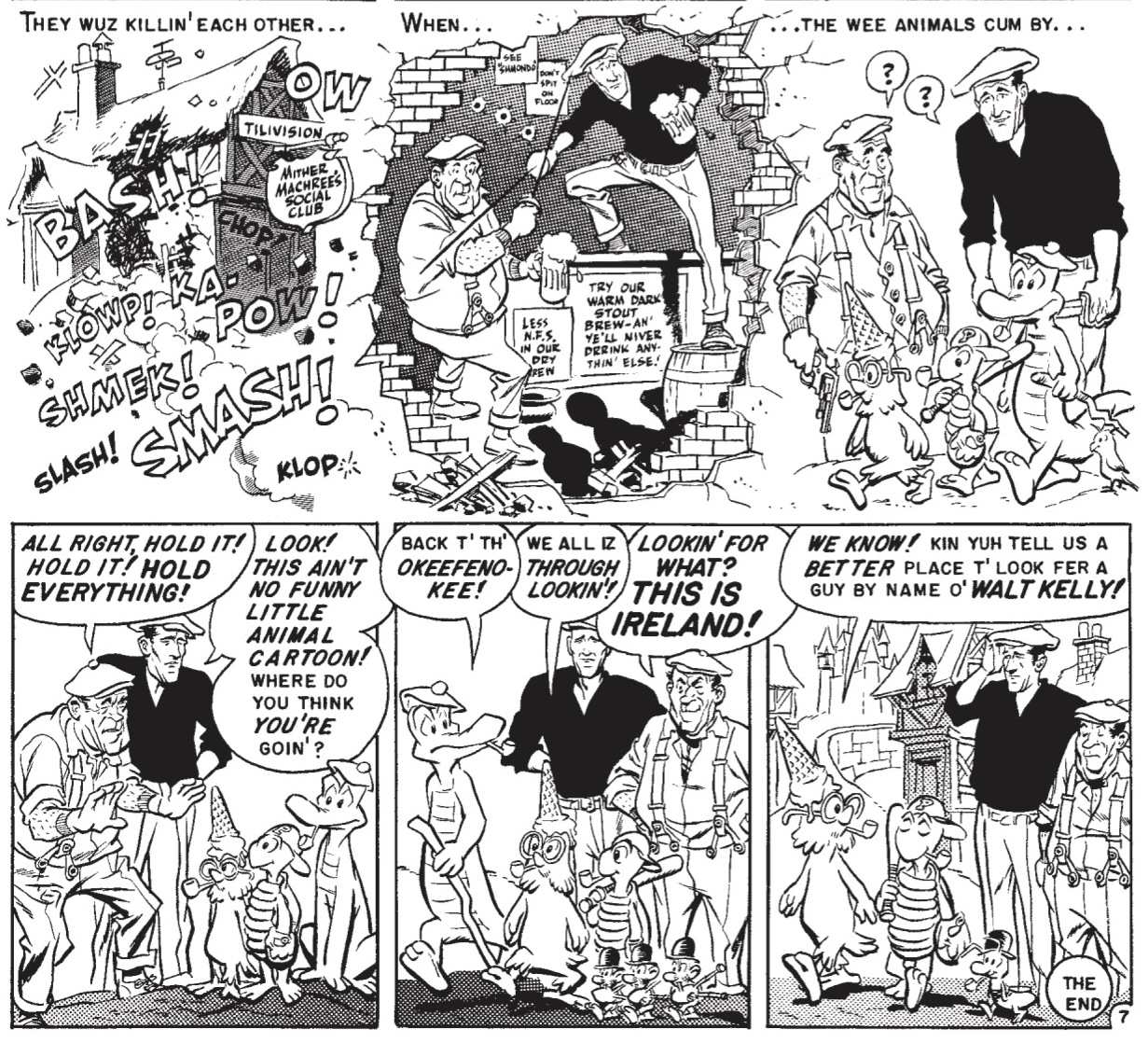
Wally Wood fared better. He was given Panic’s movie spoofs — an essential feature of the Feldstein Mad yet to come. His flair for caricature is the delight of these stories, which are mostly miss with an occasional hit. His renditions of late-era Humphrey Bogart, all wrinkles, squints and scratches, are marvelous.
“Hindu,” a spoof of the 1953 John Wayne Western Hondo, is a template for future Mad magazine movie critiques. Its characters, aware they’re in a 3-D movie, comment on the faddish format and on the motifs and tropes that riddled Hollywood Westerns. Feldstein’s endowment of self-awareness makes his movie send-ups more Pirandello-ish than Kurtzman’s. This sense of pre-destination is fascinating, and it makes the so-so visual and verbal quips more bearable.
Late in the series’ run, the humor improves. A parody of the James Stewart drama Strategic Air Command begins with a dissertation on the gimmicks used by Hollywood studios to attract an audience diluted by television. Its first three pages show that Feldstein at last understood the observational humor that made Mad great. The spoof that follows is merely filler, enlivened by Wood’s cartooning, but there’s a genuine bite to that three-page prelude.
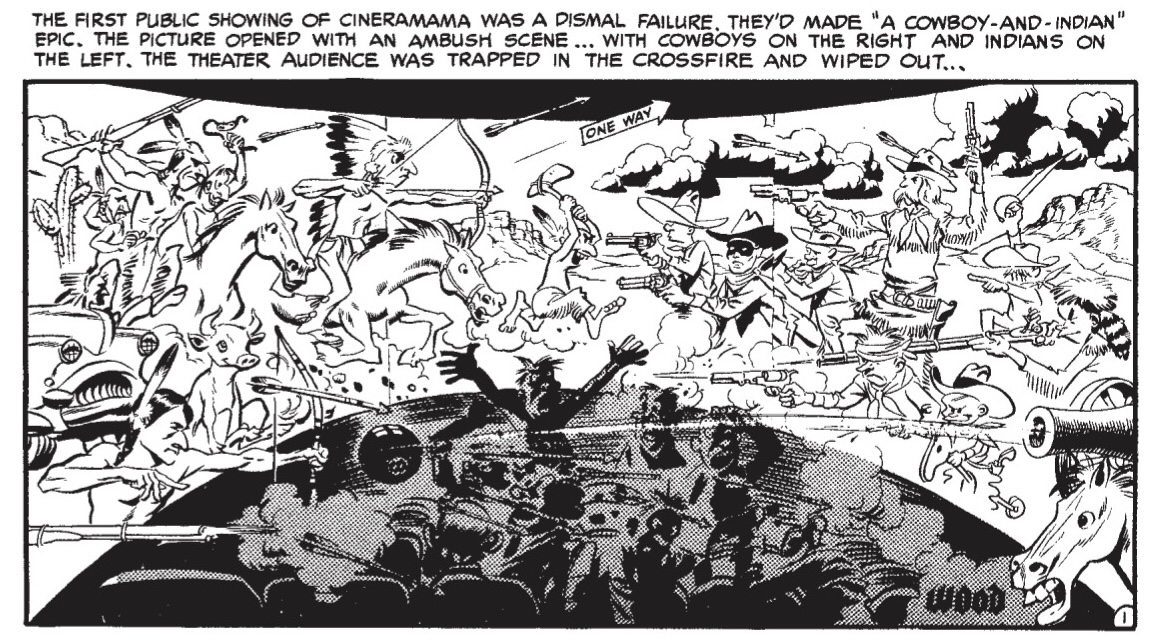
Wally Wood’s sense of cool imbues his Panic stories and he relishes the caricatures he creates. His sketches of actor James Whitmore, in a take-off on the giant-ant SF thriller Them!, pale besides Al Hirschfeld’s pen-and-ink portraits, but they’re a fine low-culture tribute to this film, stage and TV journeyman. As Mort Drucker would do in his Mad movie send-ups, Wood gets Whitmore’s essence with a few deft lines.
The Feldstein Mad is further presaged in a Jack Davis-drawn parody of Popular Mechanics magazine. It adapts the Kurtzman style of mostly-text-with-illustrations and makes some smart decisions; its repetition of ads for Tijuana Bible-style naughty comic booklets (“the kind men like”) evokes genuine laughs as the five-page feature plays out. With all its text, it makes for half an hour’s often-amusing read.
Panic isn’t a sham; EC’s quality control made that impossible. It reminds me of store-brand products — they sorta-kinda taste like the name brands, and are acceptable, but leave something to be desired. It is good to see Feldstein redeem himself after a clumsy start.
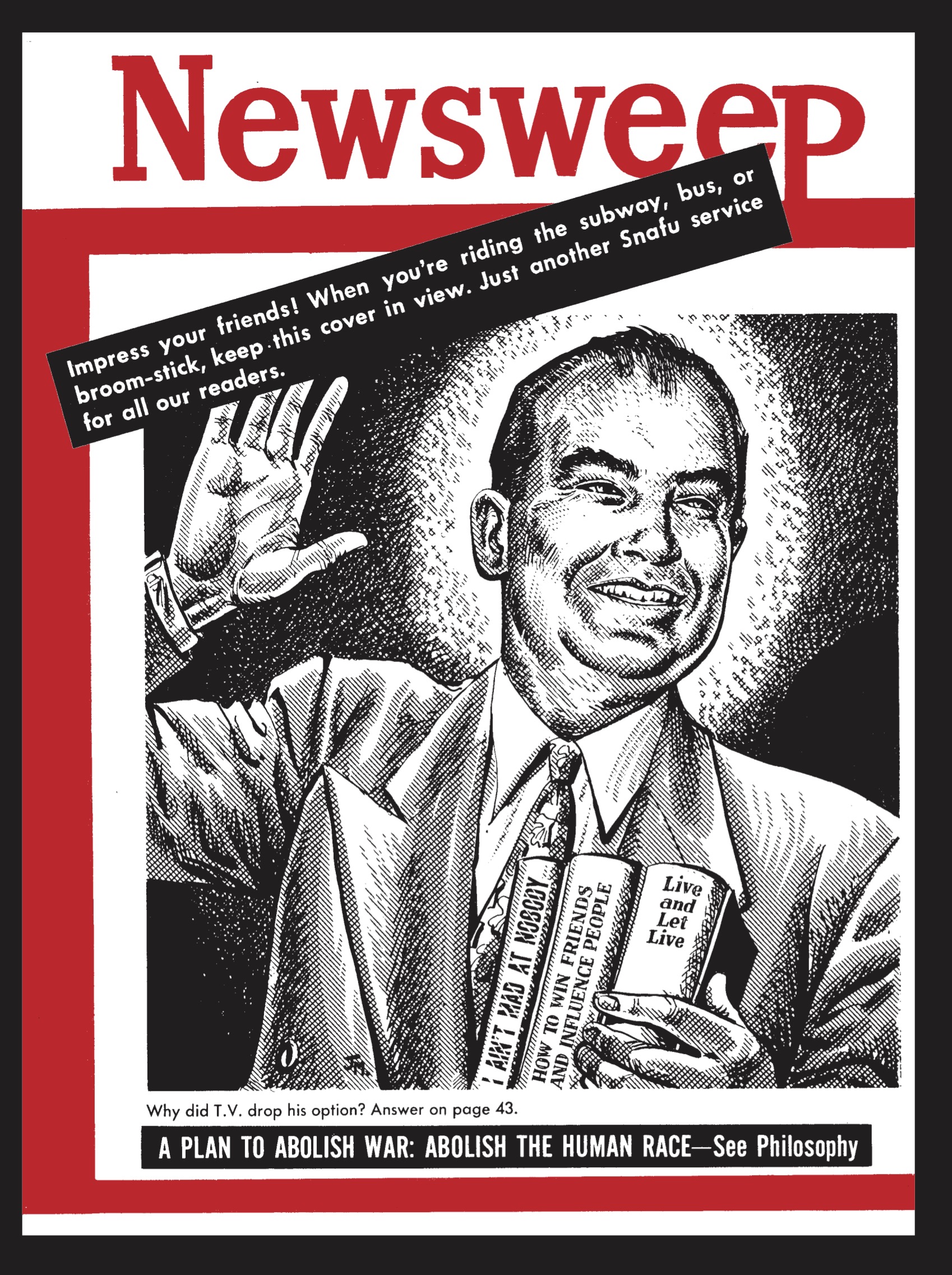
Snafu is an odd harbinger of future Kurtzman projects. Stan Lee edited (but I’m sure did not write) most of the magazine’s material. I’d love to know who really scripted the stories. Atlas didn’t yet have EC’s star artists; Russ Heath, Joe Maneely and John Severin provide most of the cartoon/illustration material. The street-wise smart-aleck style of Lee’s early Marvel Comics super-hero dialogue and captions is evident, so the editor embellished whomever’s scripts with his own easy-going cynicism.
I was surprised how often I laughed while reading these three issues, despite the painful spans of captioned photographs (blatant filler) that increase with each issue. Marie Severin, who does some artwork, was the magazine’s designer for the last two issues. She brings an elegant sheen to the low-budget layouts; Snafu was fortunate to have her on hand.
Russ Heath is a likable cartoonist, and his caricatures make a spoof of the 1955 juvenile delinquency film Blackboard Jungle a standout. Joe Maneely, Stan Lee’s star artist in the 1950s, struggles to be witty and plays with his art style in surprising ways. Had Snafu continued, Maneely had the potential to be an outstanding humorous cartoonist.
As with his work for Mad, John Severin is serviceable but unmemorable. His Roy Crane-adjacent style isn’t apt for parody or satire. It just kinda sits there and looks nice but just fills in frames and pages.
Kurtzman would resort to funny-captioned-stock-photos in his final satire magazine, the micro-budgeted Help!, in the 1960s. The effect was no better than what congests the pages of Snafu. Lee’s artists often corrupt the stock images with amusing bits of humorous vandalism; those are amusing and worth a look.
One piece that equals Feldstein’s Mad is the two-page “Do You Watch Those Midnite Television Movies?” in issue #2. Its clever use of inset photographs and comic art serves a purpose: to comment on the careless, constant interruptions of commercial breaks on late-night TV. It sets up its point, tees off and exits as the impact settles. Well done, whoever wrote this!
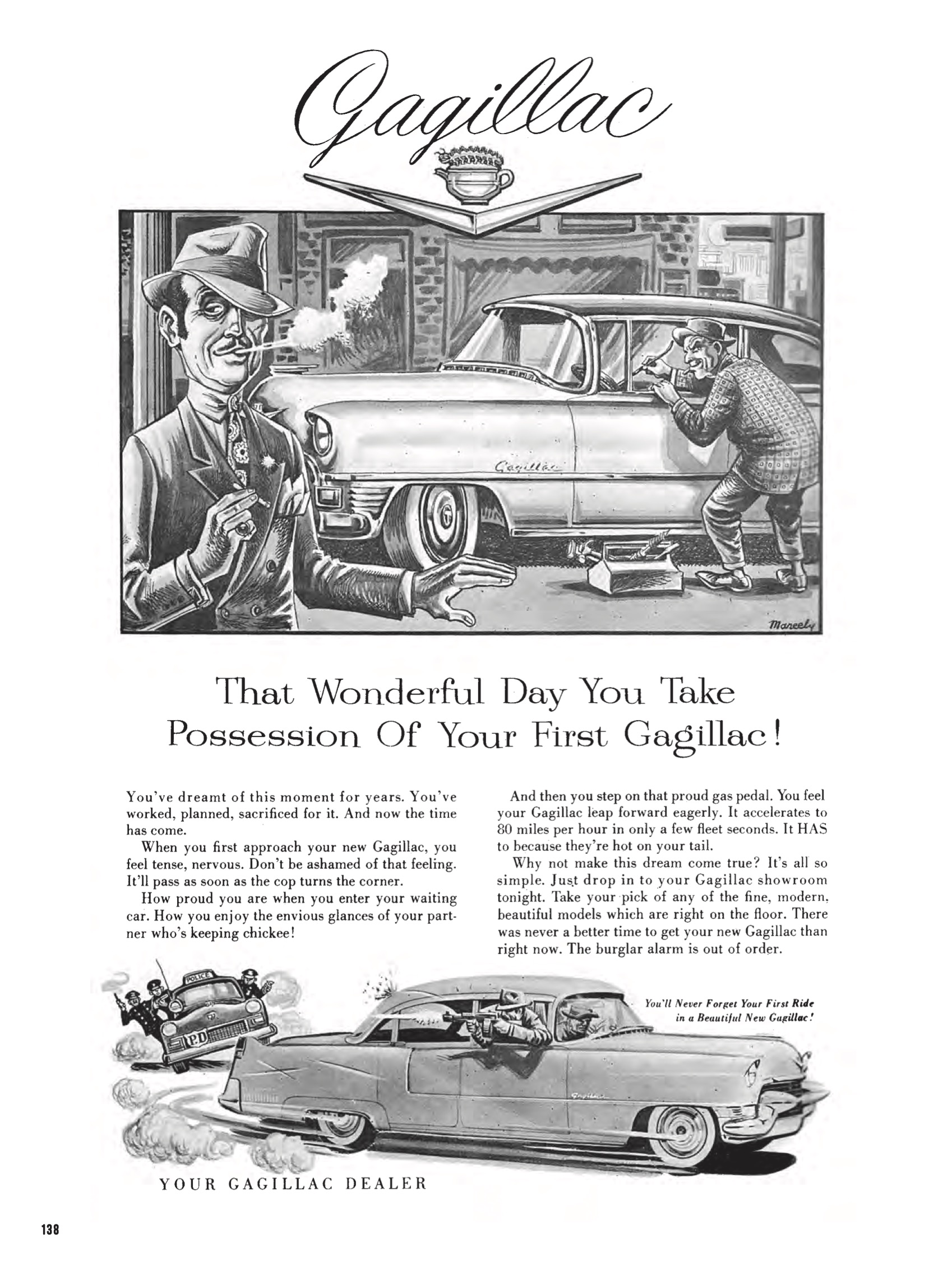
A shared virtue of these two elaborate books is their window into 20th-century life and culture. The good, bad and ugly are in abundant display, played for sarcastic laughs and vaudevillian shtick. If you can get Mad out of your head as a comparison point (easier said than done), the content of these books have a certain charm. They are robust examples of the great American cash-in.
It remains an insistent dynamic of modern life; now we have artificial intelligence to produce the equivalent of a Panic or Snafu. (Example given: those error-and fiction-laden “answers” that are the first response to any question you ask of the Internet.) I’d rather have human beings do these simulacra.
The contents of both hardcover books revel in their creators’ flesh-and-blood flaws and virtues. No one here hoped to create work of lasting value; this was hit-and-run consumer capitalism on the middle of the bell curve.
The post The Mad Panic Snafu: An American moment of hit-and-run consumer capitalism appeared first on The Comics Journal.


 Hello, my name is Jack Sparrow. I'm a 50 year old self-employed Pirate from the Caribbean.
No comments:
Post a Comment