

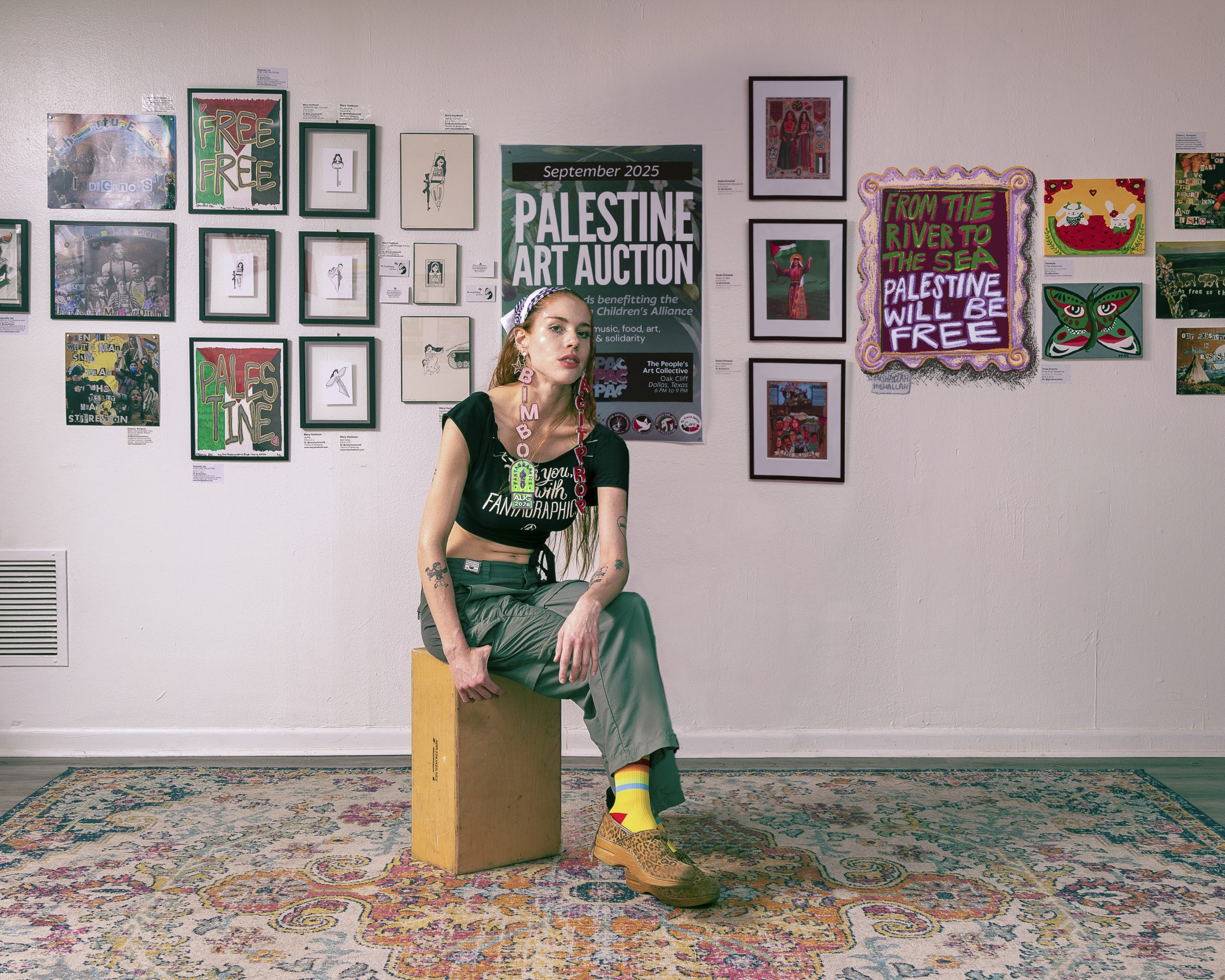
In 2020, Raquelle Jac’s comic “Misguided Love” escaped containment from NOW #9 and threatened to infect the world with its colorful chaos — and possibly chlamydia. This delightfully unsubtle, 45-page tome smacked you over the head with Big Feelings in the form of an id-fueled, nightmare/fantasy of urgent, unfiltered storytelling. Five years and 360 pages later, Jac has returned to rattle our eyeballs with Bimbo Agitprop.
For such a bold debut, Jac enters our late-April Zoom interview with politeness and trepidation. She has grown and changed since this book began to take shape, and the book has grown alongside her, shape-shifting in color, medium, and form so that reading it straight through feels like a visceral, co-evolutionary experience.
Growing up split between two abusive Texas homes haunted by Y2K-anxiety branded Jac’s childhood like a hot iron. She dutifully reproduces her worldview of that time on every page, down to the exact label on the powdered milk her prepper mom bought in bulk. Encyclopedic entries are devoted to some of the DIY healing technologies employed by her family, such as the “frequency machine” and “blood machine” — tools so obscure that she could not locate photo references. She impressed upon me that her work in local Marxist-Leninist political organizing is a rebuttal to the right-wing conspiracies she soaked in as a child, a way to caretake in a world that has treated her poorly, and has led to some of her proudest achievements to date.
Our chat touched on trauma, faith (and the fear of), and the desire to be a good person. In conversation, Jac could be hesitant, taking a beat before responding to my questions. Words then came in a deluge as she mentally and verbally circled the point she wanted to make before landing on it, all the while doubling back, questioning her rationale mid-sentence, and clouding her salient observations in self-dismissive filler words. Like her art, there’s so much crammed into one thought that it takes a moment for your eyes to adjust and locate all the exquisite details.
Survival isn’t always pretty. We aren’t our best selves when backed into a corner, but in Jac’s case, the resulting art is visually mesmerizing, raw as fuck, and deeply relatable on a human level, whether you’ve ever set foot in Texas or not.
This interview has been edited for length and clarity.
RAE WHITLOCK: Even though this book is about some really hard things, when I'm reading it, I keep thinking, "This looks so fun to draw." Your style shifts and changes, but I feel it's clear that there's a lot of love going into each page and each image you create. It also seems wildly time-consuming! What keeps you interested and invested when you're working on something that is going to take so long?
RAQUELLE JAC: I think a lot of what drives my art is emotion: rage, righteous indignation, and love, or what I have experienced that I called love, like infatuation. These emotions that are so overpowering. I know this is sort of a cheesy answer, but it's like, I have to make the art, I have to make the comic, or else. Honestly, I've alienated a lot of people in my life, and I think part of that is just because I haven't had time to make comics. I haven't had time to actually put these emotions on paper, and my emotions have to go somewhere, and they go places they shouldn't.
I see posts from cartoonists being like, "Well, I'm starting my next book, so see you all in two years." We have this really time-consuming craft, and we have to go into our little hermit alcove and hide for a while and work, and then we want to come back out and still have friends. It can be challenging for others living a more consistent lifestyle.
Yeah, it's reassuring to know that that's like a quintessentially comic artist experience because when I was working on the book, I had just moved. The pandemic happened, which sort of precluded finding a community. I found some sort of community in California, but then I moved back in with my sister. I got COVID, and there were after-effects, and that was when I got the bulk of the book done. I didn't really do anything; I didn't talk to anyone. I was also messaging people and being like, "Hey, do you want to hang out?" and then thinking, Oh wait, I actually want to — or not want to, but I need to — work on my book. It feels really good to pour so much effort into something. When I was working on the book, I put each page on my wall in my room at my sister's place. It was just covered in the pages of the book, and it felt really good to see that progression.
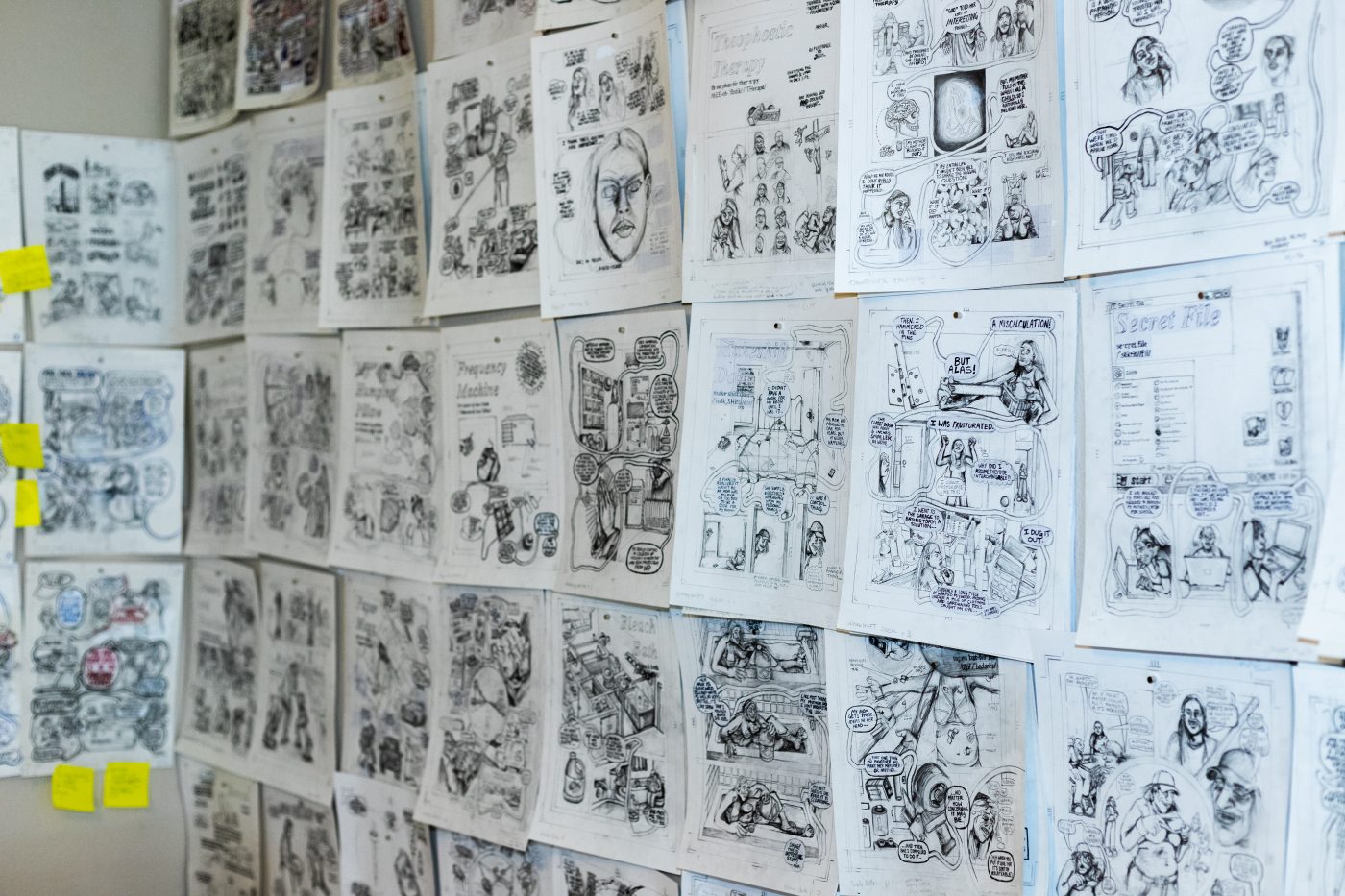
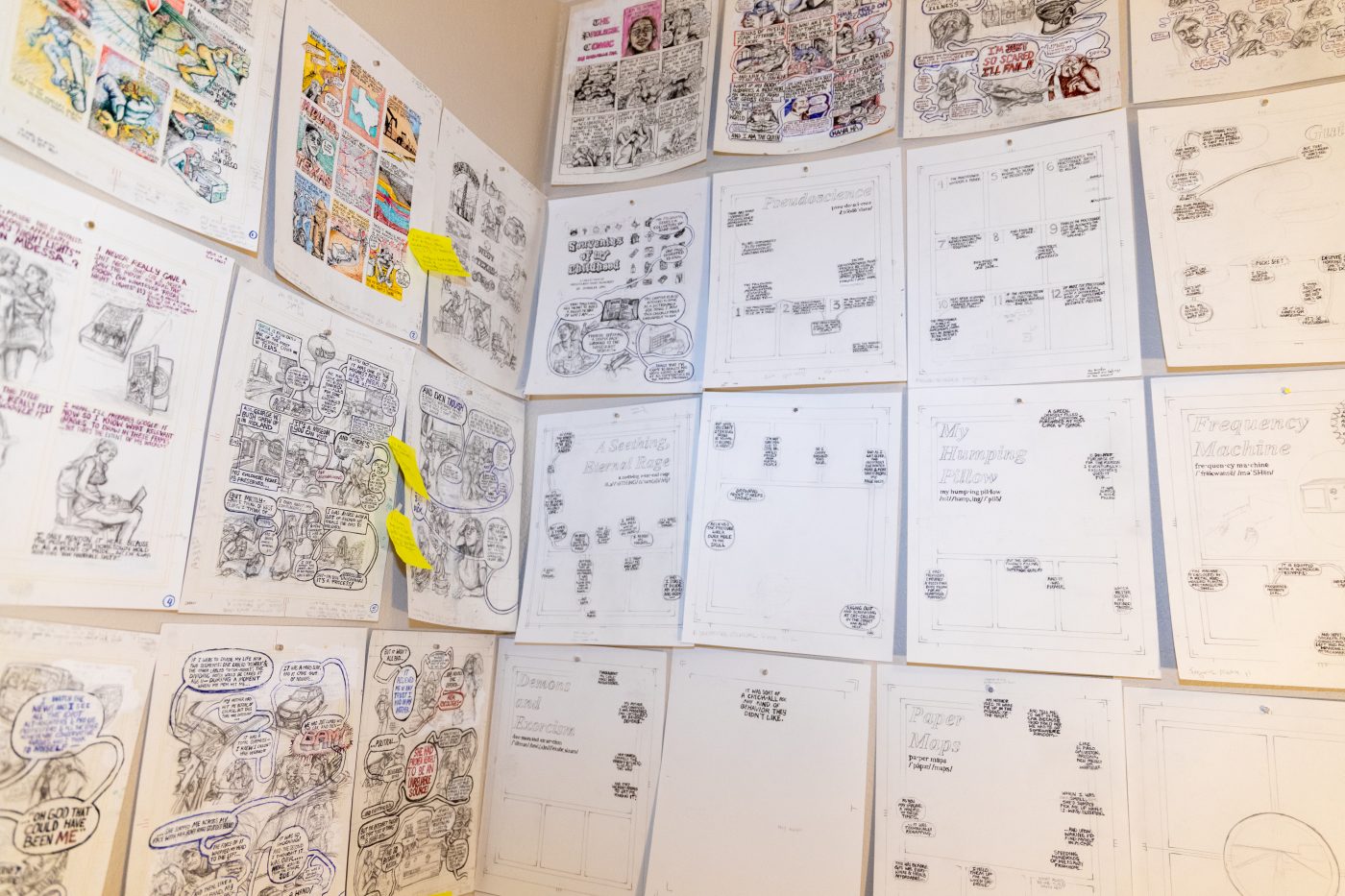
Did you draw this linearly? Is the order that you created it in the same as the published order?
It is, except the "fun stories" section was rearranged by the editor, and I think that that was a good call.
Stylistically, it looks like it was done in order because it changes. The way you have paneled your pages changes a lot: the colors and the tools you're using. Can you talk a little about that decision-making process?
I think you can tell that I'm figuring out how I want to move forward through the book. The “mom stories” formatting changes completely with “Dad Stories” and Dad's House. In the Mom's House portion of the book, I used the encyclopedia format because I grew up reading the World Book Encyclopedia. I was thinking about how to tell these stories about being at my mom's house, and there are so many different things that made me think, I don't know if people will know what that is, a frequency machine. That was such a big part of my childhood, but people won't know what that is, and so I can't talk about how my mom was just lying on the couch, zonked out, holding onto these cylinders. I can't talk about that without first explaining what those things are. In the first part, I was going to have a glossary of little vignettes that explain what those words are, and then go into an actual story with stuff at my mom's house, but then the definitions pages just became stories.
There are so many iterations of your own voice within this book. There are different pens and typefaces that you're using, different viewpoints. There's a lot of whiting out, redacting, self-censoring, crossing things out, and you as the narrator popping in and being like, "Well, that was stupid of me." What is your editing process like?
It never stops — like, it never, ever, ever, stops. Even sending it to the printer didn't stop me. I freaked out one day, and I was like, “We need to take this out; we need to take this out right now, I would really, really, really like this page to go away.” And like, "No worries if not" but also, I'm going to send four emails about this, so, it never stops. I know myself, and I know that my voice can be very self-righteous. When journaling in high school, I would write over and over and over again,"I hate myself, I hate myself." The self-criticism can be grating, because it's like, "Wow, like this person is thinking about herself all the time." Self-hatred and narcissism kind of go hand in hand. You're thinking about yourself all the time because you hate yourself so much. I would read it over and over again, and be like: Does that sound self-righteous? Does that sound like I'm a victim? Something I have been thinking about a lot is the unwillingness to see oneself as a victim, even when that might be accurate. Why is that such an issue? So many people are victims of so many different things, and everyone has a right to be pissed off and sad about things.
So part of you is looking at these pages and being like, "Do I sound like a victim? That's icky", and then part of you is saying, "Well, maybe I am a victim, maybe it's okay to be a victim, and the language around being a victim is the problem." Is that right?
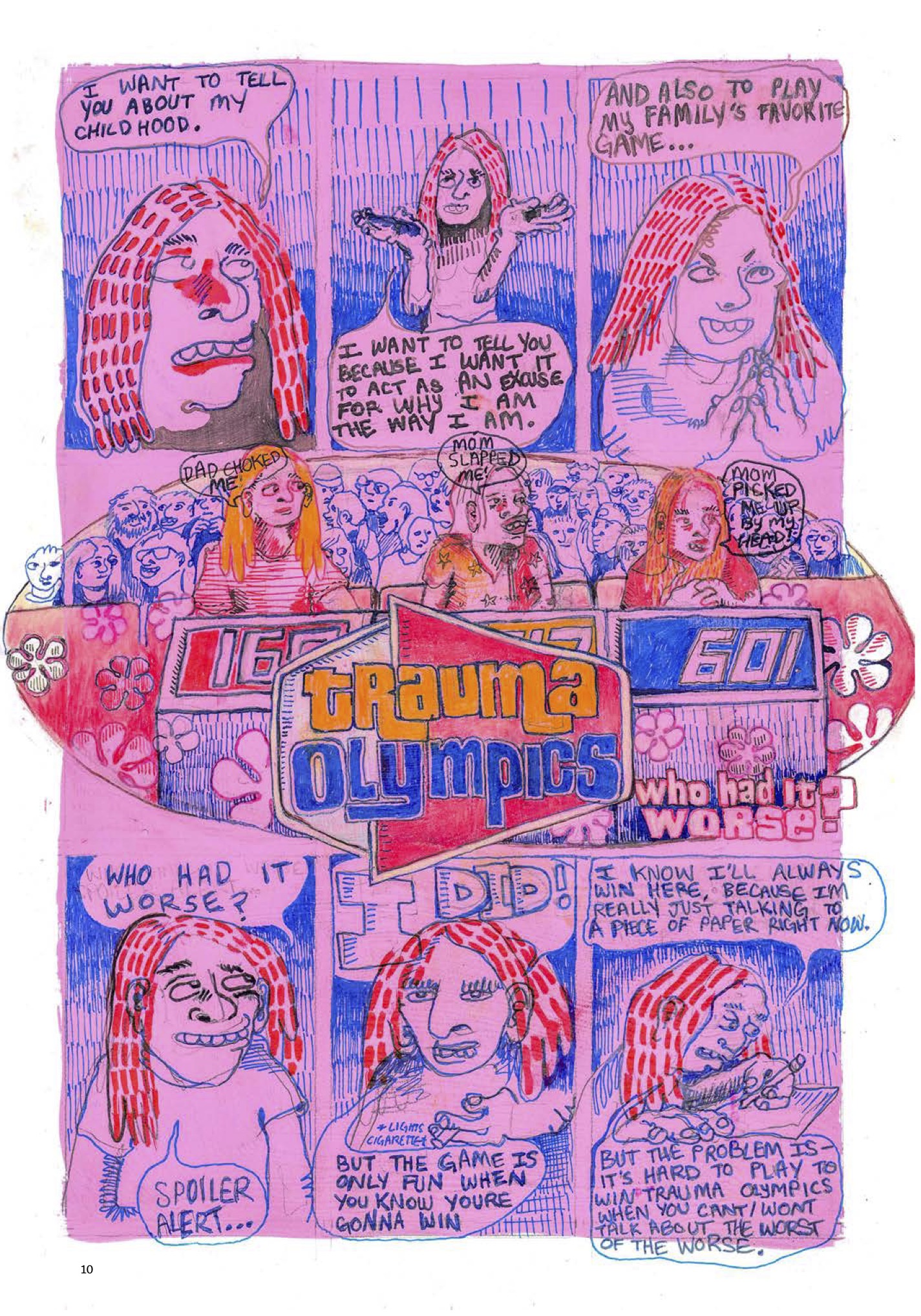
That's part of it. It's dialectical; there are two warring sides of me. I think that's pretty much what I'm saying, but it also varies depending on the content I see. Like, the thing that I was like, “Oh god, we have to stop this, we have to replace this page” — it was a hyper-sexualized page, and I don't know if I want that. I mean, obviously, there's so much sexual stuff in that book, but it was that one thing that made me feel like, I don't know if I want that out in the world. I think it's a fear of being perceived, and then worrying about sounding self-righteous, about sounding like, "Poor me." I have been through some shit, but I also know that a lot of people have been through other shit that's worse, and it's not good to have trauma Olympics.
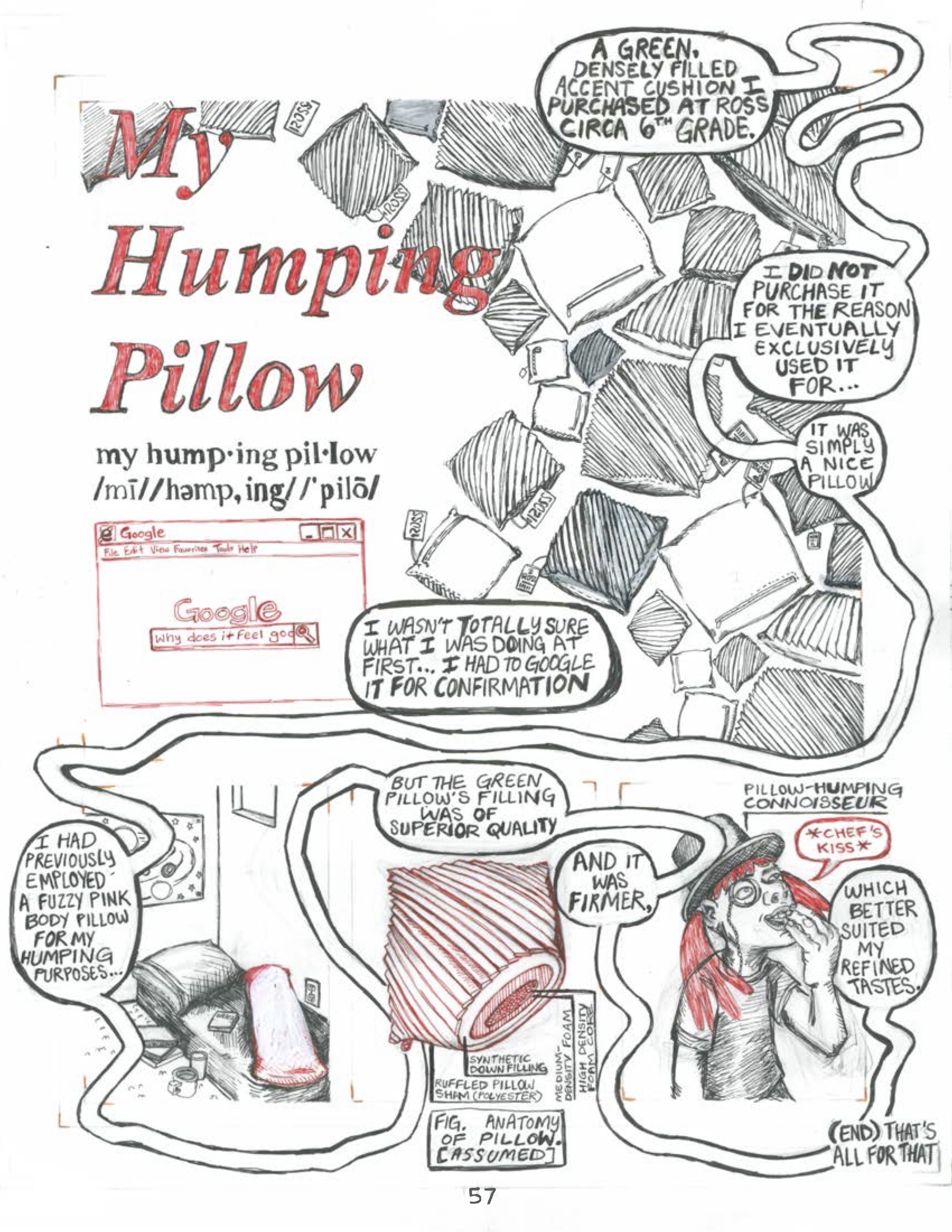
Which page did you want to take out?
Right, it wasn't removed; it was redacted. There's this one page that doesn't have a full title; it just says, “MHP.” It's in the mom's house stories, and there are pillows all around.
Oh, no, that page! Yeah, the words are there, at least in my copy! [both laugh] This page is about masturbation but doesn't depict masturbation. It's illustrations of throw pillows and a description of a favorite pillow. I love the image of you as a child with, like, the top hat, as a connoisseur of pillows. I find it surprising that you wanted to take this one out, of all the deeply personal things that you shared in "Misguided Love" and in this book.
It happened impulsively when I turned on that page. Maybe it will actually be printed, or maybe you got a previous version of the PDF, but it's good to hear that, in case it does get printed.
When you draw yourself from a place of narration, you often depict yourself naked. What purpose does that serve within your storytelling? Is this how you visualize yourself in your mind's eye, or is it just more fun to draw a naked body?
I think it is more fun to draw a naked body, and also I think that the way that I saw my body was very commodified for a while. That's sort of how I was raised, to see my body as my most profitable feature. I had some back problems because my boobs came in really fast when I was a kid, and I used to ask my dad for a breast reduction surgery, and he was like, "No, that'll be really useful for you in the job market. Bosses don't want to look at ugly things all day; they want to look at beautiful things that make them feel good." So I used to see my body as something I needed to use to make the most of it in my youth. I wasn't sleeping with anyone, contrary to what some people might think by looking at my art. I don't really have sex that often, and for a while, I drew myself naked as a way to capitalize on the body that I have — to advertise. I used to see my body as an object to be used rather than not used, and because I wasn't using it in other ways, I thought I should draw it in my comics, which is a really weird thing to think about now that I say it out loud. But it's also just more fun to draw than to draw clothes, because there are more curves, more movement.
One of your formative experiences in Bimbo Agitprop is “The Slap”. You call it an epiphany, a way that you continually recognize that your mom is not a trustworthy person. It feels awful to say this, because even though it's really painful, I loved reading that sequence, it's just so well drawn and depicted. I love the derpy face in the "before" shot, and then there's a moment-to-moment playback of the slap itself. Again, we're talking about child abuse, but you've managed to make that scene kind of silly while keeping the emotional weight intact. What creative choices do you make in your work to make these traumatic memories approachable for the reader while still carrying the emotional weight that they should?
The little annotations, or redactions, are my way of making things accessible. I was also thinking I don't want this to feel like a slog to get through. I actually say this in the book that I don’t want it to be a “humorless list of trespasses.” I can't think of any other way that I would have drawn it. The whole instant replay feels like collage, because that is how I work sometimes. Something that I was really battling against, and you see this in "Misguided Love," was that I get really tiny and try to squeeze too much into one page, and so for a lot of the book, there were pages that had already been made, but that I squeezed way too much into. The entire preface story was actually arranged in panels of nine frames, but it was way too condensed. I had to cut it up and redraw it. On some pages, I had the teeny-itty-bitty tiny drawings, and then I would scan them, cut them up in Photoshop, make them big, add the things I wanted, print out a page, and trace my own drawings to make them bigger. My process of drawing and redrawing is sort of like an instant replay; it's rumination.
Obviously, nostalgia is part of my work. Not nostalgia for bad memories, but thinking back on things. I use nostalgia, like the whole Cinderella story title page, which was drawn from The Sword and the Stone title page. That was a book that became a movie that my sister and I would watch a lot growing up. Sometimes I draw realistically, and I'll draw my face the way it is, and realize it's not reading the way I want it to, as a hyper-realistic face versus a cartoony face. I feel like I'm not answering your question, but I guess it's not a conscious process.
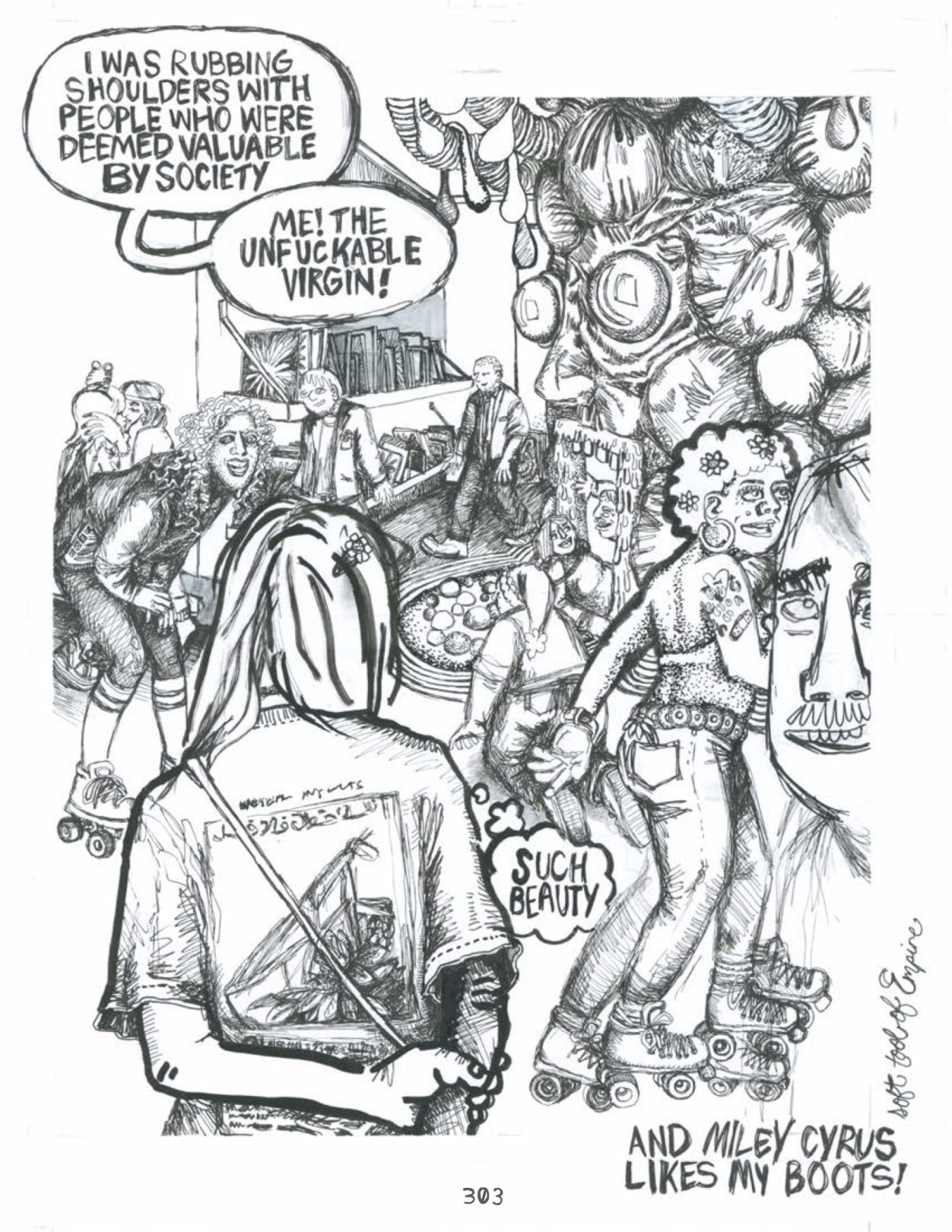
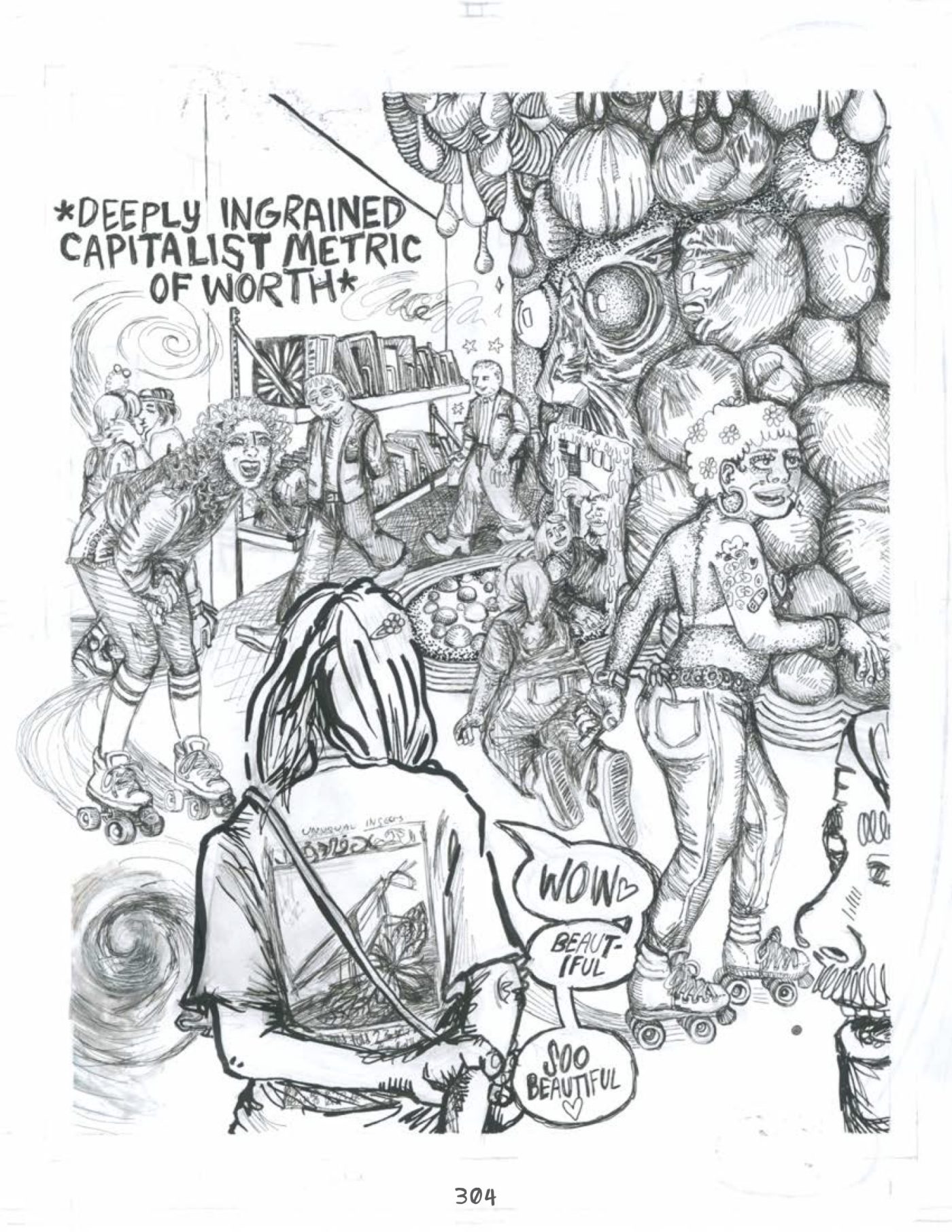
It sounds like you're intuiting your way through a lot of it. Obviously, this took a lot of labor — you're printing things out and redrawing them over and over, and towards the end of the book, there are a couple of pages that repeat one after another. I'm thinking of the OKC Flaming Lips section — there's a spread where it's the same image twice, but you've redrawn it, and some of the text is different. It’s almost like either one of those pages could have been used by itself in the story, but by mirroring them, you're giving us these different viewpoints within the narrator. Working intuitively is not the opposite of being thoughtful. You can clearly be both, but it doesn't mean that every single step of the process is planned meticulously; it means you're creating it meticulously.
Yeah, I would definitely agree with that.
Every experience in this book is filtered through this kaleidoscopic lens composed of the media and technology you were consuming, your family's living conditions, their belief systems, and your personal philosophies, all of which were also growing and changing. What was your process to create this visual vocabulary?
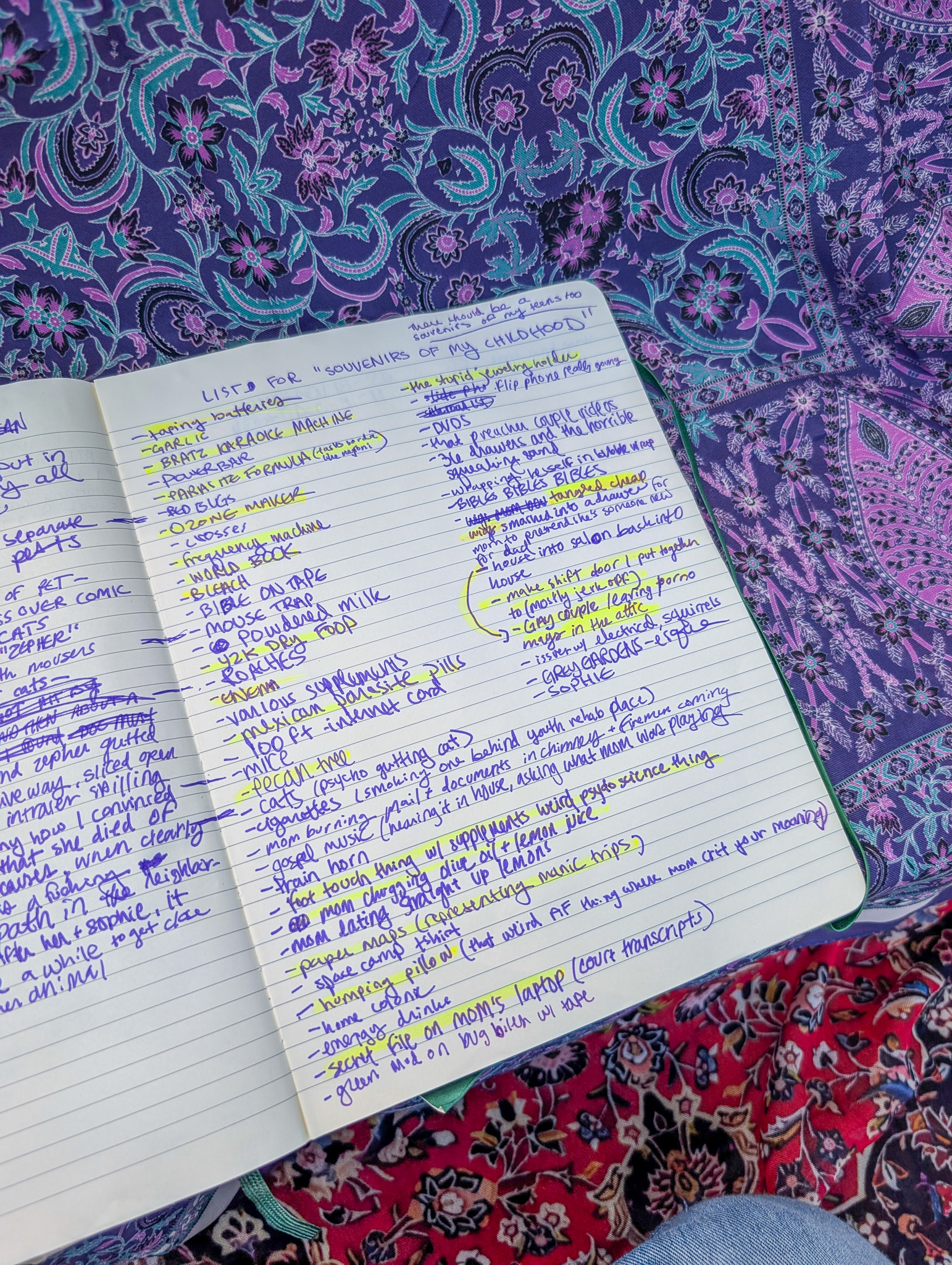
I wanted to capture the aesthetics of my childhood because I feel like it's unique, and the story is compelling because it is unique in a lot of ways, but I didn't want it to be not relatable. I think that also goes back to your other question about how the drawing can do the heavy lifting for making it more relatable. I thought a lot about the formatting of the Mom's house section, finding objects, talking about these objects, and the story around those objects — like the Bratz karaoke machine, which was a big part of my childhood. There are all these objects that are very emblematic of my childhood; there are some things that shouldn't be emblematic of it.
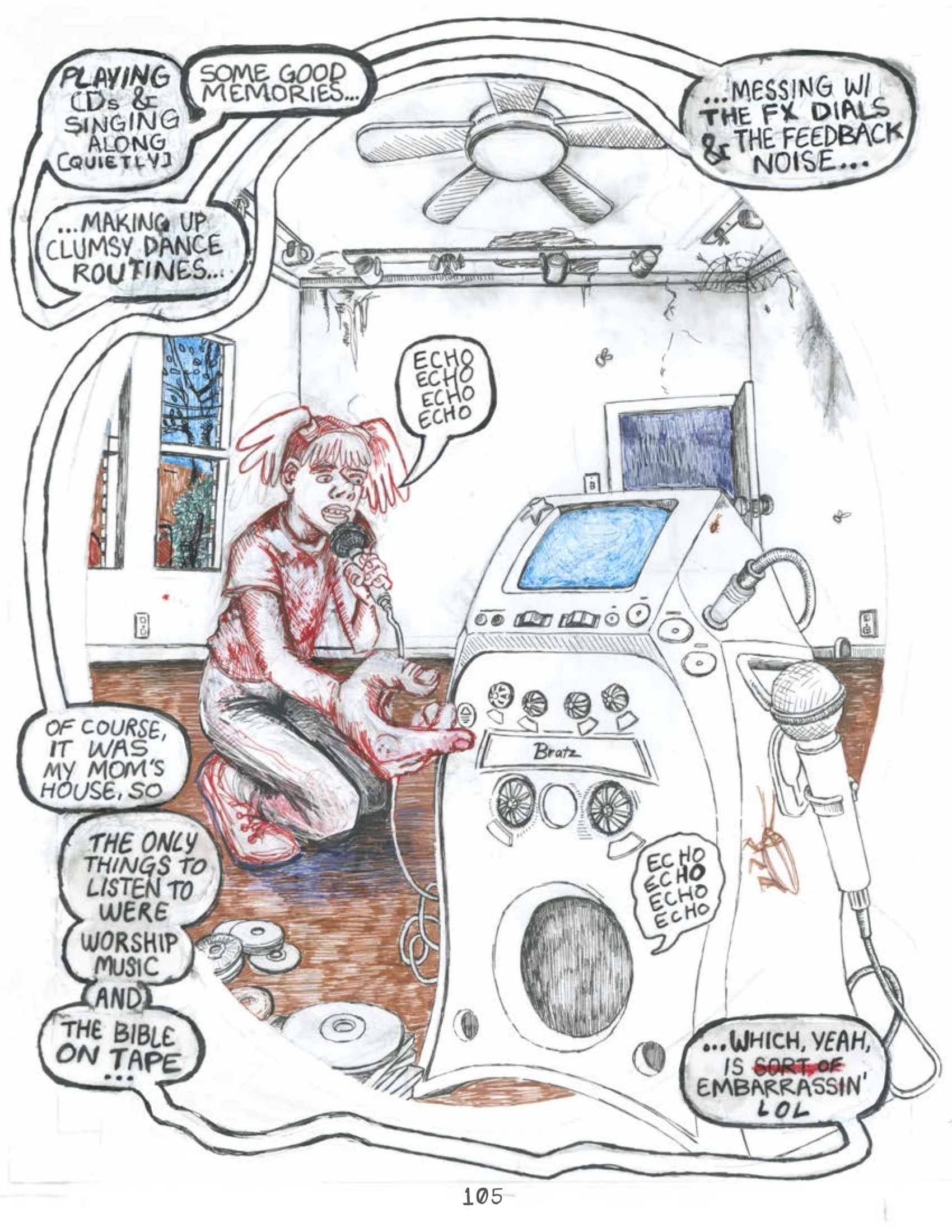
Do you mean things that weren't appropriate for a child to be experiencing?
Yeah, like the amount of excess, the amount of filth – that's what I'm talking about. And these very weird, specific things that are very difficult to explain. Like a blood machine — what is that? Why does my mom have that? I guess there is something sort of magical in the uniqueness. Magical is the wrong word, but I wanted to capture the unique aesthetics because there's something compelling about them. I made a list of things I remembered about my childhood that I wanted to integrate and talk about, and I would go on hunts for the exact object I wanted to draw because it was really important to me. I wasn't able to find the specific powdered milk brand that I wanted to draw, but I tried to find the specific TV with the canned food on top. I looked long and hard for an image of that TV online to try to replicate it in detail. There are some things I wasn't able to find because, like, how do you even find them? So the frequency machine and the blood machine — those are drawn by memory.
Were the frequency machine and the blood machine things your mom and other local practitioners were making themselves?
Yeah, I think some of it is local knowledge in these pockets of Evangelical Christian culture, and some of it is just not knowing what the exact name of it is. I don't know if these things were sold as something else, and my mom was just like, "This is a magical machine that God tells me the codes for, to heal all the illnesses that I have." Who knows, maybe someone else bought it as a different thing, sold it to my mom, and she created a system around it.
You hear about different parts of rural America, with all these folk stories and different ways communities cope with their circumstances through stories, magic, and religion, and I think that is also part of that. I think a lot of people in these communities are very old, and they're not posting about this stuff on the internet, so I think it's more difficult to find information about it.
I guess I could go back to Midland and try to see. I haven't been back there in a while. I've driven through it, but it's changing a lot, too. I mean, obviously, it's an oil town, so it's always changing, always boom and bust. My mom's house got demolished, and I think a lot of it is just disappearing, which might be a good thing.
Okay, I want to ask you about what happened with the censors with your book. Do you know what happened? Were they refusing to print it?
Yeah, it's really weird! Eric [Reynolds], the editor, was surprised by what was flagged because there's so much in there that could be flagged. There was this drawing of the world, and I drew borders on the individual countries. I think I drew a border where Taiwan is, and China thinks that Taiwan is part of it. So that page was flagged, and basically, once the borders were erased, it went through.
Oh my god, wow. Okay, I wouldn't have guessed that. I was like, oh, I don't know, the sex, the drugs, the child abuse, who knows what it could’ve been?
In your “about the author,” you mention using the autobio genre to combat hyper-individualism, and I thought that was a really interesting concept. I like autobio, but I think one of the main criticisms people have about it is that it's selfish or it's just a person whining, which is a bullshit argument, because fiction can also do that. Fiction and autobio can be good or bad. I don't think one is better than the other, but I'm curious to hear your philosophy about autobiographical work.
That's something that I have been thinking a lot about, and I think that as the book progresses, you can see how I've become a little bit more conscious about the idea of what exactly I want to put out into the world. Do I want to be uplifting the idea of the self and individualism? Or do I want to try to tie it back to something grounded in material reality that many different people can use to process their own experiences and learn about the world and how we've gotten to this point? My story is not relatable in a lot of ways, but it is in some ways, and I think it could be relatable to people who grew up right-wing and stayed right-wing. The first step in reframing your outlook on life is to evaluate your current one.
I think that reading something hypercritical of oneself can be useful for others in their own journey of self-reflection, in learning how others think, and in bridging divides. It's really cheesy, but I think that there is something of value for people to be able to look at how someone is thinking, to peer into someone's internal monologue, because it demonstrates how people become who they are. No one’s experience is unique to the point that it can't be used by other people to learn something.
Learning how others think is how we get empathy, right? It's by understanding that other people have a rich, complex inner world, just like we do. My childhood was different from yours in many ways, but there is so much in your book that I relate to. Certainly, anyone who experiences emotions can relate to emotional experiences, but I think it’s the specificity that gets us there. First off, it's just great world-building and it feels very tangible. This helps us to understand other people and other cultures. So, okay, we solved it. Autobio isn't narcissistic, and we want to tell everybody we figured it out!
Yes! [both laugh]
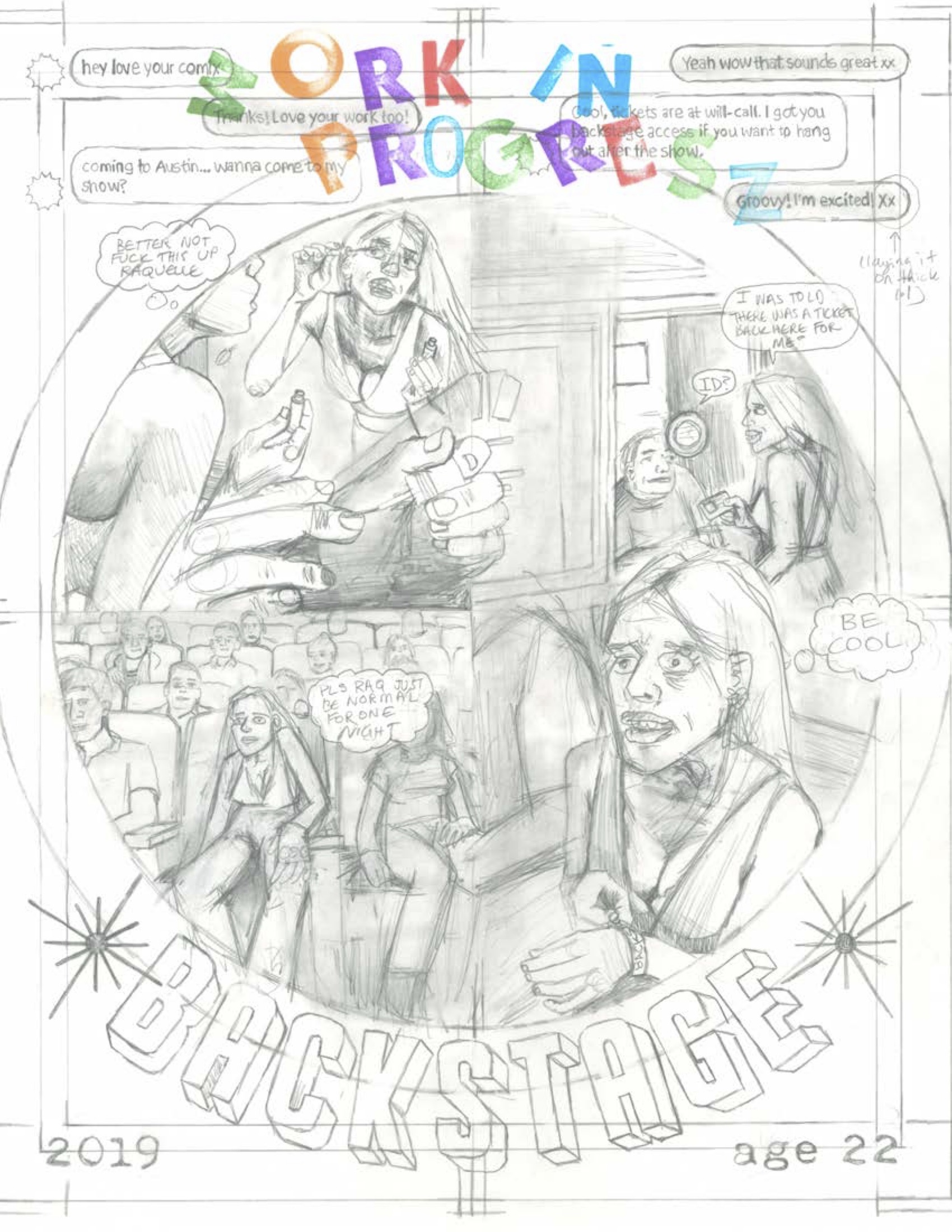
Tell me about the process and the choice to include the works that are literally rubber-stamped as works in progress on each page.
Those were included because I wanted to show that this book was done by hand and to show more about the process of the book. Honestly, at the point right before those stories, at the womb story, I thought I was finished. And then I was like, “Shit, I have these pages, and this is a really great opportunity to show my process.” If I didn't think that would work, I would have just inked and finished them, but I thought it would. It performed a useful function, and it was also convenient.
Also, this is a memoir by a relatively young person. Your life is still in progress, so I think that makes sense, too. You're not done.
Yeah, that's why, actually. [both laugh]
Okay, very important: What is the cat poop trick?
[Laughs] Okay, that's a crazy thing that I did. So my evil stepsister had a cat whom she was not very nice to. In order to torture me, she would lock her cat into my room while I was at school, forcing it to go potty in my room, and I got really fed up with that one day. I got some paper towels, picked up the cat poop, and I was gonna just throw it in her room, and then I was like, "No, then she'll just find it and throw it out!" And so — oh man, I can't believe I'm saying this — I got the poop, and then I rubbed it into the carpet underneath her bed, so that it would smell like cat shit, but she wouldn't be able to find it. It was a mission success, because when I heard her come home, she was like, “Why does it smell like shit in my room?” She was looking for the cat shit, and she never found it, because there was none.
It sounds like she deserved it. [both laugh] You said you're worried about being seen solely as a victim. It's really smart revenge to be like, no, I'm not gonna just dump it, I'm gonna make this work for me! Also, the whole section about you learning how to use the Dark Web and the Silk Road, that's so fucking cool. You were just a teenager and you were like, “Alright, I'm gonna install my own bedroom door,” you were taking charge in these ways — sometimes convoluted, strange ways, or things that some adults would've said aren’t healthy behavior — but you were demonstrating your will to live, your intelligence, and your integrity to be like, fuck y'all, I'm gonna make my life better! So I love that. None of those were "fun stories" in the book, but for me, that was fun. We all figure out how to survive, or we don't survive.
Yeah, that's really beautiful. Thank you.
Are there any questions that you wish people were asking you about this book?
Something I have been thinking about is that a lot of my comics are about other people, and I worry about how they might be perceived. I don't know how constructive that is to say. I guess it's honestly fine, and it's going to be interesting to see how I feel about this book as I get older.
The book has been useful for me. I used to think it was gonna re-traumatize me and put me into a horrible state, but it didn't really do that. It made me feel like it was a repository for all these bad thoughts that I thought about constantly — because I was like, “I can't forget about this; I have to think about this constantly, or else it's going to happen again.” There have been so many times when I'll completely forget that something happened, and then I get close to that person again, and it's like, “Shit, it happened again. I can't believe I forgot about that.” I relive these things over and over, and over again.
I was like, “Okay, the book is gonna be really great, because I can just make these comics and they'll be bound in a book and on paper, mass-produced. I won't ever forget them, and so I won't have to keep thinking about everything that happened. I'll be able to put it to bed.” That has happened, where I feel like I don't need to think about this stuff anymore, but something that I didn't realize is that just because you don't think about the thing anymore doesn't mean that the lasting effects aren't happening. It doesn't mean that everything is resolved; it just means you still have problems and you don't think about what caused them. That's been a really interesting process of discovery.
I'm still me, I'm still the person who experienced those things, and I'm still the person who has developed destructive coping mechanisms to cope. I just don't think about the things that happened anymore, and I don't know if that's a good thing or a bad thing. I guess it makes you more confused because you're like, “Why am I acting this way? Am I like treating this person like they're my dad?” You don't have that thought process anymore because you're not thinking about the original thing that happened that triggered you into thinking that this person is your dad, if that makes sense. That's something that I'm dealing with right now about my relationship to this book.
The follow-up reading companion book for your book is The Body Keeps the Score. I recommend it to everybody. [both laugh] Speaking of bodies, you referenced trepanation, like, drilling a hole in your skull, to describe how drawing feels for you — getting something out. In that section, you talk about being filled with rage and then letting some of it out in your drawing. This book has some really difficult content, so I'm glad to hear it was cathartic for you and helped you process it. You're ordering and making sense of fractured, traumatic memories, especially in your encyclopedic entries, where you list and document these bits of your life and lay them out in a pretty tidy way. Do you feel like organization is therapeutic? Are there other elements in your life where you're really into organization or tidying?
Um, well, no — if you saw my apartment right now, no, it's not organized at all, but that's because I have been dedicating all my time to community organizing. I was the steering committee co-chair for most of The People's Art Collective's lifetime. I recently stepped down because of my crash out. Something that's been very difficult for me to let go of while I take time to fucking figure out what's going on in my head is the fear that people are gonna fuck up the filing system! I wrote the foundational documents and the rules, and people are going to just make decisions; they're not going to follow the rules for making amendments and shit! I never thought I would be the type of person who cared about that. My dad has OCD, and I have intrusive thoughts and stuff, but I don't have the tidying-up OCD like he does, but there is something that scratches the itch of things going according to plan, things being organized in a certain way, and the processes we use to make things go smoothly.
Right now, I'm going through a sort of spiritual awakening. I've gotten into Islam, and that's been a really beautiful experience. There are processes for the way you stop five times a day to pray, and there are set processes you follow to pray, and there's something really soothing and beautiful about going through those processes, saying these words, meditating, reflecting, and setting your intentions. I find comfort in organizing in the sense of making sure everyone's taken care of. That's really the central part of me worrying about TPAC [The People's Art Collective] stuff, worrying if the processes are not going to be adhered to. At the core of it, I want to make sure everyone is safe and taken care of. I find a lot of comfort in taking care of others, taking care of a project that we all care about, and in doing so, taking care of others. I guess now I'm finding a lot of comfort in taking care of myself as well, with Islam.
I like that I asked about organization, and you were like, well, actually, organizing. So these are the things that provide you with comfort: thinking about ordering things within panels in a comic, but also organizing people, caretaking for people, and finding a new faith. And how long have you been getting into Islam?
I started looking into it when a close friend of mine converted. He doesn't have as big of emotions as I do, but he does have big emotions, and I saw that he found a lot of peace in Islam, and I was like, dang, I want that. I know that's so cheesy, and I never wanted to be a religious person, but it's the only thing that is giving me peace right now. I feel like one of the biggest reasons you hear all the time in convert circles is being in awe of a community that's being genocided, and learning that the main contributing factor to them continuing is their faith.
The world is very difficult right now, and you need something to cling to, especially if you're fucked in the head. I don't go to AA or NA, but there's a reason why you have to surrender to a higher power, and that's literally what Islam means: To submit to God. It's also kind of scary, at the same time, because it's a thing in my family where the women will get really religious as they get older, and I never wanted that. But it's in Christianity that they get really religious. I think a really cool thing about Islam is that there's caution: Don't get carried away, don't get fundamentalist, and also, don't dispose of your culture. I was reading about tattoos, like, are tattoos haram? Culturally, it's frowned upon within some Arab cultures to have tattoos, but if you're not Arab, then when you convert to Islam, you don't become Arab; you still have your culture. So if tattoos are socially acceptable in your culture, then they're socially acceptable; it's not that deep. I think that there are good guardrails within Islam to caution against going too hard with religion. That's something that my mom and my sisters really got carried away with.
Interesting. Yeah, it's tough watching members of our family, whatever our relationship is with them, and being like, "Oh no, am I turning into that person?" Like maybe in some good ways, some bad ways. I don't know, it might happen.
Yeah, who knows? But all you can do is wait and see.
The post ‘It never, ever, ever stops’: An Interview with Raquelle Jac appeared first on The Comics Journal.


 Hello, my name is Jack Sparrow. I'm a 50 year old self-employed Pirate from the Caribbean.
No comments:
Post a Comment