

Editor's note: Anton Kannemeyer's body of work contains depictions of child abuse and satiric explicit depictions of racism not suitable for view without context. Thanks to Robert Aman for the thorough introduction to Kannemeyer's art provided below, and thank you for reading.
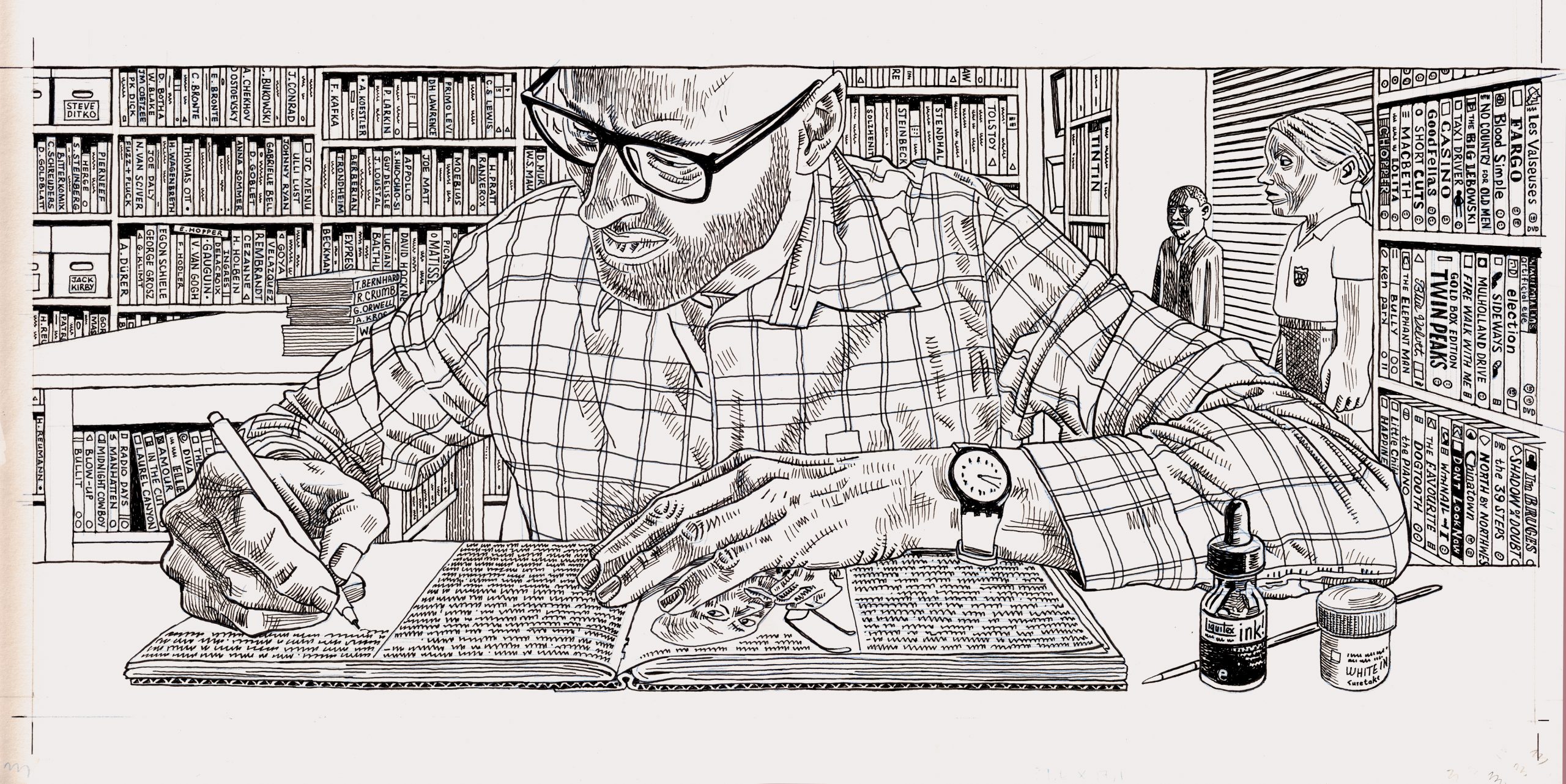
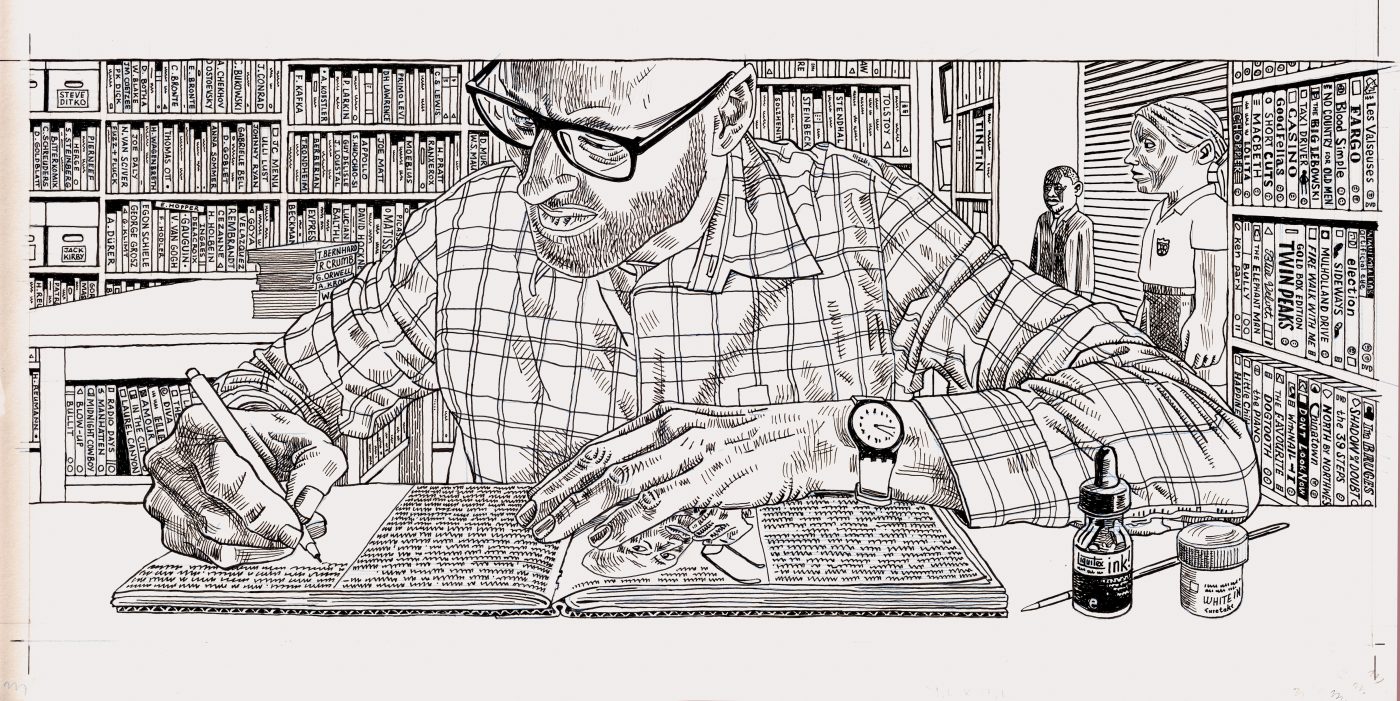
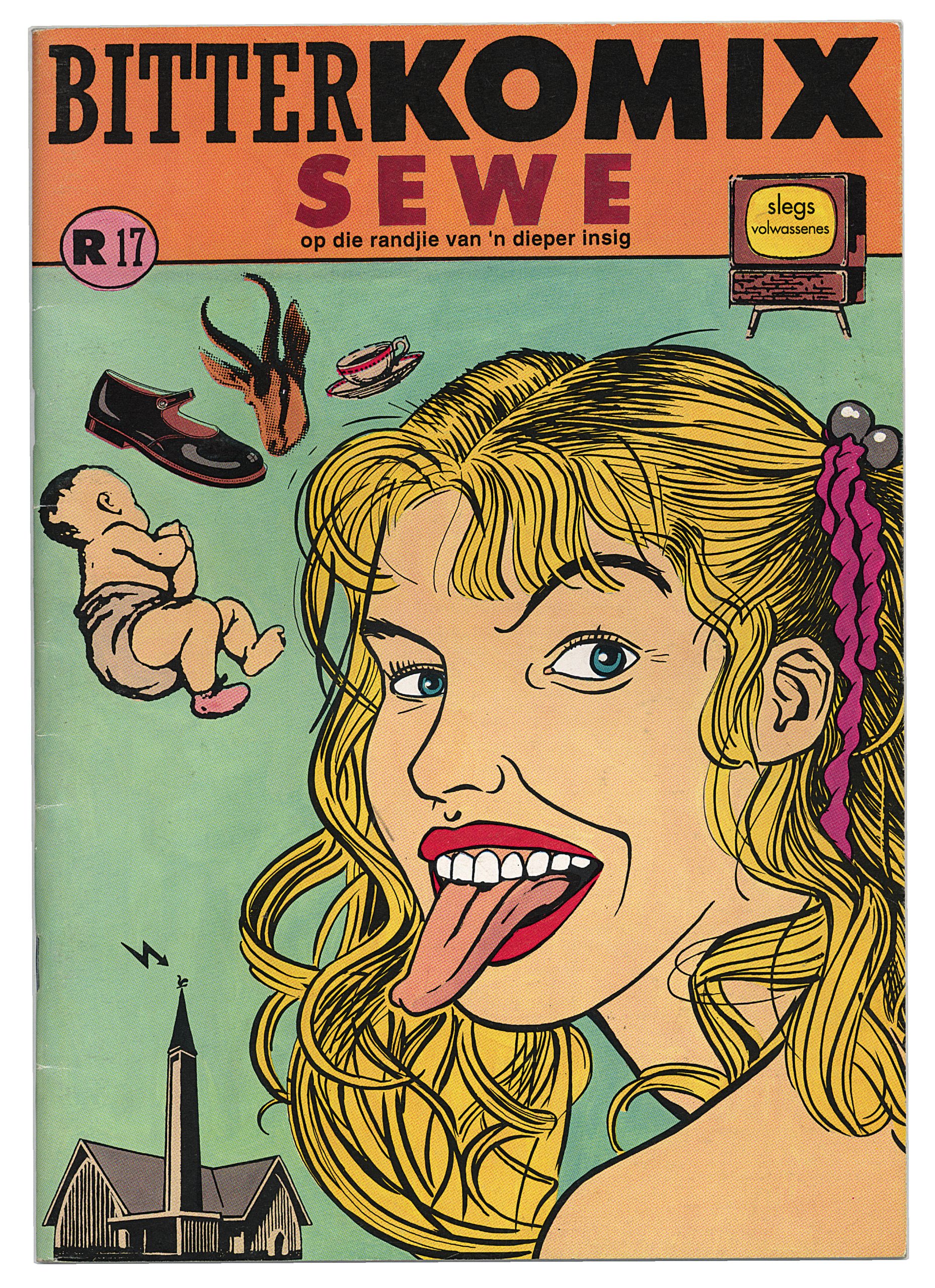
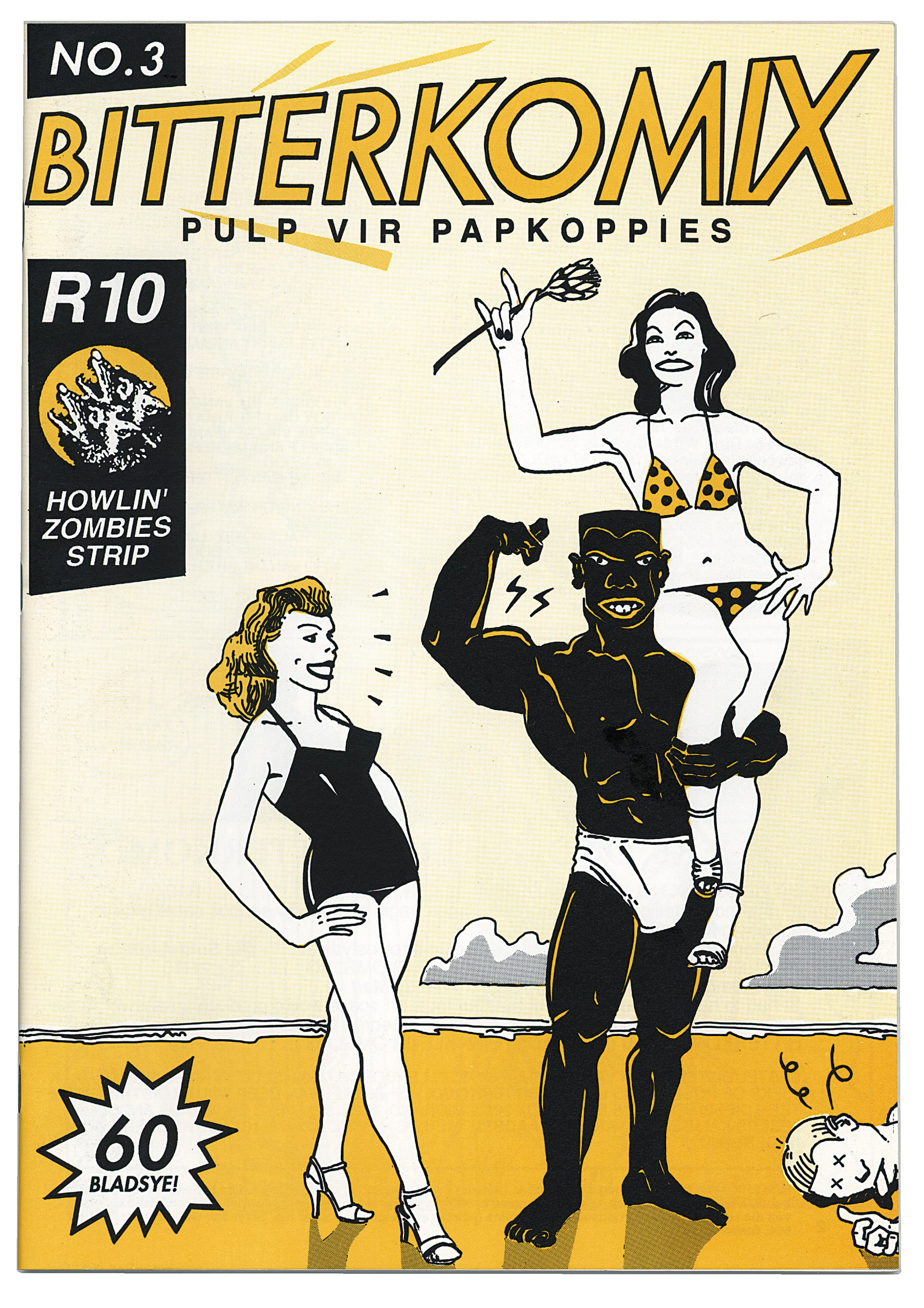
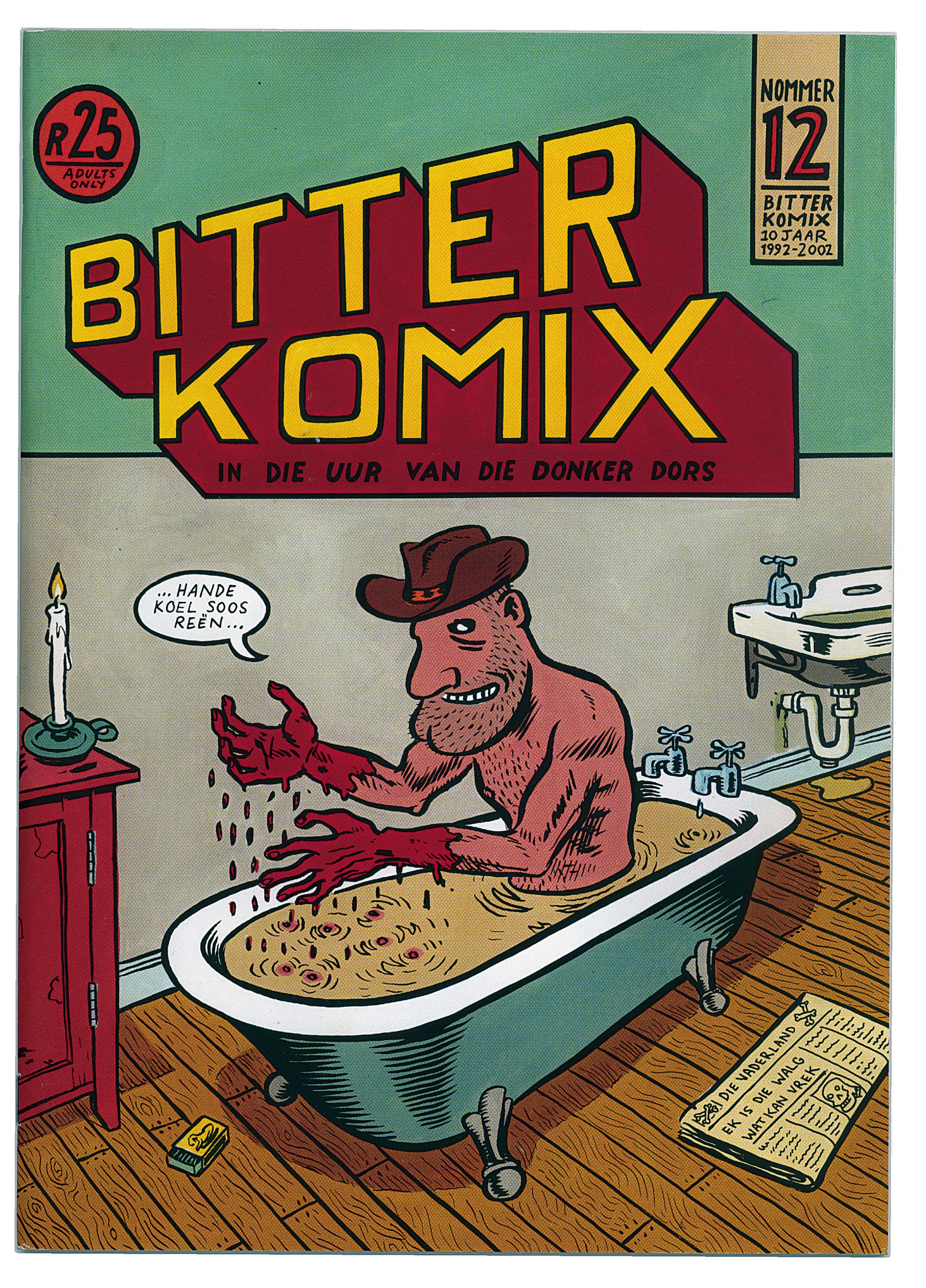
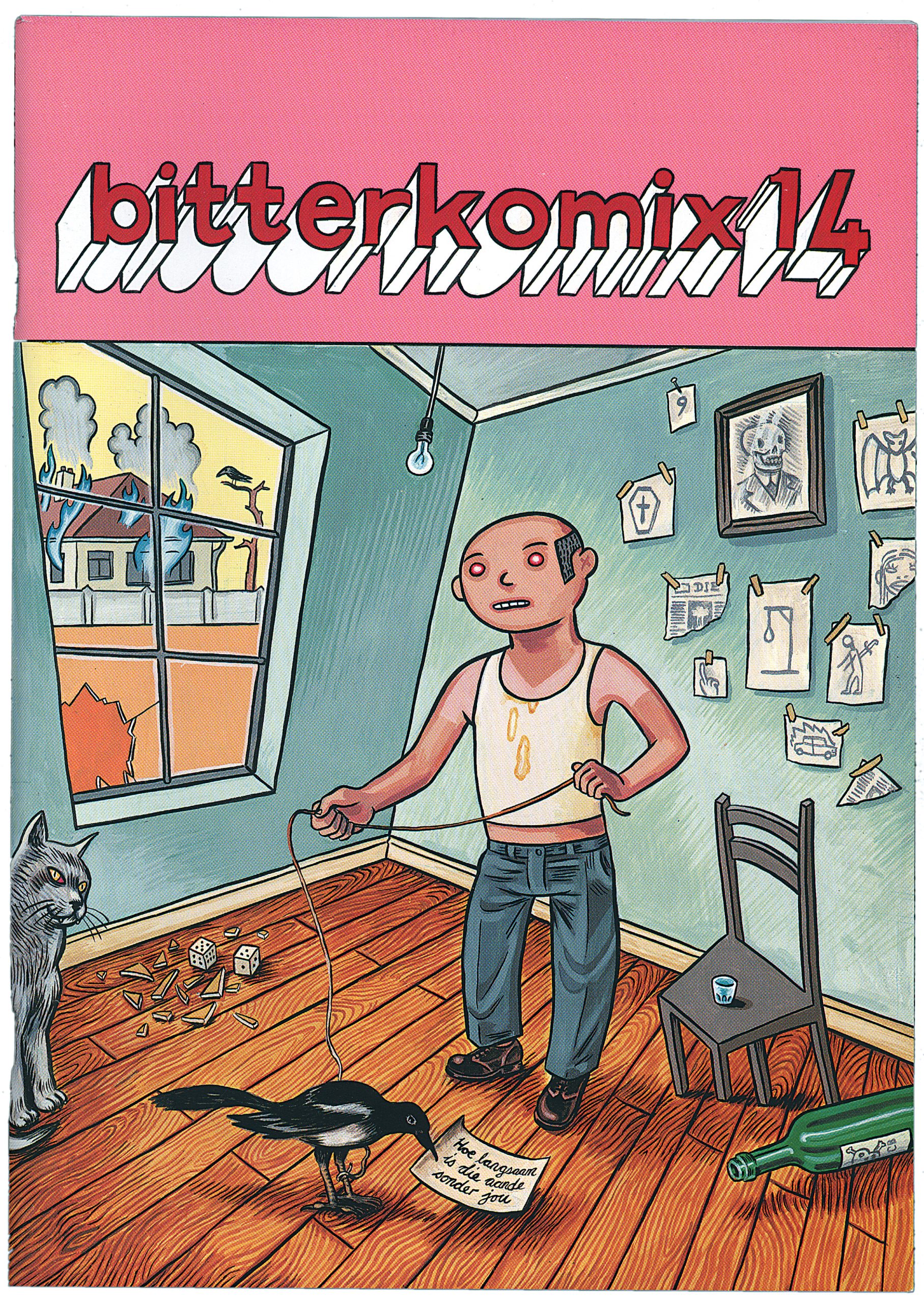
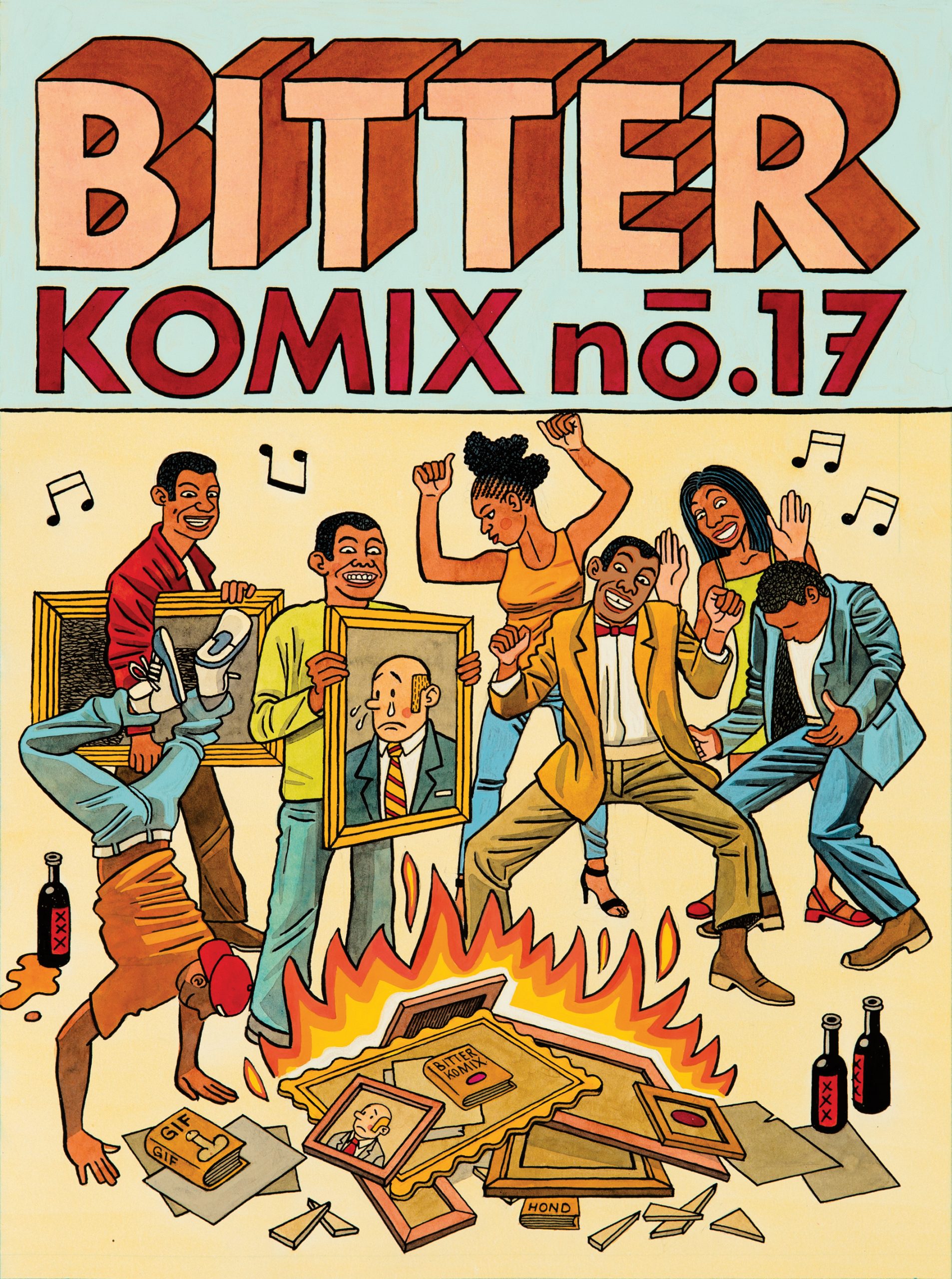
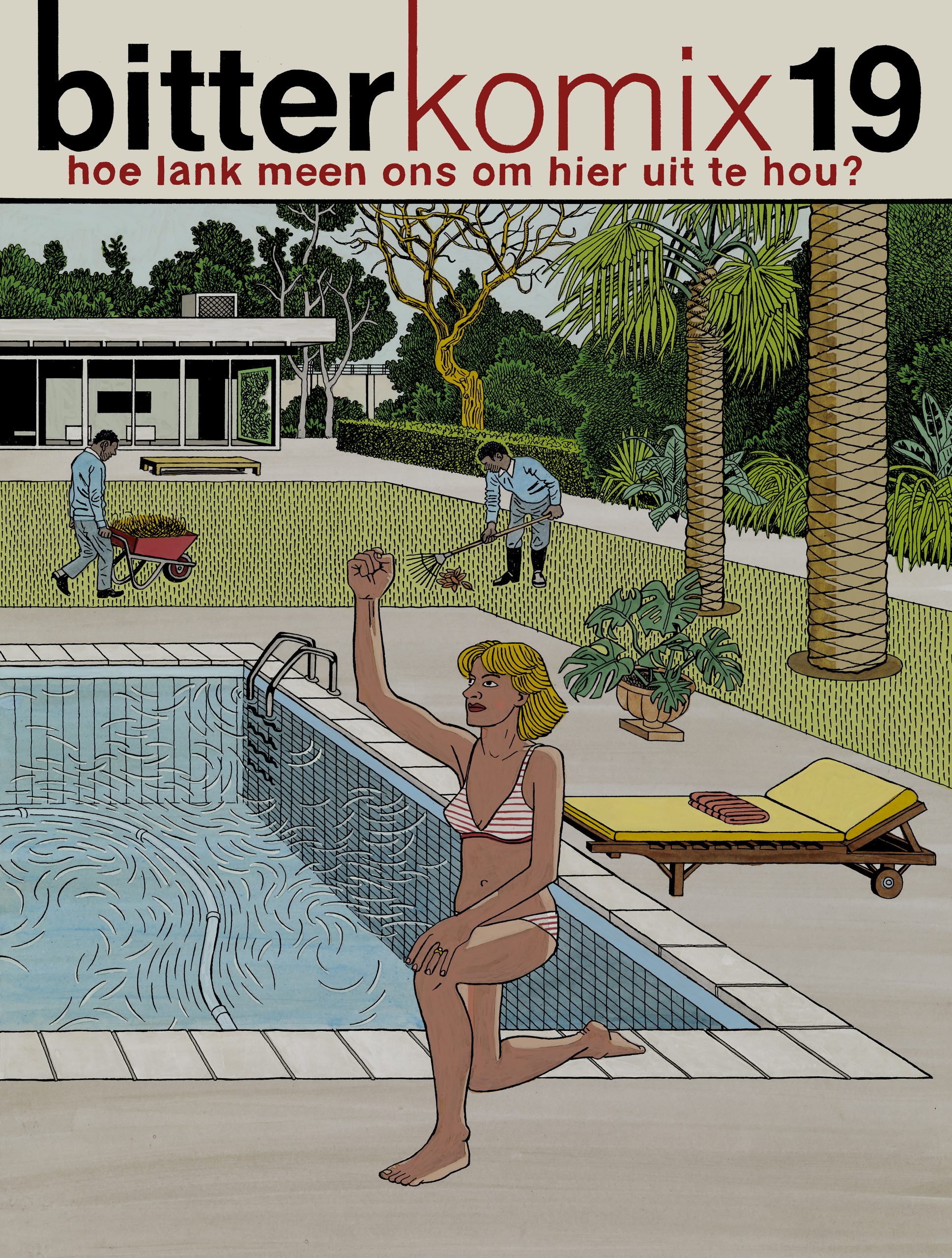
Anton Kannemeyer is a South African cartoonist and artist. He is best known as one half of the alternative comics magazine Bitterkomix, which he has published with Conrad Botes since 1992, often under their respective pseudonyms Joe Dog (Kannemeyer) and Konradski (Botes).
The year is symbolically significant. The first issue of Bitterkomix was published before apartheid was replaced by democratic elections in South Africa. This historical turning point also shapes the content of the comics. Kannemeyer grew up in a divided country where violence lurked in every corner. Apartheid was a wall that concealed a world of possibilities. On one side of the fence, people were subjected to oppression, persecution, and death. Hope for the future was as narrow as the slit of a mail slot. Yet the system also isolated and diminished the lives of those who benefited from it. Kannemeyer and Botes — two privileged white Afrikaners at the top of the racial hierarchy that structured society — have consistently used the sharp edge of satire to depict the claustrophobia that defined their existence: a life shaped by censorship, control, and threat.
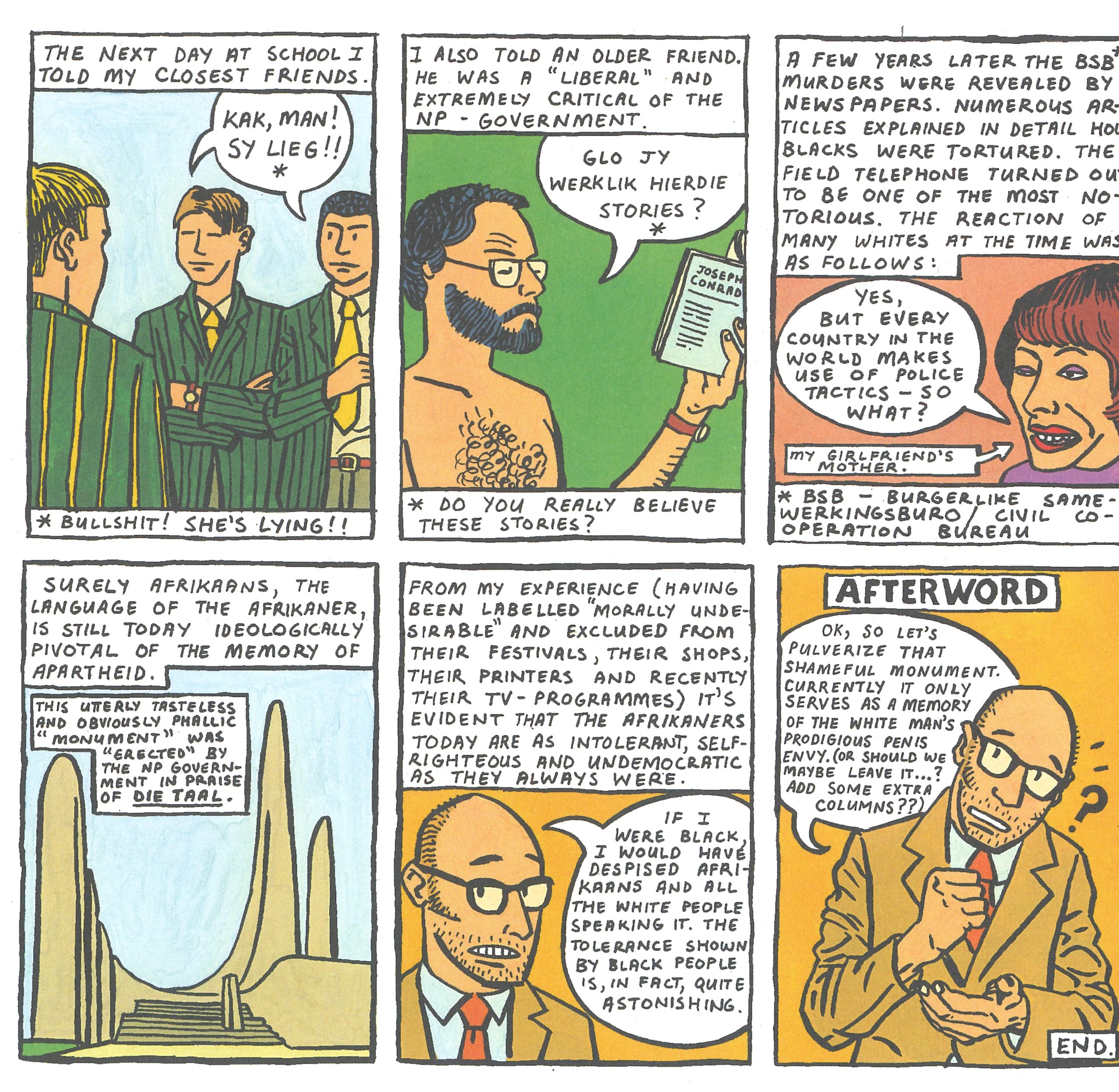
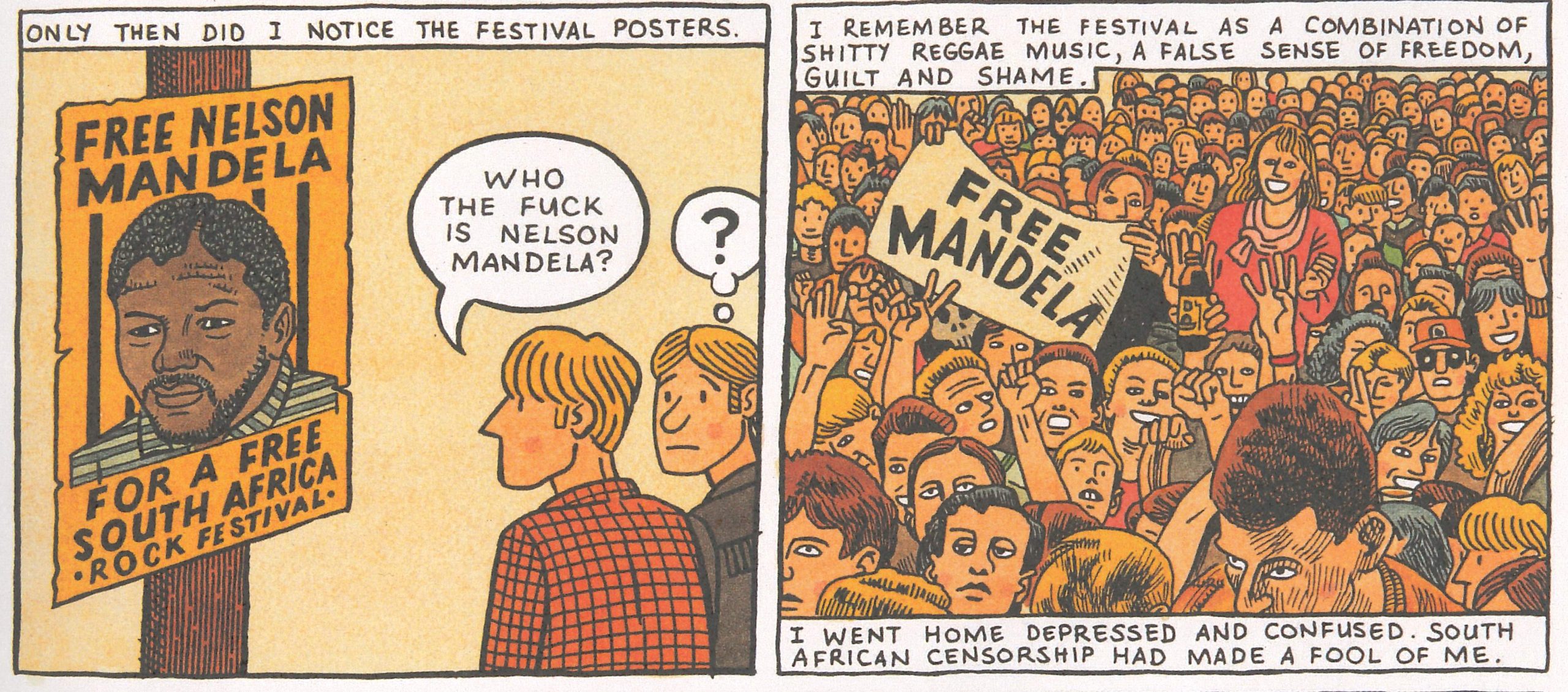
In an autobiographical comic, Kannemeyer recounts that it was only in adulthood, during a visit to Germany, that he first heard the names of the internationally renowned anti-apartheid figures Steve Biko and Nelson Mandela. For many readers outside South Africa, this revelation may seem astonishing. Since the Sharpeville massacre in 1960 — when South African police opened fire on several thousand Black demonstrators, killing sixty-nine — political developments in the country had been widely reported in international media. By the 1980s, when the events described in Kannemeyer’s account take place, most European countries had tightened sanctions against South Africa’s nationalist government, as apartheid had long been seen across much of the Western world as a festering sore on humanity’s conscience. Kannemeyer’s ignorance of these figures was therefore not simply personal; it was symptomatic of the apartheid state’s formidable machinery of censorship. Information was carefully controlled, dissenting voices suppressed, and even the images of imprisoned activists prohibited. Photographs of political prisoners could not be published. Their faces, like their names, were meant to disappear from public memory.
Kannemeyer has also depicted how even within circles of resistance there was skepticism toward reports about “the smell of spilled blood, of inhumanity, the bestiality of suppression,” to borrow a phrase from poet Breyten Breytenbach – who has also contributed to Bitterkomix – in a protest poem written from the prison cell where he was incarcerated for the crime of marrying a non-white woman while himself being white. On one occasion the family’s Black housekeeper confides to the young Kannemeyer about the torture she had witnessed with her own eyes at a police station in Johannesburg – abuses that were routine for the Black population. When Kannemeyer repeats what he has heard to acquaintances, no one believes him. One active opponent of the regime even regards Kannemeyer as naïve for having believed such “myths.” Even among liberal critics of apartheid, the assumption that Black people were prone to exaggeration or dishonesty remained deeply rooted. At the same time there was a refusal to acknowledge the abuses taking place just around the corner.
South Africa’s violent history continually haunts the pages of Bitterkomix. The tone is confrontational, the comics steeped in raw, almost pitch-black humor. Over the years the magazine has both fascinated readers and sparked outrage. During its early years, Kannemeyer and Botes primarily aimed their satire at their own Afrikaner background, the ethnic group that dominated South African politics until the country’s democratization. The content can best be described as a slap in the face to good taste: graphic violence appeared alongside explicit erotic imagery, often between Black and white characters, along with enough phallic symbolism to make Sigmund Freud arch his back in delight. The aim was to break taboos and provoke as much as possible. Until very recently, sexual relations between people of different skin colors had been criminalized.
Each issue of Bitterkomix can be read as a flash illumination of a society permeated by class divisions, racism, and sexism. Kannemeyer and Botes possess a distinctive ability to put their finger on the most sensitive points of our time, whether the subject is identity politics, religion, or sexual morality. In a society such as South Africa, in particular, the duo uses the power of satire to demonstrate how nearly fifty years of institutionalized violence is not something that simply disappears with the transition to democracy; the past cannot be brushed away like dandruff from a jacket shoulder. The scars of apartheid continue to cast long shadows over South Africa.
In his autobiography, Bo Strömstedt — then editor-in-chief of the Swedish newspaper Expressen — describes a visit to South Africa in 1994, when democratic elections were being prepared. There he met white South Africans raised under apartheid who said they wanted to extend a hand to the Black population, yet admitted that these encounters were filled with fear. Deep in their subconscious lingered myths passed down during childhood – stories about Black nannies who supposedly slit the throats of white children. This is a theme Kannemeyer repeatedly explores, often casting himself in the lead role: how racist fears continue to haunt him, like many other whites. Apartheid remains embedded in people’s patterns of thought and even in their dreams. All of this forms psychological barriers to reconciliation.
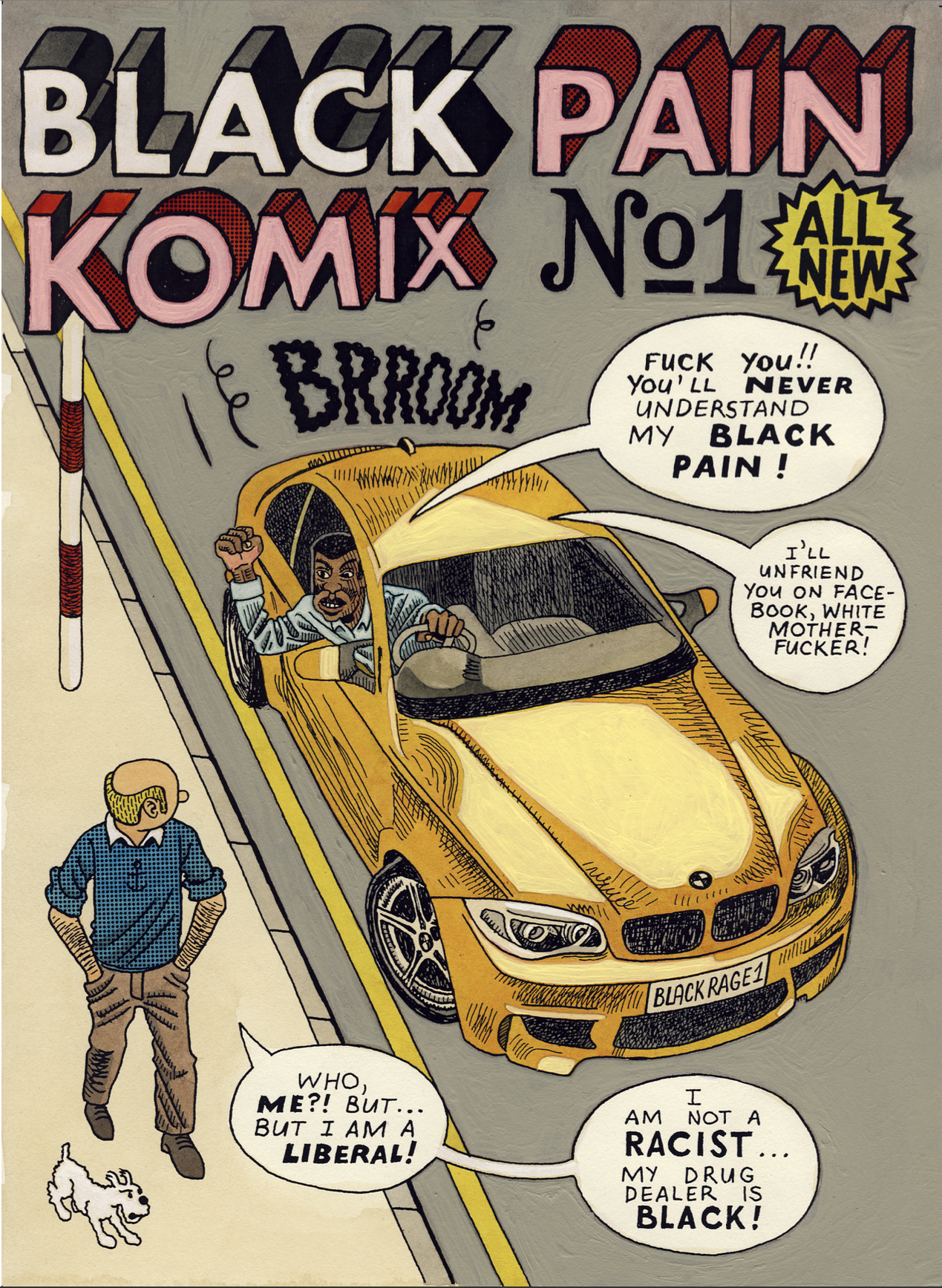
The theme also recurs in Kannemeyer’s parodies of Tintin. In them he depicts a somewhat older hero — the famous quiff replaced by a thinning scalp, and the name changed to Pappa to emphasize patriarchal authority. In one version he appears as a liberal and color-blind moral conscience of the world, so determined not to accuse Black perpetrators that he would rather allow himself to be dismembered. The burden of historical guilt weighs heavily on him. In another version, the balding Tintin — uncannily resembling Kannemeyer himself — ventures into Africa’s greenery to tame the supposed “savages” with his rifle while simultaneously bringing the blessings of modernity to the inhabitants of the jungle.
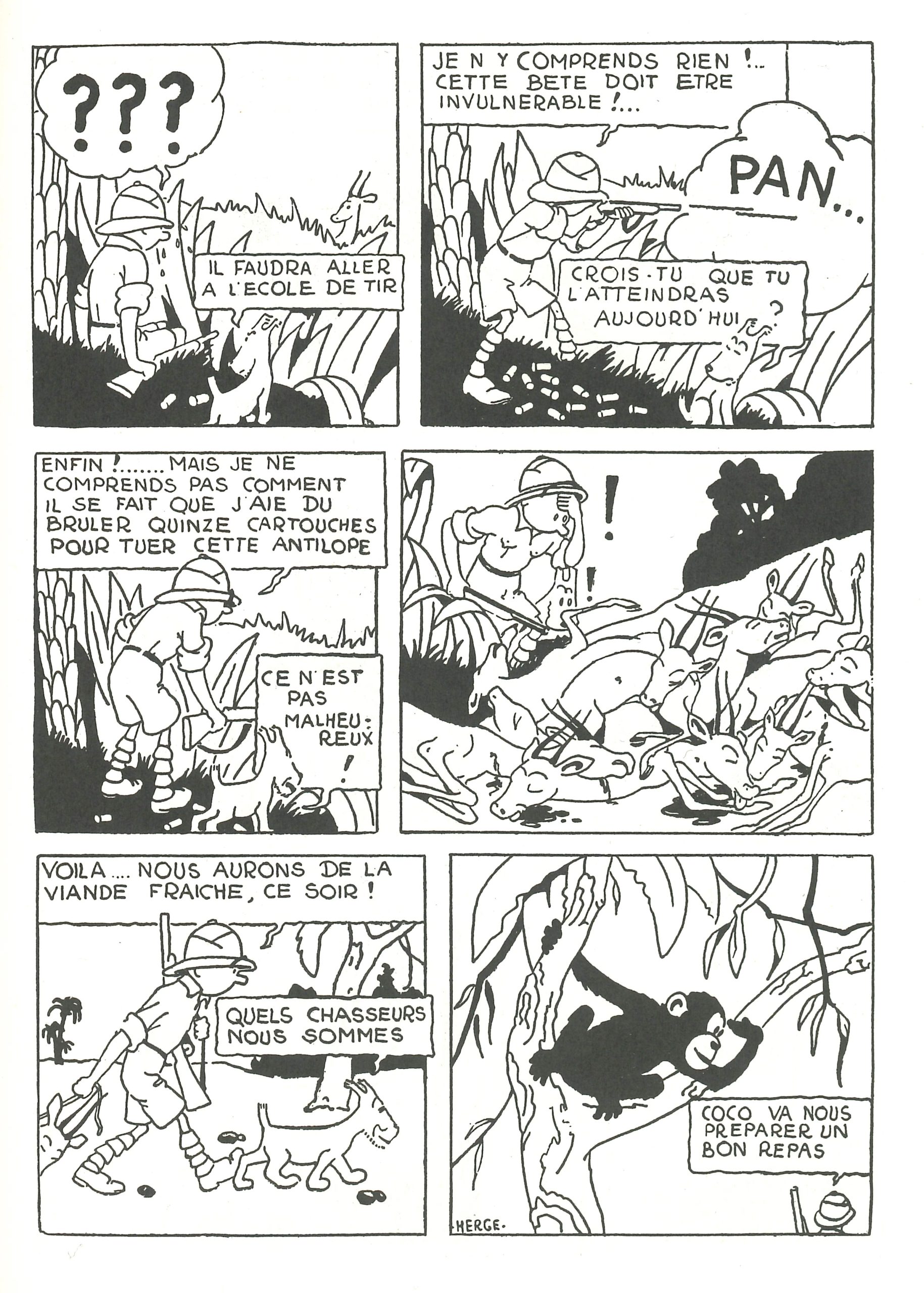
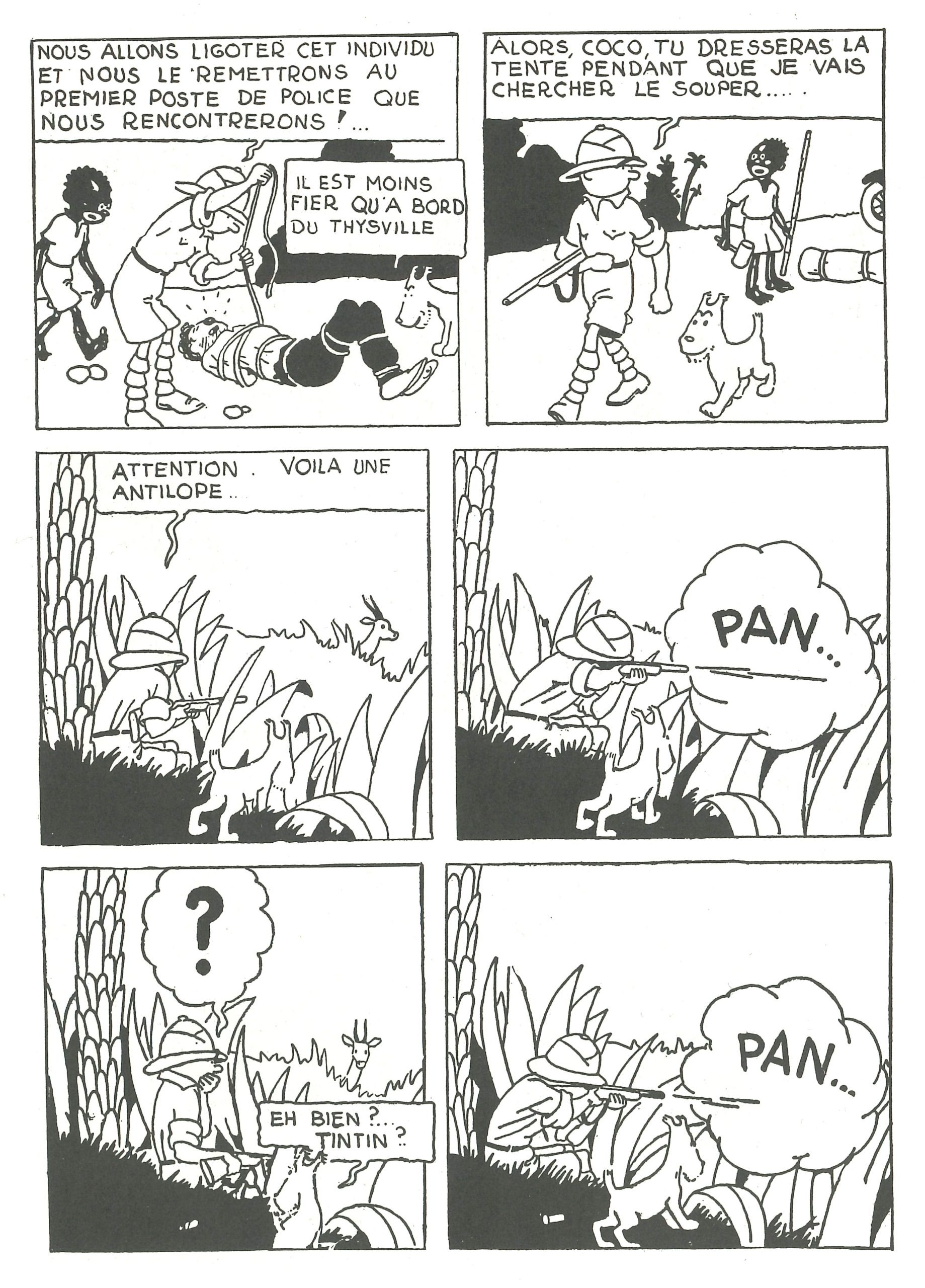
In one controversial scene in Tintin in the Congo, Tintin shoots an antelope through a bush. Suddenly the animal reappears, and Tintin pulls the trigger again. The sequence repeats several times. The antelope seems immortal. But when Tintin pushes through the vegetation he finds a pile of carcasses — it was never the same animal; they only looked identical. When Kannemeyer parodies the scene, the targets of the big-game hunt are instead Black Africans, whose appearances are indistinguishable from one another. The satire lies in how Kannemeyer turns the volume of colonial rhetoric all the way up — it becomes a racist worldview on steroids. Yet it is also a worldview disseminated through popular culture by European imperial powers to legitimize conquest on other continents, a worldview that apartheid continued to reinforce well into the 1990s.
The comic also carries a deeper meaning: the pile of Black Africans testifies to a massacre. In the next panel, the Tintin look-alike chops off the hands of the lifeless bodies. The image is unusually grotesque. Hergé’s ligne claire style is typically associated with child-friendly reading. Yet the scene also alludes to a human rights crime that afflicted people in the Congo — where Tintin lives out his adventure — during Belgian colonial rule. The inhabitants were forced into slave labor to extract natural resources, including rubber and ivory, which were then exported to Brussels. Those who failed to meet their quotas had their hands or feet cut off. This routine punishment also struck children. Kannemeyer uses Hergé’s work as a means of presenting a more truthful picture of Europe’s dismemberment of the African continent.
But unlike others who have imitated Hergé in order to address the blood-soaked history of colonialism — such as the Dutch artists Joost Swarte and Peter Van Dongen — Kannemeyer, true to form, pushes things to their extreme. Black figures are depicted with blackface imagery: half-naked cannibals with grotesque features, oversized red lips, and bulging round eyes. For Kannemeyer, this is part of his satirical project. He employs the same racist visual language that Hergé used, one that has also recurred in South African editorial cartoons in newspapers.
For these provocations, Kannemeyer has been praised as a satirist. In a 2008 review in The New York Times, his Tintin parodies were described as a ”jarringly funny contrast between its cheerful, seemingly innocent style and its reflection of the hideous underbelly of South African politics and society.” But the tide has turned. Kannemeyer has found his comics reassessed. Exhibitions are cancelled and publishing offers withdrawn. In the criticism of his work, its anti-racist core appears to have been swept aside. Instead, he is accused of acting as a tool of crude xenophobia, a henchman in the long and troubling history of racism. In an essay concluding Kannemeyer’s Pappa in Afrika from 2010, the journalist Danie Marais writes that the comics ”present the kind of crude jokes that will provoke a nervous, self-conscious laughter from any viewers of a leftish, progressive persuasion.” Marais may very well be correct in substance, but implicit in the statement is also an unspoken assumption that the reader is white — someone without experience of being both represented and treated as a lesser race, where blackface functions as an expression of colonialism’s hierarchical division of humanity. To claim that Kannemeyer’s use of a deeply offensive, racist symbol is uncontroversial would therefore be a considerable understatement. Questions of responsibility and assumptions about one’s audience are two issues Kannemeyer is asked to elaborate on in the interview below.
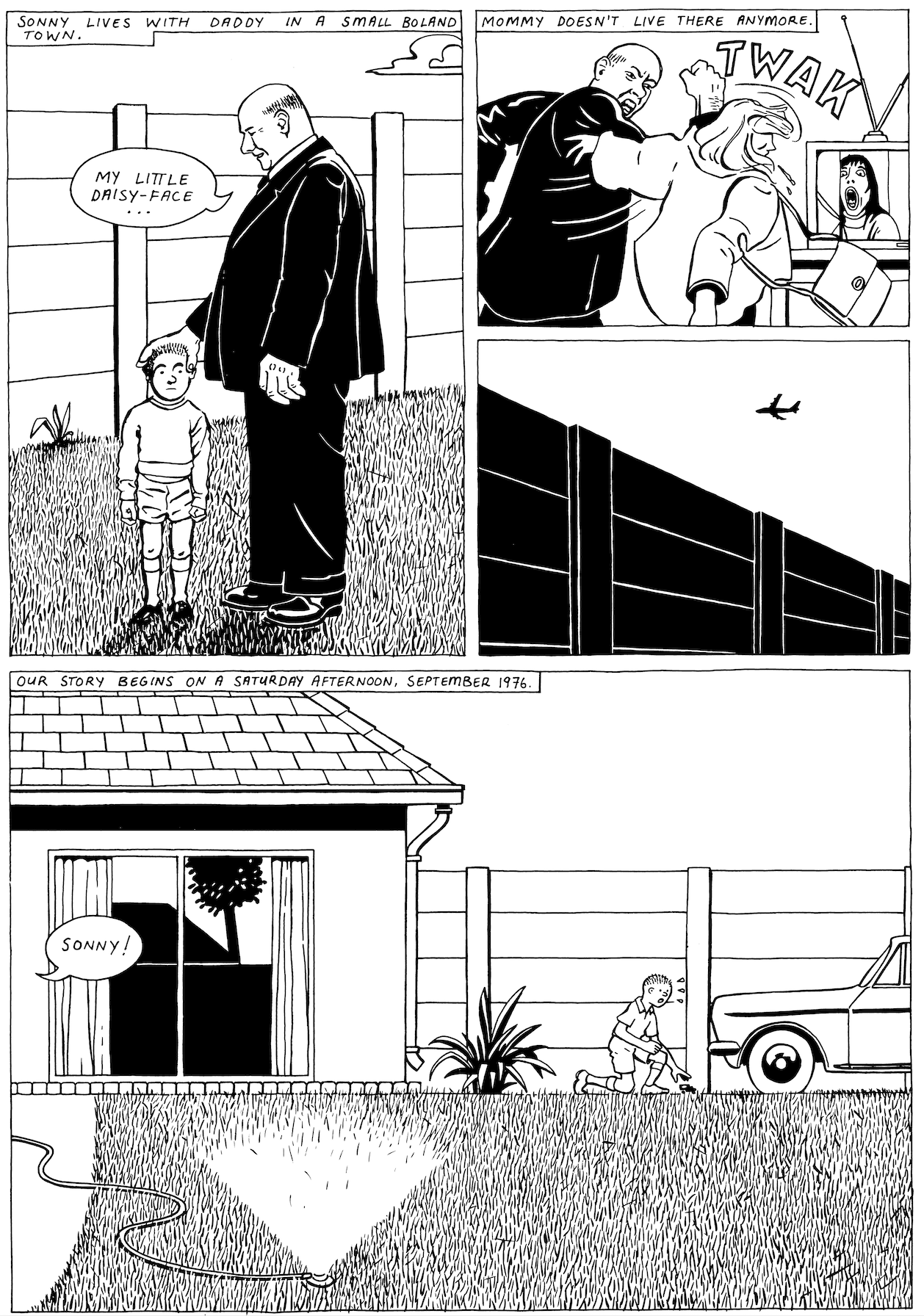
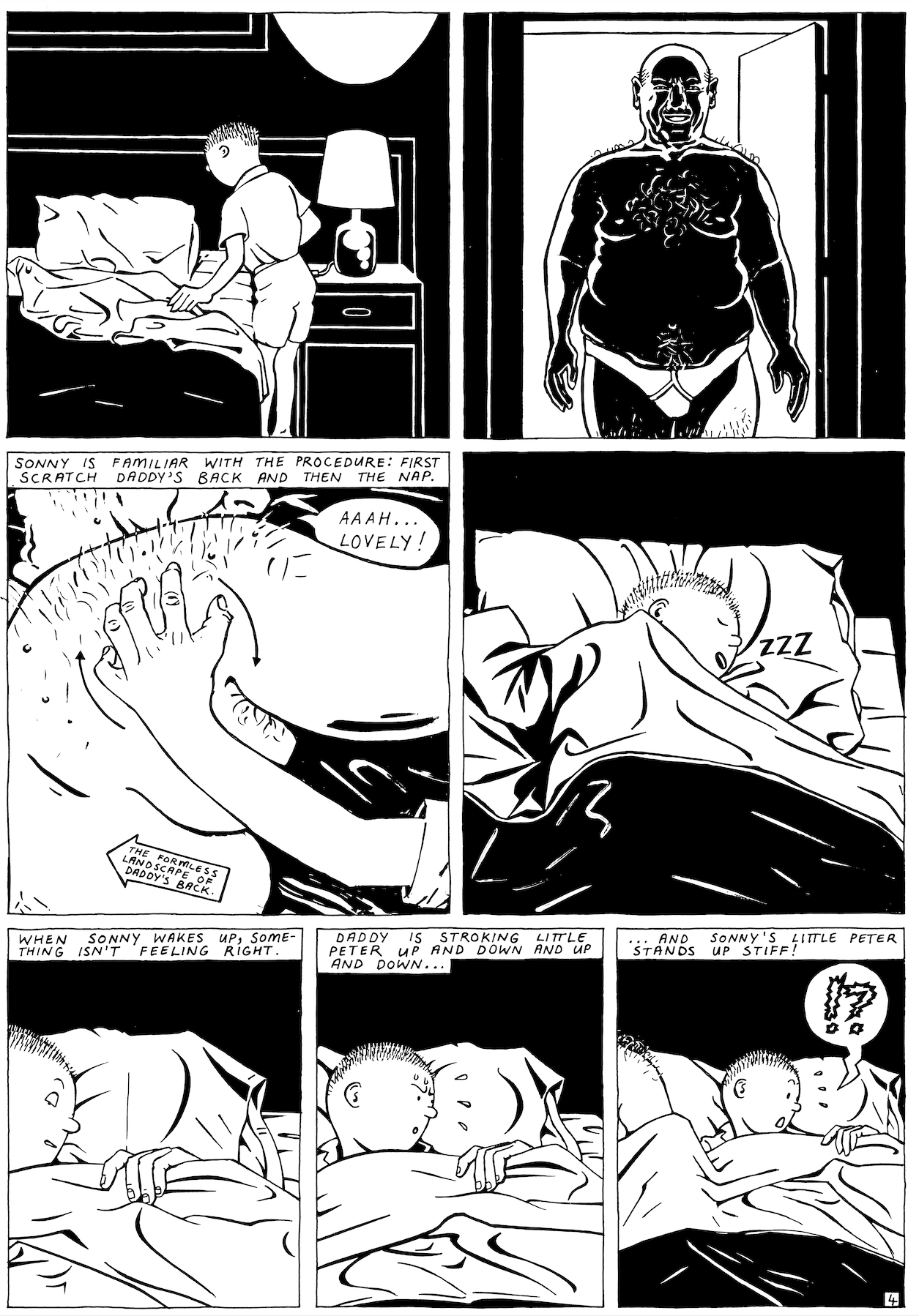
Another topic discussed in the interview is how the surname Kannemeyer carries obligations in a South African context. Anton is the son of J. C. Kannemeyer, an eminent professor of literature, probably best known outside South Africa for his many author biographies, including one of Nobel laureate J. M. Coetzee. This also means that Joe Dog was not attacking just anyone when he portrayed his childhood in comics as a reign of terror, marked by physical violence and sexual abuse at the hands of his father. A major scandal, in other words.
Kannemeyer was born in 1967 in Cape Town, where he now once again resides. He studied graphic design and illustration at the University of Stellenbosch — sometimes referred to as “the Afrikaners’ Oxford” — alongside Botes. He later lectured at several universities across South Africa before resigning in 2006 to devote himself entirely to his art. In addition to nineteen issues of Bitterkomix – the most recent published in 2023 – and several collected volumes, Kannemeyer has released a number of books consisting solely of his comics and drawings, including Pappa in Afrika, Pappa in Doubt, and The Erotic Drawings of Anton Kannemeyer. In late 2025, Kannemeyer and Botes published selections from their sketchbooks in Bitterkomix: Sketchbooks and Journals, a retrospective of the past thirty years spread across 228 large-format pages.
The interview has been edited for clarity by Aman and Kannemeyer.
The early days of Bitterkomix
ROBERT AMAN: You’ve just released a Bitterkomix sketchbook. How was it to revisit the last 30 years of work?
ANTON KANNEMEYER: I think as an artist it becomes difficult when you have that many books, that many drawings, that many references, to keep everything together. I had this book in mind for a long time. I’ve been collecting material, trying to file everything — both physically and on my computer — and documenting it properly, because everything needs to be scanned. Once something is scanned, you often discover distracting shadows, so you have to go into Photoshop and clean it up. The book you’re referring to contains 1,075 images, so there was a huge amount of work involved in getting the facsimile quality right.
Revisiting everything was interesting. There were sketchbooks I hadn’t opened in years because I didn’t think the work inside was good enough – I had simply sealed them in plastic and thrown them into a box. Still, I had a fairly clear idea of what I wanted to include. At the same time, I found many pieces that had been sold long ago or that I had completely forgotten about. It was quite a process. It took more than a year to put everything together, with long working hours and the help of others to improve the image quality. So yes, it was a major job. And afterwards, of course, you think, "Oh shit, I forgot this image, and that one, and another I would have liked to include." But I’m very glad it’s finished. I’m glad we did it. Sometimes you make a book for an audience; this one I really made for myself. It has become a perfect reference. Now I can find everything.
When I read it, I noticed two things: in the early years your and Conrad’s styles are much more similar, but later they diverge in different directions. Early on you also write more in Afrikaans, whereas later the work shifts increasingly into English.
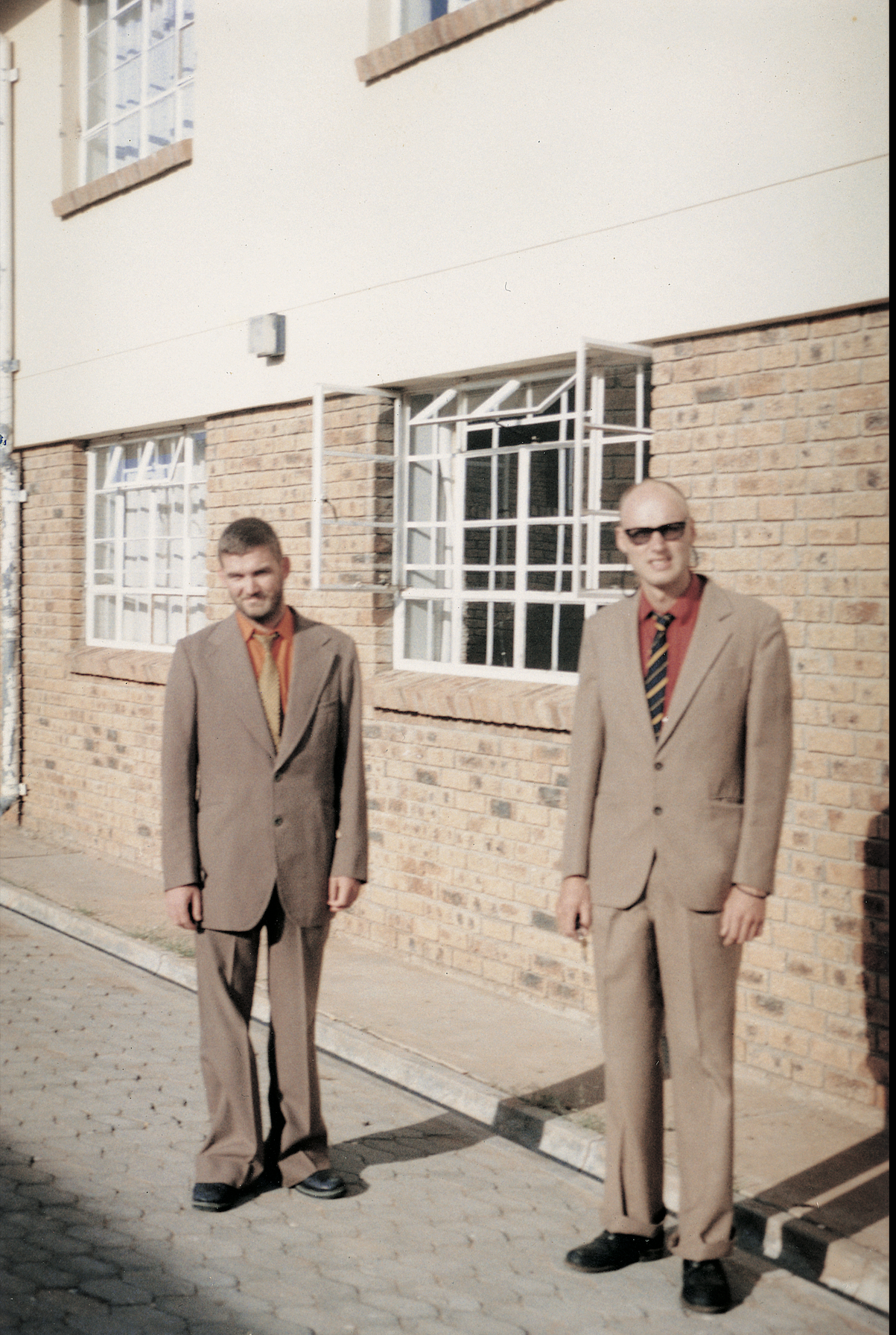
Conrad and I studied together — we started in 1988 — and our styles strongly influenced each other. We experimented a lot. He would come up with a solution, I would copy it and develop it further, and then he would copy me again — it was that kind of back-and-forth. When you’re young, you’re uncertain about where your career is going, and you can get upset if someone does something you felt was your idea and then repeats it. Other students copied what we did as well, and we were constantly looking at what others were doing. That is one of the basic dynamics of art school.
But yes, our styles were definitely close at the beginning. I worked quite loosely, and he did too; we tried to push that as far as possible. Later, I think we became interested in more specific directions. For my part, what I guard against now is becoming too realistic, too naturalistic. I have a tendency toward that, and I try to disrupt it – especially in my comics. These days I’m more interested in an underground aesthetic, where you deliberately draw a character somewhat “badly.” I’m no longer interested in the polished, romantic slickness of much mainstream European genre comics — fantasy, science fiction, that sort of thing. Conrad also moved away from genre comics, and his style has become more specific. We’ve thought a great deal about style, and there is much one could say. Perhaps his style is somewhat more romantic, while mine is more classical. In fact, our differences have probably enabled us to collaborate for so long.
Did you become friends immediately at university?
More or less. He was slightly younger than me – he had come straight out of school, while I was about two years older. The gap was partly because I had spent time overseas after giving the army the slip in South Africa. I was assigned at school in 1983 to file all the army papers — of the boys who turned 16 that year — for the head master and secretly removed my papers from the pile. I didn’t get a call up from the army! But once I registered to study at the University of Stellenbosch in 1988, 5 years later after my return from Germany, they tracked me down.
Anyway, my impression of Conrad at the time was that he was a bit naïve, perhaps simply because he was younger, but he caught up quickly. He was deeply interested in comics, and since I had access to a large collection of European albums that he didn’t, I was able to introduce him to a wide range of material.
In South Africa we grew up with Tintin and Asterix – those were essentially the only albums available in libraries. Beyond that, there was very little. We also read American superhero comics, and from Britain we had 2000 AD and possibly a publication called Titan. We might also have had The Beano. But underground comics were unavailable, and most European material never reached us. Because my mother lived in Europe, however, I had access to things others did not see. That exposure shaped my visual world.
Was this due to censorship, the lack of an importer, or a lack of general interest among potential customers in South Africa?
Well, there was, of course, censorship in South Africa, so a lot of material was not allowed into the country. For instance, Heavy Metal — originally the French Métal Hurlant, which began appearing in English in 1977 — simply wasn’t generally available. There was one shop in Johannesburg, Estoril Books, that imported these comics directly. They would receive two copies of Heavy Metal, two copies of Epic Illustrated, something Marvel did to break into the adult market. They would get two copies, and I would buy one and my brother the other, so we didn’t leave much for the rest of South Africa. That was when we lived in Johannesburg. We were quite fanatical about our comic collections and about getting that sort of material.
Someone like Robert Crumb I only really discovered after I moved to Europe. I started finding second-hand Crumb comics — Zap Comix, Uneeda, all those early titles — and I bought everything I could and brought it back to South Africa.
In his book The Literature Police: Apartheid Censorship and Its Cultural Consequences, Peter McDonald explains that censorship during apartheid also took the audience into account. A book could contain objectionable values yet be allowed if it was deemed to interest only a small circle of white intellectuals.
Yes, I think that is probably true. However, there was very little available in any case, at least in terms of comics. When the police wanted to target you, they could come in, inspect your library, and declare certain books illegal, creating grounds for arrest. The two cultural areas where censorship was most evident were film and music. I don’t know if you’ve seen the documentary Searching for Sugar Man?
Yes, it was actually directed by a Swede, Malik Bendjelloul.
There are certain things in that film that I think have become part of a popular myth and aren’t entirely accurate. But one detail mentioned in the film is true: when radio stations wanted to play certain songs, the album might be allowed, but the specific track would be scratched out on the LP so it could not be played. You could see the groove physically damaged. Certain music simply wasn’t permitted. Something like “Lucy in the Sky with Diamonds,” with its LSD reference, could be blocked — not all Beatles songs, but specific ones.
You saw similar censorship in film. I remember seeing The Shining, and in the scene where the woman gets out of the bath there was a blurred patch over her breasts and crotch. You saw the scene, but the figure was obscured. In other cases, large sections were cut, sometimes to the point where the film no longer made sense. And sometimes films were banned outright.
Some writers were banned as well. Etienne Leroux’s Magersfontein, O Magersfontein (1979) was prohibited, which had a significant impact on him. He was an Afrikaans writer whose book was banned in South Africa, meaning it was unavailable. Copies circulated privately; my father had one. But as you say, such books were accessible only to a small intellectual elite who were unlikely to threaten the government.
If we go back to you and Conrad at university, how would you describe the South African comics landscape in the 1980s?
Nothing much existed. There were very few local comics. I knew of one underground publication from Rhodes University in Grahamstown. A group of students produced a comic magazine about a year before ours. It wasn’t very good — more an expression of anger than a developed artistic language. There was also a guy called Andy Mason from Durban who made underground comics in the style of Gilbert Shelton’s Fabulous Furry Freak Brothers. Often the comics were incoherent, more slogans like “fuck apartheid” than something substantial. In Afrikaans there was absolutely nothing. The comics available in Afrikaans were a few Tintin albums and some Asterix translations, considered children’s books. Otherwise, in English, there were Marvel and DC superhero comics.
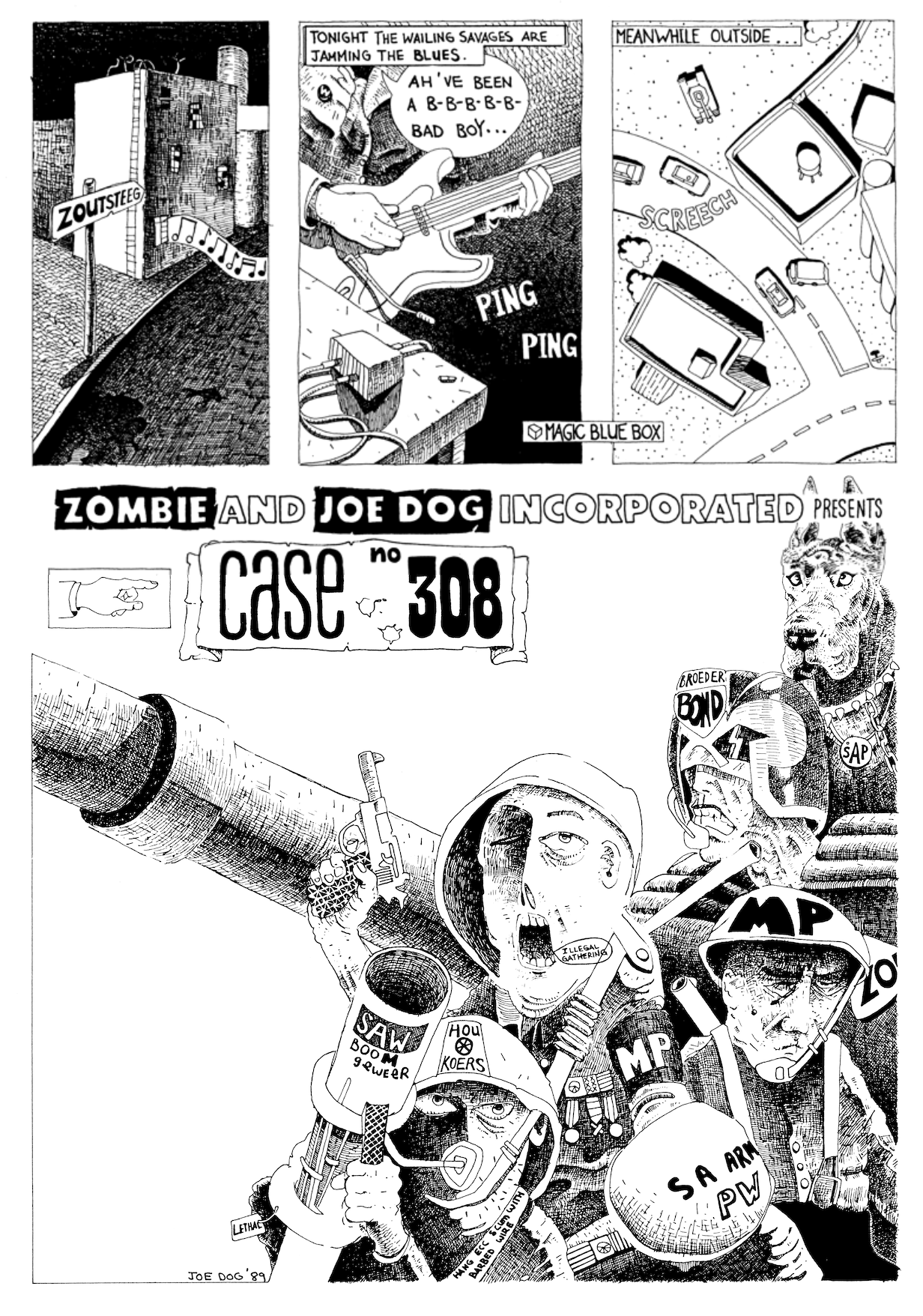
When we started Bitterkomix in our second year, we decided to draw a comic together — an anti-conscription comic — because conscription was a major issue for us. By then we constantly received letters from the army requiring two years of military service. Because we were studying, we received deferments. Had we failed a year, we would have been drafted. Some students openly refused service and were pursued by the military police. There were raids on the department. It was quite frightening. People literally had to hide. Conrad and I made a four-page comic about conscription and sent it to an alternative Afrikaans magazine called Stet in Johannesburg. They published it. That was our first published comic, in 1989.
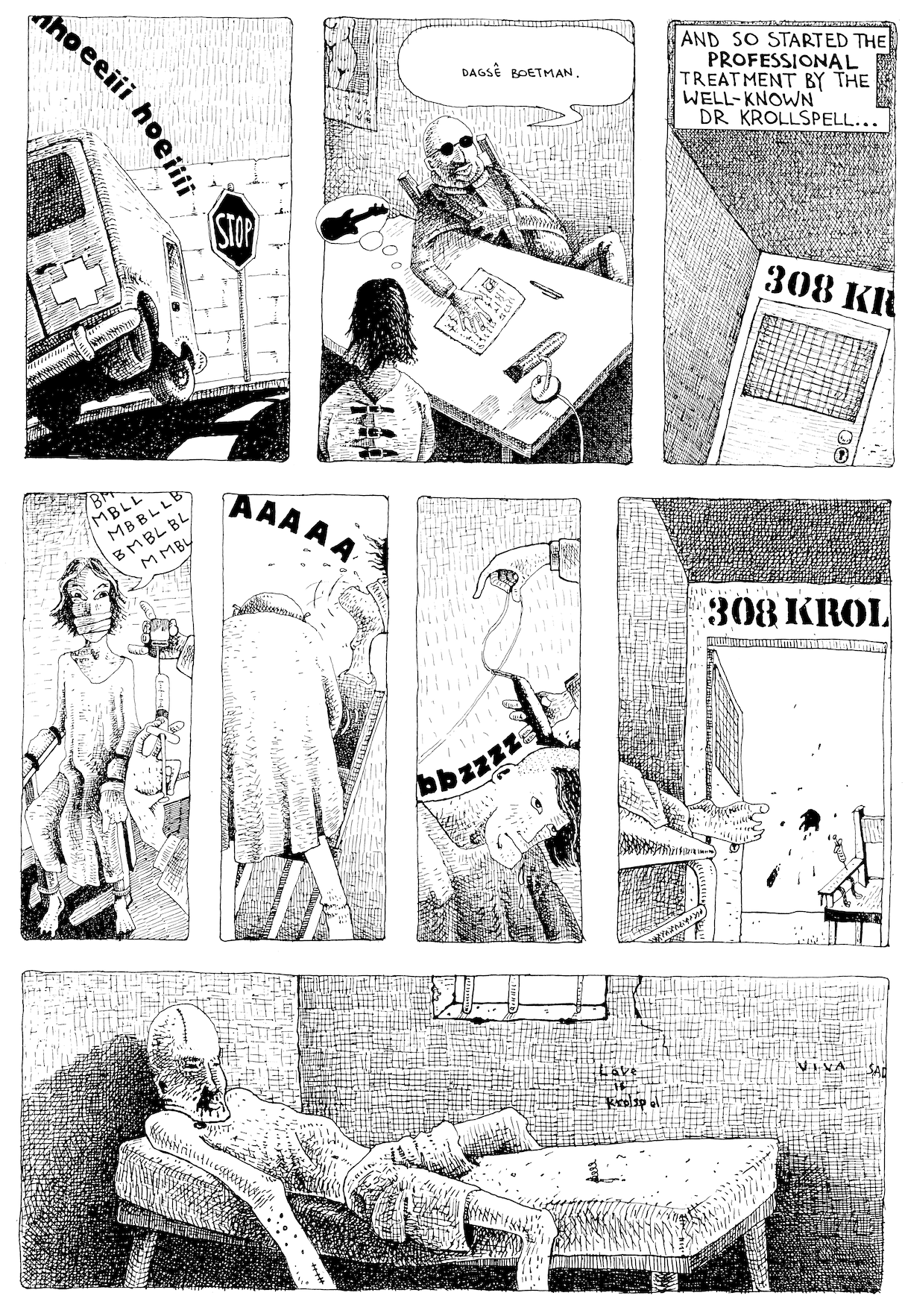
Did you sign it with your names?
We used pseudonyms. When we did Bitterkomix number one in 1992 and published it, I worked under the name Joe Dog. But our real names were still connected to the magazine — both mine and Conrad’s — so we weren’t exactly anonymous. Some of our lecturers actually warned us. They said, “Listen, you may get into trouble for this. You must be careful, because you are being monitored anyway.”
Weren’t you scared? The South African security services under apartheid were internationally notorious for their brutality. Torture, assassinations, and disappearances were routine.
The truth is that things were already beginning to change. In 1989 there was a referendum among white South Africans asking whether the government should continue the process of transformation and negotiate a transfer of power to the ANC — in effect, to the Black majority. It became a five-year transition that culminated in the 1994 democratic elections. During that period, from around 1989 onward, the atmosphere in South Africa slowly began to shift. We still had the military police and all that intimidating presence, but at the same time a transformation was underway. It was, in fact, a very exciting time to be making art in South Africa.
What was it that you feared the most with conscription?
Well, what it basically meant was that all white boys in South Africa, when they turned sixteen, had to register. The schools handled this on behalf of the state. Schools were very much shaped by what was called in Afrikaans Nasionale Christelike Onderwys — National Christian Education — which tried to instill a nationalist worldview. It was a very basic ideological education: the idea that we, as white people, were bringing “light” to Black South Africans, and so on. All of this was supposedly done in good faith.
In the 1970s the Border Wars were intense. South Africa was fighting in Angola. Conscription was initially one year, but by the end of the decade it became two years for all white males. On the one hand, the war on the border continued; on the other, by the mid-1980s, the state of emergency meant troops were deployed in the townships. These were the areas around cities where Black South Africans lived. Soldiers were sent in with military vehicles to maintain order and prevent unrest. In practice, this meant that you, as a South African, could be required to shoot other South Africans who were deemed to be “misbehaving.” Conrad and I were both completely opposed to the idea of ever doing something like that, entering townships to enforce law and order as defined by the National Party.
It was a huge issue. At the time, I think it was morally quite clear where one should stand and how one should act. If you compare that with today, things feel more complex, but I guess we will get to that.
We will. By the way — Joe Dog. Where does that come from?
When I was young, I was very into punk music. I listened to the Sex Pistols and later the Dead Kennedys. The Sex Pistols had these outrageous names, like Sid Vicious and Johnny Rotten, and I wanted something with that kind of attitude, a name that sounded transgressive. Conrad called himself Konradski, which hinted at a Russian/Communist name. It was all done in fun. But after the first issue of Bitterkomix I remember thinking I didn’t really want to keep using Joe Dog. It felt too nonsensical, not specific enough. I wanted something more politically charged, like Dead Kennedys or Jello Biafra. But the name stuck. People would come up to me and say: “Ah, Bitterkomix! What’s that guy’s name? Joe Dog? Joe Dog!” So I thought, okay, I’ll just have to live with it.
What do you remember about the reactions to the first issues of Bitterkomix?
The first issue had quite an impact. We printed a thousand copies. Many people were interested. We sold mainly to students and young people. At the time there was a kind of rock revival among Afrikaans-speaking youth. Alternative Afrikaans bands were emerging and making exciting music — often satirical, mocking the National Party — and they were hugely popular among young white audiences. That was the milieu we tapped into.
From the beginning, Conrad and I also designed posters for these bands. We did posters for alternative theatre and performances as well, mostly in Afrikaans. That’s one reason why the comics were — you asked about this earlier — predominantly in Afrikaans at first. The shift came later. After around 2000, many of my comics were first published in French, and sometimes later in South Africa. Occasionally I didn’t translate them back into Afrikaans and simply kept them in English. South Africa is effectively bilingual; Afrikaners speak English fluently.
But to return to that earlier moment: there were some newspaper articles, and later people told us the first issue had made a strong impression because they had never seen anything like it. There had never been a comic drawn like that in Afrikaans. We also had no lecturers who knew anything about comics. Nobody knew anything about the medium. Conrad and I worked through trial and error. We didn’t have anyone telling us how a character should move across a panel or any of the formal principles one learns in comics. We educated ourselves later by reading and studying the form. But I think what distinguished our work from other efforts was that we worked very hard and tried to emulate the sophistication we admired in French comics. I’ve often heard people say — especially in France, where we’ve spent a lot of time — that our comics feel strange: as if something European went to South Africa, underwent a transformation, and returned altered. A kind of cultural feedback loop.
A find that to be a fitting description. A form of cultural hybridization.

It’s a funny process. People talk a lot about style and its importance. Conrad has, by now, a very specific style. I’m still more adaptive. Because I work a lot with parody, my style shifts according to the subject matter. For me, the idea or conceptual motivation usually comes first, and from that a visual language develops.
Besides Charles Burns, what other sources of inspiration did you have at the beginning of Bitterkomix?
There were many. Apart from Hergé, we were strongly influenced by RanXerox by Tanino Liberatore and Stefano Tamburini, the Italian comics. I read all the Hugo Pratt albums and material like that, which certainly had an influence. There are particular works by Pratt that I still admire. Moebius was also a major influence, especially early on, and Conrad loved his style and tried to incorporate aspects of it. Jacques Tardi and Loustal both made a big impact on our styles. Eventually, Robert Crumb became a huge influence for both of us. I don’t love everything he did — the Mr. Natural material doesn’t grab me as much — but some of the work he did in Weirdo is extraordinary. It’s among the best comics I’ve ever read. His sketchbooks have also been a major influence. There are many others. Daniel Clowes, especially Eightball, impressed me more and more over time. At first, I wasn’t so struck by it; later I found it extraordinary. I’ve largely moved away from genre comics. I’m more interested now in autobiographical work and more literary forms of comics.
How has Bitterkomix evolved over time, would you say?
When we started, the first issue was received as something new. “Wow”, people said, “we haven’t seen anything like this." Conrad and I were very influenced by that reaction and thought, well, perhaps we should continue in that direction. The second issue is actually not very good. The third is highly experimental. My brother, who was studying in Berlin, began contributing, and I think that is one reason it became more sexually explicit.
From my point of view, it developed into a socio-political satirical magazine. That became our focus. Initially, our target was our Afrikaans background. There were many things we found terrible growing up. For instance, we had to attend the Dutch Reformed Church. We had preachers giving what passed for sexual education: you must not masturbate, you must only have sex after marriage, and so on. It sounds ridiculous now. One might say: who would take that seriously? But when you are beaten into submission and trapped in a system where everyone forces you in a certain direction, it is terrible. That is one reason I am very concerned about censorship today. I feel there is a growing tendency toward censorship, especially from the left, and that many people advocating it do not understand what they are supporting because they have never lived through it.
Censorship is a terrible thing. When you are allowed to see only certain things, to access only certain ideas, it becomes very easy for leaders or governments to manipulate you. I am very interested in history, and what happened in Nazi Germany is particularly instructive to me because I see parallels with the South Africa in which I grew up. It is very easy to sit in, say, Holland or Sweden and point a finger and say, "You were a bad white person, you shouldn’t have elected that leader, you should have done this or that." But people are indoctrinated; they behave in ways they believe are right. And then, later, you learn something else.
Mocking good taste
You mentioned that the third issue of Bitterkomix became more sexually explicit. It seems as if you wanted to make a mockery of respectable taste. I’m thinking in particular of examples such as your controversial print “Boer girls like to suck dick” – where the title is a quite accurate description of the image. Was this due to the fact that pornography was banned during apartheid?
So the thing is, there are works I’ve made specifically about this where I talk about the “five-headed monster” of my youth, and sex was certainly one of those heads. We really went through a kind of sexual liberation. It’s interesting as an Afrikaner: many of my white English-speaking friends grew up in a more liberal environment. So it’s exactly what you’re suggesting. Because we as Afrikaners felt liberated — Conrad and I especially — we thought, "Now we can do anything. There is no censorship anymore. Let’s see how far we can push this. Let’s go all the way."
My more liberal friends would say, “Hang on, now you’re overstepping the boundaries of good taste.” But I never felt those restrictions. I felt I couldn’t push it far enough. How could I be even more vulgar? That position comes from our background. I remember speaking in Belgium once about our sexually explicit imagery. Two older women approached us afterwards and said that when we began discussing the work they assumed we were just two naughty boys, but now they understood that we had a point in making it.
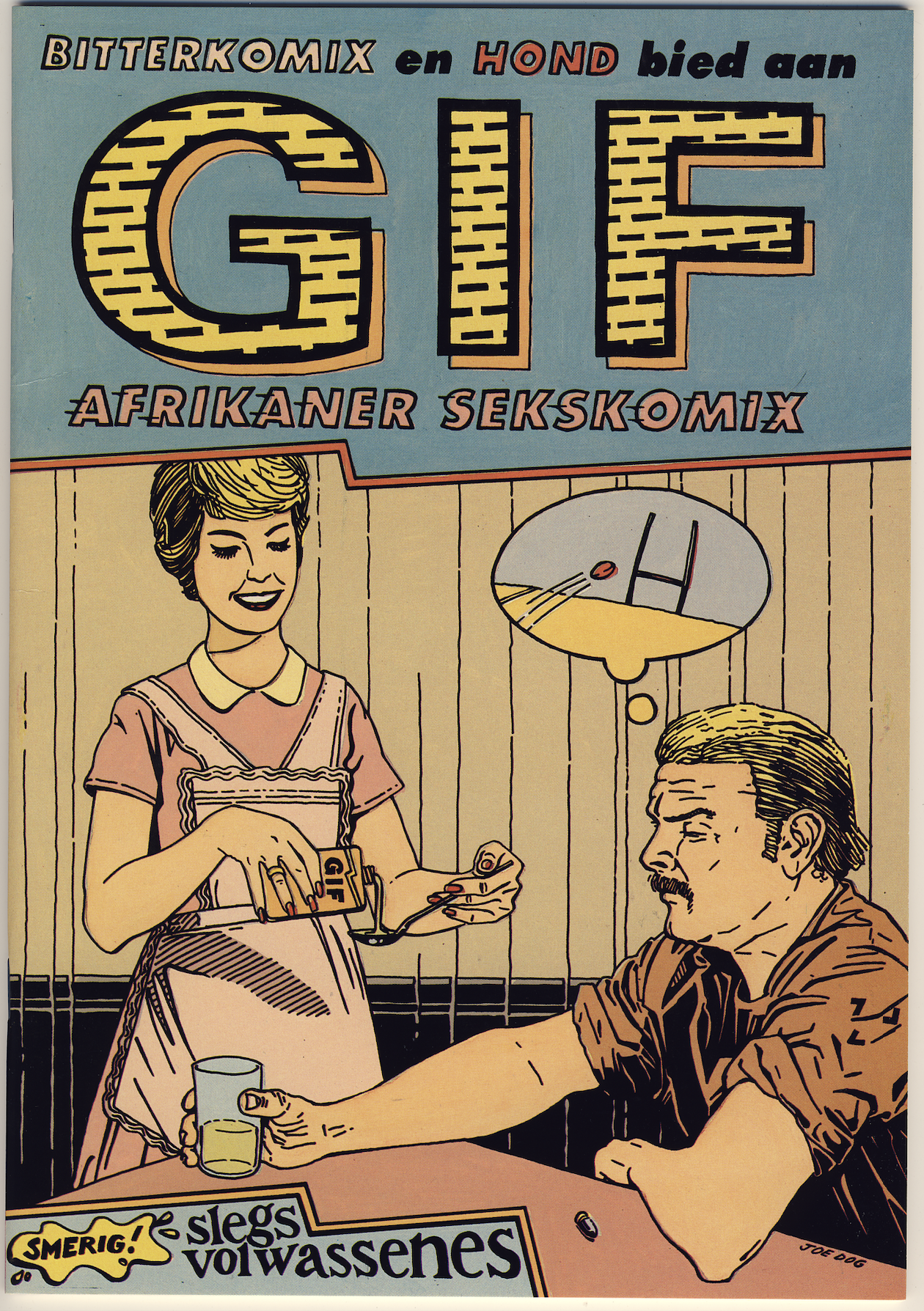
For me, it was a cathartic experience — rejecting everything we grew up with, questioning it, attacking it. We had a lot of support from young people and strong opposition from older, more conservative Afrikaners, and from English speakers as well. I remember a lecturer I respected very much. In 1994, we made a publication called Gif: Afrikaner Sex Comics. He was an English lecturer, very proper, very British — tea and manners and all that — and a very good drawing teacher. I really wanted to impress him. He asked to buy a copy after hearing about it. I sold him one. The next day he returned it. He said, “Thank you. You can keep the money. I do not want to keep this.” After that he never spoke to me again. He wouldn’t greet me. He was so upset by the publication.
There is something about Afrikaners: when they turn, they go all the way. I remember the student leader of the University of Cape Town branch of NUSAS — a student anti-apartheid organization — telling me one day they received a call from contacts linked to the ANC in Mozambique: ten or twelve white Afrikaner boys had arrived saying they wanted to fight apartheid by joining the ANC. The response was: no, they must go back, they are more valuable fighting inside South Africa than training as soldiers in Mozambique. That illustrates the difference. You come from an incredibly repressed background, and when you reject it — when you see the light — you want to change everything. There are almost no boundaries. And that, I think, marks the difference between the early Bitterkomix and what came later.
I also presume that some of your more erotic work taps into what, in an Afrikaans community back then, would have been imagined as the worst possible thing you could do: pornographic imagery of a Black man having sex with a white woman. Partly because it touches racial fantasy and taboo, which you of course have posed, staged, and pushed.
Yes. I mean, all of those stereotypes, all of those ridiculous things, we undermined them and made fun of everything. I remember in Gif there was one comic where a Black man has anal intercourse with a white woman. I had a good friend — he was the drummer in a band I played in — who refused to talk to me after he saw it. He was so upset. And I was like: "But we’re poking fun." We were trying to aggravate everybody by doing these things.
At the time in South Africa you couldn’t show penetration or anything like that. I’m talking about girlie magazines here. It was just introduced in South Africa: Playboy and Hustler. It was nipples, maybe a vagina, maybe a penis — I can’t even remember if a penis was shown, definitely not erect. This was around 1993, no, 1994, when Gif came out. Then Gif was actually banned by the ANC at the end of 1994.
Oh, really. What for?
Yeah – the first government that took over banned it.
But why did ANC want to ban it?
We eventually got the reason, published in the Government Gazette. The official wording was that it was indecent and, basically, unfit for human consumption, something along those lines. But we believe it was old structures inside the new government that enforced it. The other thing is that they didn’t inform us that it had been banned. You have thirty days to contest it, and under the new rules we would have been able to contest it. But as soon as those thirty days had passed, several shops in Cape Town and Johannesburg were targeted and told they had to remove the publication immediately. The shops phoned us and said, “What’s going on? Has your publication been banned?” We said no, and then we found out it had been banned.
We got copies of the Gazette page. The Government Gazette is this thick book, published every couple of months, with new rules and laws and so on. Who reads that? Nobody reads that. But we were told we were “supposed" to open a case and say, “This is unfair.” We would have had to pay, at the time, 10,000 rand. It was impossible for us. You could buy two cars with that money — or two second-hand cars, at least. So a lot of bookshops just said, “Fuck that, we’re going to sell it anyway,” which they did. We sold all of it. We also sold it hand-to-hand. Conrad and I would go to art festivals with backpacks full of comics and sell directly to people. We were very active in marketing our own work at the time. Then a friend of ours took Gif to the Hustler publisher and said, “Why don’t you publish this in your magazine?” And the publisher said, “No, no, no, you can’t. It’s too outrageous.” But he offered my friend a job as editor of the first Afrikaans girly magazine. My friend phoned us and said that we have to draw for the magazine. That’s one of the reasons we ended up making so many sexual drawings.
But Conrad and I just continued where we left off. We had to make one-page jokes and single-page comics, but everything we did was undermining white males. So the magazine sold well — lots of people bought it — but everyone complained about the cartoons. They said, “These aren’t sexy. They’re not funny.” We were doing cartoons about white men with small penises, men who can’t get erections — anything that didn’t make the male reader feel good about himself. Eventually we stopped working for them. We weren’t exactly asked to stop – there was an incident, but I won’t bore you with it.
Please do. What happed?
Conrad found a picture in a South African glamour magazine of a young blonde woman walking out of a bakery with a large paper bag full of baguettes. He then replaced the baguettes with large erect penises and entitled the montage “Lunch break." Anyway, it was hilarious, but he mentioned to our friend the editor that maybe it shouldn’t be published, because the model may recognize herself. Our friend said, no, it’s great, that will never happen, and published the cartoon. And of course, she saw the picture and sued the publishing company. Our friend phoned us and said, look, don’t worry, it will blow over. Anyway, it didn’t. Next thing we knew, we got sued because the publishing house told her lawyer that they received the cartoon in good faith from us. We basically said well, we’re students and don’t have any money, we can’t even afford a lawyer! Anyway, it did eventually blow over, after apologizing profusely and many letters. But in the end, we were a bit pissed off and so stopped working with them.
Growing up Kannemeyer
Another aspect of the reception of your work is that these provocative comics are made by someone with your surname, a name many in the Afrikaans community would recognize.
True. And that’s one reason I took the name Joe Dog. I didn’t want to be known as the son of a famous literary critic, which my father was. He was probably the literary critic in Afrikaans. He wrote two thick books on the history of Afrikaans literature, standard reference works. My father was a complex person. In the first interview I did in The Comics Journal with John Lent, he quotes me as having said my father was “evil” or something like that. If I ever said that, it was probably because I was very drunk, which I’m not normally. Even when I’m drunk, I wouldn’t say something like that. Because I don’t really believe in this concept of good and evil. And I’m not drunk a lot. Well, not anymore.
The point is that he had many fans, but growing up with him was very different from his public image. He was a very abusive man. He beat his children a lot. He beat his wives. He was married four times; he beat all of them. Some of those things I learned later. I’m working on a longer autobiographical comic about my relationship with him. What I’ve also come to understand is that he was a spoiled child. He felt things belonged to him; he could take what he wanted. He didn’t share. Living with him — he was also an alcoholic — was like having a very naughty child in the house. He did whatever he wanted and behaved abominably. When he died, I spoke to bookshop owners who said he was the rudest person — if he asked for a book they didn’t have, he would slam down the phone. And yet, he could be extremely entertaining with an audience. He told jokes brilliantly. He did literary tours where he’d take people on a bus and tell stories about famous Afrikaans writers. He even took groups overseas — to Amsterdam and so on — tracing the footsteps of South African writers. He had a following. A lot of women fans, especially. My brother and I were, according to them, the ungrateful sons who never behaved properly.
In Bitterkomix number five I made a comic about him sexually abusing me. I don’t mind talking about it, because drawing that comic was cathartic. Before that, I couldn’t speak about the incident. I couldn’t tell anyone. After I drew it, it was like the floodgates opened. People approached me and said they’d had similar experiences. It was an extraordinary thing. It was better than seeing ten psychologists. In fact, I’ve never seen a psychologist or psychiatrist in my life. Sometimes I think maybe I should have, but it feels as if I could resolve a lot through my work: get beyond it, be able to talk about it, and maybe make it easier for others. Publication matters too. Before something is published, it’s not open to the world – it remains a kind of secret. The moment it’s out there, people start reacting.
That’s also the thing with satire: you grapple with a problem, you debate how to frame it, you may talk it through with a gallery owner or editor and agree, “Yes, this is the way.” And still you don’t know the reaction. Editorial cartoonists experience this too. Everyone agrees it’s a good idea, you publish it, and suddenly there’s backlash you never anticipated. Once it’s out there, it’s out there.
How did your father react to the comic?
Once I published the comic, I had to confront him. I couldn’t just publish it and run away. That’s not right. So I wrote him a letter, went to his house, and handed him the letter and the comic. I said, "I’ve done this, I wrote a letter and we need to talk about it." Look, at the time I felt repulsed even by just shaking his hand. I realized something was deeply wrong between us. So I had to address the issue. He wrote back and said it was completely untrue. He claimed I’d invented it to inflate sales, or to exploit his fame, and so on. He wrote it in such good Afrikaans, so convincingly, that for a moment I thought: maybe I’m imagining things. What kept me sane was that my brother and I could talk — we’d experienced similar things. So at least I knew I wasn’t insane; I wasn’t making it up.
My father then said he didn’t want to know me, and we never spoke again until he died. He lived another sixteen years. That may sound tragic, but for me it wasn’t. I tried to resolve it: I said to him, it’s not that I want to punish you, it’s that we need to talk. If he could have said, “I’m sorry,” I could have forgiven him. But he didn’t. And honestly, my life became much better after that break. When the phone rang, I no longer felt that pang of fear. Everything turned for the better. I have a motto I tell people: “Family is overrated." You don’t always have to stay trapped in a space where people expect certain things from you. You can turn your back on it.
Sounds liberating.
Yes – but it’s a very complicated situation. To dismiss my father as someone who did everything wrong is too simple. He taught me a lot of things. Sometimes he taught me in ways that people today would find completely unacceptable. But to give you an example: when I was in high school, one day I told him I had a history test the next day. I hadn’t really studied properly — I was doing it randomly, as I often did.
I said to him, “Ask me a question from this book.” He said, “Okay, which chapter?” He asked me one question and I didn’t answer correctly. Then he pulled his arm back and slapped me across the face so hard my ears were ringing. He said, “Now go back to your room and study, and then ask me to ask you again.” I went back, opened the book, and started studying, and it was as if someone switched on a light in my head. Everything just went in. I remembered absolutely everything. Two hours later I went back and said, “Now ask me any question.” He said, “No, I’m not going to ask you anything. I know you know it now.” And for me that taught me something. I didn’t feel like a victim of abuse in that moment. I thought I was the idiot: I shouldn’t have asked him to test me if I didn’t know the work. The next day I got 100% on the test.
It’s a harsh lesson. For me, at that point in my life, it was a good lesson. I have two kids, I’ve never slapped them, I wouldn’t do that. But that doesn’t automatically mean I’m a better father. Do you understand?
I understand that you want to move beyond a reductive portrayal of him as merely a terrible person. But all of what you’ve said is of course absolutely shocking. Not abusing a child physically or sexually is a pretty low bar for being considered a decent parent.
Yes, I agree. I’ve been thinking a lot about forgiveness. But I think I draw the line at the sexual abuse, it’s just completely unacceptable. The violence was terrible as a child, but I must tell you there was a lot of that in our society. Every boy got hidings at school, and sometimes it was just brutal. My brother once got a hiding on stage, and all his fellow grade students had to come and watch. The blood was dripping down his leg. What really unsettled me as a child though was the fighting between my father and his wives, my stepmothers. It was frightening. The thing is that my father had this pent-up rage. He was incredibly homophobic, but of course I saw him with other men — he really liked men more than women in the end. But the Afrikaner society at the time would never tolerate that. Context is something people often don’t get.
May I ask what was the public reaction to the comic? Was it picked up by the media?
Yes, it was picked up. A popular and very sensationalist tabloid wanted to do a smear campaign against him. They contacted me but I advised them to drop it. I thought that would have been very tasteless. I wanted to deal with my problems on my terms.
You have also addressed your mother in your autobiographical work. In the comic My Nelson Mandela, you explain why you grew up alone with your father: after the divorce, your mother felt she did not have enough money to support you, so she moved to Germany and left you and your brother in your father’s custody. Given what you had to endure as a child, how have you managed not to be consumed by anger?
I was very, very angry when I was younger. Maybe that’s why I made the work I did — critical, harsh, iconoclastic in a certain way. Initially I was very angry with my mother as well, for leaving me with this — basically — monster. But when I got to know her again when I was eighteen, I quickly realized we had very little in common. And then, after I had my own children, I actually got to know her better. We get along very well now. She’s a very singular person. Other people might find her strange — and she is strange in many ways.
Does she still live in Berlin?
She lives near Mainz, close to Frankfurt. But yes, I mean, I don’t know what more I can add, except to agree. I did a comic recently for a Le Cri Du Margouillat that connects to all of this, because it shows the level of subjugation we lived under — the rules, and the way my father wanted us to behave. Now this is something where you have to understand Afrikaans to really grasp it. The way an Afrikaans-speaking person addresses a parent can be incredibly infantilizing. J.M. Coetzee even talks about this in one of his books: the way an Afrikaans father speaks to the mother, saying things like, “Mommy, are mommy’s feet warm enough? I don’t want mommy to get cold.” You speak almost like an infant. You can’t say, “Mommy, are your feet cold?” You have to say, “Mommy, are mommy’s feet cold?” I made a comic about this recently. In it, I said to my father: “Daddy, you need to move your car from the street into the garage.” My stepmother had told me to tell him. And then he beat me because I didn’t say it correctly, because I didn’t say, “Daddy, daddy must move daddy’s car…” You know? That level of language. So what I’m trying to say is that’s the level of subjugation we lived under. I, for instance, never had a birthday party. It just wasn’t offered. It wasn’t allowed. Sometimes I was allowed to go to other children’s birthday parties, but often he would tell me, “You’re not allowed.” He had extremely tight control over my brother and me.
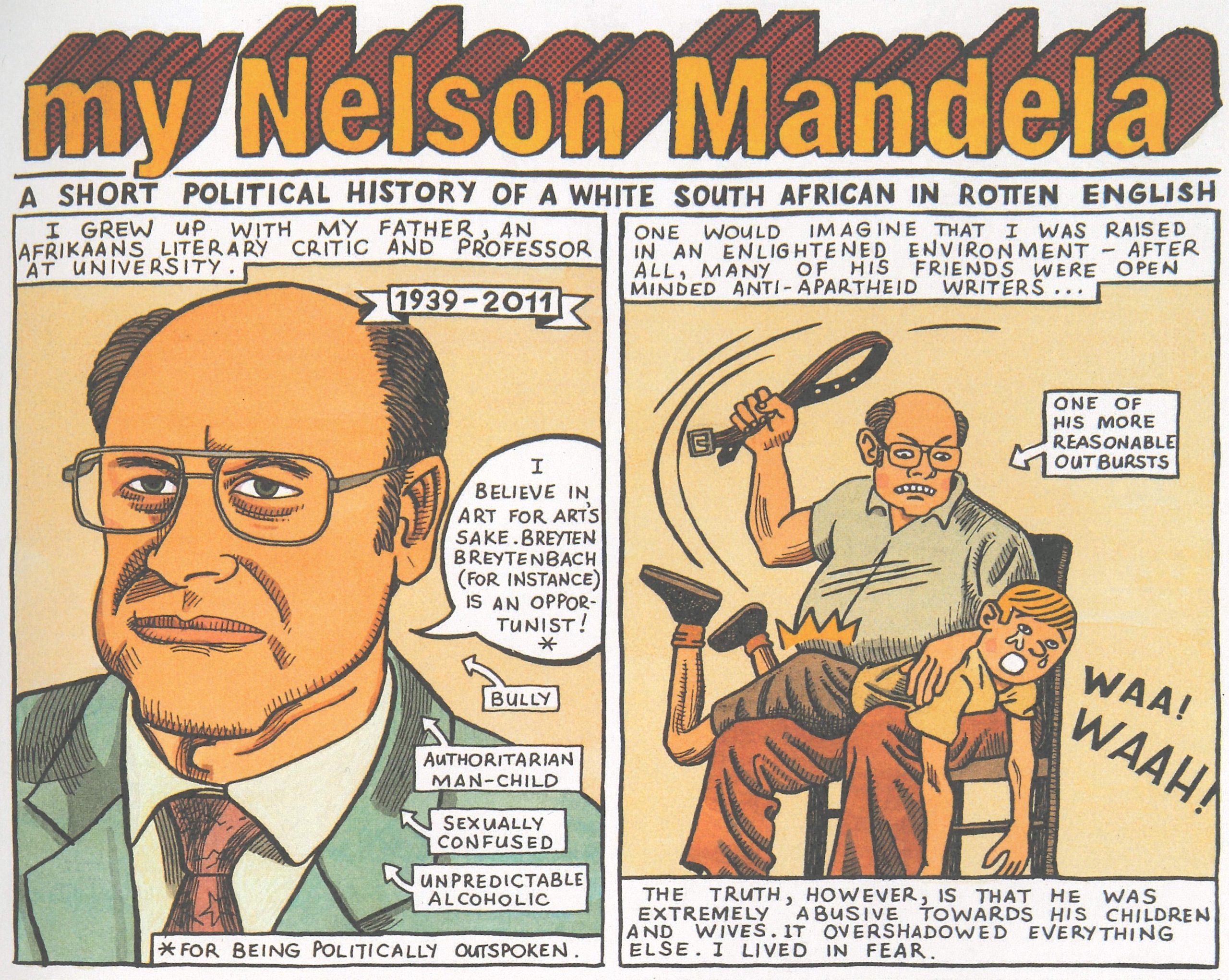
In My Nelson Mandela, you also describe experiences that may surprise European and American readers. You had never heard of Steve Biko and were puzzled by the strong reactions to his assassination, and at a rock concert in Germany you didn’t recognize the face of Nelson Mandela, even though his image had been everywhere in Europe since the late 1970s.
Well, look — this comes back to censorship in South Africa. Because Nelson Mandela was in jail, his face was not allowed to be shown in any publication whatsoever. The same thing happened to Breyten Breytenbach when he was imprisoned: you couldn’t publish his image.
I remember around 2005 I gave a lecture in Johannesburg — a symposium at a museum, I think — with mostly Black students in the audience. I said to them: I didn’t know who Nelson Mandela was. I didn’t know his name. And afterwards two young Black women came up to me and said, “That’s impossible. We don’t believe you. We cannot believe you didn’t know who Mandela was.” They said: in the late 1970s there was the Soweto uprising – 1976 – and it was on the front page of The Times in London. “You must have known,” they said. And I said: how? First, I was a small child, in primary school. Second, information simply wasn’t accessible. That’s something young people today sometimes don’t understand. Maybe if you grew up in a liberal household — English-speaking parents, maybe connections abroad — you would have known more. But we certainly didn’t.
And my father was adamant. He wasn’t interested in politics, and he felt art shouldn’t interfere with politics. That was his position. So, I grew up in an environment where I basically didn’t know anything. At my school, we Afrikaans kids were interested in other things. Sport was kind of compulsory. If you ask anyone my age what position they played in rugby at school they’ll be able to tell you. I played wing. My brother and I were very interested in punk music, heavy metal and comics in my early teenager years, not politics. Later on, my political brain began developing, especially in the last years of high school, and I was probably more open-minded than many students. But I still didn’t know who Mandela was. That’s the danger of censorship, and it’s why I think people should be aware of it today.
It sounds like your household was quite different from, say, Nadine Gordimer’s, which seems to have been full of anti-apartheid sympathizers and political discussions.
Absolutely. But because my father was a literary critic, a lot of open-minded people came through our house, some of them politically active, and so on. I engaged with them, but it was superficial. I was a kid. But it was also through those connections that our first anti-conscription comic ended up being published in an alternative Afrikaans magazine — because I met those people at my father’s house. So I always knew that there are “cool” Afrikaners too. It’s not only conservative Afrikaners. There are people who think differently. And that’s why I say my father is complex: on the one hand, a jovial storyteller and lover of poetry which he could quote at length. On the other hand, a completely authoritarian monster who used the power given to him by white patriarchy for his own gratification.
My mother told me a story I’ll include in the comic I’m drawing. She went to a lawyer and said her husband was beating her and she wanted a divorce. The lawyer said, “That’s unacceptable,” and then asked: “Who is your husband?” She said he was a professor at a university. And the lawyer replied: “A woman who gets herself hit most probably deserves it. Get out of my office.” And that was it. It’s a shocking story — and very revealing of the times in South Africa.
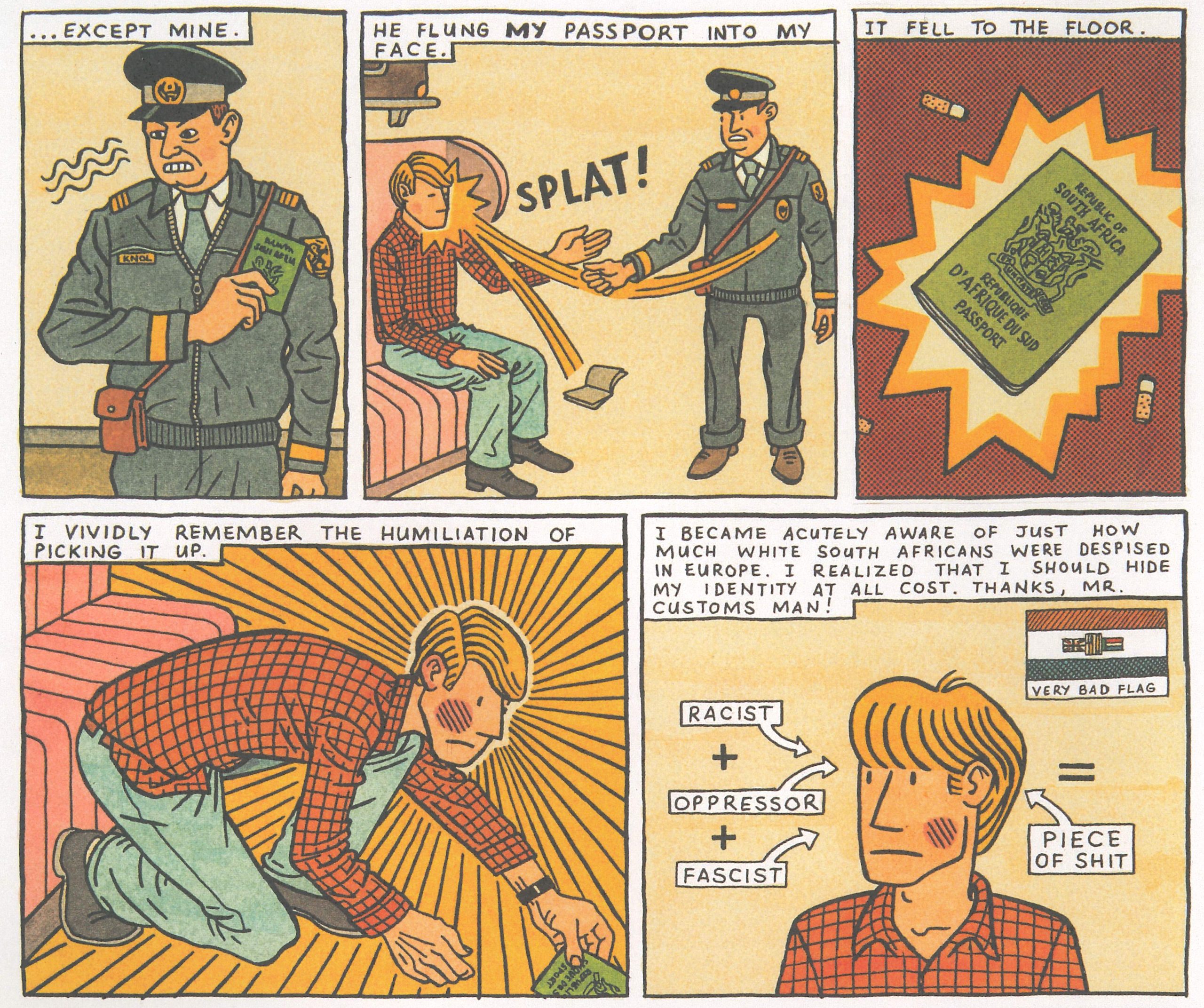
In the same comic, you show how you are treated as if you were a racist, or simply a terrible person, because of your nationality. On your way to visit your grandparents in the Netherlands, a Dutch border guard even throws your passport back at you for being South African.
In a way, at the time, I had already had many people confronting me about being South African, being white, being privileged, and so on. So I felt I deserved it, in a way. I posted that comic on Instagram recently, and a Jewish person commented that it’s similar to the treatment they sometimes get now with an Israeli passport. So that incident resonates.
At the time I was too young. I felt deeply embarrassed, but I didn’t feel, "This is completely unacceptable behavior." Now, in retrospect, I think, before you act like that, remember people are complex. I’d be very reluctant to treat, say, a Russian person like that today. Imagine I treat someone with a Russian passport like that and say “Putin is an asshole, so fuck you” — it would be unfair. People are not representatives of their flag. It’s unfair to treat everyone as if they are. Those are the people who enforce stereotypes. As a satirist, I use stereotypes to address an issue, not to tell people they are bad. And personally, I really appreciate politeness. I’m polite to people. I really don’t like people who are unverschämt, rude.
Bitterkomix goes international
With Bitterkomix you began getting more and more exposure. In the sketchbook you published, we see reviews in The New York Times, The New Yorker and other prestigious publications. You’re also translated into French and got to exhibit across Belgium and France. How did these two angry young Afrikaner artists reach other countries?
We got a lot of attention in the noughties, between 2000-2010. I don’t think our work contributed that much in terms of style or on a formal level. Although, here I must say that we were always very interested in painting and printmaking. Our art department was quite open and the different disciplines mixed quite a bit. Conrad and I would get us some oil paints and now and then paint with the fine arts students for a weekend. And we did a hell of a lot of printmaking. I’m really very skilled in color separation, for instance. All of this helped in making work that was maybe a bit more experimental than just your average graphic design. But in the end I think it was our content: it was rather unique. I was dealing with race in a way that a lot of people found very confrontational. And I must say as a South African it’s part of our culture, we all struggle with our country’s history. Both Conrad and I also have good narrative capabilities. I always was and still am a big cinephile. So with singular images you need to get the conceptual aspect right, with the narrative you have to tap into that lateral thinking mode, really live the moment — to me pure cinematography.
When I interviewed Jean-Christophe Menu for The Comics Journal, he mentioned publishing Bitterkomix in French as one of the achievements he was most proud of during his time at L’Association.
There has always been a lot of interest in Bitterkomix, and a lot written about it. Conrad and I did a lot of exhibitions of our comics work. In between we also made small paintings, larger drawings, and so on. Eventually Conrad wanted to be an artist in the fine art sense. He was picked up by a gallery and began exhibiting more and more non-comics work.
I was approached in 2006 by probably the best gallery in South Africa. They asked if I wanted to join them. Before that I’d done a few exhibitions and had a few ideas that moved away from comics. It’s kind of odd, because I’ve taught a bit in Berlin and spoken to students all over the world, and they often say they want to get into the fine art market because you can actually make money there. You don’t really make money as a comic artist. Conrad and I always knew Bitterkomix was underground, not something we’d ever make money from. But we did build a name with the Bitterkomix brand. Early on we did a lot of commercial illustration and advertising work, and we actually made good money from that. We won prizes too, because the work was seen as unique. Then Conrad moved into fine art. I moved into full-time teaching and did comics on the side. But that became so much work that I started doing more exhibitions. They went well. I sold work. Then I was approached by the gallery, and I started making art more seriously, and it picked up quickly.
In 2006, I went overseas for a residency, and a good gallery in New York contacted me and asked if I wanted to exhibit with them. It was outrageous, and I said yes. That show went very well — it sold out. I didn’t bring a single piece back. I did a second show in New York. There was a lot of publicity and interest. I got a major write-up in The New York Times, and I was also mentioned in The New Yorker. There were many magazines that picked up on that first show. I did museum exhibitions and that kind of thing. Conrad too. I think my focus on race was something people were particularly interested in.
So I did very well for a few years. And then the tide started turning. There was this new wave — on the one hand gender politics, on the other hand critical race theory becoming more central. It really picked up. In early 2015, I was preparing an exhibition in Johannesburg in October. I made a whole series. I made one painting called Extinction – included in Pappa in Doubt – and the gallery owner said, “That’s the best painting you’ve ever done.” By October — and this was after the Charlie Hebdo killings — he said: “You cannot exhibit that painting.” I said: “Why not? You told me it was the best thing I’ve ever done.” And he couldn’t really explain, although we both knew it was because there were two golliwog dolls in the image. But it shows how quickly the mindset changed in South Africa. Really worldwide. Suddenly: “No, no, your work is offensive.” The gallery was terrified. They were scared people would throw rocks through the front window. They were worried about everything. After that they never gave me another exhibition. They were just like: “Your work is really problematic now.” So especially in South Africa, that one year felt like a sudden shift in attitudes. But yes – we did get a lot of exposure, both Conrad and I.
How did all of this affect you?
Well, there’s a lot to be said about this. And there were many attacks on my work, especially in 2020 after the George Floyd madness on Twitter. I’m not even on Twitter myself, but everyone who worked with me distanced themselves from my name. It happened very quickly. I mean I was blocked from exhibiting at the Art Fairs in London and New York in 2019, but the Twitter thing really sunk my career. So basically yes, my art career came to a sudden halt. After exhibiting for years in museums and galleries across the world, I was suddenly toxic. I mean, my work is even in the MoMA collection in New York — I was regarded, according to numerous articles, as some sort of brilliant satirist, and all of a sudden I was a racist. Basically because my work was interpreted literally and because my identity was a ”white male from South Africa”. The fact that my work had always been anti-apartheid, anti-racist and anti-patriarchy all of a sudden meant nothing. I was just a white privileged male from South Africa, obviously racist. My income stopped immediately. But I started to think out of the box and worked around it. I was also supported by a few long time collectors of my work who didn’t run in fear of being labelled racists themselves.
Have you noticed geographical differences in how your work has been received, or has the reception been shaped more by time — a clear before and after 2015?
The trajectory of one’s career is not always possible to pre-determine. For instance, I participated in a group exhibition in Finland in at the Helsinki Art Museum in 2010-2011, and I could see that my work was very much appreciated at the time. There were billboards all over town of my work showing a golliwog, it was even against one building in the city — now of course unthinkable. But certain countries embrace your work, others hate it. France is one country where my work has always been welcome. They do understand satire. The Brits and Americans don’t, even though I had a period of success in those countries. I remember I once had a discussion with an art critic from Art in America, and even though they once gave me a very favorable review, he told me that a work like ”Boerenooientjies hou van pielsuig” (Boer girls like to suck dick) ”will never work in America” – the feminists will not accept it, even though I explained the context of the work. But generally speaking: your work is worth a lot if propped up by the galleries as valuable, and worth very little if destroyed by the art community. And you can see this on auctions, how a work devalues if the right ideology does not underwrite its value.
Pappa Tintin
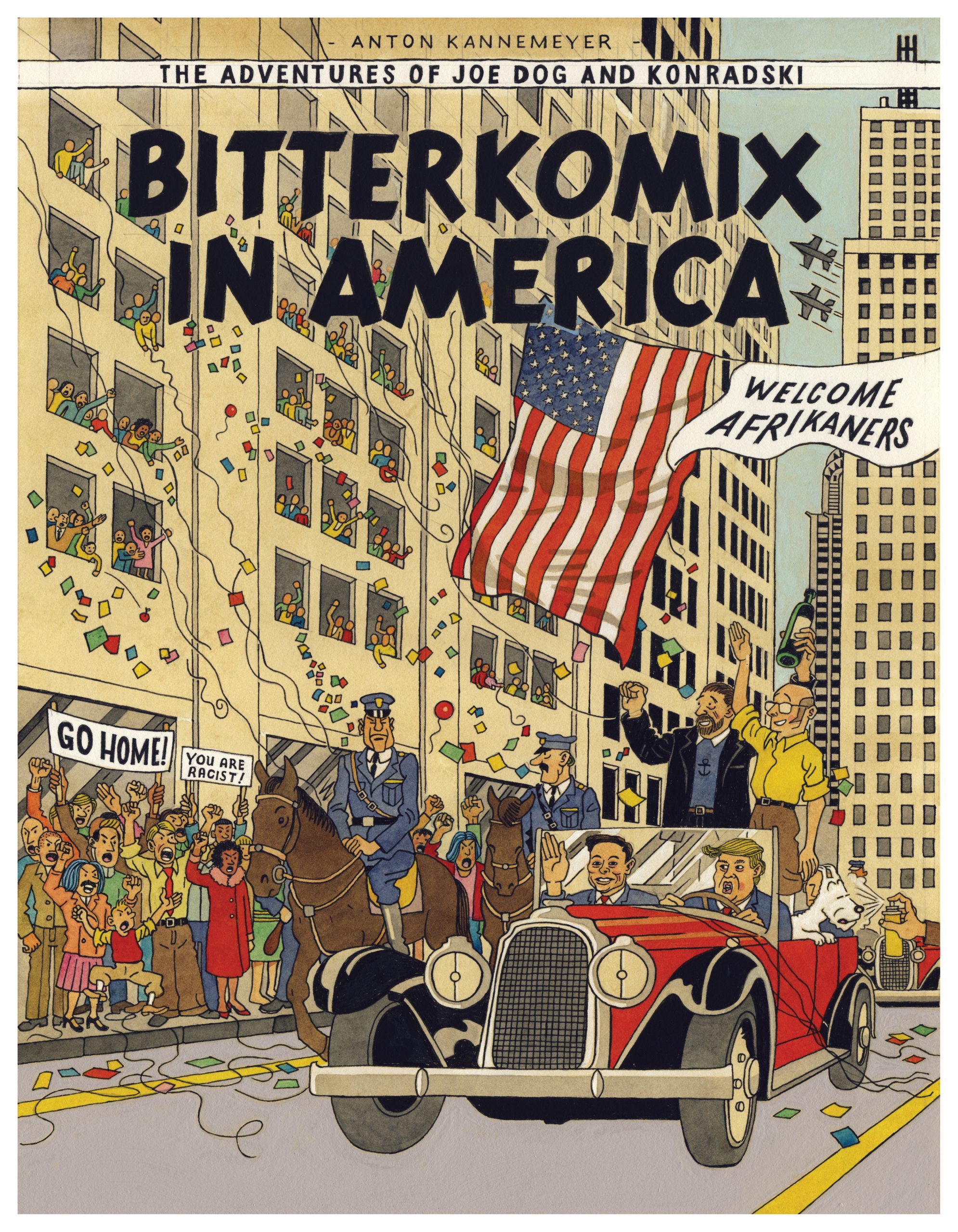
Part of the critique aimed at your work is related to the ways in which you reproduce the very same blackface drawings that Hergé used when you satirize Tintin in general, and Tintin in the Congo in particular. What drew you to this subject?
I grew up with Tintin. It was always available in our libraries, even translated into Afrikaans. As a young child I experienced all of the books as completely magical, but I liked the clean realism and logic in the narratives. In that sense Asterix never really spoke to me: it was too repetitive, the outcomes were too predictable and the art was too reduced, focusing on action or expression rather than recreating an entire world convincingly. But as a young artist I realized at one point that the golliwog face resonates with me because it was a perfect stereotype, a hyperbole that could be used to address racism in general rather than focusing on specific isolated or “real” people. Also, as a child I remember thinking that all black people looked the same. So in a way this was the faceless mob that represented something, some vague notion, rather than something specific. The thing with satire is that it passes, the moment passes, and the issues addressed become vague or even nonsensical over time, unless the viewer has specific historical knowledge of an incident etc. A lot of Honoré Daumier’s work for instance, you need to know the characters and specific incident in order to appreciate the work. When using the golliwog, I felt that the approach was far more universal and the viewer was immediately locked into the fact that the work dealt with race. Most of my satirical work, done between 2006 and 2015, dealt with systemic racism and how people ignored it, especially so-called liberals. But now I find that curators and the public in general just willfully misunderstand the work, the same as the conservatives did when I made offensive satirical work in the 1990s.
Would the critique have been any less forceful if you had not used blackface imagery?
I believe so. I tried many variations in the process of resolving ideas. People obviously don’t know this, but several works had different roughs and stages. The direct clarity of the golliwog face made the artworks pretty hard hitting. If I had used real people a lot of the works would become non-sensical or confusing. There were also aesthetic considerations and here I sometimes wonder at my own ability as an artist. I often thought maybe I’m just not good enough … I tried this several times after 2015, in one painting I tried to resolve a black boy’s face in various stages of realism – it just didn’t work … Neither aesthetically nor conceptually.
Let us stick with the question of race a little longer. You often position yourself as a catalyst within the narrative. At times you depict yourself as Tintin committing horrific acts, such as shooting a Black person, but you also portray yourself haunted by nightmares – old apartheid myths about Black dangerousness. Could you speak about why you choose to reveal these less flattering aspects of your own psyche?
I think it’s essential to implicate myself. I cannot stand outside of this narrative. Living in a house in South Africa is shameful because others have to live on the street. Driving a car, especially a nice car is shameful, I don’t even know how people can drive in luxury cars and not feel ashamed. Yet, if you think like this, nothing will get done. Each of us have to do our specific thing and contribute. Whatever it is you do, whether you are a farmer or an artist. But of course, I’m not the colonizer, that time is long over. The nightmares were ones I actually had — that confluence of the personal and life in general is in my opinion essential for art.
Who is the audience for your work? Earlier you said you made Bitterkomix for your Afrikaner friends. Do you work differently now that your audience is larger? Does that bring different expectations or responsibilities?
I’m not sure that I ever said I made comics for my Afrikaner friends, I would rather say there were lots of young Afrikaners that related to the contents when apartheid came to an end. But the fact that the comics were initially in Afrikaans did in fact limit the audience. But no, in the end I cannot write for a specific audience: I’m not good at that. I’ll just do what I feel I need to do and then hopefully find the right audience. I mean, it’s difficult to know who will eventually like your work. We were talking about Sugar Man Rodriguez, and I’m sure he did not intentionally make music for a white South African audience, yet that ended up being his legacy.
Also, the idea of responsibility is something I actually disagree with. Artists are not politicians or preachers. Our responsibility is to make good art, not virtue signal our good intentions to the world. I do not believe in this idea that it’s my responsibility to educate people. I find famous actors who tell people how to live immensely annoying. What do they know except their lives of extreme privilege?
Has criticism changed the way you approach your comics — or pushed you to go even further?
Yes, it has. It’s impossible to just ignore these unjust attacks. A lot of people said to me that I shouldn’t take it personally, but what do you do when all your so-called friends all of a sudden turn their backs on you? Never mind the fact your income has disappeared.
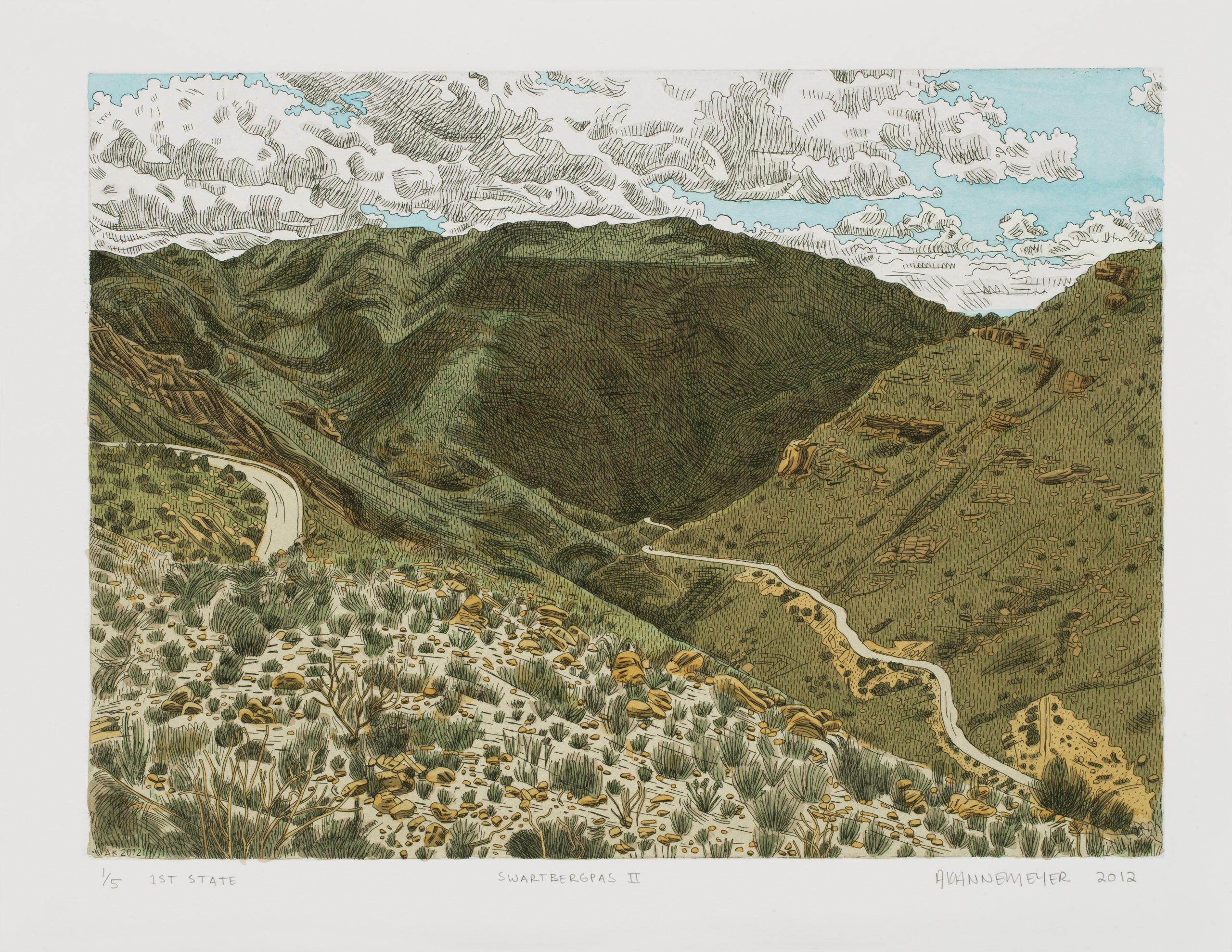
But the one thing that was a lifeline was a series of works I started in 2008: etchings and prints of trees or landscapes. Almost everyone feels that I’m allowed to make these. But there was a white American artist that recently visited Cape Town and made a point of going to all the galleries that sell my prints and he told them that they must remove my works from their websites and galleries, or he will expose them as racists online. Some of the galleries immediately removed my works, although they are just landscapes. I’m trying to understand why someone would do something like that. … But I feel a bit like Max Beckman, the German expressionist, who made landscapes during World War II to stay alive and put food on the table for his family. What do you do when your work gets censored?
Good question. But is there anything in the criticism of your work that you actually agree with? For example, one could question the legitimacy of a white, privileged man creating art that draws upon a colonial visual language.
Yes, of course. I have definitely made unsuccessful works in the past. Sometimes a concept or idea just doesn’t work, it’s inevitable. I’ve even reworked some ideas and they still wouldn’t work. The public doesn’t understand that it’s all part of a process – they just think you’re deliberately trying to be a racist, which of course is an insane idea. The other thing is that when the going was good, and I had one exhibition after the other, I was working under extreme pressure with assistants, and sometimes I delivered works that I now feel were not good enough. But with the general criticism that as a white man I’m not allowed to draw or paint a golliwog, I cannot agree. Just from a point of logic, I think it’s insane to tell artists what they are allowed to do or not to do: the entire idea go against everything art stands for. Cultural appropriation is not allowed. As an African, I’m not allowed to comment on my country or criticize my government because my skin is white. … Does that make any sense to you?
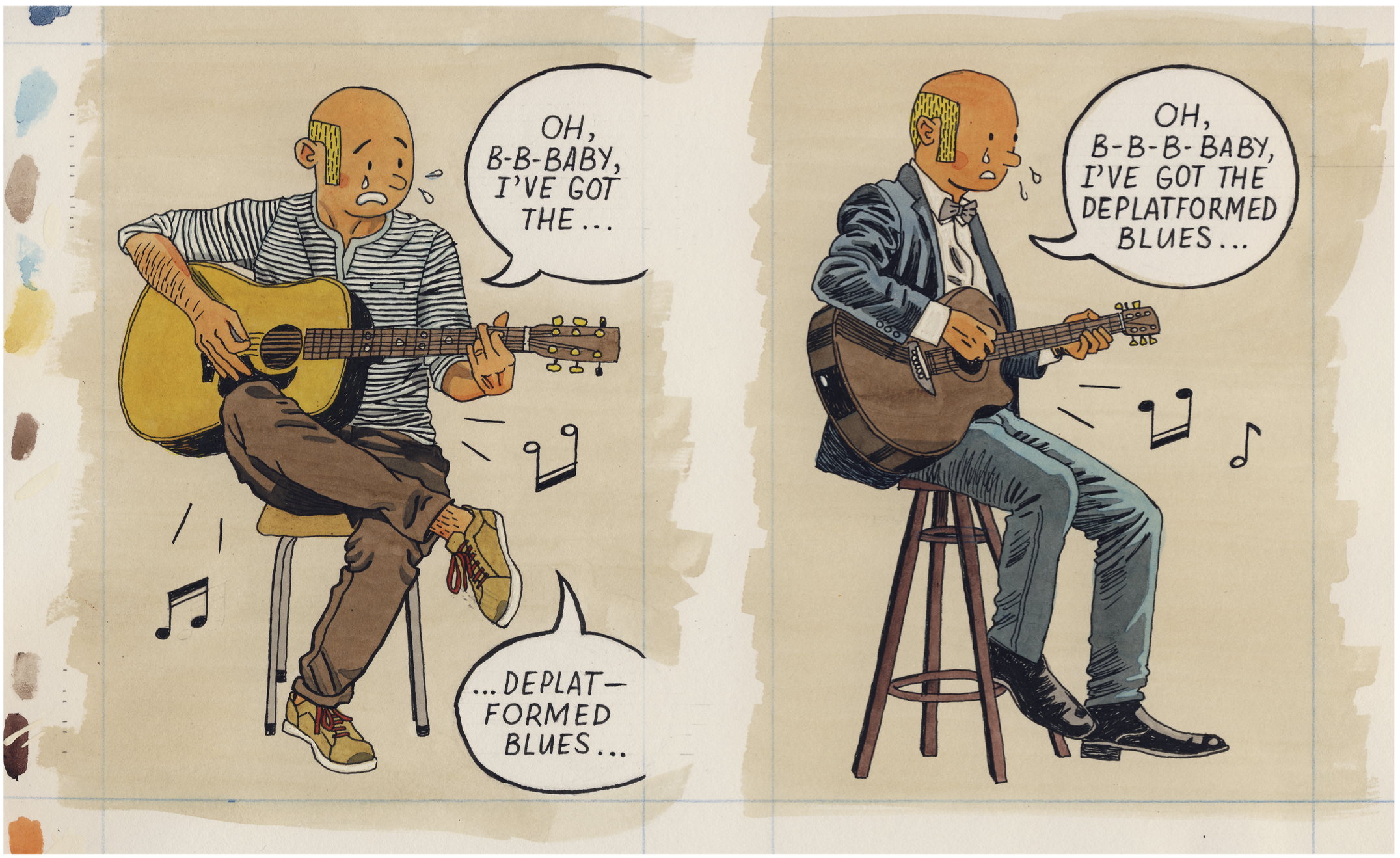
There’s of course also the theoretical idea that if you show something like the golliwog you are endorsing it and giving it life where it should be eradicated. But this is the essential problem of satire: in order to criticize something you also perpetuate that what you criticize. I often think of Hitler or Stalin here: when you criticize them you also give them another life. But I think an educated audience will understand the difference and the historical importance of satire. Nowadays, unfortunately, satire isn’t even taught at many art schools anymore in fear of offending the students.
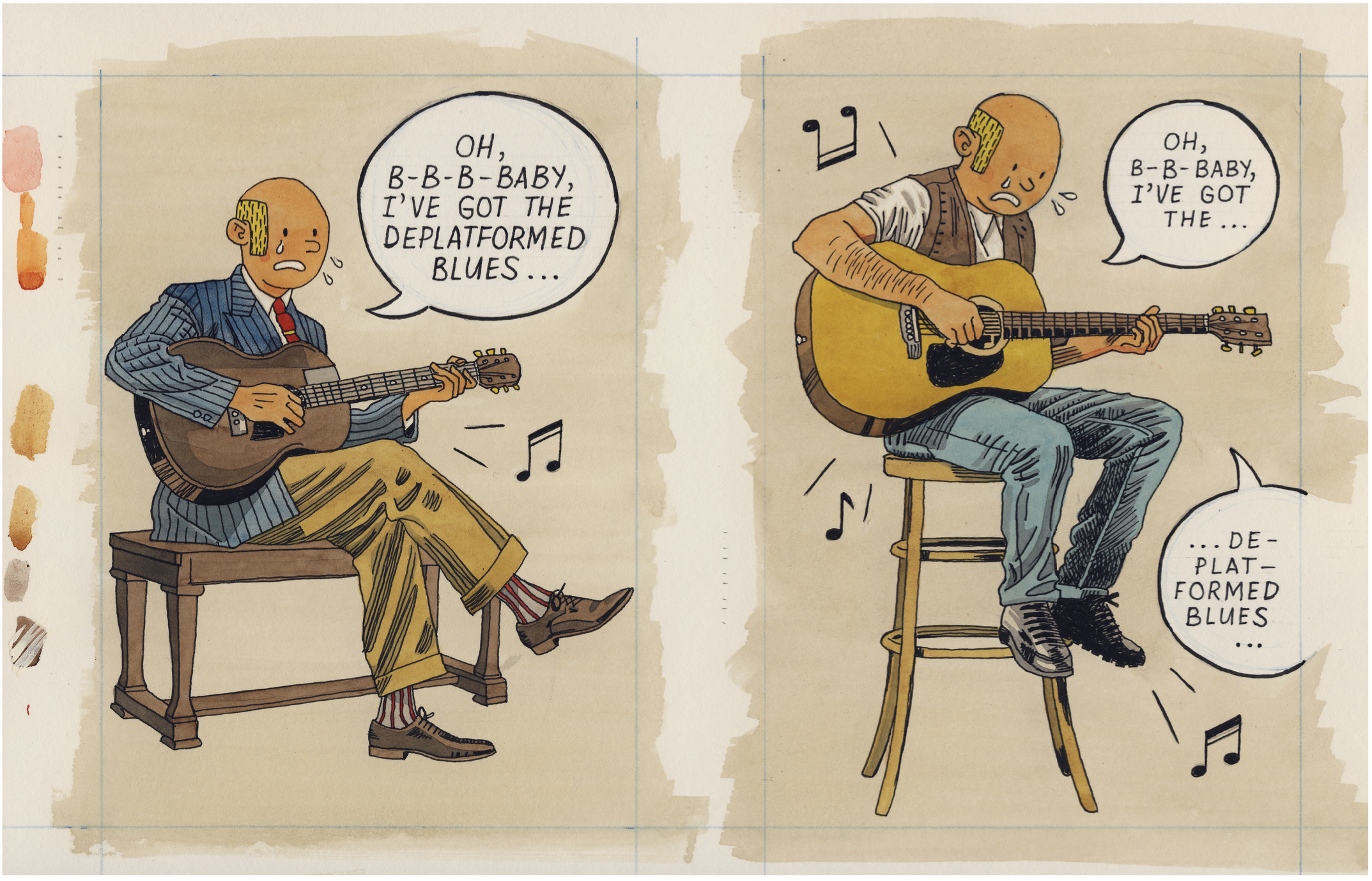
It seems that you have faced strong public backlash of the kind that is today often described as cancel culture.
From what I’ve said in previous answers it should be obvious. No gallery in South Africa will exhibit my political works. European galleries that believe in me sit with a problem: the English-speaking countries have all cancelled me, so the value of my work has been affected. On the other hand, there are many fans who support Bitterkomix and my work, so the scale has just shifted. Ironically the Afrikaans speaking readers of Bitterkomix are all very supportive – the original group that my work attacked in the past. And, as I mentioned, some collectors and certainly the French are supportive. I think the thing is that I made a big enough name for myself in the past to be able to continue. I actually feel very sorry for students and young artists who believe that they should adhere to certain rules in order to be successful one day.
Let us end on a slightly more cheerful note. What are you working on right now?
I’m working on a new issue of Bitterkomix and the graphic novel of my father. It’s still going to take a while. In between I’m making prints of trees and landscapes…
When will those be published?
Well, the new Bitterkomix will appear in November 2026, but my graphic novel will take a while longer. Hopefully sometime in 2027 – I need to put all other work aside … I also think it’s time to do a Best of Bitterkomix compilation again.
The post ‘We were trying to aggravate everybody with <i>Bitterkomix’</i>: The Anton Kannemeyer Interview appeared first on The Comics Journal.


 Hello, my name is Jack Sparrow. I'm a 50 year old self-employed Pirate from the Caribbean.
No comments:
Post a Comment