

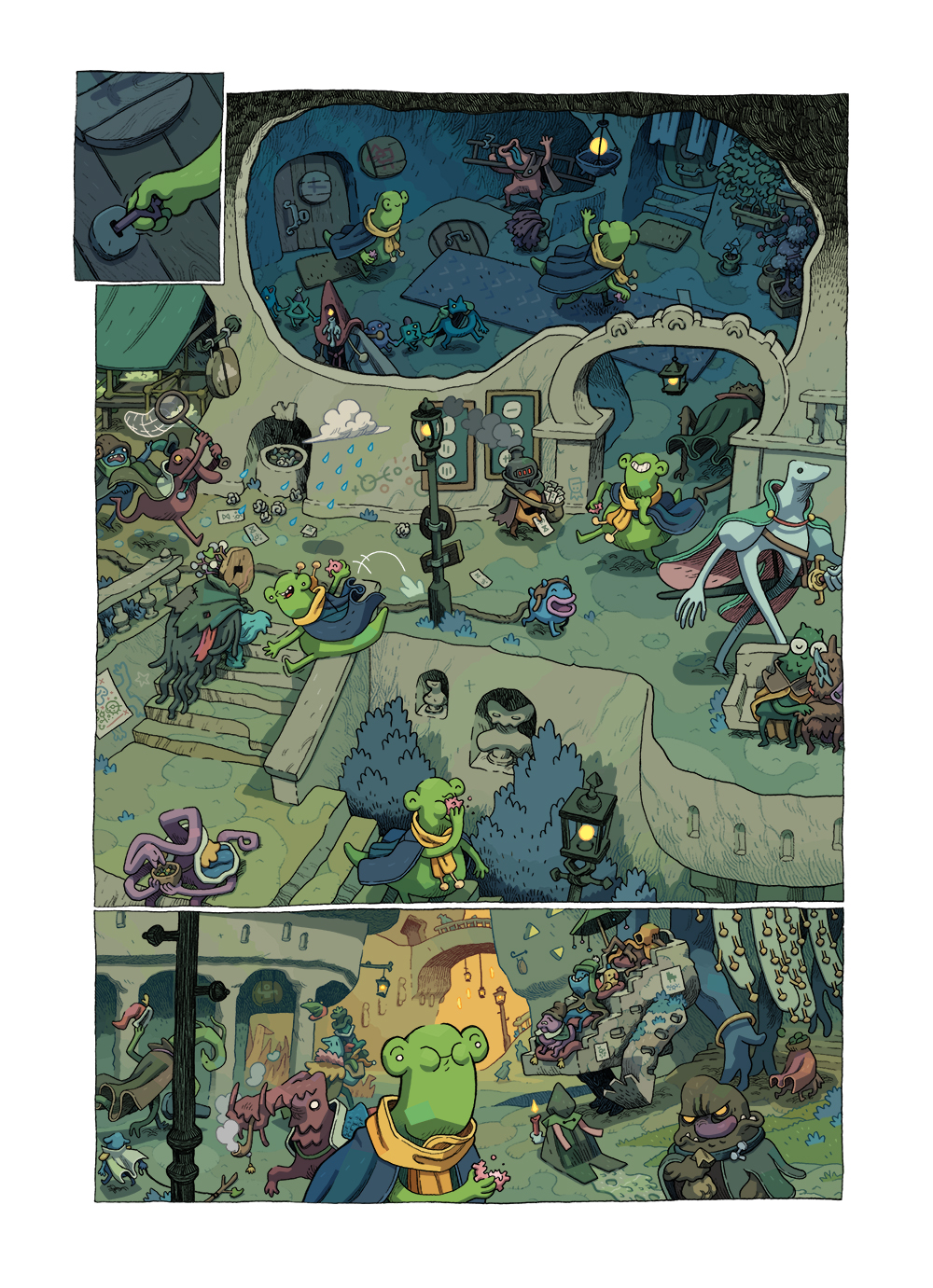
Tomasz “Spell” Grządziela is a self-taught cartoonist from Gdańsk. He writes comics, draws comics and breathes comics. His career began during the golden age of Polish webcomics, when he was best known as the creator of the strip series Stripfield. His work appeared in the comics magazines Kolektyw, Biceps and Profanum. In 2014, he made his album debut with Ostatni przystanek (Last Stop, Kultura Gniewu), a comic set aboard Gdańsk trams. He subsequently serialized Przygody Stasia i Złej Nogi (The Adventures of Stanley and Bad Leg) online before Kultura Gniewu published it in print. The bittersweet story of a likable boy who uses a wheelchair appeared on numerous lists of the best comics of 2016. In 2022, Grządziela published Zasada Trójek (The Rule of Threes), a visually arresting story about three characters living in an extraordinary city. The album earned him the Grand Prix at the International Festival of Comics and Games in Łódź, the editorial award of Nowa Fantastyka, and the Orient Men Award for Best Polish Comic of 2022 from the Polish Academy of Comic Art.
I spoke with Tomasz Spell about growing up around street theater, learning comics outside the academy, the early Polish webcomics scene and the cost of artistic ambition. He also revisits The Adventures of Stanley and Bad Leg, the Everbook, The Rule of Threes and Mishmash — works that combine personal experience with an unrestrained visual imagination. The conversation was conducted in Polish in 2026 and has been translated and edited for clarity. — Michał Chudoliński
MICHAŁ CHUDOLIŃSKI: You grew up around Teatr Pinezka, the theater company run by your father. How did a childhood spent around street theater, mime, puppetry and acrobatics shape the way you compose scenes in comics today?
TOMASZ SPELL: I don’t think it had a direct influence on my comics storytelling. It definitely shaped me as a person, though. I wouldn’t be who I am if I hadn’t performed in street theater from childhood. I also took from it a love of color and cartoony imagery. My father is a very colorful artist, and I think some of that sensibility stayed with me.
Do you think of your comics characters as actors whose movement, gestures, facial expressions and use of space have to be designed?
No, because theater is a collaborative art. A director can give an actor a great deal of guidance and a choreographer can set the movement, but when the actor performs an action, they interpret the material through their own gestures and delivery. They add something of themselves to the work. My characters have no will of their own, so I can’t collaborate with them. They are literally my puppets, and I can position them however I want. In that sense, they are quite far removed from actors.
You are largely self-taught, and you made several attempts to enter art school. What couldn’t formal education give you, and what did you have to learn on your own?
Sometimes I would like to look into another dimension where I graduated from the Academy of Fine Arts in Gdańsk and see what kind of artist I became after five years there. Still, I don’t regret my decision. I spent six months at the academy, and it isn’t true that I got nothing from it. The workload was so heavy, however, that I had no time to draw comics — and comics were exactly what I wanted to make.
It took me two years to get in, yet I left before the end of my first semester. I had to decide whether I wanted to devote five years to an art education and only then begin drawing comics, or spend those same five years creating and learning the thing I actually wanted to do. I chose comics, because you learn comics by making comics.
I had to teach myself practically everything. When I started the webcomic Another Heroes at the age of 15, it was initially black and white. Later I colored it with a mouse because I didn’t even own a drawing tablet. I began with the absolute basics.
You began during the boom years of Polish blogs, forums and webcomics. Did their creators understand that they were building a new artistic scene, or were they mostly people learning in public?
Definitely the latter. I doubt that people at the beginning of any artistic movement immediately realize they are becoming part of the medium’s history. That first internet era is an important chapter in Polish comics, but at the time we were all simply learning. We didn’t think of ourselves as participants in a conscious artistic movement. We drew because it was fun, because we needed to express ourselves and because comics seemed like the right medium for doing so.
Was publishing imperfect comics online an important part of your artistic education?
I’m not sure about the word "imperfect," because everyone drew as well as they could. We all knew we were at the beginning of the road. There is no such thing as a perfect comic. Even the greatest master is still learning — or at least should be — and setting new challenges for themselves. Some artists develop one style, cling to it and stop experimenting. That is always a great shame.
With my old series, you can compare the first installment with the last and see an enormous difference. I learned so much in the space of a single year. The internet made it possible to show that process as it happened.
The early internet was less centralized and less governed by algorithms. Does a young cartoonist have more opportunities to reach readers today, or merely greater pressure to remain constantly visible and promote themselves?
I don’t have hard data, and I no longer follow Polish webcomics closely because I moved into print and don’t particularly enjoy reading on a screen. There was less competition when I began. Today an extraordinary amount of art is being produced all the time, including comics.
Unfortunately, we live in a time when every artist is also expected to be an influencer: constantly posting online, constructing a recognizable persona, collecting followers and feeding the algorithm. I find it exhausting, so I simply don’t do it. I know I would be more visible if I put more work into self-promotion, but I don’t want to function that way.
American animated series such as Adventure Time, Chowder and Superjail! are often cited as reference points for your aesthetic. What did animation teach you that you couldn’t learn directly from other comics?
Adventure Time influenced my entire generation. I consider it one of the most important cultural works of our time. I’m also a huge fan of Chowder and Superjail!. American popular culture affected all of us because the United States is a cultural hegemon, but everyone found their own niche within it. The Hellboy comics were also a major influence on me — to the point that one of my first webcomics was, graphically, almost a copy of Mike Mignola’s style.
I took something different from every title. Above all, Adventure Time taught me to love unrestrained creativity. I remember the rain of daggers: the characters can’t leave the house because knives are falling from the sky, and the series never explains where they came from. Things simply happen. Then there is Princess Bubblegum, the Candy Kingdom and the Earl of Lemongrab. That fearless imagination was fantastic.
You once said that Ostatni przystanek (Last Stop) was not yet the comic you truly wanted to make. Do you now see it primarily as a youthful imperfection, or as an energy that is harder for a mature artist to recover?
It isn’t about some lost youthful energy. That comic was primarily a challenge I set for myself: I wanted to find out whether I could create a complete, full-length album. I had several ideas for short stories set on trams. I rode them to high school and observed everyday life in Gdańsk. I joined those episodes into a single narrative, but I didn’t feel that I was really expressing myself in it. It was more of an exaggeration of everyday life and my observations from the tram. I call Ostatni przystanek my training comic.
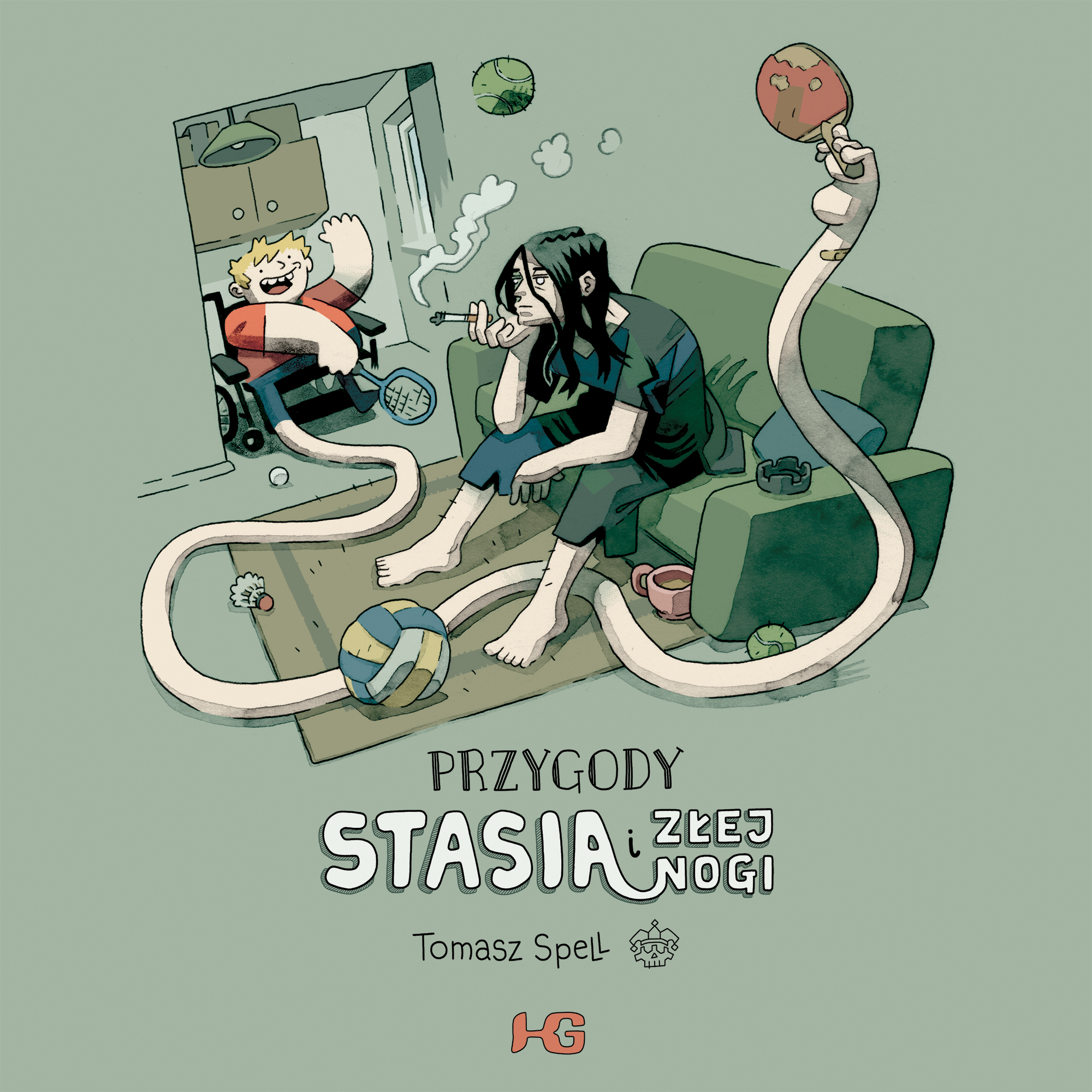
Where did the idea for Przygody Stasia i Złej Nogi (The Adventures of Stanley and Bad Leg) come from? Why did you want to tell a story about a child with a disability?
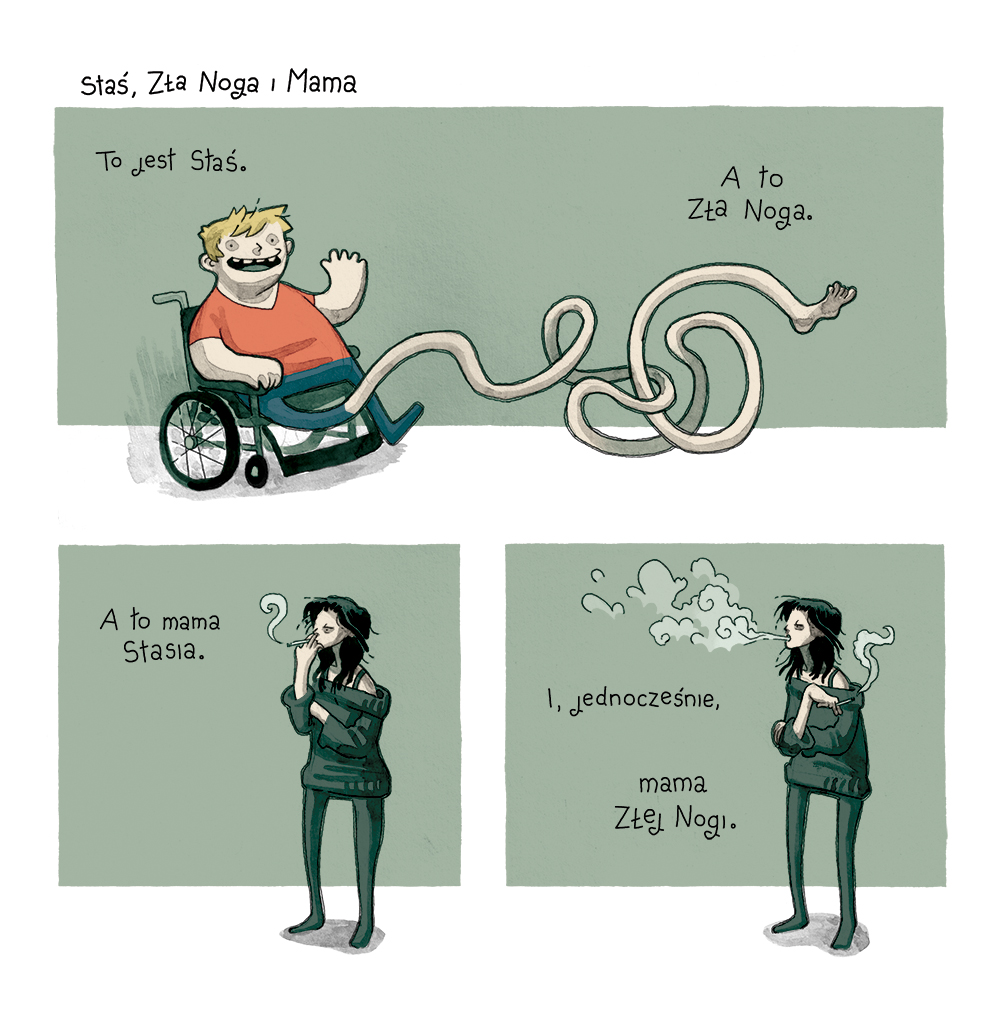
Several things came together. At the time, I read an article about non-player characters in the Grand Theft Auto games. The writer pointed out that, in this supposedly faithful simulation of a city, you hardly ever encounter people who use wheelchairs or crutches. That made me think about how people with disabilities are represented in culture. When they do become protagonists, they often end up in tearjerkers designed to move an able-bodied audience. The protagonist isn’t treated as a complete human being with flaws, virtues, worries and desires. They are defined solely by their disability. I wanted to create a character for whom disability would be only one trait among many.
Another inspiration was a boy who attended the comics workshops I taught. He used a wheelchair and had difficulty communicating, but it was possible to understand him. Every week he brought in a stack of drawings based on Dragon Ball and Naruto. He simply loved to draw. His tireless mother always brought him to the workshops. You could see the exhaustion in her eyes and tell that life wasn’t easy for her. Those two people, whom I saw regularly, became an important inspiration as well.
Stories about children with disabilities can easily fall into sentimentality or turn the protagonist into a source of inspiration for an able-bodied audience. How did you try to avoid those traps?
I didn’t avoid sentimentality entirely, because I treat it like a seasoning: you can use it, but responsibly and in small amounts. I didn’t want to wring tears from readers in a cheap way, although of course I did want to move them. I set myself an absurd challenge: could I make people cry when an amputated leg launched into space? It worked. Readers told me they cried during the scene in which the gigantic leg is strapped to a rocket. When you describe it aloud, it sounds ridiculous, yet emotionally it works.
At the same time, I have to be honest that I made the comic from a limited perspective. I don’t have people with disabilities in my family, I had little contact with them and I didn’t conduct in-depth research at the time. But I think I did and overall good job of depicting a disabled young boy.
Stanley’s mother is equally important — a loving, exhausted woman who has subordinated almost her entire life to caring for her son. Did you want to show the invisible cost borne by a caregiver?
Definitely. The mother is as important to the comic as Stanley. I wanted to show what it is like to be a single mother raising a child with a disability. Every parent pays a certain price and has to give something up, but Stanley’s mother pays a higher price than most.
In one scene, Stanley asks why he is so different from other children. His mother replies that everyone is different, but he is a little "more different." Parental sacrifice works in a similar way: it applies to everyone, but in her case it is much heavier. The character was partly inspired by my own mother. My contact with my father was limited — I saw him mostly during summer vacations, and sometimes he would be absent for months. My mother raised us practically on her own. There is a great deal of her in Stanley’s mother.
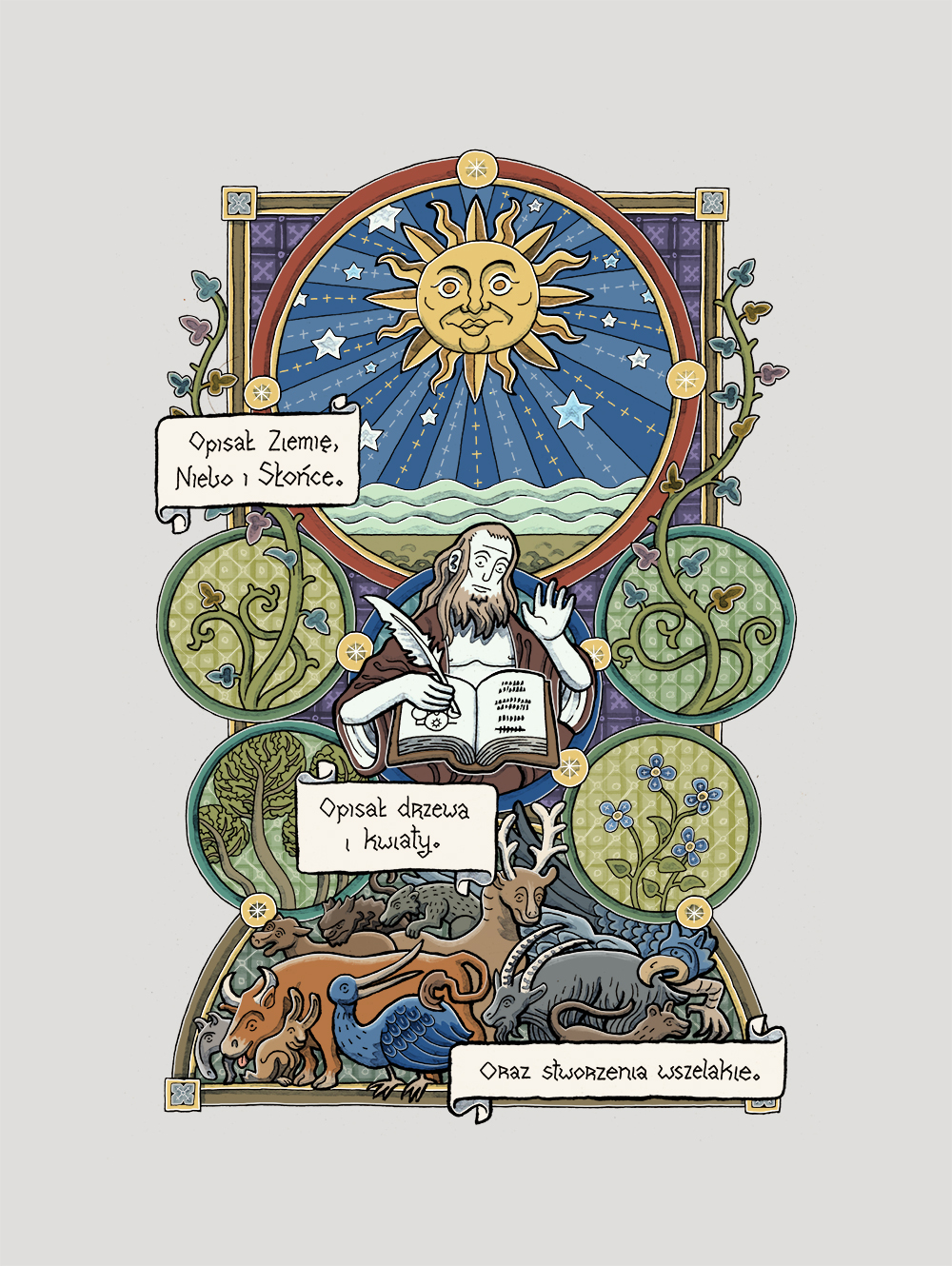
You have judged Wszechksięga (the Everbook) very harshly, saying that you disappointed yourself. Was publicly admitting that the work failed to meet your expectations a way of regaining control over it?
No. I’m simply a very open person and my own harshest critic. I don’t draw a firm distinction between a private and a public self, so I said plainly that Wszechksięga was a disappointment to me. I reached that conclusion later, after I had digested it and discussed it with other people. If someone likes it, I’m very happy about that. When readers bring me Ostatni przystanek to sign, I joke, ‘There are so many good comics, and you chose this one." I roll my eyes, but of course I sign it.
What had to go wrong in Wszechksięga for Zasada Trójek (The Rule of Threes) to emerge several years later?
Every comic I make is practice for the next one. Each new comic is, in some sense, the sum of all the ones before it.
One starting point for Zasada Trójek was your dislike of what you called ‘Tolkien leftovers.’ What bothers you most about generic fantasy?
That phrase was aimed deliberately not at Tolkien, but at his thoughtless imitators: generic fantasy reduced to fighting dragons and fantasies about an individual changing the world through violence. Zasada Trójek grew out of my love for fantasy, and what I love most in fantasy is creativity. If you’re making something fantastic, you can let go of the guardrails of reality. There’s no point reheating the same meal for the tenth time.
I’ve mellowed a little with age. Today I probably wouldn’t use the phrase ‘Tolkien leftovers" because I understand that generic fantasy can have narrative value. The stranger the world, the more space you may have to spend explaining its rules. If elves, dwarves and dragons appear, the reader already knows the basic conventions, and the author can focus on relationships between characters. The world of Zasada Trójek is very strange, but I didn’t have to explain it because its mechanics weren’t necessary to understand the personal story.
Still, when I see generic fantasy, I suspect I’m going to get a story made from copies of other copies. In art, I look for at least a few fragments of truth and some genuine reflection by the author on life and the world. Derivative fantasy often isn’t based on reality at all, but on images borrowed from other books, films, games and RPGs. A band of drifters changes the fate of an empire because they punched the right person in the face. It becomes a naïve fairy tale for adults with no nutritional value.
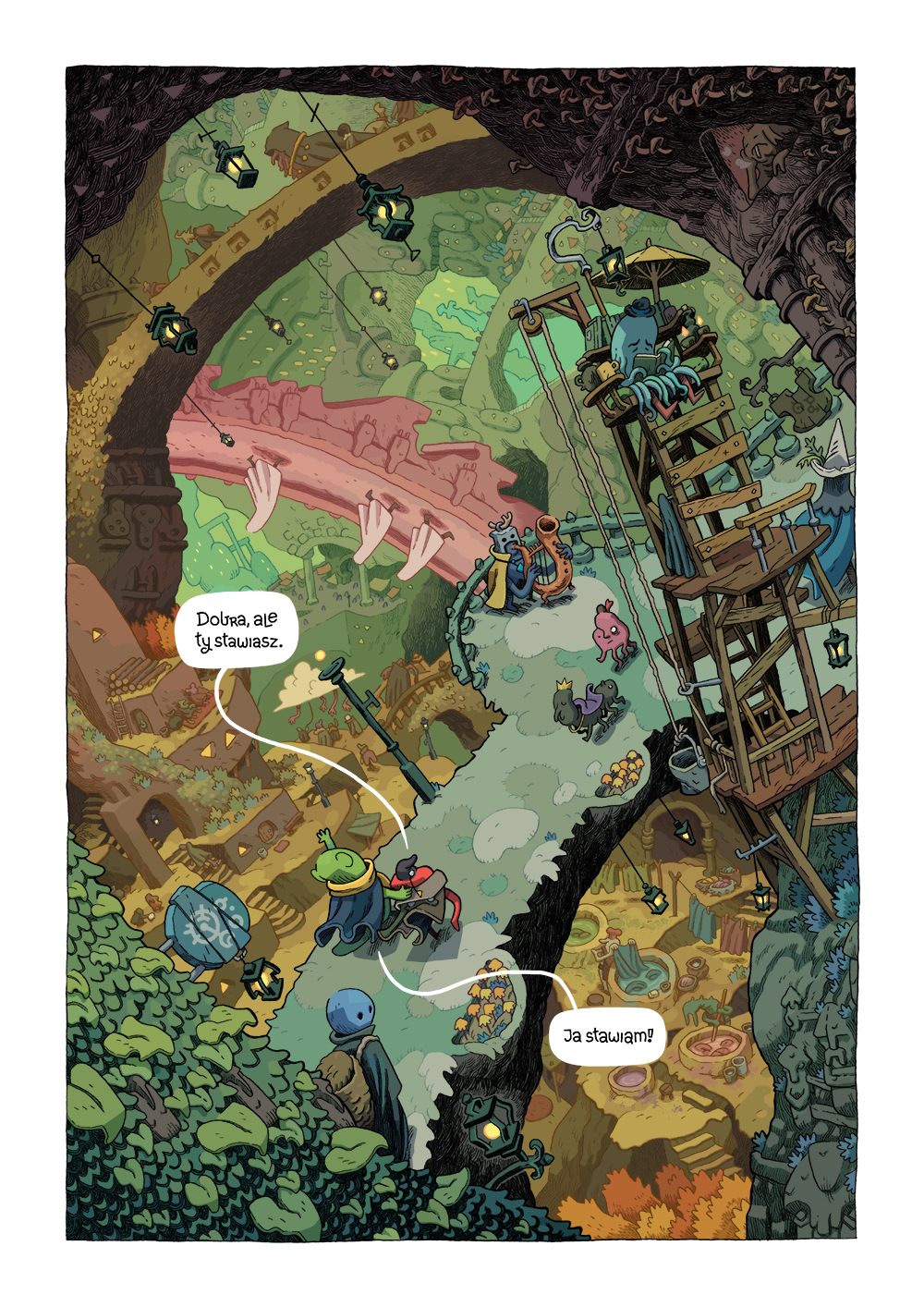
For all its visual strangeness, Zasada Trójek remains an intimate story about relationships, ambition and the obsession with self-improvement. Did fantasy allow you to say something about yourself that you wouldn’t want to present in a realistic autobiography?
It is absolutely fantasy, and I want to represent fantasy proudly. In Poland it is still sometimes treated as something inferior. I remember the discussion after Radek Rak won the Nike Literary Award for Baśń o wężowym sercu albo wtóre słowo o Jakóbie Szeli. Some representatives of "serious literature" tried to argue that the book couldn’t possibly be fantasy, as if genre fiction were inherently less valuable.
At the same time, Zasada Trójek is a deeply personal comic. I wouldn’t say that I hid anything in it, though, because I’m open and have few inhibitions about discussing private thoughts. It is a story about the egocentrism built into self-improvement. I used to call the comic an "anti-shōnen." I was inspired by Naruto and other shōnen in which every obstacle is a test that can be overcome. A more powerful opponent appears, the hero trains, discovers a new power and wins — only to face an even stronger enemy.
Zasada Trójek asks: what if the obstacle exceeds our abilities? What if I am not talented enough, and even if I train until I die, I still can’t overcome it? Worse still, what if the obstacle is indifferent and doesn’t care about my existence at all? Not only can I not win; I’m not even the center of the story. That is the premise of my "anti-shōnen."
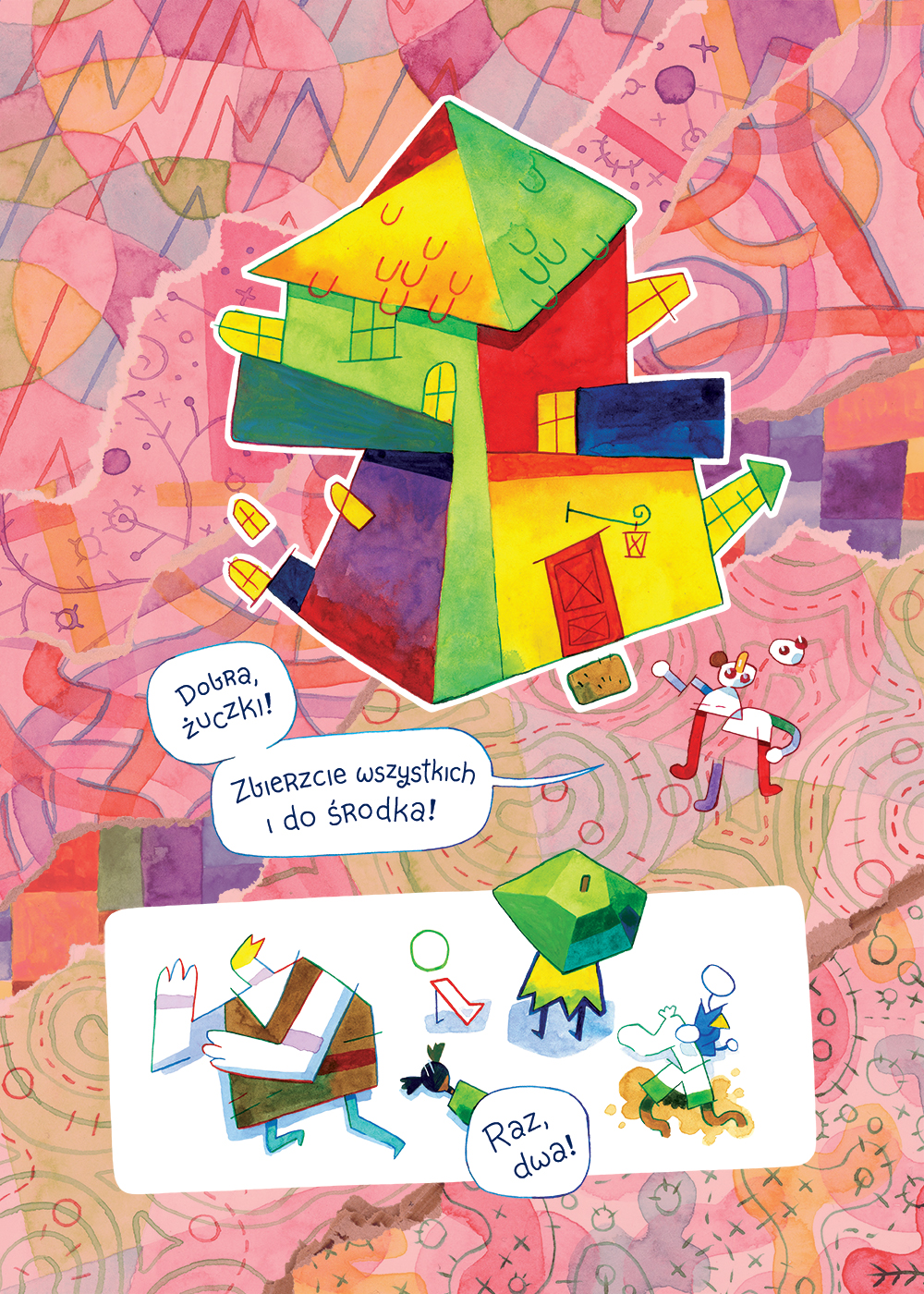
You worked on Bajzel (Mishmash) for several years and then made it available online for free. Was that an artistic, political or economic decision — or also a return to your webcomics roots?
I decided the comic wasn’t good enough to publish. It was supposed to be the first of three volumes. If it had been a single, self-contained story, I could have shrugged and said: it didn’t turn out as well as I wanted, but there is enough of value here to show a publisher. I didn’t want to continue the entire series, however, and publishing only the first part wouldn’t have made sense.
The comic was practically finished. Rather than let all that work go completely to waste, I assembled it as a PDF and put it online for free. I added a note saying that readers who enjoyed it could donate to Pracownia na rzecz Wszystkich Istot [Workshop for All Beings], an environmental organization. I wanted at least something good to come from the comic.
What does a Polish cartoonist have to contend with today beyond making the work itself? Is it possible to make a living in Poland solely by creating original comics albums?
The biggest problem is that it isn’t profitable, and the medium itself still isn’t especially popular. We’re moving forward little by little, and comics gain readers every year, but the medium still can’t compete with film, video games or books. Poles supposedly don’t read, yet they definitely read more books than comics.
I know I can spend three years working on an album that will ultimately be read by no more than 5,000 people. In Poland, that would make it an exceptionally successful comic — a real victory. Paradoxically, there is a good side to this: because there is neither great money nor fame in Polish comics, you can be sure that the people making them genuinely love the medium. They aren’t doing it for money or recognition. They do it because they truly want to draw comics.
You have achieved one of the greatest artistic successes among Polish cartoonists of your generation. What does that success look like from the inside?
People keep describing me as part of the "younger generation," and I wonder when that label will finally disappear. An entire generation of Gen Z cartoonists has already grown up, and creators from Generation Alpha are beginning to follow them. I’m becoming a bit of an old-timer, so I don’t know the new scene as well as I should. I can see, though, that many younger artists have adopted a completely different model: they publish their comics themselves, travel to festivals with their own merchandise and sell their work online. I respect that enormously.
The post ‘Every comic is practice for the next one’: An interview with Polish cartoonist Tomasz Spell appeared first on The Comics Journal.


 Hello, my name is Jack Sparrow. I'm a 50 year old self-employed Pirate from the Caribbean.
No comments:
Post a Comment