

In 2023, my fellow TCJ-ite Tegan O’Neil described 20km/h, a collection of short comics by the Chinese cartoonist Woshibai, as “an exquisitely muffled yawp of defiance against a world that offers no better personal outlet than the cudgel of petty irony.” At the time Tegan’s read intrigued me in part because in my own review of the same book I had not considered the political element at all (my understanding of the Chinese political system was, and remains, far too rudimentary for any analytical comfort) — what seized my attention was Woshibai’s preoccupation with perspective play and scale-deceptions.
I return to Tegan’s words not just because Woshibai is among the contributors to Hot Net Hotel — the first volume of System, Paradise Systems’ anthology showcasing contemporary Chinese cartooning — but because in point of fact a lot of the pieces in the anthology follow a shockingly similar mold: whether this is a broader cultural pattern or simply a preference of the anthology’s curators, most of Hot Net Hotel’s stories assume a microfiction mode, eschewing expository details and a tidy narrative-emotional "arc" in favor of concentrated real-time action.
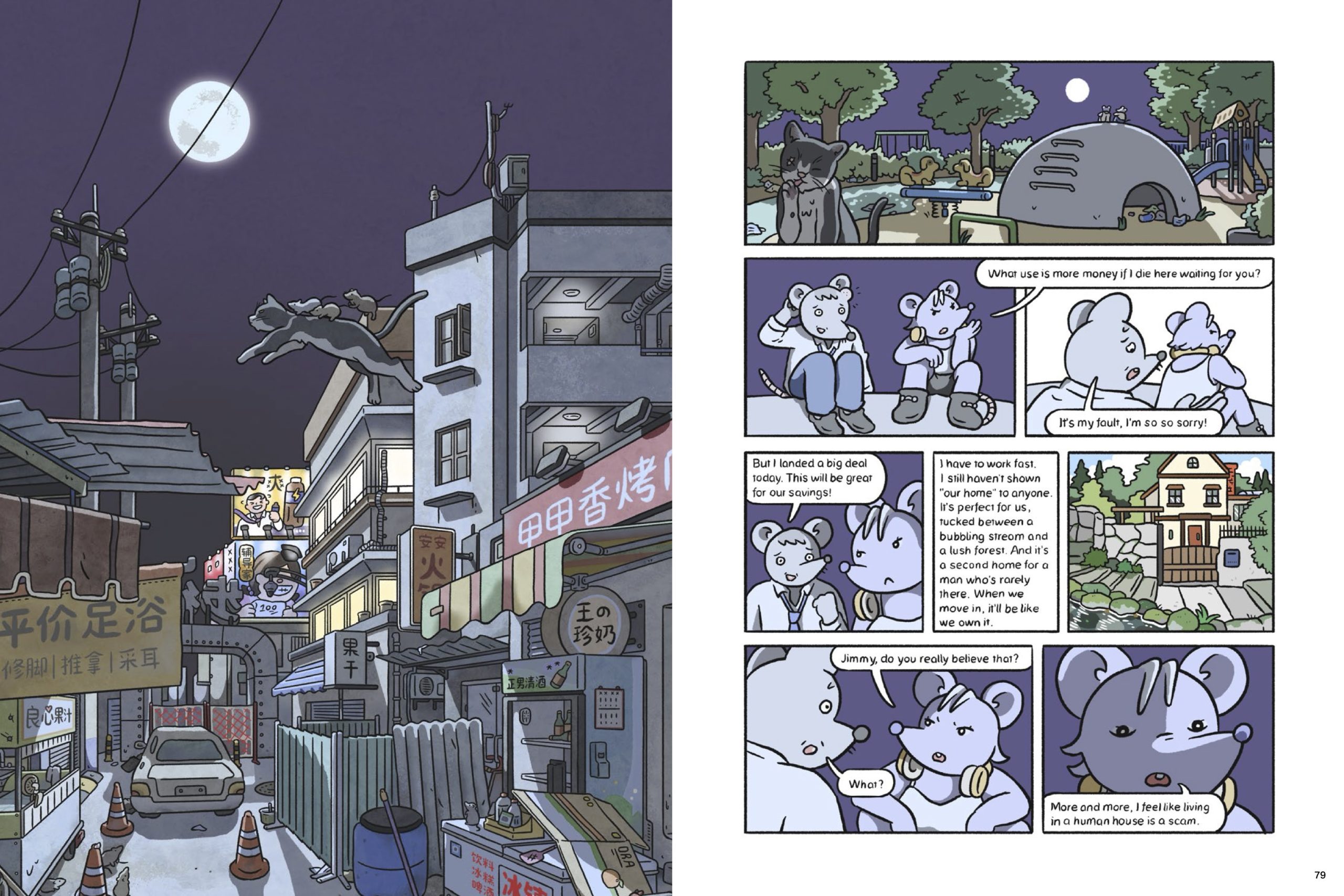
Perhaps unsurprisingly, the stories that offer the most detail about their characters and the worlds they inhabit — in the way of central metaphors — are also the most overtly political pieces in the book. In “Our Home” by Fenta, a society of city rats has established a system of non-binding house rentals, realtors and tenants signing contracts contingent on the inattention of the humans that actually live in the houses and own them. In “Homeland” by Tou Yeye, a surveillance state compiles a list of forbidden words, forcing society, and especially its poets, to find ever-contrived ways to express themselves, until they themselves have forgotten what the signifiers actually signify. Fenta and Tou are fairly different cartoonists — the former’s artwork is smooth and welcoming, defined by a streamlined sort of comfort, while the latter revels in a sort of "pleasant ugliness," with rocky lettering and awkward linework — but their concern is ultimately the same: life as a handed-down sentence that squashes any notion of an alternative.
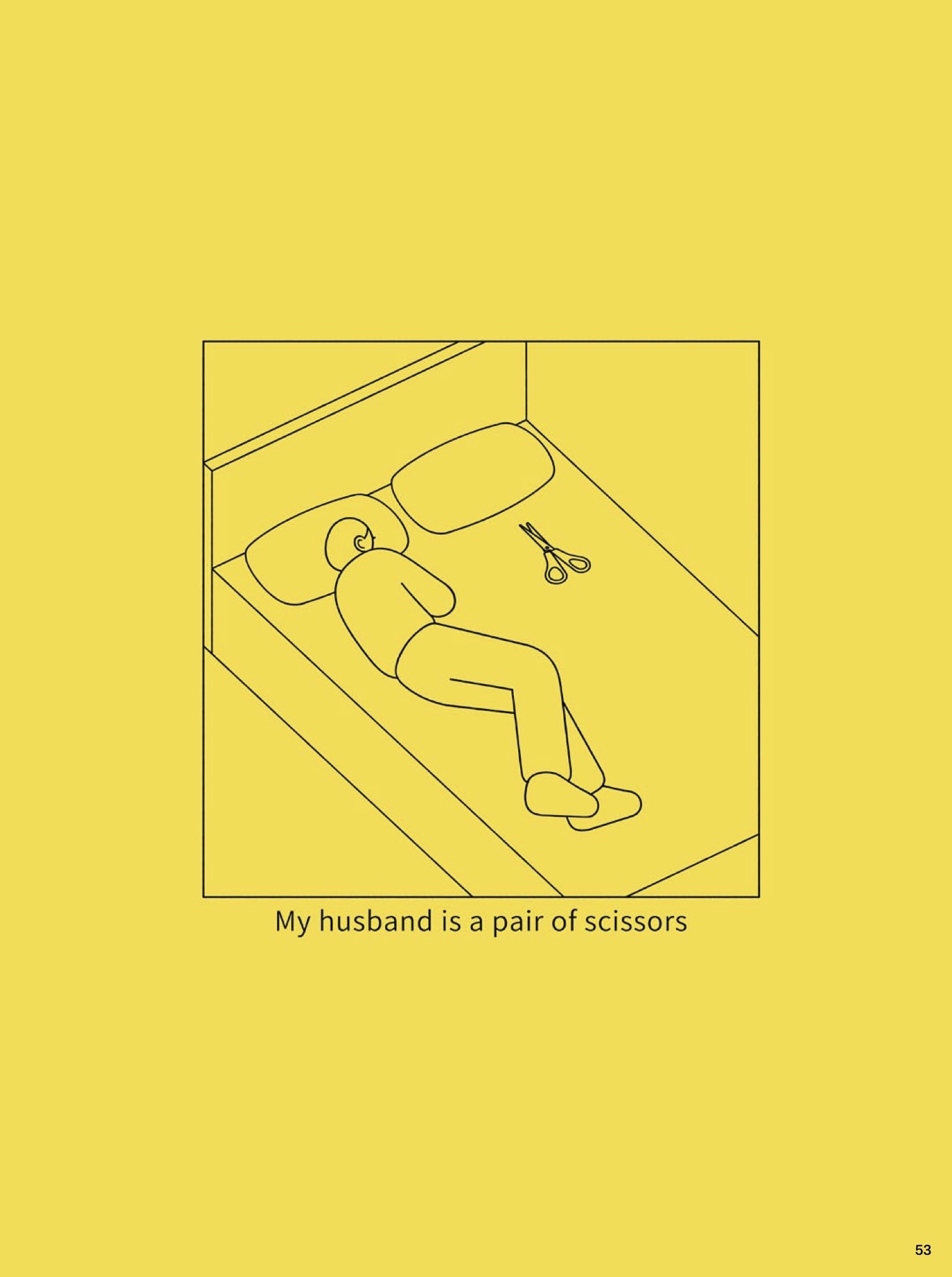
But these two stories are outliers in their concreteness; the aforementioned Woshibai’s contribution, the fleeting affair “Husband”, is far more indicative of the anthology’s overall approach, the interpersonal taking precedence over the systemic. Each of its eight pages consists of one panel, and its narration reaches a total of four brief sentences, reaching a level of Lydia Davis-like distillation: “My husband is a pair of scissors / He is sharp / and diligent / After he came, everything changed / He did everything he could.” All the while, as if in a slideshow, the reader is presented with a succession of mutilated objects, all rendered in harsh blank lines: an earphone cut off from its cord, a swing set rendered unusable. The final line — “He did everything he could” — is accompanied by the image of a baby with its umbilical cord cut off. The intent is clear: it is dangerous indeed when a loved one realizes that their skill, their defining function, can just as easily serve as a weapon, literally and figuratively cutting one off from the rest of the world. Woshibai wisely rejects the idea of emotional resolution, instead forcing his readers to dwell in the ambivalence of a love transformed into something much worse, a distant memory warped by time.
Ganmu’s “Heat”, the longest piece in the book at twelve pages, operates on a similar principle of extreme utility. Two office-workers, a man and a woman, suffer from the extreme hot weather; the man decides to go out to an ice shop a kilometer away to buy a bottle of ice water, but the woman says that it’s too far away, and too hot outside, for him to successfully make the journey. He disregards her, but when the heat gets the best of him on his way back he can’t seem to open the bottle. His coworker, watching from the office, goes outside not to help him but to take the water from him, leaving him helpless in the scorching sun. Ganmu’s cartooning, with its uniformly-weighted lines and hazy digital gradients, helps sell the core cruelty: the two buildings (and the furniture inside them) look like two-dimensional façades, while the expanse between them is completely empty and smooth, creating a feeling of conditional spatiality — of a parable, though one whose moral is a moral vacuum, a cutthroat I-told-you-so attitude. Ganmu leaves her readers on the image of the woman’s smile: a dish best served as cold as ice.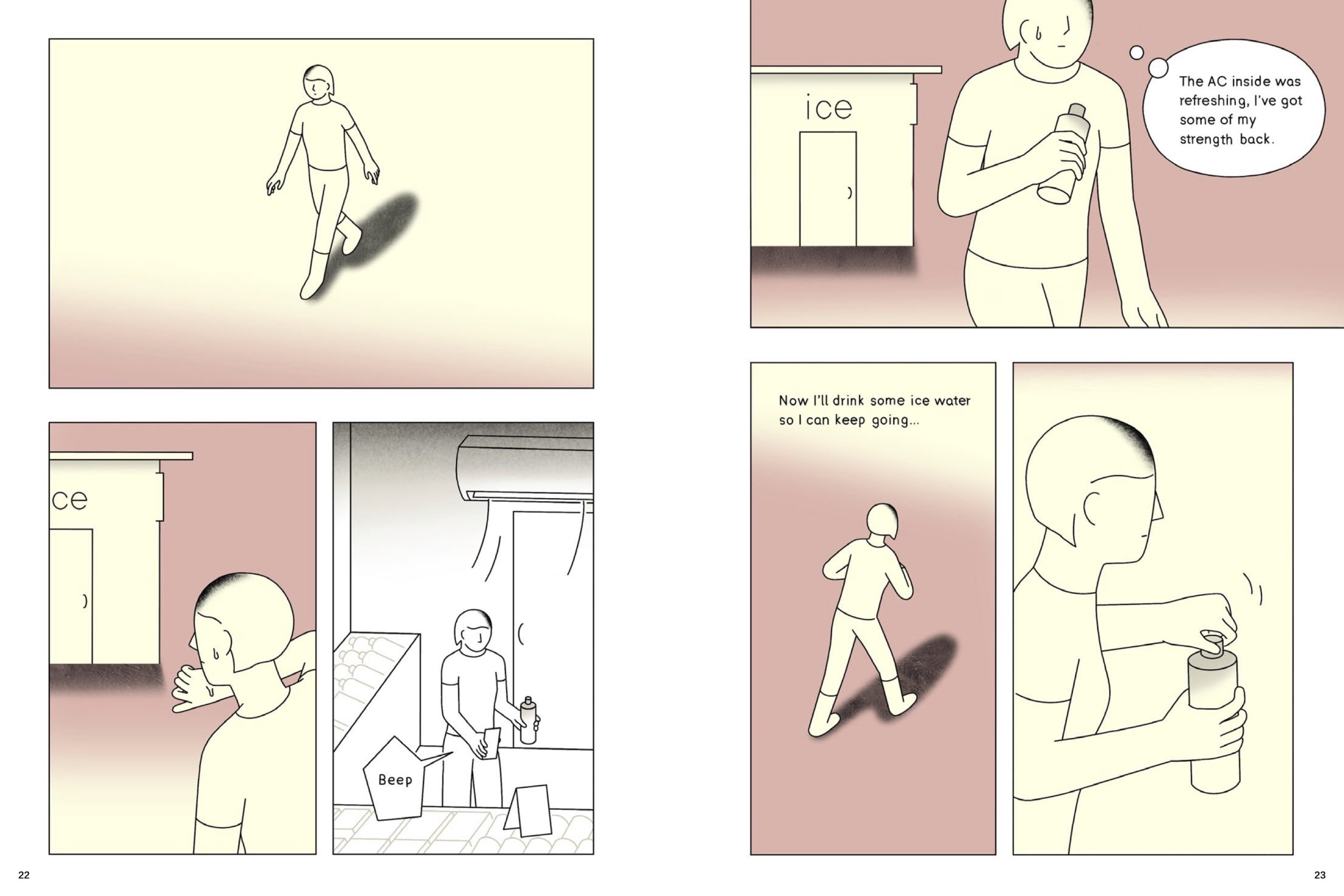
Where “Husband” and “Heat” thrive on the strength of emotional shock, other pieces betray the limits of the no-detail approach. The opening work, “Worm World” by Xiao Han, has a pointedly childlike look: rendered in pencil and crayon, it sports lumpy shapes and panels cramped together without any gutters. This childlike attitude extends to the comic’s worldview: having declared that, “Good God, it’s hard being a person,” the protagonist decides to “go underground” and start living with the worms, who eagerly welcome them into their subterranean way of life, the end. There’s a germinal cynicism buried in “Worm World” — the notion that one must deny one’s own humanity in order to find happiness — but the focus on lead-up without any subsequence creates a sense less of utopianism than of a childlike idea of utopia, one that hinges on a lack of definition. Elsewhere, Xiang Yata’s “Capture” is more an image-in-gestation than a proper story: as a hunter aims their rifle at a group of birds in the field, the birds cluster together and become a single entity — one with perfectly human features. “Capture” starts with a loose, pixel-like grid and gradually accrues visual focus before ending on carefully-rendered solidity to accentuate the violence of its core recognition — that the life you are about to take is no less worthy, no less alive, than you are. By ending on this small gasp, however, the piece becomes merely rhetorical, an arrangement of fleeting novelty and exceedingly little impact.
 Less successful still are the contributions that use their generalizations as a springboard to audience affirmation. “Constipation of the Soul” by Wang XX depicts a dual scene: a seal (Wang’s recurring character) and a manatee sit together in some kind of public space, each caught in their own anxious thoughts; meanwhile, their souls sit side by side in a “soul restroom”, both constipated. In the "corporeal world," each keeps to themself, until they finally open up to one another and offer kind words, at which point they feel strong enough to overcome their difficulties together; once their physical forms open up to one another, their souls finally find the ability to relieve themselves. Promo copy for Paradise Systems’ collection of Wang’s Seal comics, Think I’ve Still Got It, informs readers that the Seal cartoons are something of a viral sensation in China, with a line of Seal-themed merchandise. From “Constipation of the Soul,” it’s not hard to see why; between her cartooning style — immediately legible, with smooth, round shapes and handsome flat colors — and the essentially-simplistic messaging, there’s an audience-mindedness to the work that seems to beg for projection. But what makes for a fine T-shirt does not necessarily make for comics that are in any way interesting.
On principle, I can admire Paradise Systems’ effort to present as wide a view of Chinese comics as they can assemble, from the conventional narrative through the opaque-lyrical to the downright mechanical, and from the "beautiful" to the "ugly" (at least in the — again — conventional sense, even if the work itself is fundamentally controlled and palatable). As a whole, though, Hot Net Hotel serves as a reminder and a warning: the broader the stroke, the more precarious the aim. Sometimes, it hits the mark. But only sometimes.
The post Hot Net Hotel appeared first on The Comics Journal.


 Hello, my name is Jack Sparrow. I'm a 50 year old self-employed Pirate from the Caribbean.
No comments:
Post a Comment