

If any artist working in comics has a story to tell, it's Frank Miller. He's had a prolific nearly 50-year career with enough artistic triumphs and public controversies that when he announced he was writing the story of his life, I sat up and took notice.
Frank Miller's Push The Wall: My Life, Writing, Drawing, and the Art of Storytelling is a hybrid work. It's not broken into chapters, but into lessons numbered one through 16, meaning that despite “My Life” coming first in the title, his rubric takes center stage. It's a "master class" as the book is described on the back cover woven together with an autobiographical through line.
Examining Push The Wall from the outside, it's a physically hefty tome in a dust-jacketed hardcover. The book's overall color scheme is cribbed from his signature Sin City red-white-and-black motif. The edges of the pages are rendered black, a continuation of the black/white inversion that Miller practices throughout Sin City, well-utilized in the second film's casino vignette where the decks of cards are black and the clubs and spades are white, taking something that’s traditionally depicted as one color and making it the opposite. The cover drawing that Miller provides is a good choice. It’s obviously Sin City bruiser Marv but is abstract enough to be a self-portrait of the artist on a rainy New York night.
The weakest element of the book design is the "Frank Miller" masthead on the top. It would have been nice if he'd gotten his usual logo designer Steve Miller to create it considering the amazing logos the sign painter by trade has created for his brother over the years. Frank Miller is one of the greatest designers to come out of the comics field so it's disappointing to see his work wrapped in run-of-the-mill execution. The cover lettering is in the "ZAP! POW! Comics Aren't Just For Kids Anymore" font. It’s more akin to Artie Simek's '60s Marvel lettering than anything you’d see on a gritty Miller pulp noir book, but maybe they were just trying to convey generic, "Hey Kids, Comics!"
The interior is double-spaced. The typeface is big, but not ridiculously large. It’s a sight saver book with generous margins and large type, ideal for Miller’s aging fan base. There’s a gulf of spacing between each line of text in which Daredevil and Bullseye could fight a battle to the death.
It's a breezy reading experience. I’d imagine Miller has a lot he could share about his art, his, craft, his practice, but he instead chooses to dispense bromides like, "The striving for excellence is your function as an artist and writer." This is the first book of prose that Miller has penned. One can't help but think of the projects Stan Lee captained during his extended third act. The Miller name, like Lee's, has a value in the comics world and guarantees a certain amount of attention. As a reading experience this isn't that different from Stan Lee's various autobiographical works going all the way back to Origins of Marvel Comics. Like Lee's books Miller is a polite and affable host throughout who has enough road-tested anecdotes from the autograph circuit to comfortably get you to the book's finish line — The Amazing Fantastic Grim and Gritty Life of Frank Miller!
The beauty of writing a memoir or autobiography is the unlimited access to your subject. He’s been on a journey. His victories have been hard-fought and hard-won. His failures have been epic. His personal life has been the subject of innuendo and industry gossip. Now is his chance to tell that story and set the record straight. Instead Miller has written a coy and withholding story of his life. He tells his tale in the broadest strokes imaginable with precious few details and scene setting.
He paints soft focus autobiographical koans about his idyllic country boy childhood down south and then up north in rural Vermont, his hard-boiled young adulthood during the “Drop Dead” era of New York City, and his too-much time "on barstools” in the Gomorrah of Hollywood as the '80s turned into the '90s.
I realize he’s being a little bit cheeky in breaking the book down into lessons. "Get Mugged and Fall in Love" as an instruction is obviously written with a wink. In this lesson he mentions a roommate and friend named Josie. Fans of his Daredevil work may take note of the name. Is she the namesake of Josie’s bar where all Daredevil’s informants hang out before he throws them through the front window? “I went head head over heels for an alluring young woman […] she was just Josie to me,” he writes. He goes on to describe her and her waitressing job for a paragraph and then caps the “Fall In Love” portion of the book with “I haven’t seen Josie for many years. Wherever she is I wish her well.”
You "fell head over heels" and then what happened? Tell us a story, Frank. Did you tell her how you feel? Did she reciprocate those feelings? Were you humiliated? Where did it lead? Was it an unrequited love that you carried for the rest of your days? I guess we’ll have to wait for the book’s sequel to find out.
The lack of specifics is this book’s Achilles heel. Perhaps as someone who writes comic books for a living, he’s become accustomed to letting the drawings do the narrative heavy lifting. When you take the pictures away what you’re left with is rat-a-tat Chandleresque patter.
Miller isn’t writing his version of a comics how-to book like John Buscema and Stan Lee’s How To Draw Comics The Marvel Way or Scott McCloud's Making Comics. As a comics maker myself, I would’ve welcomed “How To Make Comics The Miller Way,” but the abiding goal of this work seems to be advice that’s more widely applicable to “creatives” in any field. Though he uses the term "creatives" throughout, Miller eschews that label preferring the descriptor “artists.”
The book opens with a photo of his drawing desk taken by his manager, Silenn Thomas, an echo of the photos of Jack Kirby’s graphite-charred drawing table. It's the one illustration that is actually something we haven't seen before and was a good choice, letting us inside the artist's world. Thomas' stylish documentary about Miller, with the trollishly self-aggrandizing yet arguably valid title American Genius paints a much more detailed portrait of the artist. As an unofficial companion piece to this book, it fills in some of the holes in this narrative and gives us precious footage of Miller toiling away at the drawing table. Unfortunately the quick-cutting style of the documentary takes us away from the action way too fast for my taste. His pen hovers, then makes a mark and then we immediately cut to the next testimonial interview. The studio footage is from around 10 years ago, a busy time for Miller where he took on a lot of projects, mostly done with a writer/collaborator, like Dark Knight III, Cursed, and an as-yet-unreleased Carrie Kelly Young Adult graphic novel done in the style of a Nancy Drew mystery. We see time-lapse footage of him drawing one of the DKIII mini-comics, the absolute highlight of the sequel, before the camera slows down and shows him laying down luscious pools of ink. The work he seems to be devoting his full attention to at the time of filming is Xerxes, his long-promised sequel to 300. The layouts and designs of Xerxes are top notch. The narrative and renderings are not as focused as on 300, and the work, like much of Miller's post-Varley output is undercut by the coloring process. I have a feeling the project would absolutely sing if printed in black and white like his Batman Noir editions.
What I realized watching American Genius is that Miller is happy to do comics by committee if it's Batman or some other corporate IP, but when he's working on his more personal creations like Sin City, 300/Xerxes and Ronin, he gives it his full effort and attention. It must have been a difficult decision to hand over the drawing reins to another artist on the Ronin sequel. Abrams’s Ronin Rising Collector’s Edition Hardcover shows Miller’s rigorous process, providing artist Philip Tan with razor sharp, well-designed layouts. You can see the construction lines and ruled perspectives that Miller was inspired to do before slashing the pages with pen strokes in his signature style of slow pencil construction and fast drippy inked finishes. Ronin is obviously his baby, a labor of love. For whatever reason he chose to allow another artist to redraw and reimagine it visually, but he went above and beyond what’s normally expected of a comic book writer. There were even a couple of chapters where Miller chose to provide the finished art. His layouts thrill and pulse with innovation. Philip Tan was a good choice for visual accompanist. Though the whole project seemed dubious at the outset, it found an attractive and readable final form in its faux-manga format and book design. Frank was a busy beaver on Ronin 2 telling the story of a man seduced and consumed by Artificial Intelligence, allowing himself to be walled off from his wife and son who are devoted to his rescue. It’s an elemental late career work that looks quite handsome in its compact format. He had something to say and he said it.
Maybe the greatest artists are empty vessels through whom the energies of their time pass. Maybe Miller doesn't have much to say about his process because he's as mystified about how he did it as we are. Miller's body of work is ripe for analysis and careful deconstruction in a way that most comics aren't. Everything he’s ever done up to this point has something unique to recommend it. His flops are epic flops. Everything that leaves Frank Miller’s desk has some unique twist to it, something you’ve never seen before.
It was a pleasant surprise how well Miller’s hard-boiled detective novel prose style actually works in the context of this book. "It started in a cold part of a cold city and I was a cold-bellied youngster from cold Vermont, a lot bigger in ambition than prospects." It could easily slide into self-parody but it gives this book a rhythm and readability.
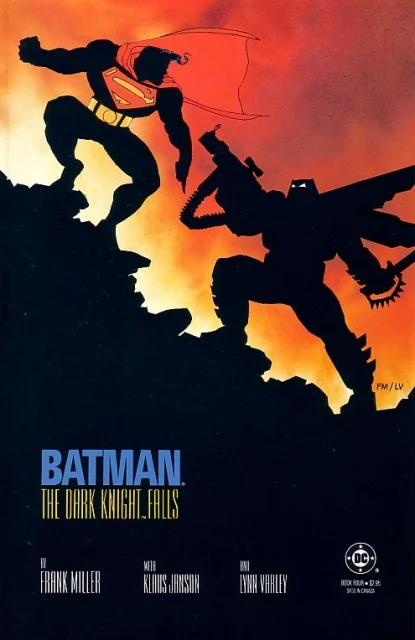
In "Lesson 7 The Sword In The Stone: The Power of Myth" Miller discusses his love of Excalibur and the Arthur mythology, fresh in his mind no doubt from his recent Netflix-enabled project Cursed, done in collaboration with writer Thomas Wheeler. He shares what appear to be excerpts from an early version of The Dark Knight Returns and mentions how Batman carries a sword on the cover of The Dark Knight Falls. This was something I'd somehow missed in my dozens of readings of Dark Knight. I had to check the cover of issue 4 and there it is, a sword in Batman’s hand, covered in spikes. Not exactly Excalibur, but a sword nonetheless hiding in plain sight partially cropped by the right edge of the page, not as attention-grabbing as the machine gun in his other hand. He shares a snippet of an alternate version of the story’s final battle between Batman and Superman where a mysterious goddess leaves a magical sword in a puddle of water for Batman to deliver the coup de grâce. “‘This is going to HURT,’ he hisses.” This is something I’d never read before. Is Wonder Woman the Lady In The Lake? There are moments like this in the book that speak to my own fannish tendencies. I'm heartened to hear he's among the fraternity that believes George Lucas was inspired by Jack Kirby's Fourth World in creating Star Wars. "... Kirby's Fourth World series must be regarded as a primary source inspiration for Lucas's creation."
'Sometimes you have to work with others to grow'
Although he's generally known as a one-man band, most of Miller's work has been done in collaboration from the very beginning. Those first dozen or so Marvel comics where he worked with writers leave the question of "what parts of those stories were Frank's ideas and which were the writer's?" I'm glad that this book confirmed my suspicion that the roller coaster sequence in Daredevil #161 was Frank’s idea and that he took the D-train to Coney Island to research and sketch The Cyclone coaster. The hard work paid off in a dazzling sequence, which he later refined in Hunt The Dark Knight.
When he talks about early Daredevil he seems to eschew controversy. Klaus Janson has written and spoken about friction and frustration over his working relationship with Miller. I would've liked to have heard about that from Frank's perspective. He mentions that "Klaus, the gentleman, did not loudly curse me for" presenting him with "an awkward heap of floppy, taped-together boards to finish", but there was a rift between the two when Frank re-inked some of the pages of Dark Knight, unsatisfied with what Janson had turned in. In Push The Wall Frank is apparently a gentleman.
When Frank Miller replaced Roger MacKenzie as the writer on Daredevil, it was a watershed moment. It seems like there’d be some kind of story there. Maybe not, but that’s a big moment that seems rife with dramatic potential that Miller skates right past. When he began writing Daredevil all by his lonesome, it went against the usual Marvel workflow and was a major turning point in his career. He often overstates, and does so here, the debt that Elektra’s origin story in that first solo issue owes to Will Eisner’s Sand Saref story from The Spirit: "So at this point, I did what all great writers do. I shamefully stole from someone else." I'd heard this for years from Miller. When I finally read Eisner's story I could see how Miller used it as a template and jumping off point, but what Miller created was as different from Sand Saref as The Spirit is from The Shadow.
I've been reading Frank Miller interviews for longer than I've been reading Frank Miller comics. That puts this book at something of a disadvantage in that I've read better tellings of many of these anecdotes. When he does tell a chestnut I've never heard before, I'm all ears. I love any story of a comics creator camping out at the printing press to oversee the production of their masterworks. I’m glad to read that Frank and Lynn did that for Ronin. “We spent sleepless nights at Montreal’s Quebecor printing, watching the roaring presses spit out pages while we shouted, 'Rouge!'" The coloring that's been applied to Miller's post-Varley work seems to suggest he's no longer as interested in what the finished work looks like. Once the boards leave his desk, his job is done.
Much of a comics creator's life is solitary. Your great accomplishments are done in isolation. In the telling of his own story, Miller appears to see himself as a Dylanesque poet of the dirty streets. “The sidewalks were broken dishware” shows its obvious noir-inspired Millerisms, but it’s also a damned fine piece of descriptive writing. Miller remains an enigmatic figure. The rare times he’s bared his soul seemed necessary, part of a process of repair and rehabilitation. He’s from a different era. He doesn’t use Facebook as a confessional. You don’t see snaps of his deli lunch or his beach vacation. We live in a different age where regular folks share every aspect of their life. Who can blame Miller for wanting to keep his private life private? Ultimately he owes us nothing in that regard. It’s his right to share or withhold the details he chooses about his life, which begs the question, "why write a book about your life at all?" That said, if he's more interested in the how-to aspect of this work, I don’t see the sense in withholding details about his process in a book that’s meant to be instructional.
'We breathe, we hunt, we kill'
He shares a couple of anecdotes from the set of Robocop 2 and Sin City, but nothing from The Spirit. On Sin City, he had the safety net of a “co-director” in Robert Rodriguez, one of the best to ever do it. Tell me, Frank, how frightening was it when you found yourself as the sole director of a star-studded feature film based on your friend and mentor Will Eisner’s signature work? They let a comic booker, one of us, direct a multimillion dollar production, a once-in-a-lifetime proposition. What was that like? Tell us a story, Frank.
Push The Wall could have been the ultimate telling of his life story. Who else but the lanky one himself could deliver on the promise of “My Life?” As a how-to book, if he had chosen to, he could’ve run rings around what Scott McCloud created in Making Comics, perhaps the most rigorous entrant in the genre despite existing in the long deep shadow of his MacLuhan-esque Understanding Comics. Miller says he wrote this book on the advice of his departed mentor Neal Adams. He asked Neal what he owes him for all the instruction he’d given the young Miller, a story told in greater detail in the documentary. Neal told him to pay it forward. Do the same for the next guy. Hence this book of lessons. Miller talks about Neal’s advice being useful practical nuts and bolts critique. Miller chooses to cheerlead with this book despite his description of Neal as a hard taskmaster.
If you’re too general, you run the risk of saying nothing. Miller is uniquely qualified to lay out and teach a process for creating comic books. He’s one of our greatest living practitioners. Perhaps the greatest of all time. He published a book of his life and a list of instructions, but the myth and the methods remain hidden. Jack Kirby was also protective of his trade secrets, but when it was suggested that he write a how-to book he was sensible enough to be very emphatic in his refusal to do so.
'Go ahead and take criticism personally'
He doesn't shy away from addressing failure. He discusses Robocop 2 and Holy Terror, which was a potentially career-ending nadir to his journey. I agree with Miller's assertion that we learn more from our mistakes than our triumphs. "Never forget: failure is your friend." A more detailed discussion of those failures as well as Miller's aforementioned solo directorial debut on The Spirit would have been welcome. While Robocop 2 and The Spirit seem to be forgotten, backlash from Holy Terror continues to this day, though it has greatly lessened since Miller has publicly disavowed the book and chalks it up to a bad decision made during a low point of his life. "It was a fever." Miller has said in recent interviews promoting this book that he eventually realized that propaganda ranks just below pornography as an art form. Perhaps the accumulated backlash he's undergone explains why Miller is so reserved in this book. He's apparently abandoned the dangerous role of provocateur.
I brought a lot of expectations and baggage to my reading of this book. I gleaned more juicy tidbits from his surrounding interviews, which is unfortunate but understandable. Having finished writing the book, he’s had more time to think about it. One of the truisms of the comic book assembly line is that you get plenty of opportunities to do it all over again. The best practice for making a comic is making a comic. He's written his first memoir. Now he knows more about how to write one. His next one should be dynamite. The Wall Pusher Strikes Again!
Comics is a demanding art form built for workhorses and workaholics. Miller describes as a fellow traveller, although at a wildly rarefied level of artistic and commercial success. However, he’s still a cartoonist through and through. He approaches a blank sheet of paper just like the rest of us. He rolls up his sleeves and gets to work. His sketches, seen elsewhere but not in this book, help demystify his process. Those perfect shapes and pools of black ink don’t immediately appear on his page. They manifest in the final stages, built on layers of underlying construction, skeletal and muscular drafting, drapery over the forms, consideration of light sources, followed by fast energetic Pollock-like application of ink and paint. Again, this is all information I gleaned from other sources, not present in this book of lessons.
He’s a working artist. The fact that we haven’t seen as much of the fruits of his labor in the past 20 years doesn’t mean he hasn’t been busy in an intense daily practice. What we have seen from him in the past eight years are largely fan commissions and variant covers while he quietly toils away at his Sin City Western and other long gestating projects. There's greater abstraction on display, greater gesture and an adventurousness that is difficult to ignore.
I root for Frank Miller. I’ve loved his work and taken great inspiration from it since I first encountered it at age 11. I’ve followed his footsteps into a career in comics. One of the reasons I chose this field is the notion that I never have to stop being productive. You can work and grow until your dying day. I believed and believe this despite overwhelming contrary evidence — artists who burn out, leave, are pushed out of the field, or keep working with ever-diminishing returns, work that is a hollow echo of previous triumphs. I want to believe that he’s got a late career masterpiece up his sleeve. Push The Wall isn’t it, in spite of its pleasant affability.
I started seriously creating comics around the time Miller was making 300. He seemed to be approaching an apex, making greater and more accomplished work that entered new artistic territory. The Miller/Varley partnership was at its zenith with seemingly the best yet to come. I anxiously awaited The Dark Knight Strikes Again when it was announced. The preliminary sketches were dazzling, sure to be a new exemplar of what this dynamic duo could do.
What would follow was The Miller/Varley team's finale, a controversial and, for many, disappointing sequel to their most acclaimed work. I find myself more fascinated by the stories behind Miller's failures and I'm hungry for anything I can learn about DK2. Back at the turn of the century when he was promoting that work, high profile interviewers like NPR's Terry Gross just asked him about The Dark Knight Returns and neglected the new work in their discussions. In Push The Wall is Miller finally describes what his goals were in his Dark Knight sequel — "Strangely enough, pop culture has taken my interpretation of Batman as the Dark Knight, the very character I created to radicalize a venerated icon, and they've turned him into a statue. This drives me crazy. I don't want him to be preserved in amber." With DK2 he wanted to smash that false idol the way he'd smashed the previous moribund Batman the first time around. When you look at that final panel of The Dark Knight Strikes Again you realize this is an act of anarchy, a comic book molotov cocktail.
'Know your ending'
Maybe you’ve only got so many masterpieces in you. You can get them all out when you’re young, when you’re old, or spread them out through your lifetime. In writing this review I revisited a lot of Miller's gems and when viewed end to end, it's a staggering output. He’s got more masterworks under his belt than anybody.
Even something as heartless and life-negating as American Capitalism doesn’t expect its workers to produce at the top of their abilities past the age of 60. He regrets that he "got really comfortable by the pools and on the barstools of Los Angeles" during his lost Hollywood weekend, but aside from the barstools, maybe that was an astoundingly good use of his time. Looking back now at the vantage point of mid-career I certainly wish I’d spent more of my days poolside. There’s nothing on Earth quite like a Miller Masterwork. Fortunately for him, Miller learned the lesson that he quotes from Bruce Lee: "The process is everything, the outcome is nothing." Another bromide, but a useful one nonetheless.
In making this fusion work, an autobiographical instruction book, Miller bit off more than he could chew from both directions. What I can recommend about it is that the reading process was propolsive and enjoyable. Push the Wall follows the dictum of “leave ‘em wanting more.” By the time I was shown the exit, I was left wanting more. Way more.
The post Push The Wall: My Life, Writing, Drawing, and the Art of Storytelling appeared first on The Comics Journal.


 Hello, my name is Jack Sparrow. I'm a 50 year old self-employed Pirate from the Caribbean.
No comments:
Post a Comment