

Years ago, I spent a cross-country flight seated next to a man who, in my recollection, never once looked up from his reading. Curious to learn what he found so absorbing, I took a surreptitious glance at his tray table and was surprised to see a bland-looking magazine immediately recognizable as a specialized journal — in this case, Sugar Journal, which subsequent research informed me was (and continues to be) a trade publication for the sugar and ethanol industries.
At the time, I couldn’t believe that anyone could be so fascinated by what seemed like such dry material, but of course I should have believed it. I’m an academic, after all, and I spend plenty of time happily poring over scholarly journals and books devoted to specialized research in my field, which many if not most readers would probably deem just as obscure as I deemed that issue of Sugar Journal to be. To some extent, we all do our own versions of this; every curious person is fascinated by something that others will find idiosyncratic, niche to all but a few devotees and potentially ridiculous to those on the outside. Try to explain the beauty of Cryptic Wit to someone who’s never read comics and you’ll find yourself in precisely this position.
I’m reminded of that flight every time I encounter Ben Katchor’s comics, from his Julius Knipl strips to more recent collections like The Cardboard Valise, Hand-Drying in America, and the even less-classifiable Dairy Restaurant, which all represent a singular effort to document the fascinations that enrich, plague, and otherwise occupy the lives of ordinary people — a systematic inventory of everyone’s personal Sugar Journal — in ways that make those lives seem extraordinary. Katchor’s brand of documentation centers on the physical world: the outmoded, dingy, but powerfully loved material objects and spaces whose significance for their appreciators seems misplaced or overdetermined, their value presented as plainly obvious even as most people would simply scoff.
Katchor’s newest book, Hotel and Farm — a collection of strips serialized in various newspapers and alt-weeklies from 2000-2004 — mines similar ground, though with a stronger organizing principle than that found in many of his other works. The volume alternates between strips devoted to the opposite poles of its title, presenting a self-contained strip on one of many small, independent hotels located in Echoic City (a phantasmagoric New York) and the various characters and contraptions that haunt them; segueing into a strip on agribusiness and the production, distribution, and consumption of extremely specific, odd-sounding foods; and then shuttling back and forth between the two without establishing a clear connection between them.
Despite the lack of an obvious narrative link, both the hotel strips and the farm strips share Katchor’s characteristic preoccupation with how everyday minutiae can become engrossing: a humble product eliciting in its owner a sublime aesthetic experience, a prickly connoisseur of culturally debased objects commanding respect for his curiosity at the same time that he embodies an absurd pretentiousness, someone’s daily routine revealed as wondrous by virtue of its embeddedness in the details of an unexpectedly fascinating trade. Like Katchor’s earlier work, Hotel and Farm is a book meant to inspire awe as well as amusement — a cracked kaleidoscope trained on the absurdity and profundity of little things and littler people.
In this respect, it succeeds beautifully. Part of its success arises from the tension between the look of the work and its subject matter. As is typical for a Katchor comic, characters are rendered in an angular scrawl, their bodies and faces so proportionally distorted that they often appear grotesque and always appear middle-aged (even the children in Hotel and Farm are homuncular, looking just as world-weary as the adults that surround them). Buildings, like their occupants, appear equally aged, with the scratchiness of Katchor’s line and the heaviness of his ink washes producing environments that feel expansive and mysterious, shadowed by long histories to which Katchor’s narration provides only a glimpse. The fact that Hotel and Farm is done entirely in black-and-white helps in this regard; Katchor produces depth by deploying a wide variety of grays, and the book’s meticulous shading gives an earthy texture to interior and exterior spaces at the same time that it makes characters appear part of those spaces, swathed in the same substantive shadows. The result is a world in which even those who pass fleetingly through hotels, restaurants, and fields are firmly one with their environments, rooted in places characterized by impermanence.
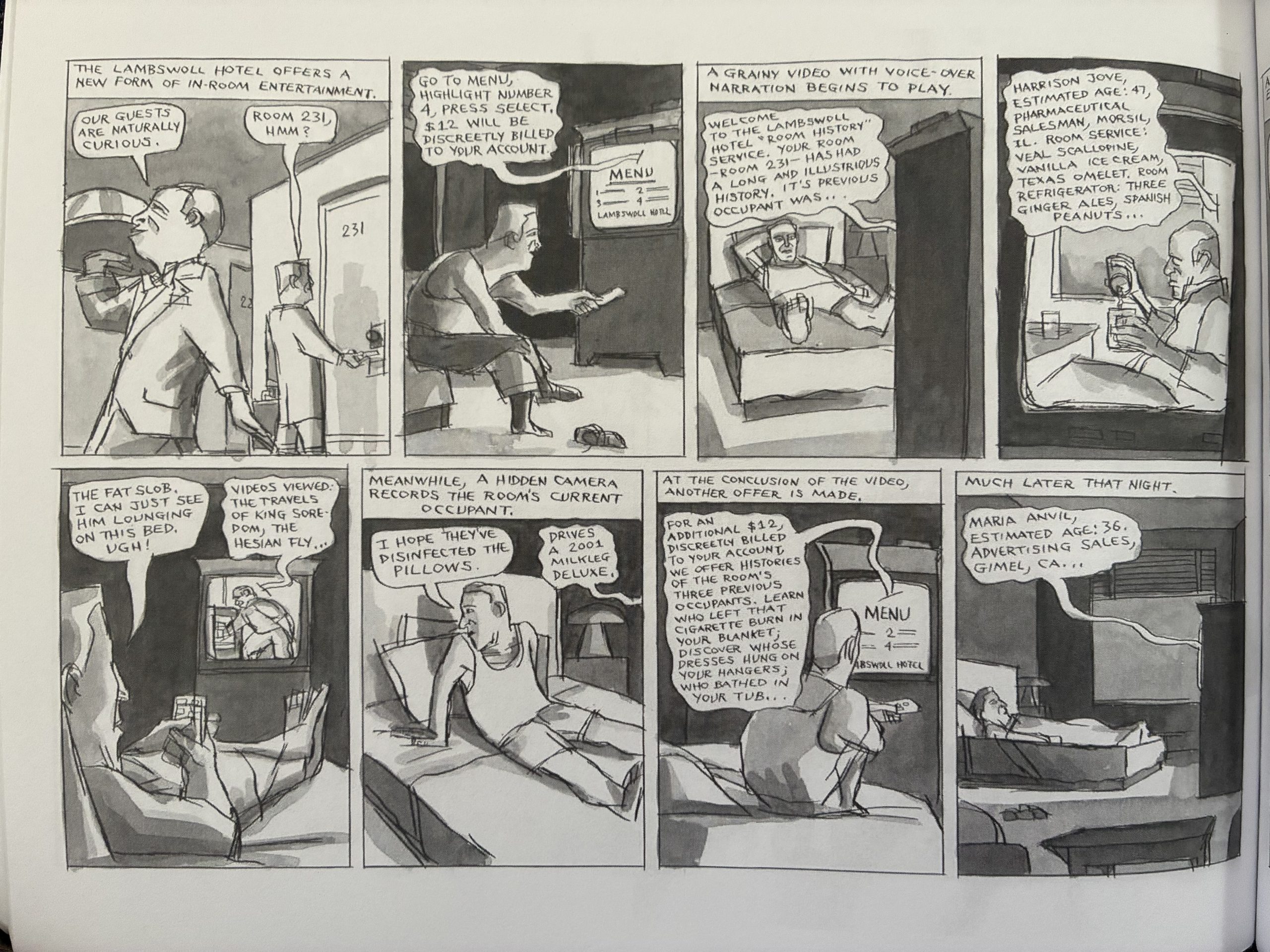
The residues of history also serve a thematic function, particularly in the hotel strips, where visitors and staff alike become immersed in all that’s been left behind over the years. In one sequence, an establishment called the Lambswoll Hotel boasts “a new form of in-room entertainment,” in which, for a modest rental fee, guests can watch a video history of the room’s previous occupant, all while a hidden camera secretly records them for the next guest’s viewing pleasure. In this strip, the guest watching a history of his own room is predictably disgusted, balking at the size of the previous tenant’s room service order, the films he rented, and his physical appearance. Yet in the strip’s final panel we see that he has watched this and other recordings of the room’s previous guests late into the night, never managing to pull himself away from the human drama contained within the confines of these four walls. Like so many Katchor gimmicks, this one seems completely bonkers, yet one must begrudgingly concede that it probably has a market, as this bleary-eyed viewer implies. How many people would succumb to the morbid fascination of knowing — and, more to the point, of seeing — what’s gone on in their room if the hotel legitimized it as a service? Would some people, even several people, practice voyeurism if it were packaged as entertainment? Is our desire to know what’s come before us in these shared spaces, even things as frivolous as room service orders and movie titles, really that strong? “Our guests are naturally curious,” one hotel staff member says by way of explanation, and that remark is borne out by other strips in the collection, which present curiosity as a consuming, immersive process, if also one that can quickly descend into absurdity. One depicts a hotel catering to news-addicts, boasting everything from a ballroom “set aside for emergency press conferences of limited interest” to in-room speakers that transmit even the most mundane items, “guarantee[ing] that nothing is ever missed.” While this hotel gratifies a desire to know the present rather than the past, it nonetheless illustrates Katchor’s broader point that curiosity, figured as an insatiable desire to know and experience all manner of minor phenomena, can become so all-consuming that it makes everyone involved appear ridiculous.
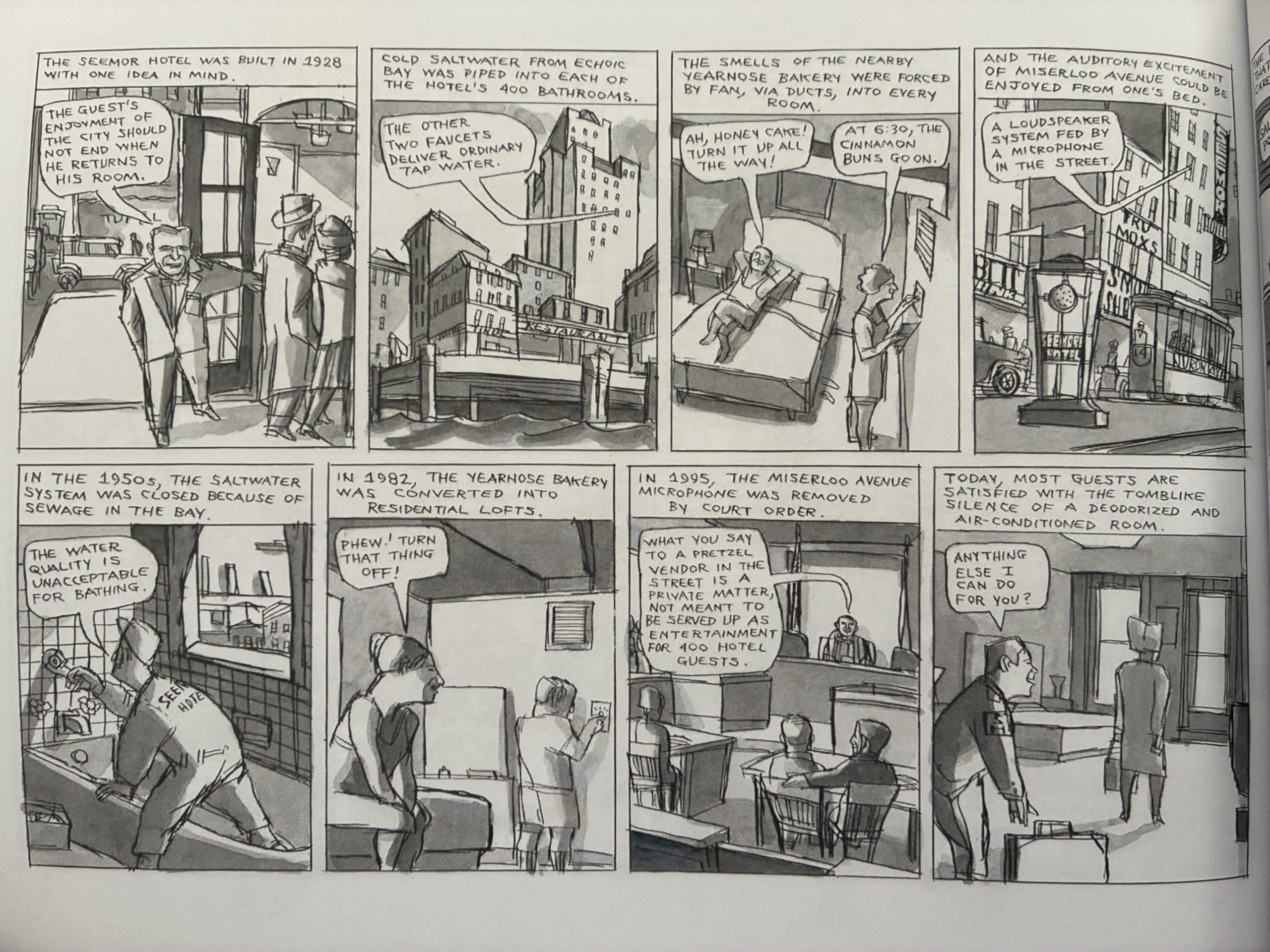
Throughout, Hotel and Farm dramatizes a tension between the desire for knowledge and the desire for comfort, the latter of which sometimes entails the suppression of the former. One strip centers on the wonderfully-named Seemor Hotel, built in 1928 to fulfill the idea that “the guest’s enjoyment of the city should not end when he returns to his room.” The strip’s first four panels track the hotel’s early years, when management took extreme measures to bring the city directly to their guests: piping saltwater from Echoic Bay into their bathrooms, pumping air from a nearby bakery through their vents, and broadcasting real-time street noise via a loudspeaker system. The last four panels, by contrast, show the gradual erosion of those quirks. The saltwater was turned off by the 1950s, the bakery was shuttered in the ’80s, and the real-time audio broadcast from local sidewalks was deemed illegal in the mid-'90s. “Today,” the final text box dourly proclaims, “most guests are satisfied with the tomblike silence of a deodorized and air-conditioned room.” People today don’t want local color, Katchor suggests, and we’re all clearly worse off for it.
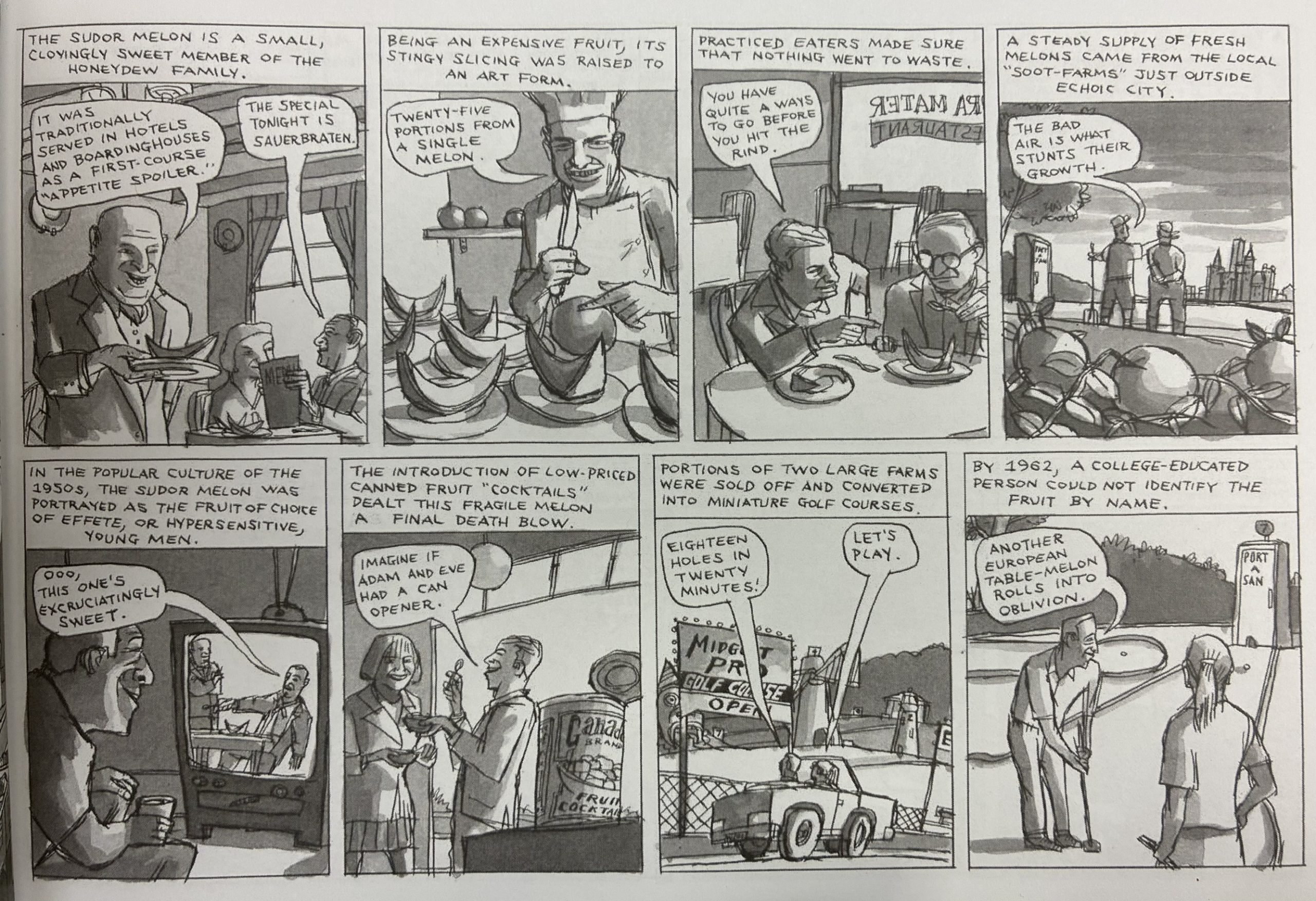
Katchor’s farm strips are equally attuned to this issue, mirroring their hotel-based counterparts in their dance between fascination and farce. Katchor has always had a knack for depicting, across precious few panels, a subject’s gradual decline in fortune and fashion, and the farm strips of Hotel and Farm richly display his prowess in dramatizing the steady march of social and historical change. One strip recounts the sad fate of the sudor melon, “a small, cloyingly sweet member of the honeydew family” once considered a delicacy but tarnished in the 1950s, when popular culture lampooned it as “the fruit of choice of effete, or hypersensitive, young men.” Katchor reveals how canned fruit cocktails finally squeezed the melon out of the marketplace, and the fruit meets its end with little fanfare or dignity: the lands used to farm it, we learn, “were sold off and converted into miniature golf courses.”
Meanwhile, other strips depict customs that are already hopelessly obsolete, existing as little more than historical curiosities. In one, a representative of “the Bureau of Vegetable Gustation” visits a rural community with the goal of establishing “a local chapter of the Boys’ and Girls’ Beetroot Club.” His pitch is useless, though, as a high schooler in his audience explains: “We feel that there’s no future in fresh beets. It’s an old-world flavor. You never see them being eaten in the movies.” That ironic assessment — an “old-world flavor” struggling to reach an audience beyond what that student derides as “wealthy young businessmen and their style-setting girlfriends [who] eat out seven days a week” — runs throughout the work. Katchor’s characters display a love for the bizarre and antiquated at the same time that they appear increasingly absurd for holding such a position in the face of massive cultural opposition, where only the most obsessive, or the most bourgeois, are willing to pursue their interests to their limits. Hotel and Farm is, in this sense, a book about popular culture becoming passé, and about how, in many cases, it has already become so; in so doing, it makes the case for studying more carefully those objects that have fallen from one category to the other.
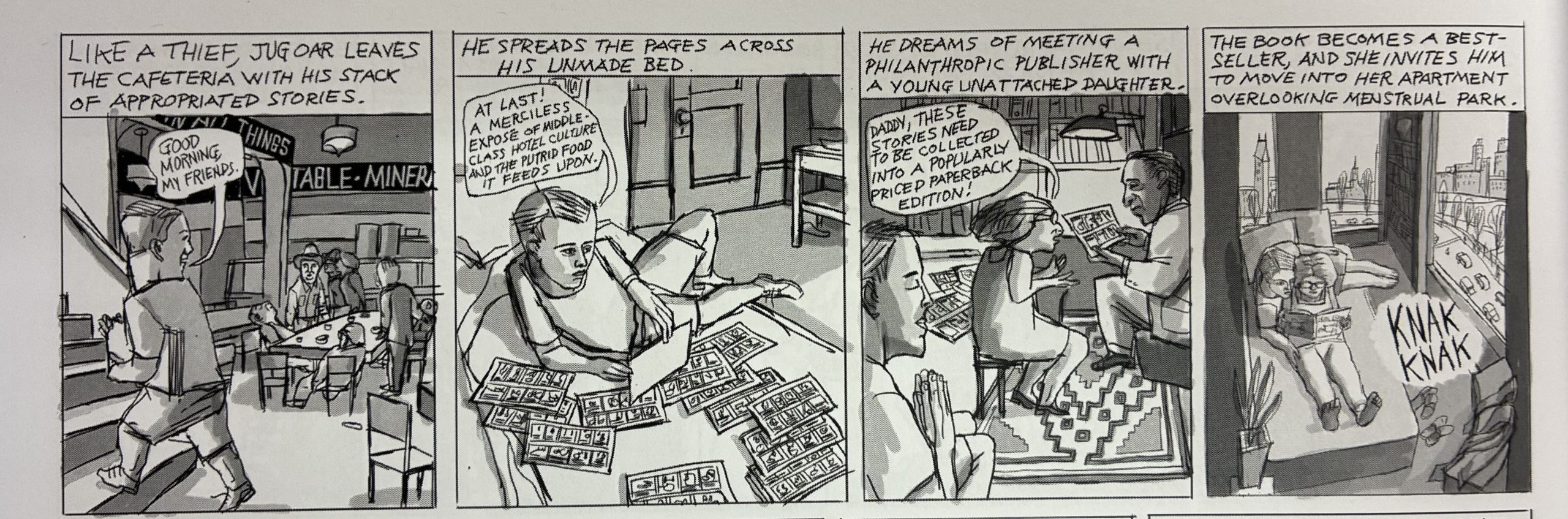
It’s worth pointing out that Hotel and Farm is not entirely a collection of old material, as the book begins and ends with a frame narrative that attempts to locate this seemingly unconnected set of vignettes within a coherent structure. That frame narrative isn’t strictly necessary, yet it centers the book within the present moment in a remarkably effective way. Like the strips it introduces, the frame narrative begins by introducing a gaggle of Katchoresque misfits, all of whom bear names that, like those of other Katchor characters, are both perfectly suited to them and reminiscent of vanished pasts. The two most prominent are Yalos Finger, a struggling manure salesman whom a few wealthy clients hire to give their otherwise sterile homes “a taste of the natural world” by maintaining “personal manure pit[s],” and Jug Oar, a dissolute writer who loiters around a community college, a hotel, and a restaurant — all transitory spaces through which people are expected to pass, not settle. Eventually, the two men visit a cafeteria where diners share stories over their meals, throwing bits of dried sausage, now used as currency in this environment of relative scarcity, to signal their appreciation for a story well-told. It’s all a bit heavy handed: rich, pet-free urbanites buying and maintaining immaculately sculpted litter boxes to feel a more authentic connection to the natural world, disaffected men gleefully accepting cuts of meat in exchange for an especially entertaining yarn. But from the vantage point of 2026, where billionaires obsessed with longevity ingest all manner of revolting things in their doomed efforts to maintain an appearance of youth and perpetually adolescent men play extreme games of one-upmanship in equally doomed efforts to dominate their perceived rivals, Katchor’s vision of a bourgeois civilization in its death throes feels frankly, depressingly current.
I don’t want to end this review on a sour note, though, as there’s so much to love in Hotel and Farm, both for longtime Katchor readers who have been eagerly awaiting the arrival of this collection, and for new initiates, who have the opportunity to discover this surreal examination of our collective strangeness with fresh eyes. Both groups should be struck by the book’s comedy, always an underrated aspect of Katchor’s cartooning. Whereas critics have consistently appreciated his comics’ fascination with the antiquated objects and practices of a world gone to seed, Katchor’s sense of humor in rendering them deserves more recognition. Hotel and Farm is genuinely funny, even laugh-out-loud funny, and it gives a wink at the old that accompanies its scowl at the new, an affection for old men surrounded by old things and old places, and who don’t feel especially comfortable with all that modern culture has yielded, or else seems poised to yield in the not-too-distant future. While I obviously hope that Katchor isn’t prophetic, I do hope that he’s right about how much fuller our lives can be when we come to appreciate the antiquated, the unfashionable, and the untimely, and, too, about how acknowledging the absurdity of our situation might render the objects of our attention even more meaningful.
The post Hotel and Farm appeared first on The Comics Journal.


 Hello, my name is Jack Sparrow. I'm a 50 year old self-employed Pirate from the Caribbean.
No comments:
Post a Comment