

[A tumbleweed of Bristol vellum rolls by.]
My pen is called upon to sing its deadly song once more…
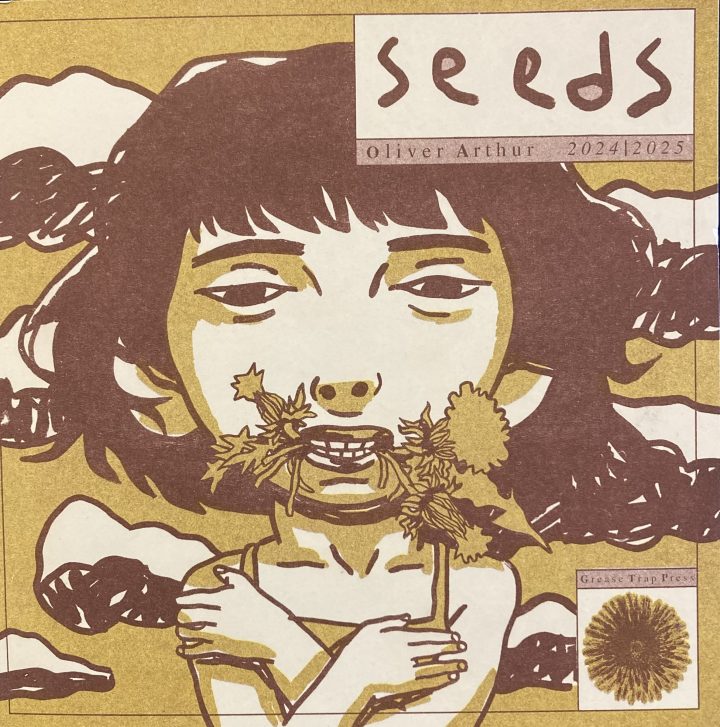
Seeds by Oliver Arthur
What does everybody want? What does everybody need? Big heads! We’ve got a new alt-comics micro-trend on our hands, folks, and it’s enough to make Charlie Brown’s noggin look modest. There seem to be quite a few artists out there right now employing this approach and I’ve reviewed the comics of Molly Lecko Herro and Mimi Chuang in the past. However Oliver Arthur might take the cake in terms of character cranium circumference. Do you chalk this up to young artists feeling like their minds are being inflated and ballooning with worry, news, and “content,” without a concrete future to keep them moored? Or is it just more interesting to draw walloping facial expressions than, like, ankles? Arthur doesn’t give you much time to ponder because Seeds is immediately engaging.
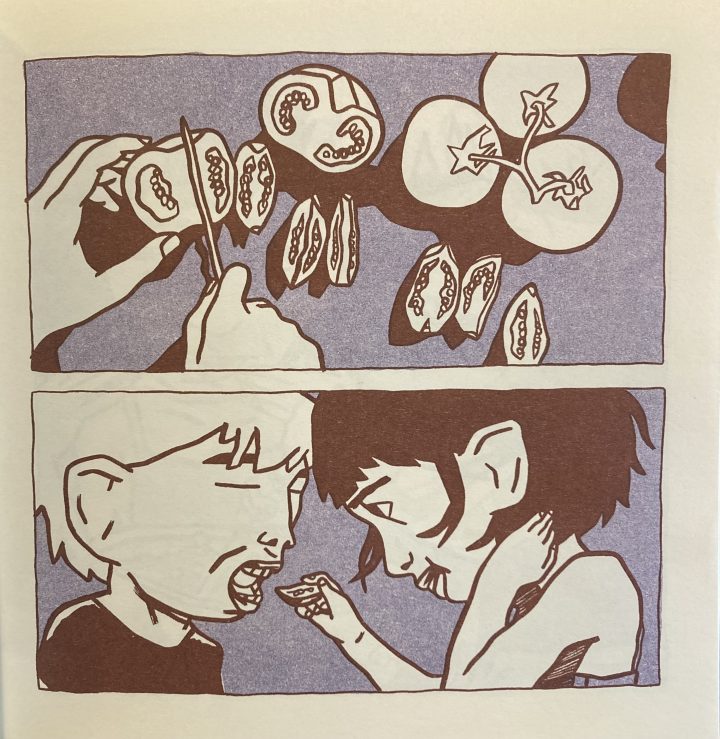
This square 60-page wordless graphic novella starts with a girl lying in a pasture, Wyeth styley. Arthur has the risograph ink of the grass slightly overlap the panel borders and draws clouds like they’re chipped pieces of shale hovering in the atmosphere. The girl gets a shovel, digs a hole in the ground, and whistles. On the other side of the hole — conceivably on the other side of the world — a boy hears her and invites her through the tunnel. This is all done in small-sequence storytelling with one or two panels per page, Arthur lets each nervous smile and warm breeze linger. The duo dance to mix tapes and combine their respective harvests to make a soup. Something’s not right about the soup though. After a long day of sharing themselves with each other, the soup tastes bitter, maybe even hurtful. In the very next panel, the girl then appears to be drowning, the scene helped along by Arthur’s wooly black and blue coloring. Before she has to drift away, the boy hands her a potted plant. When she returns home, she takes the same shovel as before and replants the gift. It soon grows and looms large, proving that not every break-up needs to be endlessly acrid. Seeds would have been eating up on prime-time Tumblr and I don’t say that disparagingly. This one’s best read with the sun on your face.
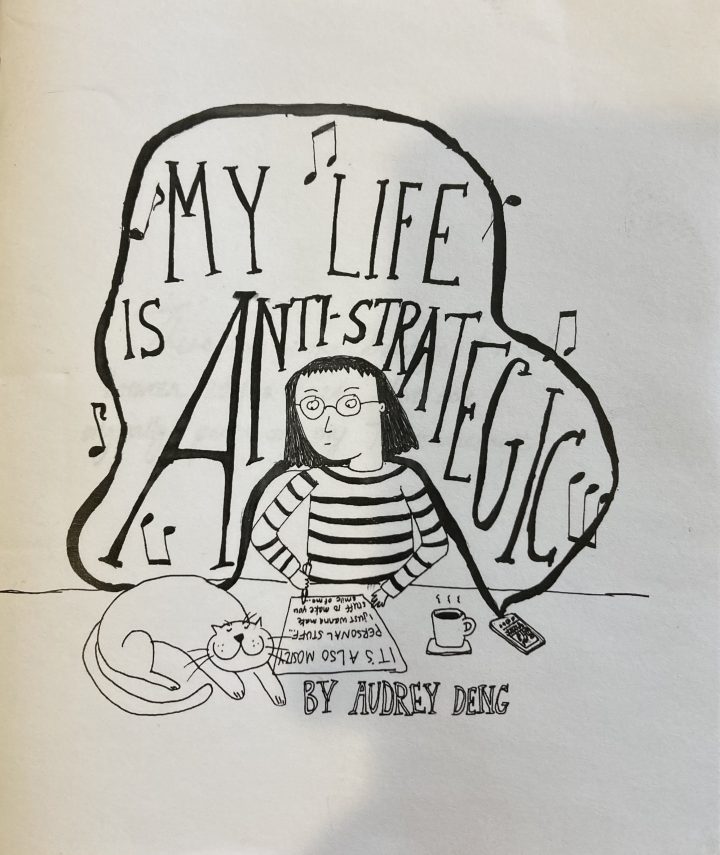
My Life is Anti-Strategic by Audrey Deng
One of my new year’s resolutions for 2026 (along with learning how to do a kip-up) was to read at least one comic strip every day. I’ve been making my way through Cul de Sac, E.O. Plauen’s Father and Son, and The Far Side since January. I tell you all this not only to receive a pat on the back for following through on my very ambitious goal, but also to say that this zine of gags definitely found me at a place where I could hop a track and perfectly land in Audrey Deng’s wavelength. Half of My Life feels like someone putting their interior monologue onto paper and the other half is doing the same for conversations overheard in public. They both work because Deng is a brilliant writer. The page shown below may be my favorite, or at least tied with another where a friend shows Deng her new engagement ring. She yells, “Waw! Show me that rock girl!” And then proceeds to have all of those words jumble around her head (“Girl a rock?” “Rock girl me that girl girl?”) until they’re a dizzying array of gibberish. It’s very funny.
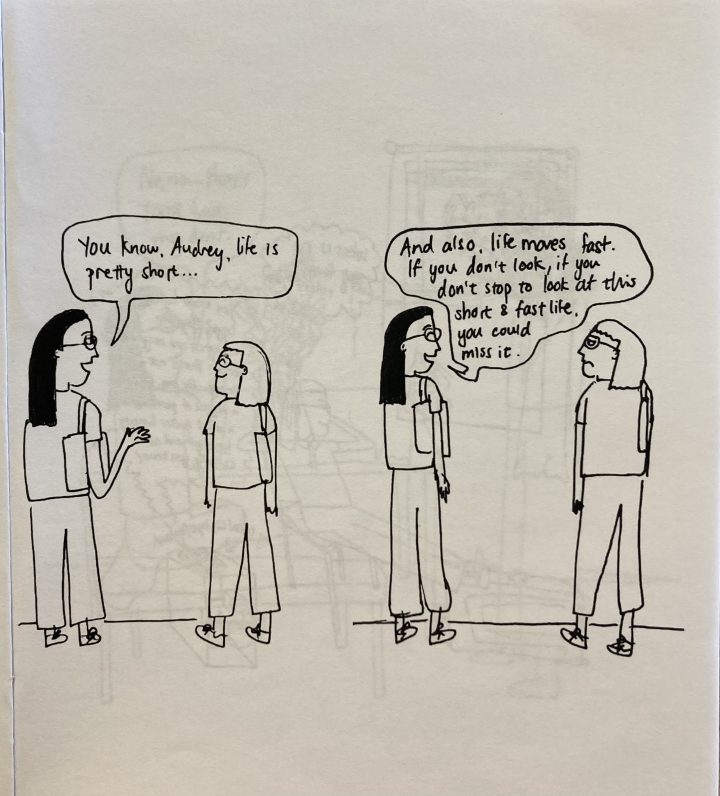
I know Deng claims “anti-strategic” and there’s an intentional lo-fi-ness to it all, but I also feel it’s important to put your best foot forward. There are a couple pages here that are difficult to physically read — either the images are too low-res or the lettering is too crammed into a thin balloon. Some of these drawings are very crude, especially early on. But there is a clear progression happening as the book goes on (and even more so if you peek Deng’s more current Instagram posts). Words are paramount over pictures in My Life and that’s OK (a breath of fresh air compared to the opposite, which I see far too often when working on this column). I don’t mind that because the humor is so sure-footed. This isn’t, “this generation is like this and this generation is like that.” It doesn’t beat the dead horse on one topic. It’s not irony or anti-humor. It’s just good jokes. In Deng’s work, fleeting thoughts are not only captured, but celebrated. Put on your party hats.
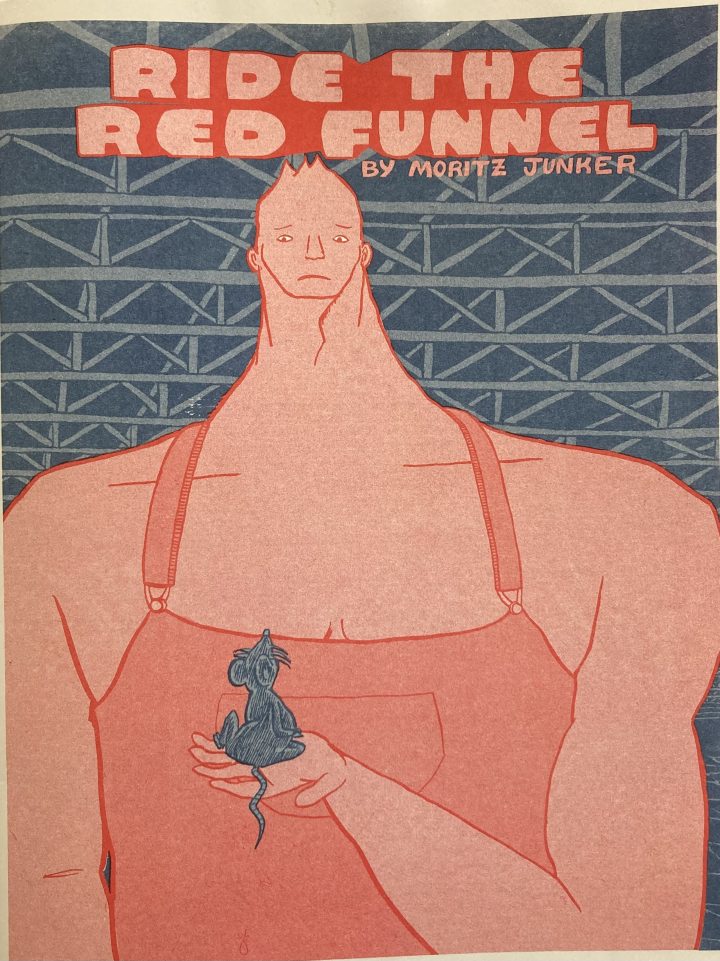
Ride the Red Funnel by Moritz Junker
You’ve heard of big heads, but have you ever considered … small heads? Moritz Junker’s got you covered with his character Carmichael Delars. With his long triangular neck, cut-off overalls, and standing at about four times the size of any other person in this story, Carmichael’s a lot like Steinbeck’s Lennie, and he’s about to unwittingly be recruited to participate in some local athletics. The sport is coached by a sweaty slug of a man right out of PE teacher central casting and the objective is for one team to catch a rat while the other team must stop them by any means necessary. The players are puberty stricken teen boys, including the coach’s sniveling son, and the field of play is an empty warehouse filled with coffee tables, pianos, refrigerators, La-Z-Boys, and oscillating fans. The winning team gets to mutilate the rodent any way they deem fit.
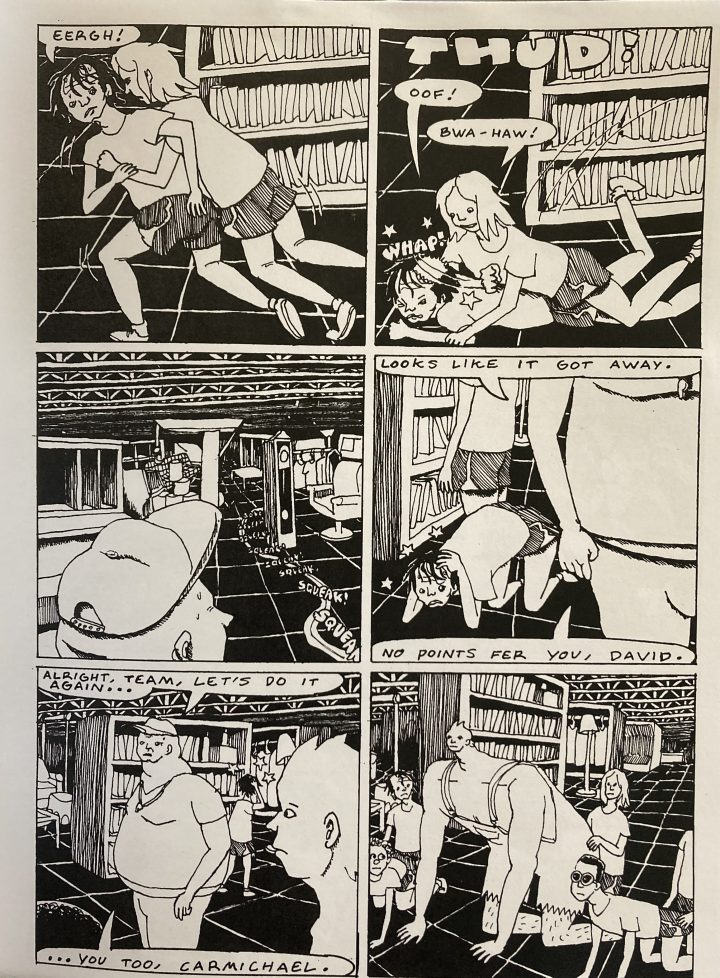
Red Funnel is an extremely unsettling and satisfying (think Happy-era Josh Simmons) psychosexual hullabaloo. Most panels in the arena/warehouse feature a metal ceiling scaffolding and Junker’s diligence and repetition make the space appear endless and spectral. The girl who brings Carmichael into the game is seen in close-up near the beginning of the story and again in the last panel, peering out at her downtrodden friend through a brick bunker, bookending the narrative in wickedness. There’s an authentic violence that’s touched on, but I don’t think we’ve seen anything yet. Ride the Red Funnel is like an urban legend come to fruition about the barbarities of capitalism, the exploitation of big bodies, and the danger of male mob mentality. When Carmichael expresses sorrow for the actions of his team and threatens leaving right then and there, the grotesquerie with a whistle around his neck tells him he might as well quit his whining because “we’re gonna be catchin’ ’n’ killin’ those rats with or without ya on the team.” The merciless cogs keep turning. In terms of Moritz Junker and an issue #2, I’ll be watching that space and hoping the best for that tiny face.
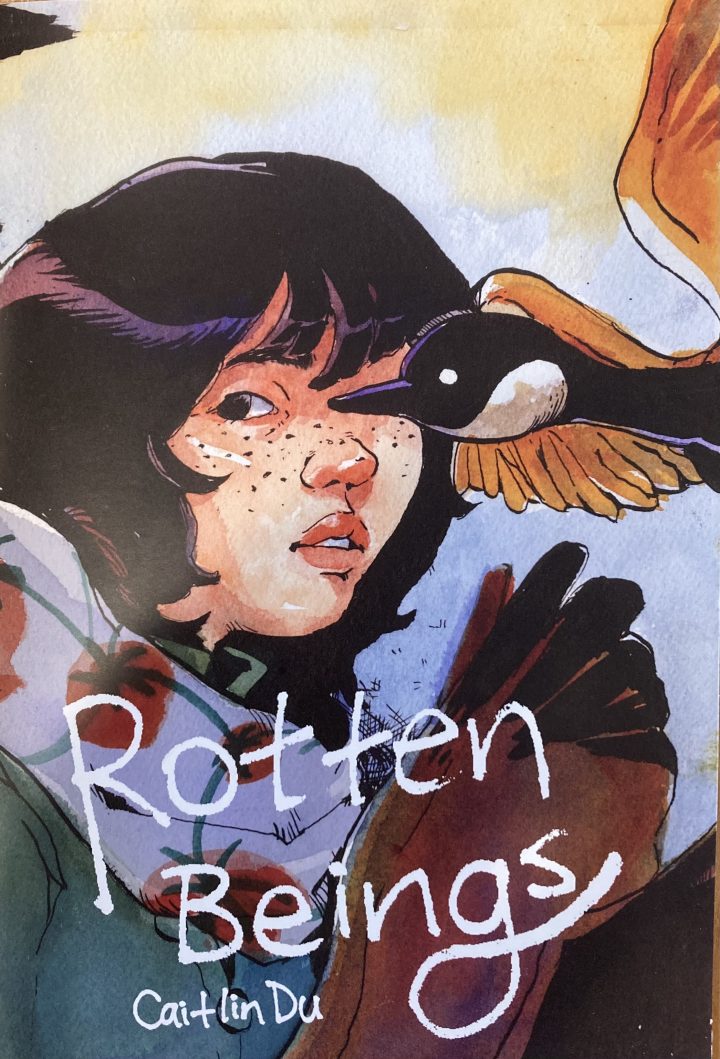
Rotten Beings by Caitlin Du
I once saw a goose steal a ladies purse outside an apartment complex in Schaumburg, Illinois. There was a loud scream for help and when I turned the corner I was flummoxed and full of adrenaline. I scrambled around looking for a solution that didn’t include creeping closer to the hissing heinous beak. By the time I had come to terms with the idea that I might need to heave a cinder block toward the assailant, the craggly, vaguely Eastern European building custodian had confidently strided in. He grabbed the handbag strap and rightfully eyed me down as pitiful. It is safe to say that I don’t share the sentiments of Caitlin Du when she claims that she wants to turn into a goose.
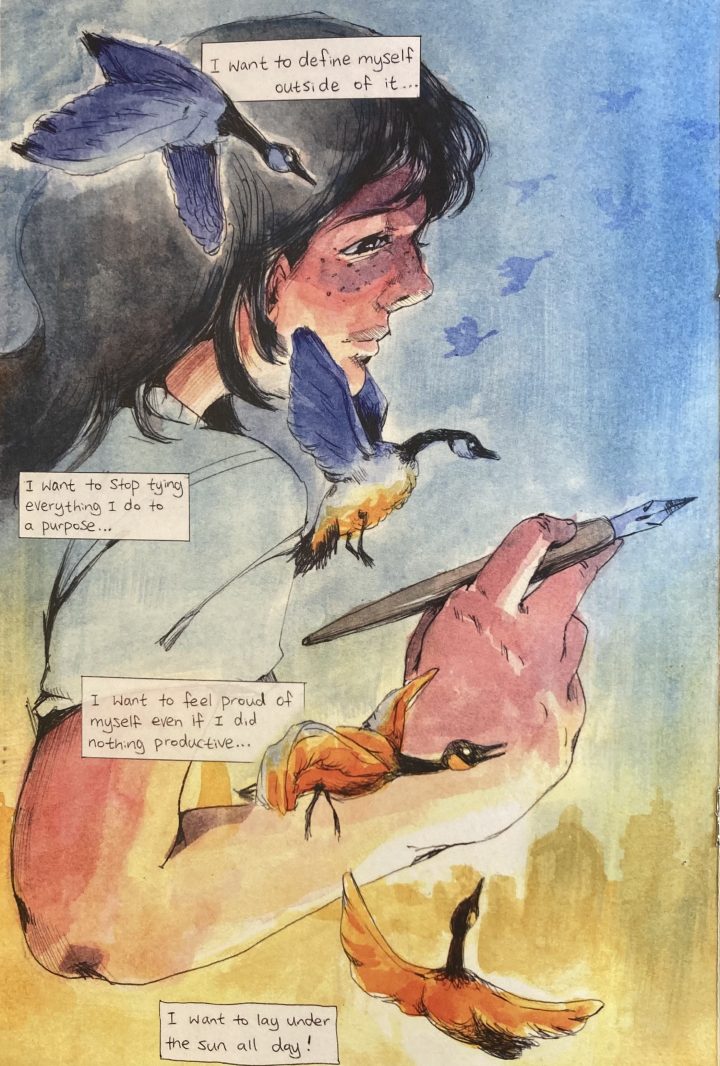
At the beginning of these eight pages, that’s exactly what she does — Animorphing along the beach and then immediately being ostrichized by the other geese. Caitlin can’t fly. Caitlin doesn’t have a gaggle. “Be a better human before trying other species,” the waterfowl sneers. This sends our author looking inward, worried about wasting away at a desk, forever grinding. The tone, the rhetorical questioning, the yearning for something, anything, outside the workaday — Rotten Beings reads obviously like the work of a young person. Nonetheless, the technical skills Du possesses here are monumental. The watercolors and various page textures achieved — not just from one page to the next, but often in the very same small panel — are rousing. My main concern comes after the story concludes. Du inserts a page on the inside back cover with “More Comics Coming Soon…” at the top. In progress we have a “light sci-fi & humor” comic as well as a “middle-grade” graphic novel. If you want to define yourself outside your work, the first step might be to kill the BISAC coder in your head. This mindset is most likely a path toward very modest financial success, but also the same path you just spent a handful of gorgeous pages venting about.
[The saloon doors dramatically swing closed as the Critic with No Name departs.]
See you next month, I hope.
Questions, love letters, and submissions to this column can be directed to @rjcaseywrites on Instagram.
The post Arrivals and Departures — April 2026 appeared first on The Comics Journal.


 Hello, my name is Jack Sparrow. I'm a 50 year old self-employed Pirate from the Caribbean.
No comments:
Post a Comment