

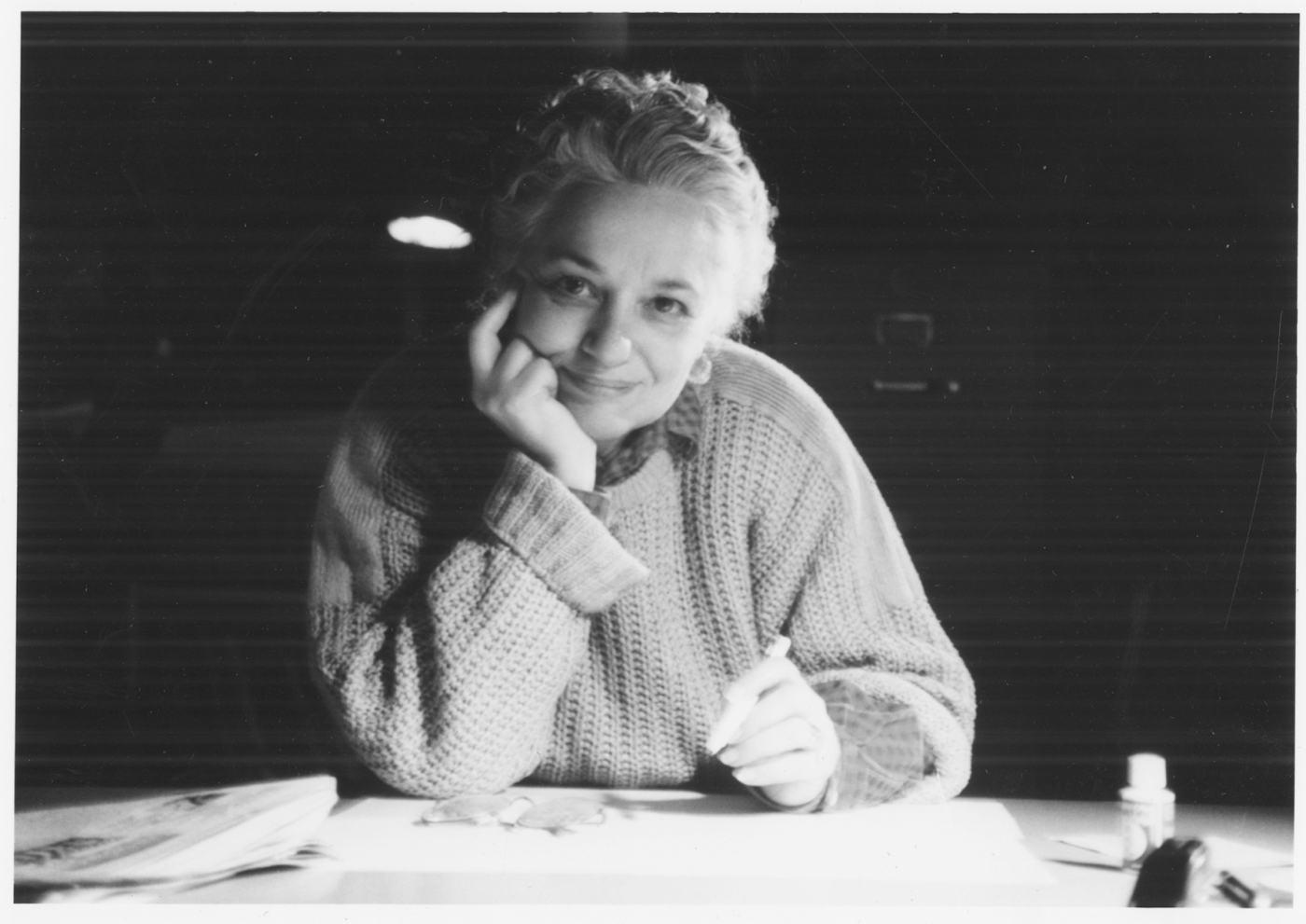
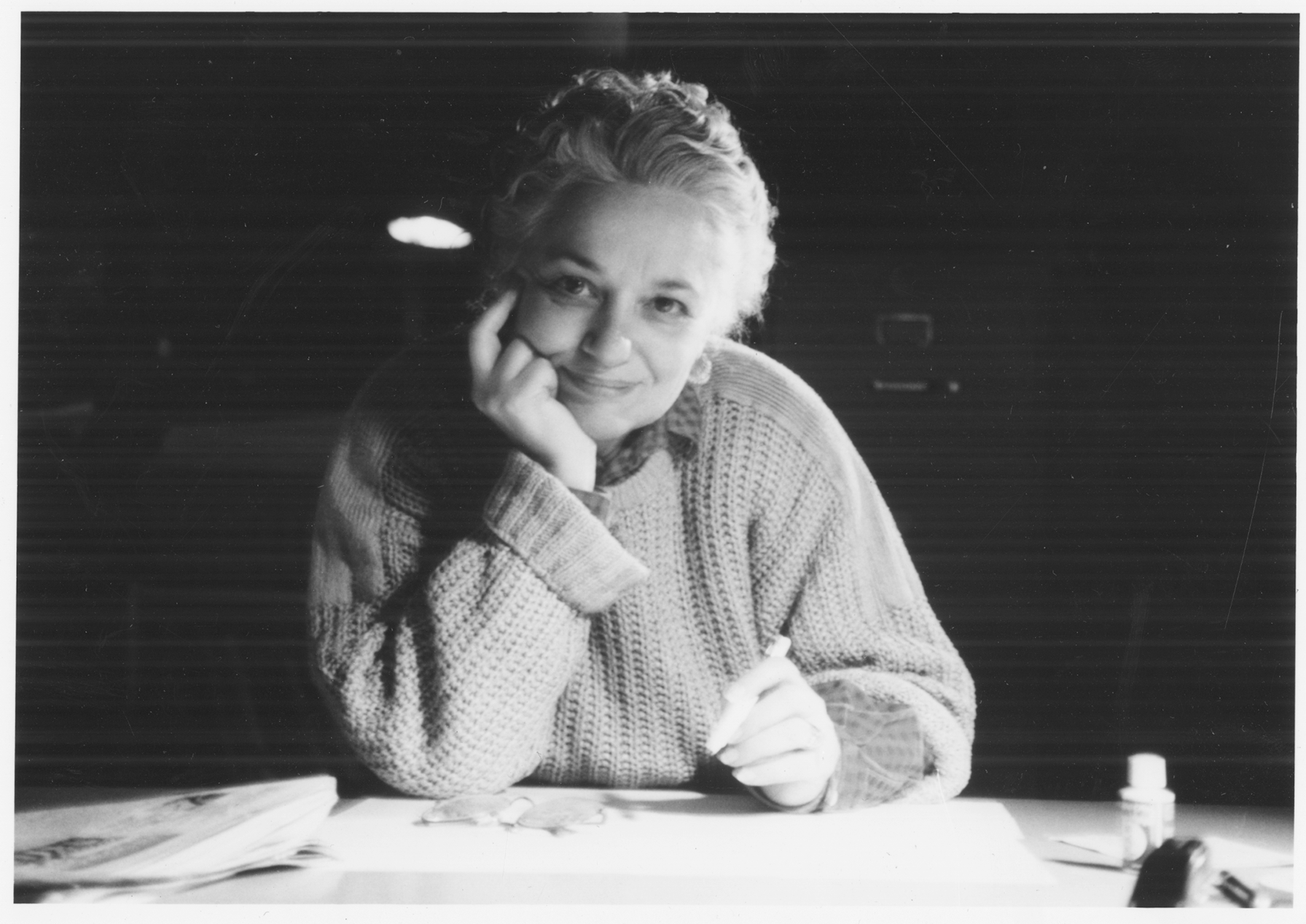
Nicole Hollander, creator of the beloved comic strip Sylvia passed away on April 23, 2026 at an assisted living facility in Chicago, just shy of her 87th birthday. Her internationally syndicated strip, self-syndicated for much of its run, ran in newspapers from 1980 to 2012, when she retired from the daily grind to focus on theatrical musicals, her autobiography, and passing the time with friends and family.
Her graphic memoir, We Ate Wonder Bread, chronicles her West Side Chicago childhood as Nicole Marilyn Garrison, the daughter of Shirley Mazur Garrison and Henry Garrison, a carpenter and labor activist. “No one had babysitters,” said Hollander, explaining her upbringing. “What I remember so vividly is being part of the life of my mother and her friends — Shirley, Esther, and Olga.” The book combined prose and illustrations as she recounted tales of gangsters, glamorous women, rundown tenements, and daydreams of a better life as her family explored the wealthier parts of town in their family car.
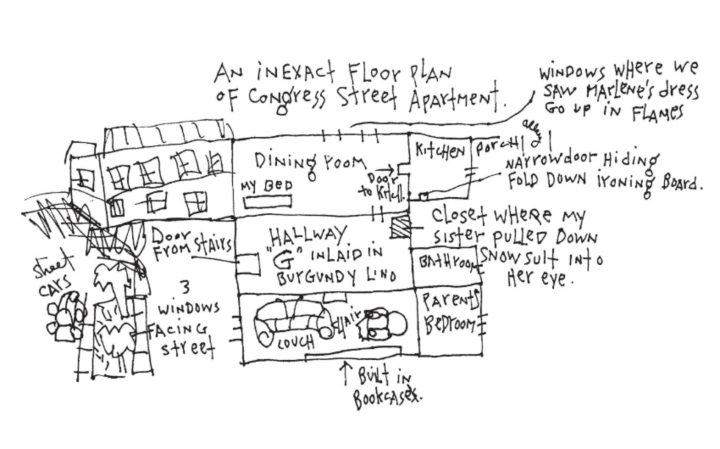
“Drawing was my first love,” said Hollander in a 2019 interview by Alex Dueben for The Comics Journal. “I drew and drew. It was hard to get me out of the house. In grammar school I was the class artist. If it was Thanksgiving, I was drawing a turkey on the blackboard. Once you are named the class artist, it’s impossible to depose you.”
In her introduction to Hollander’s memoir, Alison Bechdel commented, “As Nicole’s vivid recollections proliferate, it’s hard to imagine anyone growing up in this place not becoming a cartoonist. She has a close call involving a poodle skirt. Her sister gets a coat hanger stuck in her eye. Her mother smokes with the ashtray resting on her pregnant belly. The kitchen is stocked with Lady Aster brand schmaltz.
“The stories flow thick and fast, and seem almost animated thanks to the many, many illustrations that spill across the pages. Hollander’s vibrant crayon drawings augment and elucidate the text, but have their own delicious internal logic.”
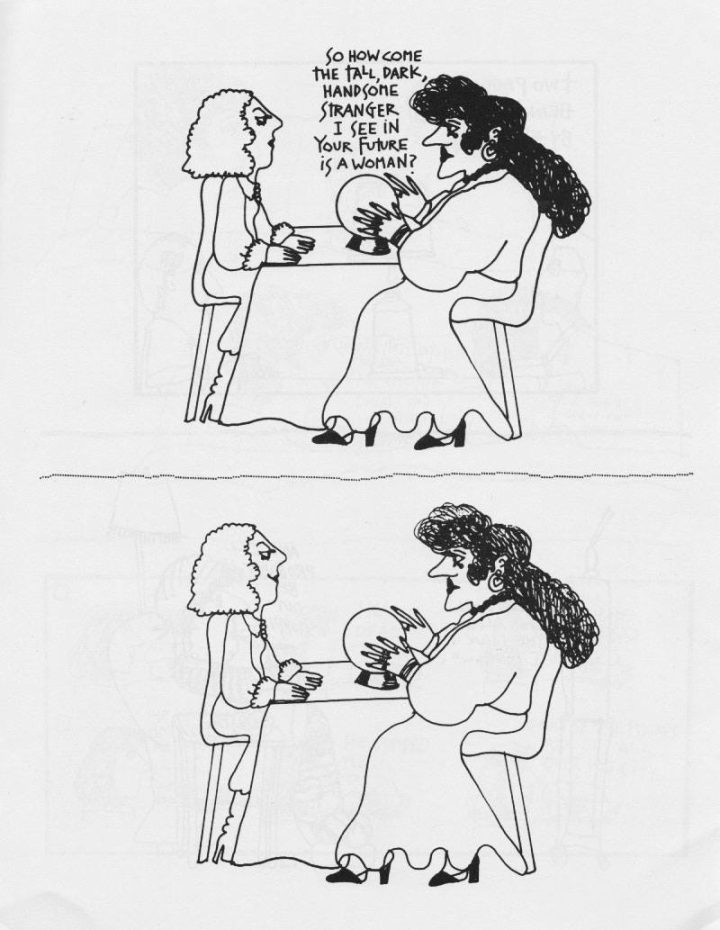
The Senn High School graduate earned a B.F.A. from the University of Illinois at Urbana-Champaign in 1962 and an M.F.A. from Boston University in 1966. “Before I became a cartoonist I went to school for fine arts so I did all sorts of big images in color. I think I wanted that to be in there. I liked color, although I had been restricted for 35 years to black and white. Sylvia was so free because I felt I could write anything I wanted," she told the Journal. "The words could be whatever I wanted and I had this limitation that only the blacks showed. That was very helpful so I could make changes and make mistakes and go back. As a painter, you paint and paint and there comes a point where you have painted too much and it doesn’t look good anymore. You either have to get rid of it or start a new painting and a new thought. They’re very different experiences and I’m really glad that I had both of those things to call on.”
Prior to grad school, she married Hungarian sociologist Paul Hollander, and retained his surname after the couple’s 1966 divorce. After working a series of unfulfilling day jobs, the talented artist established herself as a fixture in the Chicago arts community in the 1970s and ultimately landed at the feminist publication The Spokeswoman as its graphic designer, regularly contributing political cartoons and overseeing the newsletter’s transformation into a monthly magazine.
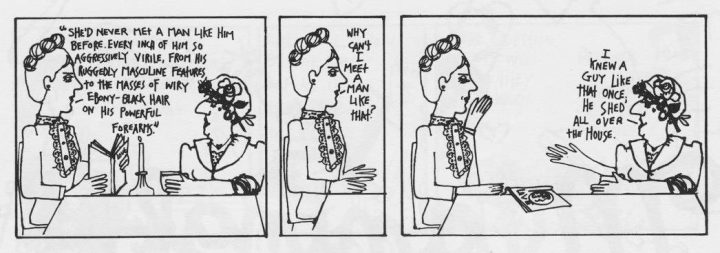
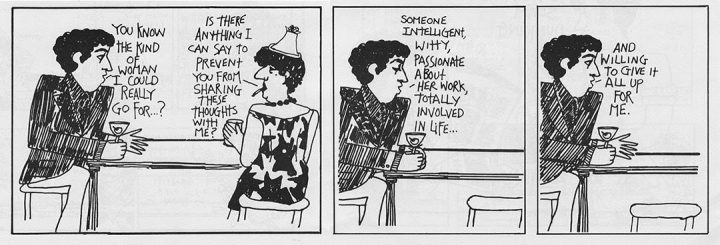
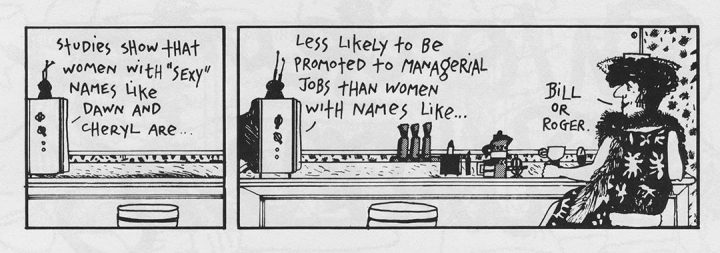
“Nicole was in reality an alt-weekly cartoonist who somehow snuck into daily papers, apparently without the editors noticing,” said graphic novelist Derf Backderf. “The only one of us who pulled that off. In 1976, Hollander's cartoons developed into the comic feature The Feminist Funnies, which became a cult hit. She got a book published, which sold well. Cartoonists had this option back then. Bookstores were full of quirky cartoon books. This led to a syndicate signing her, resulting in Sylvia. She was 40 when it launched in 1980, a rare feat for a middle-aged cartoonist. The daily comics page was at its boring low point then. The door was slammed shut to any work that was edgy or quirky. Somehow Nicole squeezed through a crack.”
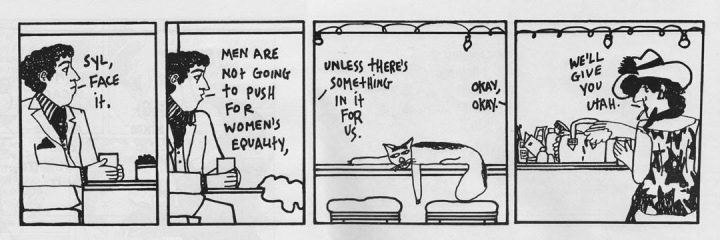
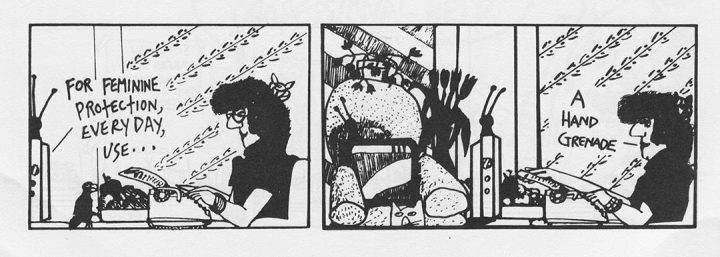
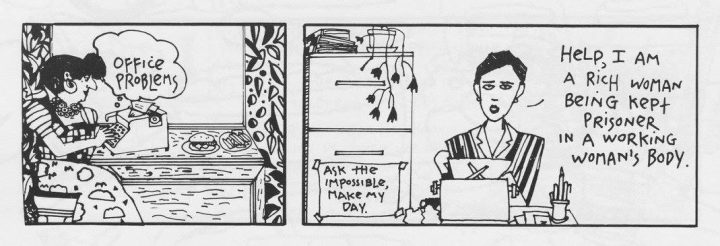
Hollander’s dry, wicked sense of humor and unique style and format made Sylvia an immediate standout on the comics page, and she found an appreciative audience in women readers, who could count the number of syndicated strips by, for, and about them on a single hand in the early 1980s. Drawing some of its visual inspiration from Jules Feiffer’s celebrated strip Feiffer, the strip centered on the titular character, who was modeled in part on Hollander’s mother. Readers had never seen anything like her before. Sylvia was a sarcastic, middle-aged woman who did not hold anything back when expressing her thoughts on political, social and cultural topics, as well as her cats.
“I think I always think in Sylvia’s voice, which is really a combination of my mother and her deadpan friend Esther. Nothing phases Esther,” Hollander said to TCJ. “My mother was funny without giving it a second thought, yet she was always worrying about something, always breaking a glass. Once she tried to glue a broken fingernail back using epoxy and had to go to the hospital to have the glue removed, her finger repaired. Luckily she worked at the hospital — convenient when you’re accident prone.
“I didn’t do a cartoon a day. I worked on a week at once. I was thinking about newspapers and Sylvia watching TV and writing a lot and then finding the joke. Drawing her apartment, the lamps, the furniture, was part of it. I worked the drawing over and over and used Avery stick-on labels when the drawing and the writing got messy. The wonderful thing about black-and-white cartoons was that the camera only picked up the black. You could white out a lot and still have the comic look clean and clear in the end.”
That “clean and clear” look was a winning combination for readers, especially Hollander’s fellow cartoonists. “The Wimmen’s Comix Collective quickly became total fans of Nicole Hollander when I brought a bunch of her Sylvia cartoons a friend in Chicago had sent me,” says underground comix creator Lee Marrs. “We immediately wrote to her care of the Chicago paper. Many months later, she happily responded and we sent her copies of W.C. asking if she’d send us something. In 1979, her first book, I’m in Training to be Tall and Blonde, came out, and we passed it around gleefully.
“She was a dyed-in-the-wool feminist of the best kind. I admired her ability to say a bitingly true comment in a single panel. Her loose style was amazing. She came through San Francisco on a book tour and I got to meet her and give her copies of Pudge, Girl Blimp and the first issue of Gay Comix. We went out to lunch with a few other people. She was as witty in person as her cartoons.”
Writer and activist Shirley Johnston also counted herself as a devoted fan. “Nicole Hollander was hands-down my favorite strip cartoonist. Only Mike Peters came close,” said Johnston. “I adored her intelligence, her sly feminism which did not shy away from the everyday absurdities of feminine experience, and, of course, her cats.
“Before we were married, [comic book artist] Brent Anderson and I attended her reading at Gaia Books in Berkeley. I think I may have been too shy to express my appreciation to her in person, so in 2004 Brent commissioned her to redraw my favorite cartoon, the one I had taped to my writing desk for years until it tattered from age. ‘A Super Hero in Search of Reassurance Visits a Couple Late At Night.’
“‘There’s a Fly in this room,’ Sylvia tells her cat. ‘Find it. Kill it.’ Nicole Hollander included caricatures of all our current and past cats in the redrawn strip.”
Liza Donnelly, then an up and comer, is one of many professional cartoonists who drew inspiration from Hollander and Sylvia. “I was thrilled when I discovered Nicole Hollander’s work in the late 1970s, my first knowledge was from her early books,” says Donnelly. “I loved the way her eccentric character Sylvia said things out loud that some of us thought, but couldn't express or weren't even fully aware of. Sylvia sarcastically went after systemic sexism, and it was groundbreaking. Hollander's drawings challenged accepted traditions about women in society; and she also made fun of women, those who were complicit or just plain silly.
“Hollander's tone in her early Sylvia cartoons was encouraging to me. Her work said: We can say feminist things in cartoons! I felt the same about Claire Bretecher, who was working around the same time in France, poking at cultural misogyny and men. There were no mainstream women cartoonists drawing openly feminist cartoons; there were underground women artists creating comix on the subject. Hollander was syndicated and she published mainstream books. Her drawings were a subconscious influence for me when, later in the 1980s, I started drawing snarky women making fun of men in my New Yorker cartoons.
Hollander's work is in the tradition of the work by Jules Feiffer and Garry Trudeau,” Donnelly continued. “Talking heads saying something about society or politics. All three of those artists were groundbreaking. With her wonderful style and voice, I am sure Hollander influenced many other women cartoonists, including myself.”
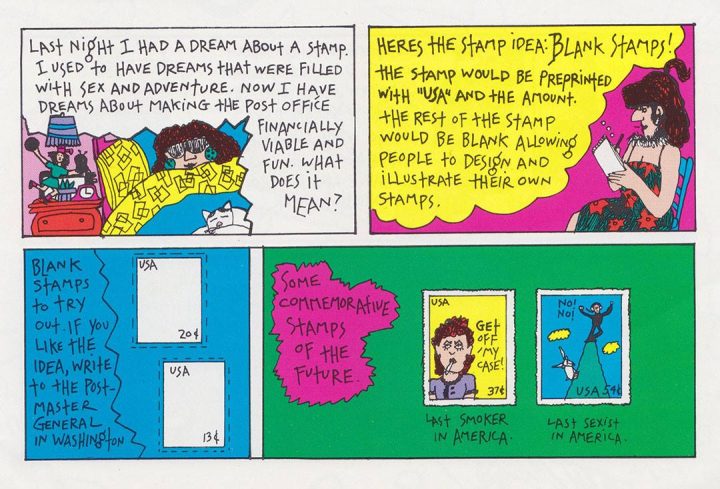 Stone Soup creator Jan Eliot counts herself among Hollander’s devotees. “In the early ‘80s I was in the early days of my cartoon career, with my first comic strip Patience and Sarah running in a few weekly papers,” says Eliot. “Nicole Hollander was at the height of her career with her strip Sylvia, which was hugely popular and spawned numerous book collections, greeting cards, calendars and more. I admired her tremendously.
“I wrote Nicole for advice, which she kindly gave, and then invited me to a cartoon conference in New York, presided over by Mort Walker, George Booth and Selby Kelly, and focusing on the work of women cartoonists. I was living on the opposite coast, poor as a church mouse, but I found a way to get there.
“Nicole made me feel completely welcome, introducing me to Mort, George, Selby, plus Shary Flenniken, Trina Robbins and others I can’t remember. My work was shown on the screen, and while it was a bit rough it drew the attention of Sarah Gillespie from United Media Syndicate, who offered me my first contract. While that contract did not pan out, Nicole had put me on a path that eventually led to Lee Salem and the syndication of Stone Soup.
At the end of the day I asked Nicole if she’d have dinner with me. She hugged me and said, “Sorry, no …” She’d been invited to have dinner with one of her own idols, George Booth. I spent the evening with Shary Flenniken, who might have taken me to a comedy/improv club instead, I can’t remember.”
Flenniken also admired Hollander, but, like most artists outside of Chicago, did so from afar. “I'm sorry to say that I was never close with Nicole, just a big fan. So, I can only tell you that in person, Nicole was friendly, nice, and funny. I loved that her character Sylvia was not cute and demanded respect, basically a role model for all women.”
Another colleague, MK Brown, also regrets that she was unable to spend more time with Hollander. “I only met Nicole in person once when she came to my house. I believe it was Shary Flenniken and Mimi Pond who brought her over but I'm not certain. After lunch that day, Nicole was enjoying my wall of framed cartoons and other silly stuff done by various cartoonist friends over the years, and said she would send me something. A few weeks later, a portrait arrived and she's been up on my wall ever since.”
Jan Eliot kept in touch with Hollander, however, and made a point of keeping in touch and visiting her whenever she traveled to the west coast. “She was a terrific speaker, really engaged the crowd and got lots of laughs. But I heard all that from the hallway where I and her other friends had been banished. It threw her off to see familiar faces in the audience.
“She also found drawing tedious, finding it difficult to draw her characters the same way each time, so she photocopied poses she used often, such as Sylvia sitting at the typewriter, and pasted the photocopies into the panels,” Eliot said. “Sometimes she cut off an arm to reposition it or redraw just that bit. It didn’t matter to her … it was Sylvia’s snarky comments that mattered.
“Nicole’s character Sylvia often appeared with a cigarette hanging from her lips. I can’t remember if Nicole smoked … but she once showed me a picture of her mother, fully pregnant with Nicole, laying on her back on a beach on Lake Michigan. She had an ashtray balanced on her belly and a cigarette between her fingers, while mugging for the camera. I’m betting her mom was a crackup and inspired Sylvia in some way.”
Rhymes with Orange creator Hilary Price followed Hollander in the newspaper page, but like many of her fans, really fell in love with her through one of her dozens of best-selling feminist, cat, and Sylvia-themed books. “I had Nicole Hollander's collection, the one where the cats say, ‘Everything Here is Mine'.” To this day, I think [of] that each time I encounter a feline.
“What I loved about Nicole Hollander and her comic strip is that her character Sylvia unapologetically took up space. She had no problem with the F word: feminist. Plus she drank. And she smoked. Sylvia was neither slender nor blonde, and thus a complete anomaly on the comics page. She was the kind of cat lady that makes Republicans nervous.
“Her presence on the comics page paved the way for women artists and women characters to follow, and in that way was a big influence on me when I was a younger cartoonist.”
Her presence in bookstores coast to coast is a testament to her business savvy and ability to predict exactly what would resonate with her audience. “In the early ‘80s, frustrated by her syndicate's disinterest in her strip, she quit and self-syndicated! This was unheard of in daily newspapers then,” Derf Backderf said. “We weekly types did it, because we had no choice. I don't know how she pulled it off. Daily editors were NOT receptive to (ugh) cartoonists approaching them directly. But she found allies, I'm guessing women editors who championed her strip.
“In addition to that, she cranked out dozens of books and a ton of swag. All before the internet. I think back to comics in the ‘80s and Nicole's work was everywhere, without being nauseatingly capitalist like Garfield or Cathy. Nicole kept her edge, and her principles.
“Her work was always leftie and man, did it piss off the septuagenarian male readership of a daily paper. One of the papers I worked at back then got the most scathing rants about Sylvia from outraged geezers. One of her regular characters was the Devil. Bible-clutchers were aghast. It was hilarious.”
Doing the strip her way may have limited its reach compared to the more mainstream family favorites, but Sylvia’s client list boasted many of the largest markets in the newspaper business, and she always played well in larger cities. As her good friend, author Audrey Niffenger, put it, “I always thought, ‘Wow, she’s getting away with a lot,’ and she deliberately pushed the envelope. She would find the line and step right over it. She got right in there and wasn’t afraid to approach controversial issues.”
That was one of many aspects of her work that appealed to Six Chix cartoonist Isabella Bannerman. “I never had the pleasure of meeting Nicole in person, but her work was definitely an inspiration and an encouragement to me. I was thrilled to appear in publications with her like titles edited by Roz Warren, and when we were both in The Funny Times," she said. "When they say that representation matters, Nicole's work is a great example of this because her content was unapologetically feminist, and she always had female characters front and center. But it was also funny, and never preachy or patronizing. I also really liked her drawing style.”
That drawing style served her well all the way up through her well deserved retirement in 2012. “A strip about women talking to each other — or to cats,” Backderf said. “Quite an achievement. I didn't read daily comics after 1990 or so, but it was always great to see Sylvia still on the page whenever I stumbled across it. As the corporate Dull-o-Tron took over papers completely and drove them straight into the tar pit, she lost most of her clients. So she created an early website that was a success. What an innovator.”
The prolific, multi-talented artist wrote and produced plays, visited colleges and other academic institutions as a public speaker, curated exhibitions of women cartoonists and in 2005 staged a one-woman show entitled Return to Lust at the Pegasus Players theater in Chicago. The success of that run led to a second one-woman show, Plastic Surgery or a Real Good Haircut, in 2008 at Chicago’s Live Bait Theater in 2009 on the topics of vanity, desire, and other concerns of aging women.
In 2012, she retired the Sylvia daily strip, and welcomed the freedom that came with her new schedule. “I started out as an artist/illustrator and I find myself more drawn to performance and writing,” Hollander recalled in her 2019 TCJ interview. “In the last few years I’ve been writing with a friend and performing stories. We are very different, but have a similar vision of storytelling. I wanted to call our performance ‘A Pentecostal and a Jew walk into a bar.’"
And, of course, her memoir, We Ate Wonder Bread, which was published in 2018, was very near and dear to her heart. “I think I work more creatively and more freely when I combine writing and illustration, because I always drew. It was later that I began to write. When I do performances – with a friend – writing and then performing works well for us. I think I must do two things at once or I get confused. The cartoon strip had a format. The illustrated memoir could be anything, almost.
“There was a feeling of freedom that I never got with a cartoon strip. I wrote six cartoons a week. I read a lot about politics and politicians. I was a feminist, I cared about women and what we could and couldn’t do. I created a character, Sylvia, who was afraid of nothing. She was quick-witted. Of course she was, she had a week to think of the perfect retort.
“I think writing for performance is more like doing a memoir because your past comes up into focus the more you write and rework, and you see the action. But where does timing come in? Because without timing you’ve got nothing! I like working with someone else because along with the audience responding, your partner is responding. We sometimes laugh as if we heard it for the first time. We both hear badly, so often we are hearing the line for the first time.”
Readers may have missed starting their day with Sylvia as part of their morning routine, but Hollander was, unsurprisingly, more philosophical about taking her final curtain call “No, I don’t miss it,” she told Alex Dueben. “But I miss the reason to look at a newspaper in a certain way. I looked at it in order to make a comment about it. I hardly read newspapers anymore. I shouldn’t say that. I get up every morning and read The New York Times on my phone and I listen to The Daily. I have to have coffee and I have to read that, but I don’t miss drawing the strip. I got in the habit of knowing what was going on. Even if I wasn’t drawing the strip, I had to know.”
An appreciation by Caitlin McGurk, Billy Ireland Library and Museum curator
The Billy Ireland Cartoon Library & Museum is honored to hold the art and archives of Nicole Hollander, which can be accessed online here. We were lucky enough to host an event focused on Nicole in 2018 just after she published We Ate Wonder Bread. During her talk, she reminisced with us about how she based Sylvia on Esther, one of the strong women in her mother's friend group. She described her as a large, opinionated smoker who "filled the chair". Nicole told us she always drew Sylvia in profile, sitting, because it was easy to repeat and collage her (she needed to draw her every day, and often used collages of reproductions to do so).
She mentioned how she envied and admired some other women cartoonists, citing Alison Bechdel for her ability to draw many kinds of women in many situations. Nicole told us she learned her comic timing from listening to Jack Benny radio shows; the long pause (a white space) and then the surprise. Fan mail and photos of groups of women at Sylvia “look-alike” contests in her papers at the Billy Ireland are a testament to her cult following. Nicole bravely self-syndicated Sylvia through the 1980s and 1990s in order to keep creative control and reach her audience directly. Her papers show the considerable amount of work involved in that decision.
Nicole didn't begin drawing Sylvia until she was 40, and her papers at the Billy Ireland include early examples of her graphic design work for many feminist publications and Chicago civic and environmental organizations. On her visit to the Billy Ireland she lamented how so many of the sociopolitical topics she commented on so cuttingly in Sylvia thirty years or more ago are still a problem today. Her cartoons remain just as relevant.
A tribute by author and friend Gina Barreca
I worshipped at the altar of Nicole Hollander from the first time I saw her Sylvia cartoons. In that way, of course, I was like every other young woman (and every smart young man) that I knew in the ‘80s. She provided the tone of voice and signature images we craved and found nowhere else.
What I wouldn’t have been able even to allow myself to imagine in my early days was that I would become friends with Nicole Hollander, and that she would turn out to be one of the most generous and genuinely authentically funny women I would ever meet. My first trade book, a surprisingly well-received work of nonfiction published by Viking/Penguin titled They Used to Call Me Snow White But I Drifted quoted Nicole Hollander cartoons several times; in fact, my previously published academic books, titled Last Laughs and New Perspectives on Women and Comedy, both recently reassured by Routledge but originally published by Taylor & Francis, were also graced by Nicole‘s work.
She allowed me, in an amazing gift, to be able to use reprints of her work — for free — in these scholarly collections. We would go on to collaborate many times in the future, including writing a small fabulously illustrated volume The ABC of Vice: An Insatiable Woman’s Guide and meet in Chicago. Nicole was more modest and unassuming in person than her characters seemed to be within their frames. Small and delicate, remarkably beautiful, I felt like I should be her tough Italian sidekick. Once at the Chicago Humanities Festival, in front of a crowd of about 500 or 700 people, Nicole was talking about her early life as a cartoonist, her family, her background, and what humor was like for women, especially women growing up when and as she did.
She did a presentation that was both moving and hilarious, and we had a wonderful time. The audience gave us enthusiastic and prolonged applause. But when we opened it up to questions, the first person to put a hand up was a man who took the mic from the handler and said, “I bet you’re both good in bed.” There was an audible gasp; I saw Nicole look at me with a sense of horror. My Brooklyn side came through, I’d like to think, channeling Sylvia, and I immediately replied “You’ll never know. Next question.” Nicole laughed and so did the audience. I think she respected me before that day, but I think she really trusted me and liked me more after it.
Her willingness to work with people across fields, across generations, and to forge connections whenever some poor soul reached out to her for inspiration, advice, or support made her a genuine hero. She got a kick out of people. She not only had great stories to tell, she liked hearing them and let you know when she found something funny, or original, or subversive. She paid attention. I hope that she always knew, even in her final days, that attention to her was paid and that her devotees will keep her creative insurgency, her signature lines, and her perfect cats in our hearts.
The post For Feminine Protection, Use a Hand Grenade: Remembering Nicole Hollander (1939-2026) appeared first on The Comics Journal.


 Hello, my name is Jack Sparrow. I'm a 50 year old self-employed Pirate from the Caribbean.
No comments:
Post a Comment