

There is a certain subset of comics fans that are convinced — certain — that the best comics by esteemed beard-owner Alan Moore are these penned for veteran British organ 2000 AD in the early 1980s. We have many names for such people. "Old" is one, but the preferred nomenclature is "wrong." These people are wrong. Which not to say the comics in question are bad in any way shape or form. Most of these are quite good, some are very good, some even approach the fabled state of "greatness." But none of the stories the man wrote early in his career are going to unseat From Hell from the topmost of Mount Comics.
This is not an insult. Mean Streets isn’t the best Martin Scorsese movie; but it’s still a goddamn Martin Scorsese movie. Most creators in narrative art take time to learn their craft, to improve and learn. Some people start off strong, some suffer a sophomore slump, some have just one trick up their sleeve that becomes dull with repetition. But the truly great aren’t just innately superior, they become rather than being born.
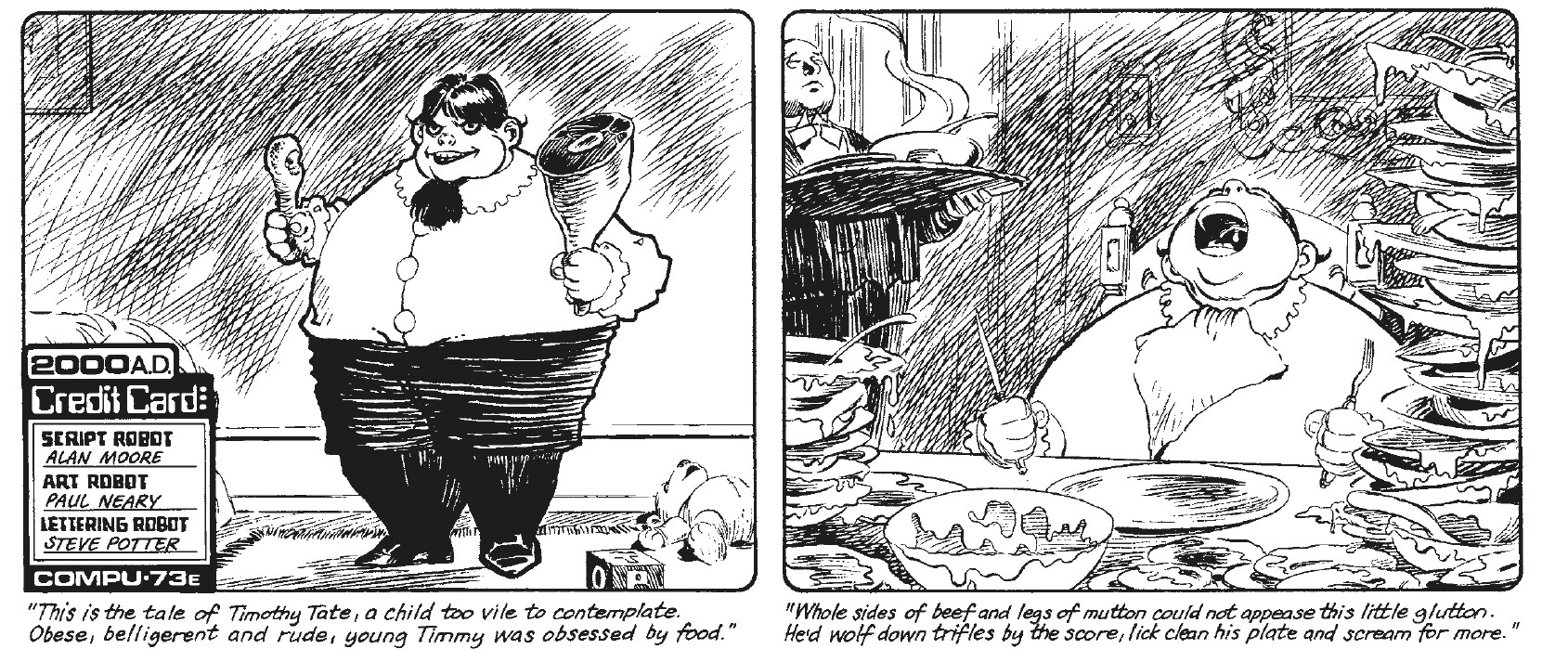
With that being said … the various works Alan Moore did as a young man for 2000 AD, previously collected1 in different trades according to title or theme, are now bound again in a series of fancy-looking hardcovers (yours truly is reading this one in PDF format). These new collections will give you the full Moore experience. The first is dedicated to short stories, covering the years 1980 to 1985. There is one quasi-serial here, Abelard Snazz, with a recurring title character; but you can pretty much open the book at random and fall on a new story. The tales verge from two-pagers to the vast scale of a seven-page epic.
With the exception of “Holliday in Hell” I’ve probably read every story here, some of them more than once, some half a dozen times. If you have not read them before you have little excuse to avoid this substantial collection of works by one of the greats; and if you read some them previously it is still probably worth your while to have it all in one crisp package2. The reason is simple — these are good stories, fun stories. With little space, and even smaller editorial leverage, one assumes, to develop his loftier theme, Moore boils down every story to a single point. That single point being, more often than not, a gag. I don’t usually think of Moore as a humorist but the stuff here is less EC and more Mad Magazine. Or, being British, more Ken Raid than Malcolm Shaw.
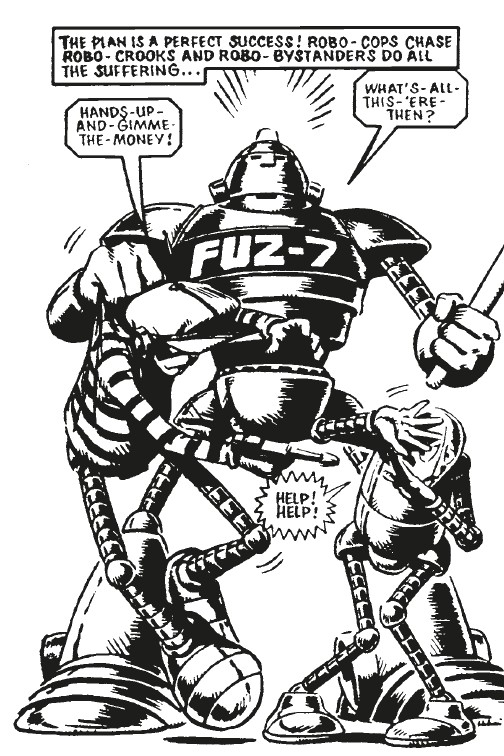
Take the aforementioned Abelard Snazz. The lead character has two brains and four eyes, he is very smart in ‘making up crazy contraptions’ sense and very stupid in ‘forecasting the results of his inventions’ sense. Every story involves the Double Decker Brain encountering some impossible problem (a crime wave across a whole planet, unemployed deities, an approaching black hole) and finding some ridiculous solution that seems to work, until it doesn’t. The first story is drawn by Steve Dillon and it’s a lesson in the simple raising of the stakes as part of a gag: to fight rampant crime Snazz builds robot cops, who succeed so swiftly in stopping regular crime they turn their sensors on lower forms of law breaking (“Using a double negative sir! You are breaking the laws of grammar!”). To stop the overzealous robot cops, Snazz builds robot criminals who go on to harass to human population until he comes off with the brilliant idea of building robot citizens — ending with a perfect panel of there types of robots harassing each other in a closed loop of human uselessness.
Dave Gibbons, another name not usually associated with humor, pops up in many of these stories as sort of an ultimate straight man; able to draw things in a frank manner, more precise than the oft-detail heavy and stiff Brit artists of previous generation. There’s nary a hint of comedic exaggeration to his storytelling, which makes to jokes so much funnier. From the domestic scenery of “Return of the Thing” (just the right length at two pages), to the colorful, toy-inspired “Wild Frontier,” to the crowding confined pages of “The Disturbed Digestions of Doctor Dibworthy.” Gibbons can do it all. Which isn’t very surprising, everyone knows Dave Gibbons can draw.
Yet Gibbons is not unique here. The illustrators’ roll call is the who’s who of early 2000 AD greats, including Alan Davis, John Higgins, Ian Gibson, Bryan Talbot, Brett Ewins, etc. Even the artists that I don’t usually consider top-notch, such as Mike White or Eric Bradburry, brush-men of the old-school, give an elaborated performance here. Already at that stage of his career Moore had such acute understanding of how to arrange a comics page that trumped writers, and even artists, many years his senior.
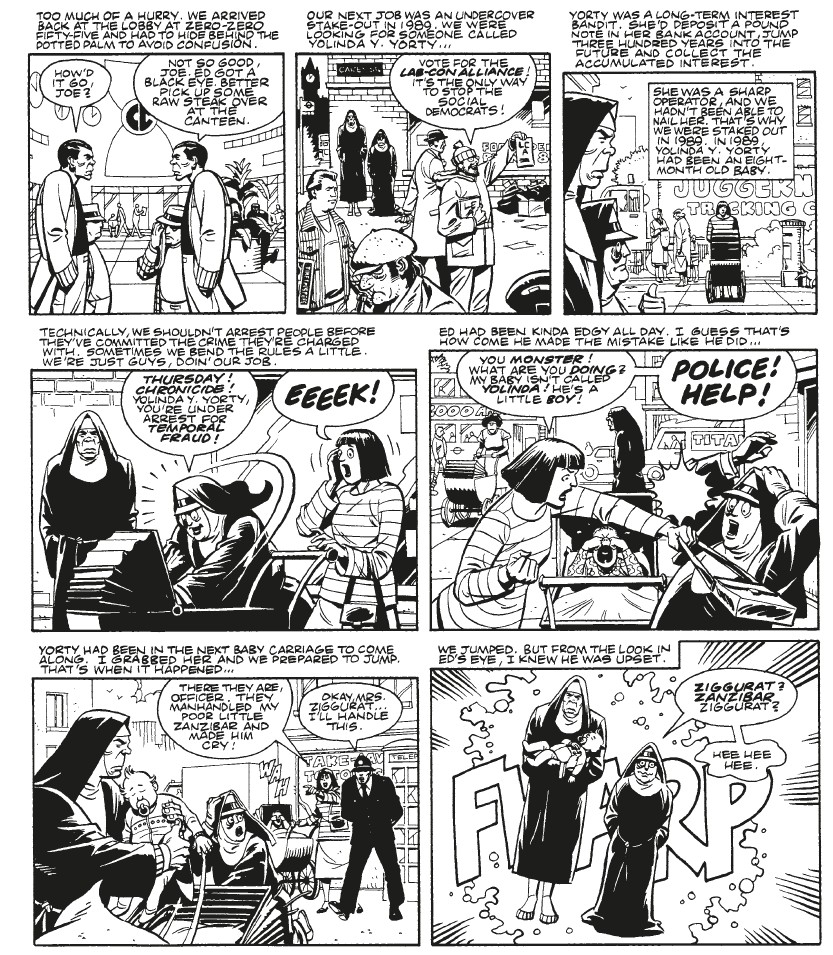
It has been well-observed that pre-1970’s British comics tend to have busy layouts. A result of trying to squeeze a full story into two or three pages, which could make them a chore to read. Information overload is prized over the smoothness of the experience. Not so whenever Moore writes. No matter how complex the tale, how overwhelming the gimmick, the storytelling is always clear. There is a never a sense that there are too many panels or too many words. I can’t help but think of Steven Spielberg, someone who is very different in many ways but similar in one, a creator who understands the visual element of his medium better than almost everyone else. Take the most famous story here – “Chronocops” (also drawn by Gibbons), a parody of Dragnet as time police procedural. Every single panel of this short is tied to every other, reading the second time is a completely new experience as the layers of deception are revealed, and despite the amount of information conveyed it never overwhelms the reading experience; the parody and the science fiction elements are in complete harmony.
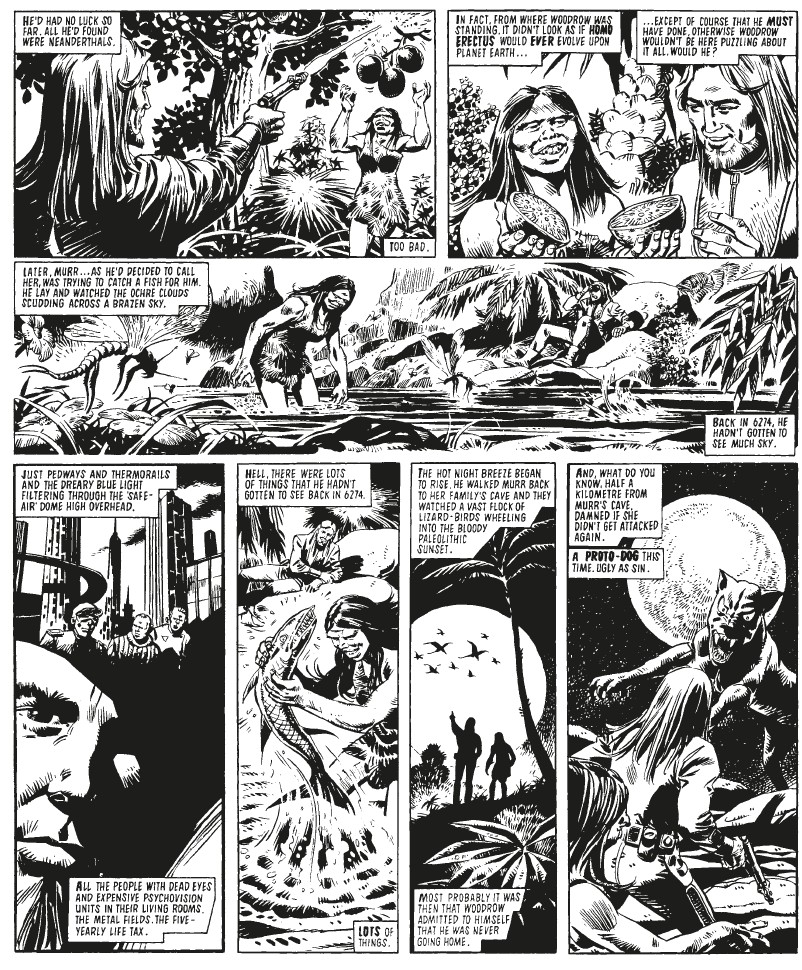
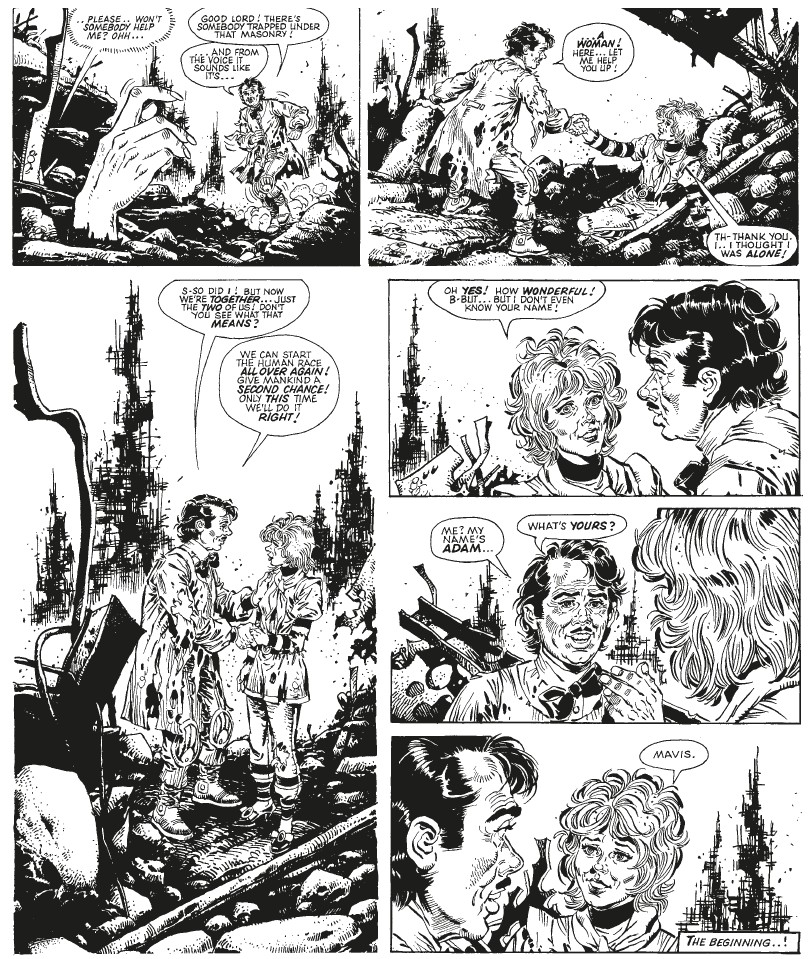
“Chronocops” and “The Disturbed Digestions of Doctor Dibworthy” are but two of the stories here that recycle ideas, the fact that both of these time paradox tales are illustrated by Gibbons simply drive the point further home, and is interesting to see how Moore advances in such a short time. “Dibworthy” is all about the build-up for a punchline, while “Chronocops” offers a more layered experience. Likewise, “A Second Chance” and “Going Native” are both variations of that old cliché, the ‘Adam and Eve’ plot. “A Second Chance” is the punchline version, while “Going Native” brings to mind the more serious Moore of later years – and it is all the better for it.
There are many such past echoes, notions that Moore would return to years down the line, one story predicts “Mogo Doesn’t Socialize” while “The Time Machine” seems almost like a reverse of From Hell’s final, "rising up through history" scene. In both cases Moore understands the unique way in which time and space entangle in comics and constructs something memorable as the forces of history drag the protagonist about. “The Time Machine” manages the rare synthesis of the mandatory twist ending with actual emotional investment. By the time you understand where the story is going you are invested enough that it doesn’t matter if you know the ending before the protagonist does; the fact the you know and he doesn’t becomes the point.
If there is a major criticism to be levied at the stories that compose The Complete Alan Moore Volume 1 it is that most of the works fail to rise to the level of “The Time Machine” or “Red Planet Blues.” Most of the stories here are clever rather than smart. Moore at the time had a breadth, rather than depth, of reading. This made his influences more outré than simply regurgitating old comics that regurgitated older ideas from Amazing Science Fiction. But most of the "mind blowing" ideas in this collection wouldn’t break new ground for the Science Fiction-hip in the early 1980s. In comics people still thought in terms of Asimov and Heinlein, while Moore was hitting them with Samuel R. Delany and Philip K. Dick. “The Reversible Man” is a good example of the cons and pros of this period in Moore’s career. Ably illustrated by Mike White, it presents a life in a reverse order, the sort of trick Dick pulled a decade before in Counter-Clock World. Unlike “The Time Machine” this story doesn’t have much beyond the gimmick and Moore’s first-rate storytelling; it is exactly what you see on the first read.
“The Reservable Man” is clever, which is more than could be said for other Future Shock stories at time, but “The Time Machine” is genuinely smart. In the difference between these two tales of unusual time lies the whole of The Complete Alan Moore, a writer who could be so in love with the notion of doing something unusual simply for the sake of doing it, and at the same time a man who could actually marry that technical skill with emotional depth that was, and is, rare in his field. Which is to say: even at his worst, Alan Moore is one of the best.
The post The Complete Alan Moore Volume 1 appeared first on The Comics Journal.


 Hello, my name is Jack Sparrow. I'm a 50 year old self-employed Pirate from the Caribbean.
No comments:
Post a Comment