


For most politically-minded creators seeking success in a commercial milieu, to be an artist-activist means to lean more heavily on the artist designation and couch the activism in subtext and signifiers. The sacrifices these artists make by not making their politics plain, they often argue, allows them to reach a wider audience with their art. The monetary rewards that accompany such mass appeal are, of course, a happy coincidence. Increasingly, there is a needle to be threaded that will stitch together the fabrics of art with a radical bent and mainstream commerce. There is an appetite for it. Paul Thomas Anderson’s One Battle After Another, a riff on Thomas Pynchon’s Vineland, just won six Academy Awards. Though Anderson’s intergenerational story of a family of revolutionaries may gesture at the deep roots of rebellion against white supremacy and the fragile masculinity that seems to rule our world, he declines to outline the vision of its heroes’ revolution. To do so within the commercial milieu, a marketplace of ideas, would be to propagandize and to propagandize is condescending, as if it were gauche to saddle any character with an explicitly stated ideology, even when the narrative makes it clear. As a consequence, mainstream stories involving radical action in the name of justice must be consigned to the realm of fable or allegory; cautionary tales that emphasize the drama, complexity, and sacrifices faced by individual characters without adequately addressing the drama, complexity, and sacrifices of enacting outré ideologies. In this way, the stories can be entertaining, while still being neutered of political divisiveness (and usefulness).
 Creators from emerging generations, given to a more comprehensive understanding of their role as workers in commercial cultural production, seem more inclined to make impassioned and unvarnished pleas for social justice than their predecessors. They have less to lose and more to gain. Without short-term material incentive, these calls go unheeded by people in positions of influence, though some of those influential people will take the time to clamp down upon and stifle the voices that get too radical for their tastes. One need look no further than the many artists who have been fired or excluded from opportunities for expressing solidarity with Palestinians in recent years. Through the lens of history, these sacrifices seem inevitable, but in the moment they most assuredly are not. When people’s morality affects the bottom line, they are fed the cost.
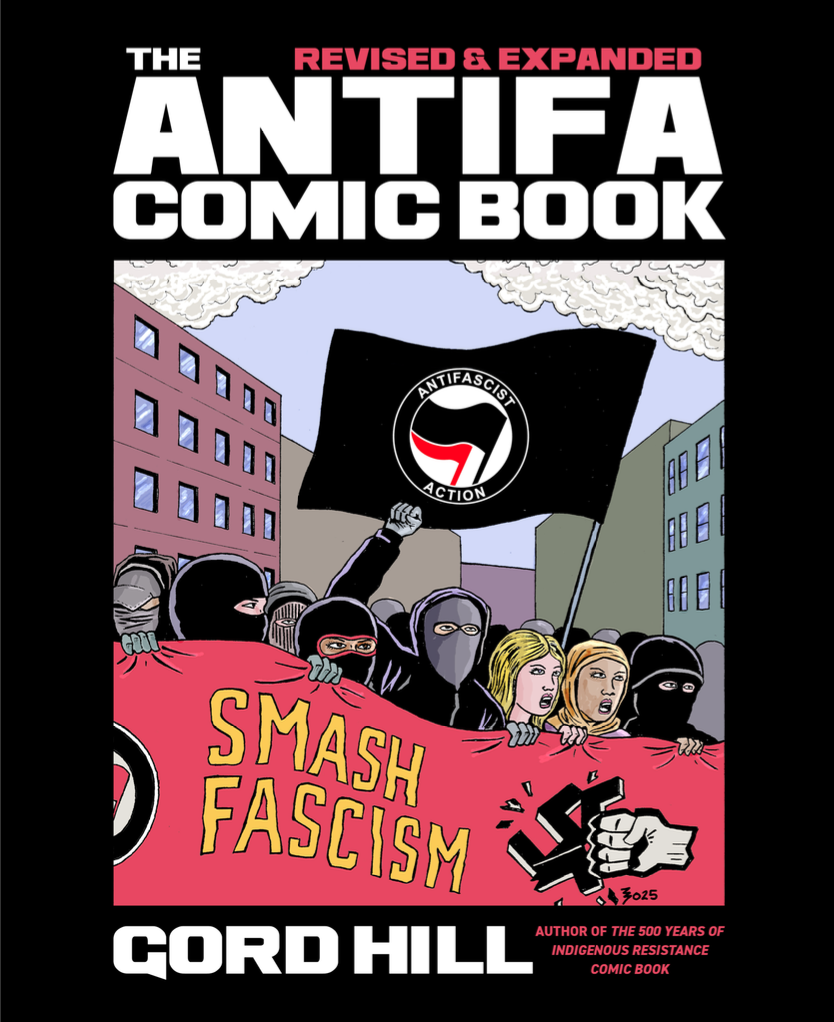
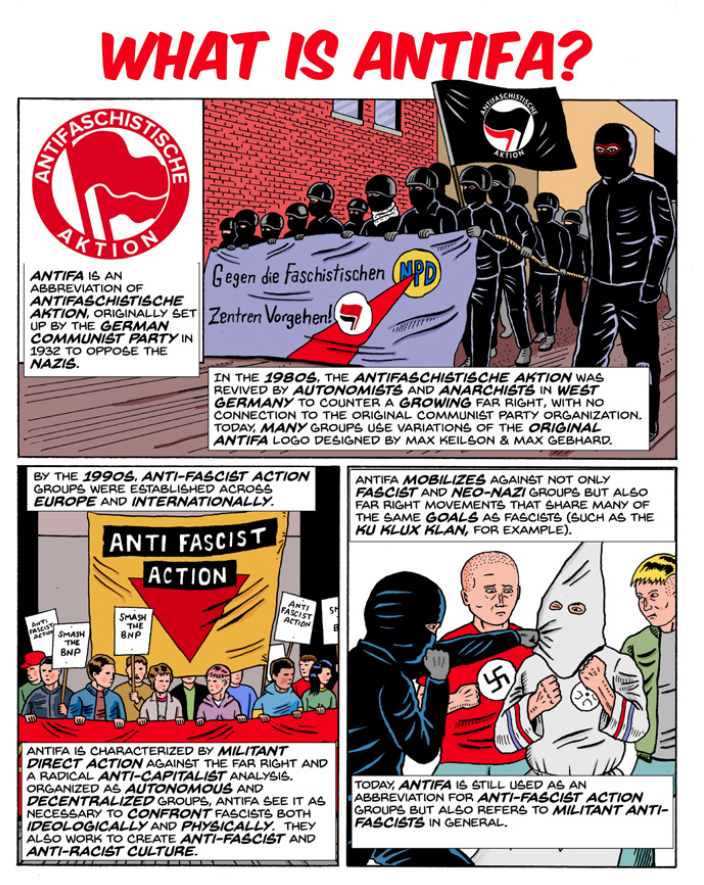
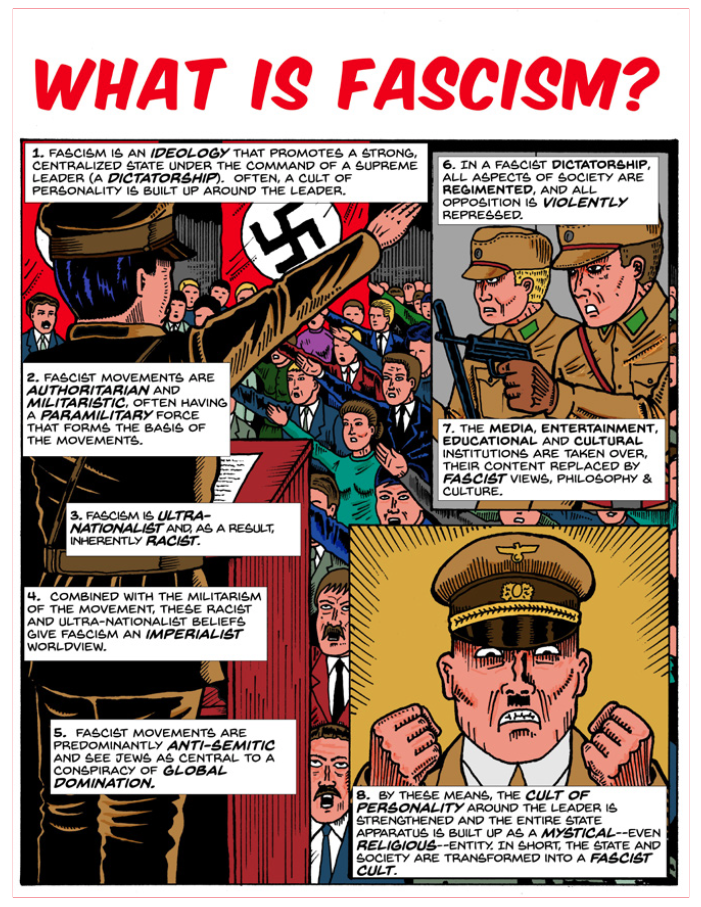
All this is to say that Gord Hill rejects the prevailing dichotomies and their priorities entirely. If hyphens are a requirement for the marketing of an artist’s work, Hill might be designated an activist-artist, but that hyphen does not connote any sort of balance. Hill’s art is in complete service to his activism. If that description makes his work sound like agit-prop, it’s because his work is agit-prop. But the drawn-from-life, concisely-presented stories of his history comics — The 500 Years of Resistance Comic Book, The Anti-Capitalist Resistance Comic Book, and last year’s The Revised and Expanded Antifa Comic Book (Arsenal Pulp Press) — are as spirited as any Hollywood epic and as moving as any ponderous prestige television series. Hill floods the page with conflict and context in a way that is both readable and instructive. More to the point, he does not decline to name the villains, their friends, or the people who stood idly by. Nor does he shrink from depicting the flags and banners unfurled by any stakeholder.
The fight against fascism, whether in a historical or contemporary context, is not complex. Those waters are muddied by those with something to gain, as can be seen from the Trump administration’s recent efforts to imbue anti-fascism with a criminal character by labelling “Antifa” a domestic terrorist organization. Democrats may quibble with the semantics of the designation, but have little to say in defense of antifascist actions. Antifascist scholar Mark Bray puts it succinctly in the forward of Hill's new book:
So why aren’t the Democratic Party and mainstream society ringing the alarm bells? Because although our culture industry continually bombards us with the notion that fighting Nazis is the epitome of righteousness, we have been taught that fascism is dead and gone, that Nazism was an aberration from European “civilization,” that rational discourse will always stop fascist ideas, that the police will never hesitate in thwarting fascist violence.
The recent high-profile occupations of Minneapolis and Chicago by ICE (and Democrats’ tepid response to them) puts paid to this to theory.
In their liveliness and their dynamism, Hill’s compositions often depict street battles and melees, evoking the likes of Jack Kirby and Spain Rodriguez, two artists who were not shy about espousing the value of direct action or entering physical altercations, themselves. But Hill's comics arrive in the propagandistic tradition of Seth Tobocman, Peter Kuper, and Joe Sacco, artists with whom he has shared space in the pages of World War 3 Illustrated.
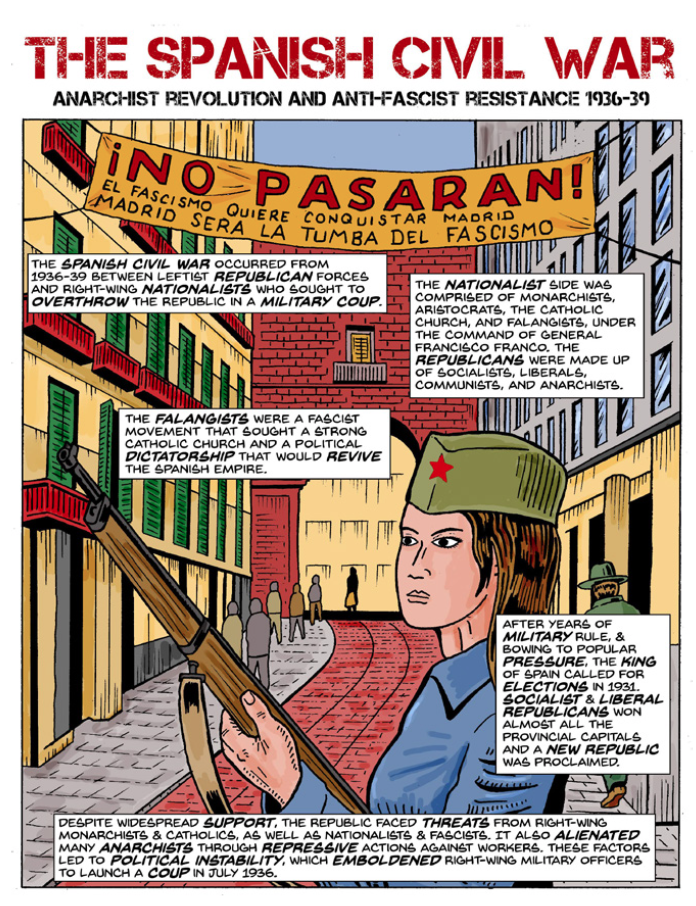
Other than the martyrs, the heroes of the Antifa Comic Book are generally centered as a cohort, rather than as named individuals. The names are lost to history or were kept secret for fear of reprisal by fascists or the state. In both their bravery and in their averageness, Hill challenges us to see ourselves. They were regular people, working people. Hill’s book pays tribute to the sacrifices made by these heroes, but takes care to make plain the similarities between their time and ours. In their stiffness and generic countenances, they seem frozen in historicity. But in the bright, vivid palette in which Hill colors them and their world, they are no different than the heroic (and largely anonymous) figures that have emerged in recent weeks in the shaky footage of protests in the US across the world, illuminating the continuity of the fight.
This interview was conducted intermittently via email in February and March of 2026. All art comes from The Revised and Expanded Antifa Comic Book, out now from Arsenal Pulp Press.
 IAN THOMAS: Can you talk a little bit about where you grew up and what you recall going on at the time?
GORD HILL: My family moved around quite a bit, so I was born in the central interior of BC, Canada, but at a young age we moved back to my mother's territory on north Vancouver Island. We lived on the Fort Rupert reserve near Port Hardy for awhile, then moved into Port Hardy itself. Like most communities in the region, fishing, mining and forestry were the primary industries. My father worked in all three, and my mother worked in the canneries. This was in the early 1970s.
Can you give readers who may be unfamiliar with your work some background on your trajectory as an artist and an activist?
I've been doing art pretty much all my life and when I became involved in social movements, I focused my art on those movements and their politics. My first work in this regard was when I participated in an El Salvadoran solidarity group based in Vancouver, where I helped design posters. Then I became involved in the anarchist punk scene and began a zine called Secret Burial, later renamed Endless Struggle. Over the years I became active in anti-racist and anti-fascist groups, anti-imperialist campaigns, prisoner solidarity, and then after the 1990 Oka Crisis, I began focusing primarily on Indigenous peoples' struggles. In the mid-nineties, I became involved with the Native Youth Movement and eventually began doing small comics about Indigenous resistance to distribute at conferences, pow wows etc. These comics formed the basis for the first 500 Years of Indigenous Resistance Comic Book published by Arsenal Pulp Press back in 2010 or so. Arsenal then asked me to do [the] Anti-Capitalist Resistance Comic Book and an Antifa comic book. Around 2018 or so I began work on revising the 500 Years of Indigenous Resistance Comic Book.
Do you remember how those initial small comics were received? Are comics typical to those venues?
I think the comics were well received. There was nothing else like them and very little information at the time about the struggles the comics covered. No, comics are not typical for these venues, but I think that was part of their appeal, they were so different.
What was your impetus to expand and revise the Antifa Comic Book so shortly after its initial release?
The revision was done at the request of Arsenal. They had a publisher that wanted to translate the comic, but wanted a more updated version, so I did that last year.
Can you talk a little bit about the additions that appear in the revised and expanded edition of the Antifa Comic Book?
Some of the additions include the neo-Nazi massacre in Norway in 2011, which I had neglected to include in the first edition but which is an important chapter considering the scale of the mass shooting. Other new chapters include the far right in Israel, the “Freedom Convoy” in Canada, as well as several anti-Muslim massacres in New Zealand and Canada, [and] a chapter ending with the second Trump regime.
If I recall correctly, the Freedom Convoy was framed as protest against vaccination requirements. How do concerns like these overlap with fascism?
In and of themselves, these issues don't necessarily overlap with fascism, but far-right movements seek to exploit social issues such as this to mobilize and recruit. With the anti-vaccination sentiment, I think a lot of it was coming from people who've been pretty privileged in their lives and couldn't stand that government restrictions were directly impacting them. For example, being told to wear a mask to enter a business enraged them because they're selfish and [without] regard for community or other people's health, which arises from extreme individualism that is a product of Western capitalist society. And this type of milieu is ideal recruiting grounds for far-right movements.
Beyond those additions, were any changes made from the initial edition?
No.
Can you go into your history with comics as a reader and an author?
I read comics as a kid and always tried to draw them, but could never come up with stories. I was into the usual superhero comics like Spider-Man, Fantastic Four, Daredevil, [and] Batman, but I think my favorite was Conan the Barbarian, whom I always thought was Native, lol. I also read a lot of Creepy and Eerie comics published by Warren, which were all in black and white. Some of my favorite artists from this time were Jack Kirby, Bernie Wrightson, Richard Corben, John Byrne, Alex Toth, Frank Frazetta, John Buscema, Frank Miller (on Daredevil), [and] Gene Colan. As a teenager I lost interest in comics and when I became politicized the only comics I read were Joe Sacco's Palestine, as well as Seth Tobocman in WW3 Illustrated. After I began doing comics with Arsenal, I returned to a lot of those comics from when I was a kid, including Jack Kirby's art, to study them more and expand my knowledge at doing comics.
What works initially resonated with you and what works clued you to the potential of the form?
I'd say Joe Sacco's Palestine. It was black and white, very detailed art, and the story really captured the gritty and sometimes brutal reality of life under Israeli occupation.
Was it the level of detail that surprised you? The tone?
Yes, the detail was amazing. It must have taken Joe a long time to do those comics. The tone was very “matter of fact,” and it simply told the story based on Joe's experiences in the Occupied Territories.
What were your earliest efforts at making comics and what in them did you find useful for your goals?
I can remember being around seven or eight and trying to draw comics, but I had no clue and no story, so these didn't go anywhere. It wasn't until I had become politicized through the punk scene that I once again tried drawing comics.They were just an addition to the writing I was doing, but I always saw the value in having diverse forms of communication, so while I tried doing comics, I was also doing posters, t-shirts, logos, radio shows, etc.
What are your goals as an author?
Mostly to maintain a history of resistance through graphic art, and to inspire and empower people.
It is now much easier to create and disseminate any of those media that you were using when you were starting out, do you think that’s good or bad? Social media plays a large role in how information is communicated now, what considerations do you think users should make when using these platforms? For example, is a platform like X, formerly Twitter, of any use to organizers despite being owned by a figure like Elon Musk?
Yes, there are pros and cons to the widespread use of social media today. It's certainly a lot easier to produce graphics and memes and distribute them. But that's part of the con, I'd say, as you're producing material for a medium that is saturated with memes and information. It all seems very transient, like you see a meme and scroll on. When I was first getting involved in resistance movements, “underground” news spread much slower. It could be months before we'd get news about a massive squatting resistance action in West Berlin, for example. And in some ways we were more focused on our specific region or locality, rather than following and reacting to something going on on the other side of the country, or the world. We knew pretty much everyone involved in political organizing, and we would know which group was organizing a rally, whereas today anyone can make a Facebook event and hold a rally. Very different dynamics. As for X [formerly Twitter], the dangers of relying on these technologies is that at any moment they can cut off access, delete accounts, etc. Yet, while organizers have them, they can be useful in disseminating information.
What did you learn about making comics in adapting 500 Years of Indigenous Resistance to the comics format?
Well, in the first edition I don't know if I learned too much really, they were short black and white comics drawn on xerox paper and pretty basic in terms of art, composition, etc. Over time, doing other comics and the revised version of 500 Years, I learned much more about composition, making the art “flow” to try and direct the reader's eye. I put a lot of effort in learning human anatomy after the first couple of graphic novels as I wasn't very happy with how I was drawing people. But I think the most important thing was to have your script completed before doing the art, otherwise you're constantly going back and trying to make revisions, which is kind of demoralizing.
What role does art play in your conception of Indigenous life?
Art has always been an important part of Kwakwaka'wakw culture. Almost everything in our daily lives had art on it, family crests such as thunderbirds, bear, wolf, raven, etc. Our houses were painted, totem poles carved, spoons and combs and bowls, all had art applied to them. It was how we retained a visual history of our ancestry.
 Do you think the Indigenous struggles for autonomy and self-direction are fundamentally different in character between the United States and Canada? What do you think drives those differences?
Fundamentally, I don't think there [are] any differences. Both involved settler-colonial states that have occupied Indigenous land, carried out genocidal policies, stolen resources, etc. One of the biggest differences is the impact of Indigenous peoples on national politics. In Canada, we are some 5 percent of the population, but have a significant impact on the country, from blockades to re-occupations to anti-pipeline movements. Whereas in the U.S., I think Indigenous peoples are not only a smaller percentage of the population but are also “overshadowed” by Black and Latino movements, both of which are much larger populations and which have a much more significant impact on national politics in the U.S.
How about from a cultural standpoint? In the states, shows like Dark Winds and Reservation Dogs have garnered critical acclaim and appeal to a certain segment of their audience on the basis of their representation of Indigenous peoples where there was little or none prior. Does it feel to you like Indigenous culture is taken for granted as part of Canadian culture?
In some ways perhaps, but in Canada it's more of an exploitative use of Indigenous culture, primarily for tourism. In regards to cultural representation, we saw a similar phenomenon in the early 1970s with new TV shows centered around Black families in the USA, such as Good Times, which serves various purposes, such as creating new markets in areas where there were none before and creating the illusion of inclusion through the corporate media and entertainment industries.
Can you describe the way you envision the link between fascism and colonialism?
As others have said, fascism is colonialism turned inward, where many of the tactics and strategies used in colonizing other peoples are eventually used against the domestic population. Northern Ireland, for example, was a laboratory for British anti-riot and surveillance technologies, both of which are now widespread in the U.K. In Nazi Germany, the practice of concentration camps and genocidal policies were first introduced in the African colonies of Namibia, Nigeria, etc. I also think that because of the inherent militarism and ultra-nationalism of fascism, fascist regimes frequently seek to establish empires comprised of colonies. Fascist Italy attempted to re-establish the Roman empire by colonizing North Africa and Nazi Germany attempted to colonize Eastern Europe, for example.
On what fronts — geographical, political, or otherwise — do you see the antifascist struggle currently?
I think it's very broad at this point. Just as fascism has entered mainstream politics with Trump and the Republican party, I think anti-fascism has also entered the mainstream. The problem is that the far-right and its fascist elements are now in positions of power, including that of the most powerful empire in the world, the USA. So, we're seeing a significant increase in militarism and the use of the U.S. armed forces to enforce U.S. foreign policy, which is imperialist in essence.
The Antifa Comic Book examines anti-fascist resistance from all over the world. Why is it so important to consider fascism and anti-fascist resistance in an international framework?
Fascism operates on international lines, so fascist groups in Europe influence and train fascists in North America and vice versa. There are many examples, such as the neo-Nazi skinhead movement, which originated in England and expanded to Europe, then to North America. Anti-fascists in North America were able to learn from the experiences of those in England on identifying and countering neo-Nazi skinheads. So there's a sharing of knowledge and tactics that's very important for anti-fascist resistance.
When talk of antifa reaches the level of national discourse it is often framed as a centralized hierarchical organization, rather than a decentralized anarchic affinity group. Would you say this is a misunderstanding or a calculated framing? To what end does this framing help those in power? Can this misunderstanding be used to the advantage of anti-fascist organizers?
Yes, I think it's a tactic by the state to smear antifa and portray it as a highly organized and therefore dangerous movement, but at the same time reveals a profound misunderstanding of the movement. I think they're also speaking to the MAGA base, and by stating that officials are working on dismantling the leadership and funders of antifa the MAGAts think they're really going to go after antifa. But, since it is decentralized and largely funded by grassroots efforts, this is a very difficult task for the state. Many months after the Trump regime announced they were designating antifa as a domestic terrorist organization, we've seen virtually nothing come of it.
Would you agree that the struggle against fascism is an ongoing one that will never be fully settled?
I believe it will be ongoing so long as the capitalist system remains, because it is from capitalism that fascist movements arise.
Who benefits when fascism is framed as something that is consigned to history?
I would say it's the fascists and far-right in general.
Do you think people who profess to be at the center of the political spectrum, centrists or liberals, benefit indirectly?
Perhaps in the short term, but they inevitably become targets of the far-right.
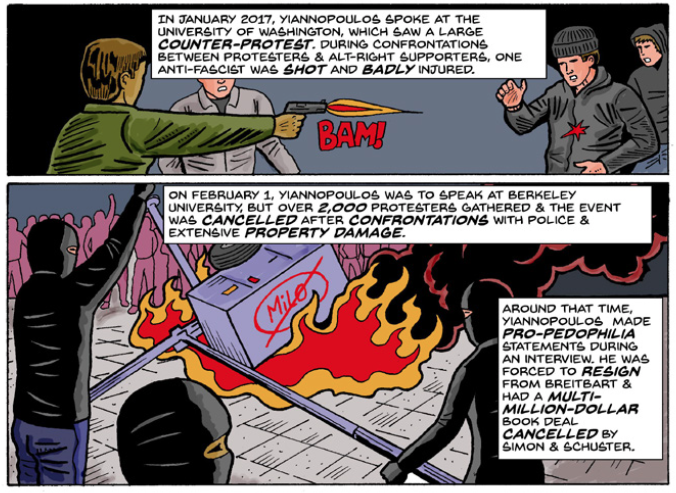
What has surprised you in the course of your research? Is there anything in the contemporary that surprises you?
It's somewhat surprising to see such an increase in fascism after the horrors of WW2 and Nazi Germany, which, in the aftermath of the war, was very unpopular. Up until 2016 with Trump's first presidential campaign, it was impossible for the far-right to take to the streets in any significant numbers and without a large police response to protect them. Now they are in power through the Republican party and figures like Musk and Stephen Miller are openly and publicly embracing fascist narratives and symbols. But looking at the context of all this, the role of social media, which is owned by people like Musk, and the white supremacy that forms the basis of the MAGA movement, it all makes sense and is not that surprising.
Is the struggle against fascism separate from other struggles on the left?
I don't believe so. It's such a reactionary movement, closely intertwined with the oligarchy, that I think it affects all struggles on the left. If we look at environmental struggles for example, the far-right has been able to overturn any serious efforts to address climate change in partnership with corporate powers that seek to overturn environmental legislation that limits their ability to exploit natural resources. The same applies to other struggles such as those for immigrant rights, anti-war, poverty, housing. I believe these are all impacted by the rise of far-right movements and regimes around the world. Ultimately, fascist movements are a threat to left-wing movements because fascists seek to not only defeat their political opponents but to annihilate them through violence, and that should concern everyone that seeks a more just and equitable world.
Do you see any value in winning liberals, centrists, or conservatives over?
I think there's value in winning over as broad a spectrum as possible to antifascist politics.
The post A talk with ‘Antifa’ cartoonist Gord Hill on capitalism, fascism, resistance and comics appeared first on The Comics Journal.


 Hello, my name is Jack Sparrow. I'm a 50 year old self-employed Pirate from the Caribbean.
No comments:
Post a Comment