

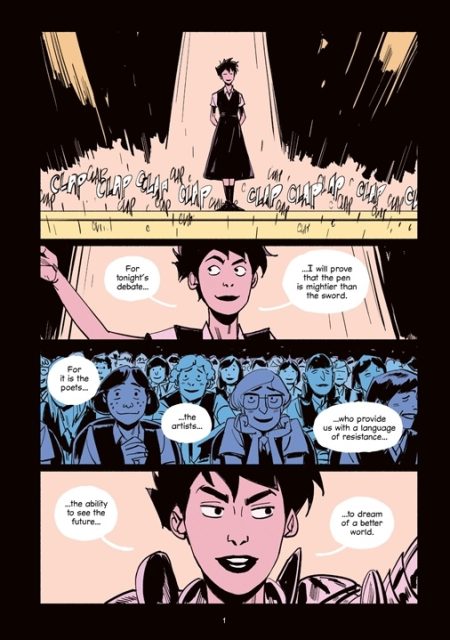
Eileen O'Shaughnessy Blair was one of the first women to take a degree from Oxford, to which she had acquired a scholarship and where she studied under JRR Tolkien. After school she worked as a typist, and helped to organize her fellow workers to oppose a bullying boss before leaving to open her own firm. When a fascist coup led to civil war in Spain, she travelled to Barcelona where she worked in the offices of the Independent Labor Party. As the Communist Party gained control of the "Republican" side of the conflict, she found herself enmeshed in both political and personal intrigue, and ultimately had to sneak out of the country just a step ahead of the secret police. After returning to England, she moved for a while to the countryside, living and working on a farm. During the Second World War she took jobs in the censorship department, and then writing propaganda for the Ministry of Food. She died in 1945 at the age of thirty-nine, soon after adopting a small boy. She was also George Orwell's wife.
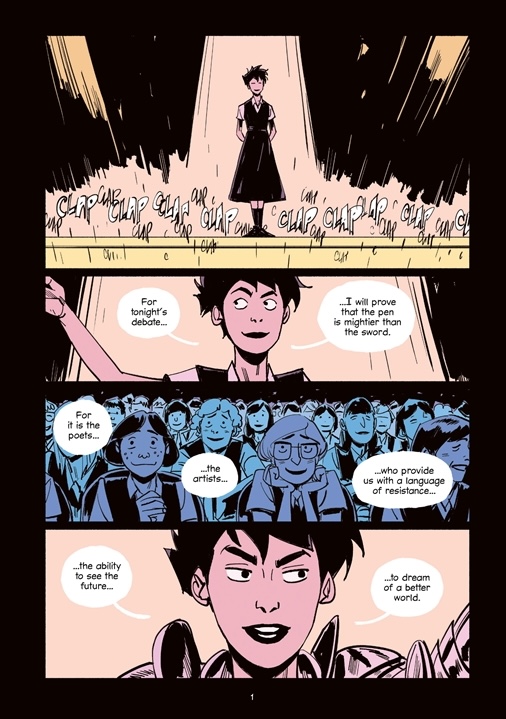 Mrs. Orwell, a new graphic novel written by Andrea Chalupa with art by Brahm Revel, covers most of these events and a great deal more. It makes the case that "'George Orwell' was a band name. Orwell may have been the front man — the rebel with a cause — but Eileen was the drummer, uncredited songwriter, and business manager." She was certainly an enormous help to her author husband, not only typing his manuscripts but editing and supplying substantive suggestions, handling matters with publishers when he was away (including the final proofs of and contract for The Road to Wigan Pier), reconstructing the chronology for Homage to Catalonia, and likely offering the key suggestion that the critique of Stalinism be presented by allegory, leading to Animal Farm. And it is true that Orwell's writing — at least the novels — showed marked improvement after they were married; just compare Keep the Aspidistra Flying to Coming up for Air. But this argument, which was earlier forwarded by Sylvia Topp in Eileen: The Making of George Orwell, can only go so far. For one thing, their wedding practically coincided with that other major event in their lives — the war in Spain — and it would be hard to say with confidence that the one had a greater effect on Orwell's outlook than the other. Moreover, his very best novel, Nineteen Eighty-Four, was written after Eileen's death — though it does borrow its title from a poem she had written two decades earlier, "End of the Century, 1984."
On the first read-through of Mrs. Orwell I was continuously distracted by the numerous distortions, suppositions, exaggerations, and poetic liberties presented as fact. Some characters are composites; some incidents are invented. There's an anachronistic use of "Ms." Eileen did omit "obey" from the wedding vows, but not (as here) without alerting the minister to the fact beforehand. Depictions of her time at Oxford leave out the mandatory cap and gown, unfortunately missing an opportunity for an amusing visual as she is (truthfully) shown riding a bicycle to class.
Even the title poses a problem, namely that Eileen Blair never went by "Mrs. Orwell." And, in fact, there later was a Mrs. Orwell, George's second wife Sonia (née Brownell). The misnomer can be partly forgiven, however, as the biography is already plagued by a confusion of names. George Orwell was originally a pseudonym for Eric Blair, though the author slowly adopted it in life as well. Eileen's beloved brother was also named Eric. And later, Orwell's commander in Spain, who became romantically attached to Eileen (though with doubtful reciprocity), was named Georges Kopp. So: two Erics and two Georges, and one of the Erics became one of the Georges. Eileen herself began with the last name O’Shaughnessy, acquired the nickname "Pig," and later started going by Emily for reasons no one has yet discovered.
Only in the afterward, an essay titled "Fighting for the Future," do we find any acknowledgment that "Mrs. Orwell is a work of historical fiction. . . ." This would have been good information to have at the outset. In any case, the decision is questionable. Mrs. Blair's life was eventful enough, sufficient in both outward incident and inward complexity, without any need for added drama or outright fabulism. Still, Mrs. Orwell is a fun read, well executed, and it gives one the right general idea of her life, even if in its detail it is not to be relied upon.
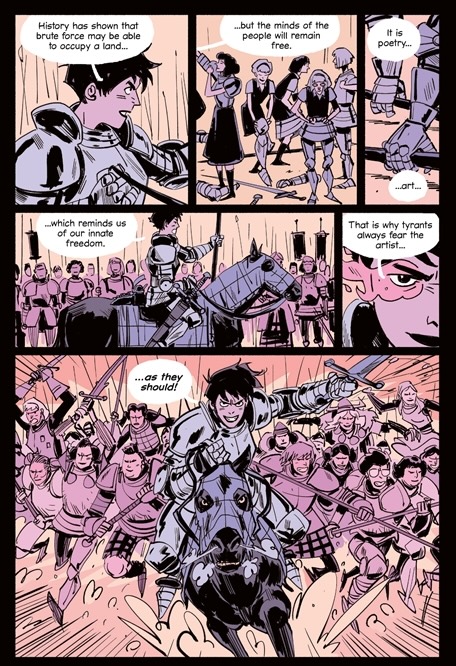
Brahm Revel's art is sharp and dynamic and reminds me more than anything else of early Love and Rockets. It captures both mood and action very well, though it succumbs to the biopic tendency to make all of the characters more attractive, or at least more stylish, than they were in life. Eileen’s' hair, by all reports, was short and often messy — but not in the post-'90s rocker chick way it appears here. In the comic, George Orwell looks almost like Clark Gable, while in the photo on my desk he appears tired and gaunt. Georges Kopp, with whom Eileen became romantically entangled, is presented here as a young, handsome, stocky, Captain America type; in truth he was middle-aged and portly.
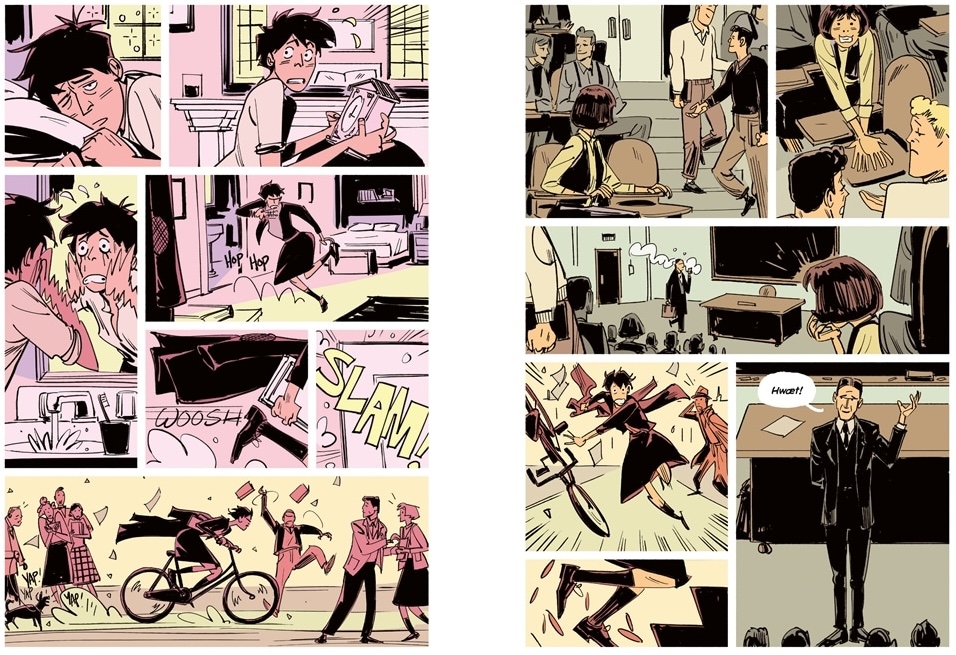
The almost cinematic elements of this telling are not accidental. "The seed of Mrs. Orwell was planted," Chalupa tells us in the afterword, "during my work on Mr. Jones, which tells the remarkable story of Gareth Jones, the courageous Welsh journalist who risked everything to expose the Holodomor, Stalin's genocidal famine in Ukraine." Mr. Jones uses the writing of Animal Farm as a kind of framing device. "Orwell's powerful words serve as a Greek chorus, reminding us that truth, no matter how suppressed, will ultimately prevail." Moreover, Mrs. Orwell and Mr. Jones share a structural similarity. Each begins with an idealistic young person with literary aspirations, traveling from Britain to another country where some stage of revolution is in process; once there they step outside the confines of official society and discover the appalling underbelly of the Stalinist system; at last they return to England where they try, but largely fail, to make the truth known. Each is a kind of political-literary adventure story, though Mr. Jones wanders for a while across genres into horror, with unsettling scenes of empty villages and the slow realization that the surviving children engage in cannibalism. While Chalupa worked on the film, she now recalls, "Eileen became my North Star. ... Early drafts of the script even included her as a character."
There has been a recent burst of critical interest in Eileen Blair. Though she had of course made earlier appearances in the biographies of Orwell, and in the various memoirs of those who knew the couple, it wasn't until 2020 that she got the full biographical treatment herself. Sylvia Topp's aforementioned Eileen is exhaustively researched and rich in detail — perhaps to a fault. Its 421 pages make for a rather long march. It does, at least, give a full and well-rounded look at a complex and intriguing woman and her reasonably eventful life, including a fair assessment of her marriage. The picture it supplies is of a definite individual, with talents and opinions and activities of her own, but its main thesis is that it was largely her support that made Orwell the writer he was.
 In contrast, Anna Funder's Wifedom (2023) feels like a book with a grudge. Funder, a lawyer by training, writes about Eileen mainly from the position of opposing her husband. Certainly Orwell had his faults, some of them very great — his assault of Jacintha Buddicom comes to mind — but Funder's approach is to give every incident in their marriage the worst possible interpretation, sometimes dismissing relevant evidence to sustain her view. The book is, then, part biography of Eileen, part indictment of Orwell, and part protest against earlier biographers ("seven men looking at a man"), along with the inevitable references to Shakespeare's Sister, and just enough bits of memoir to be annoying.
Worse, the flaws are so great that one risks overlooking Wifedom's very real virtues. Apart from a clever cover design, there are two. The first is the systematic assembly of evidence (largely from Orwell's friends) that his uneasy attitude toward women might have stemmed from a "disappointed homosexuality" — an intriguing hypothesis which, while well supported, is treated all too briefly. The second is the inclusion of new and fascinating materials concerning Eileen Blair's role in the Spanish Civil War. Nominally she was a secretary to John McNair, the Independent Labour Party's representative in Spain; but in practice that meant "running the supply, communications and banking operation for the entire contingent" of thirty-one militiamen, while also helping to produce the party's newspaper and radio broadcasts. Her contribution there was significant, and her time in Spain could supply material for a pretty decent adventure novel, even without the involvement of her famous husband.
Where Mrs. Orwell gives us the heroic Eileen, Wifedom gives us Eileen the aggrieved spouse, and Eileen gives us the catalogue of a lifetime's worth of facts, it is in Eileen O’Shaughnessy, In Her own Words: The Complete Letters of George Orwell's Wife (2026) that she comes through most clearly as a person. The book collects Eileen's surviving letters and samples some of her other writing, and then builds a biography around those texts. (The secondary material is written by University of Sunderland's Angela Smith and Eileen biographer Sylvia Topp, markedly improving upon her earlier work.) The volume thus gives us Eileen in her own voice, provides an intimate portrait, and offers at least a glimpse inside her very active mind. We get a feel for her sense of humor, her personal concerns, her cultural interests, her relationships with her friends and family and (yes) her husband, alongside an efficient telling of the basic facts of her life story. Relevant for a Comics Journal audience, the cover sports a charming and reasonably true-to-life cartoon portrait of Mrs. Blair, drawn by Colin Smith.
It is of course past time that Eileen Blair receive a measure of recognition, and even appreciation, for her contributions to her husband's work and (more importantly) to the defeat of fascism. And it is understandable, if unfortunate, that the books bringing these contributions to light all suffer from a tendency to overcorrect in one way or another. They must, after all, not only grapple with the usual difficulties of biographical writing, but take on the additional task of challenging the stereotype of the solitary genius.
Adding to this complexity are the gender politics — Eileen's, her husband's, the biographers', and ours. It is hard enough to convey the sense of individuality and individual accomplishment of a woman who is mainly known for her connection to a famous man, but so much more so when she seems to have made support for his work the main project of her life. We might consider such sacrifice admirable, regrettable, or reprehensible, but historically it is surely more common than not, and remains quite common today.
No work of genius is truly the product of a single individual, for the simple reason that no life is fully lived in isolation. We depend on each other, even in our individualism. We make each other what we are. One's very life is a kind of collaboration.
The post Mrs. Orwell appeared first on The Comics Journal.


 Hello, my name is Jack Sparrow. I'm a 50 year old self-employed Pirate from the Caribbean.
No comments:
Post a Comment