

Garry Trudeau’s Doonesbury has been having a valedictory moment lately. In 2020, the publication of Dbury@50 (Andrews McMeel), a complete digital collection of the comic strip’s five decades to date, prompted a revisiting of the various ways the strip has existed in (and metastasized through) American culture and politics over the years. Beginning as a campus strip during Trudeau’s days at Yale during the late ‘60s, the inevitable intrusion of political figures and social topics dominating the zeitgeist made it a prime candidate to move beyond the confines of New Haven and into national syndication.
That made Doonesbury a watershed for newspaper comics: its combination of character-based continuity strips, four-panel gag format, and heavily Jules Feiffer-influenced political commentary made it the first real innovation on the syndicated comics page in more than a decade: a kind of Gasoline Alley where Henry Kissinger might wander through at any moment. As Trudeau’s own generation moved from the status of counterculture outsiders to the face of the (increasingly geriatric) establishment, Doonesbury wound up becoming running document of the Baby Boomer generation in America, preserving its cultural obsessions, political scandals, and fleeting moments of introspection in newsprint instead of amber.
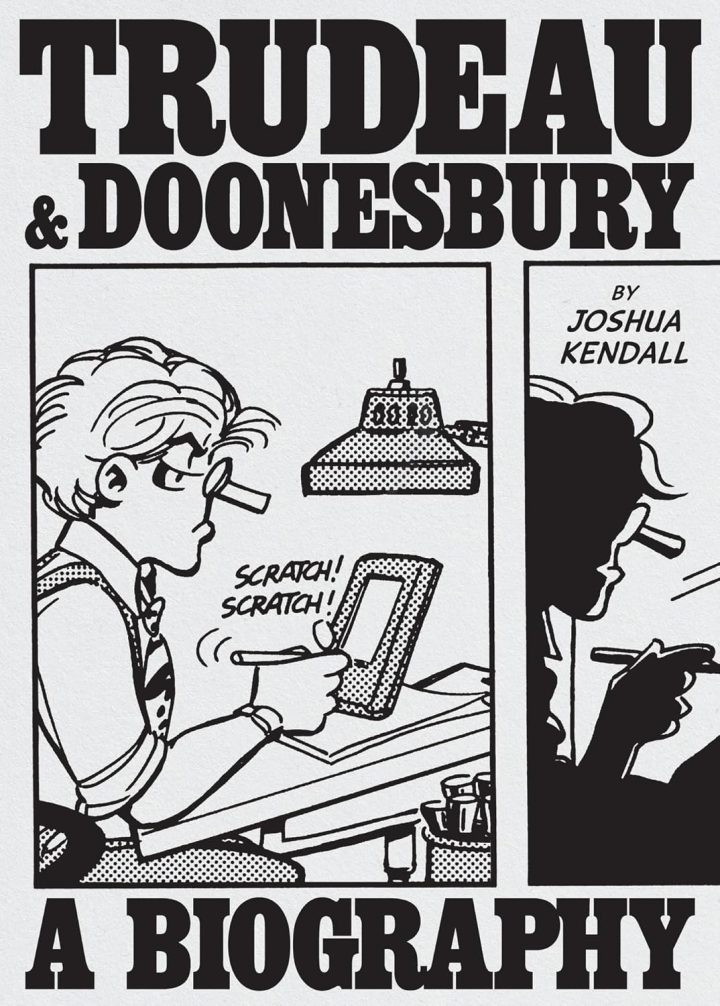
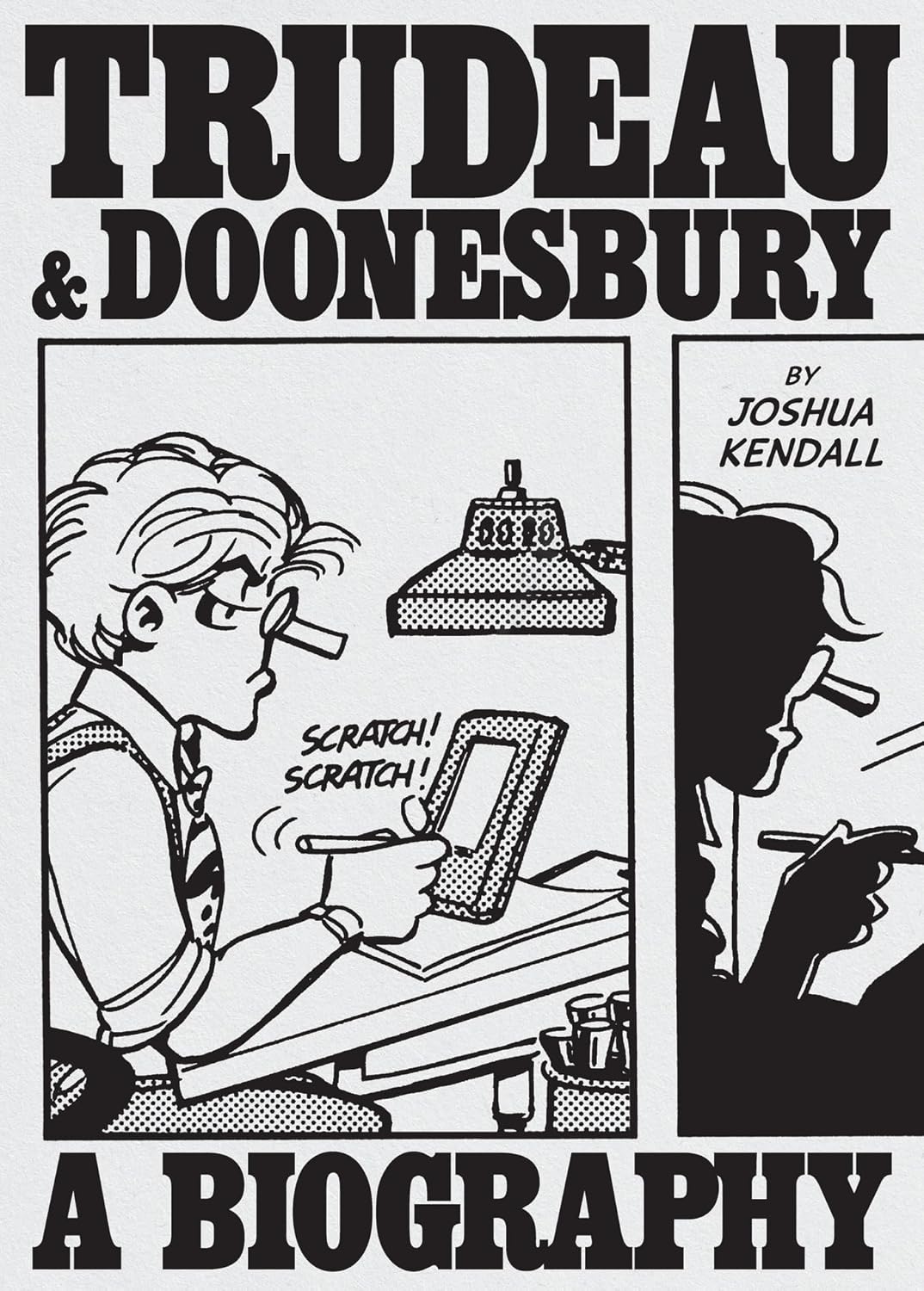
It also made Trudeau himself an unlikely focal point of celebrity, since the cartoonist (while not remotely reclusive) has never been comfortable with excessive self-exposure. Regarding himself as much a journalist as a comic artist, Trudeau has always been something of a cipher as far as his private personality is concerned. That was the void biographer Joshua Kendall set out to fill when he began work on Trudeau & Doonesbury: A Biography.
Approaching Trudeau from the realm of literature and politics much more than cartooning Kendall (who previously wrote books about both Noah Webster and the creation of Roget’s Thesaurus) had drawn from an impressive range of sources: Trudeau’s own, extensive papers at Yale, as well as interviews with neighbors, classmates, and colleagues. He’s also managed a relatively rare degree of contact with Trudeau himself, interviewing his subject at impressive length, if somewhat reluctant depth (the cartoonist is, as ever, guarded).
The result is Trudeau & Doonesbury: A Biography: The Cartoonist Who Turned the News into Art, a dual biography of both Garry Trudeau and Doonesbury itself, tracing the comic’s evolution, influence, and political outlook from the years of campus ferment to the modern era of post-newspaper media. I spoke with Kendall in late May to talk about what he’s learned.
ZACH RABIROFF: What first drew you to a subject as famously reticent to talk to biographers as Trudeau?
JOSHUA KENDALL: I come to Trudeau from the world of literature. This is my fifth biography: I always like learning about something new, and the cartoon world is kind of new to me, which I found exciting. I'd followed Garry as a Yale undergrad. I'm about 10 years behind him and I remember seeing Bull Tales [Trudeau’s college comic strip, and the precursor to Doonesbury] in the Yale co-op in the late ‘70s. I remember reading Doonesbury, and although I wasn't a huge Doonesbury fan, still there was the sense that Garry was almost our guide. In 1976, he got a standing ovation at the Yale graduation. And for a few decades, everyone looked up to him to show us how to live in this crazy world, and keep your sense of humor and integrity.
I think one of the surprises to people who might not be familiar with Trudeau, or who might not have read Doonesbury from its earlier years, is how much Yale seems to be a factor in his life and in the comic strip, certainly during its first decade.
Yes. Basically, of course, Walden College is Yale, and the president is [real-life Yale president] Kingman Brewster, and Mark was the Yale SDS leader. In the Yale files, there's a famous letter from Jim Andrews, his publisher, which says, "We really like your strip, but you've got to kind of de-Yaleify it. You've got to make it more applicable to the rest of the country and take out all the Yale references." So for the first year of the strip, he literally reused a lot of the old Bull Tales comics, but made sure that it was in some sort of fictional college that everyone could relate to without the specifics of Yale.
And even after it was de-Yaleified, it took a very long time before the strip moved beyond being a college-based strip, and it allowed itself to age the characters up.
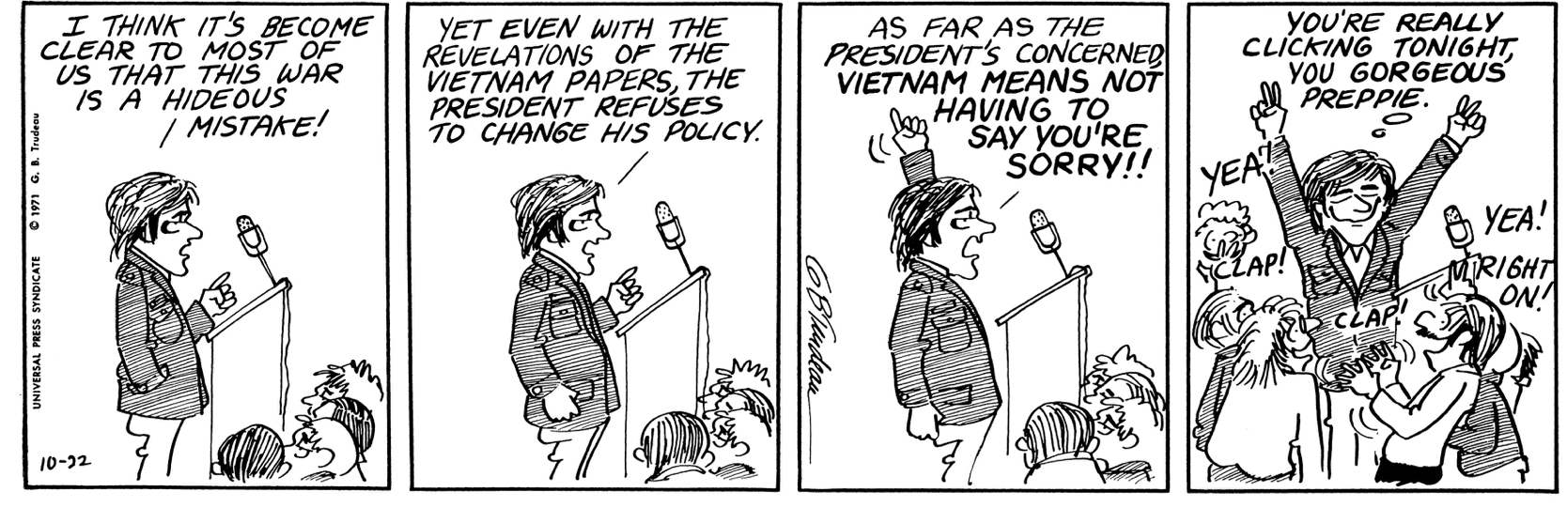
I think there's a letter I quote in the book, of Jim Andrews saying, "As part of de- Yaleifying it, I want you to report on what young people are thinking about the sexual revolution and about drug use." I think that was the springboard for Garry to take it out of the Yale mixers and the nitty gritty of the Yale football team, and all that. Also, in the early ‘70s - and this was just sheer genius - all of a sudden Henry Kissinger pops up on a park bench talking to one of the characters. That was just a stroke of genius to have the characters interact with political figures. That's something that inspired Stephen Colbert in The Colbert Report - this mix of fact and fiction. As I argue in the book, I think that was the stroke of genius that allowed Garry to really become a journalist.
What is your sense of how Trudeau saw that balance between being a cartoonist and being a journalist? He held both roles and he seemed to at various times enjoy or glorify in both.
Garry has created a kind of Dickensian oeuvre: if you want to understand Victorian England, you could read a handful of Dickens novels. And if you want to understand the Baby Boom generation, you could just go back and read five or ten of Garry’s collections. In the book, Rick Pearlstein, the historian, says he read the collections as a teenager and all he does in his books like Nixonland is just rewrite Doonesbury, because Garry had what could be called the first draft of history, and that’s what good journalists do.
In both Dickens and Trudeau, it seems like it's an aid nowadays to have a Norton's Critical Edition, because there is so much captured in those early strips that otherwise would be lost.
Garry is doing something now that he calls Doonesbury Classics [which reprints vintage Doonesbury strips]. But he's editing out of circulation some of the strips that have references that people won't recognize. For instance, in the book I talk about “Koreagate” in the late ‘70s. Everyone was looking for the next “gate”, but Koreagate didn't really make it. Still, it’s a part of history, and it's fascinating even though it's not something that people really think about.
But what about where Trudeau sees himself on the balance between journalist and storyteller?
I think he sees himself as a storyteller, and I tried to bring that out in the early chapter about his childhood. I wrote about the plays that he did in his basement, and he was this little dictatorial impresario who bossed his sister around in the basement. I thought that was revealing because he did say in an interview that it was great preparation for the strip, because there he was in control.
I think the larger project is storytelling, and in the book, I talk a little bit about Garry’s ventures into film and TV. He wrote that Amazon series that stars John Goodman [Alpha House]. Goodman told me that Garry is the “script Nazi,” that when Garry writes a script, he wants everyone to follow it, every comma. As a comic strip artist, he can control everything, but it's a little bit harder when you're dealing with other people.
Which makes it particularly funny that he was paired up with Robert Altman, of all people, for [their 1988 HBO series] Tanner ‘88. Altman is the director most likely to take away a writer's control of the storytelling.
Exactly. I think Garry's still scarred by Altman. He was short-tempered, and very controlling and difficult. I think what distinguishes Garry is this desire to tell stories, and it just so happens that he is an artist. There are two different phases of his art, and I try to bring that to the book. There's the early [Jules] Feiffer-esque phase, where the common wisdom is that the kid just can't even draw and it's really simple. I argue that he could draw, but it was kind of latent. He was in art school for two years, studying graphic design. He was working 12 hours a day and doing the strip at night. His schedule was totally crazy. I give him a lot of credit for the redesign; not a lot of strip artists do that. After ‘84 when he comes back [from a high-profile hiatus away from Doonesbury], the strip looks very different, visually.
It seems like he underwent a really thoughtful evolution of both the way he was approaching the strip visually, and the kind of stories that he was telling after that hiatus.
Yes. He [told me that] the post-redesign strip is a step backwards in cartoon history. It looks more like a Dick Tracy or something. But what most impressed me about Garry as an artist and as a person - which I often don't find in, let's say, a Noah Webster – is that there's constant growth in his art, in his characters, and in what he takes on. Biographies are often written about people who've achieved a lot, and frankly, a lot of people who've achieved a lot are narcissists. They're very self-involved. They're very driven. They don't really care about other people and they don't really grow. They have very rigid defenses. For instance, Steve Jobs would have his self-referential framework, but if something didn't go his way, he would blame others. I guess the clearest example [of this not being the case for Trudeau] are the PTSD strips, which are just amazing.
I think it's interesting that Trudeau, even to this day, continues to identify with veterans so strongly. I wonder if you got a sense of where that came from for him.
I speculate that he comes from a few generations of doctors, and I guess the argument I make is that he's a healer. Satirists are trying to heal society, in a way. So he's trying to do for society what his dad might have been trying to do for patients. I think I mentioned in the book that his father was wounded in World War II, not with post-traumatic stress disorder, knees and he was hospitalized for a while. I think there's a sense of just caring for veterans. It was so interesting that he and George W. Bush were at loggerheads since 1967.
That was an interesting detail. So much of the strip has a throughline of Trudeau’s seething dislike of George W. Bush.
But the Wounded Warriors brought them back together. Garry told me that when he was 22 and writing about the Vietnam War, he went for some cheap tricks. He said, “Remember, B.D. goes to war because he doesn't want to write a term paper." And then he said, "When I was in my mid-50s, I realized that war was a whole other ballgame. It's a very, very complicated and grueling situation." I found that to be very moving, that he could continue to grow and learn.
Did he talk about what made him change that view so late in life?
I think it's part of Garry growing all the time. As a biographer, that was heartwarming because so often there are famous people who you see the same patterns of fractured relationships. Another area that he grew in, which was very moving to me, was his take on feminism. The original Bull Tales are really sexist. Later, he was really embarrassed by that, and became an ardent feminist a couple years out of Yale. There's not enough of that in the world right now, particularly in men.
Garry said that he considers himself apolitical. How sincere do you take that self-description to be?
I think what's happened is that the Trump era has made his stance outdated, because right now there are really two sides. I wrote a piece for the National Review about a week ago about Garry's relationship with [Christopher] Buckley. Or Garry and the Nixon administration: they opposed each other, but there was a sense that verbal battles are part of the world, and we'll do our job and you do your job
Which is a pretty classic case of the relationship between politicians and the Washington press.
Exactly. I believed him until now that he is apolitical, but in the Trump era he’s laying his cards out. It's very clear that he doesn't like Trump. But he did go after Clinton, and he did go after Jimmy Carter. He didn't really do that much with Obama or Biden, but today things are so polarized.
Maybe it also comes down to that desire of Trudeau to have control over his stories and his characters: if he makes Henry Kissinger or George W. Bush a character in the strip, now he's in control of their dialogue. They follow his orders for once.
Exactly. When I saw Garry last Friday, he emphasized that Trump has all these interactions with the Doonesbury characters from the get-go. And he said that one of the reasons is that Trump himself, with his crazy hair and his boasting – even back in the ‘80s when he was just a real estate guy – is kind of cartoonish, and why not stick him next to Duke or Mike Doonesbury or Boopsy or whoever?
I want to go back to that hiatus year that he has around ‘83-’84. What motivated that?
As Garry said, "I've worked really hard and I just need to ask for this." I think the other reason is he wanted to do the musical [based on the strip, which played on Broadway], and that goes back to the playwright in the basement. He loved musical theater. He was telling me the other day that when he was eight years old, he saw Julie Andrews on Broadway in My Fair Lady. He just loved Broadway. There's a scene in the book where he gets the Samuel French version of the Doonesbury musical, and he's in tears because that meant a lot to him. I think the hiatus was partly the musical and also burnout.
What about the way the strip evolved and changed at the point when he came back? He had obviously been rethinking some things.
He jettisons the Feiffer-esque art and it grows gradually, in terms of adding perspective. The other decision, which I think really distinguishes him from [Charles] Schulz - and when I talk about Garry as a sort of Dickensian author, this really puts him on the map - is that his characters are going to age. I love the David Michaelis biography of Schulz, and I think Michaelis really captures Schulz. I know the Schulz family was upset, but I think Schulz was kind of a depressive, and his ex-wife was kind of Lucy with the football. There was a sense that he really couldn't grow, that he was a little bit stuck in life and his characters. Charlie Brown is always Charlie Brown.
Again, the strip was genius, and Schulz was a genius. He was really tapping into not only his own insecurities, but the insecurities that many of us have. He made us feel seen, which is incredibly moving. I don't mean to belittle him at all, but just to say that what Garry was able to do has rarely been done in strips. Letting the characters grow and develop, and that massive narrative with all these different characters and young nephews, just to keep the strip alive in a way that Schulz didn't. When you think of Peanuts, you still think of Snoopy, Charlie Brown, Lucy and Linus, and Schroeder, and everyone else.
It requires a certain act of creative courage because those characters are, on some level, autobiographical. They're taken initially from Trudeau's own life, and he's aging them up along with him as he goes through life.
Right. What's interesting is that people always want a one-to-one correspondence and it doesn't really work that way. I have a piece coming out in the Forward about how Garry is a WASPy preppie or preppie WASP who actually brought Jewish characters into the comics. At the turn of the century, there was Abie the Agent, there were some influential Jewish strips that ran in hundreds of newspapers, but by the 1950s, everything was homogenized Christian characters. And then you have Megaphone Mark, who's clearly a Jew. The reason I bring up Mark is that Mark's battles with his father were kind of similar to Garry's battles. Life is not to be enjoyed, it's to be gotten on with: Garry's hardworking doctor father literally said that. Mark is a radical, based on Mark Sanger, but there's also a little bit of Garry in Mark. I think there's a little bit of Garry all over the place. Obviously Mike Doonesbury comes closest to that kind of shy observer, but there's a little bit of Garry to be found elsewhere. So it's never one-to-one.
But there's always been a certain wall of how confessional he's willing to get. The confessional elements will only go so deep.
There is a big difference between Garry and his wife. Jane Pauley has written a memoir about her crisis with bipolar disorder. She lets it all hang out, and she has no problem talking about herself, even some parts that are really difficult to talk about. Garry is the other way. He likes to let his work speak, and even in his work he doesn't reveal much of what's going on inside him.
What do you sense is the reason for that?
I think it's the kind of family he grew up in, a family of privilege. In many ways, even though he's criticized the Bushes, he's a little bit like them.
I was going to say, there is something of a cultural overlap with the Bush clan.
George Bush used to say, "I don't do the ‘I’ thing." And George Herbert Walker Bush never wrote a memoir. I think Garry is close in spirit to George Herbert Walker Bush, with one difference. And I love the Skippy character: when George Herbert Walker Bush goes dark and gets a little racist in 1988 with Willie Horton, Garry comes up with Skippy to explain it.
Garry never had his Lee Atwater hovering over his shoulder.
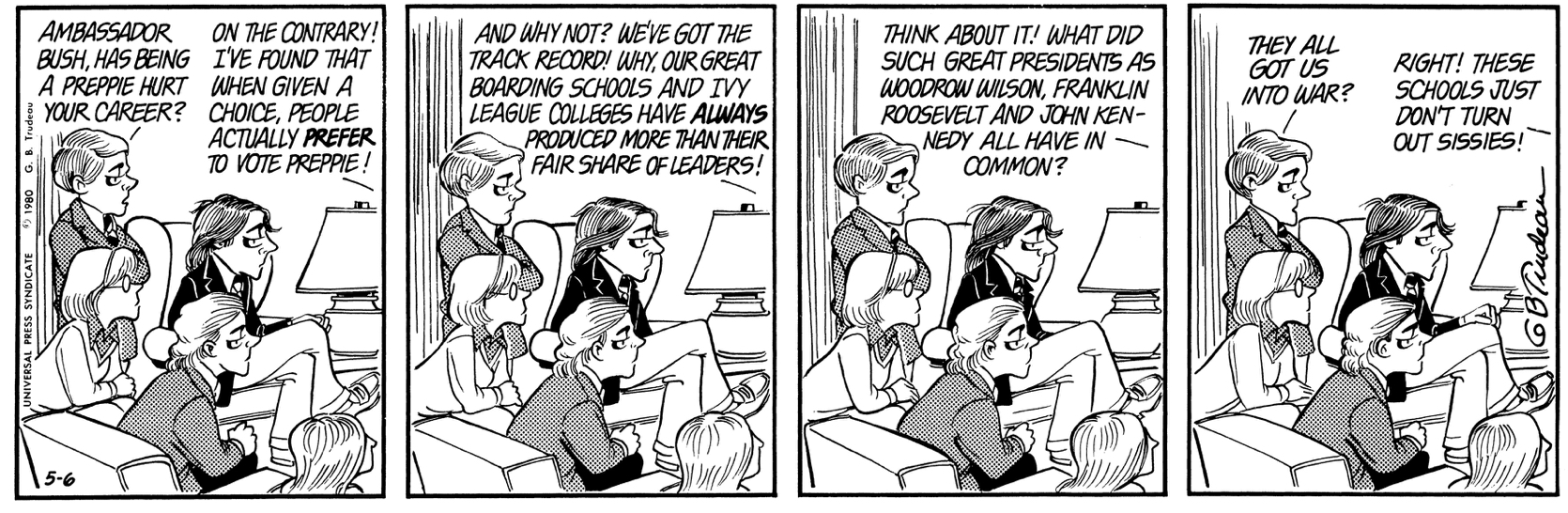
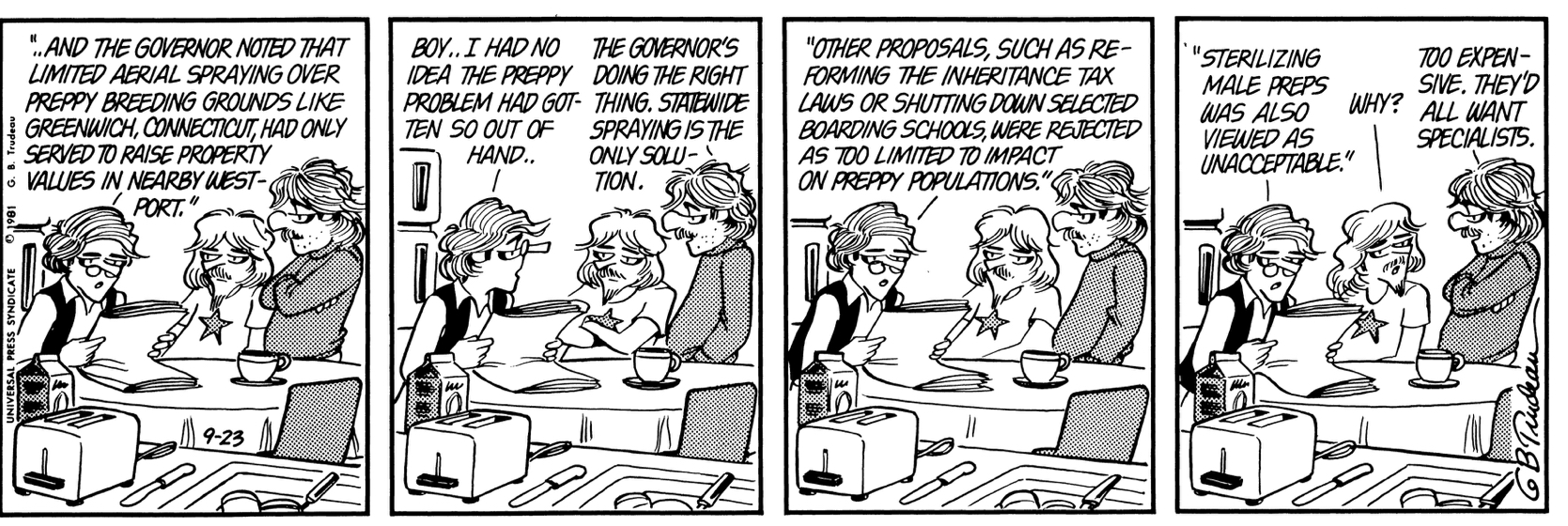
Yeah. But there is something about that kind of successful family going back generations. Bush's father Prescott went to Yale, and Garry's father went to Yale, and they went to prep school. There's something about that culture that you just stay away from emotions and refrain from talking about them. I also found it really interesting how much Garry hated preppies. One of my favorite strips that I include in the book is a strip about spraying preppies [like an exterminator]. He really hated St. Paul's [prep school]. I spoke to some of his classmates at St. Paul's and they all hated it, too. St. Paul's in the '60s was really kind of macho and a little sadistic. The masters bullied people and there was sexual abuse. No one liked the place, but Garry really hated it.
There's that strip about John Kerry in 1971. And Garry was saying, gosh, I guess I was a little hard on him, because John Kerry's testimony was very moving and important. And Garry kind of frames Kerry [in the 1971 strips] as sort of a self-indulgent preppy, which was a little harsh. Kerry lives near me in Boston, and I ran into him on the street and I asked him about that. And he said that was a long time ago, so he's forgiven Garry.
Given Trudeau's long history of reticence to open himself up publicly like that, what do you think made him participate in your book?
I think what happened was that I started talking to his friends. This is a funny story: most of Garry's papers are at Yale because he gave Yale 200 boxes. But when I was Googling, I noticed that the Radcliffe library at Harvard has two letters from Garry. It turns out they’re in the files of Lucy Moorehead, a society woman in Washington who wrote a book for Putnam in the mid '70s about how to entertain in Washington. But her daughter dated Garry in the late '60s and Garry wrote a couple of thank you notes to Mrs. Moorehead. And then I Googled and I found out that Penny Moorehead lived a couple of blocks from me in Boston. So I ended up having lunch with her and talking to her, and once Garry sort of saw that [he decided to grant interviews].
How open did you find him to be then in those interviews?
A lot of it was by email. I'd be at the Yale files and I'd say, "I found this. " And he would say something witty. I found something in the Yale files about his working for Mayor John Lindsay, the New York Mayor in the late '60s. He said, "Well, Josh, there's one thing that I really missed out on. Everyone from the Lindsay office in 1969 wanted to go to this place called Woodstock, but I decided not to go because I heard it was going to rain."
He is very private but once we started talking, he opened up a bit. I write a little bit in the book about how he was depressed at St. Paul's. I got that not from talking to him, however, but from the Yale files. He left an undergraduate paper that he wrote for this Yale child psychologist called Irwin Child. It was called “The Role of the Visual Arts in My Life”. And he wrote in that paper that he hated St. Paul's, he was really unhappy, but he found a very supportive art teacher who helped him get through his depression. He could just sit, and draw, and express his feelings. I'm a biographer, so I always try to look for what motivates people.
It's always nice when the subject of your biography simply writes a paper telling you.
Yeah. That was my “Rosebud” moment, and I thought, "Oh my God, this is what drives him." That's the way he deals with the world: the world is complicated and it's full of things you don't like. But for Garry, if he can sit in his studio, and draw, and express what he sees in the world, he feels better. He doesn't have to do the strip anymore, but for him, the strip is kind of an addiction – a good addiction, but it's an obsession. I feel like it's a way for Garry to stay connected with himself. He feels that if he can just sit and draw, he can make sense of things for himself, and feel more alive.
When I've spoken to him in the last month or so, he has said he's really interested in some of the younger characters, because he has grandchildren now and he wants to think about other people's experiences. So there's a sense that he wants to keep growing the strip. The only constraint now is that it's coming out only on Sundays, and Trump is in about one third of them, so it doesn't really leave a lot of room for his characters.
It almost has the effect of turning it into an editorial strip. So even though he's no longer drawing like Feiffer, he's gone full circle to the genre of comic that Feiffer was making. What does he see, and what do you see, as the place that Doonesbury has in the culture now? It seems like it was so much a product of its particular time when it launched.
Doonesbury could go viral in the 1970s. When I was at Yale with Garry a couple of weeks ago, we were looking at a letter from Judy Woodruff – she was mentioned in a strip in 1977. She was a cub reporter at NBC and she wrote Garry a thank you note that read, "This has changed my life. You've made my day, my week, my year." And all of a sudden, Judy Woodruff went viral. People who never would talk to her came up to her, and it's a type of thing that only happens on social media now. The daily newspaper used to be that place. Garry had that Doonesbury Thanksgiving special, which was modeled on the Schulz special, and the Schulz special had like 15 million viewers. Garry had 22 million viewers. Garry himself said that if he were young now, Doonesbury obviously wouldn't be going to the daily newspaper.
So what do you see as the role, the legacy that Doonesbury and that Trudeau have had over the decades that it's been here?
I think it captures the Baby Boom era. Garry was a trailblazer. If you recall, he was the very first cartoonist for his syndicate, a patient zero. Garry really reshaped the cartoon world and opened it up to all kinds of different voices. He was the first. I talk about Lynn Johnston who came in his wake, and obviously Bill Watterson.
One of the important legacies is that in the 1950s, the comics page was very Christian and homogenized, and Garry opened up the world for a lot of people. You see a throughline between Garry and Colbert, if you think of the Colbert Report as the Henry Kissinger-on-a-park-bench of contemporary political satire.
The post Joshua Kendall Goes Inside Garry Trudeau appeared first on The Comics Journal.


 Hello, my name is Jack Sparrow. I'm a 50 year old self-employed Pirate from the Caribbean.
No comments:
Post a Comment