

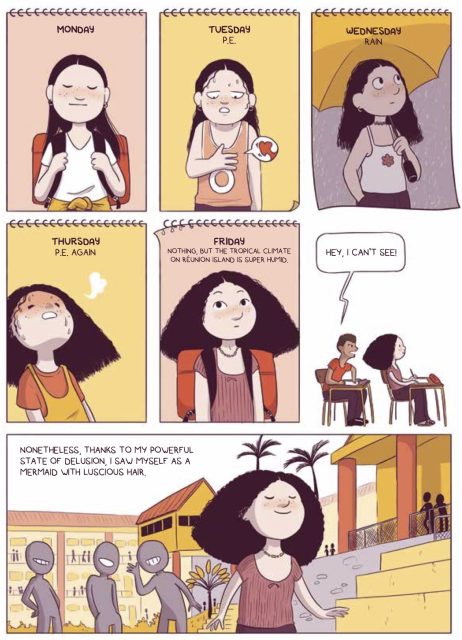
At this point, the “Black hair origin story” is somewhat ubiquitous in contemporary comics. In recent years we’ve seen work such as Wash Day Diaries (Jamila Rowser & Robyn Smith), Hot Comb (Ebony Flowers), Frizzy (Claribel A. Ortega) , Curl Friends (Sharee Miller) and other comics created by Black women on this very topic (albeit approached in various ways, which I’ll get to later). In an industry historically populated by white men, this topic may have initially seemed fringe or niche. And as of late, “identity”-led and “trauma”-informed comics have been the recipient of derision from those who feel like media has neutered its raunchy, underground, non-PC art in favor of these “thematically important,” “woke” narratives that favor “feelings” over artistry.
I’d like to counter this notion by asking, who is this work actually made for? And what about comics is ripe for this topic? In Rowser and Smith’s Wash Day Diaries, Black hair and the cultural rituals surrounding its care and expression are a source of celebration and revelry. The characters in this book live in predominantly Black and Brown communities and there is a sense of appreciation and understanding around different hair textures and styles. They are “in culture,” so to speak. In Hot Comb, Flowers’ recounts her formative hair experiences with the observant eye of an anthropologist and the ambivalence of a mixed Black woman straddling cultures.
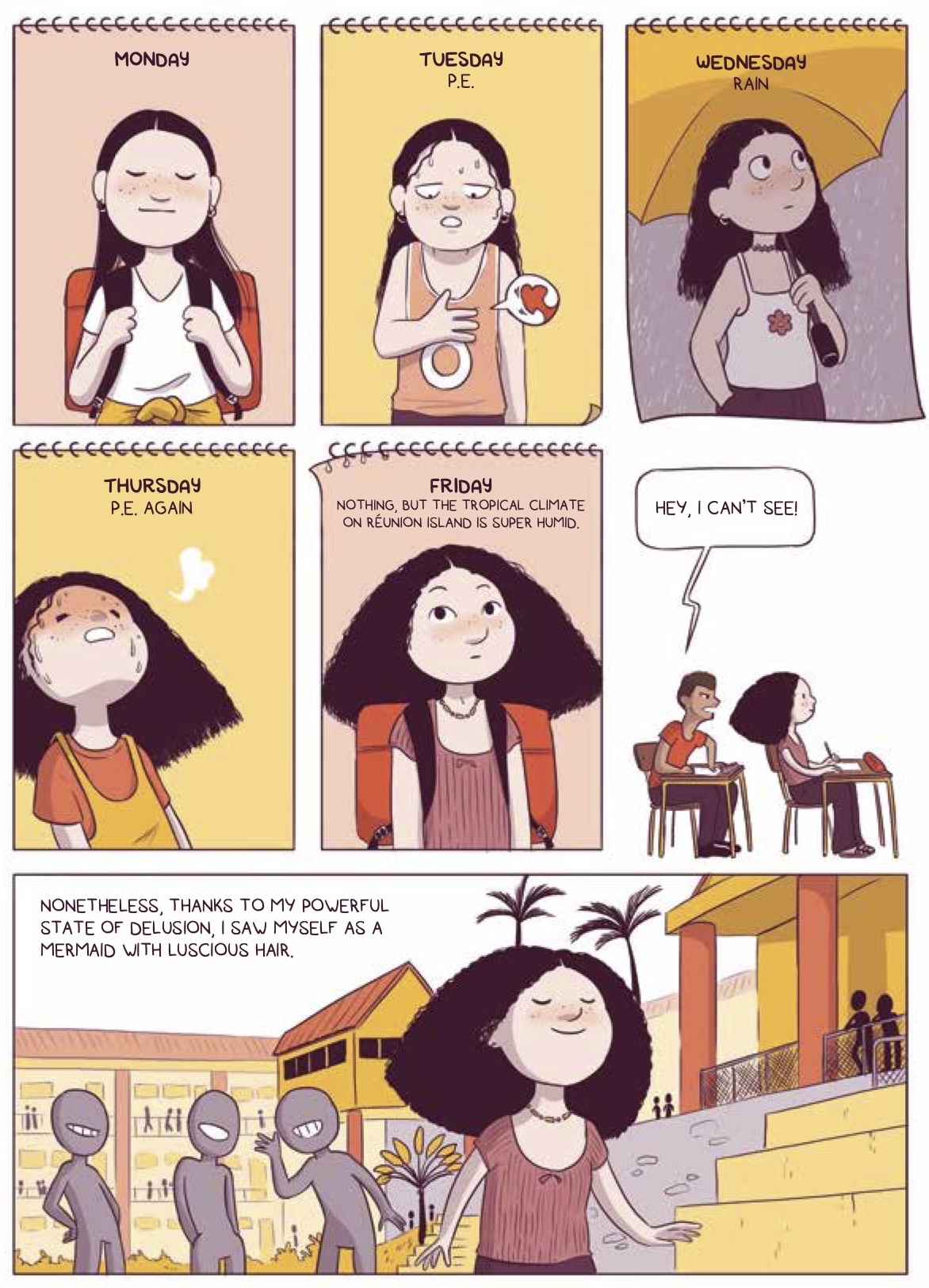 For Lubie, a cartoonist from Reunion Island, a French-colonial territory situated in the Indian Ocean, the latter rings true. Lubie, who states at the beginning of the book that it is a work of fiction (peppered by non-fiction sections) tells the coming of age story of Rose, a “White Creole” girl and her journey into adulthood as it relates to her relationship with her “kinky”/curly hair. An important distinction for North American readers is how race is considered here. In the U.S., the “one drop rule,” a vestige of Jim Crow, would dictate that Lubie would be “Black” due to the fact that her mom is “Black Creole” (she states that her father is “White Creole.”) But because Lubie has light skin, she considers herself white (at least initially). Shame, humiliation, and dysmorphia are running themes throughout this book, as Rose goes through various lengths (pun intended) to conceal, tame, and conquer her textured hair as the result of familial and societal expectations.
In her experience, white beauty is the standard that she is expected to aspire to or risk discrimination, bullying, or more common and insidious, “invisibility”. To have curly hair is to be seen as silly, clownish, unserious, and unprofessional. Rose’s internalization of white supremacy begins in her family, with a mother who feels compelled to straighten her own textured hair and present it as if it’s naturally straight. The women in Rose's family do not know how to care for her curly hair, keeping it in a braid. She feels beautiful for the first time when she is allowed to straighten her hair for her “Profession of Faith” and is complimented by her family. Rose repeatedly sees how her desirability and societal mobility is determined by how she wears her hair. White men pursue her when it’s straight (and at times exotify her when it’s natural.) Loubie quips that women’s bodies are seen and treated as public property and that white people’s assumption that they can just touch her hair is a racialized extension of that. When a classmate puts gum in Rose’s hair, she’s forced to shave it off. To her surprise, she feels a sense of control for the first time, as she is able to “manage” her hair more easily. Despite this she is judged disapprovingly by her family, bullied for presenting as “masculine” and called a lesbian. Rose, derided for being “out of culture,” despite being part of the Black diaspora and growing up in a multiracial society like Reunion feels familiar and accurate. When I’m reading a comic, I don't necessarily need it to be “relatable” but I need it to be human. As a mixed-Black woman with Louisiana Creole heritage (and friends from Reunion) I found it to be both. Loubie explores this “fish out of water” trope with the deftness of lived experience. Rose’s journey, which I assume is based in part on her personal experiences, is at once sad, frustrating, awkward, and funny. It’s sympathetic without feeling heavy-handed or preachy.
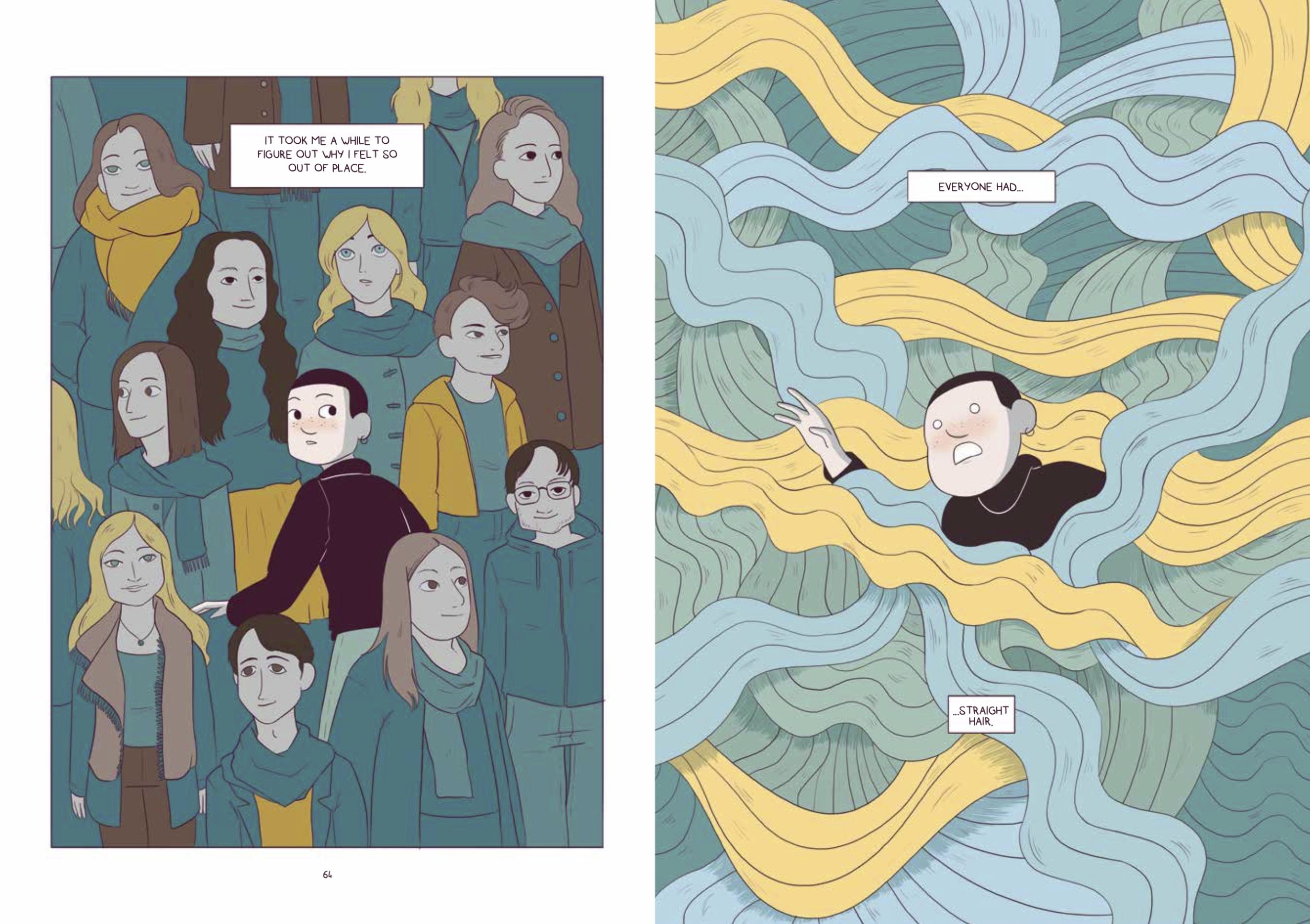
The non-fiction sections give the reader greater context into the history of Reunion Island, Black hairstyles, the evolution and morphology of hair types, the legacy of the transatlantic slave trade on beauty standards and practices, and paradoxes of “Creolized” cultures. Loubie also addresses contemporary issues surrounding black women's hair, including the economics of specialized hair care (including the Pink Tax), the exploitation of African and Caribbean hair stylists in France, Black Hair politics and workplace “professionalism”, and even the negative short and long-term health effects of altering hair through chemical relaxers, braiding, and weaves. These sections successfully play with visual metaphor, empty space, and clear and concise writing. The book as a whole has a “clean” look with a limited color palette, simple yet refined linework (the school scenes in particular are stylistically reminiscent of Daryl Seitchik’s Missy), and efficient text, making for a nicely-paced read.
So who is this book for? An intellectual exercise for the “NPR crowd” with a chance to absolve their “white guilt”? A book for mixed folks to feel seen? I’m sure it could be both of those. But I’d argue that much like living with curly/kinky hair, this book is for those willing to sit with the complexity of a liminal existence, humid or dry, and ask “yes, and?”
The post The Roots of My Hair appeared first on The Comics Journal.


 Hello, my name is Jack Sparrow. I'm a 50 year old self-employed Pirate from the Caribbean.
No comments:
Post a Comment