

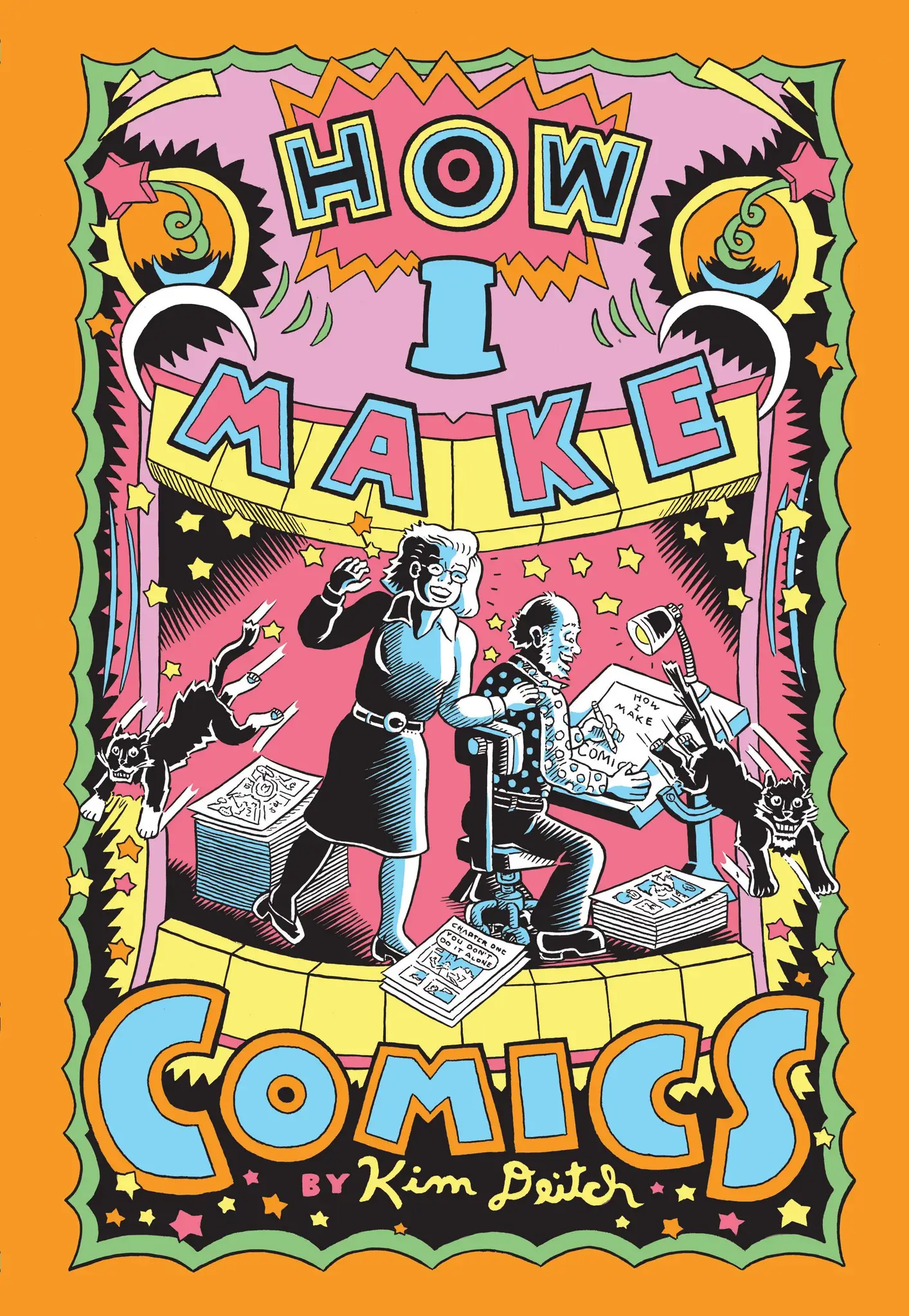
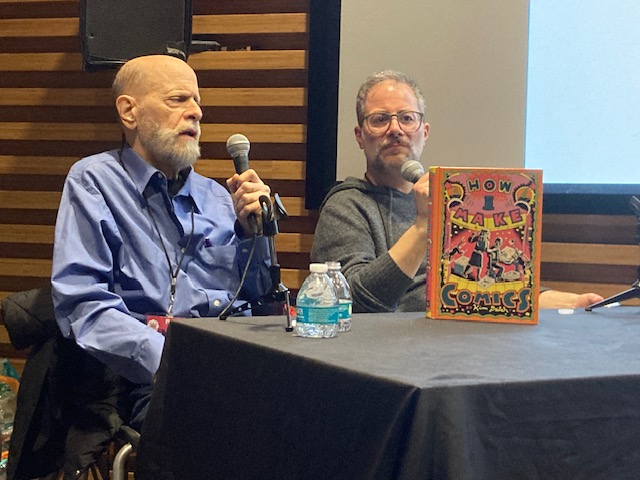
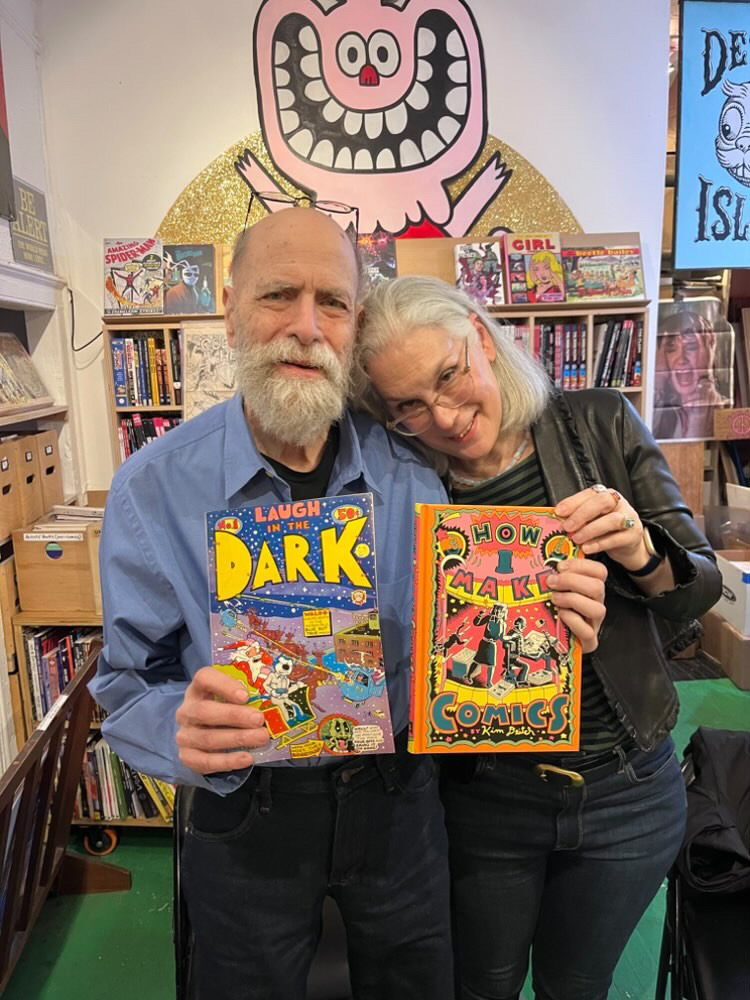
On the cover of Kim Deitch's new book, How I Make Comics (Fantagraphics, 2026), there's an image of the author (joined by his wife Pam Butler) sitting at his drawing table, writing out the title of the book–"How I Make Comics." At his feet sits a sheet of paper that reads: "Chapter 1: You Don't Do it Alone." That sums up the book pretty well.
For six decades, Kim Deitch has been one of comics great storytellers. In some cases, his stories are actually true. Or at least parts of them are, referencing historical events gathered from anecdote or research. Other parts spring purely from his imagination, and he treats history the way a novelist might treat mythology. At times, his Kim Deitch character will wander into the story, playing the role of narrator, witness or, at times, unreliable guide. It's always an entertaining act and one that he has been performing, and refining, since breaking into comics at the East Village Other in the mid-1960s.
In How I Make Comics, Kim explores the creative process; more precisely, he presents his creative process, as in "How Kim Deitch Makes Comics." This is not a "how-to" book for aspiring cartoonists, but rather a look into Kim's life (he is so productive that it's hard to imagine that he has time for anything besides working at the drawing table) and he spills the beans on how he pulls it off. It's not exactly a magician revealing the secret behind the trick, as that would be an extremely challenging stunt for anyone other than Kim to duplicate. And it turn out that he gives away the answer right on the cover: "Chapter 1: You Need Help." As we see throughout the book, Kim is fortunate to have a partner in his wife, Pam Butler, who understands his unique mind perhaps better than even he does. Throughout this extremely entertaining book we see Kim's process for concocting a story: Have an idea, do a first draft, run it by Pam, go back to the drawing board, repeat, repeat, repeat. Along the way, there are many detours, restarts, shifts and marvelous images of things you may expect to see in a Kim Deitch book–cats, mice, puppets, dancing circus animals, planets with eyeballs, and versions of historical people who are notable and otherwise (Forrest J. Ackerman, Ray Bradbury...Donald J. Trump). In a piece written for the Brooklyn Rail, comics historian Bill Kartalopoulos noted that "in the book’s framing sequences, the cartoonist’s pet cats careen through the apartment he and Butler share, its shelves heaving with antique stuffed animals."
As always, it's a visual treat and it all makes for a wonderful read. How I Make Comics is a yet another chapter in a legendary career from someone who has produced a staggering amount of consistently great work. And there's much more to come. I've seen some of the pages.
For the interview below, I spoke with Kim by telephone on the morning of May 21st, 2026. It was his 82nd birthday. What follows focuses (mostly) on How I Make Comics and is part of a much larger series of conversations I am having with Kim about his career in comics for something I am planning for an upcoming issue of my publication, Dummy.
###
JOHN KELLY: I love the title of your new book because I think some might assume it's going to be an instructional manual, like a 'how-to draw' book or something. It's definitely not that type of book, but the title is not misleading at all. It's about how you make comics. Your own personal process and the way your stories evolve and get refined. And a lot of that has to do with talking things through with your wife, Pam. It's a fascinating book.
KIM DEITCH: When I chose that title, How I Make Comics, it was more or less of a non-sequitur at the time, except I thought it was a catchy phrase. But I thought back on it and I was like, well, shit, this really is how I make comics. Because this is what goes on, this dialogue between me and Pam. It leads to continuity. On Saturday mornings, I often wake up and say to Pam, "Well, I got an idea" for a certain story. And she goes, "Yeah…" It's either grabbing her or not grabbing her. So, you know, I had this title, "How I Make Comics" and I thought, well, I better include something about it. Which is why I wrote the essay "Why I Make Comics," [for the back of the book], to pay it off a little bit there. I don't want to be just cute for no reason at all. I want to deliver the goods.
The way it works is that you'll read an article or hear a story about something, and then you'll ponder it, and think, well, what if...this happened? You concoct a sort of alternative reality about what that story could have been, right? That's how things can unfold in your stories. You always sort of got one foot in non-fiction and one foot in fiction. Maybe not always, but often enough you play that game, and it sure is fun.
Well, I figured that's what writers do, you know. I'm more of a writer who draws than an artist who writes.
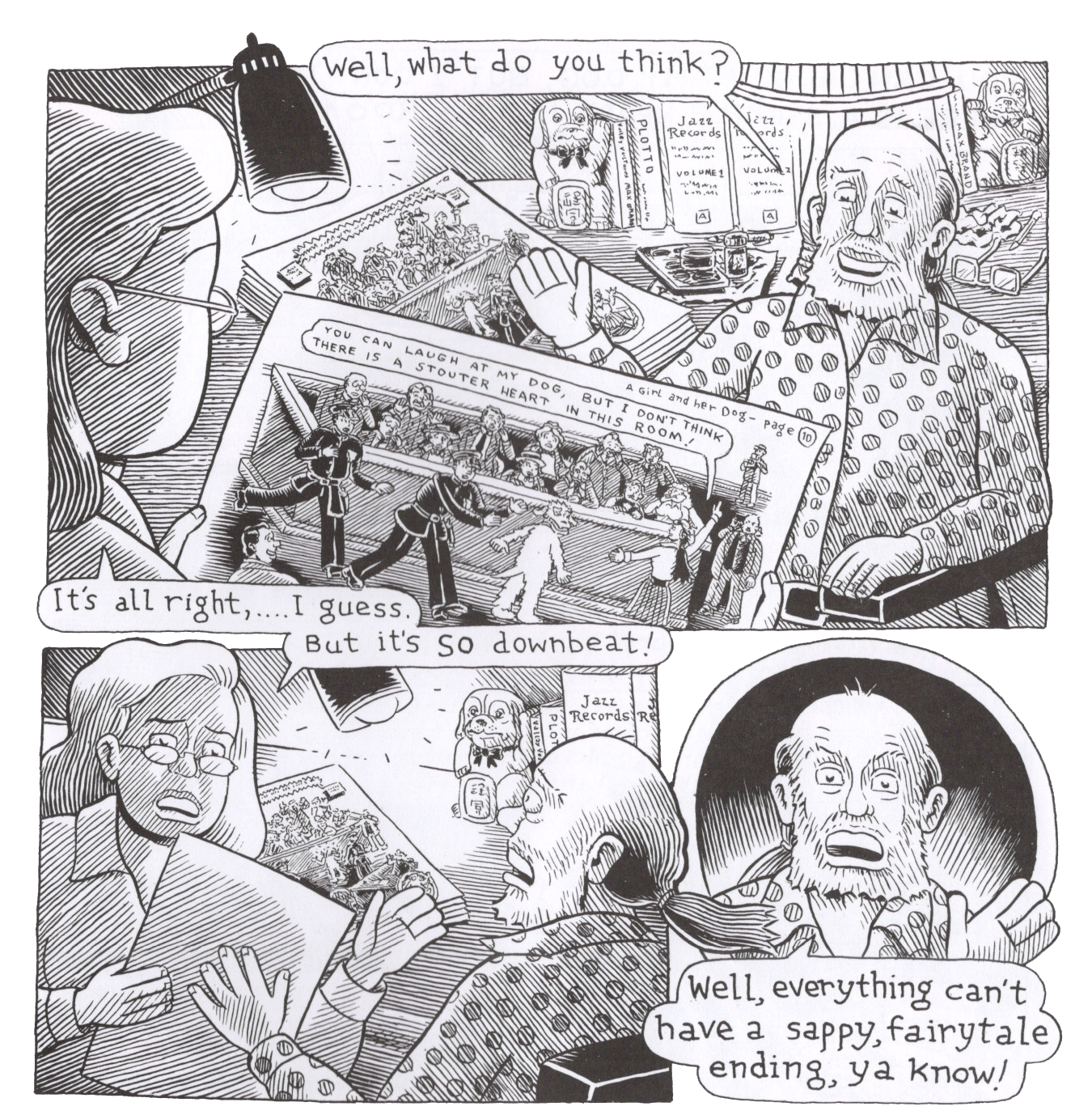
Your wife, Pam, plays a big role in the process here, which is great to see documented. It's wonderful that you have been able to align yourself with somebody who shares your aesthetics and styles and knows you so well, someone who can help you push yourself and...rethink things. It must be great to have that type of reader/editor.
I got really lucky when me and Pam got together. You know, I heard she broke up with some guy. I was talking to Carol Lay about it. She was going, "Well, you know, I bet we could find a good boyfriend for her," and I said, "You know, I think I got just the guy in mind. Me." It was horrible to say it like that but it was the stone truth. As soon as I got her phone number, I called her up and asked her out. It worked out, and the rest is history.
She's tremendous, you know. We hardly ever fight. When we do, it's civilized. Oh, she's tremendous.
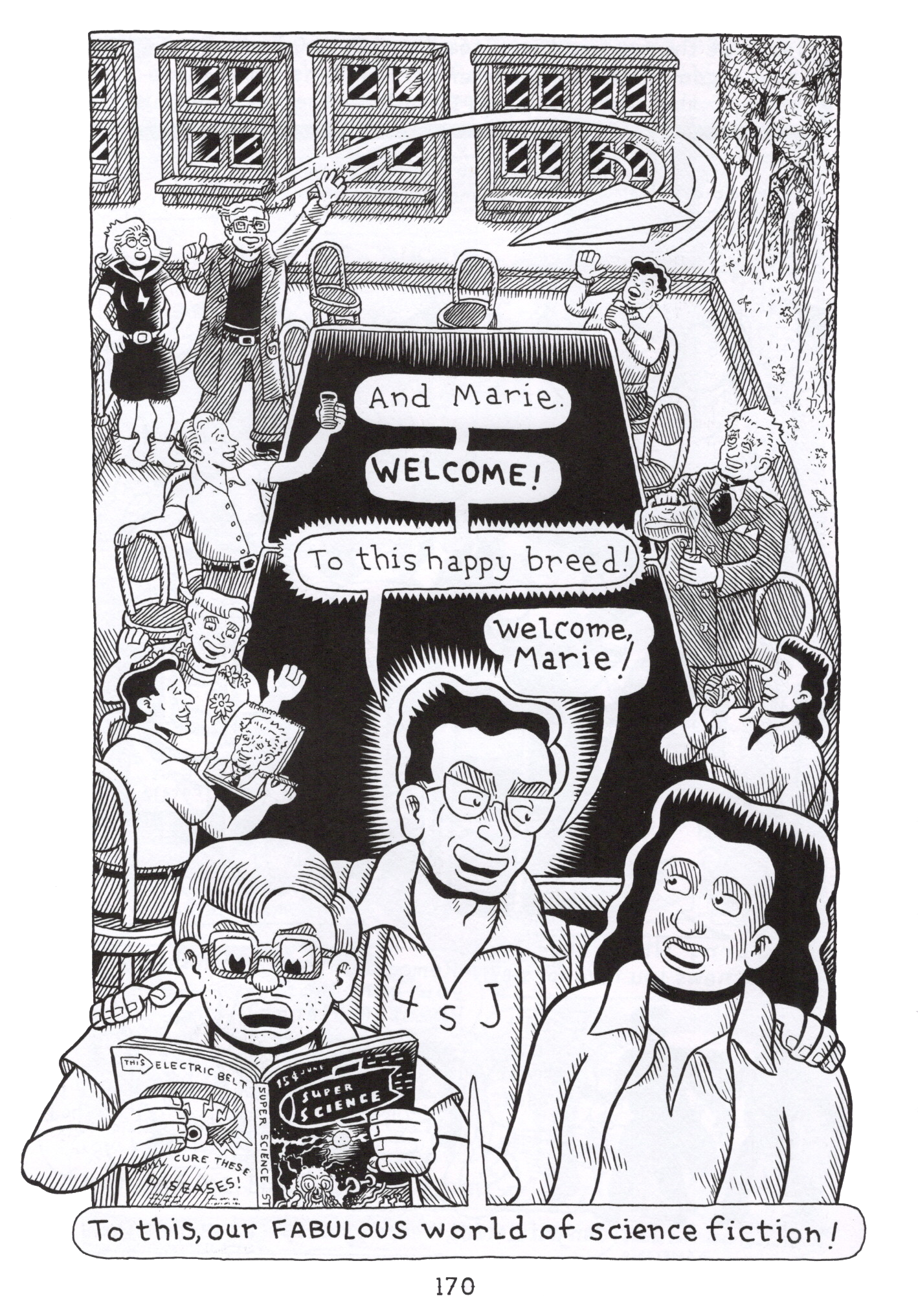
One of my favorite stories in How I Make Comics is "The 2 Maries," which is about your mother.
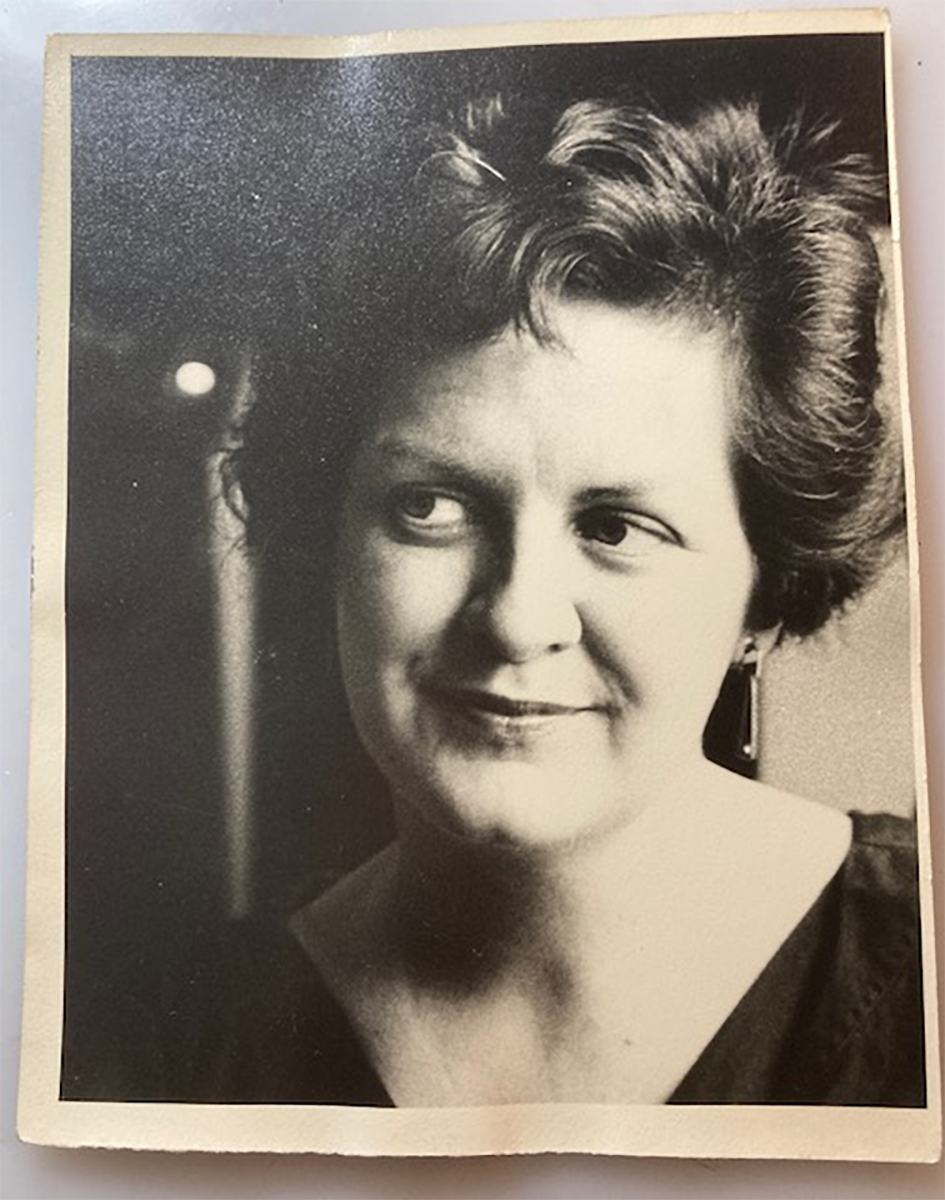
Oh, well, that's my favorite story, too, and as a matter of fact, next Monday, I have to go try it out, reading it. So, yeah, I'm gonna have to rehearse with that a little this weekend. I think I can do the whole story, but we did a little practice. I think I can do the whole story in about 17 minutes.
I happened to have been born in L.A. My mother was born and raised in Denver, Colorado. All our people, going back to the Civil War that I know of, Denver, Colorado. And then one day, my trollopy grandmother, who I got along with very well, came and picked my mother up, and they hitchhiked to Los Angeles. And, you know, they didn't actually get picked up by [Famous Monsters of Filmland publisher] Forrest J. Ackerman on the way there. But she became friends with [Ackerman] as a result, and in fact, ultimately, she introduced me to Forrest Ackerman. At first, she criticized my brother for reading Famous Monsters in Filmland. Then, one day, she looked over his shoulder and said, "Forry Ackerman puts that out. Jesus Christ, I know Forry Ackerman." My buddy and I just finished making the movie Dial M for Monster, and so I said, "Gee, if we give you some pictures, you could send those to Forrest J. Ackerman?" And she sent them, and he came right back with, "This is great. We'll do something with this. By the way, I'm gonna be in New York pretty soon at a party if you want to come over." And so we went to the party, and she introduced me to him. That's how I happened to meet Forrest J Ackerman.
I didn't really appreciate what a cool guy he was at the time. That only came later. When I was researching The 2 Maries, there was a biography of him for sale online, and I bought it. And it was a great book. It really made me think, geez, you know, you weren't really giving this guy his due, this guy was really a great fellow if ever there was one. I think he was a great guy. I wish I'd have appreciated him more when I actually knew him. First of all, I know from my mother introducing me to him, but then also, when I was going with Trina Robbins, I was reintroduced to him, being invited to parties that Trina and I went to that were thrown by Forrest J. Ackerman. Just being in the room with him and talking to him is a privilege in itself.
It’s interesting. I don't know how many comics fans know how deep Trina was into the Sci-Fi community.
Yeah, I'm not sure either. But she was. She most certainly was. Well, you know, going with her was great. I mean, culturally speaking, never mind the personal dynamics. I learned a lot from her, and all of her connections. I mean, it sort of elevated me to a new position, an underground high society, hippie high society, whatever you want to call it.
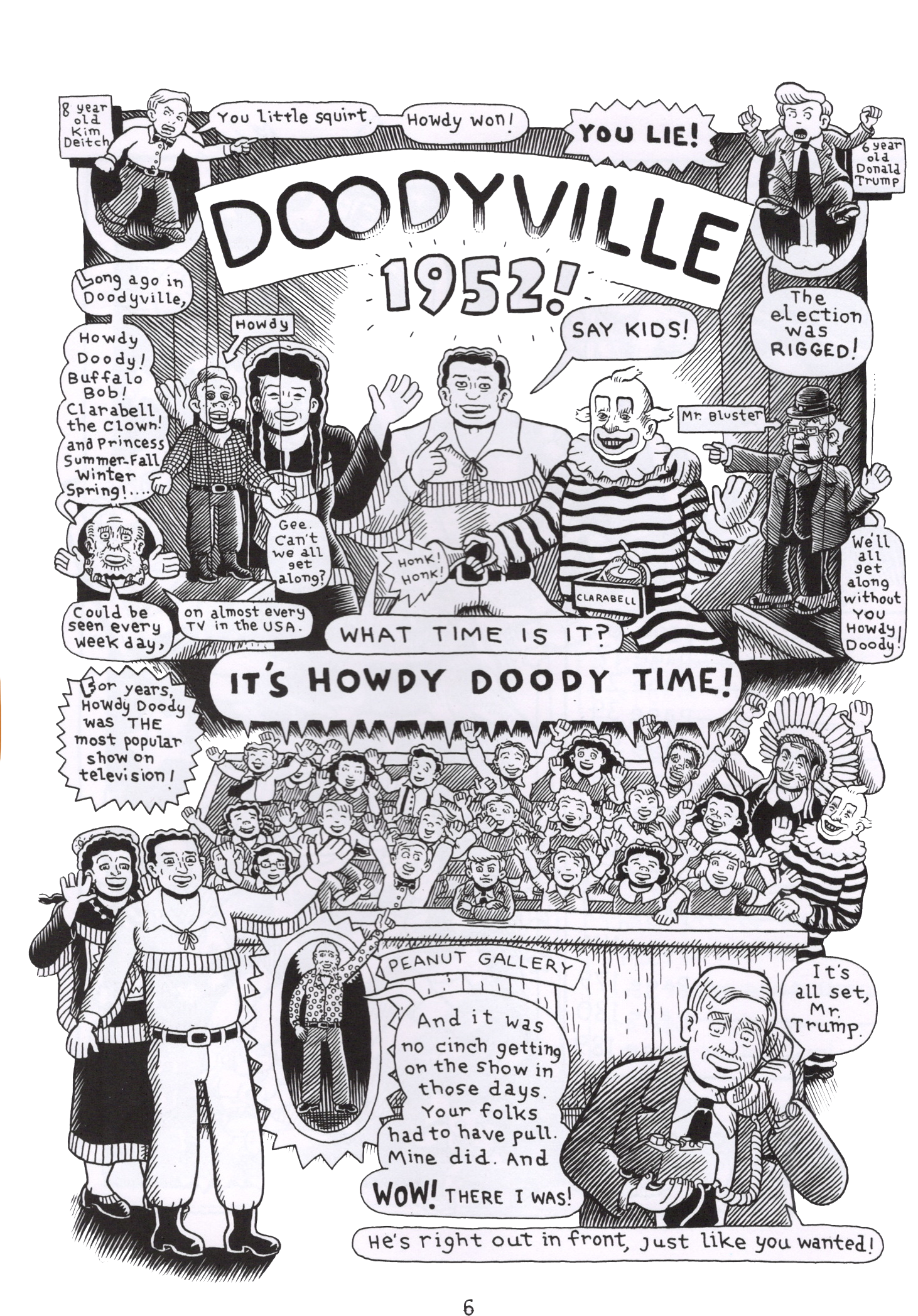
Well, you've met a lot of people. But the new book starts off with a story about you meeting, well, Donald Trump on the Howdy Doody show when you were a kid. That one isn't a true story, but it's funny.
No, that's actually the most recent story in the book. I put it up in front because I didn't want to start with that second story.
Oh, really? I like that second story ["A Girl and Her Dog"] a lot. It sort of sets up the whole book.
I'm glad you liked it. I was worried about it. That's why I put the Trump story in. I drew that one fairly recently. That was one of my Saturday morning inspirations. I was just telling that to Pam, well, you know, maybe I could have met Trump on the Howdy Doody show, that might be funny. And she seemed to like it. So, the next thing you know, I was working it up because, you see, when I was a kid, I got to see Howdy Doody during the emergence of television. There was a point when Howdy Doody wasn't just the most popular kid show, it was the most popular show on television. Such a thing is hard to believe now, but it was true. So popular that even though my father personally knew a member, I still never could get on the Peanut Gallery. And so, in a way, the story was fulfilling the fact that, well, I'll get myself in the Peanut Gallery, put myself there, myself. So I did. That's how that story kind of evolved. And then, you know, I looked at the comparative ages of me and Trump, and he's two years younger than me. Okay, that works. Next thing you know, there was a story.
And that worked, because I wanted something a little better than the story that follows it. And there it was.
Well, I like all the stories in the book.
I'm happy to hear you say that, because what do I know? It's hard to be objective about it because I'm the one doing them. So I always kind of want to know what other people think.
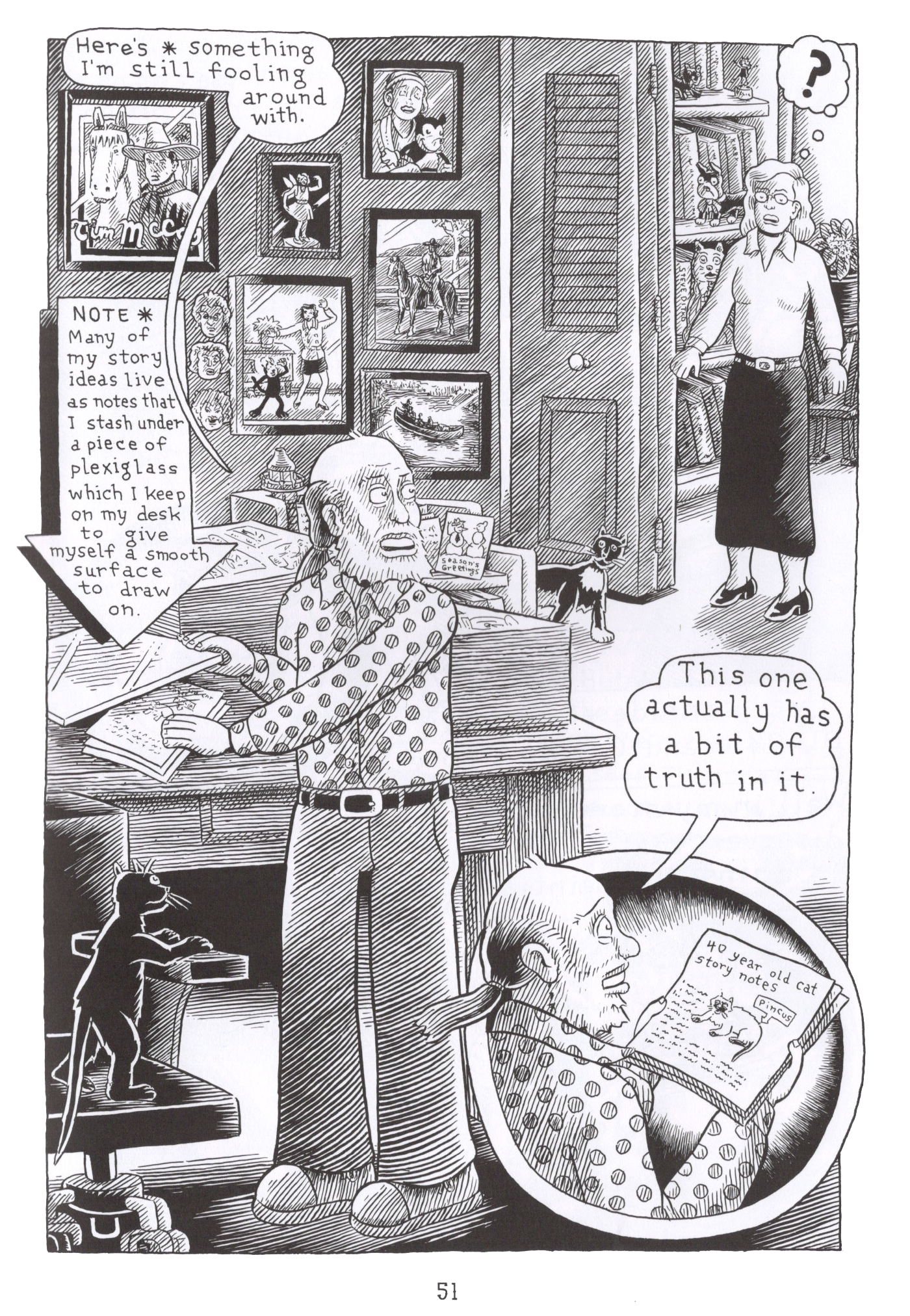
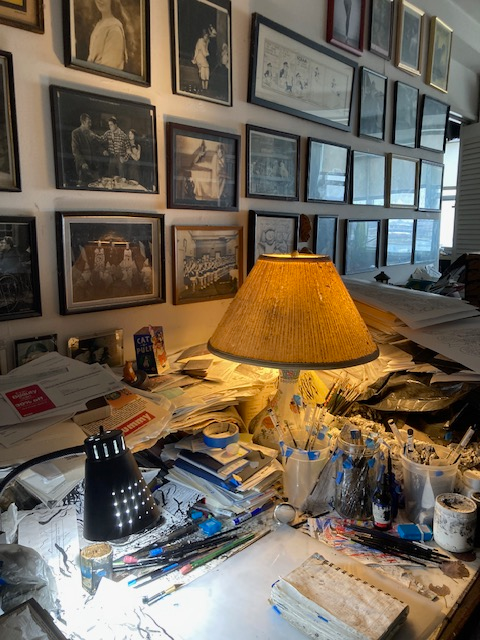
I read the book in one sitting, and have gone back through it to reread several times. In a way, your apartment is a character in the book. It's always interesting when you're reading a book and you see a space depicted that you've been to yourself. You have a version, for the stories, of your actual apartment, but there's a lot of reality in the drawings of it, too.
We were trying to keep some aspects of real. It looks a lot bigger in the book than it really is. All the stuff on the wall, I tried to keep it, like, 80 percent true on that.
You also have a story about an 40-year-old cat...was that a real thing?
No. It's a stupid idea I thought of when I was sitting around with Pam one day, And I got about 3 or 4 years ago. I just thought, well, that might be fun. All the trash talk I do, I try to pay it off. Like, 75 percent or something, you know, eventually. If I've got one good quality in the creative process, it's that I nearly always do everything I say I'm gonna do sooner or later. That's my brag, and it's true.
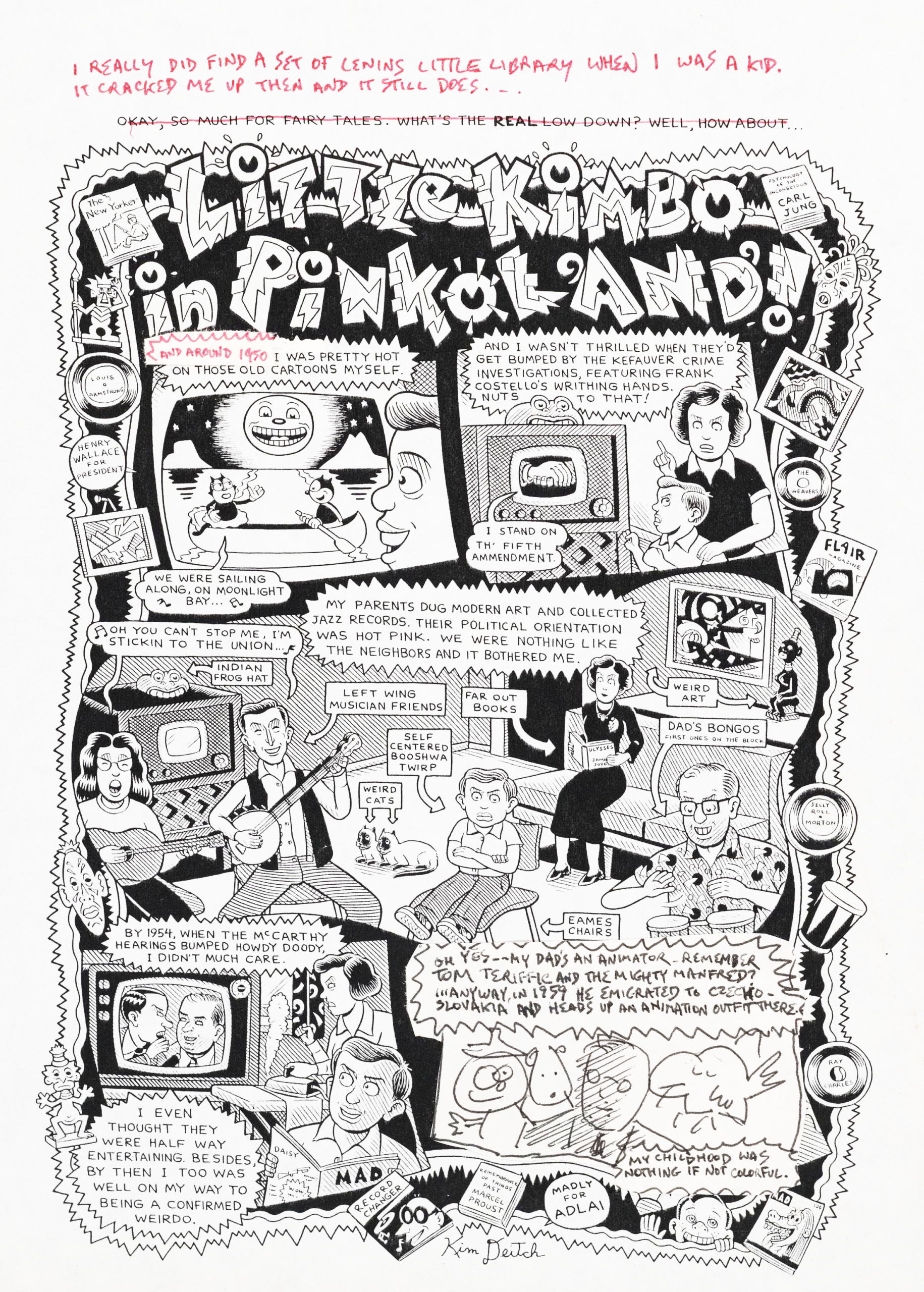
In the last story in the book, "Tales of the Midnight Demon!," you have an appearance by the mysterious singer Connie Converse. You've drawn her before and she's someone your father, the animator Gene Deitch, also knew. She's someone who, one day, just disappeared.
She was a singer that I knew when I was a kid. I was a witness one time when Pete Seeger brought her over to our house. Nobody knew her, and she was just sort of sitting around at this party, and at some point, somebody said, "Come on, Connie, you come, I'm going to get a song out." And so she sang this song, basically about getting picked up in bars, which I didn't really understand because I was 10 years old, but I appreciated the jauntiness of the song.
It stopped the party cold. You know, like, so a party that was just about general chit-chat suddenly became a party about "Who is this singer Connie Converse?" You hear about stories like that, but that's the only time it ever really happened to me. And so, I want to do a longer story about that, and I have a great reference for it because somebody wrote a big, fat book [To Anyone Who Ever Asks, by Howard Fishman] about her not long ago. I got interviewed for it, and the writer used some of what I said. I'll have everything else in the story. But the weird thing about Connie Converse–she was really good, and it's easy to get addicted to her–but if you listen to her too much, it starts to be depressing. I think she was essentially a depressed person.
So it's a little tricky even doing a story about her. I mean, basically, I knew this story, but I don't want to immerse myself in music while doing it too much, because, well, you know… To give you an example, my father was taping her from several parties, and it's a big collection of her unpublished music. But my mother would just sit there and listen to it so much that at a certain point, it started giving me the heebie-jeebies. I didn't say that or anything. After a while, when she would put on these Connie Converse tapes, I'd just quietly leave the room and go somewhere else because that's sort of what happens to you if you overdose on Connie Converse music. All the more reason, I thought I should do this story. My old man was encouraging me to do it, too. I'll do it...I doubt if it's gonna last more than 10 pages. I mean, it ends kind of interestingly. At a certain point, she just gets in her VW and drives off, and no one ever sees her again, and nobody knows what became of her.
Yeah, she completely disappeared.
I witnessed it, back then, and it was fascinating.
Well, today is your birthday and you're 82. I'm fairly amazed at how productive you are. When I was at your place, you had piles of stories you were working on.
You know? Well, that's the idea. That's what I'm working at. That's how I keep myself going. It's what I enjoy doing. You know, it took me a long time to enjoy doing this stuff. I used to like to get the results. But the actual process of sitting there and grinding is something I had to cultivate.
You have a very vigorous work ethic, right?
I figure, you know, I'm gonna be like the working man. I'm gonna do 40 hours a week. You know, I may not make it to 40 hours this week, because I'm also going to these physical therapy things for my leg. But if I don't, I'll probably slog a few hours on Saturday.
Do you start at a particular time, and then knock off when it's quitting time?
Quitting time can end up being any fucking time. You know, I'm gonna try to make 40 hours this week, but as things stand right now, what have I got? Shit, 22 hours and 31 minutes, not counting the hour-and-a-half of it. You gotta keep yourself on the ball and not kid yourself. "Oh man, I've been working..." Ok what work have you done? Let's look at the numbers. I like to have my numbers here where I can see them.
How do you keep track of time?
I log it down in a book. It's just the way it's gotta be.
Do you keep notes and stuff–sketches–with the numbers? Is it like a diary?
No. It's just numbers in a book. I'm almost out of pages, so I started racing to be able to keep using it longer. It's a nice fold-over book, and I'll miss it when it's gone. It'll be hard to replace. It must cover about four years of my daily working. There's practically no art in it. Not that I intend to never show it to anyone because it's just for my own reference.
Are you happy with how the book turned out?
Reasonably, yes. I feel pretty good about it, especially considering the fact that I was waiting and waiting, and then suddenly, alright, we're ready to go. I wanted to give credit to Jessica Fernandez DeJesus, who helped with my scanning and stuff, and I didn't get to do that in the book. A few things like that were mildly annoying. But really, when I looked at the book and I saw the shiny, sheeny cover, I wrote to Gary Groth, "Hey Gary, thanks a lot. You really did a great job!" I made a color scheme for the cover, but I didn't do the color myself. I trusted somebody, which is something I just never do. But it worked out, thank god. And now, Jessica, who has been helping me with scanning, has also gotten me back into Photoshop. I'm doing more Photoshop and it's fun. I didn't realize I missed it so much.
It can be a great tool.
Yeah. It's marvelous, and I don't know the half of it. The way I go about it is a little primitive. Like doing the blur, you know, the tool that helps you fuzz things, and I stipple it in. But, you know, that gives it a more graphic-y feeling to me. Sure, that I kind of enjoy. It takes time. And I'd say, to be perfectly honest, working on Photoshop is probably the closest to fucking off I do at the moment. Because I'm sitting in a comfortable chair, any mistake I make is eminently correctable, as long as I don't make a big mistake and have to call Jessica and have her come and get me out of trouble, but that hasn't, thank God, that hasn't happened lately. Anyway, I'm back to doing my own color and I’m getting a good result.
In your afterword for this book, which you call "Why I Make Comics," you say that you realize that you have an addictive personality.
Oh, I sure do.
How does that play out?
Well, it used to be bad drinking. Just watching TV right now, or watching Breaking Bad on TV, I'm addicted to that at the moment. Before that, I was addicted to Anne of Green Gables. I let Pam pick the TV because, you know, it's better. I get more surprises that way than if it was me, it'd just be one dumb old movie after another, you know, whereas with her, she starts to look around and finds things.
Those are the chief things about my personality, you know, part of the addictive personality is avoiding things. Drugs and alcohol. Strictly no, no. Getting into bad food jags. I gotta watch that. Borderline diabetic. It can go really south on me. Of course, right now, I'm a little worried because I can't walk long distances. I gotta get to the dentist. That's gonna be bad news when I finally show up there. But my dentist is like, you know, a mile and a half away. I can't walk a mile and a half right now.
Yeah, and it's not like the subway is just outside of your door. It's a bit of walk to get to it.
Yeah, you know, I can go on the subway when I'm with Pam, by myself right now, not quite. Maybe I could if my life depended on it, but it doesn't.
In the afterword, you also talk you talk about alcohol and you say that the booze "almost got me before I got wise to myself." So, at some point you made a dramatic change. You've been able to live in a different way for a long time now.
Yeah, I'm very proud of that. I used to be a champion "go on the wagon" guy. But at a certain point, you know, I was living in North Carolina working for somebody. I used to walk by this storefront all the time, I'd look at it and go, "You fuck up this time, you're gonna end up there." Which, you know, when it happened, I didn't really regret it because I got to know the rank-and-file citizenry of North Carolina a lot better. And really it deepened my year in NC in terms of the quality of that experience.
You came into contact, probably, with people that otherwise you never would have had a conversation with, right?
Right. And I got to love a lot of these people who I never would have even met, accepted. We're all sitting around trying to get off the booze together. And also, you know, in AA meetings, one of the things they make you do is you get up and tell your story. So, you know, all those stories were better than TV by country mile. It wasn't a chore to be there at all. I mean, it was marvelous.
So how many years has it been now that you've been sober?
1983, so probably 42, going on 43 years now.
I really like the book a lot, and if you think the next one is going to be even better…
Yeah, that's the goal, right? It's always to up the ante. And the amazing thing is, I'm into the other one. I didn't really expect that to happen, but that's my thing about overlapping stories. I was in overlapped stories with bells on when the book came out, so there's definitely going to be at least one more book. Whatever happens will happen. But, I'm deep into it right now.
I'm hoping there'll be many more.
Why not? Like I say, I got a young wife. My old man made it to 95. I'm not planning to check out. Life will check out on me, but I'm not checking out on life. I'm interested in being alive. I think that's part of it. I mean, I think half the people that don't last just haven't got enough interests.
The post “This One Actually Has A Bit of Truth In It”–How Kim Deitch Makes Comics appeared first on The Comics Journal.


 Hello, my name is Jack Sparrow. I'm a 50 year old self-employed Pirate from the Caribbean.
No comments:
Post a Comment