

When’s the last time you checked on David Lapham, anyway?
Not a rhetorical question! Tell me: when was the last time you thought about David Lapham? Because he never went anywhere. Somehow or another he’s become one of the busiest people in the industry. Or maybe he always was.
Just in the last few months, I brought home the six-issue run of Good as Dead, six extra -size color comics from Image. Violent small-town noir, cowritten with wife Maria Lapham. She does a fair amount of cowriting, but David also does a fair amount of work for hire, and outside collaboration. Right now he’s also serializing a new superhero feature with Matt Kindt, Knight City. Gorgeous and unsettling Superman riff — the hook is Superman losing his mind from sleep deprivation.
Although he hasn’t done anything for Marvel in a while he still shows up at DC all the time, doing this or that. He maybe lacks a signature run on a Big 2 book, notwithstanding 1993’s Superman Annual #5, the first appearance of Myriad, as part of that years’ epochal Bloodlines crossover.
That’s right: David Lapham drew a Bloodlines annual. Don’t even front. Do you know what his first printed work is? A Valiant book, which you might have guessed. One of the first Valiant books, actually: World Wrestling Federation Battlemania #1. He’s credited alongside Don Perlin on a Million Dollar Man Ted Blaise comic. The first feature is a Mr Perfect story drawn by Steve Ditko. For the second issue of Battlemania he drew The Ultimate Warrior, inked by Stan Drake. Yes, I double-checked, there’s only one Stan Drake in comics, and he inked David Lapham, on Lapham’s second-ever gig, an Ultimate Warrior story in 1991. With Ditko drawing the Bushwackers and the Nasty Boys in the backup.
Jim Shooter, bless his heart, had an eye for talent. Can’t be disputed. For his faults he knew how to find the people who were going to pan out. Of course, his was also a strictly mercantile eye, the product of an attitude that spent its formative years trapped in a battle of wills with Mort Weisinger. He had little patience for anyone who wasn’t there with the ultimate goal of helping get the books out the door, which is just how the industry used to work.
But if you were willing to work with him on his terms he clearly had much to teach. And the evidence we have of that is the fact that David Lapham drew part of every one of the first four issues of Battlemania, beginning with the first issue cover dated August of 1991. Then in October he drew the Rai backup for issue #5 of Magnus Robot Fighter. The next month he drew the whole issue of Magnus, and the month after that he drew Harbinger #1.
Remember Harbinger? Remember how big Harbinger was? Remember the mortal shock of picking up Wizard and seeing weirdo books like Magnus Robot Fighter and Harbinger on the list of hot books, right next to the cherished New Mutants #87? The world turned upside down.
Jim Shooter pulled that out of thin air. He found a 21-year-old kid and made him an integral part of his industry resurrection. And it paid off, with no qualifications whatsoever. David Lapham was a big part of what was special out of those first couple years of Valiant. For that matter he’s the main reason why anyone would ever willingly read Warriors of Plasm.
Do you know how many issues Warriors of Plasm ran? Thirteen. I own multiple issues of Warriors of Plasm but I would not have guessed they lasted over a year, until I actually went and looked. The thirteenth issue of Warriors of Plasm was cover dated August 1994, and by March of the next year he was shipping the first issue of Stray Bullets.
And everyone lived happily ever after.
 Oh, no, I’m sorry. Everyone did not live happily ever after. Lapham picked the worst time to try launching his own independent black-and-white crime book. The industry was actively imploding around our ears. Everyone who read Stray Bullets loved it, but stores were closing. Bone had to go to Image! Bone! Think about that for a minute: the mid-'90s were so rough that the most beloved comic of the last thirty years had to go to Image for a couple years to be able to make ends meet. How the hell do you think Stray Bullets did in that retail environment? Lapham himself would eventually decamp to Image in 2014, worth pointing out. He’s almost up to 100 issues of Stray Bullets by now, total, with the intention to do more so far as I understand.
Still, another data point in our profile. David Lapham spent precisely three years doing everything Jim Shooter told him, and by the end of that period he was ready for basically anything comics had to offer. Including, as it happened, producing an era-defining masterpiece of the crime genre and publishing it himself, marching directly against the most hellacious headwinds in a generation. The man knows how to make comics.
And he still knows how to make comics! Think about all the talented people who first came to prominence in the early '90s — how many of them are still working as often as Lapham? How many of them are still working, period? Dude is still putting out some of the best work of his career, three and a half decades into that career. To quote the sage: that’s not how any of this works!
All of which brings us to our specimen today: Hank Howard, Pizza Detective. It’s an ongoing concern, but we’re looking specifically at a two-issue mini called The Two Hollywoods, which shipped earlier in the year from Bad Idea. Have you heard of Bad Idea? Oh, man.
It’s a whole thing.
I’ll say this for Bad Idea: they get good work out of top creators. Case in point: Hank Howard, Pizza Detective, a collaboration between Lapham and writer Robert Vendetti. It’s noir farce, played completely straight and resoundingly goofy.
If you don’t know about Bad Idea, I regret to inform you. Suffice it to say that the company has been around six years and spent the bulk of that assiduously antagonizing the Direct Market in every possible way. To begin with they refused to distribute their comics through normal channels, made the process of ordering their books a series of onerous and labor-intensive games for those retailers with the free time to play, and generally built their business model from the ground up on sweaty attempts to goose the collectors’ market. The business was founded by former Valiant executives who apparently have a great deal of money to burn on generating bad will.
Somehow they didn’t go out of business, and you can buy their books through normal Direct Market channels now. The history of the company will make a fine obituary one day. The only thing I can readily conclude about the company is that despite all appearances they are not a front for money laundering, because all their onerous gimmicks are too labor intensive to be scams. They call themselves Bad Idea: my god, but you have to give them points for self-awareness.
But with all that said they must be doing something right, unironically, because as I say: they get good work out of top creators. Just the other week they dropped a new masterpiece from Tony Millionaire, of all people — The Oddball’s Odyssey. You should check it out. I have no idea how Millionaire ended up working for Bad Idea. But he did, along with David Lapham, and Bill Sienkiewicz, who they got to ink Lapham on another recent release, a horror book called The Hab — and Ramon Villalobos, long an unsung favorite, working on a bloody fantasy book called They’re All Terrible. I frankly have no idea how they get all these great artists to do so much work for them. They must pay well.
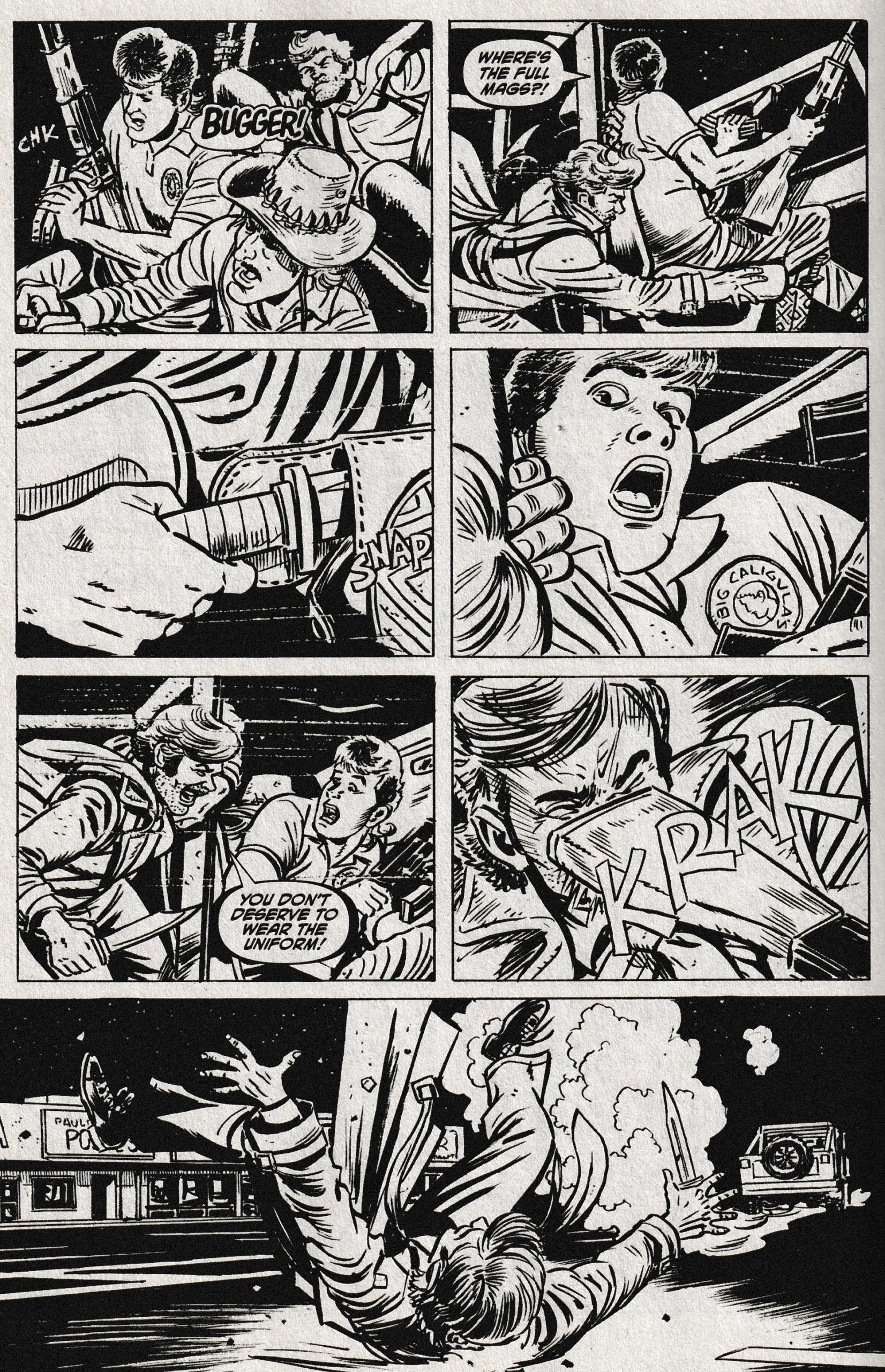
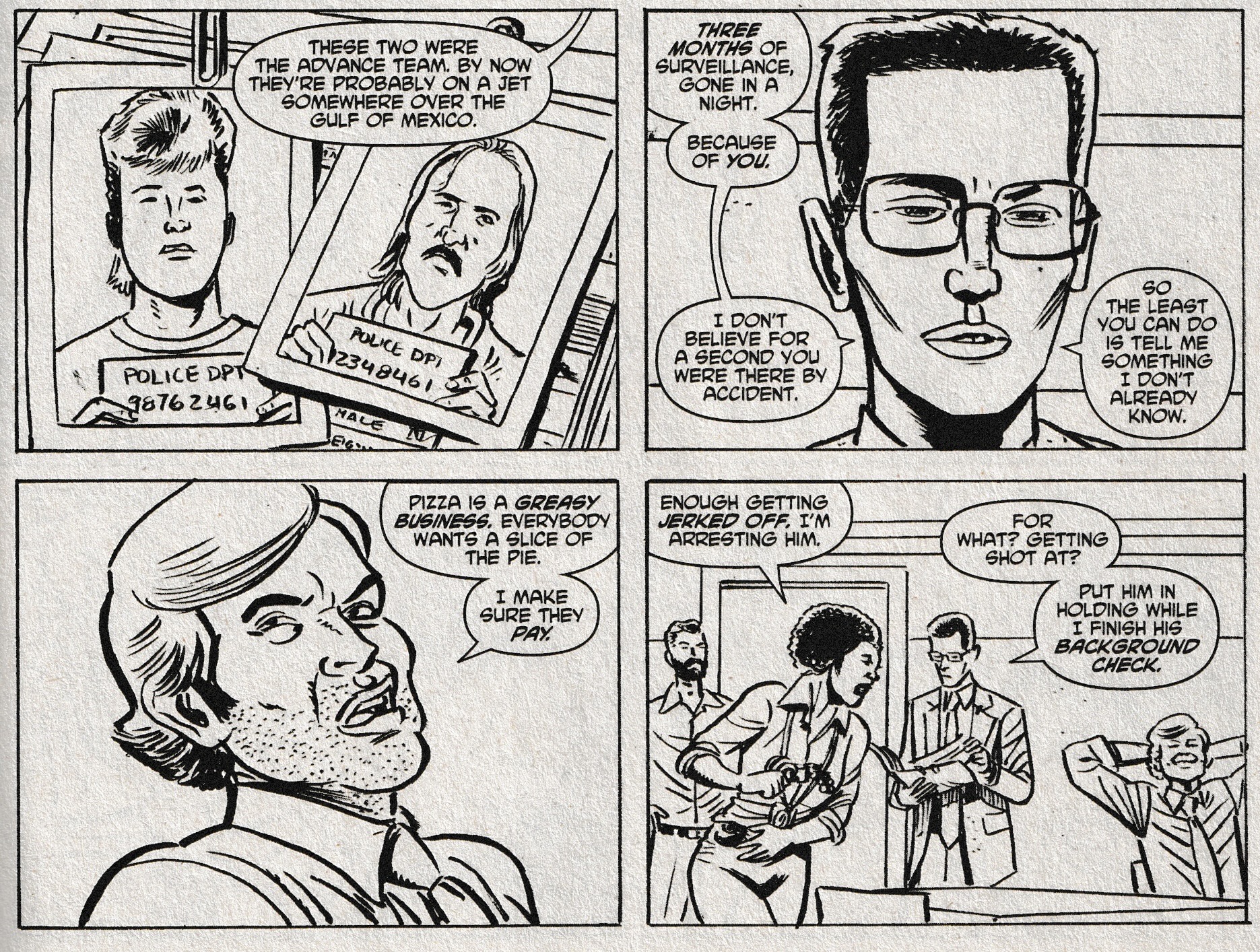
Anyway. Hank Howard. It’s a nasty book, as you’d expect from a noir, but also irreducibly zany. How else would you describe a book where all the crime revolves around pizza, and our protagonist talks about pizza in the same tone of voice that Judge Dredd talks about the law? It only works because it is absolutely, 100% deadpan at all moments, never once drops character. It only works because it’s drawn by the guy who did almost 100 issues of the aforementioned Stray Bullets.
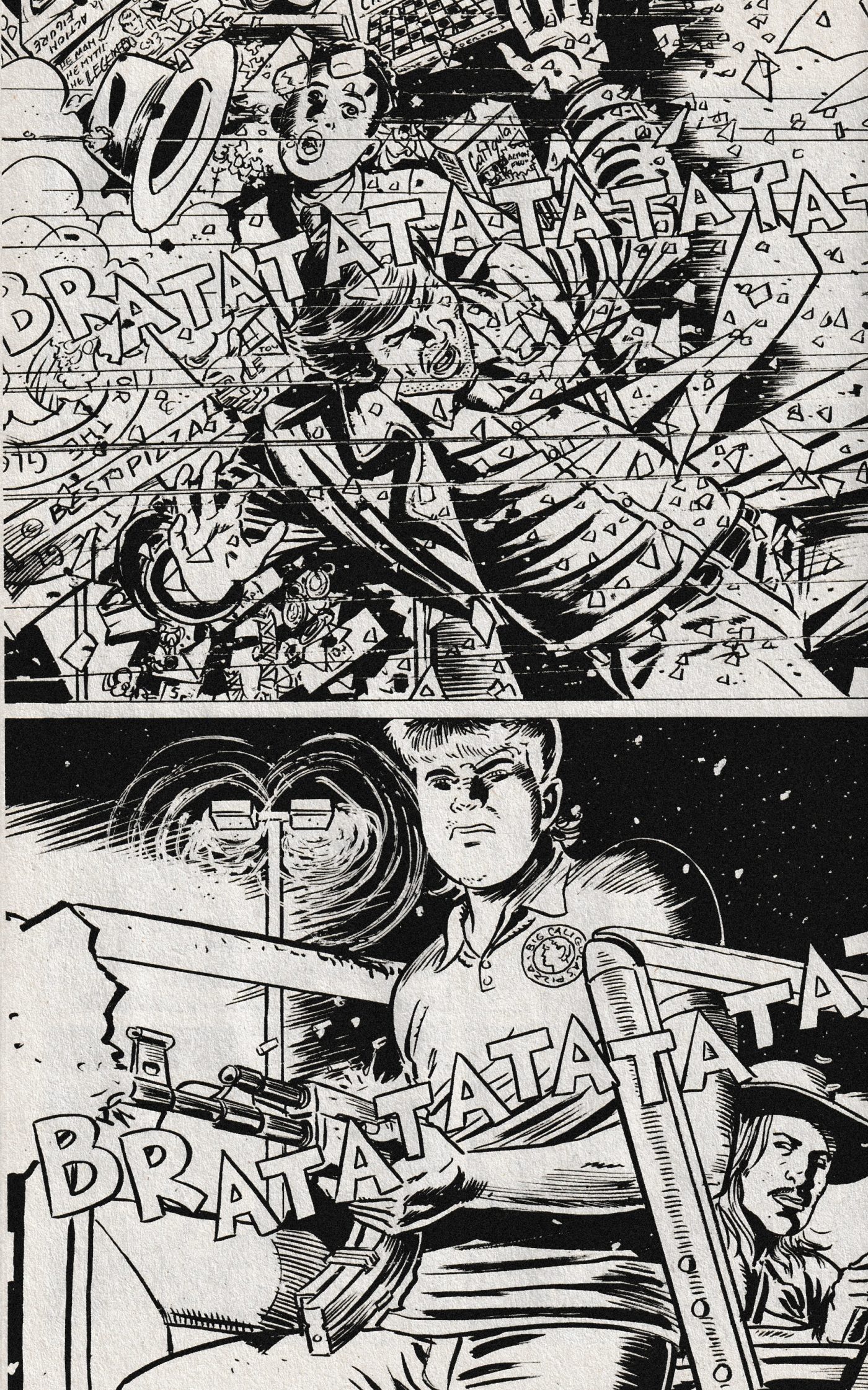
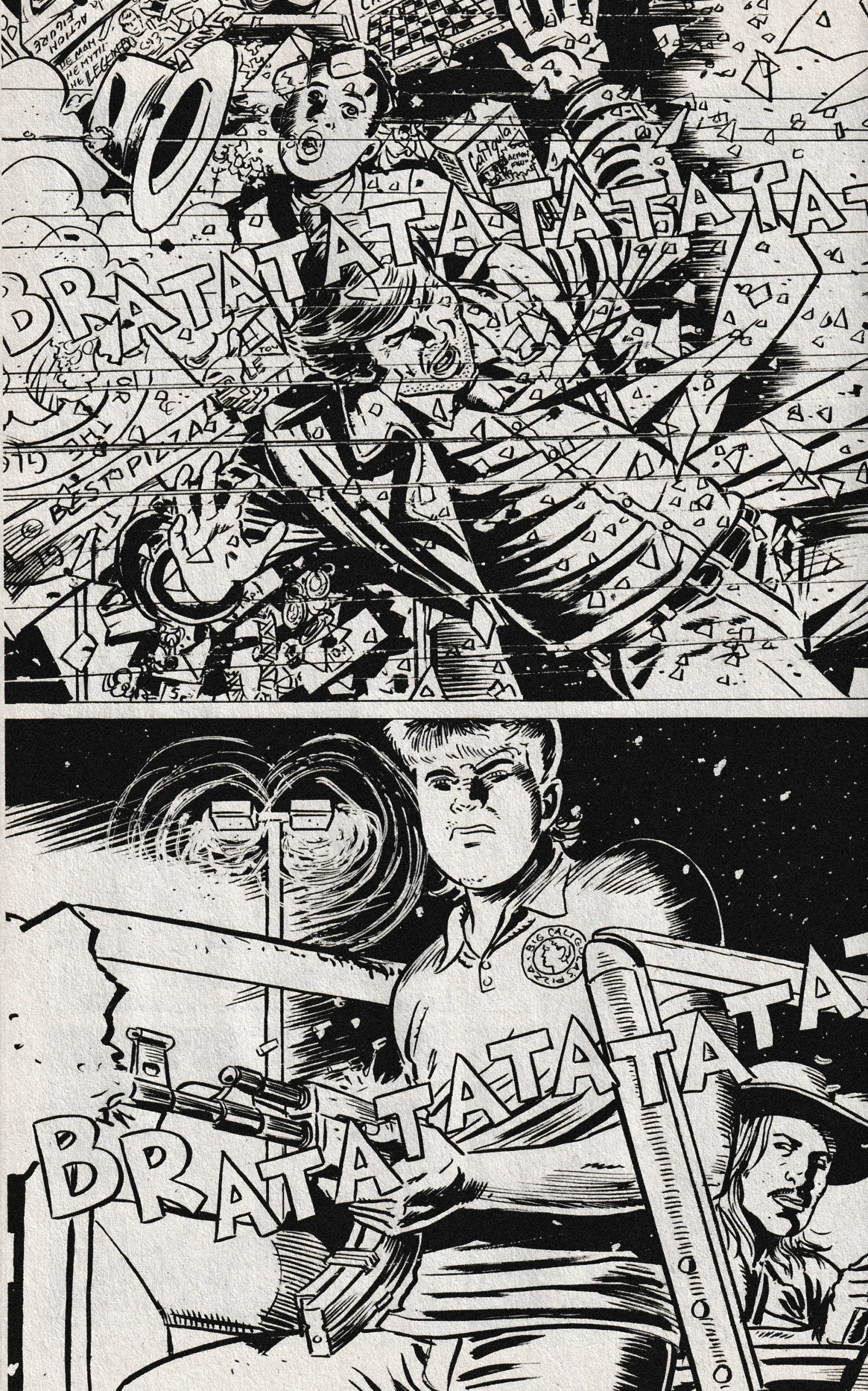
It looks so good. So good. Bad Idea print their books on a grainy newsprint that looks so good, especially for black & white. It’s a pleasing comic to hold in your hands. Just because it’s funny doesn’t mean Lapham phones it in, not at all. There’s a drive-by shooting of a pizzeria in the first issue of the series, daunting for its precision and detail. This is a joke book. It’s funny, but he’s not laughing. Someone has to draw all that shattered glass. He makes it look so damn easy.
Robert Venditti is from Florida, and the book is steeped in Floridiana — one of the Hollywoods in the title is Hollywood, Florida. The whole thing owes more than a little to Carl Hiassen, and there are certainly worse touchstones to have. It’s a crime thriller set in the suburbs of Miami, starring a hard-boiled pizza detective, somehow wearing a full length duster despite living in Hollywood, Florida. That’s funny all on its own, right?
It’s funny, and more than a little nasty. Remember up at the top of the piece when I said Lapham lacked a signature run at the Big Two? That wasn’t for lack of trying, necessarily. For instance: he’s responsible for writing one of the best Marvel comics of the current century, in the form of Deadpool MAX, drawn by the irreplaceable Kyle Baker. Released all the way back in 2010, as I recall the book was quite divisive in the moment despite, ahem, that creative team. It’s a nasty book! It’s about American foreign policy. As I recall Cable plays with his poo on-panel — am I misremembering? It’s the type of book where that thing could happen.
As unlikely as it may seem if you’re not acquainted, Deadpool MAX is one of a bare handful of books to ever try to breathe the same demented air as Elektra Assassin — it’s got a bit of that same vatic intensity. Pure expressive absurdity. Crank it up to eleven. If you’ve never, you really should do yourself the favor.
Because that David Lapham? He’s made a lot of good comics over the years. He’s a master in the field of crime fiction, but still quite handy in the realm of superheroes or horror. He can play it funny when he wants to — and some of his best work is pure satire. Perhaps most importantly he knows how to do everything himself when he needs, and how to choose the most effective collaborators when he wants. Hank Howard may be a trifle but it’s gorgeous and it makes me laugh. Who knows how much Hank Howard there’ll ever be? What there is, is good. Him and Venditti make a good team.
I’ve never been disappointed in David Lapham before, and I’ve read Warriors of Plasm. Well, I’ve read parts of Warriors of Plasm. Let’s not push it.
The post Hank Howard, Pizza Detective: The Two Hollywoods #1 appeared first on The Comics Journal.


 Hello, my name is Jack Sparrow. I'm a 50 year old self-employed Pirate from the Caribbean.
No comments:
Post a Comment