

Earlier this year, we spoke, you and I, of Harpy, an energetic and fun urban sci-fi action comic by EPHK. Today, we're right back in the soup, with Metadoggoz, another attempt from la belle France to give us a break from our dystopian cyberpunk reality by dragging us into a dystopian cyberpunk fantasy. (Or ... is it? Sorry, sorry, won't happen again.) This time, our gracious host is Bérénice Motais de Narbonne — or B*MO, for the diacritically impaired — who sets their tale in the same fictional universe they started building in their first graphic novel, Quitter la Baie (Leaving the Bay) six years ago.
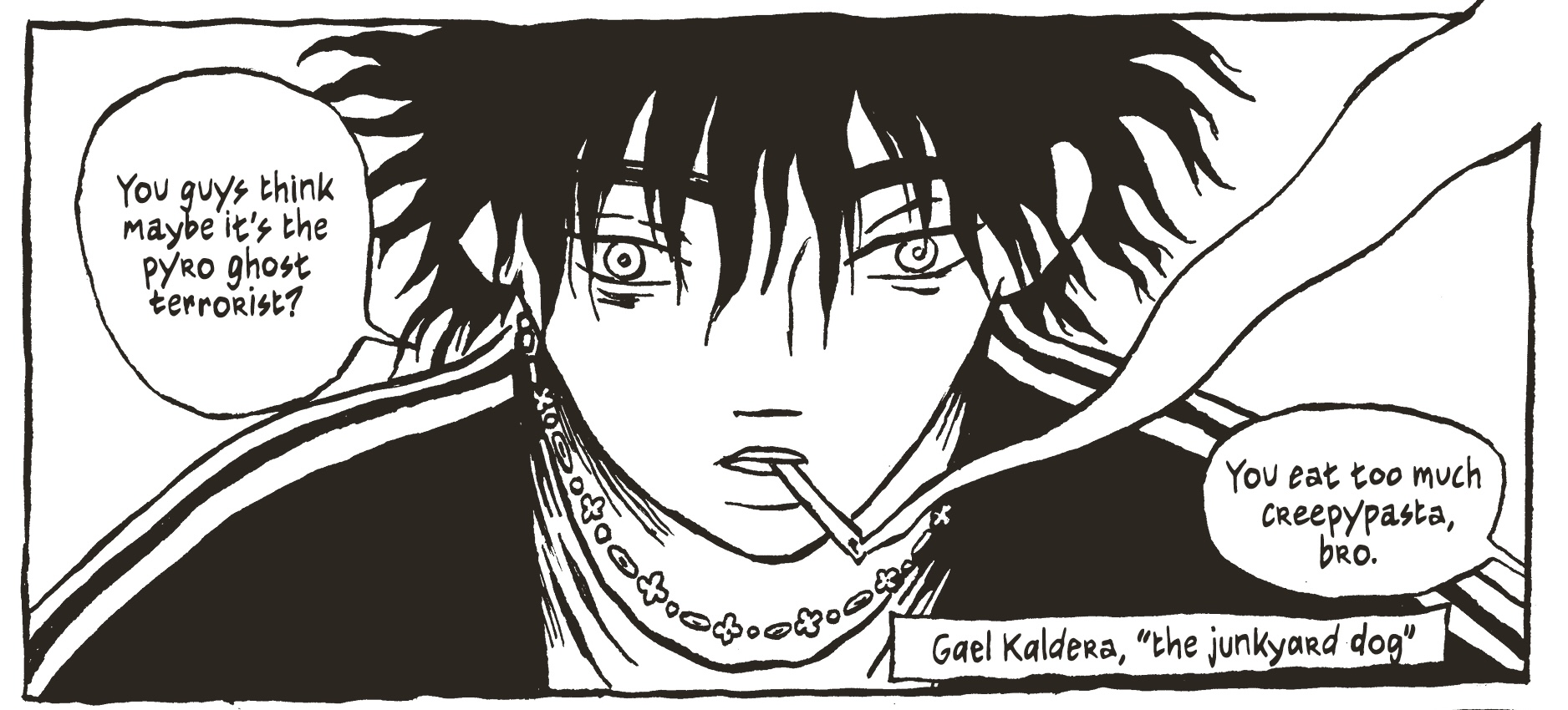
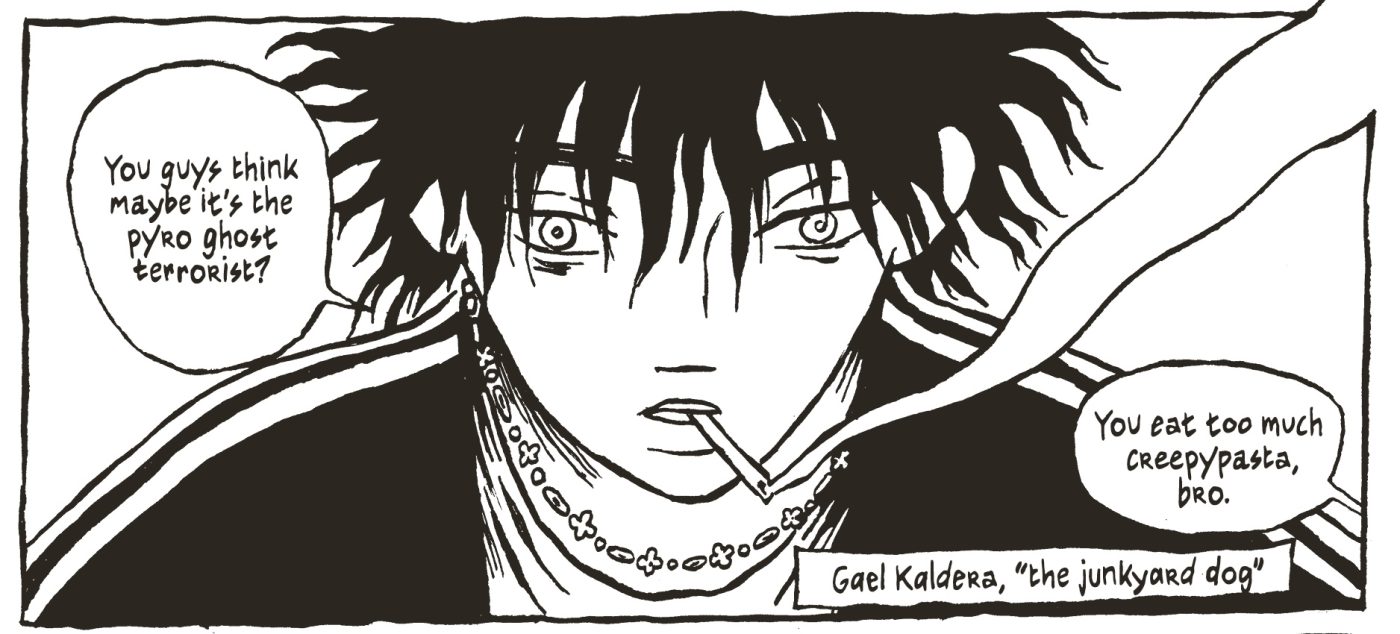
Gael Kaldera is our protagonist (at first, anyway), all angles and asymmetrical hair, the very picture of a cyberpunk anti-hero. He hangs out with a bunch of like-minded lowlifes with names straight out of a World of Darkness campaign, the first, but not the last, example of the distinctly '90s TTRPG vibe of a book that keeps reaching back while trying, and often succeeding, at being something very modern. “The city's on fire,” he says, perpetually smoking a coffin nail, to which one of his running crew responds, “Again?” Yes, it's that kind of a book. It starts out immersed in edgy punk attitude and stays in that vein even as it reaches for something more.
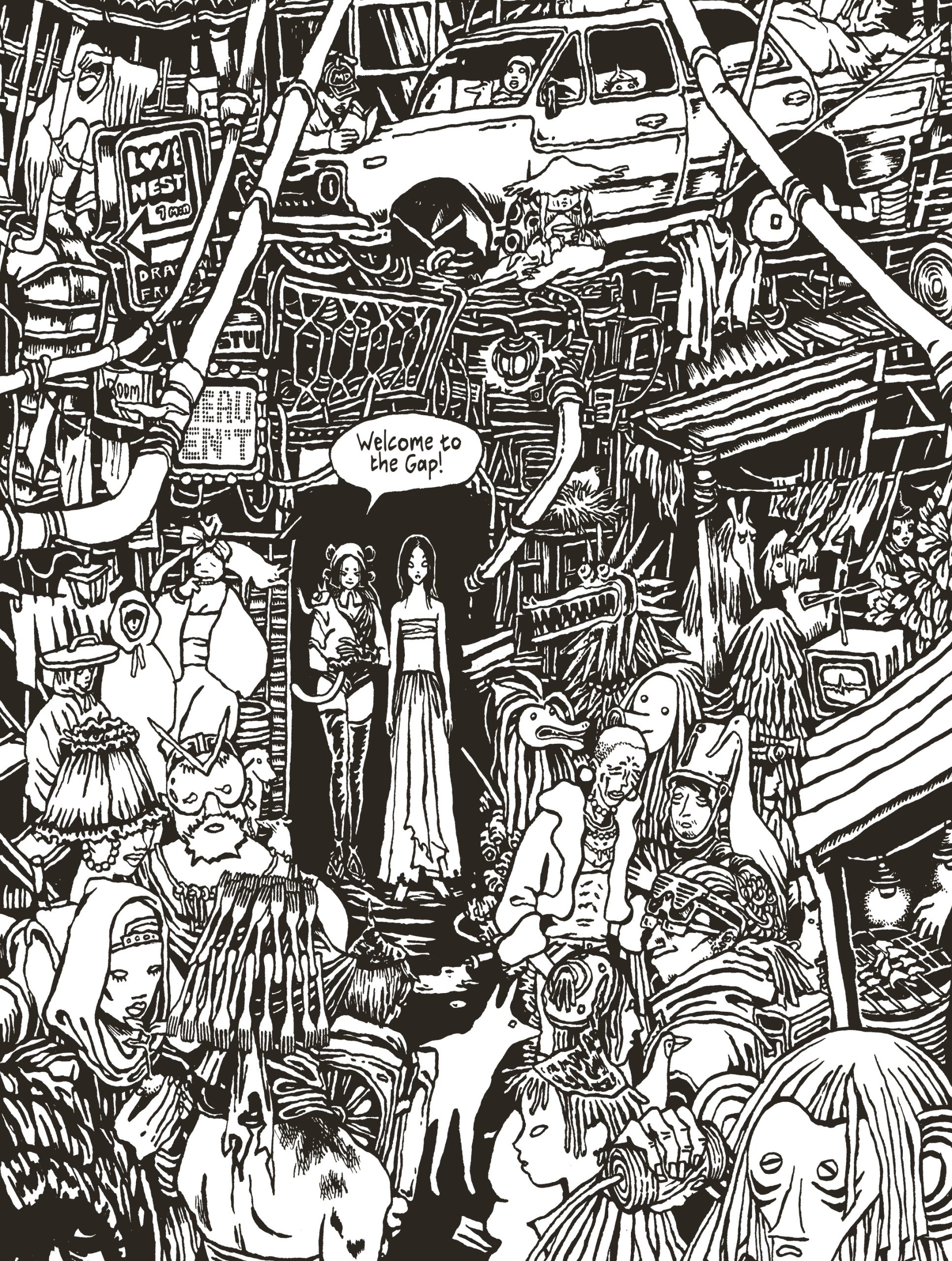
The city in question is the Metastation, a vaguely situated and enigmatic, if gorgeously assayed, high-tech mega-sprawl straight out of Shadowrun. Through an equally flimsy quest and the aid of some potent club drugs, Gael stumbles through weird sexual encounters, out-of-body trips, and close encounters of the crust-punk kind into the Gap, a sort of intra-urban liminal space, and meets up with a new cast of characters, the most prominent of which is Borísse, a self-styled healer and mystic who gathers lost souls like himself in search of ... well, something. Soon enough, Naomi, a secondary protagonist, arrives on the scene, the action opens up, and we rocked towards a conclusion that is certainly a spectacle, if not especially spectacular.
If all of this makes the plot of Metadoggoz seem a bit loose, that's because it is. Storytelling is the weakest point of B*MO's book, and that may be on purpose, but the narrative flies by coherence and cohesion at such lightning speed that you barely even notice it's there. I've read the book three times now and I still couldn't really tell you what it's about, even though the good people at this publication are paying me to do so; it ranges from plot lines that start but don't really stop to pure vibes. This is, to be very clear, absolutely a criticism: there's about 15 pages of story in this book of over two hundred, and ultimately, I found it pretty unsatisfying. But the fact that I did keep going back, well, that's also a defense, and I stand by it.
Why? Because the visuals are just that good. Metadoggoz showcases art that is absolutely fantastic, a sprawling, ambitious, and shockingly mature given its subject matter. You have to wait a good bit between anything that moves the story forward, but you don't have to wait any time at all for a stunning splash page, a brilliant use of layout, a masterful use of negative space, and shading and ink-work that makes a book done entirely in black and white pop like the most pyrotechnic color comics. From the beginning of the book to the end, every turn of the page reveals sophisticated and intricate artwork whose level of detail and attention both makes up for the slimness of the plot and makes it seem even more frustrating by comparison.
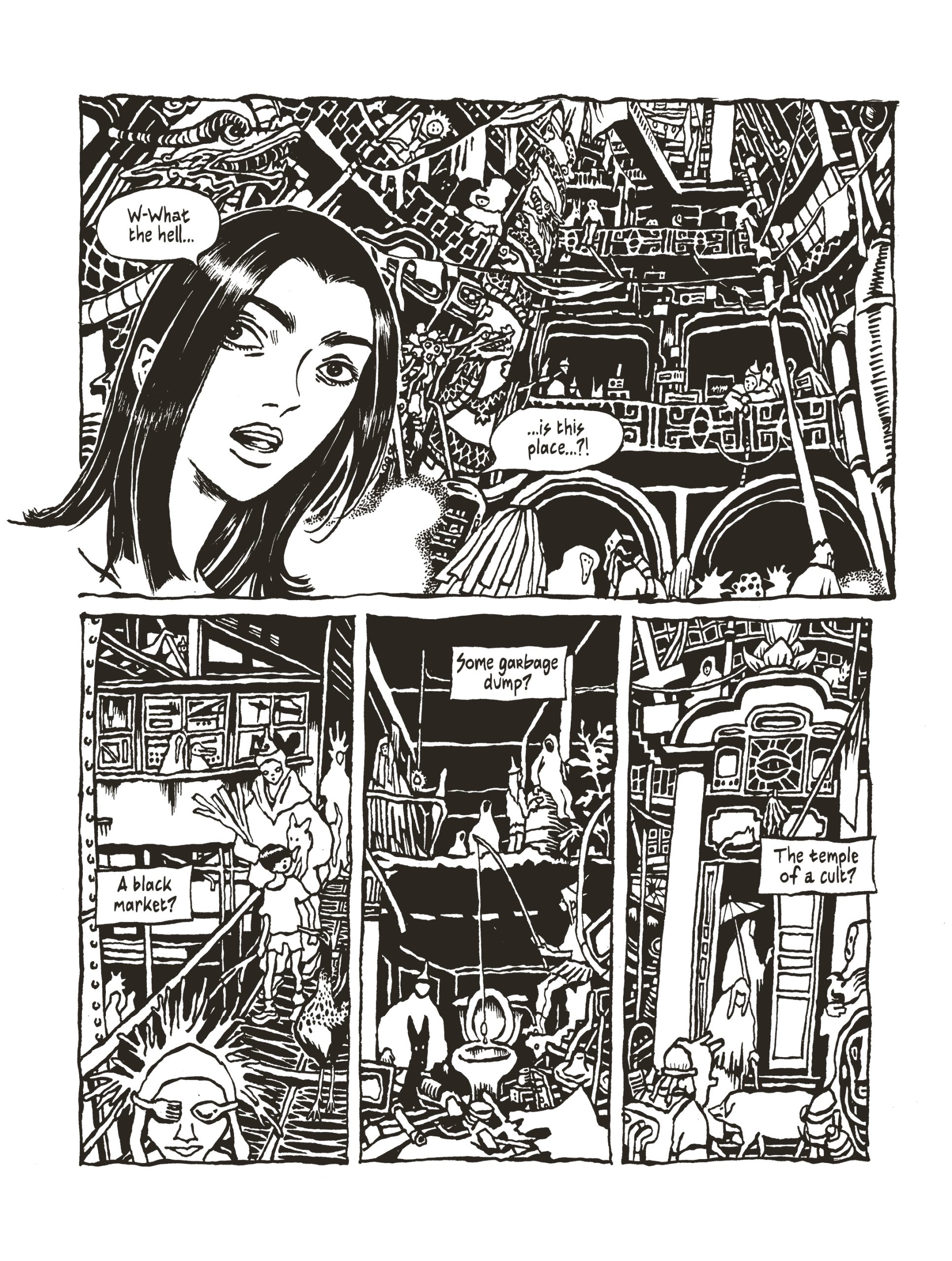 This contrast only serves to deepen the throwback qualities that make the book seem like such a curiosity, simultaneously of its moment and creating echoes of work from the past forty years. Its punk sensibility, which saturates every bit of the storytelling, recalls nothing so much as '80s zine culture; its heavy black inks, skittering lines, and rough but expressive lettering harkens back to a lot of late '90s comics; and its explorations of sexuality and personal identity, deeply felt but often surface-deep, are throwbacks to indie work (and especially online comics) of the 2000s. And yet, in most every circumstance, it reads as very particularly now. (Its youth argot, unfortunately, also fits this mold, in that references to “creepypasta” and “fuckboys” sound a decade out of date, not ideal for a book set in the near future. My French isn't good enough to know if this is a flaw of the translation or of the original work, but it's another distraction, however minor.)
The comparisons to Harpy are many, and not only because I read them both over the space of a couple of months: they're both visually dynamite, with action and movement in every frame; they're both suffused with a rambling, suggestive sense of both dread and meaning that never quite coheres into a whole, hinting at depths that don't quite manage to break to the surface; and they're both books with lead characters that would shine brighter if they were surrounded by a supporting cast that were fleshed out with a little more substance.
None of this is to say that Metadoggoz is a hard book to like, even with that unlikable title. It's got power and heft to spare, its momentum and speed carry through even the slow patches of narrative, and the art simply never stops being rewarding. If you're reading this, you know that comics are uniquely positioned to demand both good art and strong writing, and if you're reading me, you know that I'll generally give more slack to a book full of beautiful and striking visuals accompanied by weaker plot and dialogue than I will to a well-written book where the art is more forgettable. Metadoggoz puts that commitment to the test, and when I close by saying it's a book worth looking at by a talent worth watching, you should know how good that art really is.
The post Metadoggoz appeared first on The Comics Journal.


 Hello, my name is Jack Sparrow. I'm a 50 year old self-employed Pirate from the Caribbean.
No comments:
Post a Comment