

It is a universally acknowledged truth that a man in possession of a comics pitch would probably do something with H.P. Lovecraft. Either the man, or any of his many-tentacled creations. One would think that we have gone past that zenith long ago. But I can assure you that one cannot throw a stone in a comics-oriented space without hitting a fish-person or one of the avatars of Nyarlathotep.
This unholy spread of Lovecraftiana has been most thoroughly explored in Providence (by Alan Moore and Jacen Burrows), a work that culminates (as many Moore works do) in a world-ending that is both physical and metaphorical. It’s H.P. Lovecraft’s world, we’re just living in it. Providence may have been designed as the final word on the subject, and for all its qualities it is exhausting enough in its verbosity that any sane reader probably wishes it was; but that isn’t going to stop other comers from stepping into the ring. In fact, at this point Providence itself had been folded into the extant Lovecraft mythos, as can be gleaned from a guest appearance of a (nameless but easily recognizable) Alan Moore1 in today’s subject matter: The Last Day of H.P. Lovecraft.
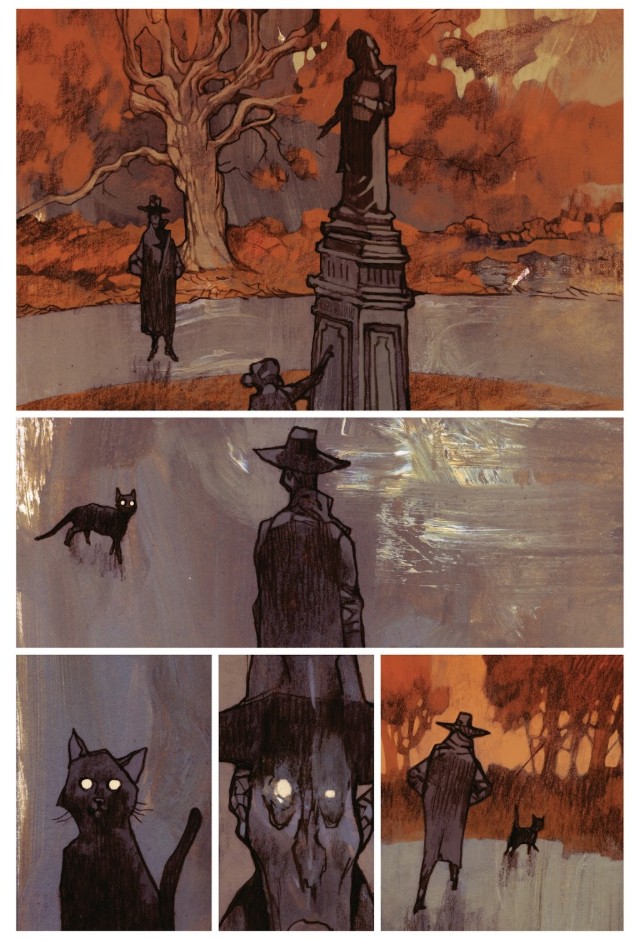
It's a French graphic novel written by Romuald Giulivo (to whom this is my first exposure) and drawn by Jakub Rebelka (a superb artist who deserves more recognition in the English-speaking world); with translation by Mercedes Gilliom and English lettering by Ed Dukeshire. In America the work got serialized as a five-issue miniseries by Boom Studios, in a manner that does not offend too much but certainly does not contribute to the reading experience; there are chapter breaks in the text, but they do not seem to correlate exactly to American issue page count. Now that the work is complete one can read it in one go, as intended, and pass final judgment — a thoroughly un-Lovecraftian terminology. For "judgment" donates care; and in Lovecraft’s world the universe does not care.
The story, little of it there is, is exactly the title promises: we are in the final day of Howard Phillips Lovecraft — March 15, 1937. Illness took him away at young age of 36. At the time, he was mostly unknown and mostly unmourned. A minor writer within a minor literary scene. Certainly, he could not imagine that the mere mention of his name would become a byword for certain type of horror fiction; that in terms of public recognition he would transcend pretty much all of the authors he so adored (with the possible exception of Edgar Allan Poe). "Lovecraft" is more than a name, it is a term, an idea, a genre. Just as it is enough for a comics reader to hear Kirby-esq to imagine what a work would look like, so any horror fan, from the veteran to neophyte, can immediately understand what to expect from a "Lovecraftian" story2.
Algernon Blackwood and Ambrose Bierce are now known mostly by experts and historians, but Lovecraft is on everyone’s mind. Thus, he remains a subject worthy of exploration, both as a person and as an influence on others. Last Day of H.P. Lovecraft tries to do both and succeeds at neither. It is presented as the stream-of-conscious of a dying mind, think The Third Policeman minus the odd charm of Flann O’Brein. Lovecraft himself, while writing mainly in the pulp plot-forward mood, was a not a stranger for such dreamlike narratives, as one can see in The Dream-Quest of Unknown Kadath.
The graphic novel follows our author in a series on encounters he hallucinates on his deathbed (or does he?!3) which include his wife (Sonia Green), several co-creators (including Harry Houdini), writers that followed in his footsteps4 and his own fictional creations. Together all of these try to prod into the soul and mind of a man in his final moments, to see what made him and what he made of the world.
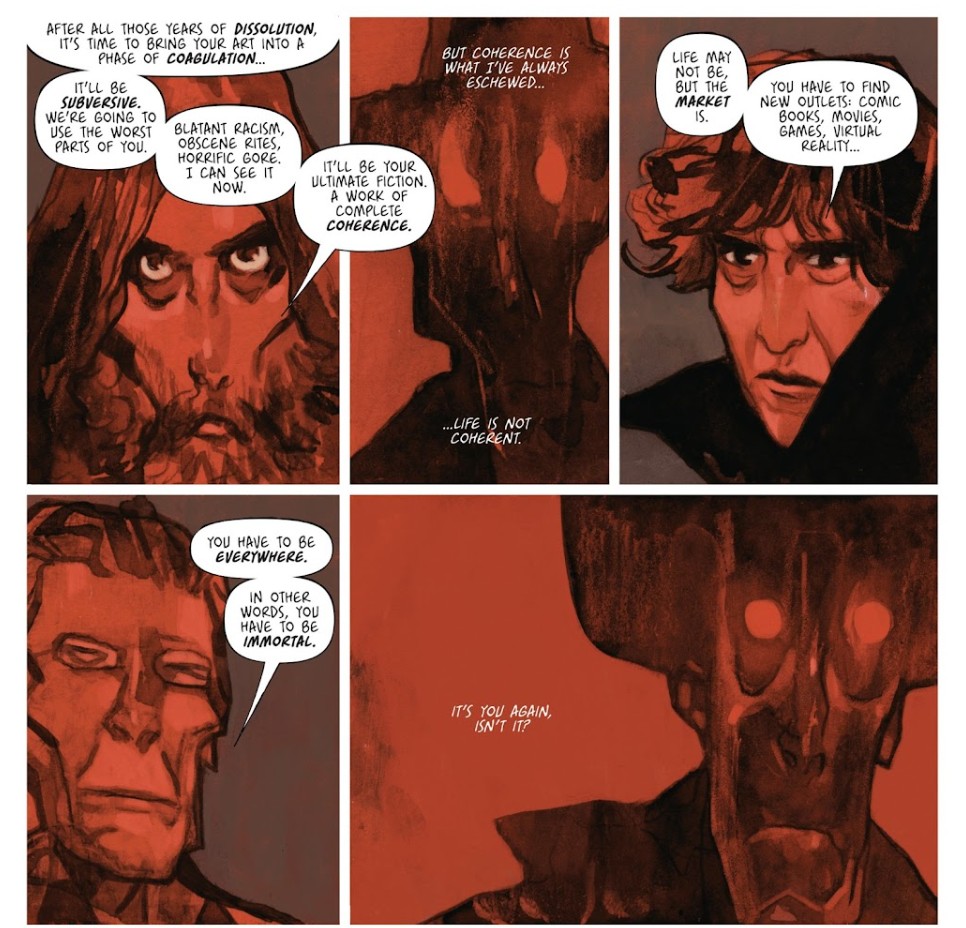
The first thing one notices in Last Day of H.P. Lovecraft is Rebelka’s art. A man of few peers in this day and age, his figures have this odd charm, as if molded by clay that slinks across the page, shifting intangibly from one scene to another. I cannot help but recall the old Soviet block cartoons that sometimes ran on state television, low on budget but high on aspirations — unlike the slickly produced American cartoons they existed in an amorphous, ever-shifting world in which one’s physical existence changed with one’s state of mind. But it is in his environments and backgrounds that he truly excels — the pathetic fallacy rules over all in his pages, the environment becomes a mirror for the character and vice versa. It doesn’t look anything like Sienkiewicz … but it has the same emotional resonance.
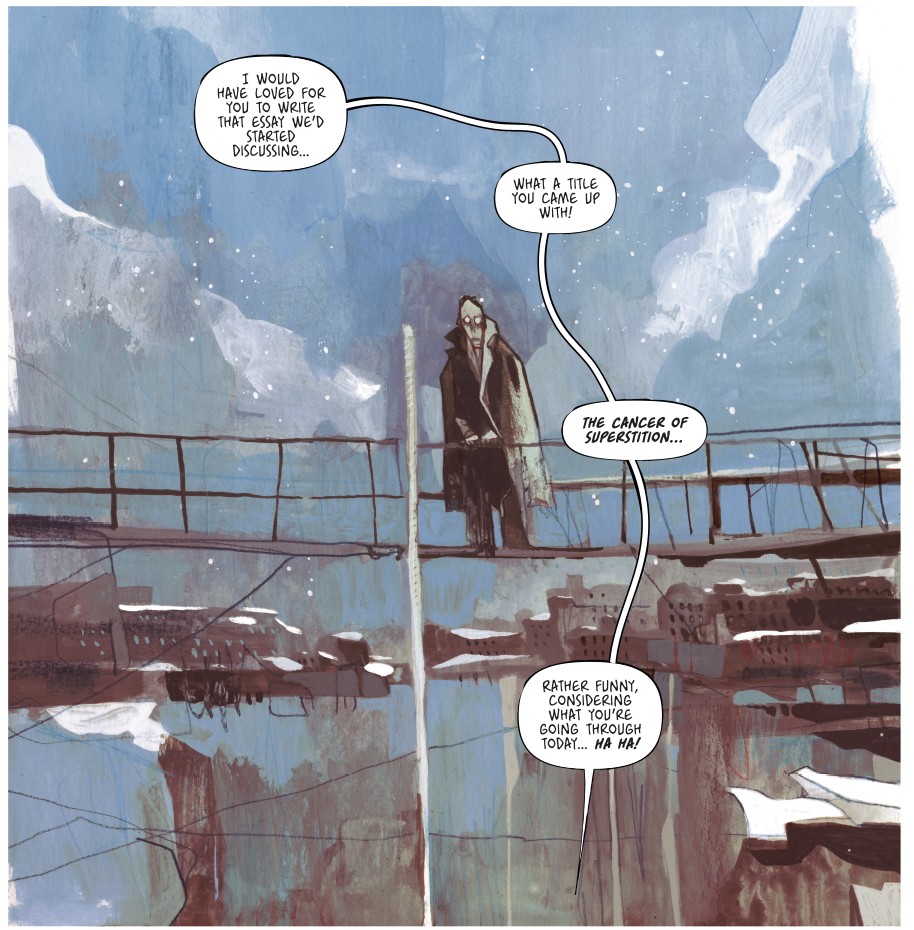
In that, Rebelka is a perfect choice to draw a man slowly dying, drifting away from outer reality and into his own inner world. The opening scene of the story, a depiction of nature as an abyss ruled by shades of red, would be disastrous in the hands of most artists (too much, too soon) but he makes it work. He makes it sing. Yet even Rebelka can’t make this dirge into something more. This is not so much a book as it is an essay trying to birth itself.
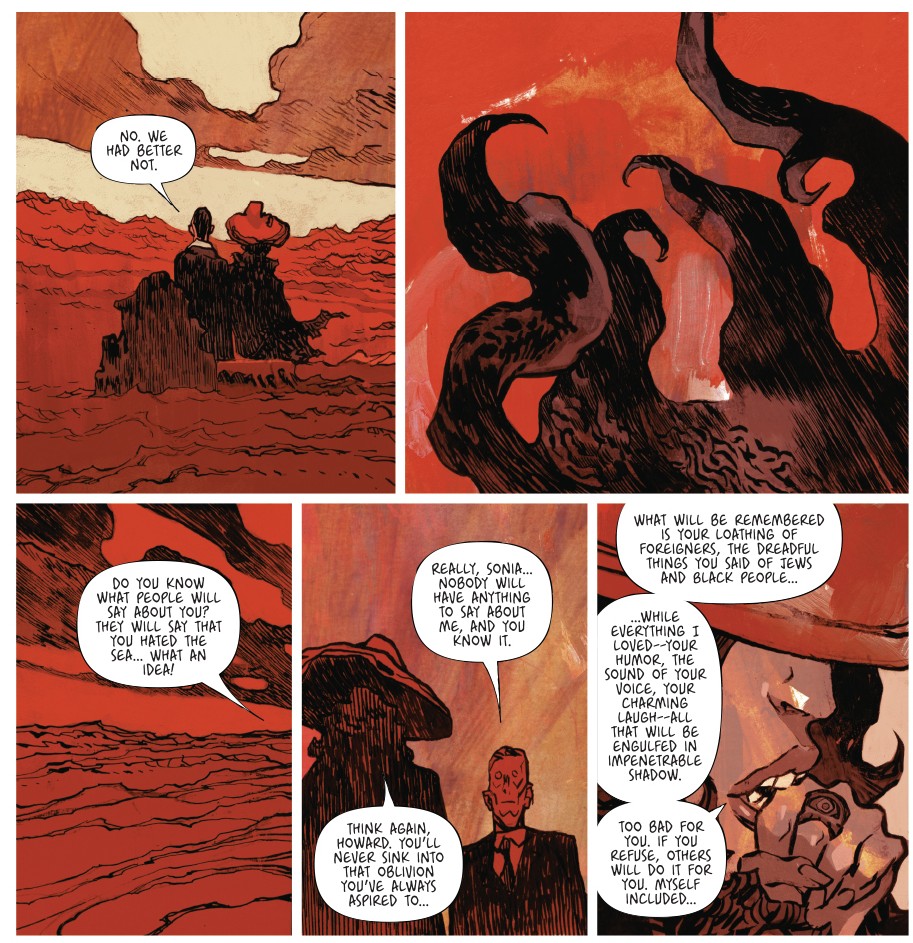
Which is fine, in theory, that is what Providence was for quite a few stretches. The same is true for many other post-Lovecraft works: from The Ballad of Black Tom (superb) to Lovecraft Country (overreaching). These books had a clear point of view and a strong thesis. The Last Day of H.P. Lovecraft is closer to a true depiction of dying in that is thrashing in mad frenzy, gesturing at all sorts of ideas and notions without developing any of them fully. Who is Lovecraft? What is Lovecraftian fiction? You will find no answers here, you wouldn’t even find the proper questions. The most memorable scene is the one previously mentioned, in which Lovecraft confronts his would-be literary successors and takes pot-shots at them. But memorable isn’t the same as good; it invites comparisons it does not want.
The Last Day of H.P. Lovecraft is not quite as bad as Lovecraft: He Who Wrote in Darkness (a previous French graphic novel that made a stab at biography), this one at least has grand scope in mind and the art to match, but it is not that much better. Lovecraft scholarship, and Lovecraft-related comics, are not something that world is lacking at this point. If one wishes the stand out amongst the crowded masses one needs to offer something more than same familiar homilies about the cruel universe, the conscious racism, the spreading literary influences, etc. All things that have been discussed as many times as Shoggoth has eyes. If one wishes to read a biography one can have go at S.T. Joshi, if one wishes to try at unexamined cultural aspects there’s Bobbie Derie. And if one wants to read Lovecraft comics … you can always pull Providence off the shelf again.
The post The Last Day of H.P. Lovecraft appeared first on The Comics Journal.


 Hello, my name is Jack Sparrow. I'm a 50 year old self-employed Pirate from the Caribbean.
No comments:
Post a Comment