

Released 50 years ago by Spire Christian Comics and illustrated by Silver Age great Al Hartley, Hello, I’m Johnny Cash presents the trials, tribulations, and eventual redemption of the country singing Man in Black.
Before his origins were revealed in book form with his 1997 memoir, Cash: The Autobiography, or on the big screen with 2005’s bio-pic Walk The Line, Cash turned to the comics medium to share his story. While only a few decades removed from being considered the lowest rung of popular culture — if not an outright moral scourge — comics represented pop art accessibility, priced to move at 39 cents a copy.
Now reissued as a stand-alone, remastered floppy by Z2 Comics for Local Comic Book Day on Sept. 23, the new edition retails with a higher price point in our era, $9.99, but comes complete with a new essay by Alex Segura, an interview with Johnny’s son, John Carter Cash, and a series of new covers, including a very sharp Hartley remix by Chip Kidd.
“It was fairly unusual for musicians to have licensed comic books back in the mid ‘70s,” Carter Cash says in the new back-matter. Sure, Frank Sinatra had appeared in some funny books, even on (a photo) cover of Four Color Comics. And there were The Monkees: the pre-fab pop combo had their own series through Dell Comics. But Cash’s comic was a rare example of deeper engagement with the medium. It may have been something of a novelty, but it was a novelty with a message.
In Hartley, Cash found the ideal artistic collaborator. Like Cash, who’d spent the early ‘70s vocally extolling his Christian faith, Hartley was a believer. In 1967, he underwent a dramatic conversion experience worthy of its own bio-comic adaptation. Wiped out after two decades of work with Stan Lee and other collaborators in the trenches at Atlas and Marvel Comics, his marriage was on the rocks and he was deeply unhappy in his life, feeling, “sterile, numb, and filled with fear.”
Pushed to the end of his rope, Hartley fervently prayed for God to “take hold” of his life. Along with his wife Hermine, he became a born-again Christian. His newfound religious zeal began to influence his work in the popular teen saga Archie, and soon he began working with Fleming H. Revell’s Spire Christian Comics.
Targeting an audience of churchgoers and Christian bookstore shoppers — and maybe even a few unbelievers if they crossed over — Spire launched in 1972 with a pair of adaptations of popular Christian books, Rev. David Wilkerson’s The Cross and the Switchblade and John and Elizabeth Sherill’s God's Smuggler, both done up in Hartley's colorful and exuberant style, cartoony, but groovy in its sensibility. Eventually, Hartley convinced Revell to license the Archie characters too, and soon enough, the Riverdale gang was appearing in a series of explicitly evangelical comics for the upstart publisher.
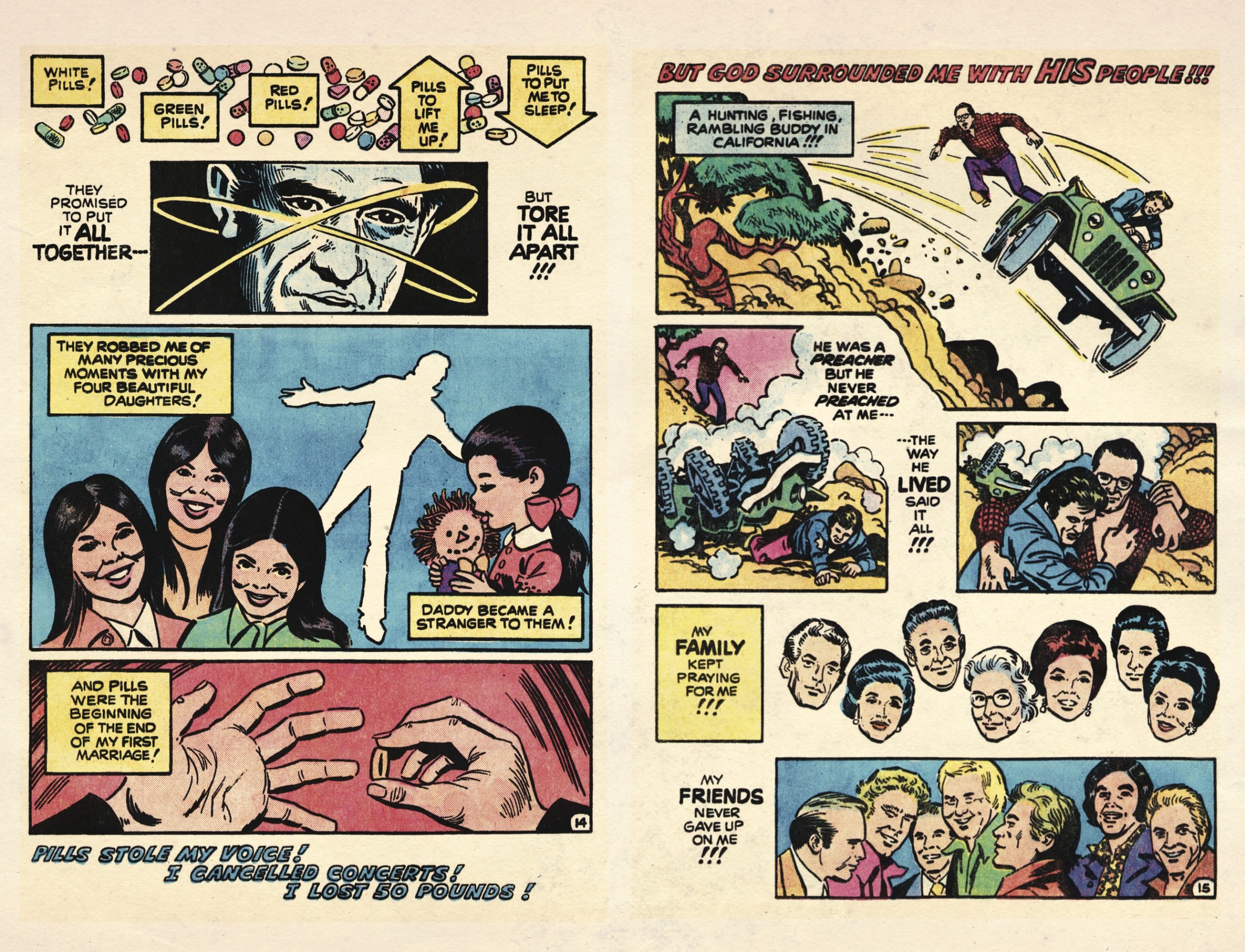
While some unexpecting, secular fans of Betty and Veronica may have been intrigued enough to pick up a Spire Archie title out of curiosity, Cash represented the comic company’s biggest get yet, a mainstream star with genuine name recognition. Drawn from interviews with Cash himself conducted by Hartley and evangelist-cum-comics author (and former White House chaplain) Billy Zeoli, nearly every panel of the comic bristles with fervent energy, showcasing a creator inspired to instill a sense of grandeur and widescreen scope into Cash’s testimony.
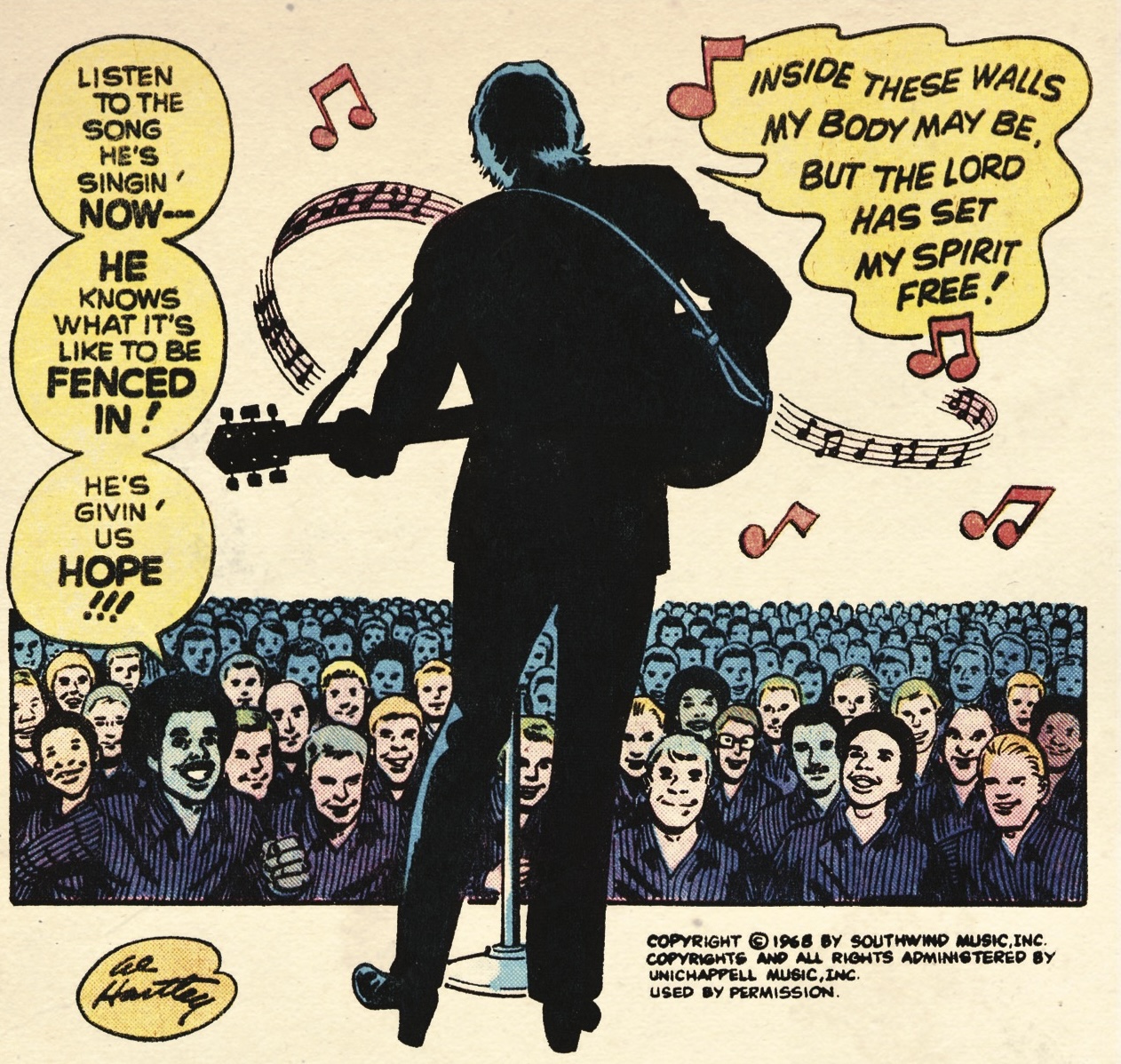
Throughout the book, dynamic splashes denote pivotal moments in Cash’s career: his commercial heyday playing major venues; the making of his ambitious big-screen debut, 1973’s Gospel Road: A Story of Jesus; his infamous performance at Folsom prison in 1971, depicted here with one Afro-sporting inmate reporting with a massive smile, “He knows what it’s like to be fenced in.”
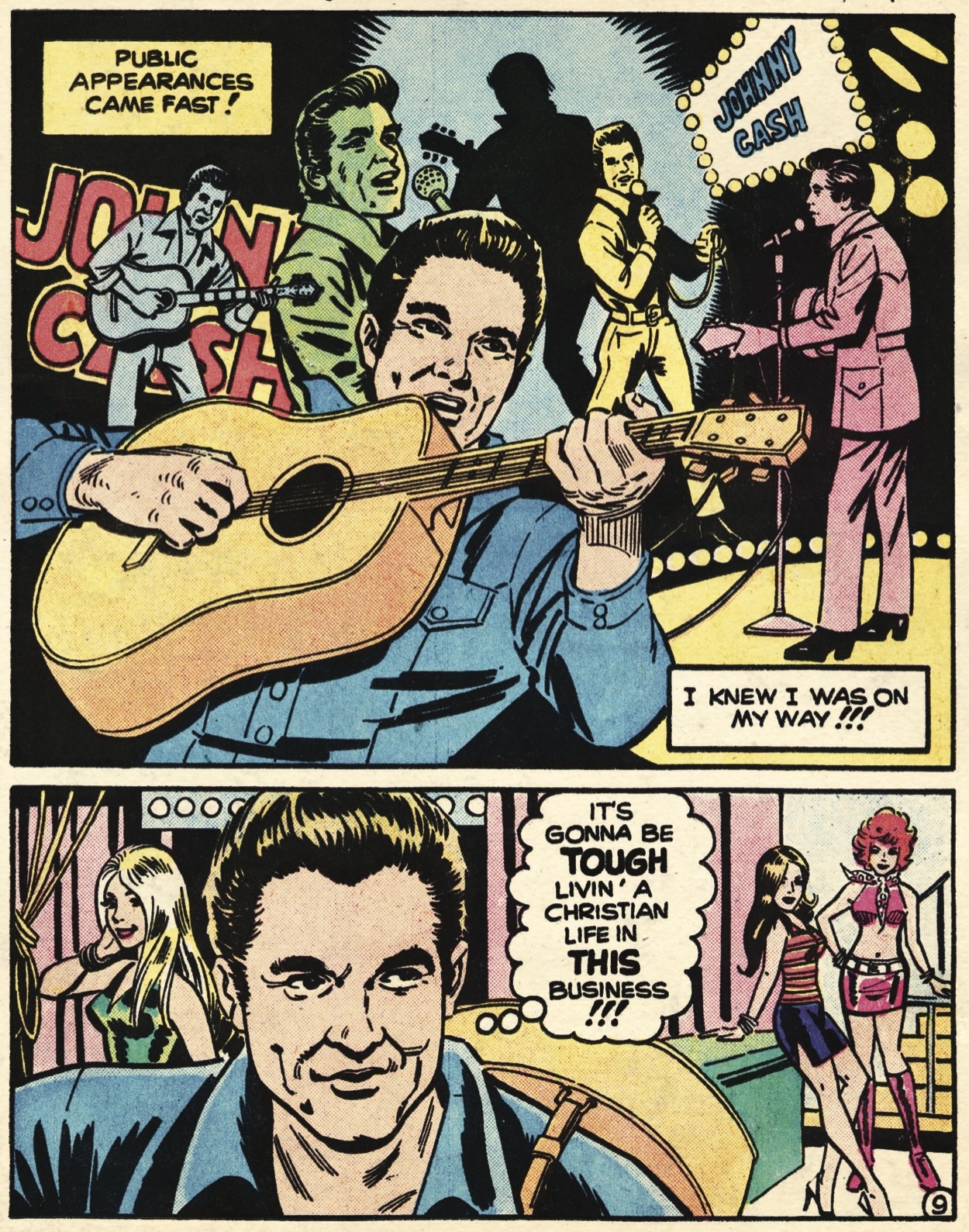
But the real magic of the comic lies in Harley’s more intimate panels, depicting a wealth of human expression. The facial work on display in one of my favorite sequences even edges into the comedic: Cash, surrounded by beautiful would-be groupies, wears a sly grin while while remarking, “It’s gonna be tough livin’ a Christian life in this business,” with three exclamation marks to sell the point. Elsewhere, as Cash suffers in the throes of addiction, we see a close up of his face, bloated and sweaty, framed by three miniature representations of Cash performing in concert, his pain evident.
These close ups are paired with zippy collage sequences, which collapse time, simulating the dizzying effects of the pills that Cash pops to maintain his relentless creative pace, his narcotized drift away from his family.
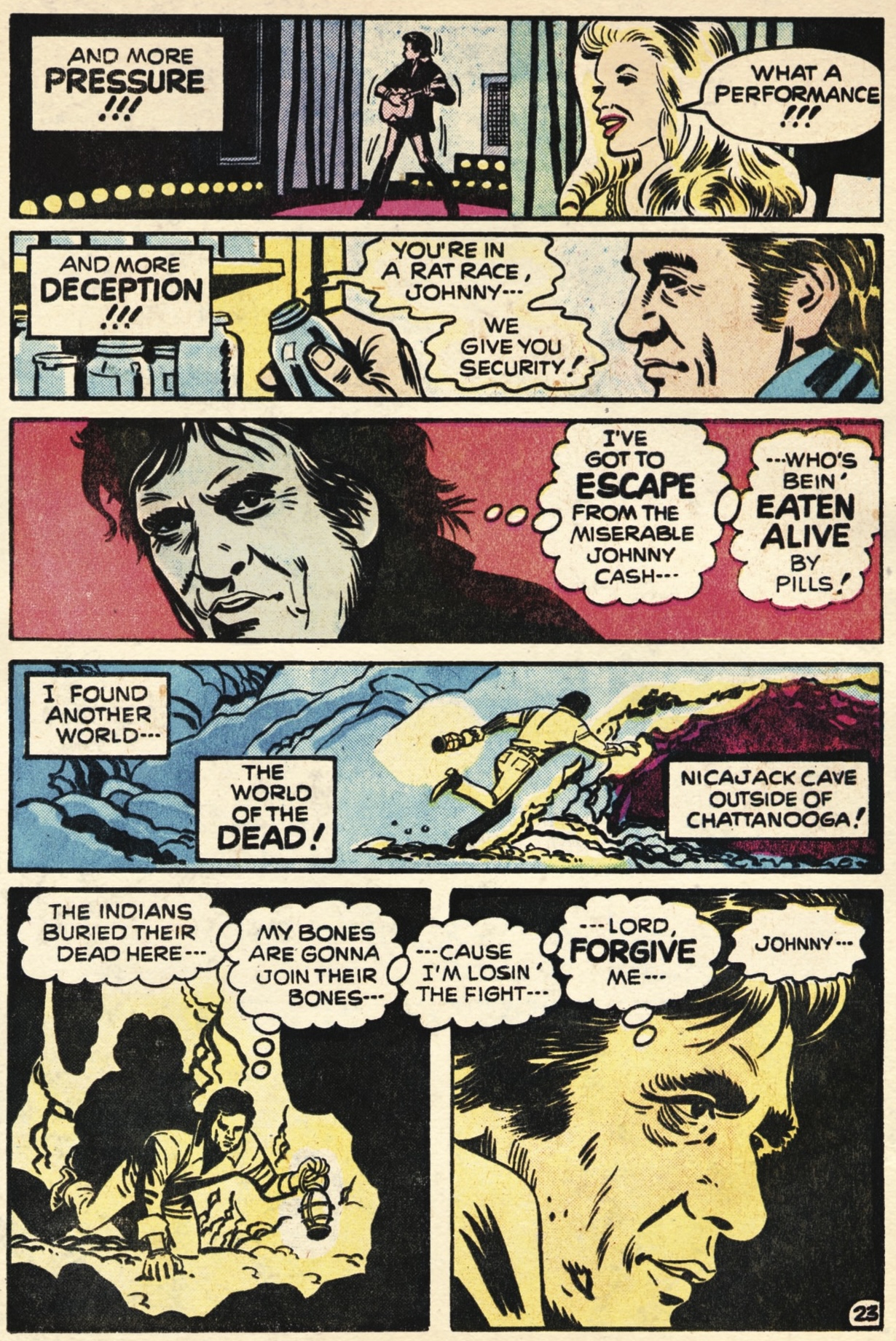 Cash’s turning point is a highlight, illustrated almost like an EC horror comic, all arcane color combos and moody nocturnal landscapes.
“I’ve got to escape from the miserable Johnny Cash who’s bein’ eaten alive by pills!” Cash says, drawn like a pale zombie in front of a blood red background.
From there, Cash flees into Nicajack Cave outside of Chattanooga, Tennessee, entering “the world of the dead,” intent on dying, his bones scattered there with the Indians who died there before him.
It’s in this literal dark night of the soul that Cash finds his deliverance, feeling the hand of God upon him, prompting him to crawl for hours, prompted by a cool breeze to escape the cave in which he’d become lost. Though Cash may have exemplified an outlaw archetype, the story he and Hartley lay out is one of redemption, the rogue gone good — here that story finds a foundational myth.
Given its all-ages nature, Hello, I’m Johnny Cash doesn’t get as dark as it could. There is, after all, no mention of the accidental death of Cash’s brother Jack Cash, who died at 14. And it also sidesteps some specificity about the way his faith played into his creative life, including Cash’s vocal opposition to the Vietnam War and his controversial Native American advocacy.
As with other Spire comics, when it comes to the salvation stuff, Hartley lays it on thick, but the rest of the drama comes with a light touch. The energy embodied by the infamous flipping the bird photo isn’t found in this comic, but even keeping it PG, Hartley captures a real sense of spiritual tension. In one key panel, Cash’s second wife June Carter Cash points him to the Apostle Paul’s words in Romans: “I want to do right, but there’s something in me that makes me do wrong.” The comic concludes with Cash wearing a wide grin, fully domesticated and in the keep of kith and kin, but nonetheless, there’s a reason the man still dressed in all black when he took the stage.
Following Cash’s comic debut, gospel singer Andraé Crouch teamed with Hartley and Spire for his own comic, On the Road with Andraé Crouch. And in the immediate following years, rock bands like KISS, Alice Cooper, and even the defunct Beatles would bring their stories to Marvel Comics. In the decades to follow, Prince would team with DC Comics and Revolutionary Comics would publish a series of popular but unauthorized rock bios under the Rock ‘N’ Roll Comics banner.
What makes Hello, I’m Johnny Cash a compelling publication even 50 years later isn’t the fact that it beat all those other titles to press, but that it’s a great comic book on its own and a genuine if slightly sanitized version of the story. “Sometimes I am two people,” Cash once said. “Johnny is the nice one. Cash causes all the trouble. They fight.”
Z2 notes more modern Cash comics are on the way. Here’s hoping those contrast some “Cash” energy to this book’s distinctly “Johnny” tone. But taken on its own terms, Hello, I’m Johnny Cash is an archetypal story of grace, family, and personal salvation rendered by a comics legend who put his all into it.
The post Hello, I’m Johnny Cash appeared first on The Comics Journal.


 Hello, my name is Jack Sparrow. I'm a 50 year old self-employed Pirate from the Caribbean.
No comments:
Post a Comment