

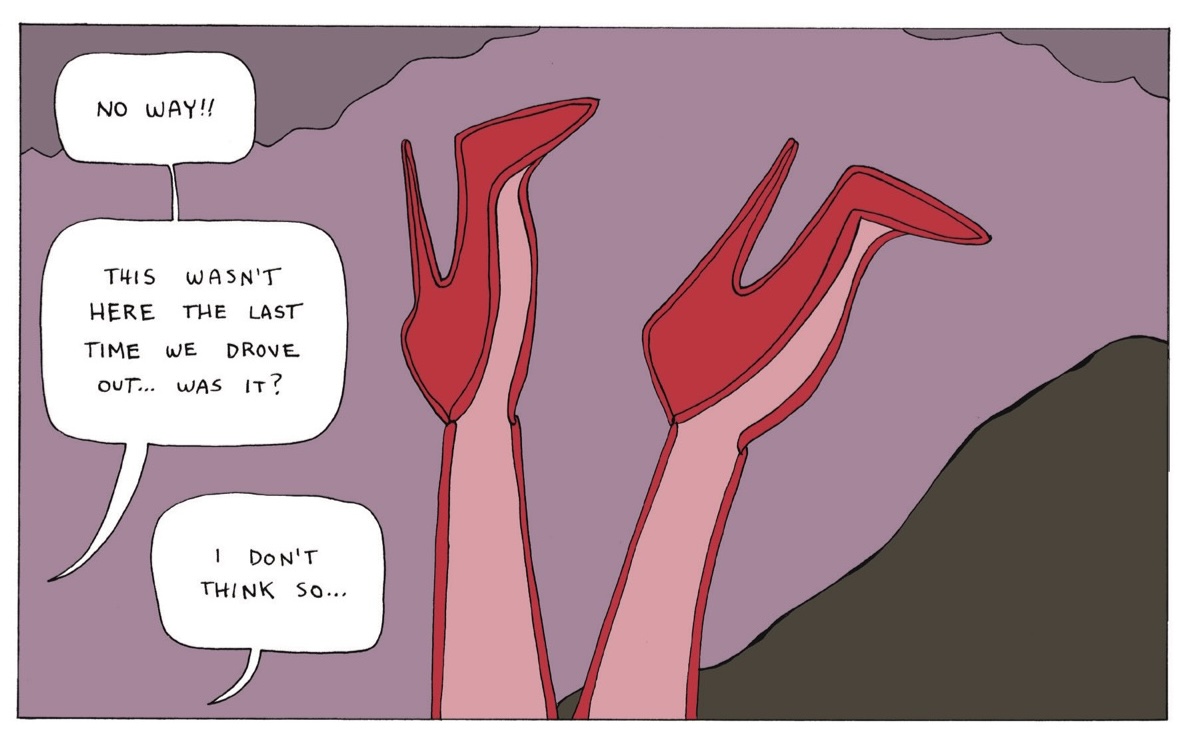
The promotional copy for Katie Skelly’s graphic novel, Heaven, informs us that the new book is Skelly’s first outing in six years. In other words, it tells us: Katie Skelly is back. Of course, to those following, Skelly has never, strictly speaking, gone away — in the last six years she has launched her own small press, Strega Sporca; edited two volumes of her horror anthology Viscere, as well as a book of wrestling drawings by Jaime Hernandez; and released several self-published mini-comics of her own. Nonetheless, a new project from Skelly is always, to me, a cause for celebration, and Heaven sees her at her sharpest and most introspective yet. I spoke with Skelly over email about the new book and the long journey to its completion. This conversation has been edited for flow and concision, and contains spoilers for Heaven, in stores now. — Hagai Palevsky
HAGAI PALEVSKY: So, a major part of the promotion for Heaven is the fact that it’s your first long-form release in six years. Does it feel like a major event to you, within your body of work? Does it feel like I was away and now I’m back, baby?
KATIE SKELLY: Ha! In a way, sure. It's harder for me to zoom out and see what's happening. I'm more just moving through things day-to-day. A lot has changed for me in the last six years, but I always had something going on, comics-wise. A collected book is an opportunity to present a formed idea to the world, but it takes a million little steps to get there. I understand the angle, though. It feels nice to be met with enthusiasm on that front.
Tell me about your life at the time you started working on the book. 2021, you’re in New York, COVID restrictions in full swing. I think you were in a long-distance relationship at that point. Were you still holding down a day job?
Yeah, I was in New York. I finished working on my last book Maids the weekend before the lockdown started in March 2020. From there, it felt like everything just sort of got chopped off. All of these things I was looking forward to, like getting to go out and travel, do the bigger, national shows, were gone. I couldn't even really go out and celebrate finishing the book with my friends. Small disappointments in the greater scheme of things, and of course it could have been much worse. But that was still disheartening for me.
I moved to Los Angeles in April 2021 and started working on the first issue of Heaven a few months after I got there. It was something to lean on as I was figuring everything out. I was still working. I still am, though I quit full-time work in 2022 for a few months to try to segue into part-time work and get more into just creating comics. But I just wasn't there and went back to full time. I'm sort of institutionalized at this point, I've been working since about when I started making comics and it's just how I know how to structure my life.
So when I started drawing Heaven, I was thinking it would be this long, gritty story, but something a little more tender started weaving itself in. I was like, All right, this is my Los Angeles mutation starting. It felt like something fresh and interesting coming off of the heaviness of Maids. I was like, Let's see where it goes.
I hadn’t realized you still had a job outside of comics, actually. Would you mind saying what it is?
Office stuff. Not super interesting.
The thing I find significant is that it sounds — please correct me if I’m wrong — like you went back to full-time work not so much out of financial necessity as for your own internal rhythm. Which is interesting partly because it’s somewhat rare to hear cartoonists speak in favor of that arrangement — usually the ideal is to focus on your art and be “your own master,” so to speak. So I’d love to hear about your routine and the balance between the two.
Believe me, it's a financial necessity! I just came to the conclusion that I want to make comics, and I want to do it my way; I need to have a life that can sustain me to do so. So, if that means I need to put x number of hours a week in to get my insurance and relieve the stress of wondering about the next paycheck, I'll do it. But it's also like ... I've worked for some genuinely great places! And I worked with a lot of really talented, creative people who I learned a lot from. My setup felt very normal in New York. Because I was working for art institutions, pretty much everyone had something else going on that they really cared about. I made lifelong friendships and had all these experiences I wouldn't have had necessarily otherwise.
I look forward to working on my comics at the end of the day or on the weekends. Sometimes I'll use vacation days to draw or catch up on things. When I was younger I'd get up before work and draw, but I need more energy these days so it's primarily an after work thing.
On a typical day, after work, how long do you work on your comics for?
Maybe a couple of hours, but it depends. If I'm just drawing it's more straightforward and I can get more done. If it's more figuring things out in the writing and the drawing then that can be longer.
How instinctive are you, as both a writer and an artist? Do you have to actively work at your story or is it something that comes naturally? I note the phrase that you used when speaking about Heaven a bit earlier, “something a little more tender started weaving itself in.”
I just like to clear my mind and see what happens. If something starts making itself known, I'll listen to it, but it has to do it a few times. I read once that ABBA would spend time improvising music without writing it down, and if they could remember the melodies the next day they knew they had something worthwhile. I like that idea. I'll be working off a scene I wrote, and, if the next time I come to it I have the same idea about where it could go or what it could do, I'll explore it. But, if it's not interesting enough to recall, if it hasn't stayed on my mind, I'll stick with my original plan.
How much do you write that doesn’t make it onto the finished page? Auxiliary material, backstory, etc. — stuff you know but the reader doesn’t necessarily. Is that an approach that interests you at all?
Not very much. If it doesn't exist in the comic, it probably doesn't exist elsewhere.
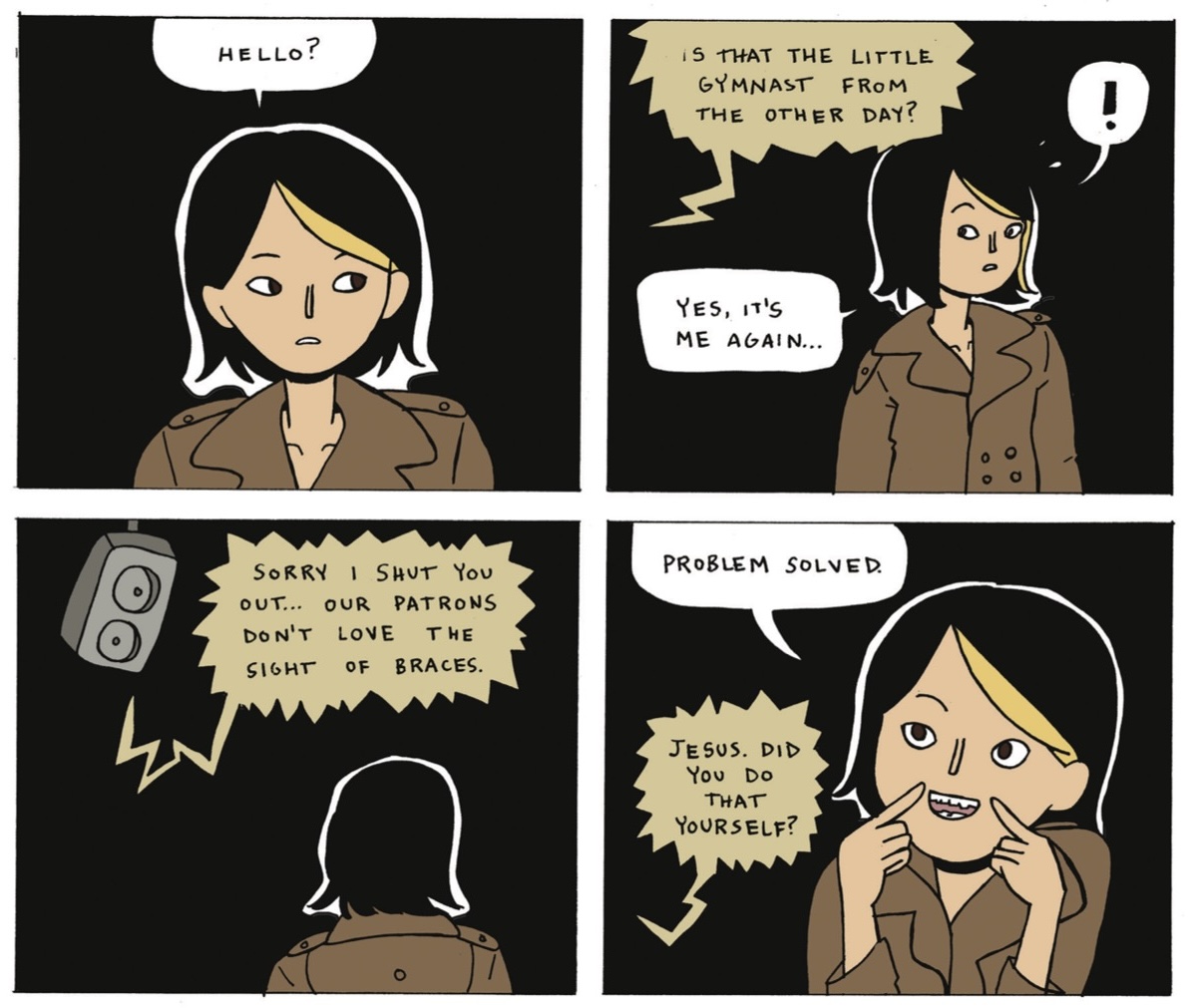
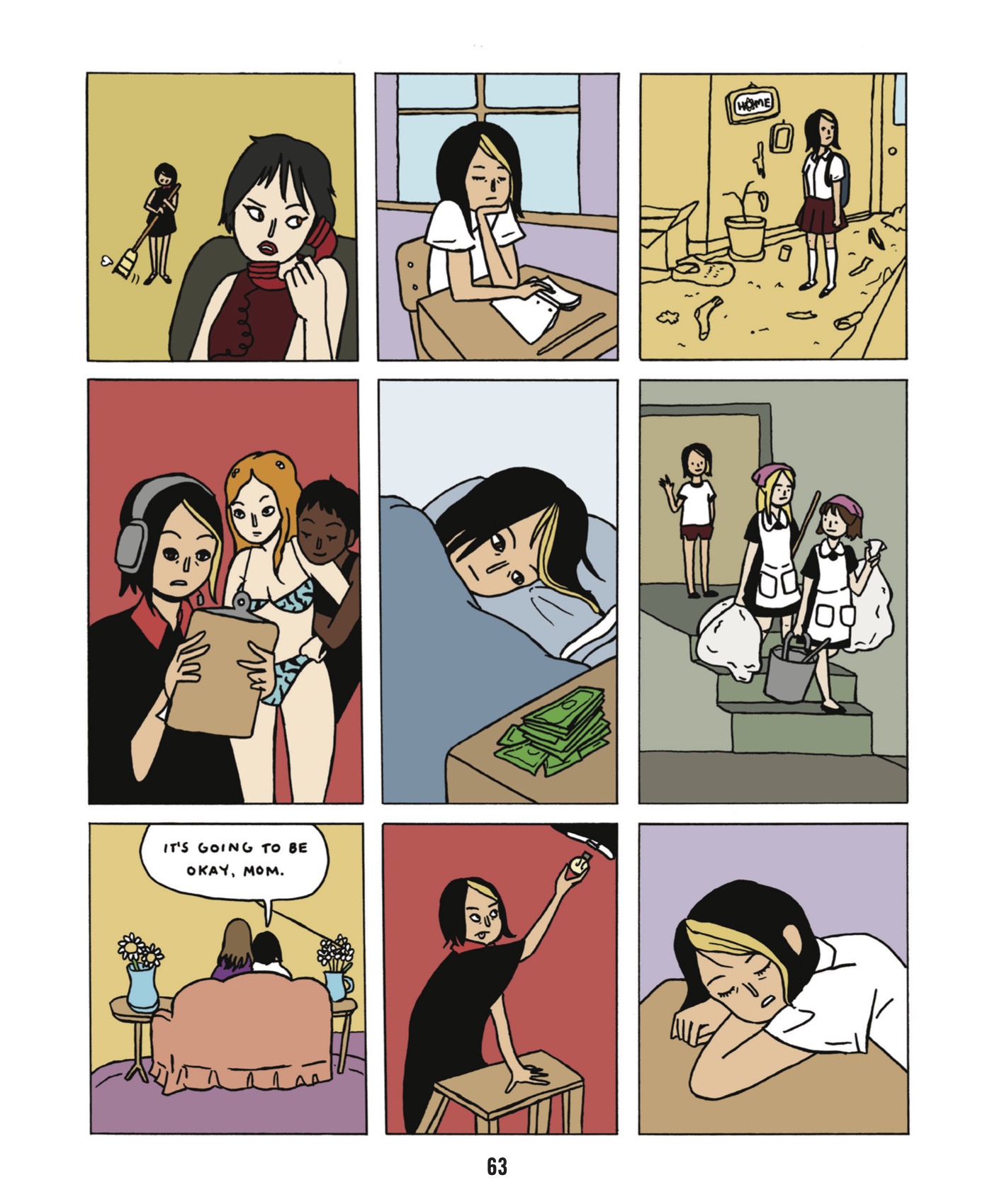 I did notice in Heaven that you tend to focus on real-time action. Your characters are constructed very clearly, but it’s through action. They don’t stand still and talk beyond what’s purely necessary. We can see, for example, that Dolly’s family is dysfunctional — her house is a mess, her mother is "in her life" but a conspicuous absence in the story itself — but these are details that are mentioned rather than lingered on. So I guess the question would be, at what point does a character "come alive" for you, beyond the broad type or role that they play?
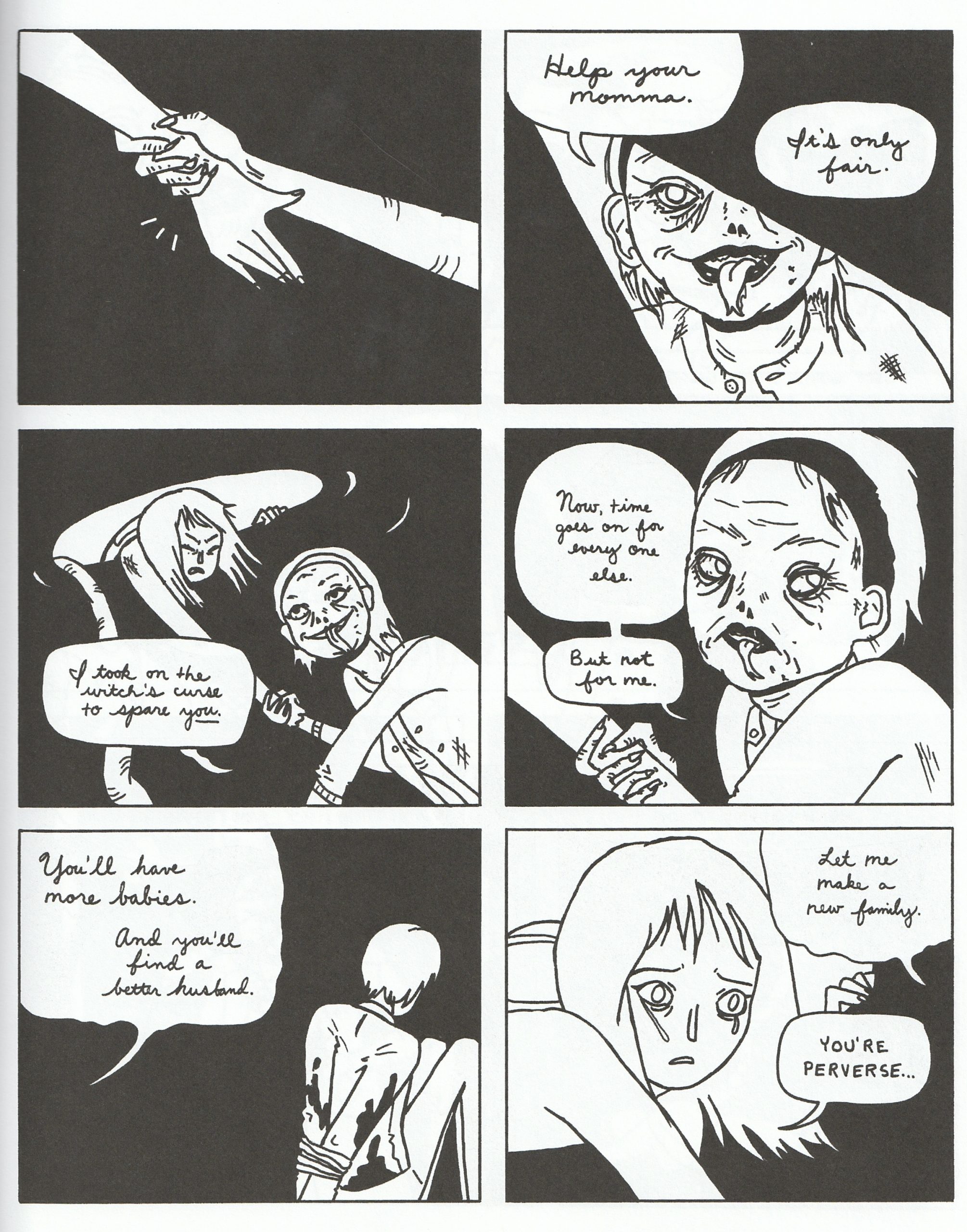
It's in the choices they make for themselves. When Clover throws herself against a restaurant window in My Pretty Vampire to look inside and streak blood on the glass. Dolly plying her own braces off in Heaven, or Sheila trying on a kid's dress and sitting around like that photo of Chloë Sevigny in The Face. It's like they're in a fishbowl existence but then they strike out with some exuberance and it breaks that surface tension.
Do you feel attached to your characters, in those moments? Is there an emotional resonance?
Yeah, definitely. I like it. When they start to surprise me, when they start making themselves known, it's like I become the conduit for them to do their thing. I sound like an insane person, but it really does make sense when I'm actually making it. It's just abstract.
No, I think it makes perfect sense. Do you do much revising after the fact at all? Or are things pretty much set?
I'll go back and clarify things, like if I feel a panel could make more sense in better service of what's going on. But for the most part, yeah, things are pretty much set.
I know that the initial inspiration was a tweet about how The Weeknd used to make “haunted strip club music.” When you saw that description, that phrase — where did your mind take you, in terms of a story?
Yeah, it started there. I was trying to visualize what that was and wondering what could be accomplished in a space like that, horror-wise. And I realized I don't really have any comics about a specific place. It was an idea that was just stupid enough to be interesting, and it started taking shape as a longer, gritty story. I was thinking along the lines of, "Okay, it's a place..." so this could be like a Sin City thing with a bunch of interconnected stories. Tough guy stuff! I thought I might just release issues forever. So, originally, Dolly and her friends would have been more of a chorus, but they were compelling and stole focus, and that changed the format.
Do you see yourself returning to those other stories? Like a spinoff, Tales from Heaven. Or have you basically gotten this world out of your system?
I already have my next comic written so I hadn't considered it. What do you think, should I?
I think it’s a good concept, definitely. The first time we hear Dolly’s voice — though it’s in a piece of writing, technically, a school essay — she is imagining her own death. Yet in the comic itself she isn’t, strictly speaking, suicidal, nor does she seem, to me, like someone who has an active death wish. Who is Dolly to you? Where do you think she’s at, at the start of the story, before Heaven comes in?
She's an embodiment of all these anxieties I had during COVID. What if this ends, what if things are never made right again, what if this is all just spinning out into nothingness and meaning is gone, etc. But you put those feelings in someone young because that's how life feels at that age all the time anyway regardless of what's going on in the world. And because it's easier than being like, so, I'm 36 and thinking about getting into nihilism. So, yeah, there's a death wish in a way, but it's more a longing for a transformation into something meaningful. And teenagers equate all kinds of things because life resonates with them on an emotional level, not necessarily a rational one yet.
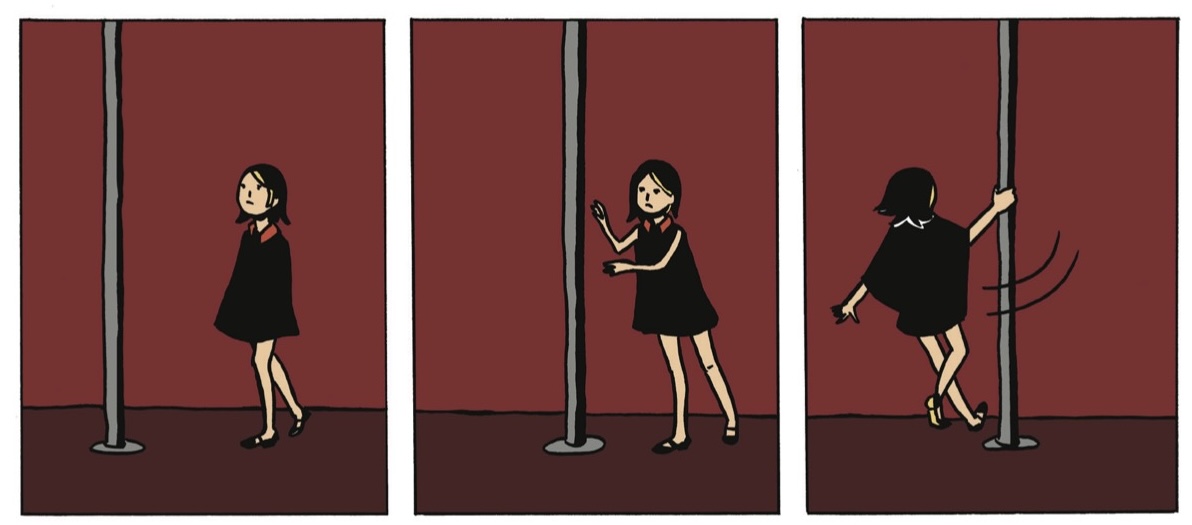
That’s interesting, because one of the things that leaped out to me was how, I guess, mutually exclusive Dolly’s social life is — her school friends try to help her, but the club is literally inaccessible; the strippers at the club are accepting of her, but she’s kind of a mystery to them, they’re not really a part of her life. And, you know, I think about early COVID, and the thing that really defined those first couple of years was that collective attempt to understand “what it means” to be in another person’s life in the absence of physical presence. But I may be making connections where they don’t exist.
Yeah, it's all compartmentalized for sure. I think that's fair.
Did you feel like it helped you, putting those feelings and anxieties on the page?
Definitely, even if it's not a one-to-one correlation between what I'm feeling and what's being expressed in the comic. Tapping into feelings leads to tapping into more feelings. So making comics doesn't necessarily do anything to mitigate whatever I'm going through personally, but there is a hope in creating the atmosphere where a particular emotion could live. If I get the conditions right, maybe another person will stumble into it and be able to relate to it and, best case scenario, take something away from it with them. To me, that's worth pursuing.
Is the impact on the reader something that figures into your thinking?
Yes. I'm not there to see when that happens to a reader, so I have to feel that impact myself first as a guide.
How did your headspace change, from the moment you started the book in 2021 to the moment you finished it four years later?
Quite a bit. Real Ship of Theseus hours since 2021. I would love to say I'm calmer but I don't think that's it. Maybe just more resolved. I write lists of things I'm grateful for, keep a journal, all that stuff. The next comic idea even came to me without much of a fight. I'm doing things because I'm excited about the process and I want to see the results, not just errantly imposing my own suffering. I guess that's the difference.
I would love to hear, in the context of the way life changes and headspace inform the work, about the move to California. Was it a big adjustment?
You know, because of COVID I felt like I had already lost all this muscle memory for going out and doing things in New York, so being in a more spread out place with extra time and space to myself felt fantastic. And I was there to be with Jaime, who had already been showing me around the city and introducing me to new people, so I wasn't jumping in completely cold. I got to meet Jas Hice who was also new to LA and get to know them and their work, which is very good. My cat loves it here and keeps bringing lizards in the house. I miss my friends in New York, but a lot of them have also moved away now, too.
Otherwise, my days honestly aren't too much different. Computer, drawing table, life, repeat. But, if things ever feel dire, the sun is shining and my husband is just in the next room. I love Los Angeles!
One of the things you started working on between Maids and Heaven is the horror anthology you curate, Viscere. How did the idea for the anthology come about?
I started going out to comic shows again in 2022 and was seeing work by artists I didn't know at all before COVID, and it was really exciting. I would buy work from them and just kind of daydream about trying to publish them. Comics is really difficult when you're starting out and I was impressed at their resolve to show up and present something different. Shows can be brutal when you're getting started. I had always wanted to try publishing, just to see what would happen. Then I think I just started subliminally taking the steps to do it.
I thought organizing them by specific little horror niches would help make all this different work cohesive and drew up a plan. I went to Anne Koyama and asked if she'd consider me for a grant and she was kind enough to support the project, and then the two volumes were funded with Kickstarter. So now these artists have a book they can take to shows and it functions as a little showcase. I know Chloe Brailsford — who really took the ball and ran and turned out this 25-page beast of a comic — has used her story in the first volume to pitch her own bigger projects. That's very cool.
To publish Viscere, you set up a designated label, Strega Sporca. Is that just for the anthology, or are you aiming to publish solo works as well?
I wanted to keep that open as a possibility, yes. So it's in my back pocket for now. We'll see if the timing is ever right. I'd love to.
How have the material conditions of comics — of making them, publishing them, making part of a living off them — changed over the years, in your experience?
Things are more expensive to produce and to travel to, but I'm also established in such a way that I'm not footing the bill on every single little thing, which is a blessing. But the challenge remains the same as when I started, which is still to do the impossible with absolutely nothing.
Are there any particular anthologies, or publishers for that matter, that serve as an aspirational model for what you want to achieve with Viscere? Or were you going in fresh, just purely your own approach?
Kramers Ergot was and still is major in my life, but that's an impossibly high standard. I was thinking about Secret Comics Japan in terms of mood and presentation. I adore that anthology.
The thing that leapt out to me, both in Viscere and in Strega Sporca’s broader mission statement, is your focus and emphasis on genre. A lot of words have been expended on the sometimes-cynical way the "entertainment landscape" peddles in genre signifiers and tropes, and I’m curious as to what you feel is the importance and value of genre as a broader framework that elevates the individual work.
I mean, everything is genre, right? Everything has its tropes and clichés. But seeing how different artists arrive at those tropes and clichés is the most interesting piece to me. Do you resist or subvert what's come before, or do you try to adhere to the preexisting rules? Assigning work in genre is like handing over the scaffolding and saying just go crazy in here until you're done building.
I note, in that context, that you have made a conscious effort to include people whose individual aesthetics are harder to attribute to X genre or Y lineage, like Erika Price or Caroline Cash, both of whom I adore; artists whose distinct individual tone, I think, trumps the framework.
Thanks! Yeah, it's a way of making these broader ideas cohesive even if they're visually distinct. I chose everyone because I liked their particular vantage point and wanted to see more.
Back when you did your first interview with TCJ, in 2014, Chris Mautner remarked that it “[used to be] considered déclassé in alt-comics circles to indulge in certain ‘low’ genres like science fiction and fantasy.” Which is a point of view that I think — Chris might disagree with this — is still very much around today. And I wonder if, from your point of view, there has been any change in the way these spaces are viewed since you’ve started publishing your comics.
I think there's a wider acceptance, but it's also like, who are we talking about? People on message boards? That stuff is flippant, and also kind of not real. I don't think alt or indie sci-fi or fantasy was as popular when I was getting started as it is now, that landscape was a lot of flannel shirts and autobio minis, but I never felt a straight-up rejection because of the subject matter of what I was doing. In fact it only ever helped me. I was serving a niche. But I can't really speak to the greater genre project in indie comics. Let's hear from Chris! [Editor's note: I have no idea what the alt-comics circles clamor for any longer. — Chris ]
In addition to your cartooning work, you’ve obviously worked as a critic as well. Do you think of making comics as a sort of criticism in practice? When you mention Sin City and Russ Meyer in the context of Heaven, for example, did you feel like you were in any way analyzing how and why they work, responding to them, and so on?
I think they're pretty separate. I don't really let analytical thoughts in when I'm creating or else I'll freeze up and stop. But if something has been front-of-mind I know it will seep its way in. It's just difficult to pinpoint exactly how until a few years later when I have some distance.
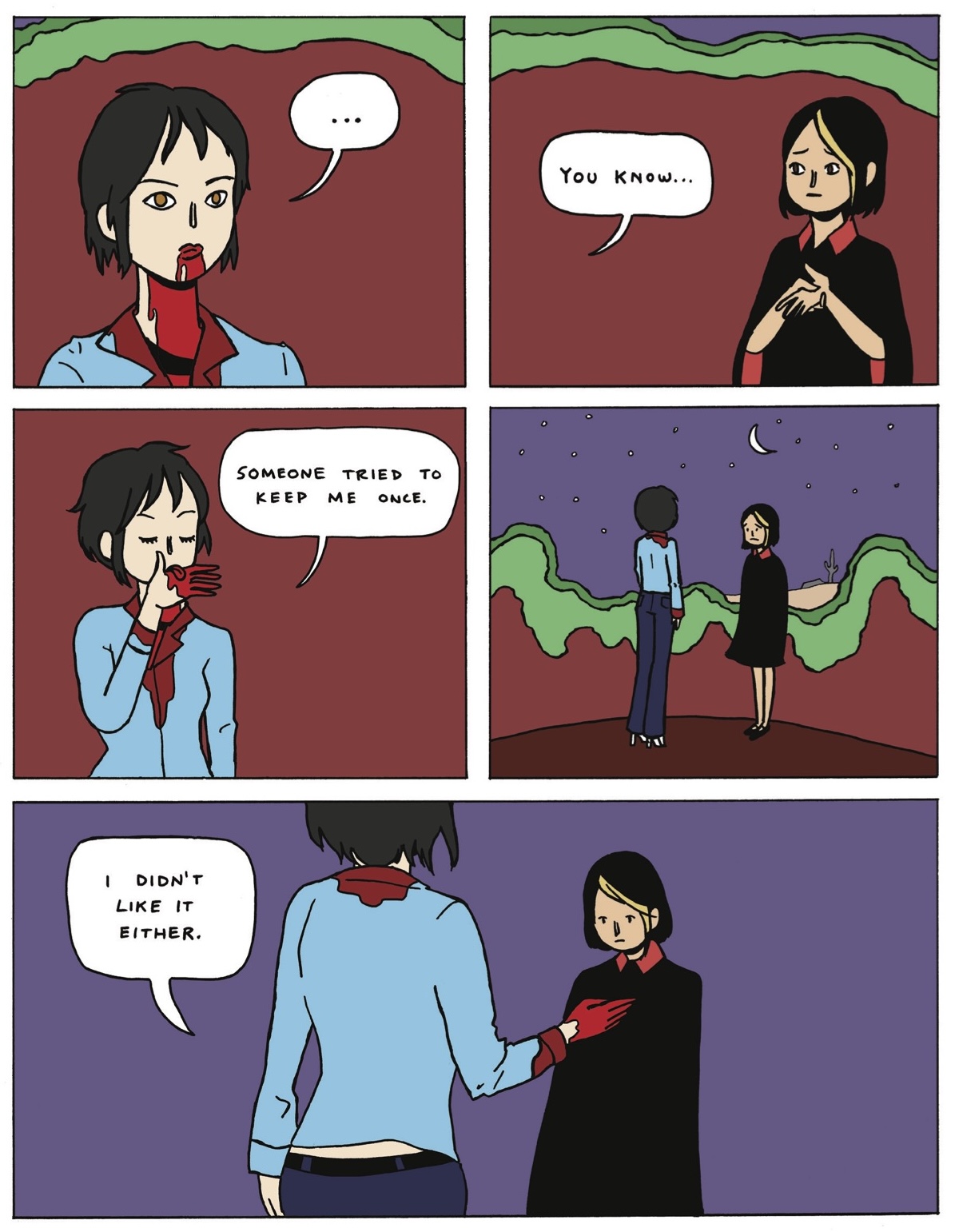
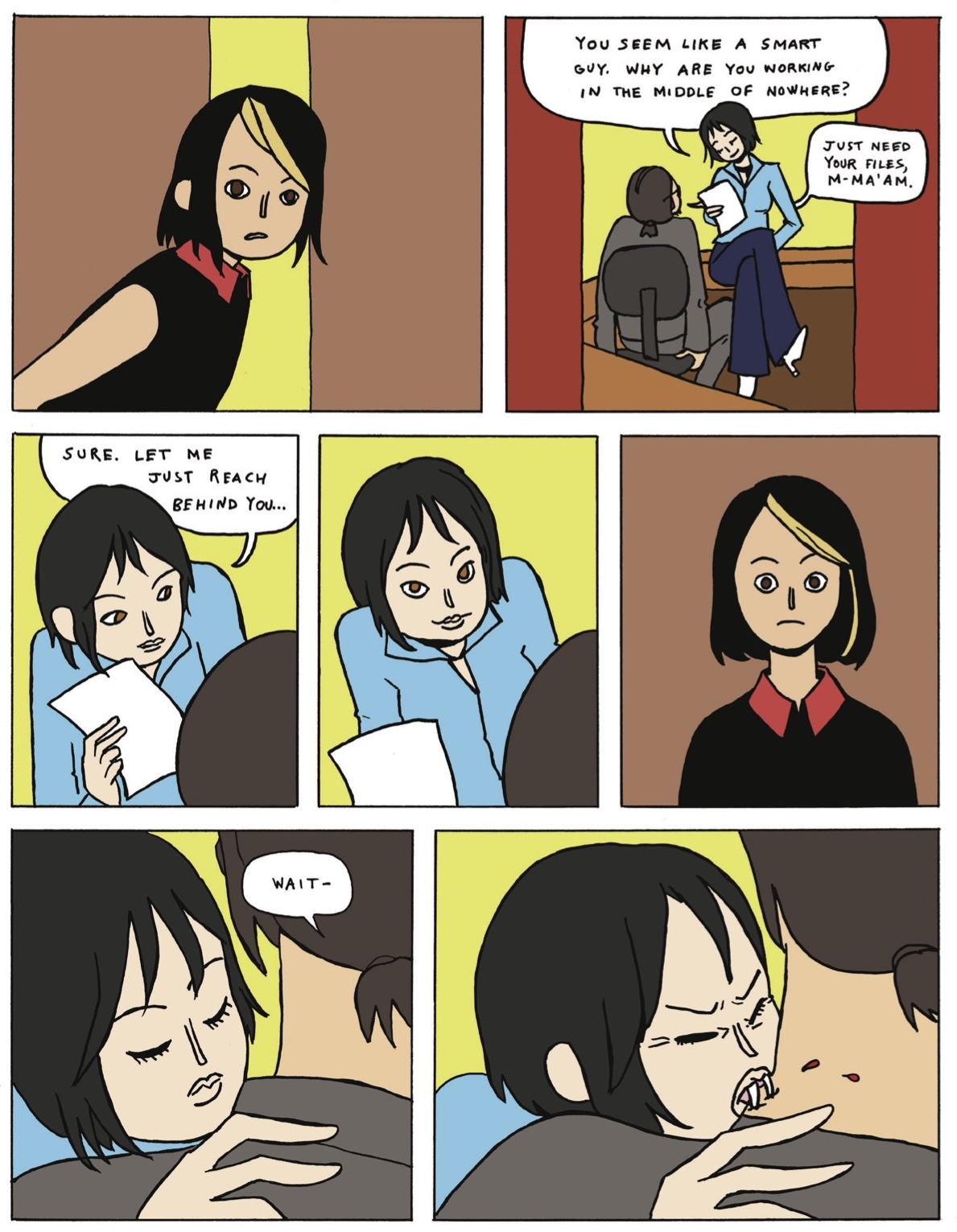
At the end of Heaven, you reveal that the book exists in a sequence with My Pretty Vampire — Lover, the manager of Heaven, is in fact Clover, the protagonist of My Pretty Vampire, a couple of decades later. That’s why she lets Dolly go so easily — as she says to Dolly, “Someone tried to keep me once. I didn’t like it either.” How did you get the idea to tie the two books together? Was that always the plan, or something that asserted itself during the work process?
Clover immediately came to mind because she's so unable to be kept! And I loved how, in Helter Skelter by Kyoko Okazaki, the protagonist Liliko ultimately becomes this kind of sideshow legend. That was the trajectory I wanted for Clover ultimately, someone who interpolates her bizarre circumstances to take on something greater. And I wanted to keep her hair from the ending of My Pretty Vampire after she catches on fire and singes it off — she's the same person, but she's hardened a bit now, and who even knows how long she's been "alive" to that point.
You’ve said elsewhere that Heaven is the last story you tell in the “cool girl” mold, and the ending of the book — with Dolly choosing to divest from that crew and live more or less a normal life — very much reflects that, as “the old” lets go of “the new.” What led you to feel like you were ready to say goodbye to that vibe?
I've changed a lot and what I want out of my own work has evolved too. I won't fully know what it's going to become until I'm doing it, but, when I envision it, it's not the same. Every single one of my books has been different. With the exception of Clover, I've never relied on any particular character or ongoing story for what I do. So the ability to shift is built into what I designed for myself as an artist and a storyteller. So, if I want to move on, I can and I will. It's the one area of my life where I have almost total freedom. My thought is always, Let's see what else I can do.
At the same time, I suspect the lon-time Katie Skelly reader will see that ending, that farewell, and think to themself, "Hang on, is a ‘normal life’ even possible, or aspirational, in this world?" I wonder what you think about that.
Survival is aspirational. That's all I know.
Where do you think Dolly goes from here? How does this episode change the trajectory of her life?
For right now it's a blank. She'll probably tell me in a few years.
Similarly, you’ve alluded to your next book a few times. Where does Katie Skelly go from here? What does the "new" vibe look like?
All I can tell you is that I am planning to go back to black-and-white and fleshing out a larger cast for the next comic. I am also trying to get certified to be able to teach Pilates.
The post ‘Survival is Aspirational’: An Interview with Katie Skelly appeared first on The Comics Journal.


 Hello, my name is Jack Sparrow. I'm a 50 year old self-employed Pirate from the Caribbean.
No comments:
Post a Comment