

Frederick Noland’s graphic biography of Marshall “Major” Taylor focuses on his life as a cyclist, moving from his beginnings in Indiana to the end of his career that had led him around the world, making him “the world’s fastest man,” as the subtitle says. The biography proceeds chronologically throughout his life, the racism present in the society at large as well as in cycling, specifically, remains the primary conflict facing Taylor. The story is one of compelling inspiration, despite the absence of internal conflict or flaws keeping readers from seeing Taylor as fully dimensional.
Noland begins the work with context about bicycles, setting the stage for Taylor’s career. That focus runs throughout the work and helps the reader see Taylor's world, particularly in terms of cycling. At the turn of the century bicycle races were a significant form of entertainment before automobiles came along to displace them. Noland reminds readers that bicycles first came about because of a decline in horse populations due to a catastrophic volcanic eruption, even though cars earned the nickname “horseless carriages”, bicycles were a type of evolutionary link between horses and cars, though their heyday was short-lived.
That heyday, though, came at just the right time for Major Taylor, as he was a talented cyclist, teaching himself tricks, with several benefactors helping him enter the profession at large. Given the time, those benefactors were all white. To their credit, they were also sometimes his rivals, though they often supported Taylor as their careers were winding down, helping them remain involved in cycling long after they could realistically win races. Still, they used whatever means necessary to help Taylor enter and win races against other white cyclists.
Louis “Birdie” Munger gave Taylor a job and helped him sneak into races. At times his enthusiasm got the better of him, such as when he tried bleaching Taylor to make him white enough to enter races legitimately. A market for such products already existed, so Taylor went along with this endeavor, as he did with almost anything Birdie and others suggested for him. He was passionate about cycling, and would put himself through almost any type of abuse to be able to race.
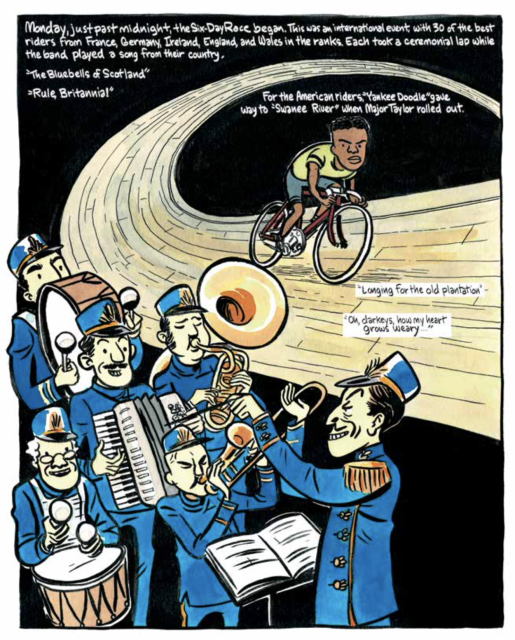
Much of that abuse came in the form of racist attacks from other racers, as well as the governing body in charge of the sport. Sometimes that comes in obvious ways, as when Eddie Bald, a rider he defeats in a half-mile race and who became one of his archrivals, uses the n-word to discuss how he feels about losing to Taylor. Bald and his compatriots also try to injure Taylor during races, forcing him into walls or poles, leading to accidents and injuries. At other times, though, the attacks come in unexpected ways. At the beginning of a six-day race, each rider takes a ceremonial lap, and the band plays a song from their country. For the other Americans, the band plays “Yankee Doodle,” but they switch to “Swanee River” for Taylor. Noland quotes two parts of that song to highlight its racism: “Longing for the old plantation” and “Oh, darkeys, how my heart grows weary.”
Taylor has larger concerns, as well, as the League of American Wheelmen, the main professional organization, bans African Americans from participating in cycling. He relocates to Massachusetts to try to find races, and he often is only able to enter when those who manage such events realize how much attention—and, thus, money—his presence will bring. Whenever he tries to travel to the South to race there, though, Jim Crow laws keep him out of hotels and restaurants, even leading to his having to flee Savannah altogether when he receives a threatening note after passing several white riders on the road.
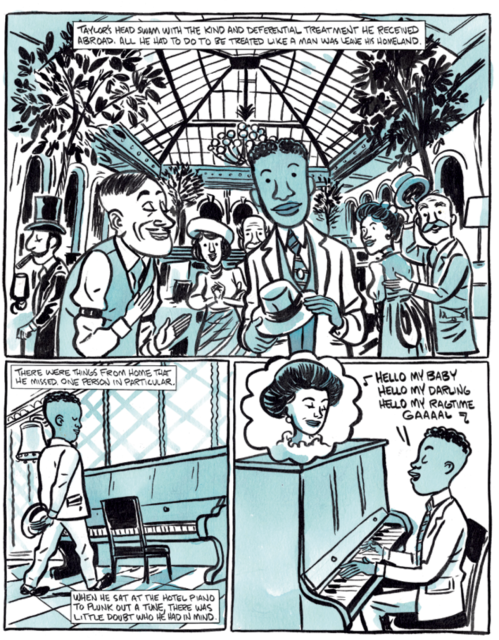
His continued success in spite of all of the opposition leads to his traveling to Canada and Europe to race there, and he not only finds the competition invigorating, but the fans are much more accepting of him. When he travels to Canada for the first time, in fact, the band plays “The Star-Spangled Banner” to celebrate one of his victories. Noland even uses one of his few double-page spreads to show Taylor in Paris, as he is amazed at the beauty he finds there. However, there’s an irony even in the positive reception he finds. A significant form of entertainment in Paris was minstrel shows, and Taylor even goes to see the most famous actor/comedian, Chocolat, who starred in slapstick comedies, where he was also the butt of the jokes. They acknowledge each other’s abilities as Chocolat winks at Taylor during a performance, or, as Noland writes, “One black star to another. Game recognized game.” Similarly, in Brussels, crowds came out to his hotel room, standing in the rain when he couldn’t race, just to see him. However, as Noland writes, “The dark irony was, while most Belgians had never seen a Black man, Belgian ruler King Leopold II kept the Congo as his personal domain, subjugating and slaughtering millions of Black Africans for personal gain.” Throughout his time there, though, he defeated the best European riders, even changing his style to match their approach, asserting himself as the fastest cyclist in the world, again and again.
One of the main ways Noland captures Taylor’s feelings is through his remarkable portrayal of facial features to convey emotions. He repeatedly uses close-ups of the cyclists, showing their effort during the race, but also how they feel toward Taylor. He uses the same approach with Taylor, but primarily to show his moving through the challenge of riding to the calm he exudes in the face of attacks, but also the anger he often feels off the track, as he didn’t hesitate to condemn the abuse he faced.
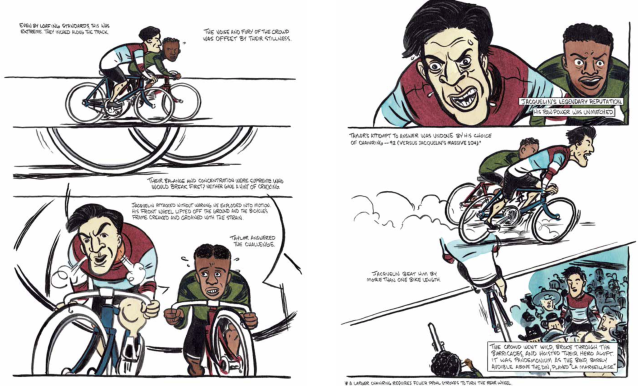
Noland also uses color to offset different sections of the story. When he provides context, he often slides into more subdued colors, sometimes using only black and white, such as when he provides the overall context of cycling. However, when he shows races or important moments in Taylor’s lives, the pages are much more colorful, a fitting choice given how much people’s perceptions of color impacted Taylor’s life. The watercolors Noland uses work well for both approaches, as they present the atmosphere of the context with a feel of the distant past, while the more colorful sections bring Taylor’s story to life.
An important part of Taylor’s life is his faith, an aspect that runs throughout his story and directly impacts his racing career. He often has to negotiate contracts to avoid racing on Sundays, which he views as a violation of keeping the Sabbath holy. That faith comes from his family, who are always in the background of his life, even when he has to leave them to pursue his cycling career. For example, the first time he wins a cash prize ($200), he sends the money to his mother. He takes in his sister when she’s suffering from tuberculosis. He even goes beyond his family with his generosity, as he splits prize money with his pacers in one instance and gives other prizes he wins to those around him.
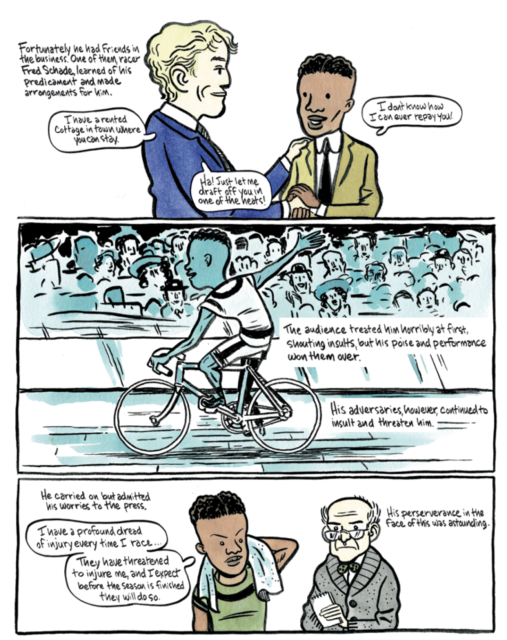
That portrayal of Taylor leads to the one complaint I had about this work. Taylor seems almost too good to be true, in that the reader never sees any real flaws or even internal struggles. When he receives attacks, but continues on, Noland praises “his perseverance” and refers to it as “astounding.” Part of this approach comes from what we might call the Jackie Robinson problem. When somebody like Taylor or Robinson attempts to integrate a sport, they not only have to be better athletes than those around them, they have to comport themselves in such a way that nobody has any grounds for complaint. Thus, Taylor may simply have behaved that way because he had to, and Noland has no evidence to the contrary.
However, there might be another layer here, and it’s a chance encounter Taylor has that reminded me of this idea. When Taylor is sailing for Europe after his wedding, he meets Booker T. Washington. Noland comments that “Washington advocated for working within the system, while Taylor had been battling against it, but they had common ground.” That description is true, but Taylor seems to carry himself in a way Washington would approve of. Washington believed in “social responsibility,” the idea that, if African Americans simply behaved in a responsible manner, whites would recognize their inherent worth and grant them equality. While Taylor certainly works to cross the color line in cycling, he wasn’t doing so in a way that would anger the white establishment, carrying himself in a way that was beyond reproach. Noland seems to acknowledge that he’s presenting Taylor in this way in his Afterword where he writes, “It’s an old trope in biography to build a character up only to tear him down by story’s end. I was never going to do that to Taylor, and after spending all this time with him, to do so would feel like a betrayal.” Perhaps there’s no evidence of behavior or doubts that could tear down this image of Taylor, but it doesn’t sound like Noland would have done so, even if there were.
I’ll admit that this complaint feels a bit petty, given everything Taylor had to endure simply to pursue the cycling that provided him with his livelihood and his purpose. Noland has shown quite clearly that he was a great athlete and racer, despite all of the obstacles society and cycling put in front of him. This book acknowledges that, and readers should be thankful for the opportunity to learn about Taylor’s greatness. His story truly is inspirational, and Noland does a great job of laying out that story clearly and with literal and metaphorical color. We need such stories, especially in the world as it is now.
The post Major Taylor appeared first on The Comics Journal.


 Hello, my name is Jack Sparrow. I'm a 50 year old self-employed Pirate from the Caribbean.
No comments:
Post a Comment