

“I believe that the drawing [in comics], while its appeal is primitive, is extremely sophisticated; and the stories, on the other hand, while they are written by reasonably sophisticated people, are extremely banal and primitive.” — Gil Kane
“[P]eople like Alex Toth and Gil Kane, the whole pantheon of superior artists — were cranking work out on such an industrial schedule, that they couldn’t really tailor their work to their own personal vision or personal expression so much as they simply had to draw as well and as quickly as they could; and since they were told what to draw and what they were told to draw was basically adolescent in nature, their styles either conformed to that adolescent context or never coalesced with it. And I think that has had a deleterious effect on them as cartoonists and on the art form.” — Gary Groth
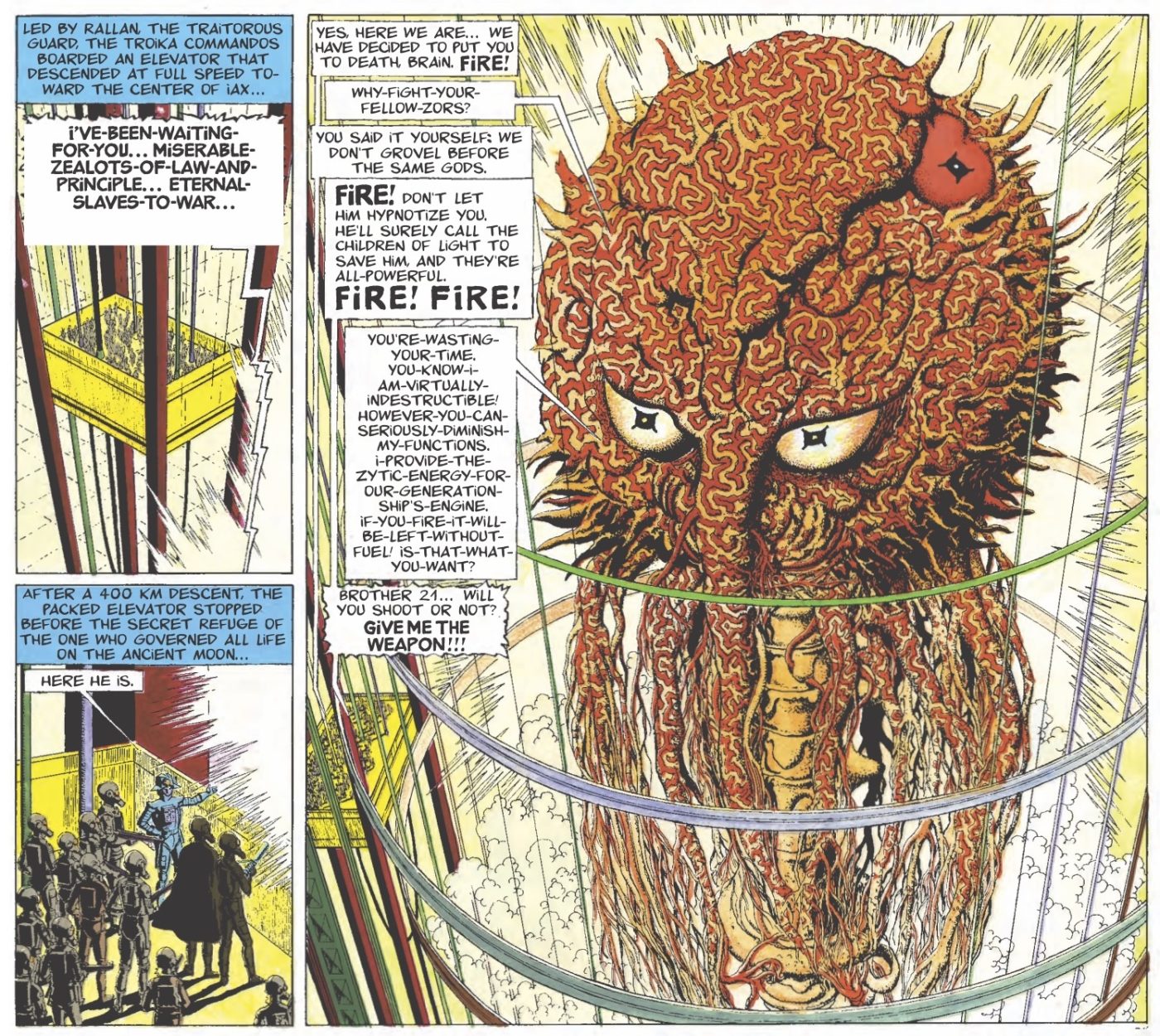
How difficult it is, reader, to imagine something outside of yourself; how difficult it is to even try. It’s something I think about from time to time, the notion that you are just the sum of your native environment, total and inescapable. Fortunately, we have Jean Pleyers to reckon with this issue for us. The Belgian cartoonist’s solo work The Children of Light — originally serialized in the French Métal Hurlant during the tumultuous Jean-Pierre Dionnet years and now co-published in English by New York Review Comics and Breakdown Press, in a translation by Luke Burns1 — establishes its premise within the first few pages: the Zors, an advanced alien society forced to leave its dying planet, face threats external and internal; the external threats are easier to mitigate, thanks to the titular Children of Light, a group of cosmic deities that come to the Zors’ aid in exchange for their worship, while the internal threats, in the form of an nihilist–secular anarchist faction, are somewhat more persistent.
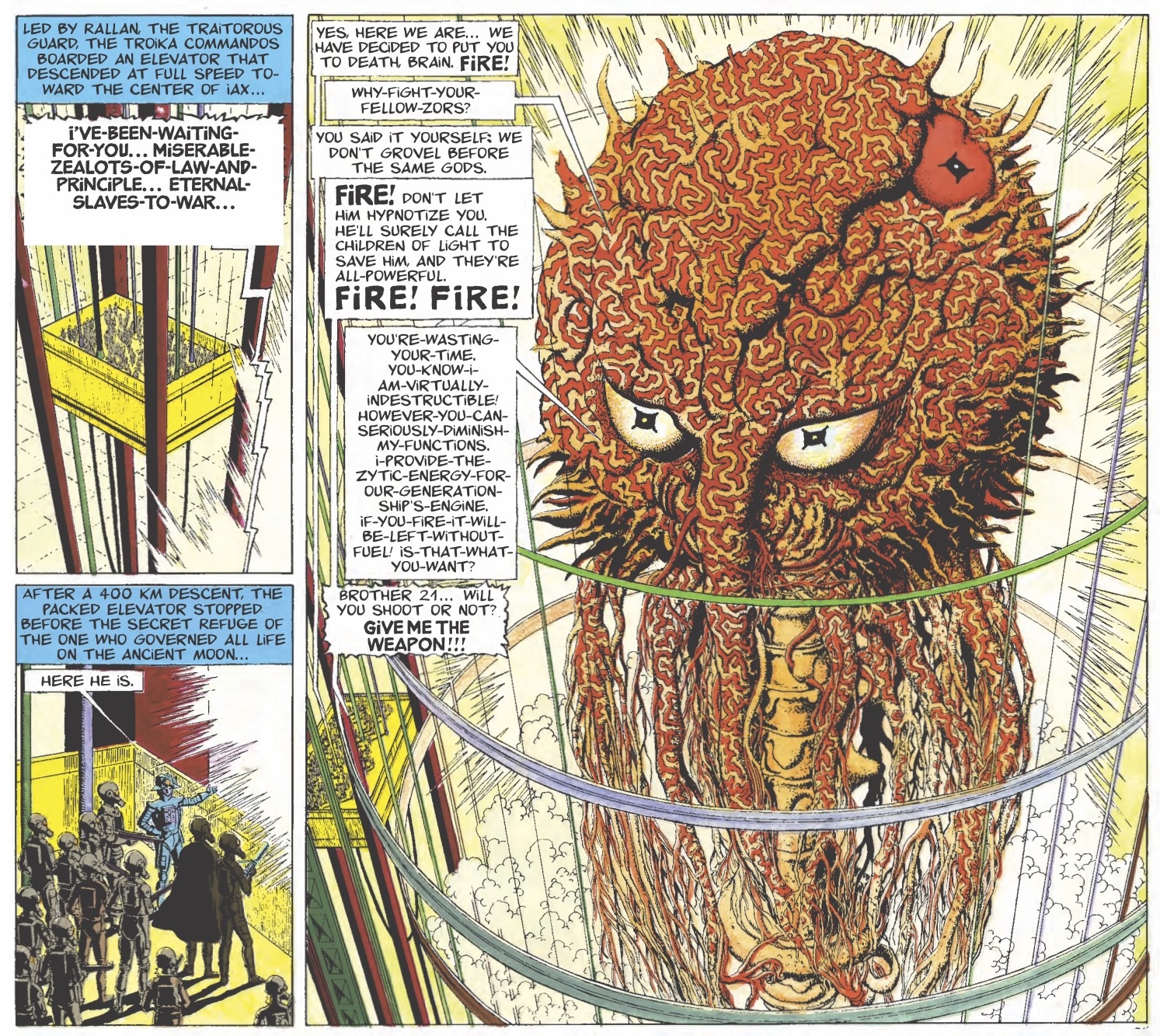
Pleyers is an artist of illuminated spaces; he favors light, sun-bleached hues and rarely uses shading for dramatic intent, instead choosing to showcase his architectural care and physical solidity. In his afterword, Breakdown Press’ Tom Oldham compares Pleyers’ ligne claire sensibility to Métal Hurlant contemporaries Yves Chaland and Serge Clerc, though I don’t think the comparison is quite apt — Chaland and Clerc are, of course, proponents of the revisionist–revivalist Atom Style, characterized (at least in my mind) by a certain degree of tonal distancing from the source, whereas Pleyers is nothing if not earnest in his callbacks; the physicality of his cartooning call to mind the early work of Edgar P. Jacobs, as well as Burne Hogarth and Alex Raymond, the latter two he expresses an admiration for in his back-of-the-book interview with Oldham.
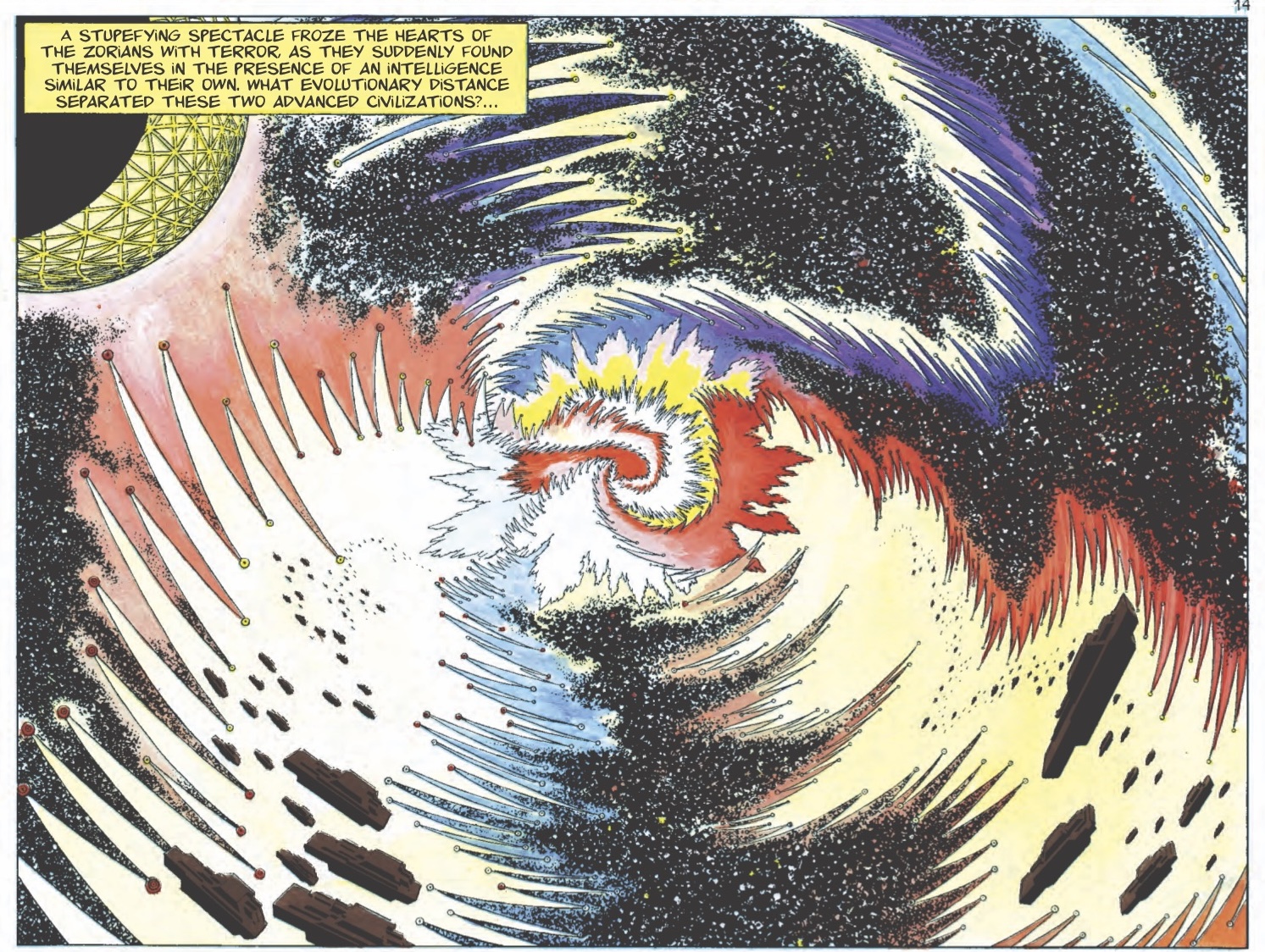
What carries this aptitude for precision is a simultaneous sense of cosmic grandeur. The Children of Light, for all its politicking, is still a story about a journey through space, and Pleyers is at his liveliest when he must step outside of himself to depict that which isn’t made by, and for, human(oid) hands. On two occasions, the Zors encounter a perilous cosmic phenomenon (a black hole the first time, a quasar the second), and on both occasions these bursts of energy feel genuinely new; especially in the pre-digital age of color, it stops me cold and makes me wonder how on Earth he achieved this. The sweeping undulations and scorched colors of the black hole, the razor-sharp jags and warring red-yellow-blue of the Quasar — it’s a beauty that inspires genuine awe; the sort of beauty only mortal danger can have.
In Oldham’s afterword, readers are informed that The Children of Light was inspired, in a way, by true events. As Pleyers himself said in his first email to Oldham, “I was actually contacted by these aliens. They dictated this story to me telepathically in 1981.” It’s an interesting claim, with a sensationalism that commands the reader’s attention and forcibly prompts a reaction, whether from a position of belief or disbelief. In Oldham’s back-of-the-book interview with Pleyers, the cartoonist goes on to provide a comprehensive overview of his experiences with aliens, a succession of visions and unexplained phenomena spanning from 1973 to 2014. Of these, the one I find most interesting is a 1974 vision, in which a UFO appeared before Pleyers and delivered a telepathic message: “Let’s raise the subject of your cartoons…”2 The reason I find it interesting is specifically because up until this point, and for a few years afterwards, Pleyers’ career was defined by a distinct lack of creative autonomy: assistant work for more well-known cartoonists, educational and advertising strips, and for-hire adaptations of pulp novels, all of which were produced while Pleyers was also working non-creative side-gigs. It would be a few years before Pleyers joined up with Alix creator and ligne claire legend Jacques Martin to create Jhen/Xan — without a doubt the most commercially-successful work in Pleyers’ bibliography — and a few years after that before Pleyers created The Children of Light, his first solo work. (When Pleyers’ overview reaches the period of his collaboration with Martin, Pleyers sees fit to mention Martin’s resentment of their erstwhile publisher, Casterman, for favoring “more elitist comics” over Martin’s own mainstream fare.) Underneath the mysticism and transcendentalism, then, a concurrent thread of thought emerges: The Children of Light as an attempt to confront one’s own internalized flightlessness, to transcend oneself and assert autonomy.
In this context, it’s worth examining the political structure of Pleyers’ world. Zor is an “advanced collectivist society” with little signs of individual liberty, as well as a total theocracy, the governing council answering directly to the Omniscient-Overmind, the conduit of the gods who readily come to the Zors’ aid when needed. The gods’ manifest existence — the reader sees them in action less than ten pages into the book — ensures a certain level of faith, thus establishing a world of assumption and foregone conclusions — that the gods are on the Zors’ side; that freedom (of vision, of thought) is unnecessary; that the people will be suppressed. Thus, more than as an antagonistic force in its own right, the Troika anarchist faction exists in order to reveal the issues inherent in the system: when they attack the protagonist, the engineer Ylo, and steal his plans to save the planet, it is Ylo who is punished, sentenced to 250 years of hard labor; when anarchists incapacitate the Omniscient-Overmind, the government chooses to keep this fact as a state secret, arresting everyone who finds out and threatens to alert the people to that fact (their reasoning being that “the Zors are far from being psychologically mature enough to accept the idea of an empty universe without God”).
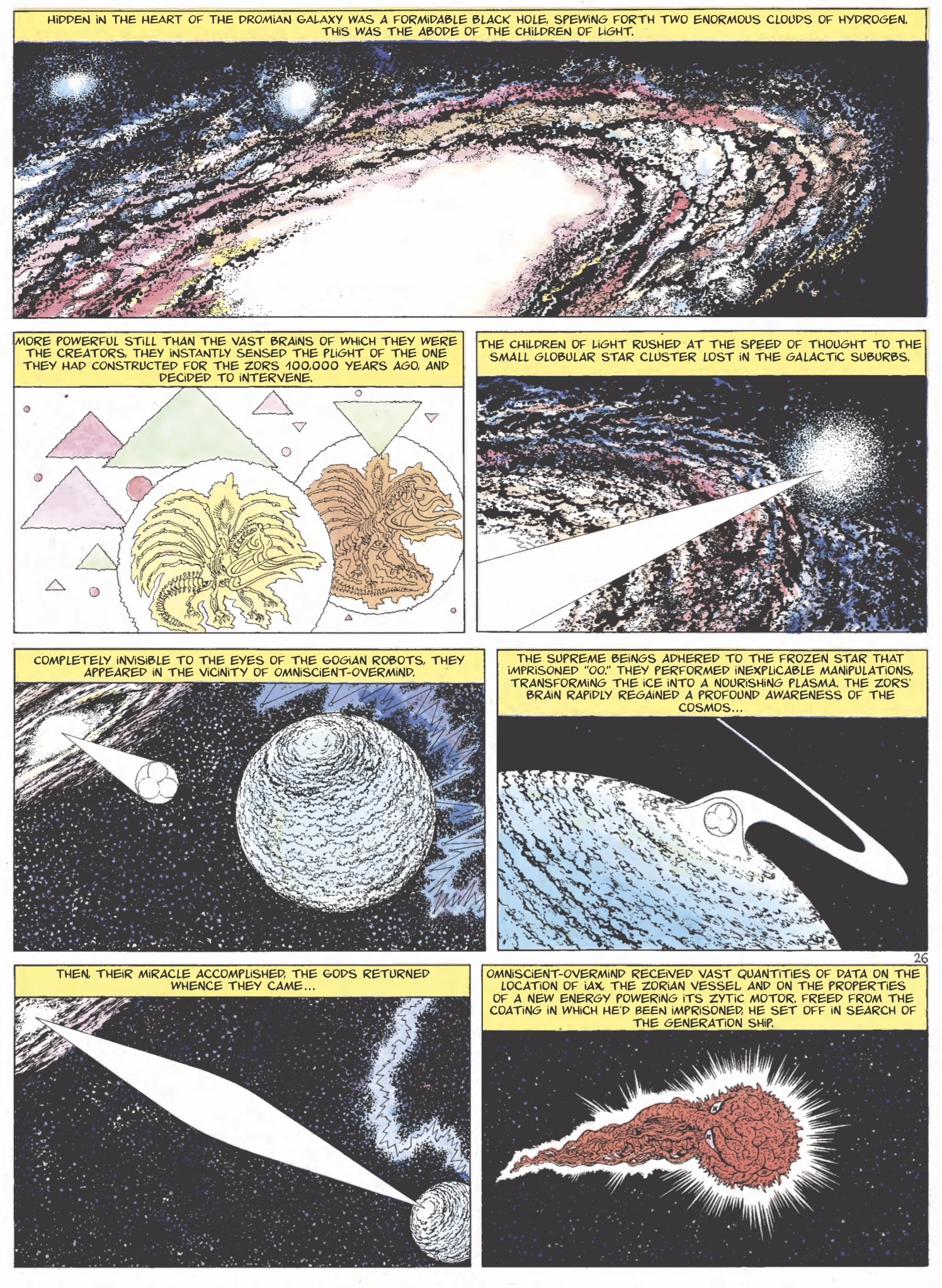 Interestingly, though, Pleyers’ narrative sensibility — that extreme pulp-pragmatism, where characters are logical to the point of emotionlessness, doing what must be done without deliberation — complicates the moral question. Ylo, for example, doesn’t resent the government for his harsh, undeserved punishment; when he eventually escapes, he goes back to help the government combat the anarchists, proving loyal to the same principles. Nor is the government’s destabilization treated as a positive development; when the Omniscient-Overmind returns to save the Zors and their regime, delivering its decree that, in lieu of resettlement, the Zors will become a nomadic race sailing through the cosmos forevermore, it is played as positive, a largely-happy ending, a collective sigh of relief.
This, then, is the tension that lurks at the heart of The Children of Light: the need for a greater vision that stems from oneself versus the need for the affirmation of authority; a disdain for the ingrained dystopian mindset on one hand, a fear of revolution — of revolt — on the other. Pleyers doesn’t try to reconcile these warring impulses, instead fully inhabiting the inherent contradiction. It is this lack of resolution that makes him frustrating; it is this lack of resolution that makes him, in a way, admirable. When, at the start of the book, Ylo faces the supreme council, the council regards him with skepticism and apathy. Only an army general, Kadi, comes to the engineer’s defense. “He is not a soldier, your honor,” says Kadi; “he’s an artist. He’s a realist when it comes to his work. Outside of that, he dreams.”
The post The Children of Light appeared first on The Comics Journal.


 Hello, my name is Jack Sparrow. I'm a 50 year old self-employed Pirate from the Caribbean.
No comments:
Post a Comment