

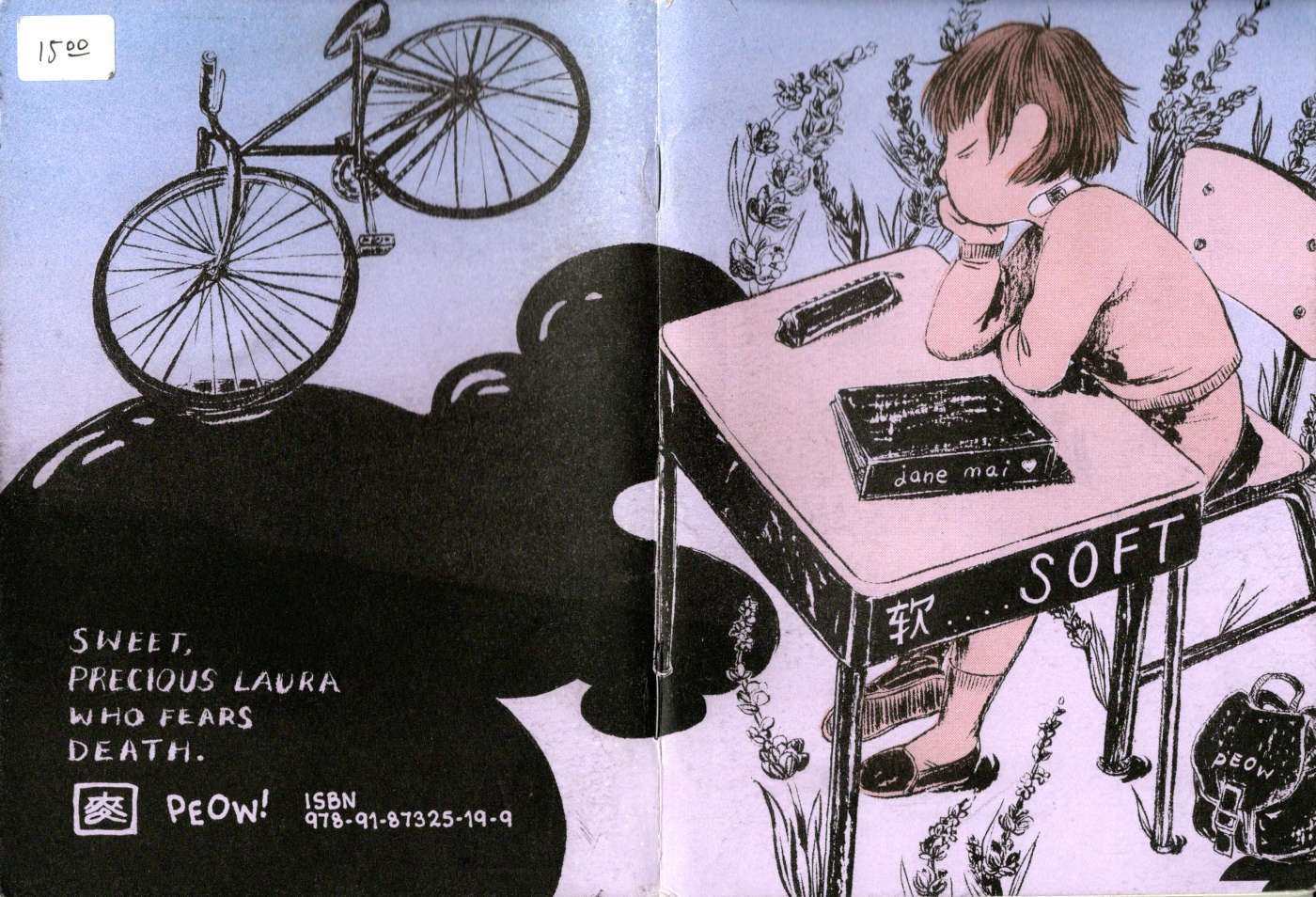
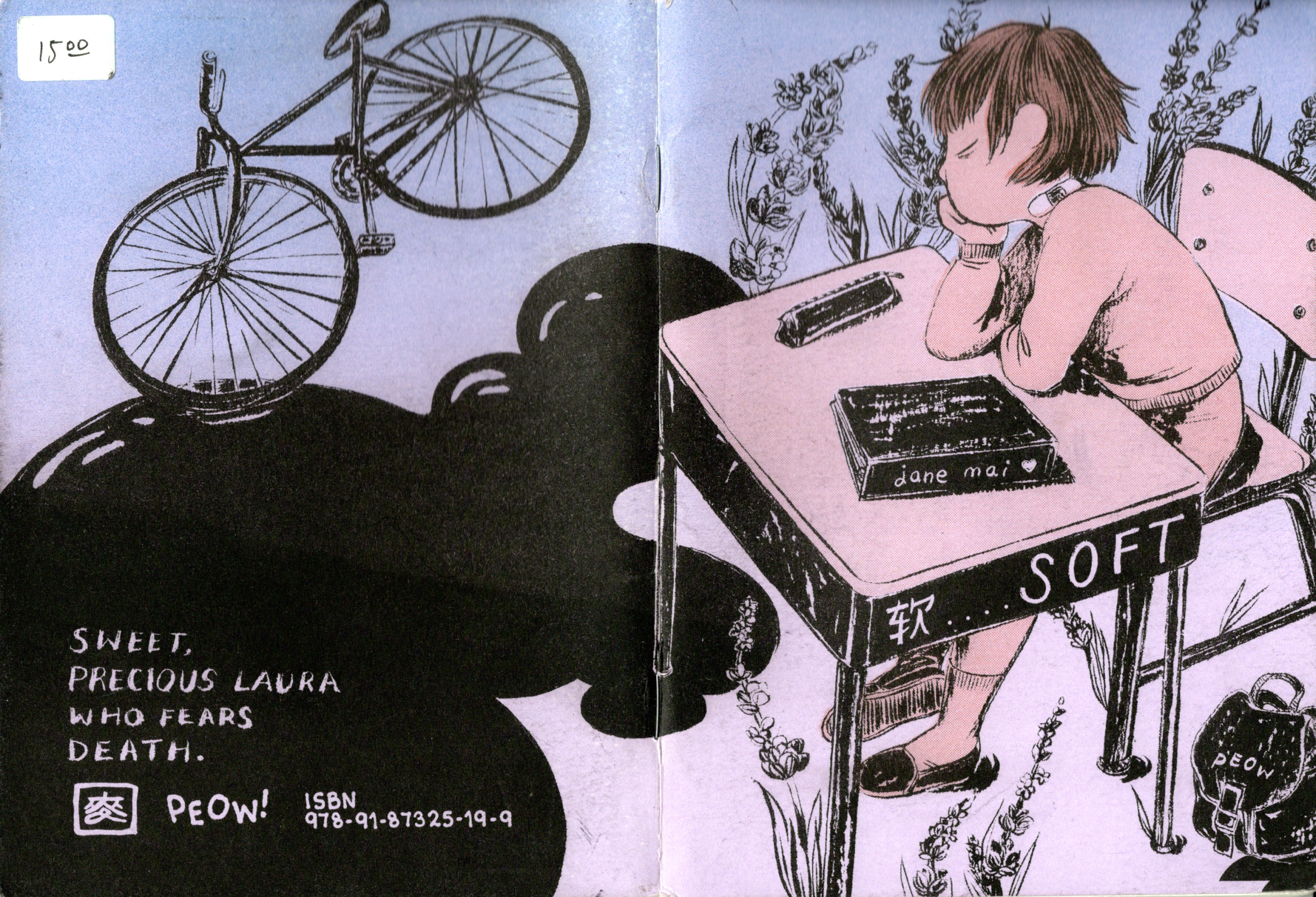
Let’s say the year is 2015 and you’re at a local comic shop perusing the indie section. Hiding in the shadows of larger works you find a slender, purple volume. The spine is folded rather than flat, so no title would be visible at first glance. Removing it from the shelf would only raise more questions. The cover looks scarcely like a cover at all, more a rolling tapestry of flowers. A tired school girl is placed at its center, a Band-Aid covering the crook of her neck. The title, Soft, is etched into the side of her desk, the author’s name — Jane Mai — on the spine of her binder. The back of the book is filled by an enormous pool of black. In lieu of a plot description is a quote from the story fashioned into a poem: “Sweet, / Precious Laura / Who fears / Death.”
Here begins your introduction to Jane Mai’s singular masterpiece, a work whose interior mystery and allure matches that of its cover. Its story centers on the aforementioned Laura, a school girl caught on the cusp of adulthood. Her life is ordinary: she bikes to school, visits her best friend June at the mall and tries not to get into too many fights with her single dad. She’s also gay and closeted, two facts which are revealed when she steals a porno magazine from a neighbor’s mailbox and hides it under her bed. It is these qualities of Laura’s life (her fear, her gayness, her “normalcy”) that make her vulnerable to Carmilla.
As implied by the name, this is a vampire story. Laura discovers a young, pale, beautiful girl who is more than happy to manipulate her. Existing outside of the restrictive world Laura has learned to navigate, Carmilla’s sardonic gaze and mysterious history offer an opportunity to explore love, sex, death and the adult freedom that lies just out of reach. The blossoming of this profane love feels nostalgic, almost chaste. But as furtive glances give way to carnal desires the gory truth of Laura and Carmilla’s relationship threatens to consume not just both of them, but anyone who happens to be in their way. While many coming of age stories feature destruction as a product of love, Mai’s work grounds that idea in the raw and visceral, something seen not only in her words but her images as well.
Soft is currently out of print. It now exists not on bookstore shelves but solely in private collections. And while Mai is by no means a forgotten name, her work is often not mentioned when it comes time to discuss the very best in comics from the 2010s. It’s a shame. Soft is not only a prescient and invaluable artistic statement, it is also the finest argument for Mai as an auteur. Her many preoccupations are on full display, from the gothic subject matter to the obsession over femininity as an aesthetic. To revisit Soft is to find a missing piece of indie comic history, one that fits in among its peers even better now than it did upon release.
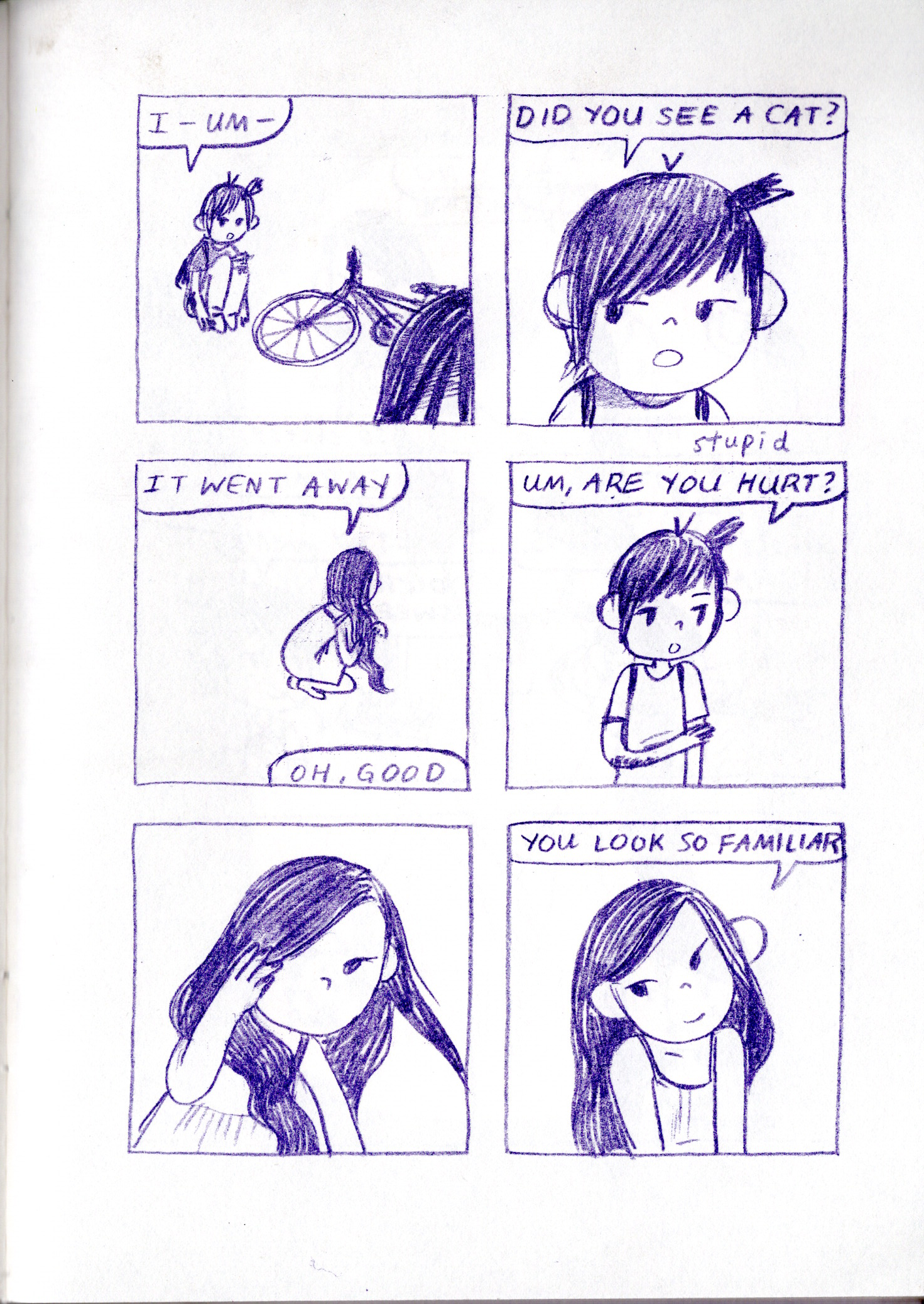
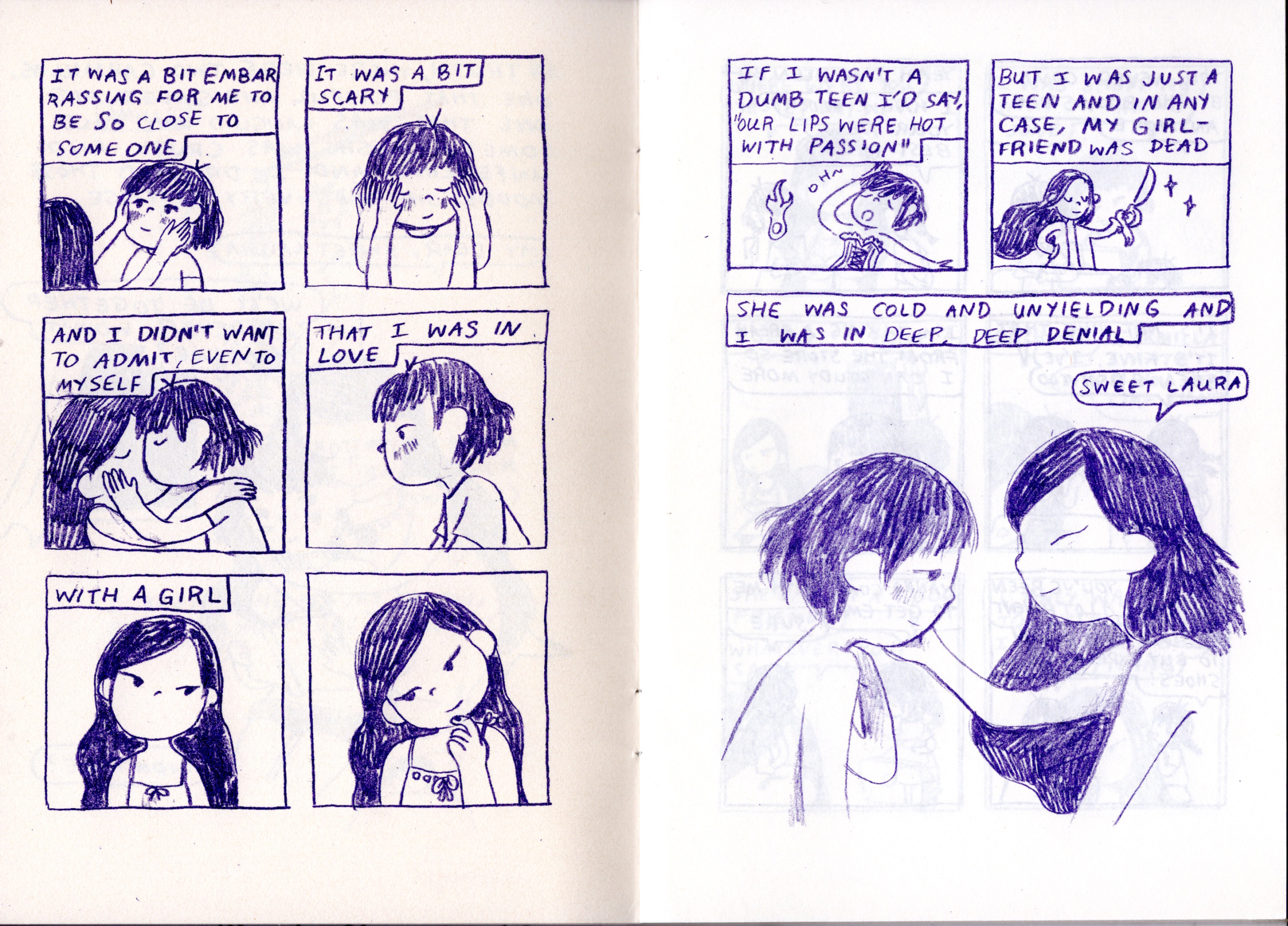
Perhaps its under-appreciated status is because of the deceptively unassuming nature of Mai’s art. The story is mostly made up of simple character drawings placed in blank backgrounds arranged into 2-by-3 grids of panels. Occasionally details from the environment will be shown, like the gated-off tree which floats behind Laura when she meets Carmilla for the first time. But mostly we are left to sit with the two dots and one line that make up all of the characters’ faces.
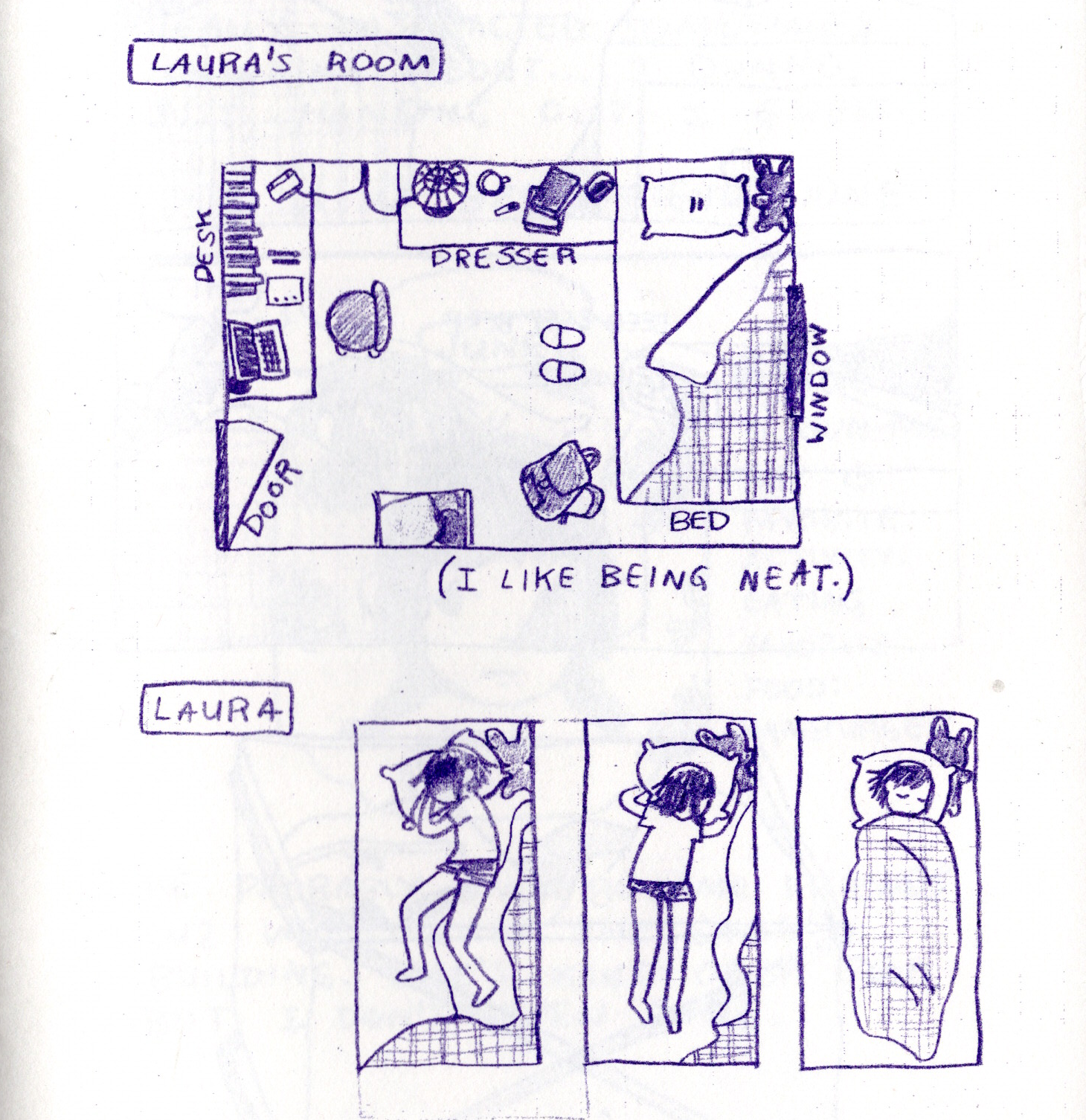
Mai’s aesthetic is grounded in feminine signifiers of beauty. Her drawings are neat, delicate, and organized. If you wanted to be more pejorative, you could describe it as “cutesy”. Several locations in the book are rendered as top-down diagrams that invoke stationary. When Laura introduces her own room with one such drawing, she notes, “I like being neat."
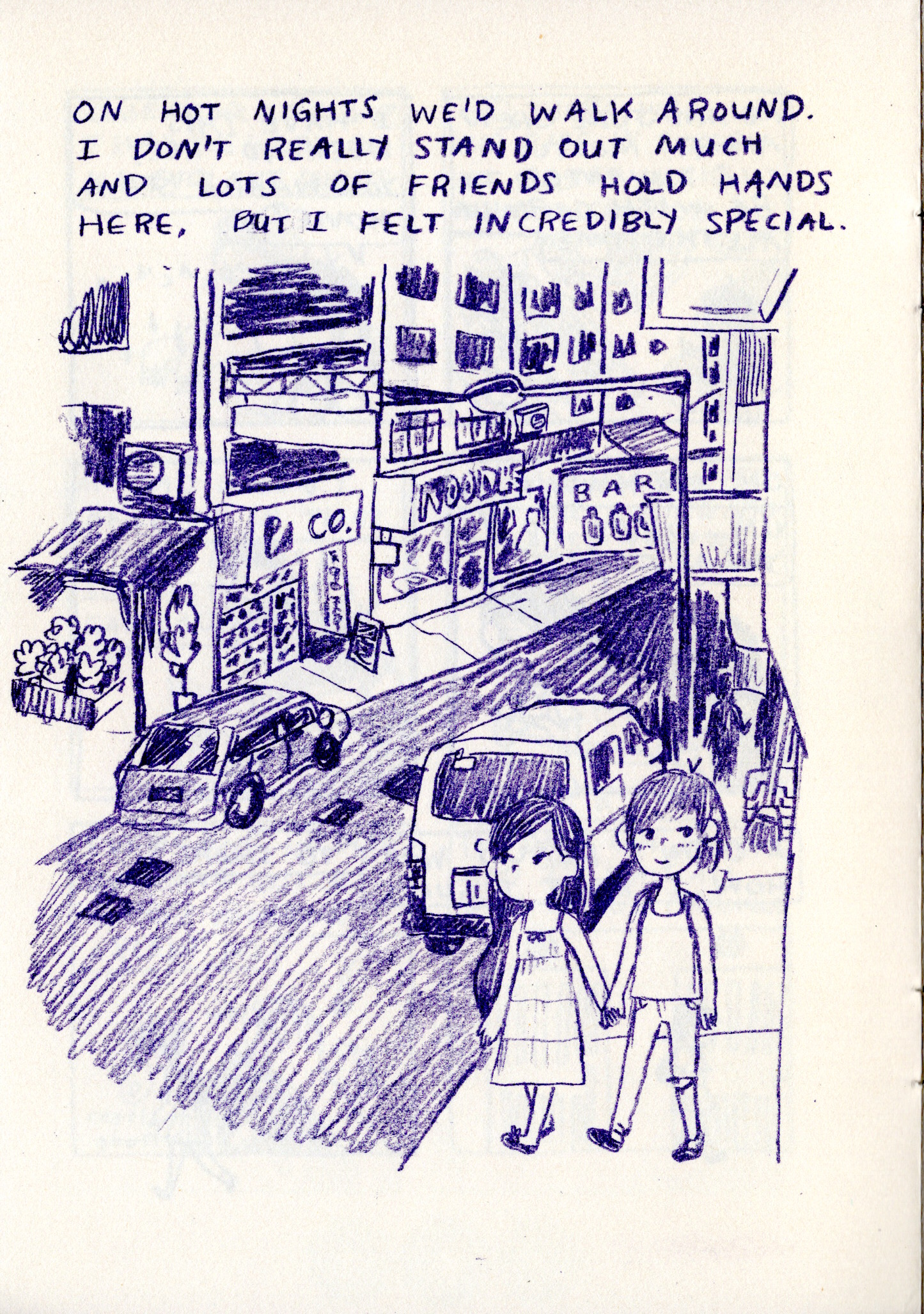
This works in the comic’s favor. As the story develops, and the stakes of Laura’s life become dire, and the adult world spills in. The second half is punctuated by richly textured street scenes where signage, advertisement and refuse spill out along jagged roads. While the stripped-back conversations never cease, this context radically changes how they read. The juvenile sense of “cuteness” becomes a lens of nostalgia placed over rotten memories of abuse. The first page of the book is one of many to feature just text and it begins with this: “Do you remember the first time you fell in love? I do, one summer when I was 15.” These two sentences set the terms for approaching Soft. It exists in the hazy realm of memory.
The most consistent technique Mai uses to achieve this effect is evident on every page. Each is printed in gorgeous lavender hues via risograph. Combined with the delicate graphite linework, the story is drenched in a warm fuzz. This is especially complimentary to the pages where Mai abandons the panel structure and lets different elements of the scene float in an undefined, abstract space. The first of these pages features a pair of eerie cat eyes drifting above a fluttering window. Those eyes return as Laura meets Carmilla for the first time, her bike toppled over into the void.
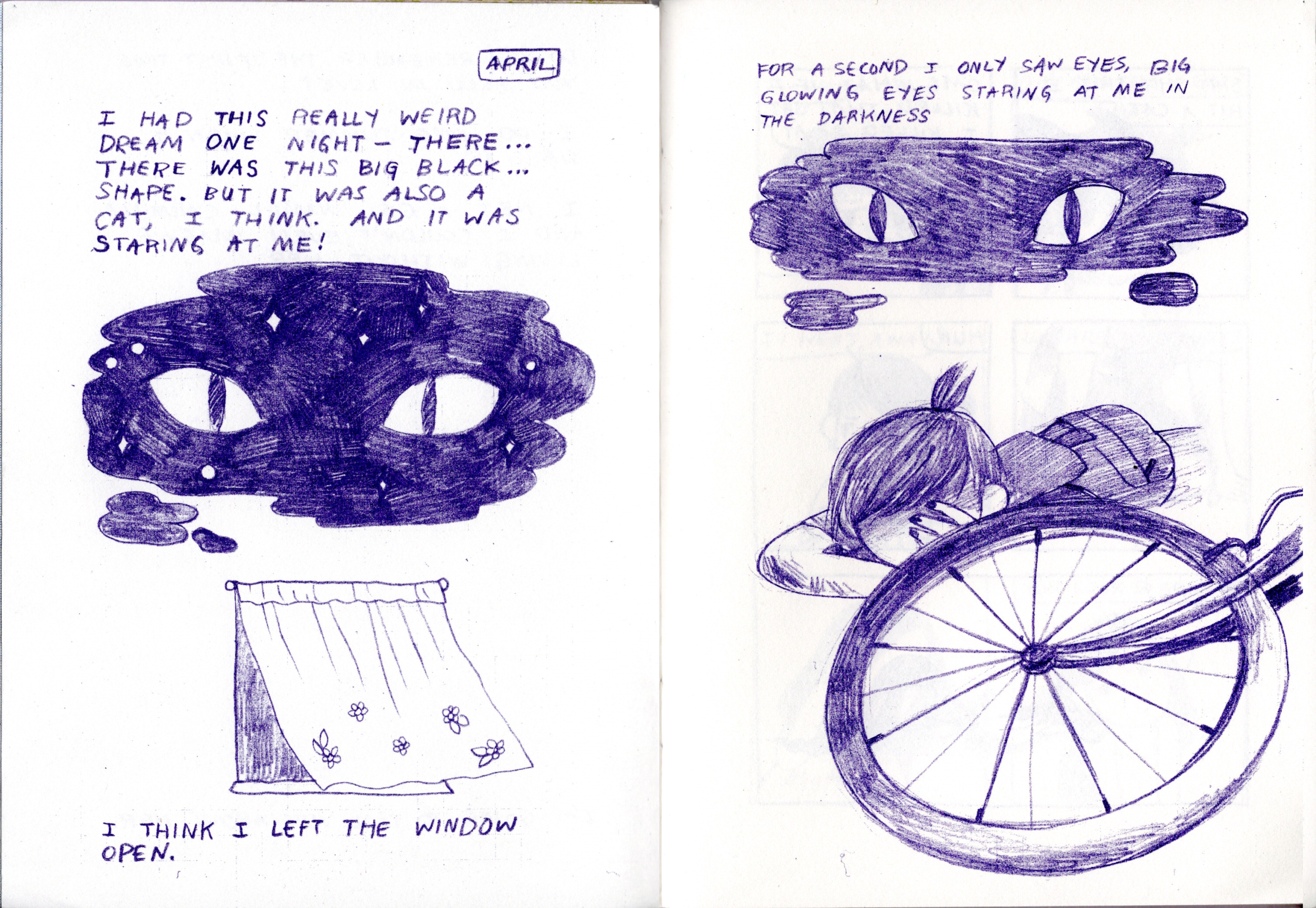
These tableaus serve to highlight the emotional reality present in Laura’s memory rather than the literal events, contrasting as they do with the rigid format of the dialogue sequences. They might highlight quotidian details of the world, such as Laura’s period-blood-stained underwear resting in her hamper. Alternatively, they isolate singular, impactful moments, the kind that seem to exist out of time. At one point Laura and Carmilla sensually gaze at each other, their naked bodies fading off into the white of the page.
Mai’s greatest trick as an author is invoking the presence of violence in her world without showing it. At multiple moments it's made clear that Carmilla is feasting on Laura’s blood. We don’t see this act itself, just the moment immediately preceding it and the gory aftermath. Near the story’s climax, Laura goes to the school nurse’s office, patches of blood and bruises covering her body. An image of Laura attempting to cover herself from the Nurse’s view punctuates the scene. Free from panel borders, the portrait fades off at the waist, leaving nothing of the surrounding scenery to ground the young girl. She looks so frightfully alone. She has heavy bags under her eyes. Her downcast gaze appears vacant. The elegant, graceful line art contrasts with these new marks, which look smudged and jagged, like stains on her body or ink seeping through the page. Leading into this image is the nurse asking a question: “Is your boyfriend abusive?” It seems as though no one on earth could understand Laura.
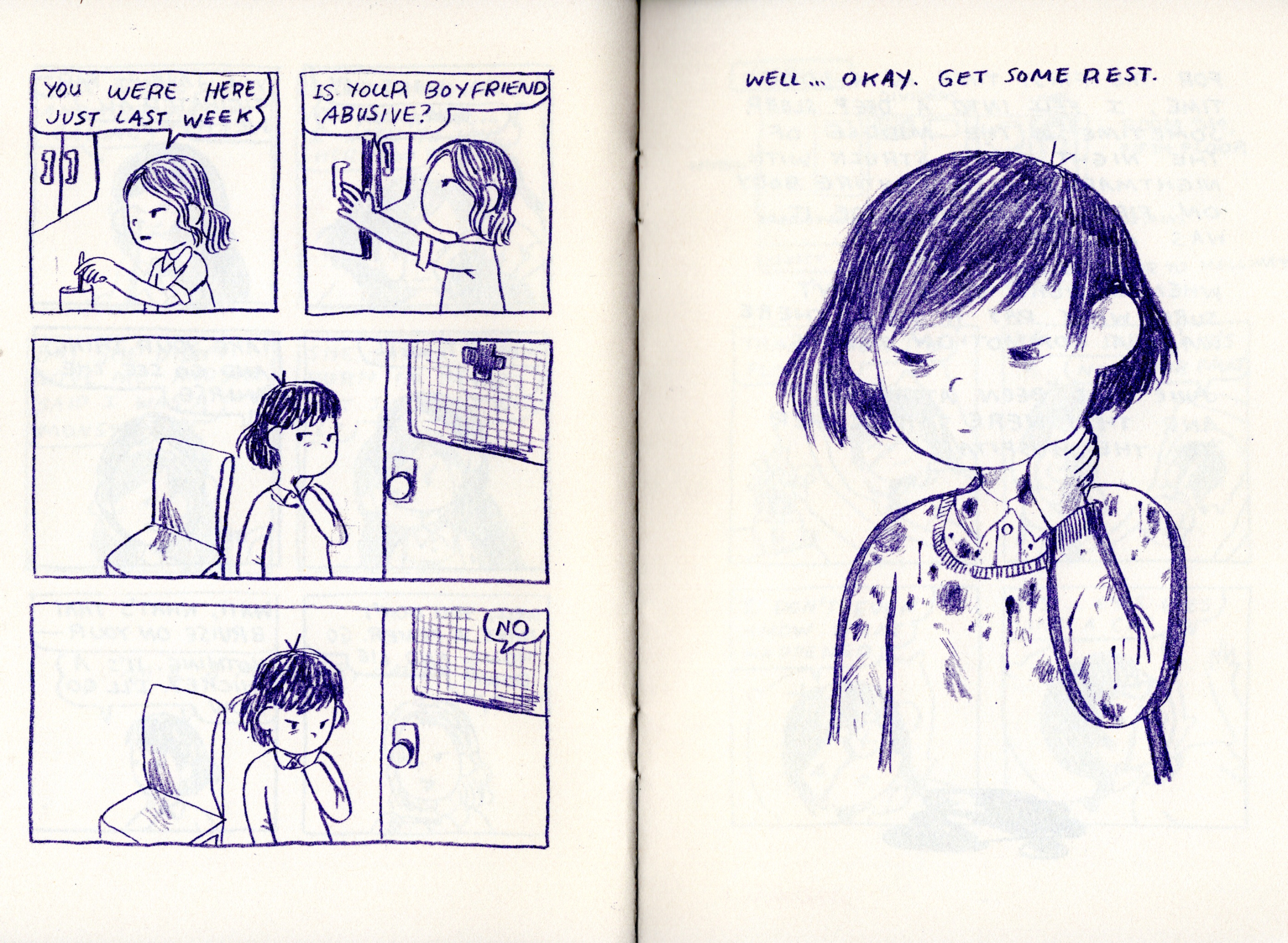
This scene represents the purest fulfillment of Mai’s aesthetic interests: constrained, feminine beauty contrasting with savage violence. If you were to pare down her artistic voice to its most essential element, this is what you would be left with. Understanding its origins, however, requires turning to So Pretty/Very Rotten, a book of essays and comics made by Mai in collaboration with writer and artist An Nguyen in 2017. Its focus is Lolita fashion, an obsession of extreme importance to both writers’ careers.
For the uninitiated, Lolita is a style of fashion developed in Japan at some point in the 1970s. Inspired by Victorian era women’s clothing, it incorporates petticoats, ruffles, ribbons, elaborate accessories and a general sense of feminine abundance. It is an opulent style meant to invoke a “cuteness” so extreme that it becomes nearly grotesque. Some practitioners of the style take this idea farther than others. Gothic Lolita, one of the style’s most popular subgenres, incorporates darker colors, more sinister motifs and openly plays with vampiric imagery. So Pretty/Very Rotten features an interview with Lolita designer, author and scholar Novala Takemoto, who describes this effect quite eloquently:
Were someone to try and make the beautiful Mona Lisa even more beautiful by adding a crown to her head, but by doing so, actually somehow make her less beautiful, and by doing so, get in trouble with the Louvre Museum for graffiti … this is the kawaii of Lolita. While if someone were to customize the Mona Lisa in a girly manner but only to such an extent as to not be in trouble with the Louvre staff, this would be mainstream kawaii. (pg. 128)
Both Nguyen and Mai attempt to articulate the exact nature of the rottenness invoked by Lolita fashion, but they go about it in very different ways. For Nguyen, who writes the lion’s share of the essays, the focus is on materialism. To her, Lolita is at once a liberating fashion statement and a capitulation to global capitalism. While these issues haunt the entire fashion industry, it’s hard to imagine a style more susceptible to over-indulgence. She also frequently discusses the judgment people who wear Lolita fashion face from outsiders, and the societal pressure to conform with one’s clothing.
Mai’s rot is more carnal. The first comic she pens in the collection features a fictionalised version of herself shearing parts of her body off to receive inspiration for a Lolita centric retelling of (surprise!) the Carmilla story. For the fictional Mai, the gothic quality of her clothing is a reflection of something interior, dark and unknowable. An urge to destroy oneself and others in the most beautiful way possible.
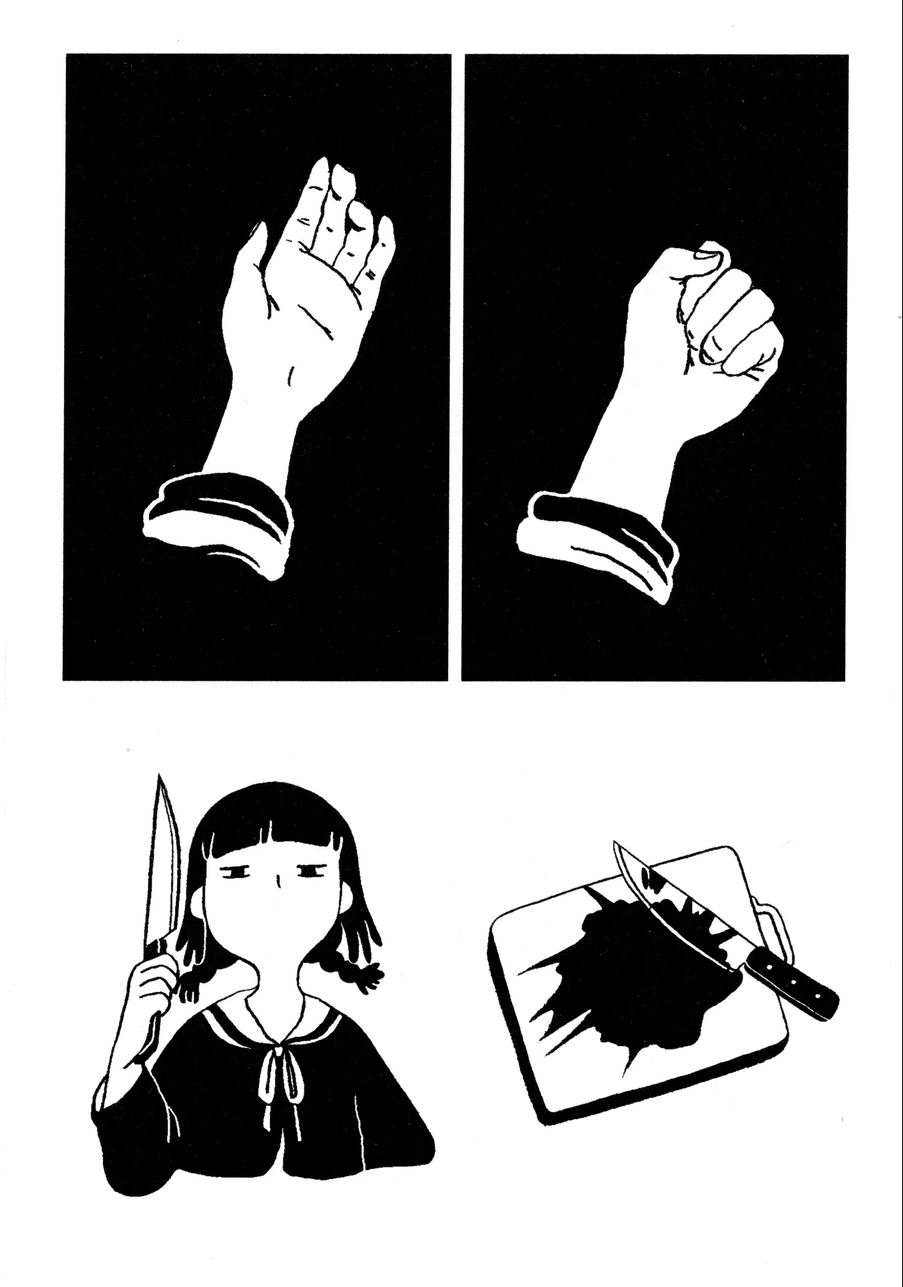
In an early essay by Nguyen, she writes the following: “…for women ‘Lolita’ fashion exists as a domain removed from the sphere of cis-male influence. Lolita has agency, feelings and power. She is a reminder of a woman’s own precious childhood memories growing up as a girl.” (pg. 15)
Mai’s body of work feels like a direct response to this. She is quick to note that growing up as a girl is hardly ever precious. Rather, the hyper-feminine performance of Lolita serves to express the idea of purified womanhood, and the inevitable failure of its fulfillment.
Though the dress Carmilla wears in Soft is too simple to be labeled truly Lolita, it does feature the kinds of ruffles and lace adornments associated with the style. This clues us in to how Mai uses her narratively. With her pure white dress, porcelain smooth skin and eternally feminine design, Carmilla serves as an embodiment of pure girl-ness. Nguyen offers us insight into this connection when she describes Lolita culture’s fixation with death. To her, being a Lolita involves entering a state of “pre-death” (2017: 168) to subvert both male desire and the process of aging itself. For the Carmilla of Mai’s story, we could substitute the phrase “pre-death” for “undead”.
Like the story’s violence, Soft only rarely engages directly with our society’s obsessive consumption of young girls’ bodies. It’s there in the porno magazine images Laura covets and the hypersexualised posters that haunt the walls of Carmilla’s apartment, but we never see it directly acknowledged. Still, it’s hard to imagine a force the book is more concerned with than this.
To come of age as a lesbian is to be both subjected to the sexualizing gaze of the world and to mortally fear that you are a part of it. First-hand experience with dehumanization forces you to conceptualize of your own sexuality as something destructive and dangerous. Soft literalizes this act of consumption in Carmilla, who feeds on her girlfriend’s flesh. At the climax of the narrative, Laura must take Carmilla’s life. We do not see this moment. Mai elects to describe it only through text. Violence in this world can only be felt through the prim and proper.
The peak of Mai’s fixation with prettiness and its rot, however, is felt in the shadows of her drawings. Great patches of black are filled in with chaotic, scratchy marks that wildly crawl back and forth across the page. Even the pale shadows are wild and intuitive, like dry sticks crammed into a hollow orifice.
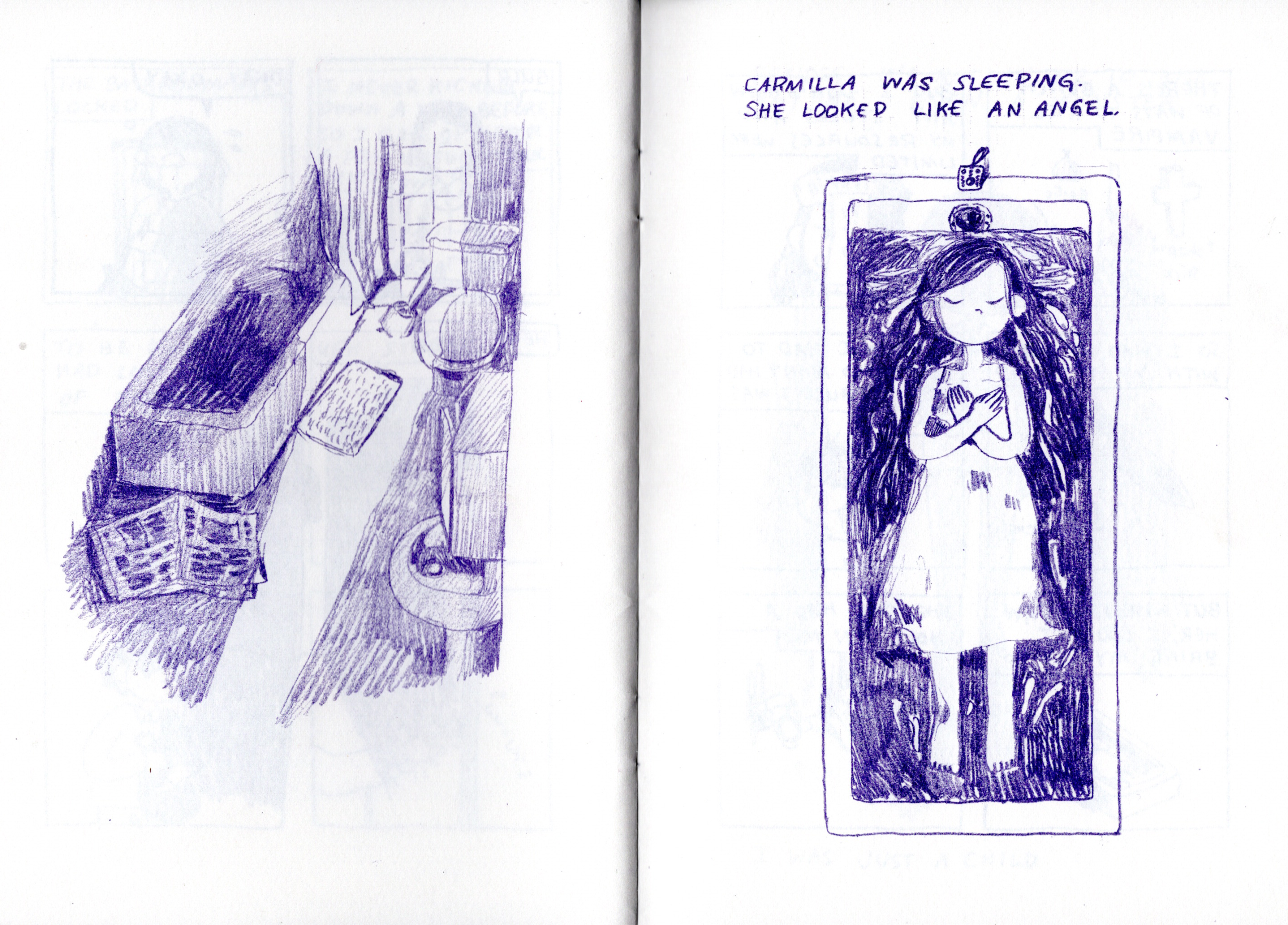
This tension is what makes Soft an invaluable and underappreciated work. It was the key to why I, a closeted young comics reader, coveted my copy for so many years. It was what allowed the work to feel as though it had answers about my true nature hidden within its simple drawings of sad girls. Like Laura and her magazine, it was an object to be coveted for its beauty as much as hidden for its danger. It was one of the many secrets I kept from my parents as a teenager. The length of time it’s spent out of the public eye has only accentuated these qualities.
Hopefully soon Mai’s magnum opus will rise from the dead once more to haunt the shadowy corners of bookstore shelves, whispering to young people the secrets of their lives they dare not say out loud.
The post The best comic of the 2010s you never read: <i>Soft</i> by Jane Mai appeared first on The Comics Journal.


 Hello, my name is Jack Sparrow. I'm a 50 year old self-employed Pirate from the Caribbean.
No comments:
Post a Comment