

Hodo is written in Korean as 호도 and in Chinese characters as 湖島. It's supposed to be a name, and the scene where the title character imagines her parents naming her is evocative of the comic's overall grim, neglectful tone. Hodo's father think it's a poetic phrase, referring to an island in the middle of a lake. Her mother doesn't like it but also doesn't care enough to argue about it. This is, as Hodo's stories about her parents go, fuzzy and romantic.
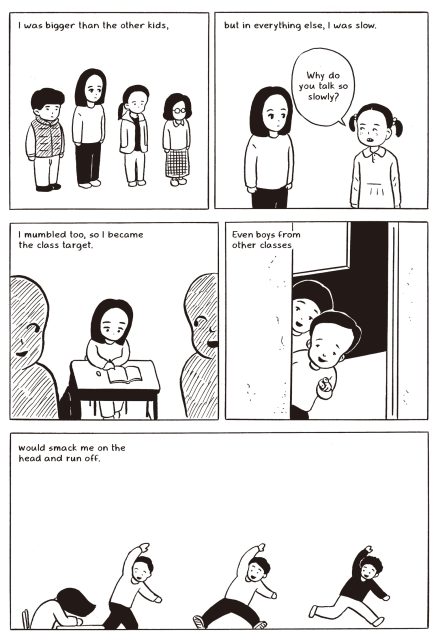
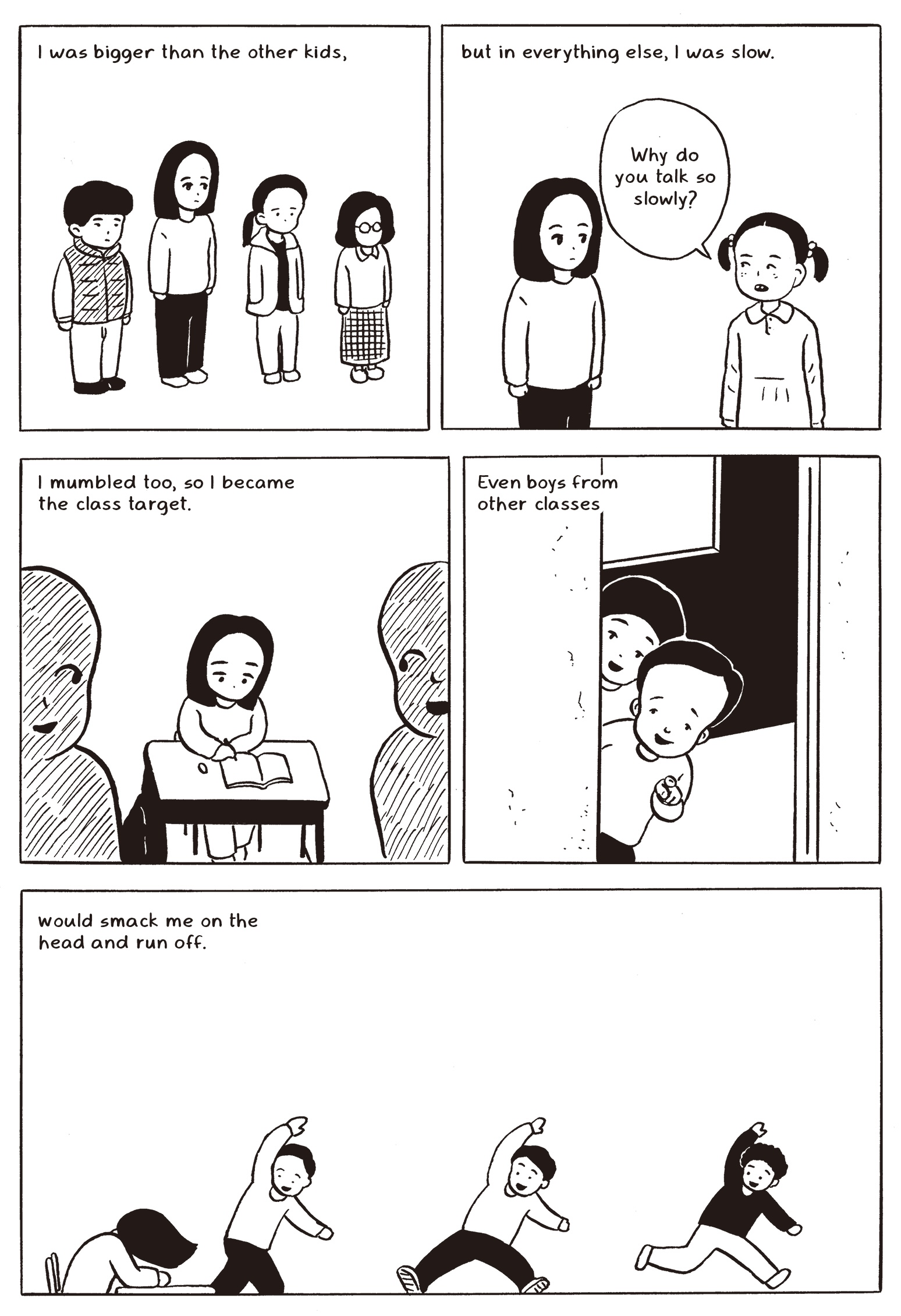 Yeong Shin-ma's semi-fictionalized narrative revolves around a series of interviews she had with the painter Un Kyoung (은경, 恩庚), discussing various horrible events in her life with a blandness that belies just how awful these vignettes are. Shin-ma's simple art style forces a coherence to the cruelty and abuse which comes remarkably close to achieving the disaffected tone necessary to demonstrate how Un Kyoung copes. Un Kyoung's own influence as a painter on Shin-ma is also noteworthy, as Hodo is filled with artistic flourishes and displaced temporality that feel more in place in an abstract work of art than a graphic novel narrative.
This distinctiveness is obvious as soon as you open the book. The two stories, "Lake" and "Island," can be read in either order. "Lake" is read Western-style, from front to back, while "Island" is read manga-style, from back to front, both stories meeting in the middle. "Lake" starts at the beginning of Hodo's life while "Island" focuses more in the middle, but there's clear overlapping material. There's also the implication, when starting with "Island," that Hodo is remembering unfortunate events of her childhood to try and make sense of her generally disturbed mental state in the present day.
Indeed, the more I think about it, "Island" might be the more appropriate starting point if only because "Lake" very quickly becomes unavoidably grim. It's largely a book about a child being abused by nearly everyone around her, and who comes to see this as so normal it doesn't occur to her that there's anything all that odd about her family. I'm not a fan in general of the social commentary genre of South Korean comics. They unavoidably become exoticized documents when translated into English, coming off as attacks against Korean culture specifically when they're not necessarily read that way in the original cultural context. Yeong Shin-ma's previous book Moms is an example of this.
But Hodo evades these unfortunate implications for the truly grim reason that the abuse Hodo faces is entirely arbitrary. It's difficult to argue that Hodo is necessarily an attack on Korean patriarchy, for example, because she's beaten by female characters, most notably her mother, far more often than she's victimized by men. Which isn't to say that the men in Hodo's life are much better. This is a brutal story with sexual assault and rape. But it's also every bit as arbitrary and bizarre as the more run-of-the-mill violence. It's difficult to guess what any given male or female character will do in a situation. Sometimes they believe Hodo, other times they think she's lying, other times they think she's telling the truth but making too big a deal out of it.
What makes these relationships particularly messy is that Hodo maintains an emotional attachment to her family despite the fact that more often than not it seems like she would be better off not doing so. The semi-fictionalized adaptation is fairly necessary in this context, since if these were Un Kyoung's actual friends and family, the story might seem slanderous. While Hodo doesn't feature any of Un Kyoung's own artwork, it's easy to guess the sorts of feelings her paintings are supposed to evoke, a sort of sublime horror manifesting in the emotions she must suppress in order to get through her everyday life.
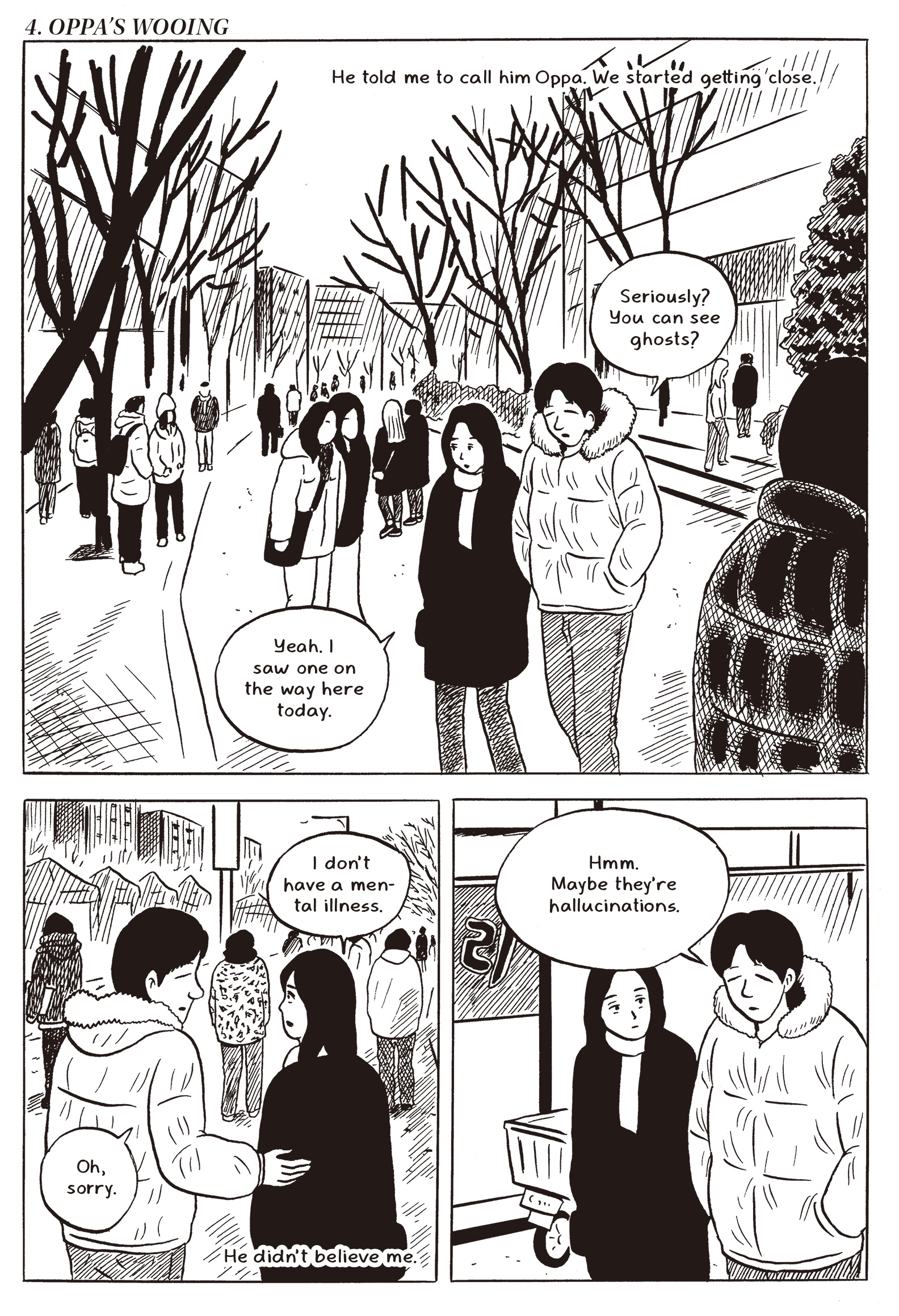
Along those lines, Yeong Shin-ma's own artwork clearly internalizes a lot of that pain. He doesn't accomplish this with anything all that flashy. The main distinctive flourish is the withdrawn way Yeong draws Hodo's eyes. This quickly becomes a calculated means by which we can gauge the emotional intensity of other characters. The most sympathetic character, closest to Hodo's own emotional wavelength, is seemingly drawn with his eyes always closed. This serves a dual purpose: preventing him from engaging in the sudden outbursts or casual cruelty that defines so much of the misery in Hodo's life while also giving the impression that he's hiding something, and that Hodo can never truly trust him either.
Then again, truly abusive people don't generally feel the need to hide their behavior. They believe themselves to be so self-righteous and wronged it genuinely doesn't occur to them that they have anything to hide. Both "Lake" and "Island" end with Hodo having an emotional breakdown because she's been forced to defend herself in a situation where it seems fairly self-evident that she's in the right and it's more than a little incredible that anyone would think to argue against her.
These are Facebook horror stories, the kinds of fractures that lead to people these days to disown their family members. To Hodo, however, moral self-righteousness isn't the end goal. More than anything else, she just wants to better understand her feelings, so she can reassure herself that she isn't crazy. It's an extremely relatable depiction of modernity, despite Hodo herself not just representing some fairly specific cultural situations, but also that she genuinely does seem to be mentally ill, and aware of it.
Did the abuse break Hodo? Or was this just what she was always like, awkward and emotionally coldn? Hodo never seems sure about the answers to these questions even if they seem fairly obvious to the reader. Hodo herself is not a perfect victim any more than her tormentors are perfect perpetrators, and has just enough scattered moments of genuine happiness we can see why she hasn't quite succumbed to siren call of suicide yet. Nevertheless, that specter always lurks just in the background.
The post Hodo appeared first on The Comics Journal.


 Hello, my name is Jack Sparrow. I'm a 50 year old self-employed Pirate from the Caribbean.
No comments:
Post a Comment