

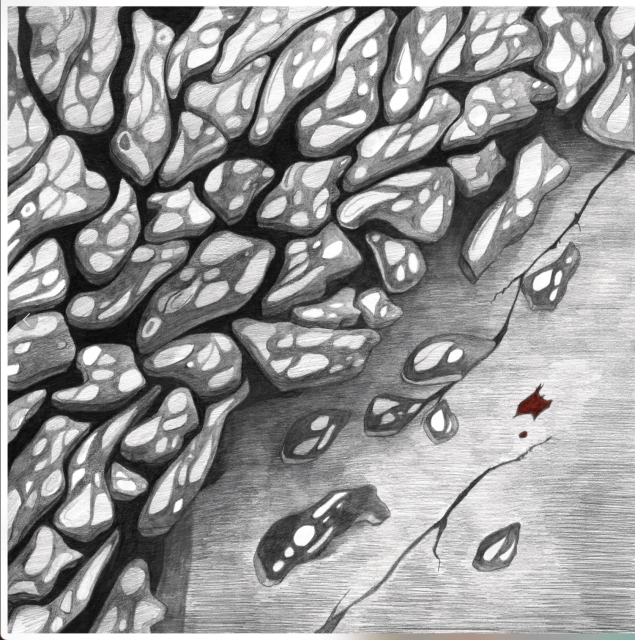
The ground is cracked and arid, scattered scab-like vegetation clogging its pores. A pair of pliers, perhaps shears, lies on the ground. A spatter of what seems to be blood has dried, yet the longer we examine the picture the less these droplets look like what they are, beginning to resemble petals, fiber. Looking to the next page, this deep red becomes the scales adorning the hide of a lizard, its rouge flecks at times punctuated with a pale pearlescent blue. The fragmentary crescent of the creature's form which we are given to view is in turn replaced with the haggard leather of a working woman's shoe, the visible strain upon her blistered foot dry and cracking like the desert earth beneath her. Her habit is spattered with blood. Reeds rustle, red like veins, moss dies on the rocks it clutters turning rust. She sets forth on a modest harvest.
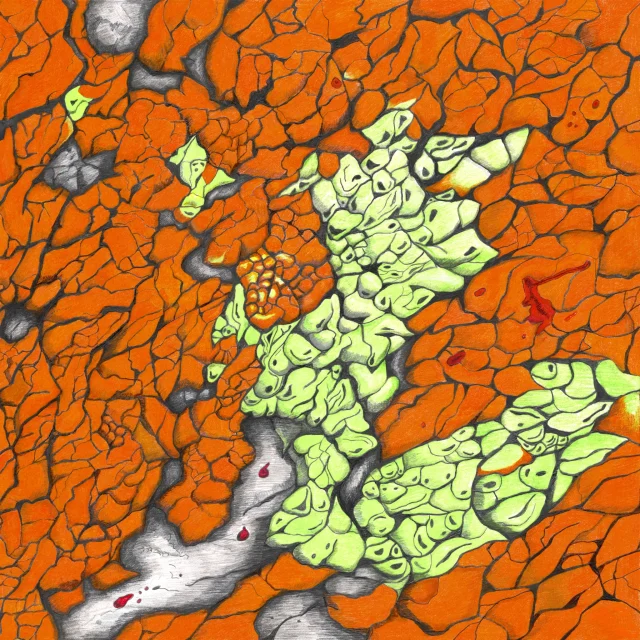
The Interpretant, a collaborative work from the writer-artist team of Lily Thu Fierro and Generoso Fierro, is a comic of microcosms and ominous detail, petri dishes held under narrow frames and examined with as much precision as ominous uncertainty. The spare narrative we are given weaves between the negative spaces left between religion and science, revelation found in the smallest speck. Juliana the nun, like many mystics before her, has imposed isolation upon herself, remaining in a desolate, uncertain place. There is seemingly just one human-built locale, a small beet red home with metal interiors that may also function as a research facility, or perhaps a kitchen. Juliana meets with a researcher, who she speaks with through sign language. The researcher likewise has elected for a period of voluntary exile, remaining at the lab to work on her mission for another year, with Juliana's visitations, delivering harvests of plant life for study or for consumption, the only punctuation of this great loneliness. First the researcher appears to Juliana in plain olive green work clothes. Later, possibly decades later, the researcher returns, hair greying, face adorned with wrinkles, clad in the bulky suit of an astronaut.
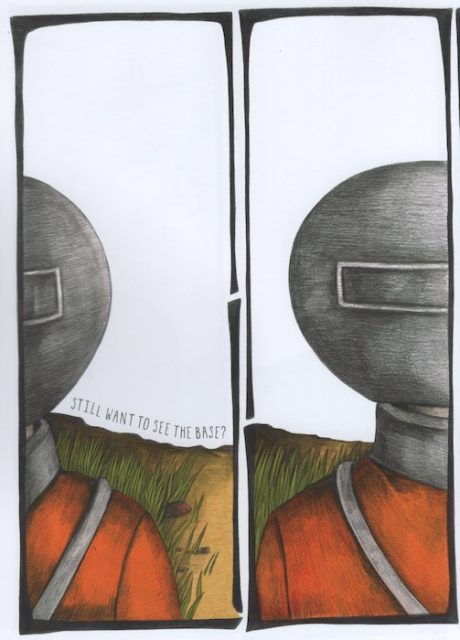
The two prepare and eat meals largely in silence, reeds and succulents carved up and mixed with canned preserves, then clean up and go on their way. They exchange small talk as best they can, weighted by their need for company. On their second visit, the researcher, perhaps impulsively, offers to show Juliana the research base where she spends her days.
The psychedelic closing pages of the work take Juliana across the desert to a strange facility, space suits looming out a closet door ominously suggesting the former presence of others, our gaze now taken under the microscope, the lizard's scales once again appearing within the cells within the petri dish. The lizard has been following her, following us perhaps. Its belly close to the heat of the ground, the baking metal floor, the scorched dust of the earth. Within the scales are more samples under glass of their own, a world within a world opens of colored scales cracking, color leaching and returning, drying valleys flowing with water all red as blood, as the lizard's scales. Juliana returns, kneeling, from this vision to the desert, surrounded by pebbles. The land stretches out before her, yellows dotted with deep lively vegetated green. She makes her way back to her outpost, a now familiar shade of rouge.
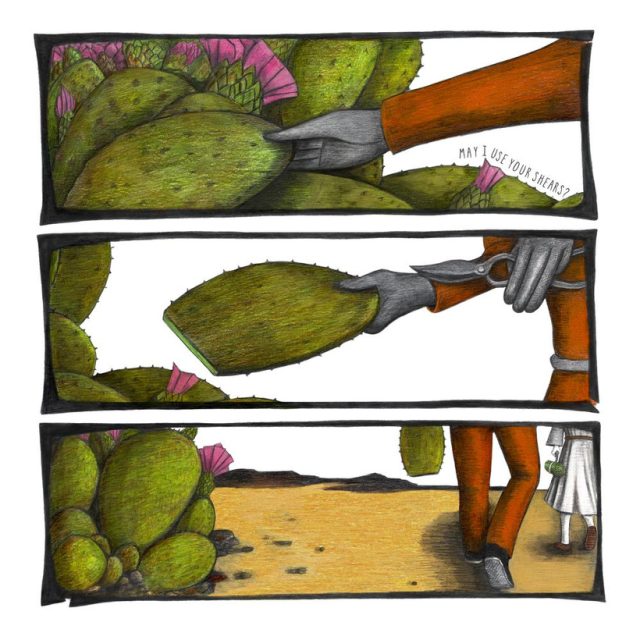
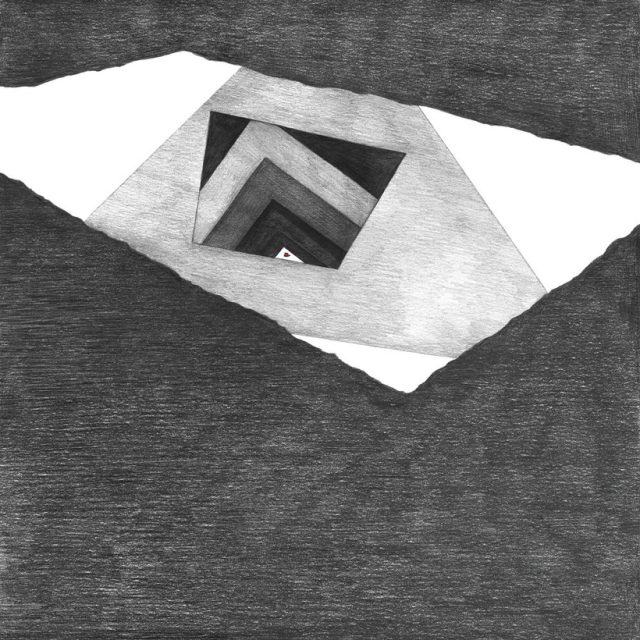
This is a spiritual work that nonetheless draws heavily from writer Lily's background in cognitive science, playing as much with the limits (and possibilities) of communication as with the terror and wonder of the infinite. We know many ways to communicate without words — for example a mute person can speak through signs signs or text, and a speaking person can learn new modes of listening in these circumstances. But how to communicate the unnameable, inarticulate mysteries of nature? Generoso's illustrations demand such contemplation, earthy shading accomplished through horizontal slashes of what appears to be a mix of colored pencils and pastel, rendering a setting of bright light and heat one nonetheless of shadows, crevices, folds in fabric and hidden secrets. Her compositions are often vertically or diagonally slashed into panels with strong dark borders and vast white gutters, juxtaposing open vistas with tight closeups at a disorienting clip made only further troubling as they widen into full page spreads. These are compositions to linger on then return to even on one's first read, situated and recontextualized on every pass, like an ambiguous sentence or new vocabulary describing an alien concept.
The Interpretant is a challenging work of comics that asks us to consider our world, ourselves, and each other, the language we use, our very perceptions. As a story and as an aesthetic experience, readers are encouraged to enter a state of contemplation away from yet deeply within the expectations of narrative. At its core, The Interpretant is not so much a revelation as it is a story about revelations, of communication after isolation, of speaking to each other, of speaking to ourselves.
The post The Interpretant appeared first on The Comics Journal.


 Hello, my name is Jack Sparrow. I'm a 50 year old self-employed Pirate from the Caribbean.
No comments:
Post a Comment