

“When a person says he’s ‘just being honest’… this is a good time to start looking for the exits. Especially a potential romantic partner. People who put great priority on ‘just being honest’ … that means they’re about to harm you in some very essential way. Not just that they’re going to screw you over and cheat on you — they’re really gonna find the vulnerable part and get to it. Because it gives them pleasure. That’s how they get their pleasure. And so they say to you, ‘Hey, you know, I just try to be an honest person.’ Oh, my friends … locate all the places to run in a fire in that kind of situation.” — John Darnielle
Joe Matt makes me sick.
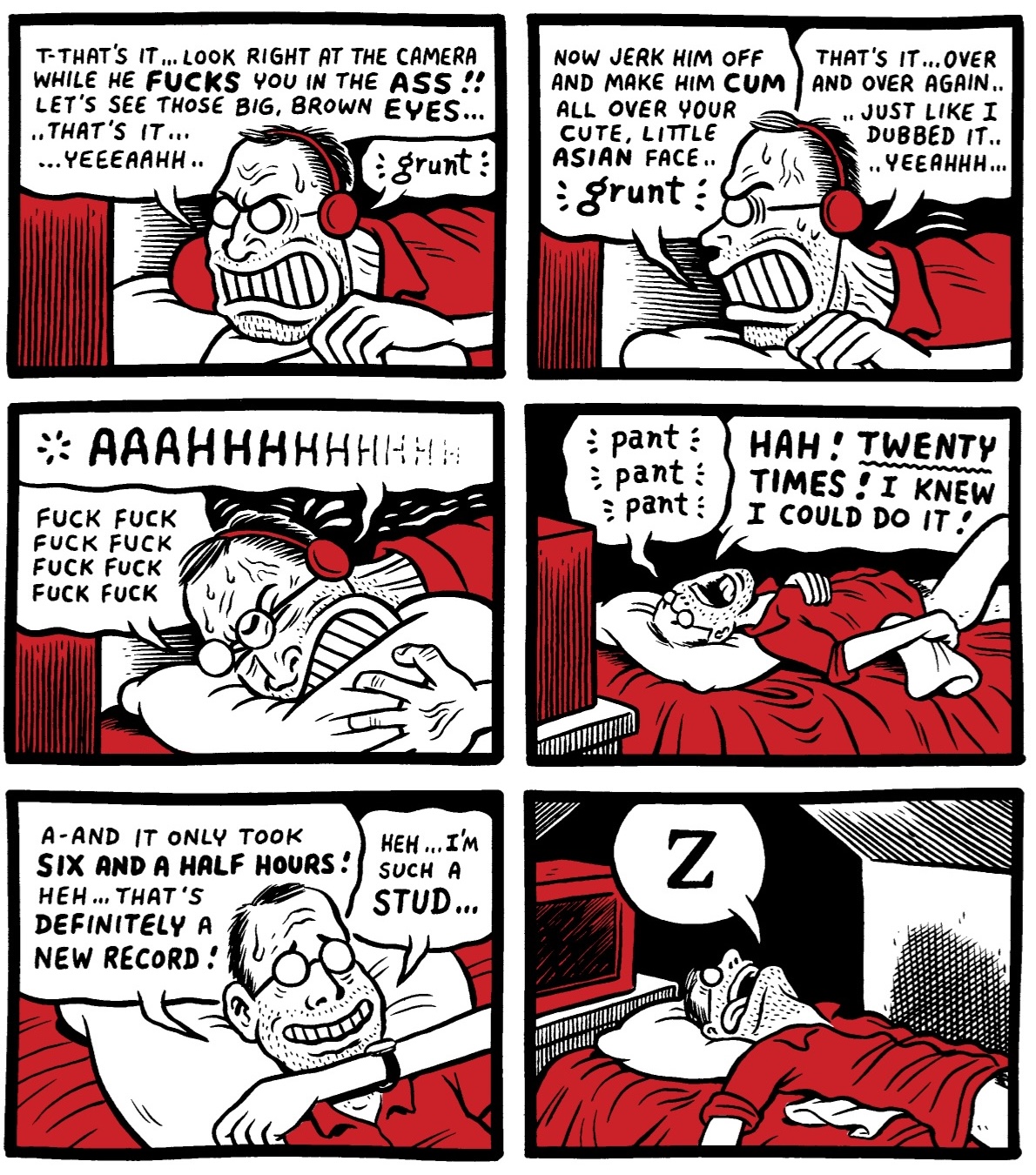
I don’t mean that as a moral judgment; that part comes later. No, I mean it in an immediate, physical way: Joe Matt makes me feel ill. Specifically, I think of the first time I encountered his work, in the excerpt from Peepshow #14 included in the Chris Ware-edited issue of McSweeney’s. The issue, which opens on Matt’s cartoon stand-in masturbating, reaching orgasm, and then declaring, to himself and his reader alike, a new record — twenty orgasms in six and a half hours — is a perfect encapsulation of Matt, insofar as it evokes an inescapably vivid sensation, the reader having no choice but to consider exactly how it feels, to have cranked it for so long and so many times in a row. Crass though it may be, I use the phrase “cranking it” advisedly: by that point, all that remains is the mechanical act; any pleasure is, surely, unimaginable.
Though this excerpt was the first time I encountered his work, it was not the first time I encountered the man himself. My first introduction to Joe Matt the man occurred some months earlier, when, after his 2023 passing, TCJ published a collection of remembrances from friends and peers. Reading it at the time, I was immediately struck, and not necessarily in a good way, as the remembrances, at turns hilarious and repulsive, painted a vivid portrait of a man who had done perhaps the most dangerous thing an artist can do — become fictional. Which is to say: having allowed his whole life to become story-fodder, he lived, it seems, according to a set of affectations and mannerisms largely untenable within society, thus ensuring that these stories are reliable. I’ve known a good few such people — people who lower circumstances so they are never expected to rise to any occasion. On the reader level, it is entertaining; on the human level, it is agonizing just to think about, let alone experience firsthand.
If all this sounds unfair, a bit of armchair psychology evaluating not the man’s work but the man himself, that is in no way unwarranted. Just read the man’s own words:
Autobiographical comics are not as simple as they appear. They are not intrinsically truthful, self-aware, or even honest. In fact, I tend to regard the entire genre as fiction of a sort, mainly due to the selective editing of one’s life that the process entails. […] Still… there’s one thing I find irresistible about all autobiographical comics, and that’s the sense of reality that the reader brings to the story, right from the outset. […] With autobiography, there’s a tendency to believe that what one is reading is true and factual … much like a biography or work of nonfiction. But autobiography offers far more leeway and much less accountability.
Written in 2005, the above passage, which now appears as (part of) the introduction to The Complete Peepshow, recently published by Fantagraphics, conveys a clear attitude: plausible deniability is the name of the game. We are what we pretend to be, wrote Vonnegut, so who cares what we are, anyway?
Let us start at the beginning. The Complete Peepshow collects all fourteen issues of Joe Matt’s one-man anthology, published by Drawn and Quarterly from 1993 to 2006 and collected as The Poor Bastard (collecting issues #1-6, published 1996), Fair Weather (#7-10, 2002), and Spent, (#11-14, 2007), as well as issue #15, completed by Matt’s friend Chester Brown after Matt’s death and released by Fantagraphics in 2024. These first fourteen issues of Peepshow differ from many of its contemporaries in one key sense: unlike Eightball, Yummy Fur, or Dirty Plotte, just to name a few prominent examples, there is no balance here between serials and standalone short-form works; instead, each issue is a whole unit, an installment within the broader arc, that arc being “the life of Joe Matt, as viewed from the outside by Joe Matt.”
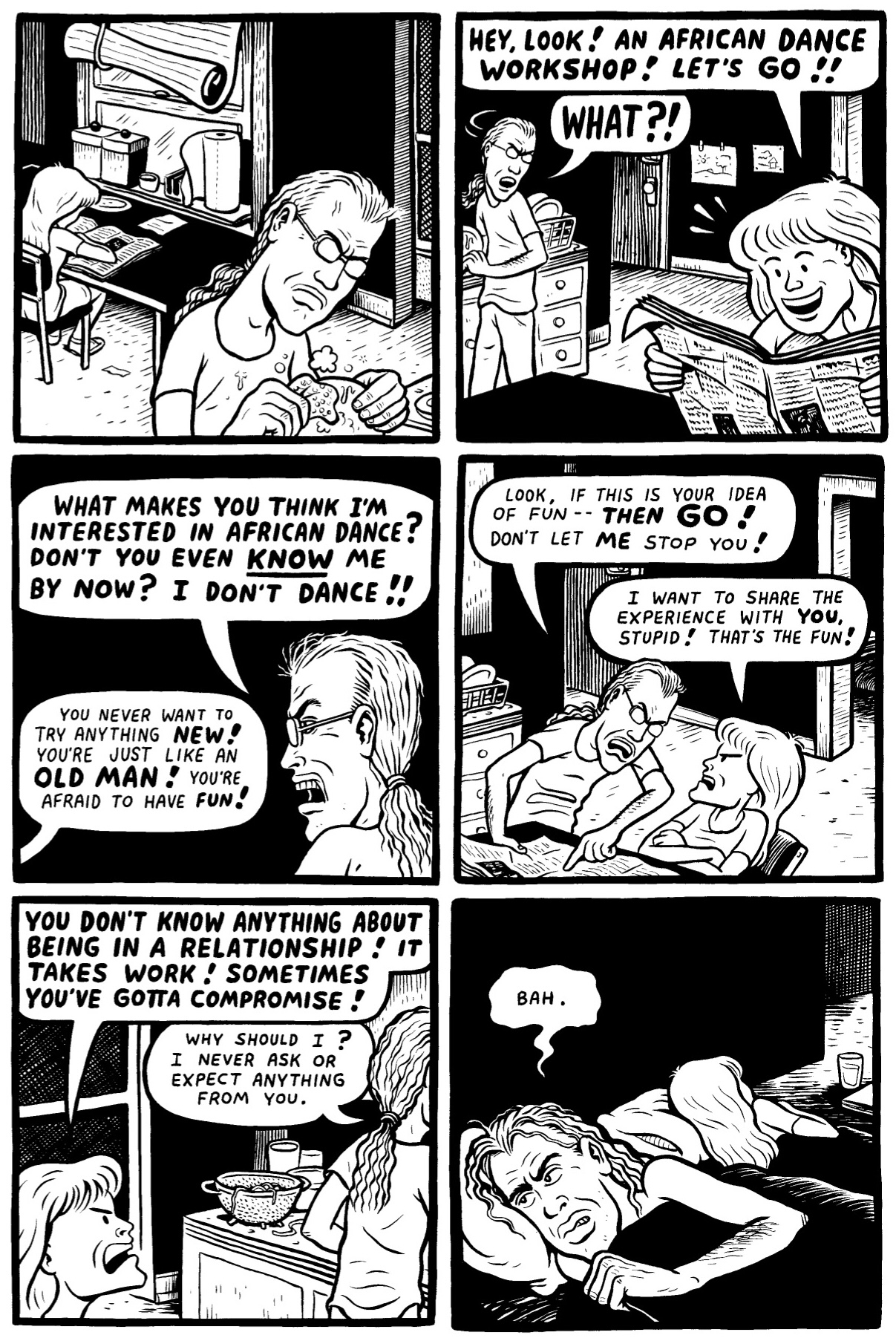
The first movement of Peepshow, later collected as The Poor Bastard, starts out as a more-or-less unstructured view of life in real time. Joe1 is a cartoonist. His relationship with his girlfriend, Trish, is in its dying days. His friends, fellow Toronto cartoonists Chester Brown and Seth, are his only refuge. When he is with Trish, he is constantly reminded of his failings; when he is with Seth and Chester, he is constantly reminded … of the same failings. Seth and Chester are generally portrayed as level-headed and well-adjusted in comparison to Joe, thus framing them, in essence, as an oppositional sounding-board.2
A word, here, on cartooning style. Not included in the Fantagraphics book are Matt’s early comics, previously collected by Kitchen Sink Press in a book titled Peepshow: The Cartoon Diary of Joe Matt. Despite the shared title, these early shorts — mostly (though not exclusively) one-page affairs featured in anthologies over the preceding five years — show a different side of Matt altogether, one that is more formally curious — shifting between real-time diary comics, flashback strips, “data sheet” gags, and visual/compositional play — and whose artistic ‘hand’ is still somewhat insecure, with uneven shapes and pen-strokes. If anything, this graphic insecurity only helps the material; it is exciting precisely because it is excited.
By the time the one-man anthology rolled around, Matt had mellowed out considerably; he had settled into a fixed six-panel grid and traded his shaky pen for a smooth, elegant brush. It is, by all means, more professional-looking, but professionalism is not always equal to vigor. Matt’s character work is charming when the characters are in frenetic motion; when Matt draws himself banging his head against a table, say, or gesticulating in a fright while in the car with a would-be paramour, he draws every part of the gesture, Lale Westvind style, creating a sense of a temporal solidity. But when they are "at rest," as it were, the characters are smooth to the point of featurelessness, and thus become tedious and grating to look at.
The one exception here is Joe himself: where the other characters have lines (when closed) and black blobs (when open) for a mouth, he has thick lips; his eyes, when drawn sans glasses, have sclera and irises, while most other characters have just dots. The result is both telling and obvious, an immediate incongruency, and there is, in fact, a sense that it’s “Joe alone against the world,” although if anything he is more cartoonish than the people around him, not less. Matt portrays himself as essentially unfit for living in society: he is incapable of viewing women in any way outside the sexual, and he is capricious to a fault, prone to spending whole days masturbating or looking at View-Master reels (a favorite collectible of his) instead of working. More than anything, his notion of human relationships is shallow and childish, completely stripped of mutual obligation: Seth and Chester seem to have very little going on in their life outside of Joe (he certainly doesn’t show any great interest in them), while Trish is constantly trying to get Joe to show his commitment to her only to be met by a wall of resistance.
The tension between reality and depiction dogs Joe the character and Joe Matt the cartoonist alike. After the first issue — wherein Joe becomes infatuated with a friend of Trish’s and constantly devises ways to get into the same room with her, all the while abusing Trish both emotionally and physically — the second issue shows Trish finding out that he had made the whole episode into a comic, even though she had urged him to stop roping her into his work. In the book’s afterword, Diana Schutz (Trish’s sister, as well as a close friend of Matt’s through his work for Comico3) quotes Trish, who says that “We had terrible fights over [my appearances in his work], and he told me I had no say, that there was no law against it.” Matt, for his part, chose to play somewhat coy; in his 1996 interview with The Comics Journal’s Christopher Brayshaw, he said simply that Trish “flew off the handle” and that “Some things are just better left unspoken in a relationship, I guess.”
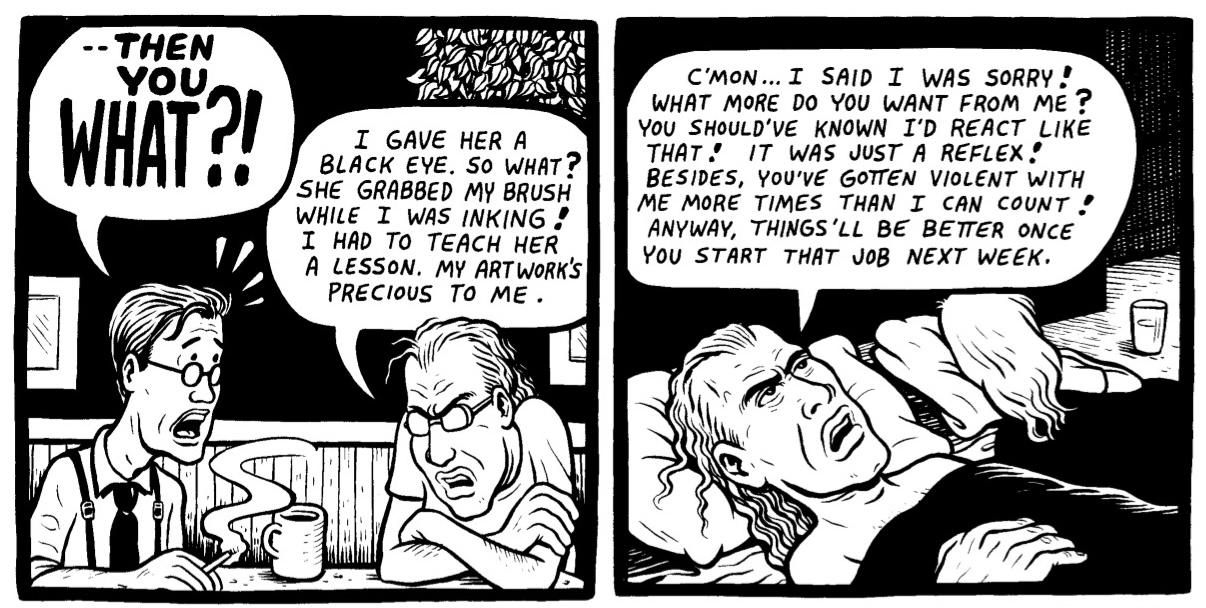
At first glance, this may seem like a mere ethical circumstance, worth discoursing in theory but of little pertinence to artistic criticism. In truth, however, it directly feeds into Matt’s rhetorical positioning. A point that often comes up in discussions of Matt’s work is that, because he is laboring to present himself as The Worst Man Alive, rearranging the facts, if not outright inventing them, to achieve this aim, his work is not to be taken at face value, not to be believed verbatim. In isolation, this argument is not, strictly speaking, incorrect, in the sense that Joe is consistently pathetic and deplorable. But to argue that he is squarely and exclusively in the wrong, from the perspective not just of the reader but the author as well, is to ignore a certain rhetorical defensiveness inherent in the work. Trish is a perfect example: whenever she appears on the page, she is almost uniformly nagging, castigating, and quick to argue, as well as profoundly insecure; just pages into the first issue, she first begs for reassurance that a girl he was checking out wasn’t more attractive than Trish, leading Joe to put her down even more (“You place too much importance on appearances! No wonder you’re so insecure!”), then cruelly mocks him for not getting any work done. Though this doesn’t excuse what happens next — he loses his temper at her and gives her a black eye — it certainly creates, in the reader’s mind, a context, one that is overtly manipulative. Later, he will state that she had hit him on numerous occasions before.4 Joe’s housemate in the second issue, Charles, receives a similar treatment: Charles points out that he has only ever seen Joe “criticize, belittle, and discourage her”, and that it’s Joe’s “insecurity and feelings of inadequacy”, not his supposed desire to help her get better at art, “that made you hurt her.” These are, of course, reasonable points, undermined by Charles’ previous depictions as a disgusting slob with whom every conversation is exhausting and pointless, and whom even Trish, the same Trish he “sides” with, finds repulsive and creepy.
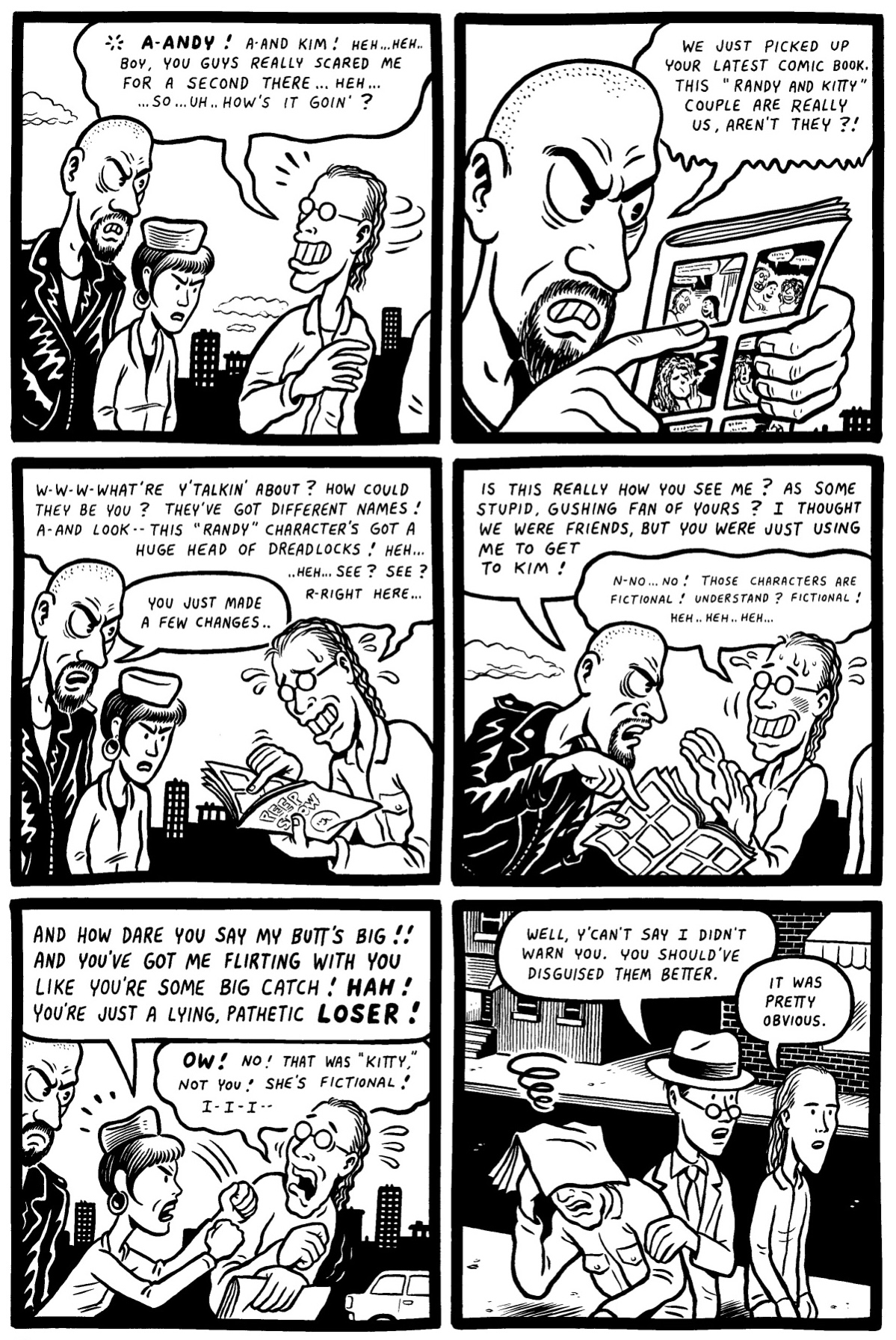 Soon after she finds out about the comic, Trish finally leaves Joe. As a result, he is completely unmoored, swinging rapidly back and forth between unadulterated lust — particularly a fetishism of “Oriental” girls and the reduction of life into pornography — and total desperation. Eventually, his lust settles on a specific subject: Kim, whose boyfriend, Andy, is a fan of Joe’s comics. Initially put off by Andy, Joe nonetheless befriends the couple for the chance of hooking up with Kim, who appears surprisingly receptive to Joe’s broken-hearted sad-sack act, and the two try to play matchmaker for Joe, but to no avail. Toward the end of the arc, while walking down the street with Seth and Chester, Joe is accosted by an unexpected party: Kim and Andy, who have just spotted two familiar figures — “Randy and Kitty” — in Joe’s latest comic. “Is this how you really see me?” asks Andy. “As some stupid, gushing fan of yours? I thought we were friends, but you were just using me to get Kim!” Kim has her own complaints: “And how dare you say my butt’s big! And you’ve got me flirting with you like you’re some big catch! Hah! You’re just a lying, pathetic loser!” Joe, for his part, claims that Randy and Kitty are completely fictional characters, not meant to stand in for anyone, but the lie is obvious. Matt acknowledges this key conundrum of autobiography—the extent to which one is the ‘owner’ of one’s life story—but in no way is he interested in reckoning with it. At the end of The Poor Bastard, he gets a phone call from Seth, filling him in on Trish’s post-breakup life; when Joe hangs up the phone, he puts a porn tape into the VCR, taking comfort in the unconditional love of the one-sided.
The arc serialized in issues #7 through #10, Fair Weather, sees Matt completely breaking from the mode of life in real time, instead choosing to depict a period of a few days from his childhood. In truth, Fair Weather was the first time Matt conceived of the collected volume as a whole work — the first three issues of The Poor Bastard were conceived independent of one another, and it wasn’t until issue #4 that he began to think about how to make a satisfying, cohesive collection — and the increased sense of liberty is palpable right away. While his pages are still set on a more-or-less fixed three-tier, he allows himself to merge panels or to play with their widths; he leans into atmospherics, with an abundance of environmental shots. In particular, he shows a great knack for black-spotting; in The Poor Bastard, he has a tendency to render every single surface, either in full or in the Bushmiller-like mode of selecting a single patch of the surface to imply this is a brick wall, whereas here he frequently chooses a black-on-white silhouette, which serves as a handy textural offset, a relief for the eye. His characters, too, with their beady eyes and excitable acting, fit within the world of children more readily than they do in adulthood.
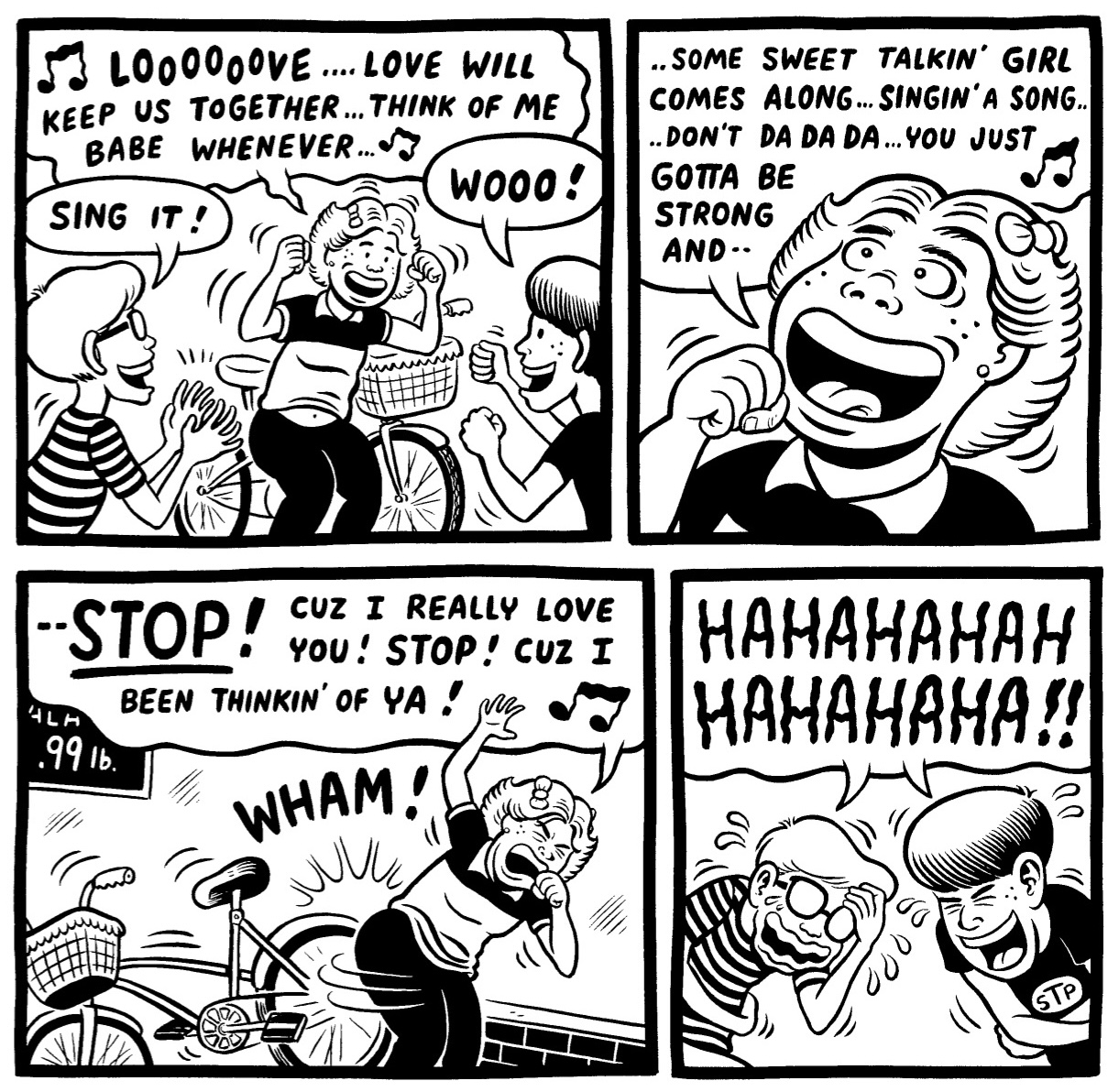
Like in The Poor Bastard, at the center of Fair Weather is a duel between social contexts: with his family, Joe is beleaguered, put-upon; his best friend, Dave, is his escape. Dave had previously appeared in a one-page strip included in the Kitchen Sink book, though that piece was inflected with hindsight, lingering not just on their friendship but on its eventual fizzling-out, as Dave first got into the habit of juvenile delinquency then, to Joe’s resentment, started having sex (Matt ends the one-pager strip on a telling note: “Maybe I was just jealous of Dave for growing up … hell, I’m still happening for it to happen to me!”). In Fair Weather, by contrast, these developments are still far past the horizon, and sex and money — the two hostile forces of adulthood — have yet to rear their heads.
In his TCJ interview, Matt said that, while he had always wanted to write about his childhood at greater length, it was Chester Brown’s then-recent foray into autobiography that inspired him to pursue Fair Weather. In particular he cited Brown’s I Never Liked You (a pinnacle of memoir comics, if you ask me) as a source of inspiration. To view Fair Weather as a response to I Never Liked You, however, does Matt no favors. Brown’s native environment — the religious repression, the trauma of his mother’s mental illness and eventual death — offered him, if nothing else, a conducive friction to grow from, the likes of which Matt had seemingly very little of. (In a sequence that overtly mirrors I Never Liked You, Joe says the word “fuck” for the first time, which Dave gets a kick out of; unlike I Never Liked You’s Chester, however, with Joe the reader never gets a sense that profanity is a cause for concern.) Consider, too, his choice of period and time-span: very little actually happens during these days, in terms of "life events," and Matt fails to offer up any novel arrangement of the familiar. The question that arises, then, is why: why go back to childhood to start with, and why focus on this specific time, seemingly as ordinary as they come?
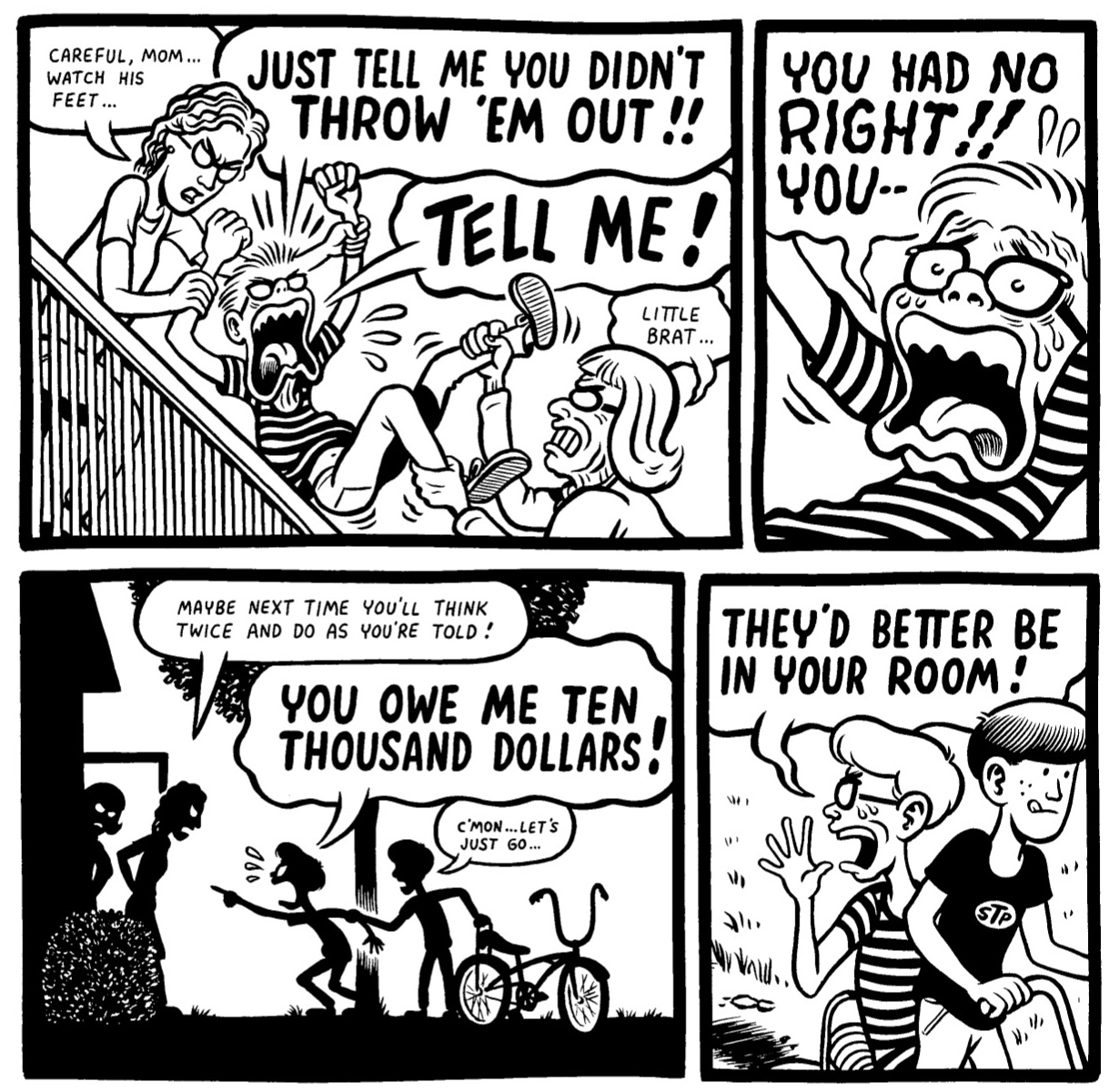
The answer, evidently, has to do with societal expectation. Simply put, where an adult is judged, a child is educated and absolved; narratives of childhood, certainly the embarrassing and the downright ugly ones, thus serve as the ideal vessel for the cruelty and the self-effacement of Matt’s work, as they bear the implicit they-didn’t-know-any-better and thus the implicit but-luckily-now-they-do. This is where Fair Weather is completely transformed by context. A reader of Fair Weather as a standalone work who sees the young Joe berating his grandmother for buying him damaged comics, or making fun of a mentally-disabled girl, wouldn’t be faulted for reading these depictions as a sign of contrition. A reader of Peepshow, however, remembers that the same boy who, after being told that “You don’t screw your friends over!”, justified his actions with “But he didn’t know! That makes a difference!” will eventually grow up to become the same grown man who tells his girlfriend that “How you feel is your problem.” It thus becomes clear that, more than Matt regrets these things, he wishes they were still permissible; it’s not his petulance that he resents, but the societal expectations that make this petulance more difficult to sustain.
Though the stuntedness of Joe Matt the "character" are obvious from the get-go, its extent and implications seem to hit Joe Matt the cartoonist like a genuine revelation. When he returns to the present day for the third arc, Spent, he is, at least in some ways, a changed man. Consider the visual-graphic changes in Spent: after the elasticity of Fair Weather’s layouts, here Matt returns to a fixed grid without any variation (eight panels, this time, as opposed to The Poor Bastard’s six), with the new addition of red spot-coloring — another wisely-chosen textural offset to keep the eye alert. Most notably, though, Joe no longer looks as solid or as realistic as he did in The Poor Bastard. Gone are the lips, the rendered eyes; now he is as smooth and clean and cartoony as the rest of his world. If there was a note of success to The Poor Bastard, it was in Matt’s portrayal of himself as an ill fit, with all that that entails; for him to blend into the rest of the world, then, is an admission of defeat.
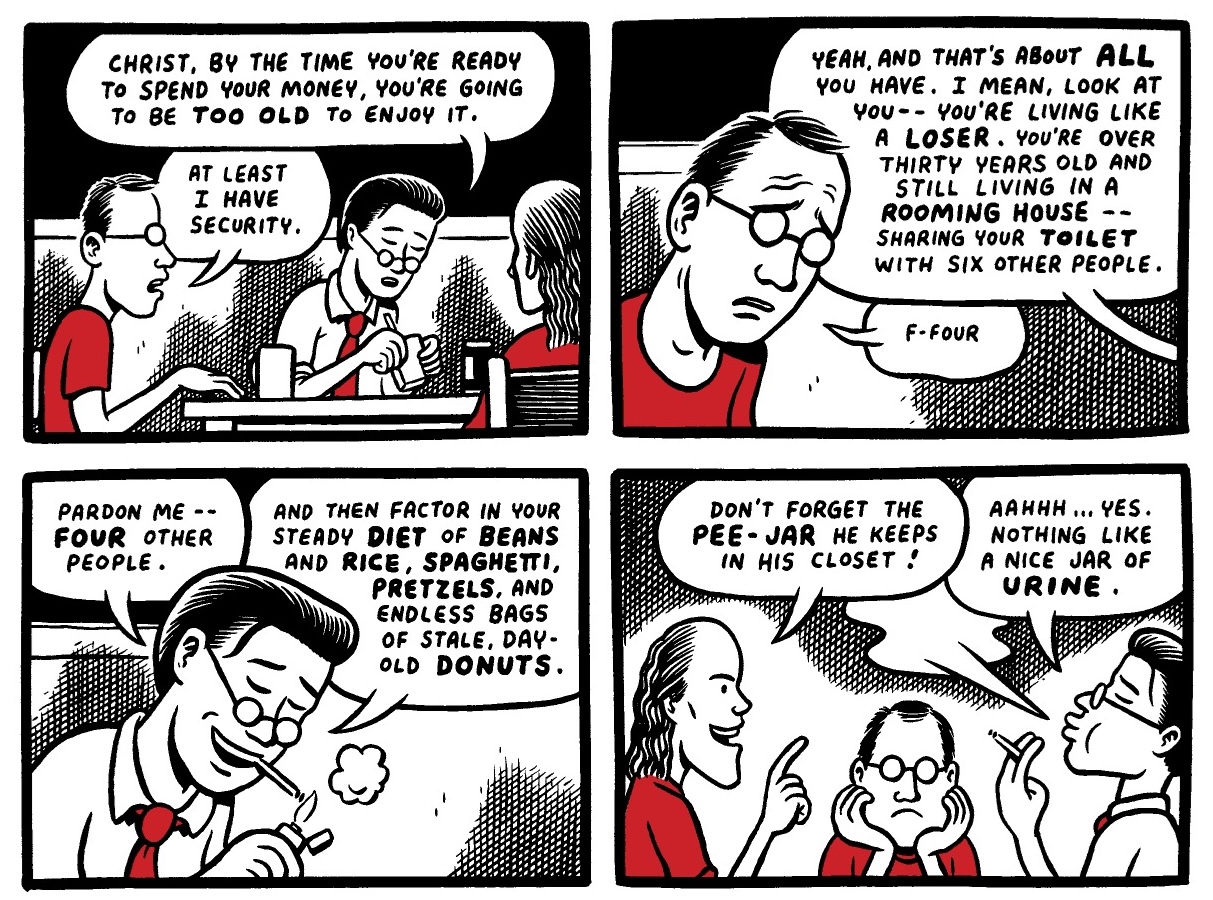
And gone indeed is that comedic-grotesque disaffectedness. Earlier this year, in an essay on Takano’s Miss Ruki, I wrote about what I call "sitcom realism," which I defined as the mode of narrative “where a joke gains poignancy through sheer repetition even though the characters lack the memory to sufficiently perceive that repetition.” This is the lens through which Matt viewed himself in The Poor Bastard, which Spent is a response to and a warped mirror image of, with its focus on the way patterns of compulsion render pleasure impossible over time. Spending time with friends, masturbating, collecting comics — all these activities, which by this point have come to define Joe in the mind of the Peepshow reader, are shown to have lost their luster. Whenever Seth appears on the page, he berates Joe; he mocks him for describing things as “cool” (“What are you — sixteen years old?”) and castigates him for sitting at a café without ordering anything. (Chester, for his part, either silently agrees or overtly joins in on Seth’s side.) Where Seth and Chester’s ribbing in The Poor Bastard felt amicable and conducive, here it takes on a note of hostility, a two-against-one battle that creates real, lasting discomfort.5
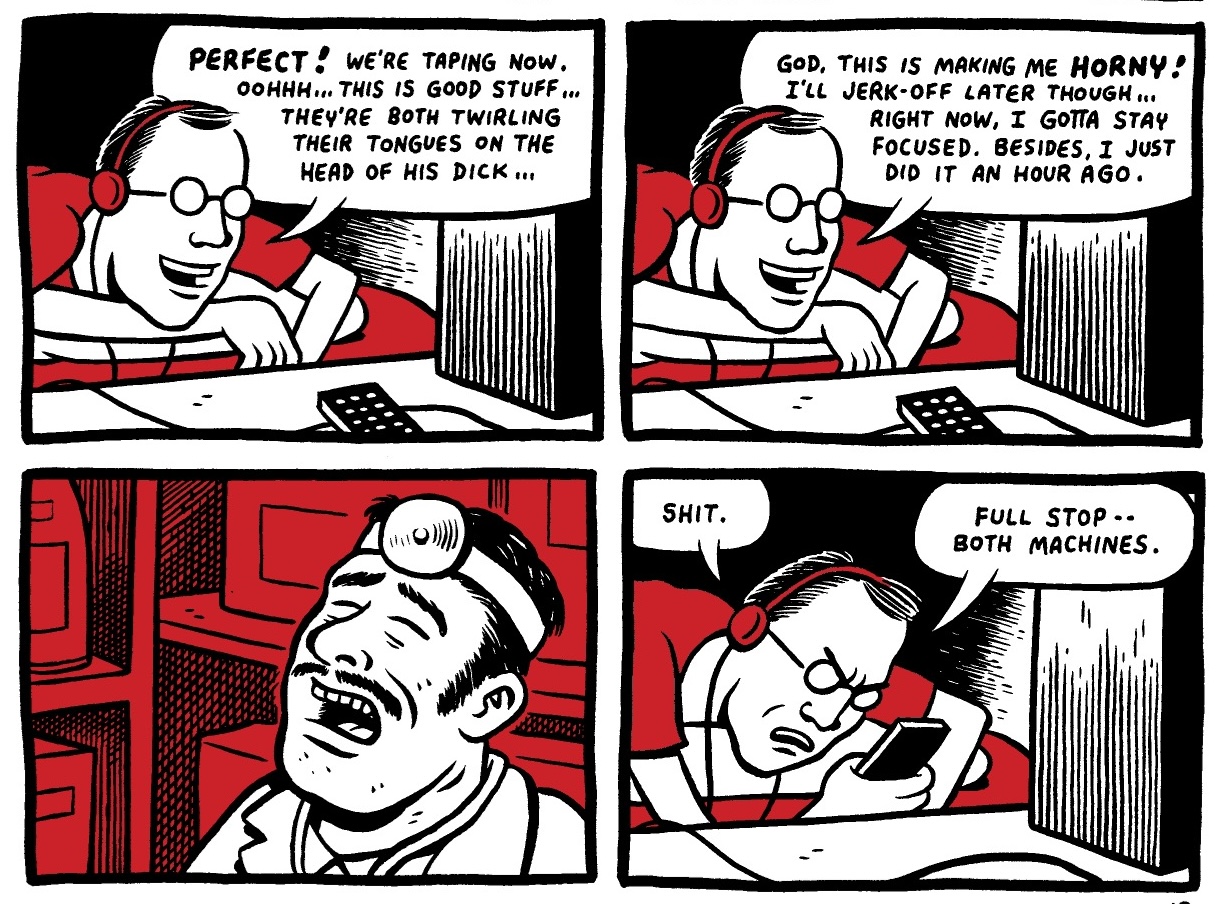
As for masturbation, it takes up more and more of Joe’s time, less because he wants to than because he truly can’t help himself. He resents the porn that he nonetheless keeps watching (“It’s like watching their innocence being destroyed,” he tells his porn dealer); he starts fantasizing about people he finds revolting then hates his brain for “conspiring” against him. He tells himself to resist the temptation to go for another round, then goes for another round before the page is over. All the while, he goes back and forth between flashbacks to adolescence (his discovery of masturbation, his excitement at a girl asking to kiss him which turns into disgust on learning that she is asking to kiss everyone) and rambling soliloquies in the present day, about how much he doesn’t deserve the things that he desperately needs.6
In her write-up of the posthumous Peepshow #15, Helen Chazan wrote that “If Spent has any flaw it is that it is a comic that one can sentimentalize.” It’s a point I wholeheartedly agree with — these moments, especially the two issues that Joe spends alone at home, are the closest the cartoonist ever comes to emotional honesty. But, if Spent implies that Joe Matt — either the cartoonist or the character — is finally in pursuit of growth, if only to alleviate his own frustrations, Peepshow #15 goes out of its way to disprove the notion on two major counts. For one, there is Trish, who receives two mentions in the third arc, once when Joe finds a specially-printed t-shirt she had given him on his birthday and then again when he reads through the pages of The Poor Bastard and remembers when he gave her the black eye. Though both of these mentions are overtly negative — on the first occasion he remembers her “trying to scratch my eyes out or stab me with a pair of scissors,” while on the second he goes as far as to call punching her a “sweet moment […] so cathartic after years of pent up rage,” saying that she “really did have it coming” because of the “million times she beat the shit out of me” — they at least have the plausible deniability of being contextualized by Joe’s own self-flagellations, describing himself as “a waste of a human being” who doesn’t “deserve a girlfriend.” Trish’s appearance in issue #15, in an overview of Joe’s love life up to that point, is more pointed: depicted in the middle of sex, she chastises him for slowing down (“Why are you stopping? Is it because I’m not Asian enough?!”); when discussing their eventual breakup, Matt’s narration cites “two unfulfilled shortcomings”: “the desire to watch porn videos, completely unrestrained” and “the desire to date an Asian girl”. Any other, more egregious differences go unmentioned.
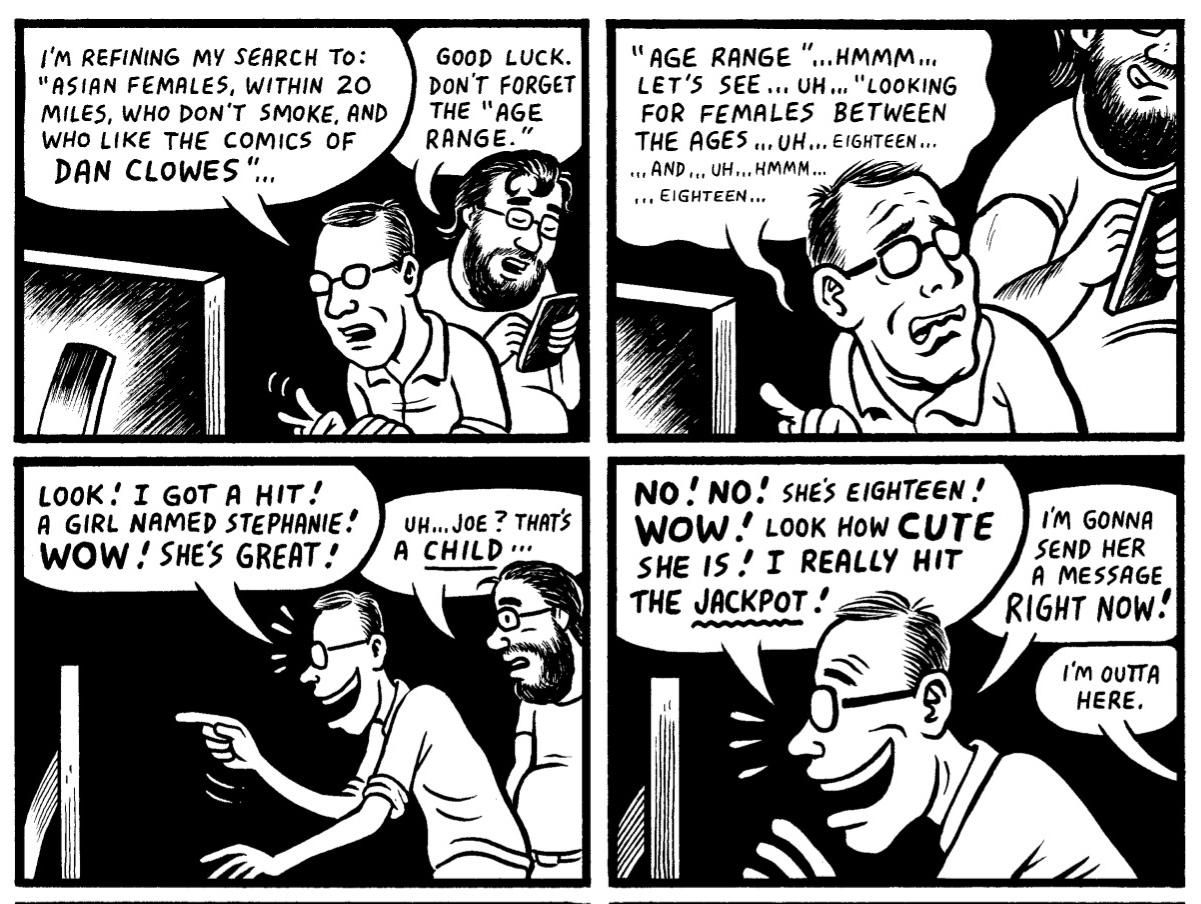
The other count is his preference for younger girls. At one point in Spent, Joe depicts himself ogling a teenager, only for Chester to interject: “Don’t you think she’s a little young for you? She’s probably still in high school.” Matt protests that she's “easily in her twenties,” and Seth interjects, siding with Chester. On its face, Matt is obviously trying to portray himself as the one in the wrong — and yet, some years later, in issue #15, we see him setting up a dating account, and when his friend reminds him to set the age range for his search, he is visibly conflicted: “Let’s see … uh … ‘Looking for females between the ages … uh … eighteen … and … uh … hmmm … eighteen …’” When he does find a candidate that fits the bill, he resorts to legal justifications in lieu of moral justifications: “So what if she just turned 18? I’m not doing anything wrong. She’s legal. And if she wants to date a 40 year old man, that’s her business.”
In the letters pages of Peepshow #10 — the finale of Fair Weather — a fan and fellow artiste compares his own work and sensibilities to Matt’s. “You and I are both shedding light on our despicable ids,” says the fan, “and we both feel guilty for what we uncover.” His name is Rivers Cuomo, frontman of a little band David Letterman mistakenly thought was named Tweezer (“ha-ha-ha-ha-ha-ha … that’s kind of an odd name for a group … HA-HA”), and the letter, sent soon after the release of the band’s second album, Pinkerton, rather reveals, in my opinion, the problem with the taboo-busting approach to art: more often than not, it comes with a gleeful abandon that is automatically and absolutely self-excusing, as "honesty" becomes so obviously laudable that any accidental damages are relegated to “a price worth paying.” In this sense, Matt clearly takes after his beloved Crumb (“in fact, that’s what I love most about Crumb,” Joe says in #15: “his portrayal of himself and his willingness to just lay it all out there”): in lieu of interrogation, he chooses the easy catharsis of humiliation; he looks at the camera and asks “ain’t I a stinker?”, knowing that should give him permission to continue to stink.
***
The first time I read David Foster Wallace, I was left in a daze. Specifically, the book was Brief Interviews with Hideous Men, a prolonged seethe of a collection which, for its central question, takes up the map–territory correlation between justification and self-justification, applying it to different use cases from the supposedly well-intentioned to the downright evil, to prove its unwavering thesis: that self-knowledge is not a cure, simply a handsome frame for ugly patterns. And it does, I hate to say, achieve its aim with alarming ease. Wallace’s prose is so rigorous, so compulsive, that anyone who even vaguely recognizes themselves in, say, “The Depressed Person” will come away hating themselves even more than they already do.
For better or for worse, in his fiction, Wallace was an absolutist writer; his work stemmed from his worldview — his interest in mathematical logic, his fears of cultural erosion, hi,s moral ruminations on the weaponization of enlightened-progressive rhetoric on the macro scale to justify abuse on the micro — just as much as, if not more than, it stemmed from his literary forebears. “For better,” in the sense that it afforded him a degree of focus on and articulation of ideas that few writers can dream of achieving; “for worse” in the sense that his narrators are, by and large, part of him, stemming directly and unwaveringly from his own personal voice. More than most other authors I’ve encountered, to read the fiction of David Foster Wallace the author is to witness, in real time, the mental mechanisms of David Foster Wallace the man.
But, of course, to talk only of the man’s writing prowess is to tell only part of the story. Given the stories of abuse brought forward against Wallace after his death, with patterns not dissimilar to those of the "hideous men" depicted throughout, one is readily prompted to wonder whether his excoriations of social manipulation were written as a preemptive strike — an attempt to prop up a shield of public image — or, in fact, as self-targeted, self-loathing attacks. No matter which "read" the critic may choose, however, the danger is the same: to subordinate the man’s life to his body of work, and thus to include his victims and their very real human pain within that body of work. Brief Interviews with Hideous Men is, to me, a great work of art; it is also a byproduct of something much worse.
David Foster Wallace, let it be said outright, was a better writer than Joe Matt. But, even if Matt never read Wallace, he certainly lived by his manual. He put all of his patterns on the page, and, by saying the worst, he hoped for the best. Often, this worked out pretty well for him (“while Joe might not have been much of a boyfriend, he was one hell of a cartoonist,” writes Diana Schutz in his defense), though whether that’s a good thing or a bad thing depends on who you ask. Personally, I think of the words of Seth, in Peepshow #2: “Talking to you is like being on a treadmill!” Me, I’d rather take a walk outside. I might still end up right back where I started … but at least the view will be better.
The post On the inside, looking outside, looking in: Joe Matt’s <i>Peepshow</i> appeared first on The Comics Journal.


 Hello, my name is Jack Sparrow. I'm a 50 year old self-employed Pirate from the Caribbean.
No comments:
Post a Comment