

At first, it almost feels like a joke. A Garth Ennis-written comic called The War. Just The War with no further explanation or elaboration. Ennis, who almost single-handedly holds the genre of war comics in the anglosphere on his mighty shoulders, has been doing comics about wars (historical, modern and even some futuristic) for over three decades now. It’s about 90% of his bibliography, with the rest being shared equally between gross-out horror and gross-out comedy. It’s like Mark Waid writing a series named Superhero, Grant Morrison producing something called Metafiction or Ed Brubaker doing a run titled Crimin …. you get my point.
And yet The War is no joke. The War is deadly earnest. In fact, it just might be the most earnest thing Garth Ennis has even written. Punisher: The End, for all its vaunted nihilism, still had a certain amount of emotional distancing to it. As much as it was a story about the end of the world it was also a story about the Punisher, a known fictional character — however depressing things were, they happened to someone who doesn’t exist, wouldn’t exist, can’t exist. It was also a story built on some satisfying emotional payback (everyone dies, including all these rich assholes you hate), which helped to blunt its edge. It was probably for the best. Punisher: The End is a great comic because it dances that particular dance of anger and fear so carefully1, The War is not as great because it is not a dance, unless you’re thinking of a particularly brutal mosh pit. It’s not a dirge or a lament or a requiem or any other word that evokes something gentle. It is a howl, a shout of rage.
It’s the feel-bad comic of the year. It’s undoubtedly powerful. And yet … "powerful" isn’t the same as "good." Getting punched in the gut is powerful; I still wouldn’t advise it. Certainly not over and over again. The War is powerful because it touches on stuff that is immediate and raw. Its fears are ripped from the headlines — the possibility of a nuclear war, that kind from which there is no escape and even the survivors would envy the dead. With that kind of subject, you’d have to be lowest of low-tier creators to fail to evoke an emotional response. It’d be like pressing your finger into an open wound and failing to cause pain. And the people involved are far from low-tier.
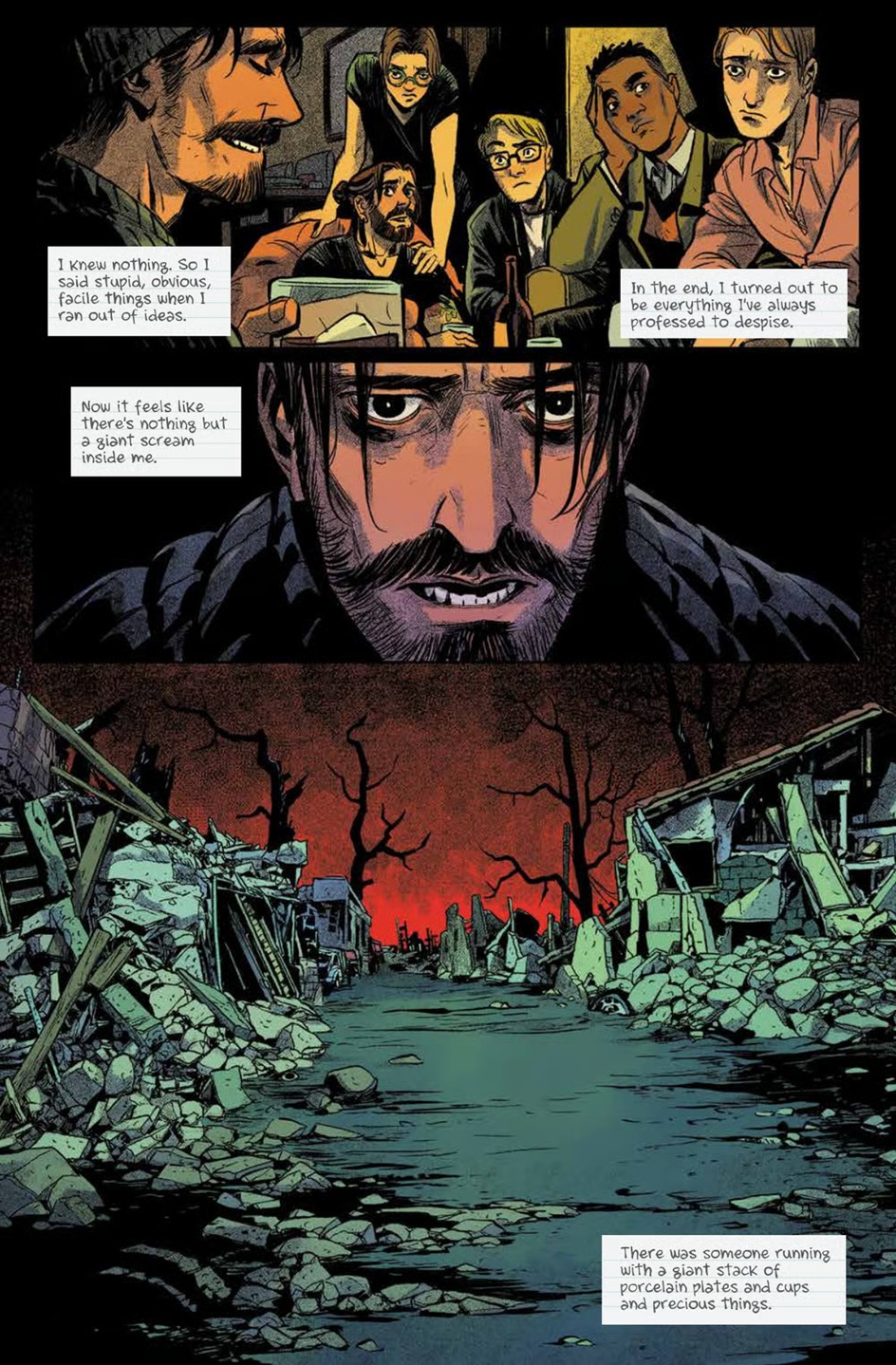
I’ve been reading Garth Ennis for almost three decades now, and for all the possible gags one can make at his limited artistic palate and preference for terrible comedy I still believe he is one the best. Becky Cloonan is another creator that’s dear to my heart, there’s aways something uniquely "pretty" about her art — not some generic "cuteness" that makes everything sickly sweet, but the ability to find a doomed beauty even in stories about misfits and horrors. It should be the wrong choice for this kind of story, the kind that seemingly cries for a sharper, cruder style. Instead, it is the best thing about The War, because it shows us these people being normal before it takes them lower, and then lower still. Before dragging them (and us) to hell, Cloonan and colorist Tamra Bonvillain give us a taste of normality2.
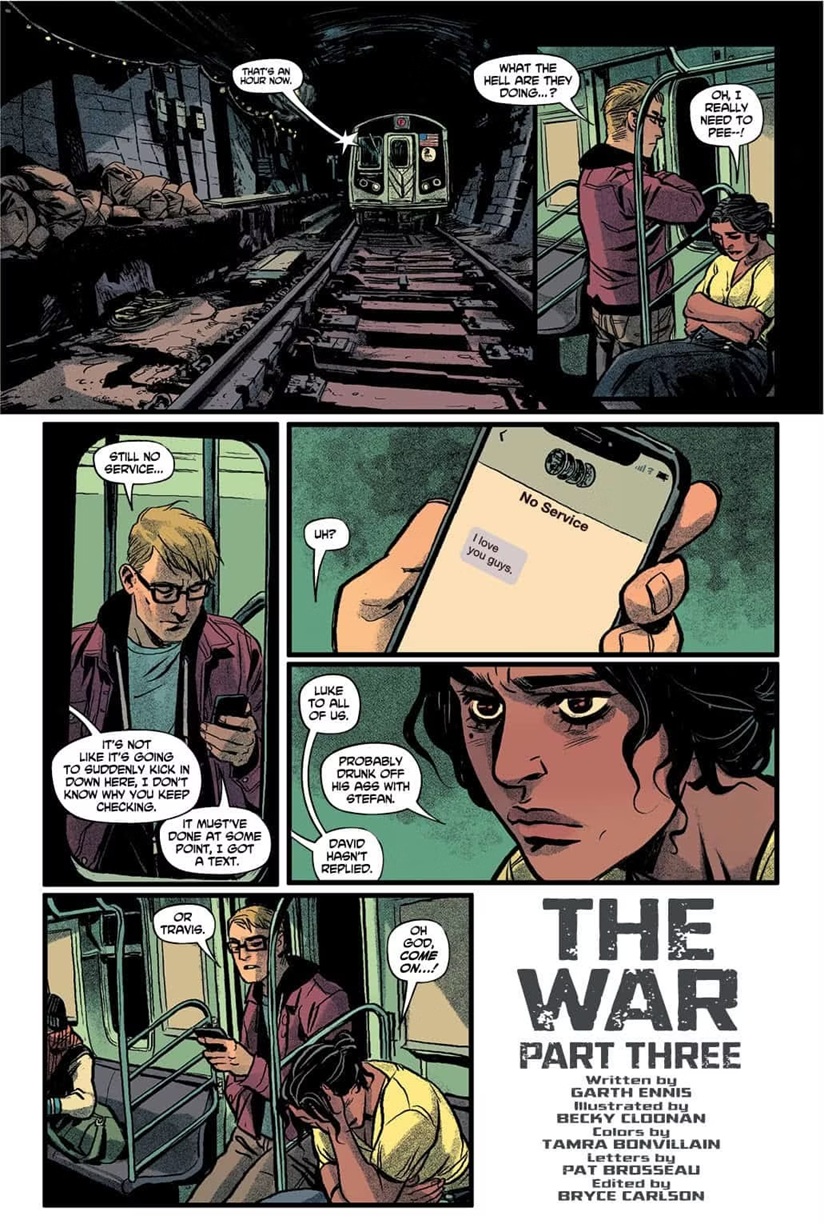
It is not enough to save the series. While Ennis is a old hand at establishing character through conversation, David’s opening lecture on the Russian invasion of Ukraine lets us know exactly what kind of a person he is, a lot of time these characters are of a type. Which is fine in a "war story," because the point is how these people react in a professional (or semi-professional) manner to these events. It is less fine in The War because the whole point is that none of these individuals are professional. None of them know what’s going on, none of them have a procedure to follow3. These are people lost at sea. And also, the sea is burning. For these kinds of protagonists we need more depth than Ennis is providing here. We need the depths of the soul, because there is very little action to fill the void. They are not caricatures, but neither are they fleshed out enough to make their pain give the reader more than a visceral reaction. It hurts because it looks like it hurts (again kudos to Cloonan for giving us just the right amount of suffering) not because it feels like it does.
But even if there was this depth … there is something odd about this series. There’s a point being made about people whose only relation to tragedy occurring halfway around the world is how it affects them; but at the same time this is a story about what is happening to these poor English-speaking people. It starts with Ukraine and forgets all about it after the first chapter. The War is a story that strives for real suffering by foregrounding the possible suffering of its expected reader — "It could happen to you." The book almost yearns for pain, the cleaning hand of fire burning away the guilt.
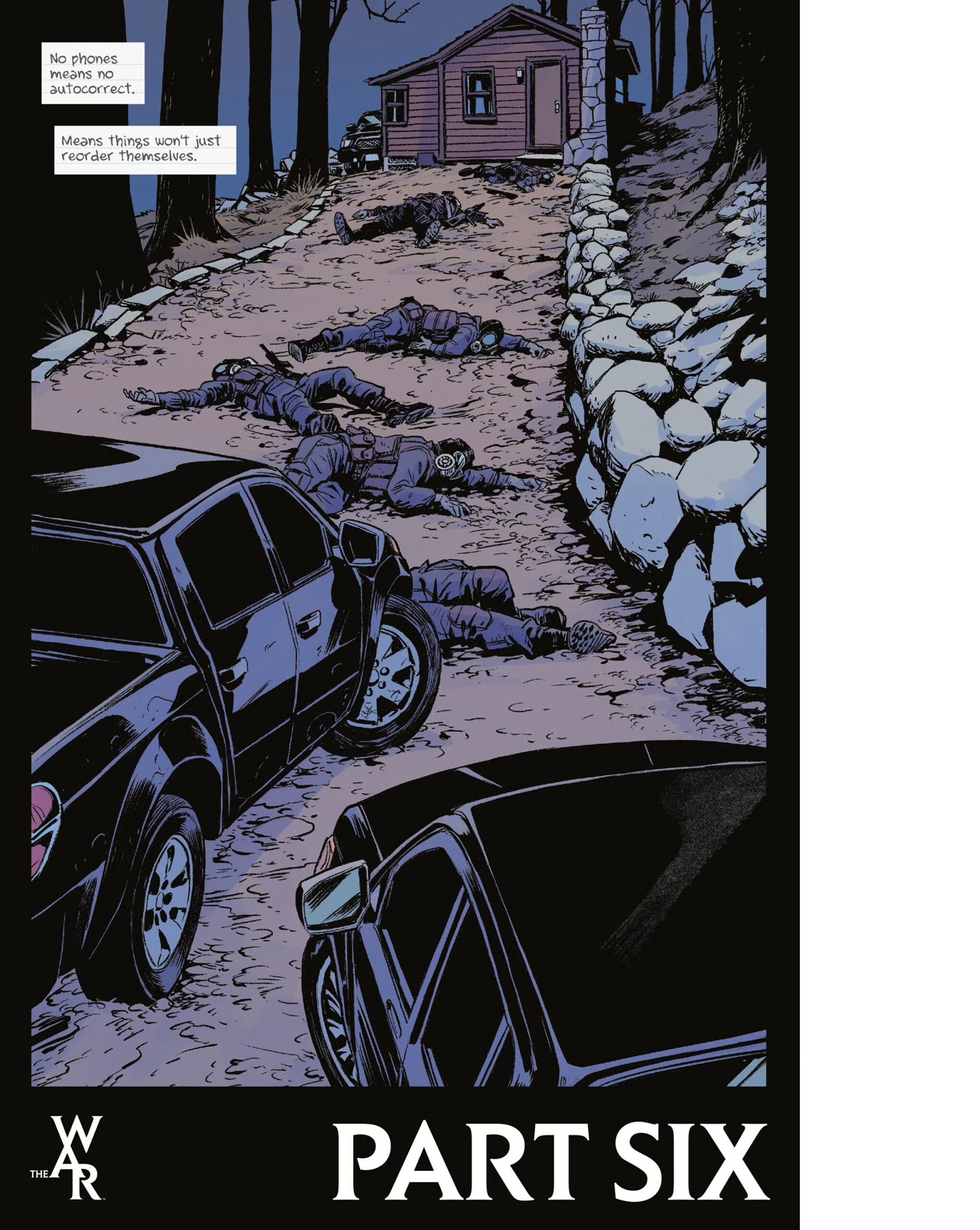
And then there’s the end. A whiff. A true "so what" if there ever was one. I guess there is only so much one can do after choosing to go down that particular path, you either kill off everyone or you leave some sliver of hope. The War seems to realize it already showed us all the bad stuff it can so it tries to shock with a final page of something slightly worse. I fail to see who would care about one more degradation at this point in the story.
It is weird to say "there is stuff to like" in a story like The War, which doesn’t read as if it wants to be liked. Maybe the problem is that the talent is too polished for a subject so raw. Everyone is a professional doing their job (as in 90% of Ennis’ stories), when what this subject calls for is an angry amateur exploding at the page. The War is a good horror comic about pain and suffering of some individuals, but it wants to be more than that, and in that it fails.
The post The War appeared first on The Comics Journal.


 Hello, my name is Jack Sparrow. I'm a 50 year old self-employed Pirate from the Caribbean.
No comments:
Post a Comment