

“Tell the crowd, tell the world:
I want everyone to get high.”
—The Mountain Goats, “Passaic 1975"
“I came up with that song because I saw so many kids in our audiences being wiped out on drugs. I tried to think of a time when I was really young and what it was like being real naive. I thought of 1957 and remembered what was going on in 1957 in my life, and I thought of a funny record called ‘Old Cape Cod’ by Patti Page. It was a big hit. [...] I wrote a song about going back in time. I was 13 and I was afraid to go on to high school because I [might] get beaten up. Now, 14 years later, I realize how tame those times were and I was thinking, ‘Gee, how great it would be to go back there for a minute.’ Because it's so hard these days, with everybody overdosing... and that is what that song is about. People being a little naive but a little healthier.”
—The Beach Boys’ Bruce Johnston, on the quasi-fascistic hit “Disney Girls (1957)”
When I was a teenager, I had it all backwards. I thought that, when I grew up, I would live in service of writing, I would go to every extreme of the human experience to ensure that my writing was interesting. My reading diet at that time consisted of Hunter S. Thompson and Grant Morrison, so inevitably I thought—to myself, in secret—that I would follow in their footsteps and do every drug, and particularly every psychedelic, known to man. There were a few problems with this, of course: first, it’s more or less impossible, or at the very least exceedingly improbable, to reverse-engineer good writing, no matter what your lived experiences are; second, and more importantly, I was, and remain, a fucking wuss. I fostered the delusion of adventurousness for five minutes or so; to date I have not gotten high or even drunk a single time in my life.
All of which is to say, Keiichi Koike and I have led, at least as of the time of this writing, extremely different lives, though whether or not that’s a good thing remains to be seen. Case in point: Cub, the protagonist of Koike’s three-volume effort Ultra Heaven, the English translation of which recently saw its completion from publisher Last Gasp and translator Ajani Oyole.
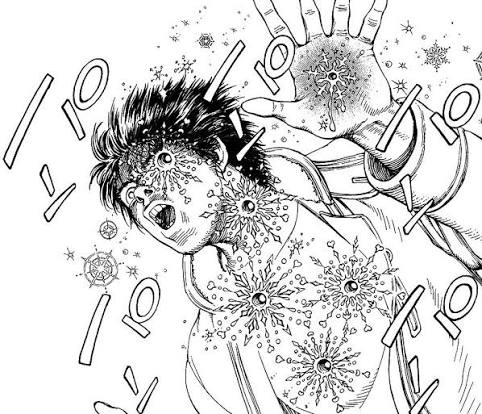
Cub—note, if you will, the inherent helplessness stuntedness of his name—is in rough shape. When he wakes up, groggy and listless, he finds that he has run out of his drug of choice, forcing him to settle for the state-sanctioned alternative. Unfortunately for him, he waltzes into the wrong bar — that is to say, one with ethical standards. When the bartender sees him for the high-risk lowlife that he is, he serves Cub with a cocktail of his own invention, giving Cub the high of a lifetime then building up his immunity so he can’t seek it out again. Frustrated and shaken, he goes home. All the while, two shady businessmen watch and film him; the next stage in their plan has arrived.
Y’see, Cub is a dealer of street drugs; in this regard, he is a member of a dying breed. He is also perpetually strung out and burnt out; in this regard, he is nothing special. Koike’s unnamed metropolis is strewn all over with licensed establishments freely dispensing mood-regulating drug cocktails known as ‘pumps’, a national pastime sought out by the unemployed and the salaryman alike. This should come as no surprise, given the makeup of the world of Ultra Heaven at large: oppressively monotextural, a hyper-urban world that appears to have neither genuine nature, with the exception of city parks, nor any real localized culture or identity (signage in the city varies from Japanese to English to Portuguese and beyond) — when texture is lacking in the exterior world, the only respite is in the interior.
In his informative-but-frustrating Manga: A New History of Japanese Comics, Eike Exner—long a proponent of evolution through international cross-pollination—attributed a significant part of Japanese comics’ leap into stylistic modernity to none other than Mœbius. While Exner stresses that the shift can’t be ascribed to a single artist or even a single cause, he explains the impact of the French cartoonist and comedically-large-hat enthusiast, encountered by the likes of Akira cartoonist Katsuhiro Ōtomo in Japanese fanzines, by analyzing one novel and relatively foreign component of his art: his combination of thin, uniformly-weighted lines with meticulous three-dimensional perspective and hyper-rendered backgrounds.
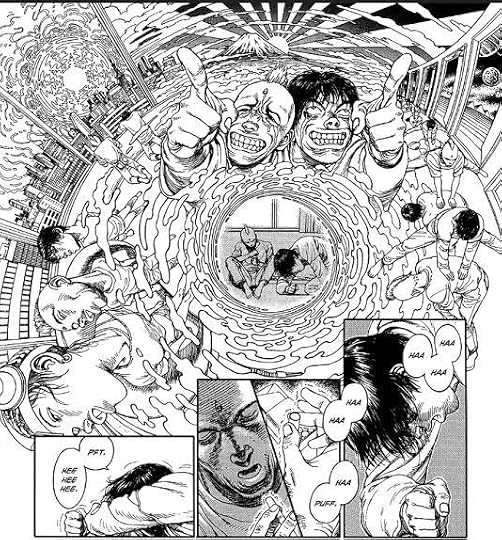
Koike, for his part, offers an obviously lysergic twist on this same approach. His penwork, meticulously hatched and rendered, bestows his objects with an absolute solidity even as they warp and lose their shape. Immediately we get a glimpse at a loftier idea — matter is real, but its arrangement, its coherence, is an illusion. His layouts, meanwhile, vary between traditional rectangular arrangements and ones that are more focused on the experiential — corpuscular panels spiraling and collapsing into one another, calling to mind, at least by dint of cultural context, the poster and album art of psychedelic rock acts like The 13th Floor Elevators, or sharp diagonal slivers that fit into one another chaotically like pieces of a broken mirror.
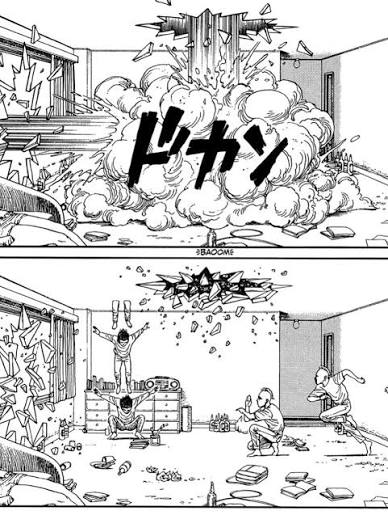
It’d be tempting to assume that the variance in page layout neatly corresponds with ‘objective’ and ‘subjective’ states of consciousness, but even the objective has faults — in a notable sequence in the first volume, the protagonist, the street-drug dealer Cub (note the inherent stuntedness and helplessness of the name), gets high with his friend/client Seven. Soon, the two begin to move around Cub’s apartment in a Tasmanian Devil-like frenzy, dancing and cleaning and bouncing off the walls. Though Koike portrays this scene in conventional horizontal panels drawn from a uniform perspective, the literalism of it is questionable: Cub and Seven appear many times in the same panel, De Luca-like, and as they run around they break the windows and walls, which miraculously repair themselves from one panel to the next. This is what Koike wants his reader to remember: at this stage in time, no matter how neat the presentation, his story, his world, is past the point of reliability. There is no sobriety in narration.
Later, in a public park, Cub is approached by a homeless man, evidently an accomplice of two traffickers-on-the-down-low who had watched him at the pump bar, who offers him a dose of a new drug. The drug, Ultra Heaven, completely destabilizes his sense of reality. He sees abstract effects and crystalline configurations, and teleports back and forth from the park to downtown; he is confronted by ‘health officers’ (the de facto police, in this drug-addled world), who shoot at him repeatedly but do him no harm, then decides to steal the gun from one of the officers and shoot him, this time killing him immediately. When the high fades away somewhat, Cub learns that only some fifteen minutes has passed, but the experience leaves Cub—and the reader—rattled.
On that excursion to the park, Cub is accompanied by the closest thing he has to a friend, his frequent customer Sally; after his bad trip, Sally is forced into the position of caring for Cub, taking him home and watching over him. Alongside her drug use, Sally also dabbles in the spiritual, using a device known as an neuro-amp. Invented and marketed by a local but wide-reaching spiritual organization, the amp allows one to ascend to higher levels of consciousness from the comfort of their own homes (up to a point, anyway, as users eventually find their limits and are instructed to come to the organization’s center if they are interested in ascending further). Right away, then, a contrast between Cub and Sally is established: Sally uses drugs to achieve transcendence, while Cub uses them to stagnate, at least initially.
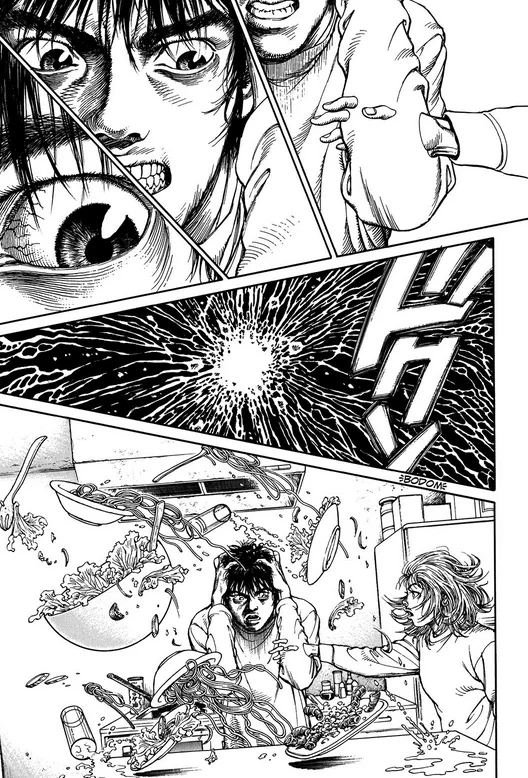
At home, Cub frequently dissociates. Existential boundaries—between the self and the other, between the present and the past (and between the immediate past and the distant past)—become porous: he makes dinner then thinks it was Sally who did the cooking; using what appears to be a form of involuntary telekinesis, he makes his spaghetti ‘dance’ and blend with his own body; he sees past moments from the outside and seems able, at least in his own mind, to interfere with them (in one iteration of a specific scene, Cub flings himself into the kitchen sink to wash his face; later, Cub sees the same scene from the outside, and he physically grabs his past self and washes him in the sink).
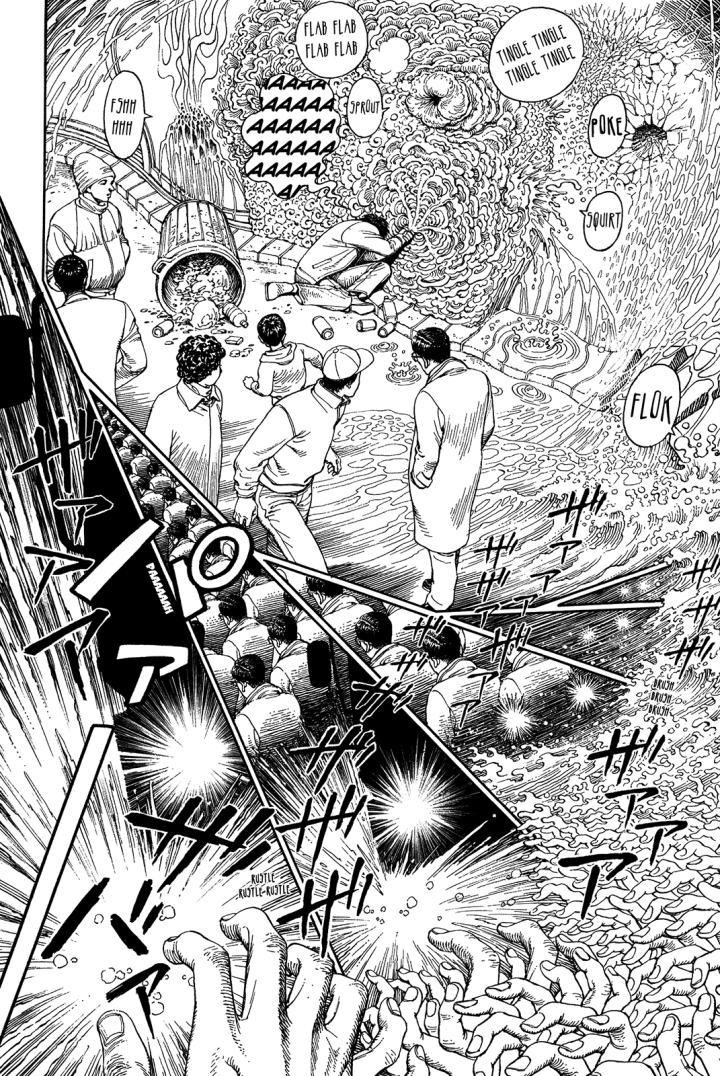
Soon, Sally returns, this time with a ‘tandem’ neuro-amp that will allow her to help Cub process his own psyche and recover from his present diminished state. Gradually, through repetition and variation, Sally and the reader learn that Cub’s mother was an addict herself, in the pre-regulation heyday of the pump phenomenon. The mother, loving but neglectful, would take Cub along on her benders; her eventual death (of an overdose, naturally), when Cub was a child, essentially determined the course of the rest of his life. Sally, having understood the depth of his trauma, wants Cub to unplug from the amp, but he insists on continuing, and though he almost dies in the ‘dream’ state he eventually gains back his agency and lets go of his trauma; at just that moment, a video informs Cub and Sally that they have reached the limits of what the home device can do for them and invites them to the meditation center to continue their journey.
This, I think, is where Ultra Heaven loses its focus. The preceding sequence, from the moment the mysterious street drug kicks in to the moment Sally returns with the amp, is probably the most interesting part of the comic, precisely because it implies a lasting, profound lack of control; coming from someone with Koike’s experience with drugs—“Except peyotl, I have tried almost everything: hashish, heroin, cocaine, acid, magic mushrooms…,” as he is often quoted—it scans almost as a mea culpa, or at least a “pump responsibly” infomercial. There’s a genuine fear that, simply put, doesn’t seem worth the risk, and thus sends the comic into the territory of a personal reckoning, even if couched in reactionary terms. (“I pray that you survive… in this world,” says the bartender at the pump bar, shortly before Cub’s client Seven expresses relief that Cub survived a previous overdose, “even if the world you came back to is the ridiculous one we have now”; this combination of fear and scorn toward the world seems aimed at the reader just as much as at Cub himself.)
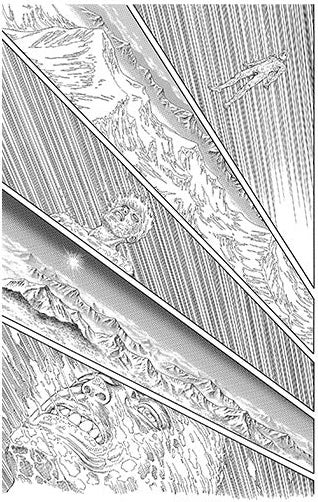
From the moment Cub plugs into the amp, however, we see the limits of Koike’s drawing-as-a-way-of-thinking: much like the impossible materiality and clarity of his cartooning, he is, fundamentally, a linear, solid thinker, seemingly unable to let go of his narrative control and put his trust in the experience. Psychedelia, by definition, describes the convergence between the solid and the numinous, the plainly-seen and the indescribable (note the etymology: psychedelia translates roughly to manifesting the mind, i.e. reaching the otherwise-unreachable full potential of consciousness), but the cartoonist, for his part, seems more concerned with a surface-level psychoanalysis that says, in truth, very little beyond “one cannot advance and grow before having processed one’s trauma” (or, framed in the positive, “processing one’s trauma will help one advance and grow”).
When they get to the meditation center, Sally leads Cub to the Drome, a shared spiritual space collectively designed by the meditators where readers learn of a certain factional division between the traditional spiritualists and the younger, more hedonistic generation; Sally, it turns out, is celebrated by the latter group and deplored by the former. The traditionalists, sick of Sally’s mischief (which includes imposing a jumble of carnivalesque referents on the previously-chaste desert), leave the Drome, and in their stead comes a group of well-trained spiritual masters. Cub tries to fight these masters themselves, and even manages, after some effort, to defeat them by astrally projecting outside of the Drome and attacking their physical bodies.
What’s striking about Ultra Heaven is the relative speed with which Koike seems to lose interest in, and indeed mostly abandon, his initial premise and setup. In the first volume he labors toward a panoramic view of the world — the wide range of delusions that different pumps offer and the extent to which even respectable society depends on them (a salaryman, feeling disrespected by his peers and plotting his revenge, regains his sense of worth and personal necessity), the moral and ethical wrinkles in the system (though pump bars are run by medical professionals, their license grants them total freedom of discretion; if they so wish, they can turn their clientele into addicts “in moderation”, and the customer, not the provider, will be punished by the petty-authoritarian ‘health officers’). Once the story hones in on Cub, the pump system and its collective impact essentially fall by the wayside.
And yet, although Koike wants his reader to root for the underdog, there is never much to root for; from addiction to childhood trauma to spiritual ascent, Cub himself is never a human so much as a role, rendered in strokes too broad to carry any interest (note that blessed-are-the-poor gesture of having Cub defeat the spiritual masters, a choice that stems strictly from his being an untrained drug addict rather than from any actual indication within the text itself), making it much more interesting to see him lose control than to watch him regain it. When, early in the first volume, Koike draws Cub strutting into a pump bar, he deliberately makes him look like a Cool Guy by giving him a badass outfit and drawing him from a low angle to evoke power. Initially, this scene initially plays out like a joke, and an effective one at that — just moments prior, the reader had seen Cub strung out half-naked on the couch, underscoring this moment as an affectation. Over time, however, it becomes indicative of the cartoonist’s dilemma: the extent to which victory is inherent to protagonism, even when it is undeserved.
Sally is similarly caught in a state of incoherent positioning: given the way she feels about the Drome—“[the traditionalists] go on and on about holy items and purity — bla bla bla… In other words, this whole setup is a diorama for meditation. But let’s take all that and toss it out! To remind ourselves that everything is an illusion!”—it is unclear why she spends time there to start with, other than as a provocateur. Her regard of Cub is similarly perplexing in its breakneck shifts: initially revolted when he hugs her during his come-down, she nonetheless volunteers to become his replacement mommy to help him heal, with little interiority of thought shown between the two impulses.
After Cub defeats the spiritual masters, he seems to reshape the Drome in his own image, with drugs sprouting out of the newly-grown flowers; himself he imagines as an Ultraman-type superhero, the star of a tokusatsu show he used to watch as a child, now reimagined as the savior of the Drome while its denizens are locked into a neverending cycle of danger and redemption and danger once more. Cub’s child-self, meanwhile, watches on, and implies that this cycle will never end, presumably because it gives him a feeling of power, of agency, otherwise absent.
Of course, a major question that surrounds Ultra Heaven is the question of completeness. Following the appearance of the third volume in 2009, the cartoonist announced that the manga would be going on hiatus; seventeen years on, it appears increasingly likely that the story will never be finished (with the exception of a 2011 project about “Learning from Native Americans”, Koike has had no major published credits that I can identify). As it stands, he leaves his readers on this expression of ambivalence. It feels fitting, in a backwards sort of way: the authorial compulsion toward control becomes the protagonist’s compulsion as well — and, when control is more than one can handle, it drives the whole world to a standstill.
It’s possible that Koike is fighting a losing battle: that the things one sees on drugs are truly impossible to communicate to the sober mind with any fidelity, and that without surrendering some of my own control to gain that real-life experience I will never be able to meet him on his level. But, if he wants his readers to know how illusory our earthly existence is, why, coming from his pen, does it feel so solid? If he wants his readers to know how unimaginably big the universe is — why, under his hand, does it feel so small?
The post More like Ultra Far-From-Heaven appeared first on The Comics Journal.


 Hello, my name is Jack Sparrow. I'm a 50 year old self-employed Pirate from the Caribbean.
No comments:
Post a Comment