

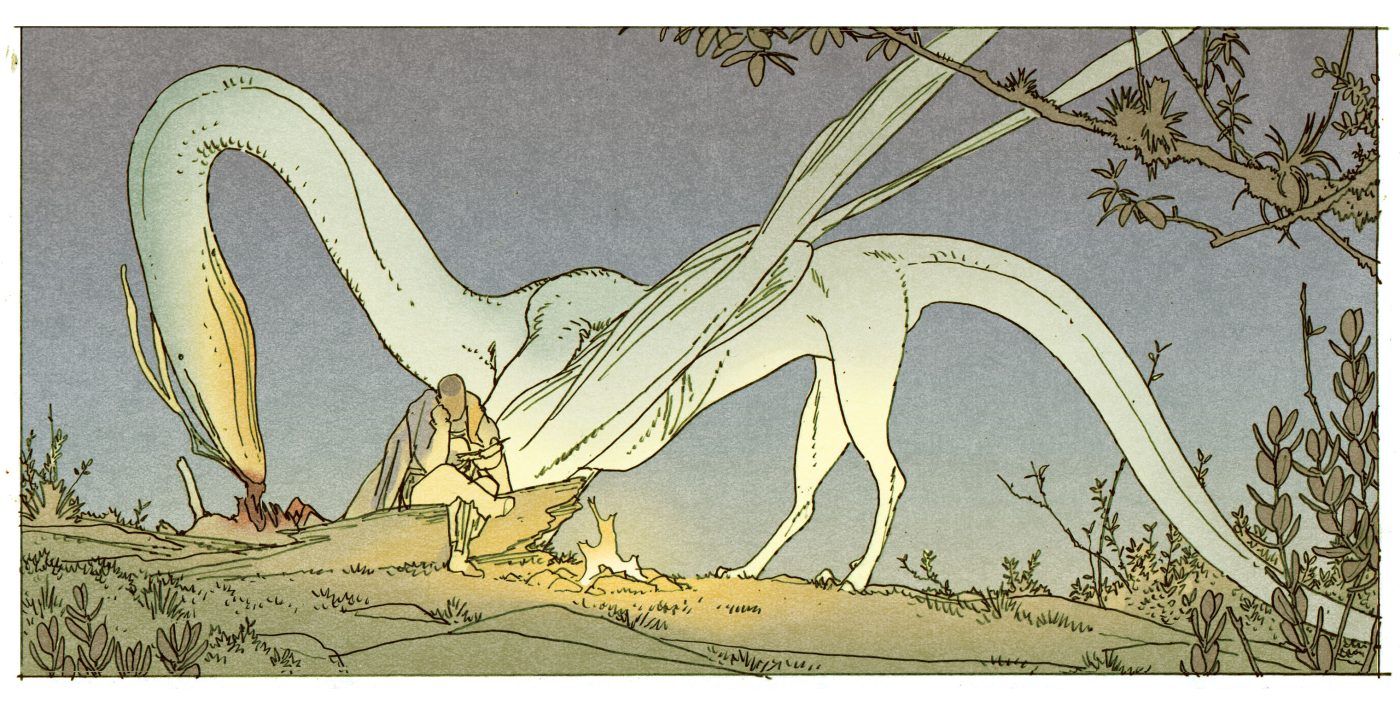
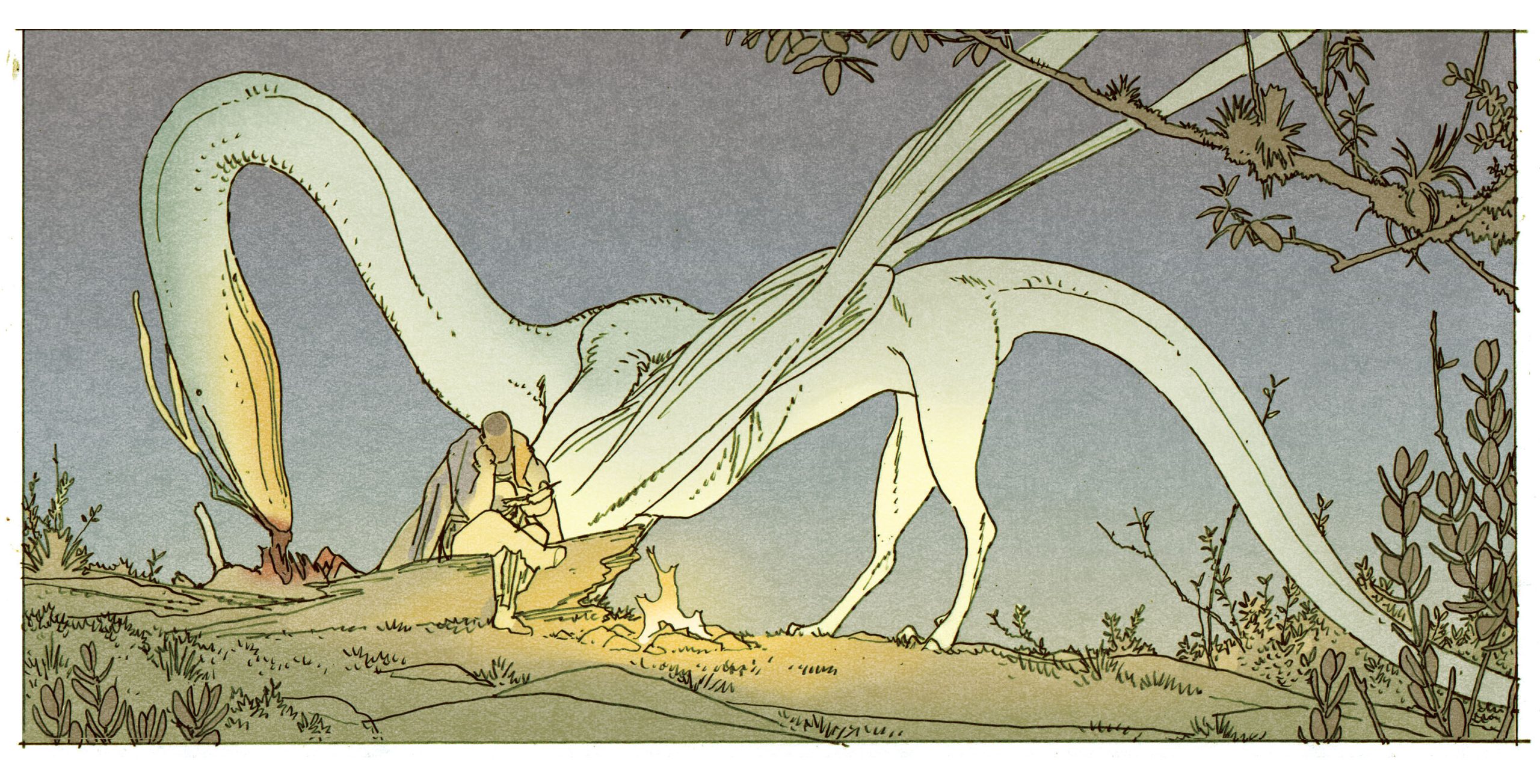
"This thing keeps going. ppl seem to demand this," Linnea Sterte wrote recently on Instagram.
If you’ve been following along with Sterte’s career, you’ll have seen two new graphic novels coming from her in the past year: the first, World Heist, is about a small quest to steal and then visit the egg of a world. The second, A Garden of Spheres, is the first part of large quest to explore a world filled with gods and dragons.
But maybe you came to Linnea Sterte’s work earlier, like last spring, when she was the poster artist for the MoCCA Art Festival.
Or perhaps you’ve read her stories of frogs. So many frogs.
Or her Eisner-nominated graphic novel Stages of Rot, depicting the decomposition of a whale.
Her lyrical, contemplative, nature-inspired, gorgeously-illustrated books keep going and going and going, carving her out a unique territory in comics.
Read on for: cats, dragons, frogs, whales, and all other things Linnea Sterte.
GINA GAGLIANO: Your books are all gorgeous! Can you talk about how you make your art?
LINNEA STERTE: Bunch of different ways! I sort of rotate between workflows to keep myself from getting bored. Right now it's been mostly digital — since a couple of years back I've restricted myself to using the round brush in photoshop for a lot of my comics — and also some pages and illustrations that are traditional lines with digital color. I keep bouncing between wanting quick results (the round brush, Huion tablet) and also wanting to make lush, elaborate things (graphite, a light table).
Your art seems very inspired by the Art Nouveau movement — and I know I get flashbacks to John R. Neill's Wizard of Oz illustrations every time I open one of your books. Can you talk about your influences?
I came to art nouveau the boring way, [Winsor] McCay through Moebius. And Moebius is the one everyone points at, obviously, though it's a bit of a cliche to compare every sf/fantasy comic to his works. I also tend to absorb contradictory influences and always want to move towards something other than whatever it is I'm doing. I started working on some little nonsense comic last fall and my goal there was to find some super-smooth style that would be a bit Hugo Pratt and a bit Erica Sakurazawa, or general sketchy josei and a bit of Fujimoto, maybe, which I haven't achieved at all. The early pages for A Garden of Spheres vol. 2 that I just started working on are trying to lean more towards McCay and a bit less Moebius.
You incorporate a lot of nature into all your books. What about the natural world inspires you?
The messiness of it, maybe. Lots of unexpected shapes sort of coexisting. Also a bit of a morbid fascination — some friends and I used to watch videos of Werner Herzog on YouTube and do little imitations of his accent but his take on the jungle as this terrifying, wasteful place feels very real to me.
Do you do a lot of drawing outside, with live animals and plants?
As often as I can, especially while traveling.
Do you have a favorite plant? A favorite animal?
Right now I'm still enjoying the high of running into a bunch of wild Sinningia muscicola while in Brazil. Favorite animal I'm contractually obliged to say "my dog Arvid," though I'm also a fan of puffer fish (all types) and I think monkeys, lemurs, tree kangaroos, etc., are all very cool.
You're based in Sweden. Can you tell us about the Swedish comics community?
I live in the middle of nowhere (Älmhult), so I'm not very physically present in the community. I remember back when the Peow2 men contacted me about making "a book" (that ended up becoming Stages of Rot), they did so in part because my way of drawing struck them as un-Swedish. Sometimes I manage to drag myself to a small convention here and I always manage to find a couple of decent zines, so I suppose the scene here is alive and doing OK.
You're very online — you post a lot of your comics on Instagram, Tumblr and on Patreon, and have a big following in those places. Can you talk about how you came to be so online, and how your online presence affects your work?
Mostly through being a bit of a hermit or a bit of a nomad, so during some periods in my life the internet has been where I've had my most stable presence, if that makes sense. But I'm also a bit terrified of becoming too online. Post pandemic, I decided I had to get back to reading fiction and I found myself drawn to older books or books by older writers where one could feel in some totally intangible way the author had never been in a twitter argument and did not live in fear of ever being in [one]. (Twitter, or maybe Bluesky these days, or do people argue on TikTok? I hope not.) Not that I want stuff that's regressive, but more an attitude of like non-defensiveness, or self-sufficiency, maybe. Have said this elsewhere, but some months ago I had coffee with a fellow Concord survivor in Rio who said she hadn't expected me to be so online based on my work, which in her opinion read like the works of a not very online person, and hearing this lifted a huge weight off my shoulders.
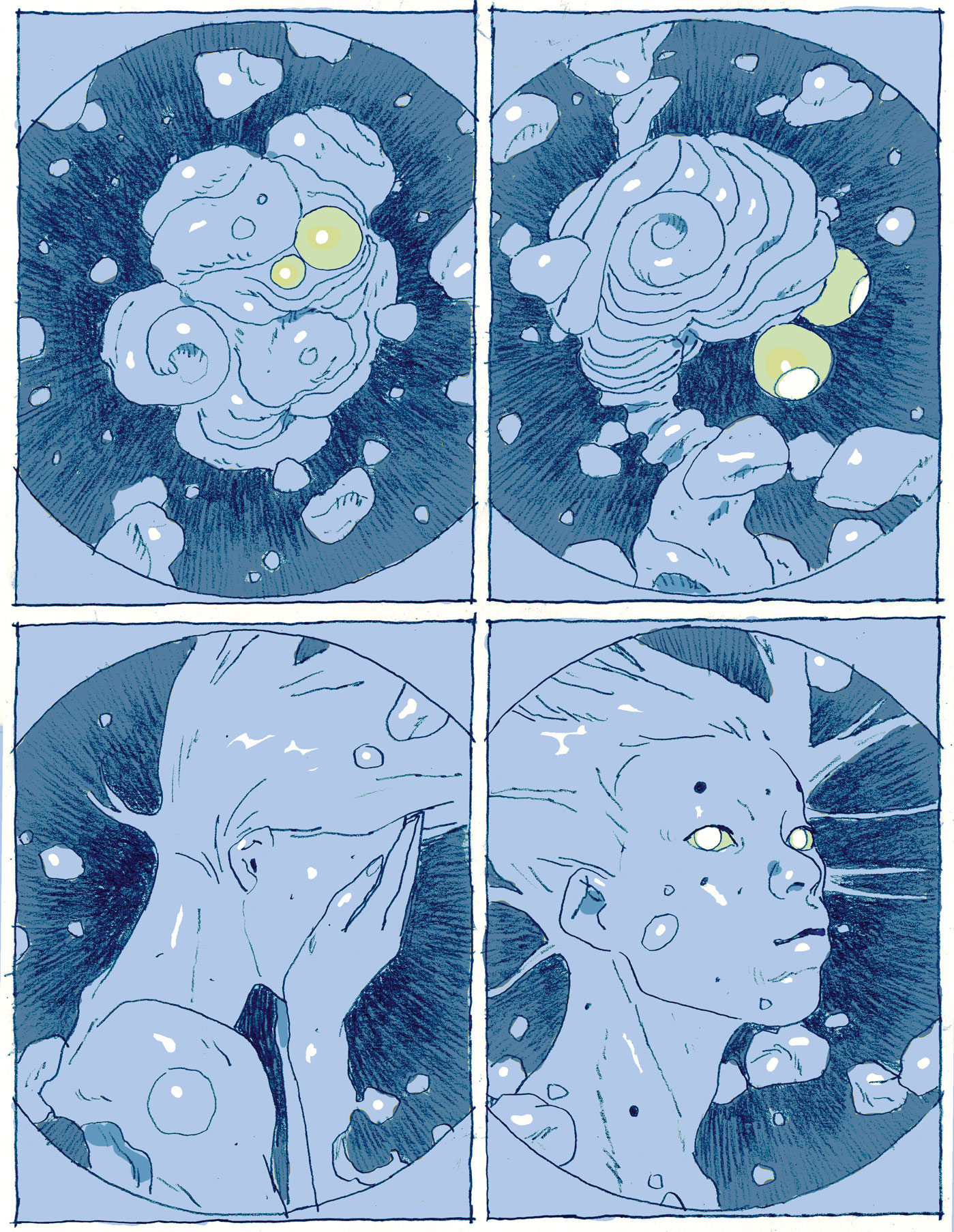
(This is Concord the video game, which was briefly launched then un-launched by Sony after failing to find an audience. I did some early concepts years and years ago then assumed the project got cancelled.)
A lot of your work is science fiction and fantasy. Can you talk about what inspires you to make comics in that space?
To some extent those are just genres I enjoy reading. Gives you a lot of space to just improvise in your drawings too, I've always tended towards a fairly precise or "stylized realism" way of drawing, and with a story set in real life, suddenly I'd have to think about what type of car the main character drives and what that says about them, or what that would have said about them in the '50s, or did this car even exist in the '50s, would anyone bother to check? Is any of this relevant? Etc., etc. It's nice to operate on more of a dream-logic level, or just making shit up. Back when I started doing comics in earnest, Prophet was sort of a thing, or that universe of weird Image or Image-adjacent comics, and Stages of Rot seems to have attracted a bit of the same audience, and now that's one of the crowds I'm trying to please.
All your books in the U.S. have been published by independent publisher Peow2. Can you talk about how your experience of working with them has been, and why you like working with them?
They pay me OK. Their books look really nice. Mostly they just let me do whatever I feel like, artistically. I've been in contact with Fanatagraphics at some point and I think the frog comic might have worked there but they didn't seem very interested in the fantasy/sci-fi stuff. Failed to not-quite-pitch a thing to Viz and then they wanted me to take part in a competition, but my intuition with competitions is I always lose so I didn't bother.
In general I'm kinda shit at pitching. Both the part where I'm supposed to give a neat summary and also the part where I'm supposed to say it's a bit like x-popular-thing and also y-popular-thing, only the stuff that inspired me is like a sci-fi book from the '70s I read eight years ago then forgot the actual plot of. I'm too lazy to go pestering everyone with my half-baked ideas so it's nice to be able to make my comics then come to this tiny publisher like a cat with a dead bird and they're grateful for it. Also the guys at Peow2 buy me food at times, often Chinese, which I appreciate. [Peow2 co-publisher] Patrick has the energy of a boxer's little manager like you'd see in a movie. When he's playing Magic: The Gathering it's like he's doing something illegal.
What can you tell us about your next project?
More A Garden of Spheres, I need to do at least a few chapters of volume 2 before I get dragged into some other project or it might never happen. Simon Roy has convinced me to draw another short comic so he can put together a book for his next kickstarter, which is very important and very urgent. I have some publishers pestering me about stuff and eventually I'll succumb and say yes to something, out of fear of becoming irrelevant, like what happened with Dargaud (who published Cat Cafe). I really, really want to draw a fake shounen manga about fighting demons and such but it's too much of an undertaking right now. I'm trying to move somewhere.
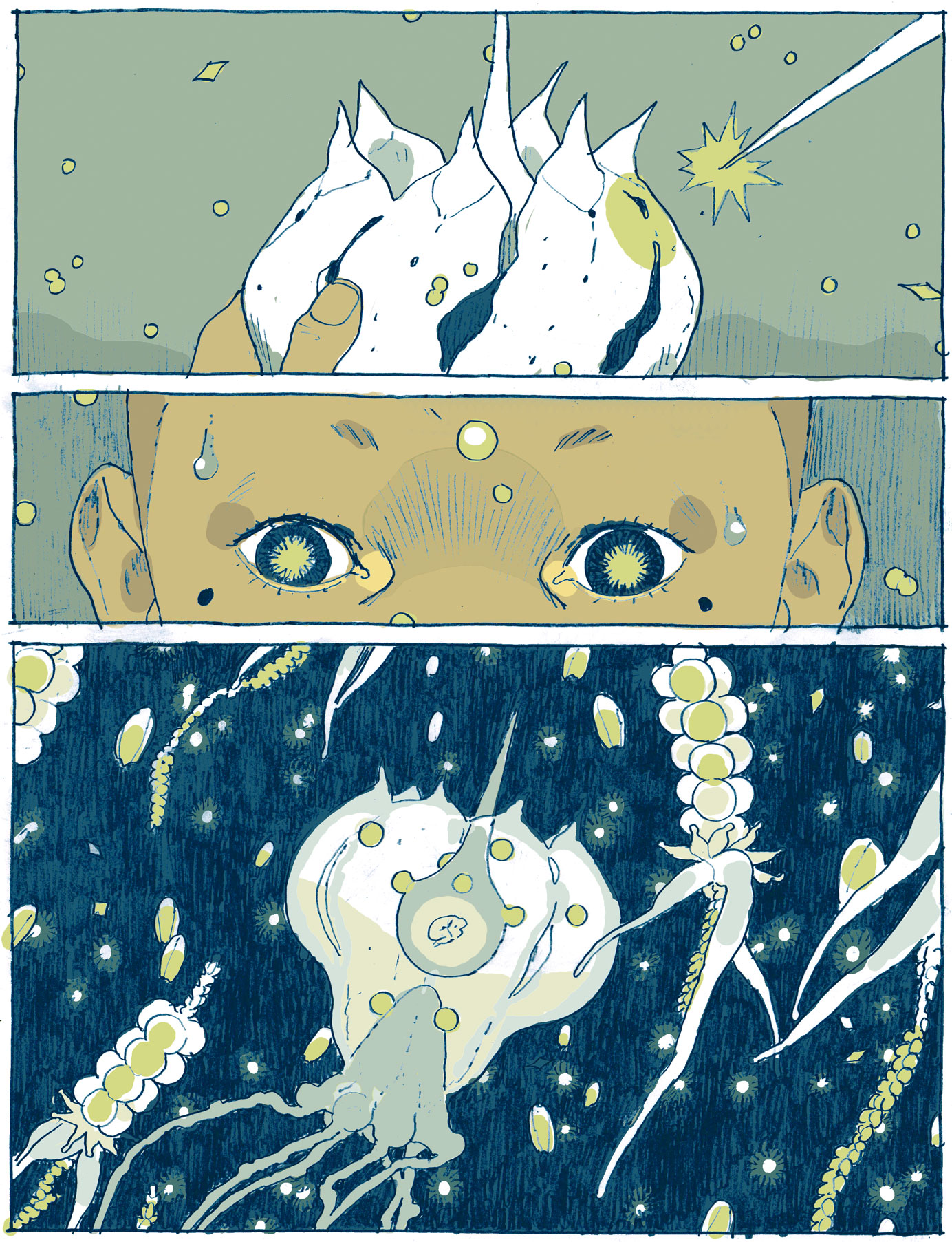
How did you get inspired to do a graphic novel about a whale fall?
Was originally trying to do a graphic novel about something else, got stuck, a podcast I was listening to had on a worm scientist to discuss a new worm discovered on and around whale falls. This sort of merged with a previous idea I'd had of doing a story documenting the decay of some large monster. Originally this was meant to look more like a Connor Willumsen-type trippy comic but I'm not cool enough to pull that off.
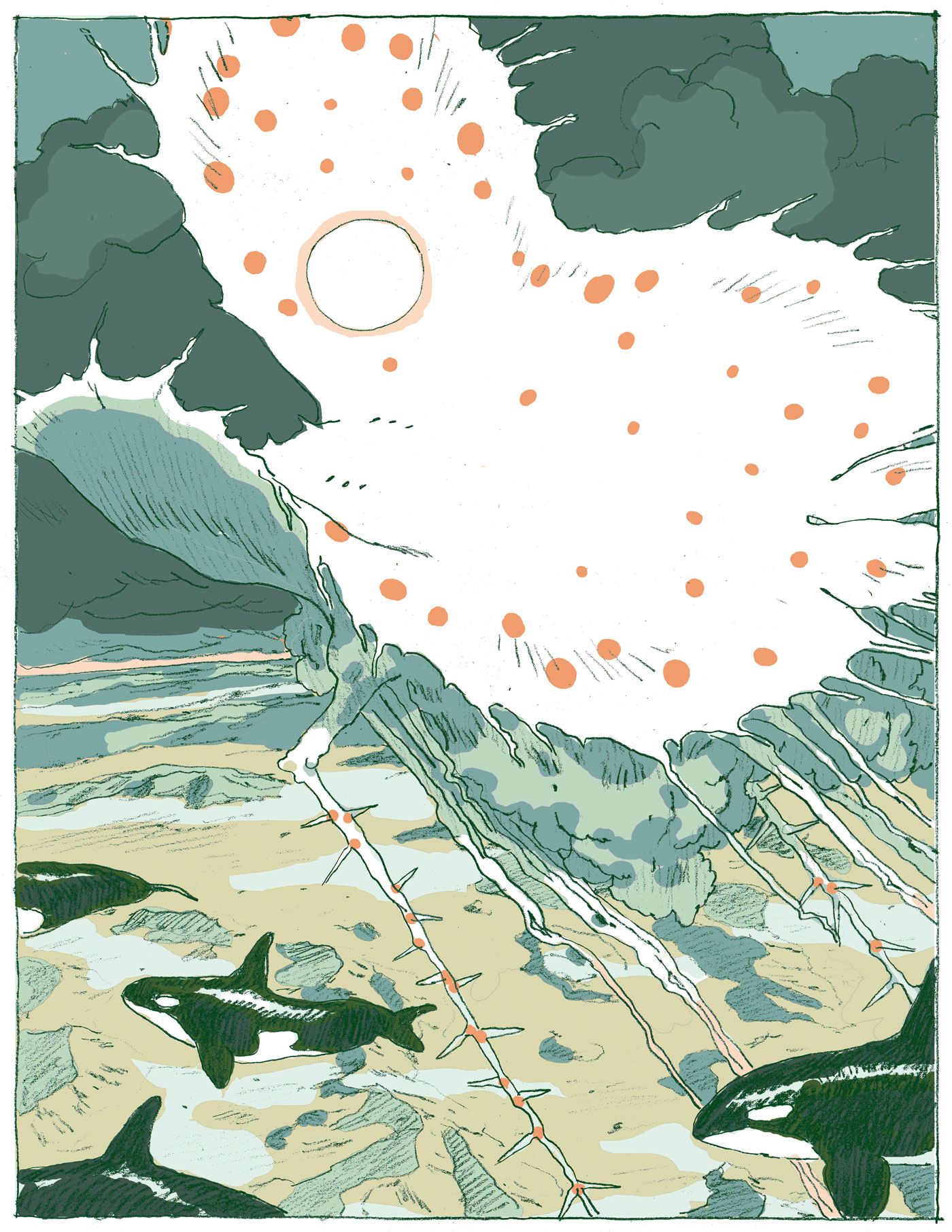
So many of the visuals of [Stages of Rot] brought me back to reading the classic science fiction Edgar Rice Burroughs' John Carter of Mars books. Are those books — and that classic era of science fiction — something you've read (or watched or consumed in some other way)? Have they had an influence on your work?
Have read a bit of Conan, etc. but not John Carter. In my steampunk phase at like age 14, 15, 16, I read a bunch of H.G. Wells, bit of Verne and so on, like very early sci-fi, but my interest in the pulps is more the weird tales — Lovecraft, Merritt, Shaver mystery-type stuff. I like the way that era of speculative fiction overlapped with really silly forms of occultism & conspiracy. The desert imagery is maybe more of a Star Wars thing, or a Moebius thing, or maybe John Carter absorbed through Star Wars, seeing how Star Wars is sort of trying to do pulp-y space opera?
So, in a roundabout way, maybe.
This book is organized with the structure of a life cycle. That's not a typical plot structure — can you talk about how you think about plots and narrative?
For something like Stages of Rot, which is narratively pretty loose and abstract, I just wanted there to be a frame I could hang everything on. I always start out with just images & vibes things I feel like drawing & then in order for it to become something readable I have to set some limitation to it, put a frame around it. And what that is is kinda arbitrary, I've never fully understood how to make a normal three-act structure or save the cat-type narrative work — which is a huge flaw in my character — but I always try and find some rhythm or thematic coherence that can make the things happening look like a story, if you squint.
This is your first book, and it got a lot of awards and attention! Did that encourage you to keep making comics?
Yes, though for the longest time I felt pretty lost with regards to what types of comics I wanted to make. I really wanted to get started on some big action-adventure type thing, only my writing skills weren't there (arguably still aren't). The book also seems to have been a bit of a sleeper hit; for the first year or so I didn't make a ton of money, then I started getting little animation jobs based on people having read it, and then the frog book was the thing that convinced me I could do this for a living.
Let’s talk about the frog book! What about frogs is so awesome?
They have to be some of the most anatomically messed-up animals on land, next to penguins maybe. Just extremely odd. It's amazing animals like that exist.
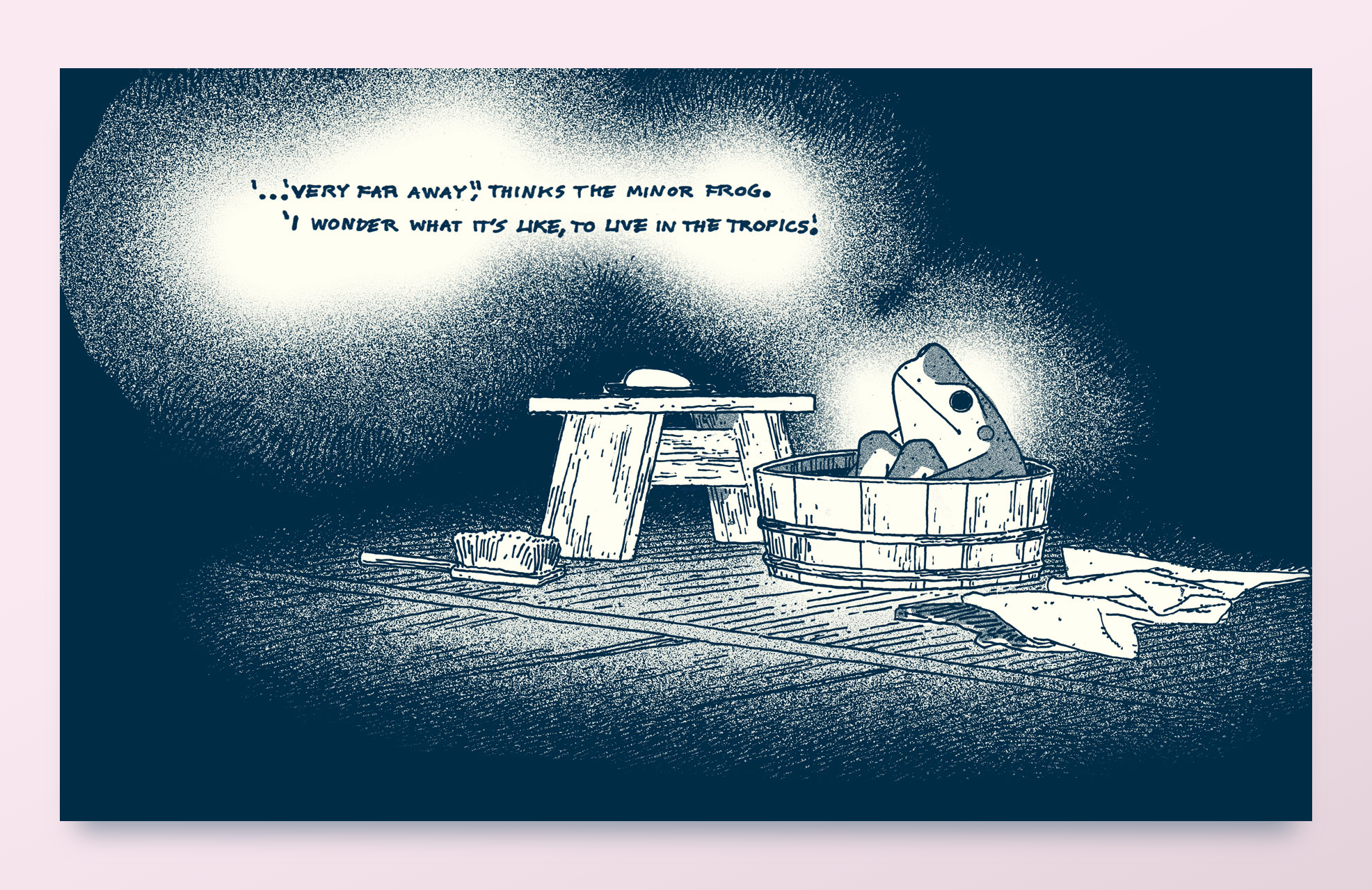
This book is mostly single-page illustrations (though with speech balloons). Can you talk about going from your work in the comics format to something that blends comics and picture books?
Initially I was thinking of it as a storyboard comic more than a picture book. There are a lot of pages here that are a and b panels, or re-using backgrounds as a form of limited non-animation. But then since it's sort of a children's tale (or a child-appropriate all-ages comic), the storybook format felt natural and the book fell into that cadence. This is a comic I made in a kind of fugue state over one summer, so once I had the first fifty pages I was like, this works, and then I didn't think very deeply about the formal aspects of it.
This book has a unique binding. Can you talk about how you think about the physical production of your books, with bindings and pantone colors and foil?
I think this is all part of Patrick's quest to win a publication design Eisner. This will only happen after I die tragically of cancer or something.
But the Peow2 guys seem to have decided all my books ought to be a bit fancy? The frog book is probably the one where I was the most involved. I originally wanted it to be softcover, the format being based on an instruction manual I found inside my father's new Jeep, though the men insisted this would make the book uncomfortable to hold. In the end I went looking for pictures of a type of binding I'd seen on some book in my mother's office. She was still at a local university teaching graphic design at the time only to find [Peow2 co-publisher] Olle had already sent me an email suggesting the exact same thing. Or maybe it was the other way around.
Your lettering in this book has some words or letters that are crossed out. Can you talk about how you tackled the words in this book and why you decided to leave the cross-outs in?
You know that thing about Robert Pattinson's shirt collar in Twilight? It's sort of like that. I mostly just left the corrections in cause it looked nice & maybe as a dumb performance of carefreeness and spontaneity.
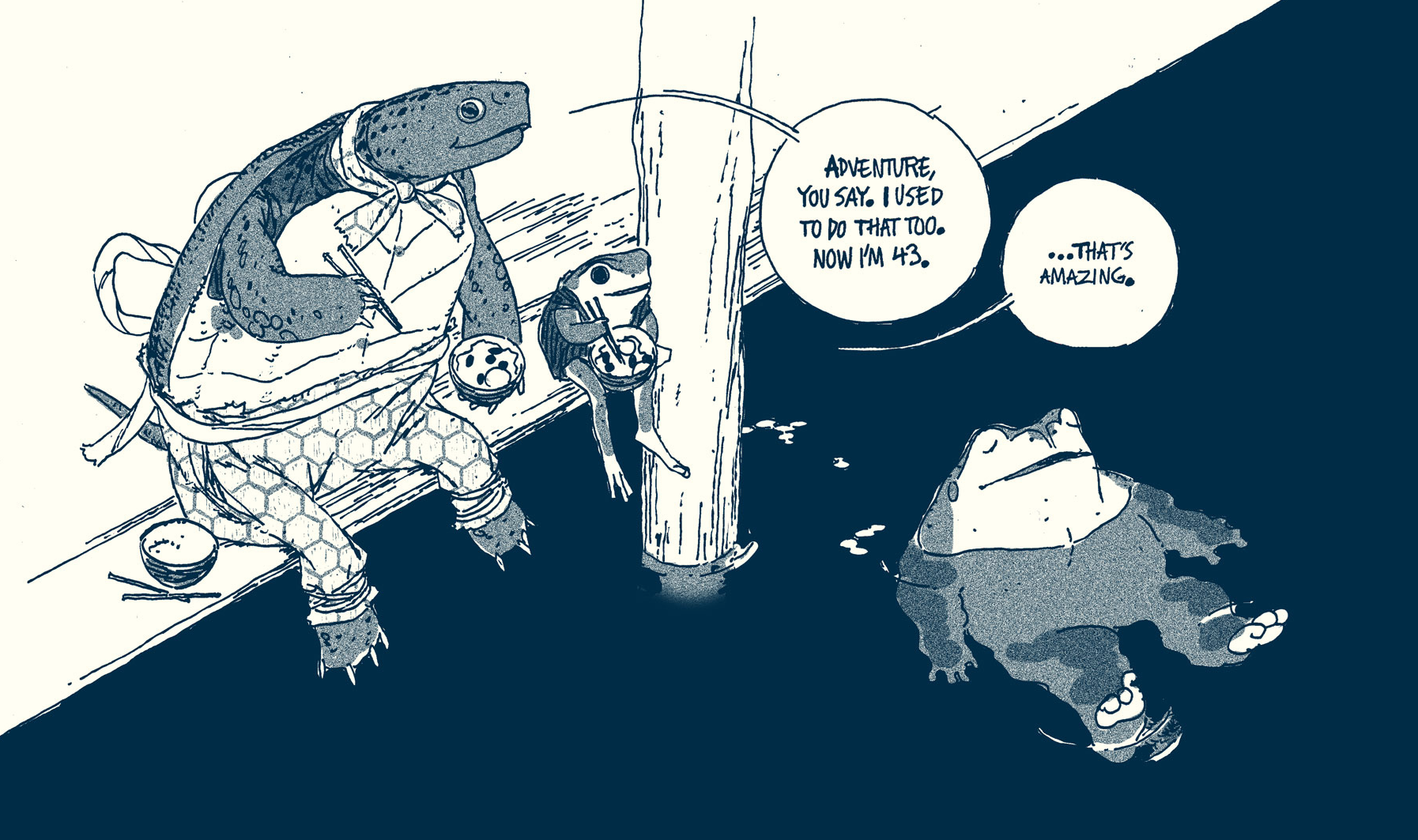
There are so many small moments in this book — the surprise of the second pair of pants! Eating noodles! So many books focus on the big moments of life or of large-scale adventures — can you talk about how you write small moments?
Small moments are probably the easiest thing for me. I've never felt an overarching sense of drama or destiny in my own life but (despite always complaining about how nothing ever happens) whenever I try and write a diary I end up with several pages per day where I absolutely have to mention some person I ran into or little treat I ate or something dumb my dog did. When doing comics, once I've set the parameters of the world & the characters in a way that makes sense to me internally, a lot of that stuff just sort of happens.
This book has a lot of food! I always think food should be more a part of everything given the amount of time we spend thinking about it, preparing it, and eating it (and sometimes growing it). Can you talk about how you see food in your work?
Maybe as another thing that helps put the reader in the world. Like, as a tool of immersion? Comics can't do smell/taste in a casual way like in a prose novel but I think specifying what characters eat beyond like "stew" or "meat" does convey a bit of that. So I could group detailed drawings of food in with like detailed drawings of the ground, detailed drawings of dead things, whatever, that I always feel compelled to do.
What do you think it is about small animals wearing clothes that people are obsessed with? From Robin Hood to the Rats of Nimh to Wind in the Willows to Redwall, they're everywhere.
Wouldn't it be super cool if tiny creatures wearing clothes, cooking their meals in pots, etc., lived in our walls, in the sewers, in tree stumps? Wouldn't the world feel much bigger and more alive? Humanity could perish in a nuclear apocalypse but hundreds of years later little rat bards in rat-size cloaks would still wander the wasteland singing songs about the subway systems we built.
This book is set in Japan. Can you talk about Japanese art and comics and their influence on your work?
That's a big question. I had a cooler friend from a bigger city when I was a kid and every summer she'd bring manga in English, not just Dragon Ball but things that registered to my kid self as real manga with the big eyes, etc. I'd borrow a lot of CLAMP books from her. And it went on from there, but rambling on about this would be a long paragraph just listing a bunch of names. The main thing for the frog book was window shopping indigo-dyed Japanese fabrics on Etsy and thinking of how those textures would work in a comic, the way (especially older) manga often uses screen-tone textures for clothes etc, which is also why the comic is printed in blue.
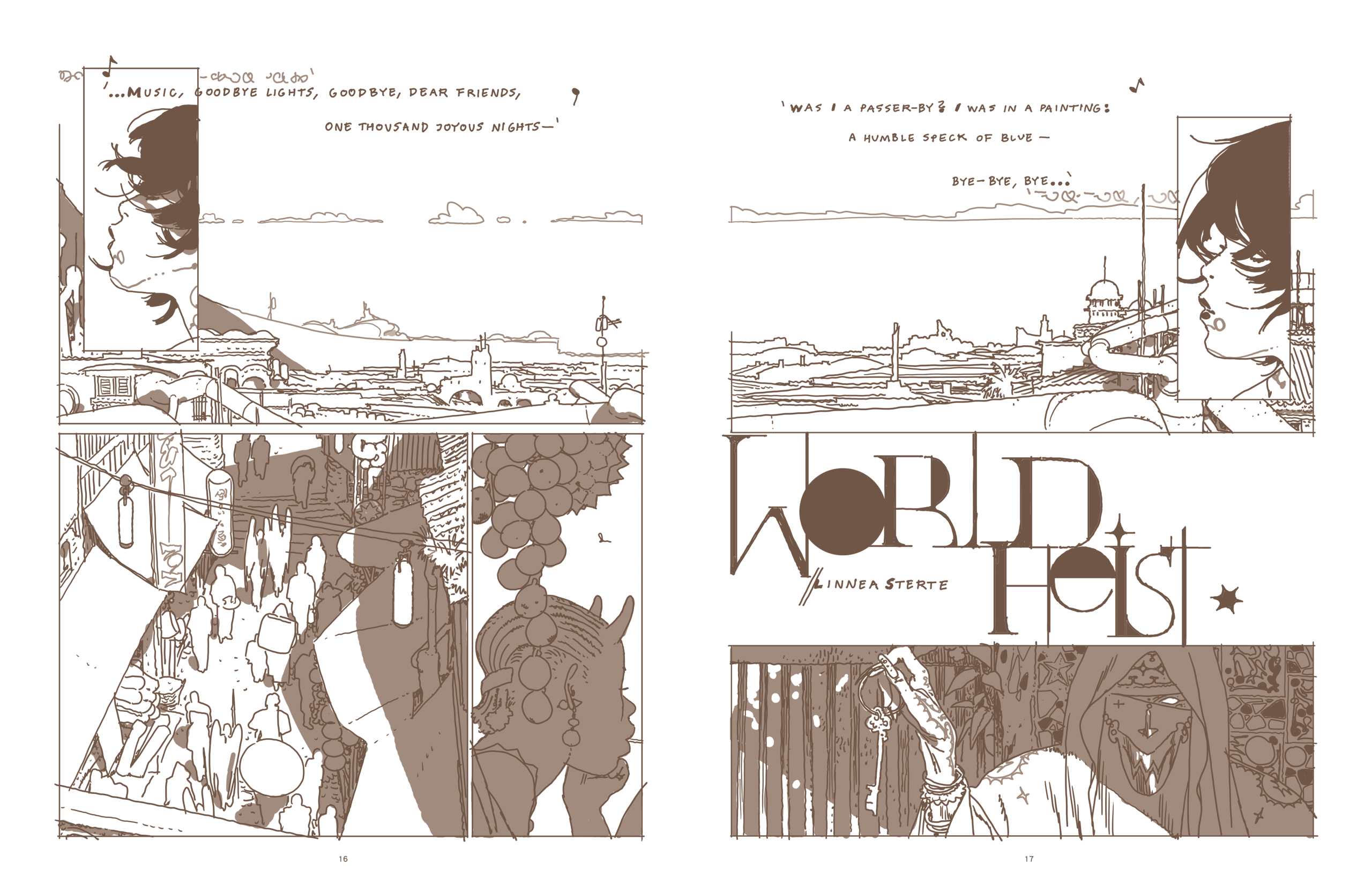
I love the concept of your graphic novel World Heist — stealing a small world to go on an adventure in it. Can you talk about how you came up with the idea for this book?
Wanted to do cyberpunk but also didn't. Tried to dream up a fantasy equivalent to hackers entering VR, that sort of thing.
Zro is a bit of a scoundrel or messed-up in some way. Probably just because that would work better for a shorter story? Like the farm boy has to go from being a farm boy to being a sword-wielding hero before the big fantasy story can happen in earnest and we don't have all day.
With Tiger, I wanted something between a gentleman thief or a dandy and also Corto Maltese. Cat face just came about while I was doodling and now if I want to do more stories about the guy I'll have to eventually explain how this happened. Task is maybe something between Noodle from Gorillaz and the weird doll body the Major ends up inhabiting at the end of Ghost in the Shell? But I guess the important part was for Tiger to have a less flamboyant accomplice, so there'd be a bit of contrast between the two.
There's so much interesting jewelry in this book! Can you talk about designing and drawing jewelry for your characters?
Instagram has decided I love weird earrings. I get a ton of ads for those. I never buy any but I bookmark them for reference. There's this type of globby, Y2K-inspired thing happening in the semi-cheap silver jewelry space right now and once you've seen enough of it you can sort of internalize the shapes & draw that stuff almost like you're a diffusion model, it's all very irregular-looking regardless. I guess I try and draw stuff I'd like to wear if I were more willing to actually spend money on it. There's a part of me that genuinely wants to buy silver clay and one of those little microwave kilns for firing it. I'm being radicalized.
Clothes for the characters in this book range from nudity to wedding attire. Can you talk about how you come up with the clothing for your books and characters?
Again: stuff I'd like to wear but can't afford. Stuff that's being sold to me but probably wouldn't look good on me. Then altered a little to fit the vibe of the world, or altered because it's drawn from memory. I also look at historical dress for reference, at times. I'm not a historic dress nerd in the sense of like looking at period dramas and noticing everything that's wrong in them but more like, looking at early modern art you'll find amazing sleeves there.
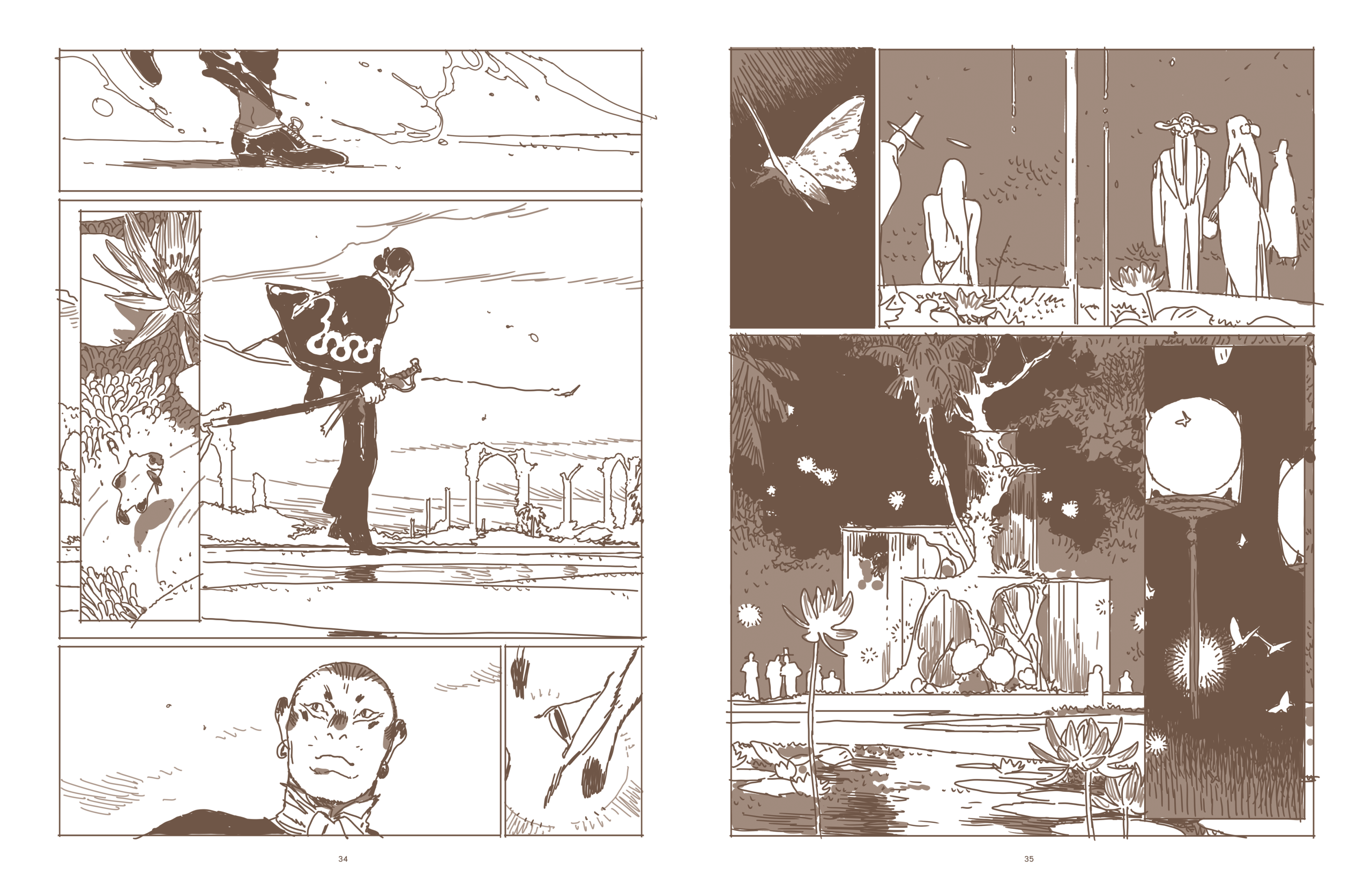
There's a lot in this book that feels very fairy tale-esque. How are you inspired by fairy tales?
Mostly filtered through golden-age-era illustrations and half-remembered Disney movies. I think I like the idea of the fairy tale more than I enjoy reading them.
This book is about a heist. Do you have other favorite heists?
I like it when people commit high-level crimes for really silly reasons. Like Gary McKinnon, the guy who hacked the pentagon and almost saw a photo of a UFO, allegedly. Or that guy (a flutist) who stole dead birds from a London natural history museum so he could use the feathers for making fly lures (some of which he then sold so he could buy himself a fancier flute iirc). He had this all planned out in a word document.
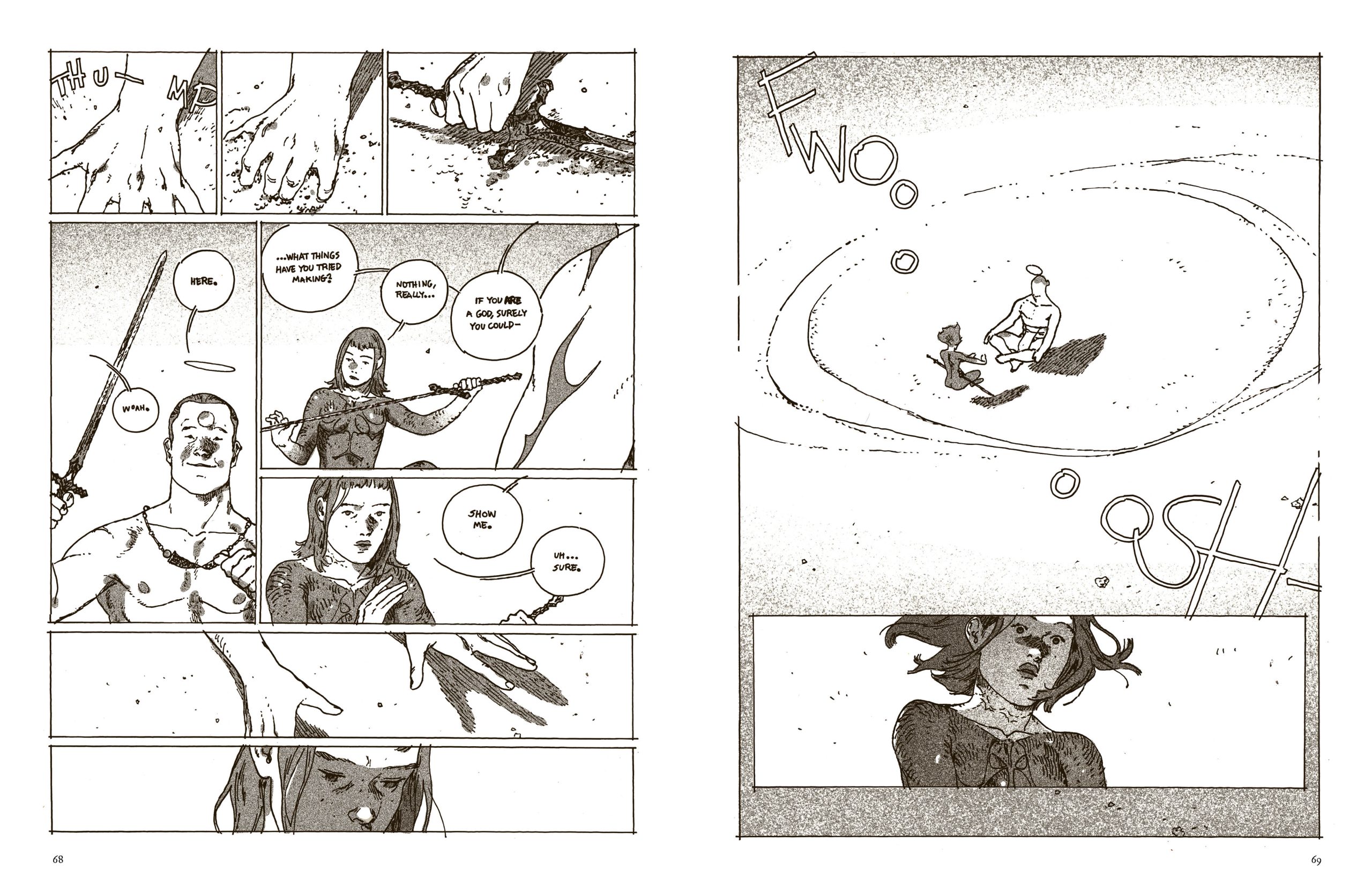
Your new graphic novel A Garden of Spheres is all about gods and deities (as is World Heist). Can you talk about what you read and looked at that inspired you in the world of mythology?
I read The Silmarillion in Swedish years ago and then again in English a bit more recently. This probably damaged my brain a bit. Then, for an earlier project that ended up not happening, I made some effort of reading up about various odd religious things. I remember a collection of essays or papers on buddhist afterlives, some writings by Caroline Walker Bynum (which I found through the excellent Medieval Death Trip podcast) regarding incorruptible saints & relics & whatnot.
A lot of this is also just my idea of what fantasy should be, like all the dragons and gods and elf-like pseudo-people happening in this book is just me over-indulging in the genre. The idea of having many gods creating different realms means one can put a bit of everything in there. The gods bestowing different magical gifts on their peoples originated from me wanting a weird power system like One Piece, where characters can have various odd or impressive or useless abilities.
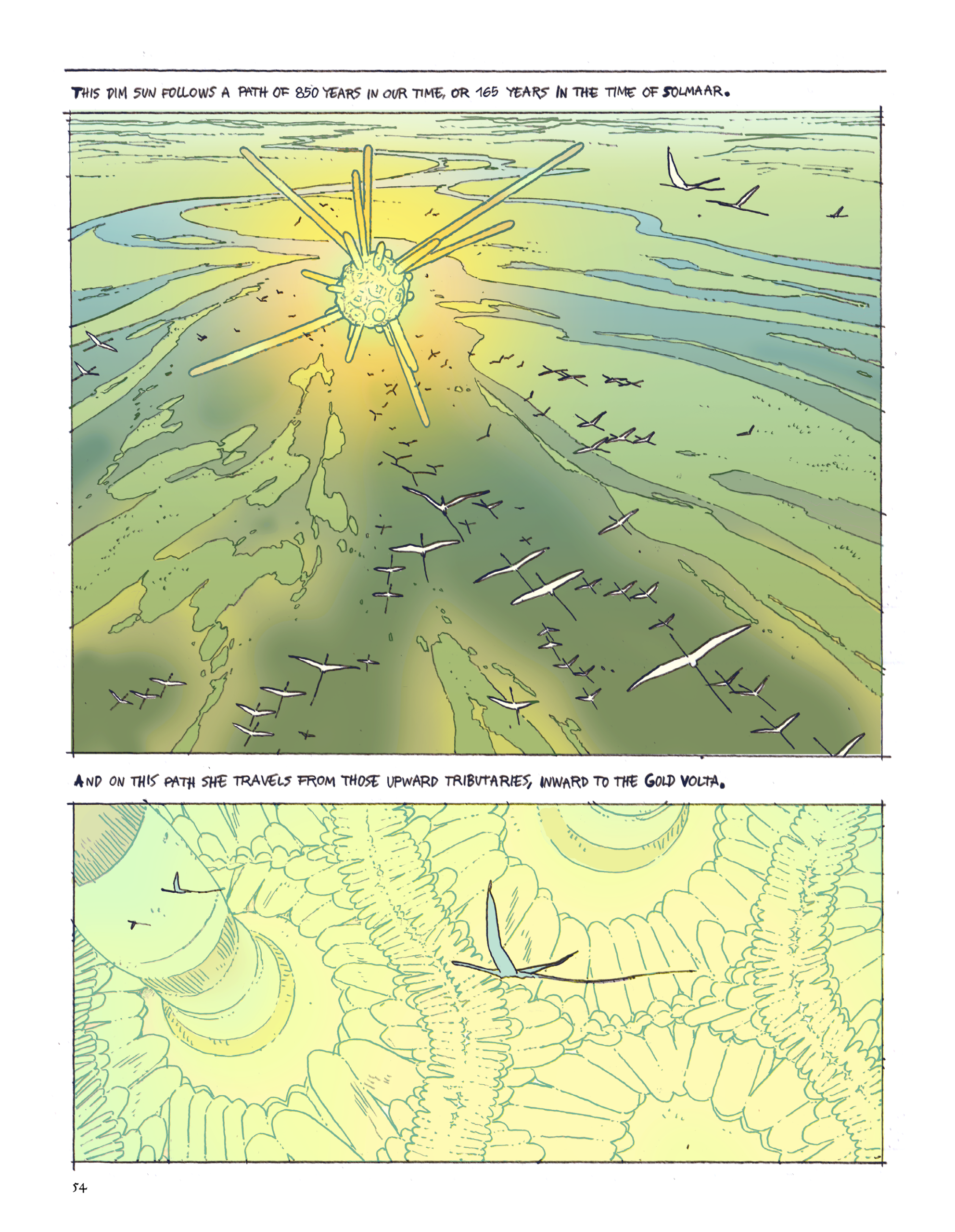
I feel like gods must be so interesting to write about, because they have so much power in the world and over people. Can you talk about how you think about your protagonist and her place in the world?
I started out thinking of the un-maker as just, something to which I could anchor the camera so to speak, so her god-ness is mainly there as a thing that detaches her from time and space. One thousand years can pass, she can wander a desert with nothing to eat, etc., and one doesn't have to think too hard about how this would affect her emotionally or the logistics of it all. She's like a cactus almost. Or a pet rock.
It also creates a bit of an anthropological distance between her and the people she encounters, or the POV of a nature photographer, where she's not obliged to intervene in or judge what's happening. I'm hoping to do more with this in the next volume, when I get around to it.
From your endnotes, it sounds like you created this book by having some ideas about geography/botany, then creating the main character and "having her wander around" to explore. How did this work as a book-making strategy? Were you happy with the narrative and the world that developed?
It led to massive mission creep. Originally I meant for this thing to be like one volume, 500 pages, black and white, but color snuck in there and I happened across ideas that demanded more space than I'd accounted for. On the other hand I started out having an image of a world and some disparate characters but no idea what sorts of stories I wanted to tell in this setting, and now I have an annoying, almost stressful amount of ideas for things I want to do next.
So I guess it worked, in a way?
You've got some parts of this book that are black and white, and some that are in color. I'd love to hear about how you think about color when you're making your art. Some of your books are entirely black and white, some are entirely color, and this one's in-between!
I love the quiet of black-and-white art. In some manga there's a sense of peace even in the action scenes, like you have this character hanging in the air about to kick a monster cyborg in the face and you can see their shadow on the ground, the background is maybe white or just a gradient, etc. A lot of times I want to do those kinds of panels and color feels like a hindrance there, like clutter, almost, or additional information that distracts from the main action. On the other hand there's this instinct I have, which is the main reason I don't write prose, where I want to make every bit of visual information available the way it looks in my head. So everything I make is kind of a compromise between these impulses, like having short color chapters in-between longer black and white sections (so the reader knows what color this character's hair is) or working with limited color schemes.
So many comics have multiple people talking in every panel — this book in comparison is filled with pages and pages of silent moments. How do you use quiet as a narrative choice?
Whenever it feels right. Could be damage from my animation days, where if you wanted words you had to get someone to say them for you so it's easier to just figure out how to tell a story with minimal dialogue. On a subconscious level I often end up rationing the dialogue like that. plus early Nihei (BLAME!, etc) was a bit of an inspiration for A Garden of Spheres early on, those comics are very quiet. Nausicaa opens with just a bunch of silent pages, nature and post-apocalyptic landscapes, and you don't even get to see the main character's face until a few pages in. Maybe these silences sort of happen naturally when a sci-fi or fantasy comic wants to show off its world & like characters going about their day.
There are so many dragons in this book! Can you tell us about fictional dragons that have inspired you?
Falkor obviously, The NeverEnding Story movie is what taught me a dragon can just look like whatever. Dinotopia, though those are dinosaurs. I don't know if people have warmed up to the Ghibli Earthsea movie or if it's still regarded as a disappointment but I think those weird metallic dragons they had there were pretty cool.
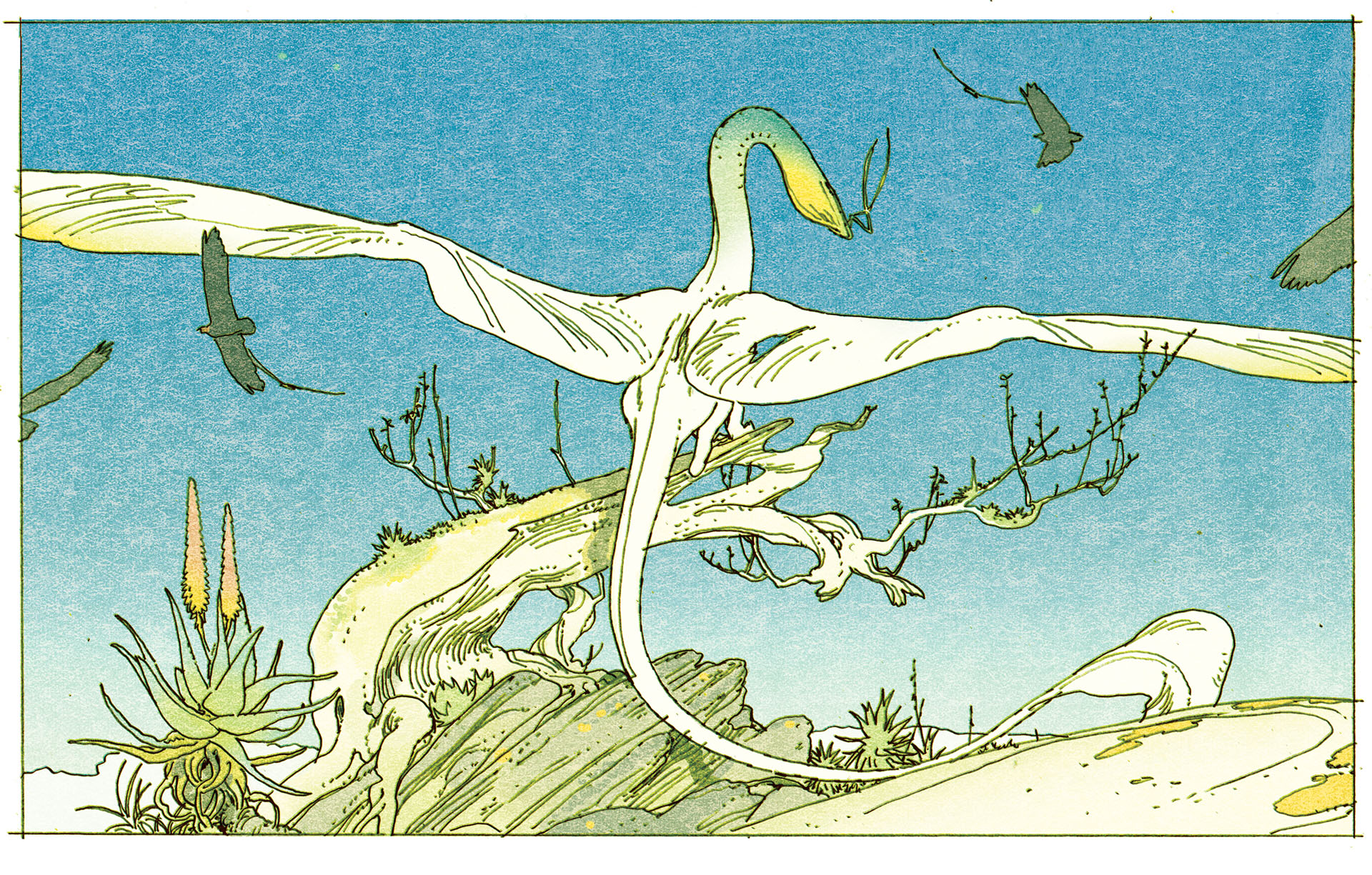
Can you tell us about what inspired the visual design for the dragons?
Tropical fish, mostly. Ribbon eels. Weird bugs. Moths, with those odd antennae they have. A lizard I saw on instagram. They're animals I'd like to own as pets but can't, sort of forced into a dragon-shaped mould. Dragons in this world are clearly a polyphyletic group. Some of them look a bit alien while others are clearly reptiles.
There are so many flying things in this book — dragons, kites, winged people, people who can fly without wings, flying machines. What particularly interests you about flying?
Visually, it gives you a cool perspective on the world. Lets you draw landscapes from some fun angles. Being on airplanes is a bit of a guilty pleasure for me. I especially love how Canada and the Arctic look from above. Greenland, where you think it's clouds but really it's an endless expanse of ice, which is amazing to see if you haven't slept for thirty hours. Also flying feels like something both gods amd dragons ought to be able to do or they wouldn't be very impressive.
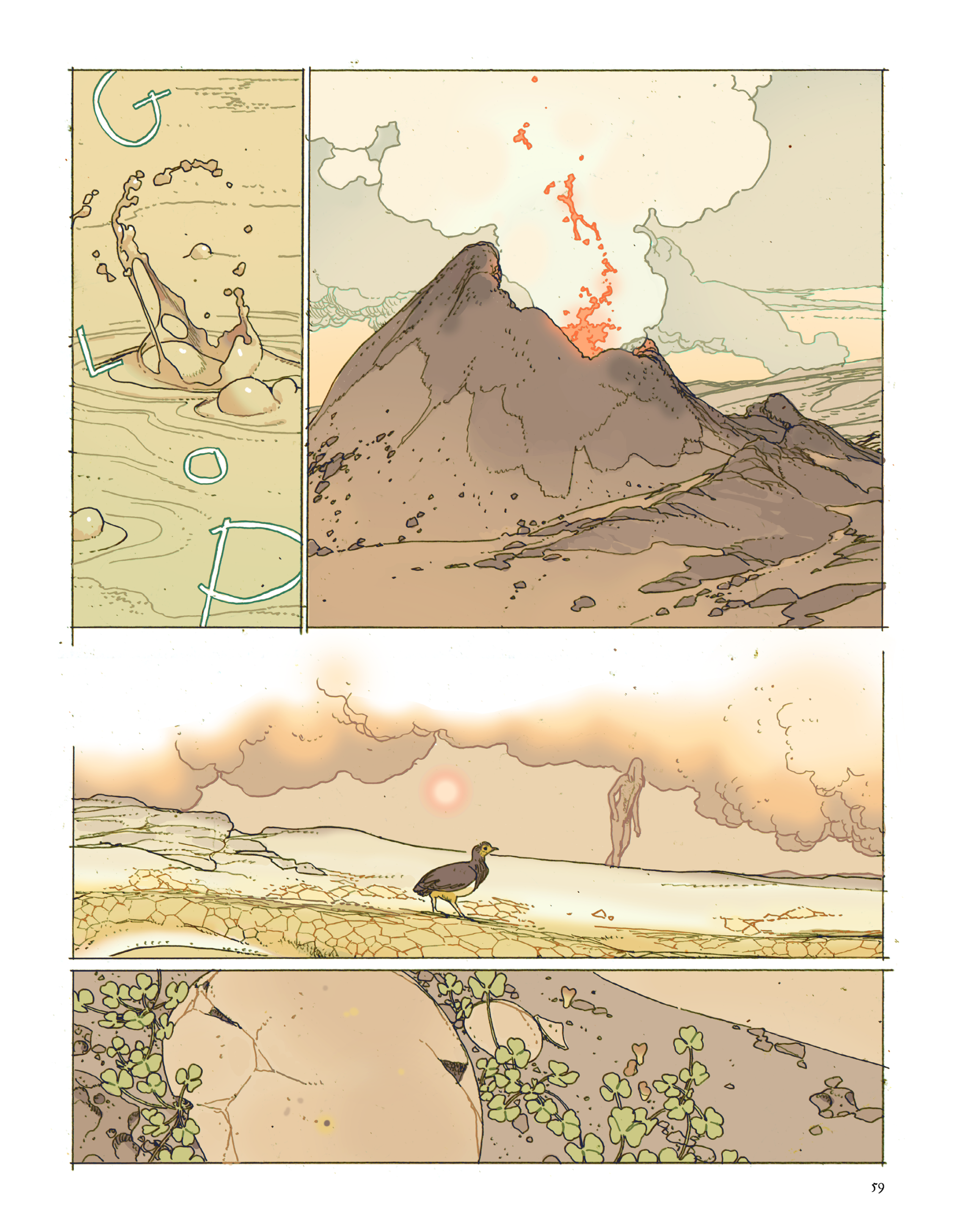
This book happens at a huge time scale — the structure is a set of vignettes at different eras of The Wanderer/The Unmaker's life. and she's continually commenting on how short of a life the various people/animals/geological formations have. What was it like to think about a story that takes place during such a long period of time?
As a former dinosaur kid I find this headspace weirdly easy to inhabit? I'm not sure I thought about it much. It's the same as how GRRM claims Westeros is the size of South America though the characters interact with it like it's the U.K., mostly. The larger you make things the more epic fantasy it is, which applies to timescales, too.
One of the themes of this book is that the world just keeps going. Can you talk about your feelings on that topic given all that's happening in the world today?
I'm a pretty anxious person so I probably spend more time than normal thinking about the end of the world. It's sort of a macro-micro thing I think, like a quantum physics of existential anxiety, where in my everyday life things mostly just keep happening and I'm just trying to keep up, not murder my houseplants, etc., and that's working out OK — not great but I'm not in a state of abject poverty or sickness or anything like that. Then in world politics there's a constant sense [that] it's all about to collapse though things never seem to actually get there. The oceans are dying, etc. There’s a breakdown or a war or a revolution always a few months away. And then on an even larger scale the earth could disappear tomorrow and 2,000 light years away there's some puddle of sentient slime basking in the sunlight totally unbothered. My father told me when I was six that if the universe really is infinite there must be an infinite number of planet Earths out there, some the same as this one and some with slight variations. Since the laws of physics only allow for so many types of planets on an infinite scale there will inevitably be doubles.
I hate thinking about these things and I try not to since I can't alter this state of affairs but it does seep into my work.
You just published a new graphic novel in French with Dargaud called Cat Cafe. Have you been to a cat cafe yourself? What do you think of them?
Ages ago! It was cute. I think the cats mostly ignored me.
I wasn't really thinking about cat cafés when I started working on the comic, it just had to be about food per Dargaud and I wanted to draw cats. The title I had in mind was "Cha Cha Café," which I thought would be a cute pun on cha-cha-cha and "chat" but maybe had some secret obscene meaning in French that I wasn't aware of. Since this comic insists on being my David Lynch's Dune (with slightly better pacing) Dargaud higher-ups decided to change the title.
Will Cat Cafe be coming out in the U.S.?
It seems inevitable.
More comics by Linnea Sterte: inevitable.
Yay!
The post An Interview with Linnea Sterte: ‘Small moments are probably the easiest thing for me’ appeared first on The Comics Journal.


 Hello, my name is Jack Sparrow. I'm a 50 year old self-employed Pirate from the Caribbean.
No comments:
Post a Comment