

Caravaggio is one of the most recent works by master of erotic comics, Milo Manara. It followed The Borgias (2006–2010, written by Alejandro Jodorowsky) and came after a series of largely questionable commercial projects, most notably a comic dedicated to motorcycle racing star Valentino Rossi and the animated TV show Adrian, created with singer and entertainer Adriano Celentano — a cringeworthy experience for some, a guilty pleasure for others.
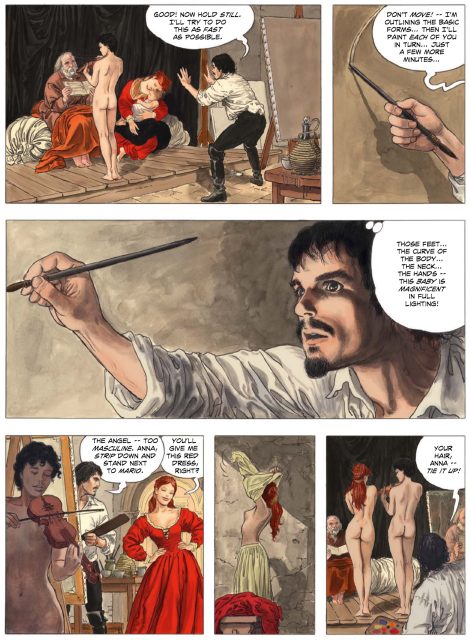 The two volumes of Caravaggio — originally published in Italy by Panini Comics in 2015 and 2019, and later released in English by Fantagraphics in 2024 and 2025, translated by XXX — marked a new phase in the career of the now 80-year-old artist. Shortly after, Manara also completed the second and final volume of his adaptation of Umberto Eco’s The Name of the Rose. As with that project, he was assisted on Caravaggio by his daughter Simona Manara. Both works clearly required extensive research, especially Caravaggio, which depicts late sixteenth-century Rome with notable attention to historical detail.
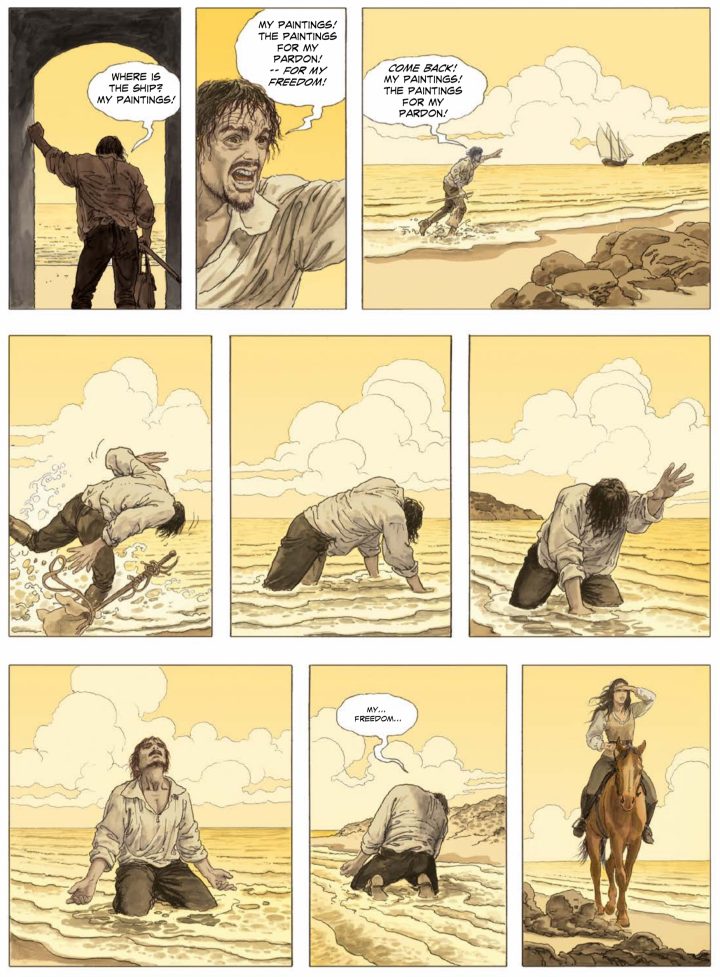
Manara’s story begins when the painter — born Michelangelo Merisi in Milan in 1571 — arrives in Rome around the year 1592. This is where he will become the Caravaggio we know, considered by some to be the last great painter of the Renaissance, and also the first of a new movement he helped initiate. He remained in the city until 1606, when he was sentenced to death for killing a man during a brawl. He then fled to southern Italy and later to Malta, before attempting to return to Italian territories after running into further trouble. The book concludes with Caravaggio’s death — or rather with one possible interpretation of it, given the many theories surrounding how and by whom he was killed.

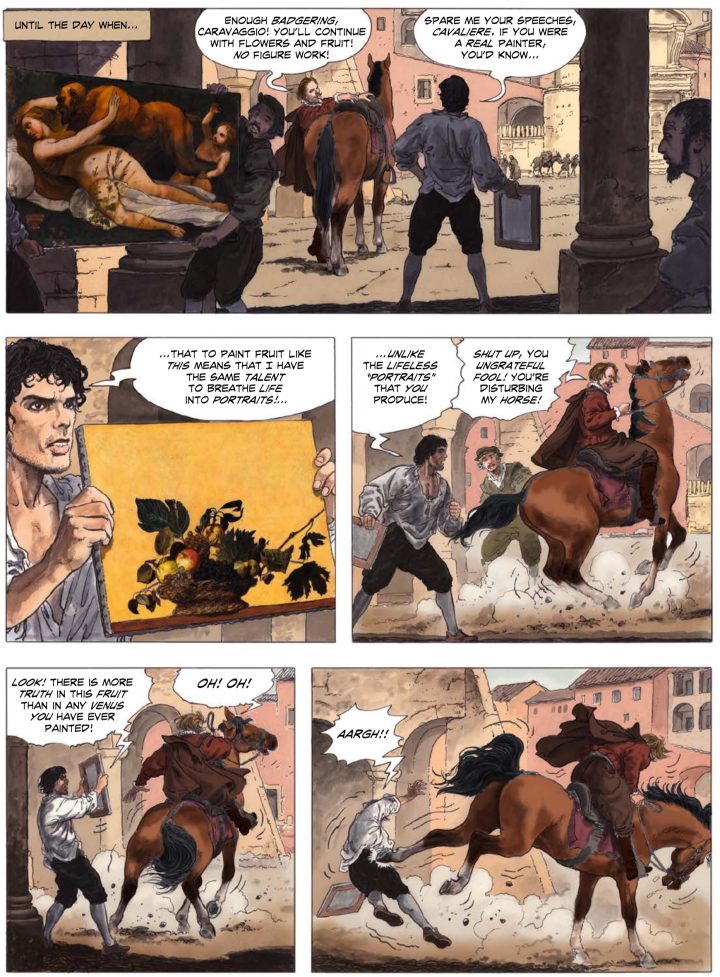
From the opening pages, one thing is immediately clear: Manara’s Caravaggio bears little resemblance to the familiar figure once depicted on the old 100,000 Lira banknote, from Italy’s pre-euro currency. Instead, Manara's artist image in the book is modeled on the face and body of Andrea Pazienza, the Italian underground comics artist who died of a heroin overdose at the age of 32 and who was published in some of the same magazines as Manara during the 1970s and 1980s. While Pazienza was known for his eccentric personality, he was clearly not the kind of scoundrel Caravaggio was. Manara has explained that this choice was meant as a tribute to his friend, as he stated in a 2015 interview with Fumettologica. Still, in the book Caravaggio often comes across as foolish or unpleasant whenever he is not fully engaged in painting. One might assume that using Pazienza’s likeness also allowed Manara to rely on an “actor” he knew how to place in chaotic environments — taverns, nighttime streets, and wild situations.
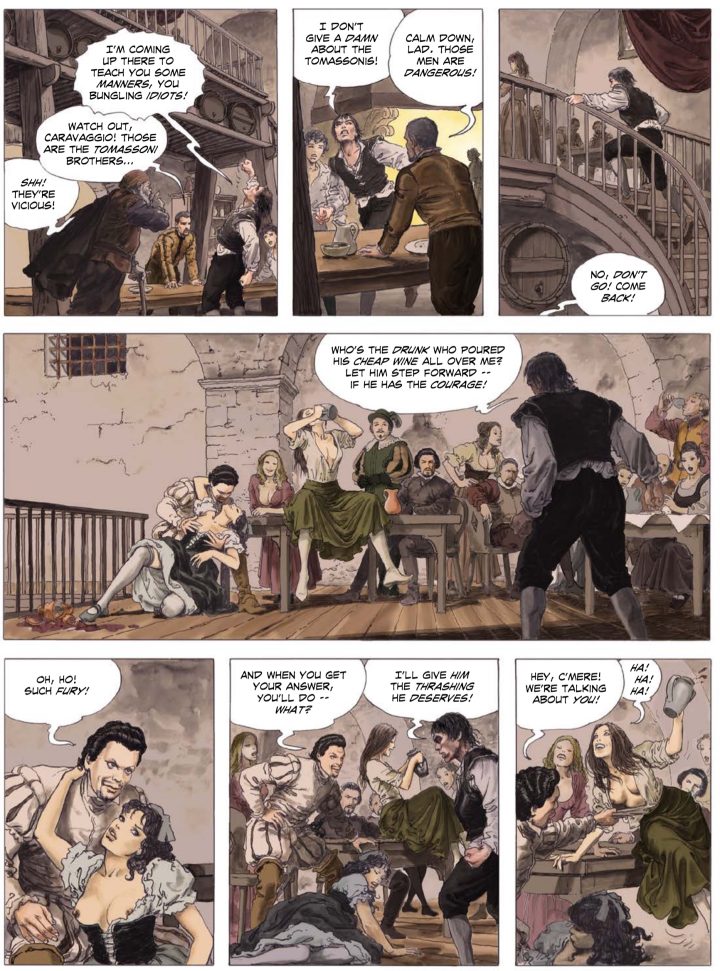
Manara has often uses the faces of real people or actors for his characters, as he recently did in The Name of the Rose, where he modeled one of the main characters on the actor Marlon Brando, but rarely does so with his female characters, who display a very limited variety of features and expressions. In Caravaggio, as in many of Manara’s books, most women share nearly identical faces, and even here — where some of them are based on real historical figures who played an important role in the painter’s life — the artist seems to struggle diverting from the usual “Manara woman” (brothel scenes are particularly bizarre, with so many women who almost look like clones). For his women, hairstyles and clothing change, but facial features and expressions remain largely the same. Women are portrayed merely as objects of male desire, with a sugary and seductive look on their faces. And this book is no exception. They are objects in the hands of men like Caravaggio, shown on the streets and in brothels.

The opening scene of the first book is emblematic. A wagon carrying two prostitutes tries to enter Rome when the mistress leading it offers sexual favors to the gatekeeper, while Caravaggio himself is forced to beg to be let in. The episode designed mainly to establish Caravaggio as a fool and a rascal, and to introduce prostitutes as the narrator’s and Caravaggio’s second main object of interest. Yet these two women, who make such a ludicrous entrance, will soon prove to be very important in the artist’s life.
While Caravaggio was certainly no moral figure to be celebrated beyond his art, Manara gives limited depth to his persona. He is depicted almost exclusively as a man who enjoys Rome’s nightlife, consuming it in the worst and dirtiest corners of the city and frequently ending his evenings in drunken brawls. By day he is patronized by aristocrats and high-ranking clergymen; by night he lives among the city’s poorest and most marginal figures. His interest in human being appears purely instrumental, as almost everyone who enters his life ends up serving as a model for his paintings, even when they are suffering or on the verge of death. Real historical figures, such as the prostitute Anna Bianchini — one of Caravaggio’s models, perhaps his favorite (if that term makes sense, considering how she is treated here) and possibly more than that — are pushed into extreme, violent, crude, and sometimes grotesque situations. Most of these episodes are broadly grounded in history, but they are rendered through a narrative that often indulges in a morbid fascination with pain and lust, blurring the line between historical plausibility and unwarranted exaggeration.
Caravaggio was undoubtedly a reckless, reprehensible character, and in the end, an assassin. But he was also a complex and larger-than-life figure. In Manara’s telling, however, he becomes largely one-dimensional, defined by excess and cruelty, ruthlessly consumed by his artistic drive and unconstrained attitude. A possible identity of the man, perhaps, but not the most narratively convincing one.
Despite my reservations about the perspective adopted to recount both the man’s life and his artistic journey, the book has one undeniable merit: it draws you away from it. It sparked my curiosity. At times, driven by skepticism toward Manara’s interpretation, I found myself putting the book aside to learn more about Caravaggio’s paintings and the historical events behind them, and the edition of the two volumes does help in this regard, providing useful images and information about the artist’s works. You find yourself craving to know more about figures who seem to be treated unfairly by the author, especially Anna Bianchini. In this sense, even through disappointment, Manara’s book succeeds in encouraging further knowledge and exploration of its subjects—not only Caravaggio himself, but the broader world of his time.
The post Caravaggio: The Palette and the Sword Books 1&2 appeared first on The Comics Journal.


 Hello, my name is Jack Sparrow. I'm a 50 year old self-employed Pirate from the Caribbean.
No comments:
Post a Comment