

The opening of “The Secret of Tristan Bantam” shouldn’t work. You shouldn’t be able to open an adventure story, a story of brave sailors, assassination attempts, magic, treason and historical mystery, with something as static as a shot of man lounging in a chair; and if you do decide to simply show a would-be man of action in a pose of absolute inaction you certainly can’t have your narration refer to him in such grandiose terms as a “man of destiny.” That is – you can’t, I certainly can’t. But Hugo Pratt can. When he draws Corto Maltese, even at repose, he always draws a man of destiny. A man at ultimate ease with himself, who knows who and what he is, yet a possessor of nearly-endless curiosity. That opening panel shows man looking lazily at the world, at the reader, knowing that the rest would soon be over; some strange things would come.
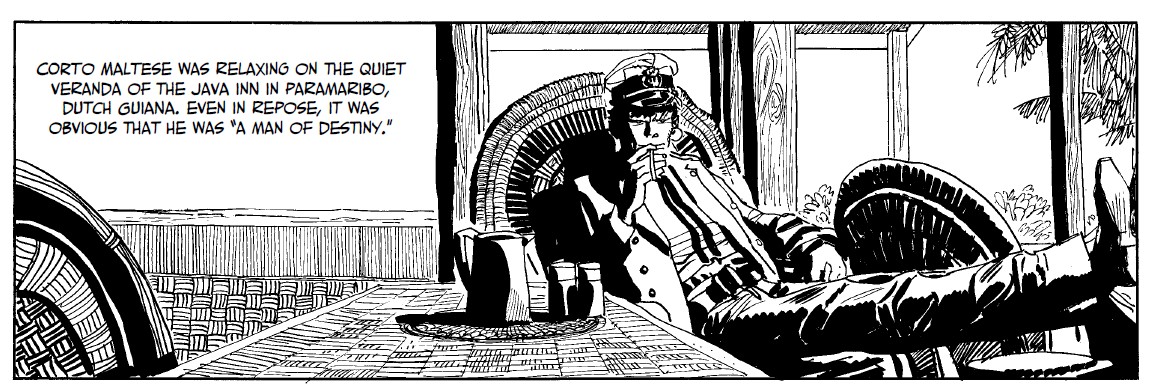
That was my first introduction to Corto Maltese, both character and title, though to newer readers, who would hopefully pick up this volume, it would a come after sixty pages of of escapes and intrigue. Not the wisest of choices, in my opinion, but maybe I’m just nostalgic. For to read Corto Maltese always involves a degree of romantic nostalgia – for adventure fiction of the days of yore. For the likes of Robert Louis Stevenson and Alexander Dumas; exciting – yes; yet also intelligent, literate. Those works have stood the test of time. Likewise Corto Maltese.
My first exposure wasn’t that long ago, opening the large pages of Under the Sign of Capicorn from IDW’s short-lived Euro Comics imprint. That publishing venture has made two valuable contributions to the world of English-reading comics: The first is the full translation of Alec Sinner, in two vast volumes; the second is a complete edition of Corto Maltese, one of the most seminal of the European "adventure strips." Both series had been partially translated before, and sometimes with art trimmed and reshaped to the limitations of American size, so it was good to see them in their full glory (ugly cover design aside). Alas, no good things last for long, Euro Comics died a quick death and anyone wishing to get copies of Corto Maltese had to pay through the nose (and maybe some other bodily holes) to get their hands on a copy.
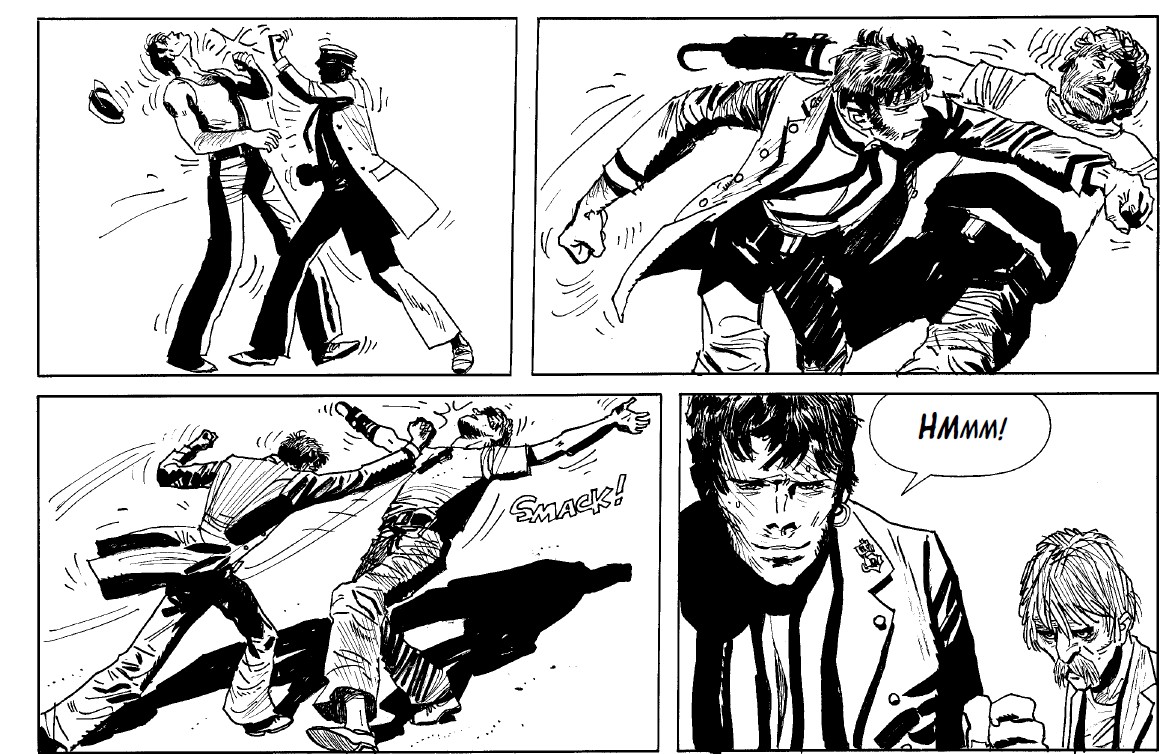
Which is why I’m so glad for this new initiative, this time by Fantagraphics, reprinting the whole series yet again; still using the Dean Mullaney and Simon Castaldi translation from Euro Comics; though in different publication order, which is why a story I first read in Under the Sign of Capricorn is now published as part of Fable of Venice and Other Stories. Readers who simply wish to fill holes in their collection might have their work cut out for them. I might, just like in the case of recent Moomin reprints, argue with some of the choices made by the editors in terms of printing chronology and order of the books (Fable of Venice is a book that assumes some familiarity with the character and his world, the long-running side character Rasputin pops up in the middle with little explanation). These, however, are mere quibbles – any Corto Maltese is good Corto Maltese,1 a classic since the day of its inception whose power only grows with time. So whatever else you see in this review let it be known that I’m giving Fantagraphics a salute – but of the slapdash type Corto Maltese would probably give someone, acknowledging authority without respecting it too much.
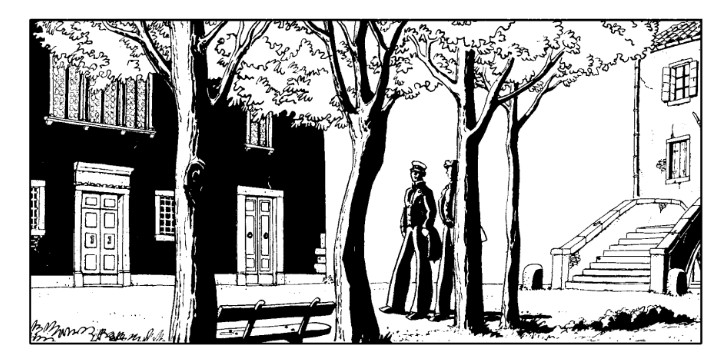
Corot Maltese, in case you are uninitiated, is a sailor operating the first half of the 20th century, who tends to end up in various hotspots throughout the globe, from Ethiopia to Siberia to (the subject of the first half of this collection) Venice. The character and title are, on the surface, not much different than dozens of other adventurer types that inhabited much of European and American comics of that period (it would not surprise you to learn that Pratt is a big fan of Milton Caniff). Yet one expecting a chest-thumping simplistic adventure provided by the likes of Terry and the Pirates, Captain Easy or Scorchy Smith would be (pleasantly) surprised. For Corto Maltese is written with a true literary intelligence that eludes much of the competition, and with historical and geographical depth that comes from curiosity.
Even something as short in the overall cannon as Fable of Venice contains research into the Freemasons, the influence of Islamic explorers of the architecture of Europe, and the exploits of classic English novelist Baron Corvo. Later works such as The Golden House of Samarkand demand either a keen ability to keep abreast of enough names to populate a Russian classic or a working knowledge of post-World War history. Pratt respected Caniff a great a deal; one can certainly see how he cribbed bits of Caniff’s drawing style, though Pratt wasn’t as rigid as his artistic forbears, and was more willing to experiment with abstraction and using the full scale of the page to his advantage rather than being jailed by the limitations of the panel2, Yet while the played in the same general arena their skills as writers couldn’t be any different.
Pratt, one of these rare comics scribes who had experienced the wide world3 before trying their hand at making art, doesn’t treat other countries as mere canvasses for adventure. In some of the best Corto Maltese stories, such as The Ethiopian, Corto is a mere visitor and observer; sometimes assisting and sometimes being dragged along other people’s stories. While Fable of Venice is not the best demonstration of this openness for other cultures, a rare trip to Italy by this Italian writer, its use of Islamic figures (both in the terms of "people" and "script") is thankfully free of broken speech and stereotypical drawings. "Respect" is a key phrase; Pratt respects his readers, never writing down to the younger crowd, and he respects his characters and the culture they represent.
“The Secret of Tristan Bantam” has a Caribbean witch demonstrate her powers, yet the moment is presented by Corto as a matter of fact — he has traveled the world far and wide and knows that there are things he doesn’t know. That is part of the charm of Corto Maltese after all. For all its depictions of political violence and repression it presents a snapshot of the world at the last moment when it was still wide, when the unknown was still possible.
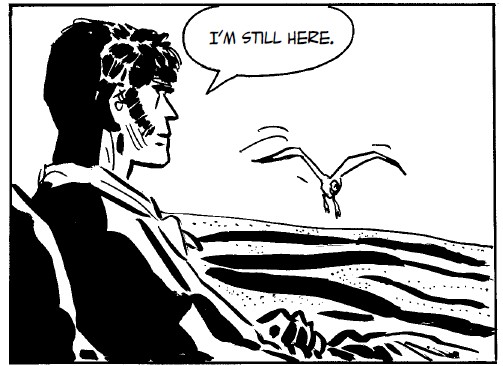
When Corto Maltese looks at the titular seagull in “The Seagull’s Fault,” it’s the simplest of drawings: the bird is of a basic shape, the sandy beach is just black solid lines and dots, even our main figure is sheared of details — what we see of his mouth is a single half line. Yet in that panel, just like "the man of destiny" panel, there holds an entire world. The full measure of a man, something Pratt achieved with every drawing. Thirty years after the death of its author and almost half a century after its original publication, Fable of Venice still holds up. It is as Corto says, “I’m still here.”
The post Corto Maltese: Fable of Venice and Other Stories appeared first on The Comics Journal.


 Hello, my name is Jack Sparrow. I'm a 50 year old self-employed Pirate from the Caribbean.
No comments:
Post a Comment