

“No dictator is displeased by cartoons showing his terrible person stalking through blood and mud…What he does not want to get around is the idea he is an ass, which is really damaging.”-David Low, cartoonist.
Nazi Germany is not a place we think of as being full of yuks. Italian Communist Palmiro Togliatti once remarked to novelist Ignazio Silone thus, “In judging a regime, it is important to know what it finds amusing.” What did the Nazis find amusing? One answer comes from Hitler himself, a fan of Laurel and Hardy and Mickey Mouse shorts.
Another answer can be found in the pages of Der Stürmer, the newspaper published by fanatical anti-Semite Julius Streicher. Streicher’s rag (“The Stormer” in English) carried the cartoons of one Philipp “Fipps” Rupprecht.
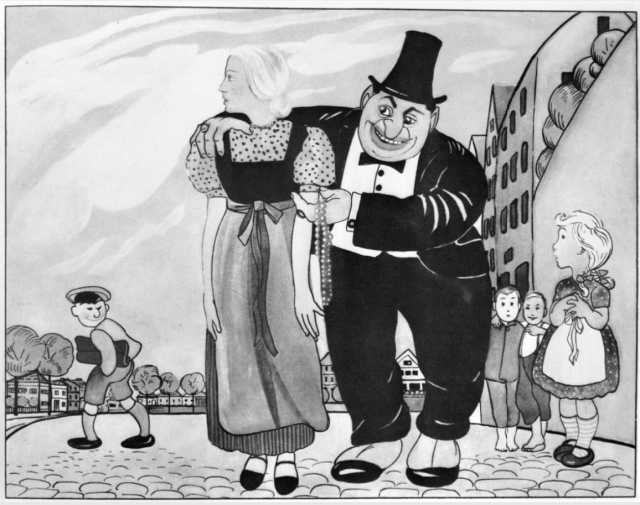
Fipps was a crude, ugly cartoonist, perfect for a crude, ugly publication. A Streicher biographer stated Fipps “became identified with the Stürmer almost as closely as Streicher.” Indeed, if Satan himself had put the duo together, he could not have done a better job. Streicher’s stories routinely slurred Jews as capitalist plutocrats, subversive communists, and rootless traitors. Fipps’ cartoons followed the same lines of attack. The cartoons may have even been worse. A complete illiterate unable to parse Streicher’s articles could still see the drawings of Jews-as-snakes, Jews-as-spiders, Jews drinking Christian blood, and molesting young girls and get the idea. One can imagine progenitors to the modern anti-PC crowd guffawing at the illustrations. “What’s the matter?” they say, “Can’t you take a joke?”
Turning Togliatti on his head, one can also learn a great deal from which amusements a regime tries to prevent. Here, the Nazi example is likewise instructive. Despite their meticulously curated reputation for ruthless invincibility, the leaders of the Third Reich were sensitive to mockery and satire; so sensitive that they made efforts to fight caricaturists both at home and abroad.
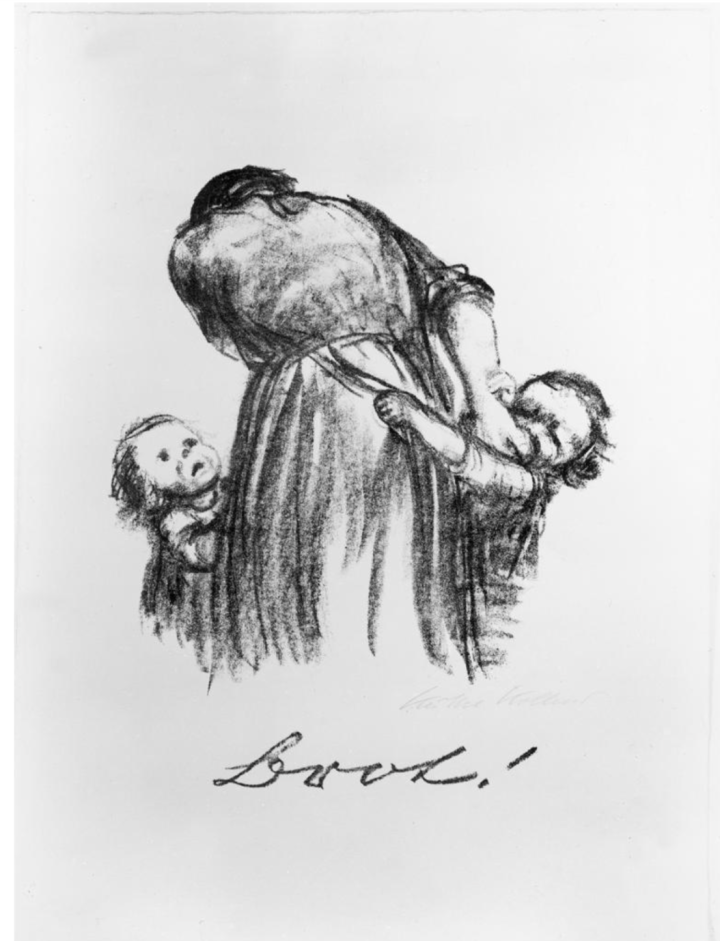
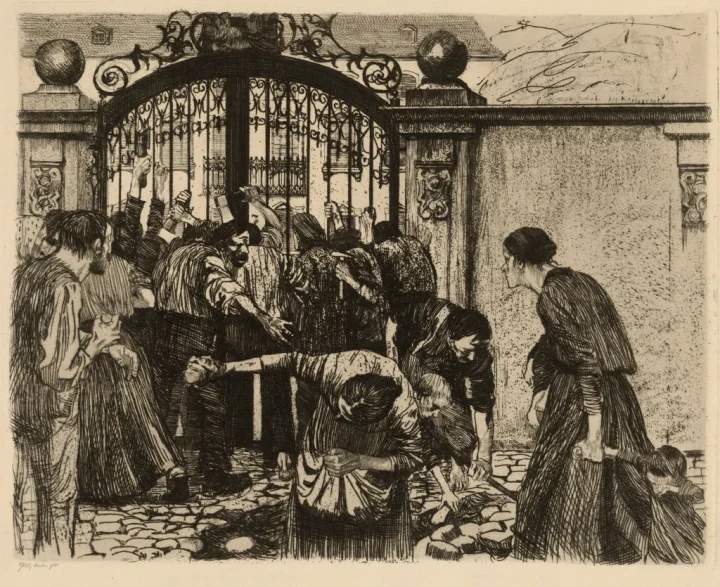
Response by the Nazis to native caricaturists was typically blunt suppression. Käthe Kollwitz is not typically considered a cartoonist because of her seriousness and the fact that she worked in a variety of artistic styles, from sculpture to woodcuts. Nevertheless, Victor S. Navasky included her in his survey of political cartoons, The Art of Controversy.
A supporter of the revolutionary socialist Spartacist League, Kollwitz was forced to resign from the Prussian Academy in 1933 for her beliefs. She was denounced as a “degenerate” artist by the Nazis for political beliefs, and her work was included in the infamous 1937 Nazi exhibition of “Degenerate Art,” used to inflame the German people against modern art styles. Kollwitz received an unwelcome visit by the Gestapo but threats to arrest her and send her to a concentration camp proved empty. The Nazis were wary of provoking a global reaction over imprisoning such a famous artist.
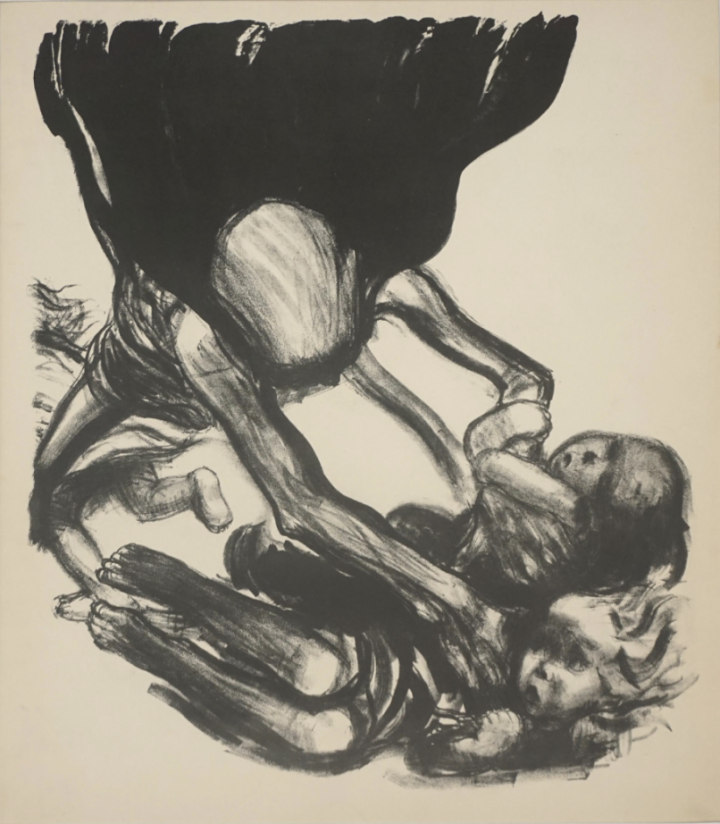
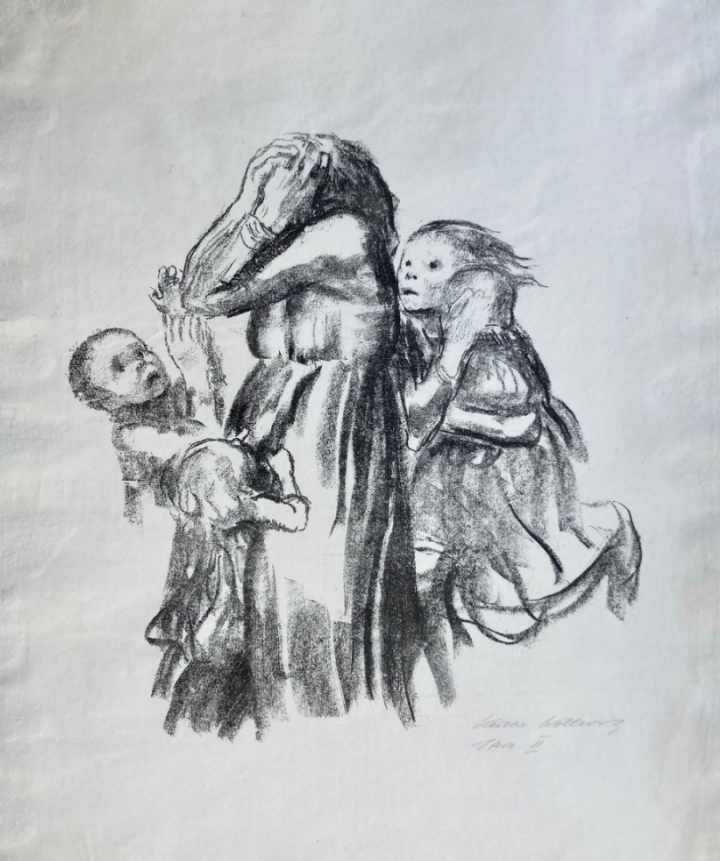
Like Kollwitz, John Heartfield’s work appeared in the German satirical magazine Simplicissimus. Like Kollwitz, critics like the Observer’s William Feaver denied that Heartfield was “a caricaturist in any conventional sense.” And, like Kollwitz, he was harassed for his work by the Nazis. Heartfield used photomontage to make his points. A famous Heartfield work mocks “Adolf the Superman” who “swallows gold and spouts junk.” Another shows “the real meaning of the Hitler salute.” Hitler’s open hand recieves cash from a German plutocrat.
In response, Hitler’s SS ransacked Heartfield’s house and burned his art. The artist escaped by jumping from his balcony into a garbage bin. Heartfield went into exile, first to Czechoslovakia, and then the UK. Even in exile, the Nazis attempted to erase his artistic career. While he sheltered in Prague, the Nazis tried to extradite him over an anti-Nazi art exhibition.
Caricaturist George Grosz was denounced by the Nazis as Germany’s “cultural Bolshevist #1” over his onetime membership in the Communist Party and his continued leftwing politics. Even before Hitler’s ascension to power, Grosz had been prosecuted for blasphemy in 1928 over a cartoon mocking the clergy as apologists for war. Grosz fled Germany for good in 1933, a week before Hitler assumed power, and took up teaching in the United States.
One of the most bizarre Nazi responses to artistic criticism was the spawn of Hitler intimate Ernest Hanfstaengel. Hanfstaengl, known as “Putzi”, decided to hit back at Hitler’s satirical critics. Collecting a sample of anti-Nazi cartoons from Germany and abroad, he decided to, as much as possible, rebut their arguments. The result was Hitler en der Karikatur der Welt: Tact gegen Tinte or “Hitler in the Caricature of the World: Facts versus Ink,” published in the spring of 1934. Although it was obvious to any observer that the book could only have been published with the sanction of the Nazis, officially the book was released by an independent publisher in order to obscure its parentage.
Although many cartoons originated in Germany, Putzi was irritated particularly by foreign cartoonists who, in his view, misunderstood Hitler. His book would set the record straight. One cartoon came from the Nation, then as now a left-liberal magazine from the United States. The cartoon shows Hitler as a towering grim reaper with a swastika shaped scythe. He leads an army of skeletal storm troopers. Putzi summarized (correctly) the cartoon’s argument that “Hitler was a war-monger.” He responded “On July 15, 1933 Hitler authorized the German ambassador to Rome to sign the Four Powers Pact, through which Italy, England, France , and Germany ensured peace in Europe for the next ten years.” It would’ve been a swell rebuttal if only World War II hadn’t spoiled everything.
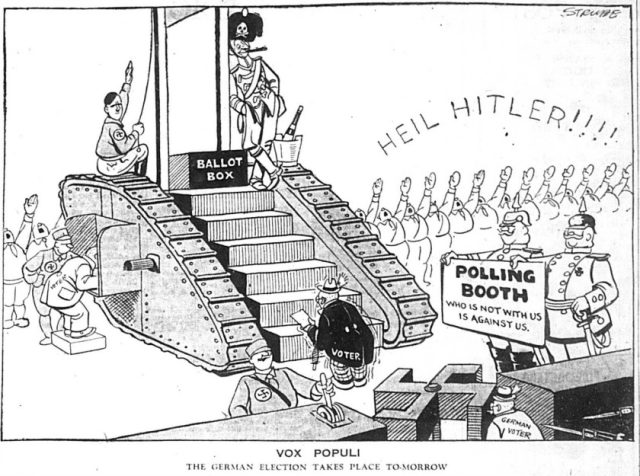
Other examples were similar. One cartoon from London's Daily Express shows a timid looking voter in the March, 1933 election intimidated by sieg heiling Nazis and war machinery. Putzi’s response? “The author of this caricature neglects to mention the fact that elections in Germany are decided by secret ballot which prevents any influencing of the result.” Another from the New York Times depicts Hitler leading Germania (The female embodiment of the German nation. Think Uncle Sam or John Bull.) to “The Dark Ages.” Putzi’s response is to quote the owner of the Daily Mail—a newspaper so pro-fascist it’s often mocked as “the Daily Heil”—as saying “It is Germany's good fortune that it has found a leader who knows how to unite all the strongest forces of the country for the common good... Hitler has instilled into the national life the unconquerable spirit of blessed youth.”
If Putzi was hoping for a stampede of praise from foreign critics, he was sadly disappointed. Only Dorothy Thompson, who was the first American journalist expelled from Nazi Germany, bothered to review his book in the United States. (Thompson was later kicked out of the German American Bund’s infamous Madison Square Garden rally for heckling wannabe fuhrer Fritz Kuhn).
In the Saturday Review of Literature, Thompson wrote that Putzi “uses this book over and over again to repeat the myth that Hitler came into power as the voluntary selected leader and dictator of a majority of the German people.” In truth, “Hitler did not win the power, it was handed to him by President von Hindenburg and the German nationalists.” Thompson noted that Putzi responded to claims Hitler “will not fulfill his election promises and indicates that he is misleading the voters” by writing “to the irritation of his opponents, Mr Hitler made no election promises.”
Putzi’s book ended on a note of supreme optimism. Of anti-Hitler critics, he wrote: “Whatever they say about him, they are bound to envy us for him.” Thompson concluded her own review by noting the contrast between the Nazis' seeming good humor and their treatment of political opponents. “The book concludes with a photograph of a laughing chancellor, and an admonition to German readers to follow his example and smile, too,” she remarked. “Tell that to sixty thousand emigres, whose sense of humour seems singularly undeveloped. Dr Hanfstaengl apparently is, but the world is not amused.” Putzi was to find himself within the world of the unamused when, upon falling out with Hitler, he was forced to flee to the United States.
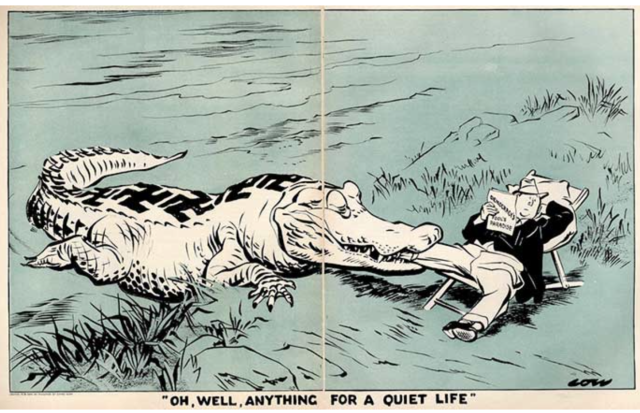
The London Evening Standard’s David Low had one cartoon in Hitler en der Karikatur der Welt, but that did not end the Nazi’s obsession with his work. Low’s cartoons, which often portrayed Hitler as a spoiled child prone to temper tantrums, were a particular irritant to Nazi officials. Foreign Secretary Lord Halifax told the publisher of the Standard of the “frenzy” and “uproar” in ruling circles caused by Low’s caricatures.
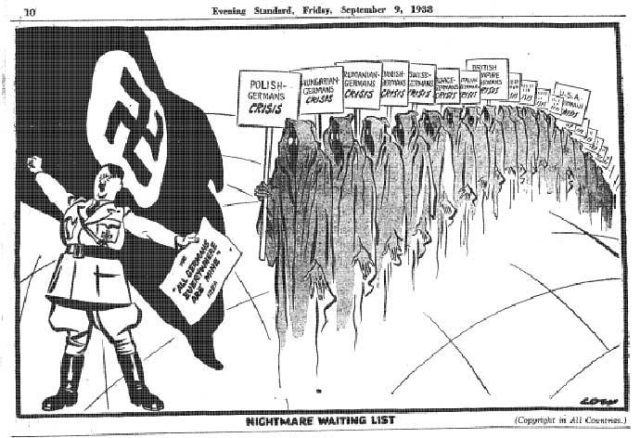
Both Halifax and Low’s publisher thereafter appealed to the artist to tone down his criticism of Hitler. His attacks were “a factor going against peace” and, in their view, could even lead to full-scale war between Germany and the UK. Low briefly complied but resumed his previous tenor when Hitler annexed Austria.
For his efforts, Low’s newspaper was banned outright in fascist Italy. That was a minor consequence compared to what could have happened. If the Nazis managed to successfully invade Great Britain in their Operation Sea Lion, Low’s name was included in the Black Book of anti-Nazis for arrest and possible execution.
Regimes censoring, harassing, or even imprisoning cartoonists are not things confined solely to the Nazis and the history of the Second World War. Egyptian cartoonist Ashraf Omar has been imprisoned by that country’s dictatorship as of this writing. After being indefinitely detained for over a year, Omar has ridiculously been charged with terrorism over his artwork.
Turkish cartoonist Pehlevan has been imprisoned for insulting President Erdogan and “inciting hatred and enmity” for supposedly depicting the prophet Muhammad. Palestinian cartoonist Mohammad Sabaaneh was imprisoned by Israel in 2013, also under absurd charges of terrorism.
Although the First Amendment protects American cartoonists from such obvious suppression, that has not stopped publishers eager to curry favor with the current occupant of the White House from engaging in censorship of their own. After its purchase by right-wing media conglomerate Sinclair, the Baltimore Sun instructed their “ultra-liberal cartoonist” KAL to focus solely on local issues or start looking for other employment. KAL refused and was gone from the Sun by the end of June.
Similarly, the Washington Post’s Ann Telnaes quit after a cartoon mocking Post owner Jeff Bezos and his subservient attitude towards Donald Trump was spiked. The American Association of Editorial Cartoonists condemned the paper’s decision as “political cowardice” and “craven censorship in bowing to a wannabe tyrant.”
The extent to which governments and the corporate press continue to clamp down on illustrated satire prove an essential point: Despite the general decline in print media, cartoonists still can be thorns in the sides of the powerful throughout the world, just as they were during the era of the Third Reich.
The post Nazo Funny: The Third Reich’s War on Cartoons appeared first on The Comics Journal.


 Hello, my name is Jack Sparrow. I'm a 50 year old self-employed Pirate from the Caribbean.
No comments:
Post a Comment