

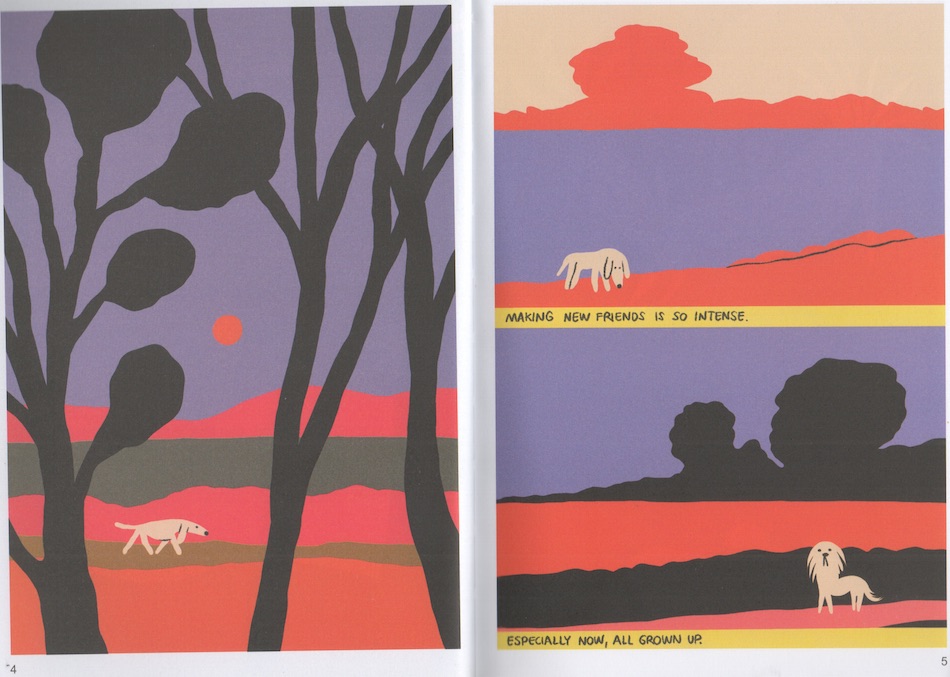
Wisps is Amanda Baeza’s second collection of short stories published by the Latvian publisher Kuš; her first, Brume, was published in 2017, the second in their line of “Kus Mono” books presenting the works of a single author at book dimensions larger than the quarter-sized minis they typically deal in. The first book in the series was by Roman Muradov, with whom she shares an ability to shift styles from one piece to another. At times, Baeza assembles bright colors into compositions almost reminiscent of textiles, stitching tapestries together from the shapes of shreds, and recognizable forms are treated as abstractions employed for pure beauty. This is perhaps most evident in the first story in the book, where these color fields appear absent a holding line, but all of Baeza’s approaches float around a sun bright in color and bubbling in its emergent shapes. You can think of it in terms of the work put out by Nobrow Books at their peak, or you can think of it as part of larger tradition of editorial illustration.
While the core of Baeza’s visual style suggests affinities for Anna Haifisch or Aisha Franz, the approach to writing favors an approach based less in interactions of named characters and more on a sort of poetic monologue where forms and figures explicate visual metaphors. The pleasure is not to be found in seeing how characters react to situations, but the sense of revelation as we understand what the author is talking about. While we may be initially hooked, in the first story, by the depiction of cute dogs, quickly we come to learn that the story is not really about dogs. The plain-spoken prose unfurls against the images, and we recognize the point has been made once it’s passed and we’re on to the next story, the next idea announced with a new visual approach. This suddenness can make individual stories feel slight or insubstantial, though the reader should’ve been warned by the book’s title that each moment is an ephemeral thing to be savored before it dissipates.
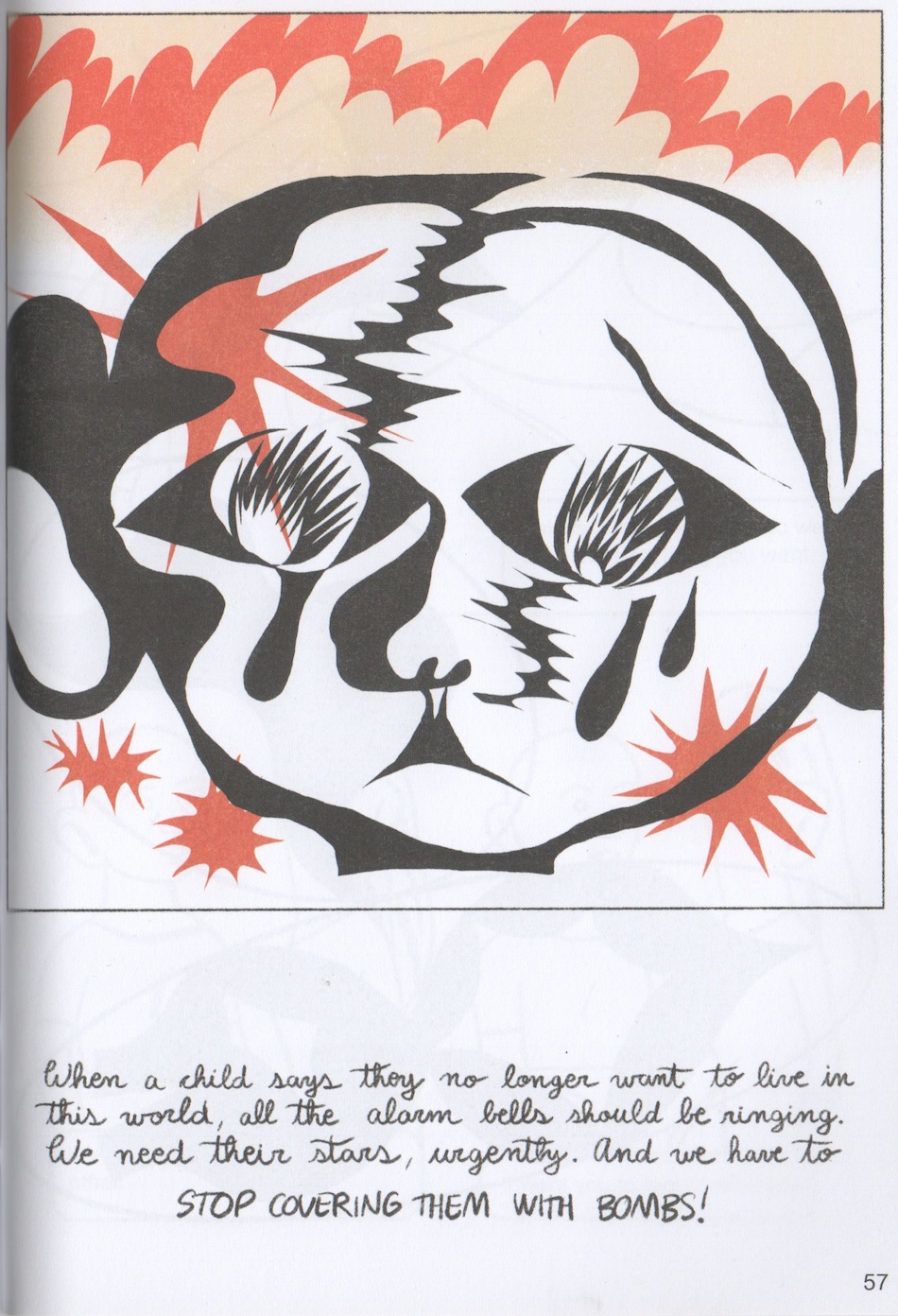
As candy-colored and appealing as Baeza’s images are, the topics discussed tend to a moral urgency. One piece is explicitly about Palestine and the deaths of children. There, the depiction of a child’s face, black and inky, as the light leaves its eyes, recalls Noel Freibert, though it also has a children’s-book character to it, the culmination of a story paced out at one image per page.
Baeza is Chilean, living in Portugal now. I am unaware of the reasons behind her emigration. Born in 1990, the year Pinochet stepped down from the presidency, it’s likely a reach to assume she and her family were fleeing the regime’s death squads and suppression. But one story, "Not From Here, Not From There," suggests fear of a mysterious pursuer never leaves. Alternately, it could be about how being seen as an outsider in a place one has lived forever creates unease. The specifics of why a strange interaction feels strange are left unknown, but the anxieties of the story remain immediate, due to Baeza's deliberate use of color as a way to register fluctuations in emotional temperature. Her line turns red like an alarm sounding, a register of a cortisol spike, blood beating faster through the heart and flushing the skin of the page. Seriousness of subject does not preclude or forbid a sense of formal play, nor does pain negate the hunger to engage with the beauty of a form. In this context, the choices being made become practical: These are the brightly colored clothes worn to a summertime protest.
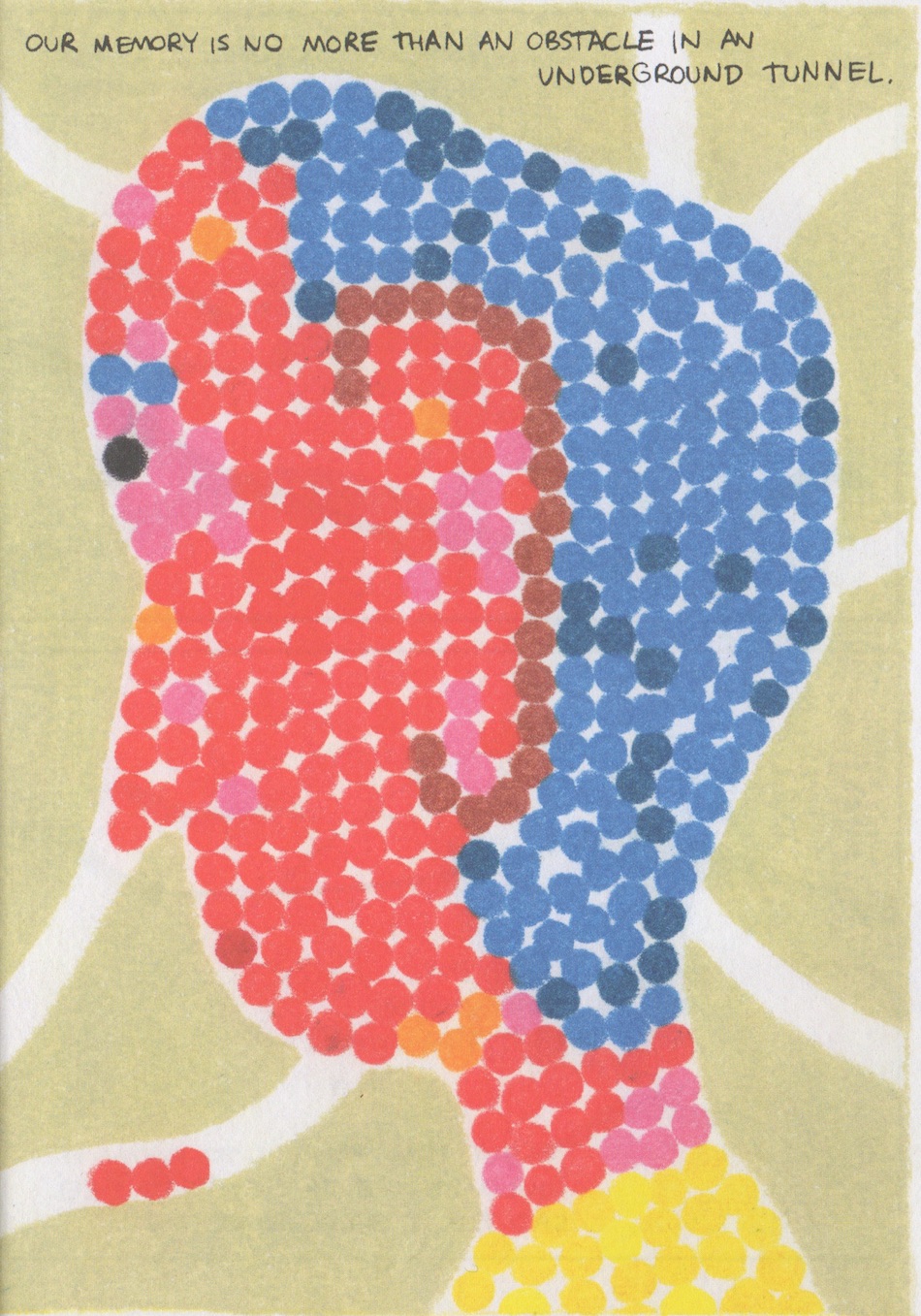
The book is broken into four sections, each of which table their contents on pages designed like bits of fabric hung to dry on a clothesline, while the cover shows a person waving a cloth before their face that renders the silhouette of their profile in another color. Let’s not forget line-drying is the most environmentally courteous way to deal with such necessaries as clothes and the sun. The story “Clothes” explicitly speaks about this thing, reflecting on fashion as an affect, from a vantage point situated past humanity’s destruction of the Earth. All these thoughts are intertwined like so many fibers, complicity acknowledged as a patch on the hole we’re rending.
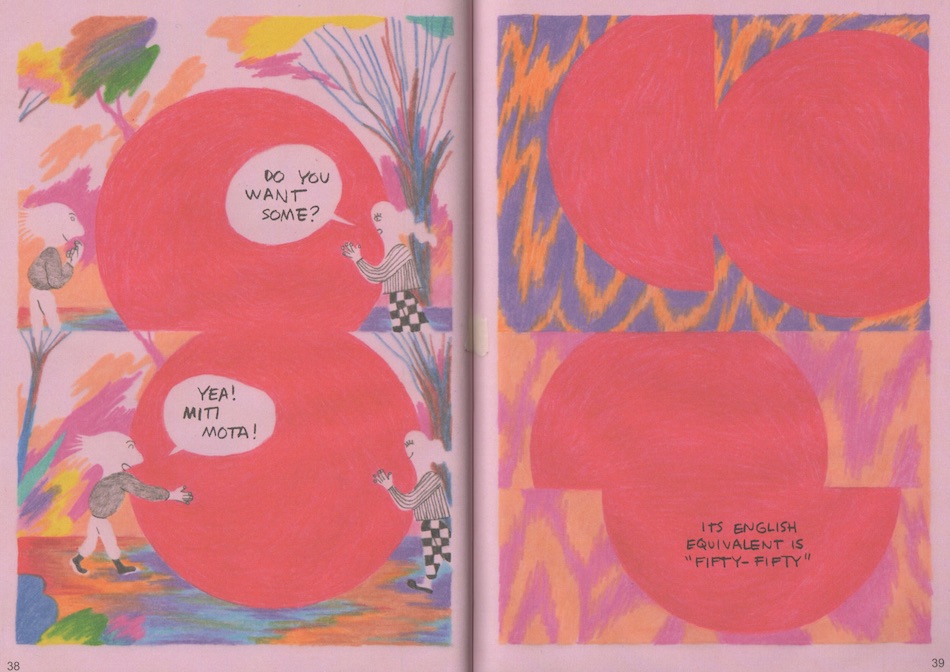
Working with cloth provides a useful framework for the moments of abstraction in a piece like “Miti Mota,” where images are cut and reassembled to demonstrate the nature of play, of sharing. This is not a version of comics as predecessor to storyboards, where identifiable character designs are paramount, but comics as a form of folkcraft where the artist expresses themselves through every choice made. This is not to say Baeza does not take comics seriously, but rather that she understands it healthily. 2021’s “The Scene,” included here, is about using comics as a way to connect to other people, reducing loneliness by finding peers, and feeling known in the assurance that one’s work is being read. This story is in graphite-toned grayscale, as if alluding to the democracy of photocopiers, rather than the jewel-toned colors disseminated via computer monitors and paid-for-by-publishers color printing. Baeza’s Wisps of paper function the same way clothes can, badges brandished as signals to others who might feel the same way.
The post Wisps appeared first on The Comics Journal.


 Hello, my name is Jack Sparrow. I'm a 50 year old self-employed Pirate from the Caribbean.
No comments:
Post a Comment