

It has been seven years since Comic Arts Brooklyn last turned out its lights in November 2019, and the landscape of the borough’s comic conventions since then has been, if not exactly overpopulated, then certainly not vacant, either. There is the Brooklyn Independent Comics Showcase in April, populated with the up-and-comers of the risographed zine world, followed by the slick but obscure Brooklyn Comic Con in June. For devotees of New York’s neo-underground, there is the Frog Farm comic reading in early spring, and PictoBeach Bazaar in the summer (assuming you’re committed enough to take the F train to its final stop, that is), and for more focused demographics there is the Brooklyn Pride Comic Book Fair in June and (at least for a few hours on one Sunday in 2025) the sensory-friendly Include Con at the Public Library. And, of course, this is to say nothing of the broader solar system of comic events as soon as you cross the subway tunnel across the East River into Manhattan: queer haven Flame Con, and upstart Big Apple Con, and highbrow MoCCA Fest, and Europeanly highbrow Comic Arts Fest, and of course the big one, the vast and awesome monument to commercialized subculture that is the New York Comic-Con.
And yet, there is a void — at least as Tiny Onion founder James Tynion IV would tell it. “I feel like the level of curation, the level of trust, the…festival aspect of the show is what was missing,” from the comic festival circuit, Tynion says. “[We wanted a festival with] the level of legitimacy that CAB once had.”
Thus, the newly-announced Brooklyn Expo of Comics, which touted its existence in early April with plans for a fall convention in November — to take place, naturally enough, at CAB’s old stomping grounds of Mount Carmel Church in Williamsburg. CEB will be, however, only the first visible output of the acronymically-named Brooklyn Organization Dedicated to the Endurance of Graphic Arts (BODEGA), a 501(c)(3) nonprofit chaired by Tynion, and intended to be a blanket organization for the support of independent Brooklyn and New York comic creators well beyond the convention itself. At present, their ambitions include (to quote the organization’s press release): “exhibitions, independent educational programming, live readings, artist talks and signings, and direct financial grants for New York creators and community-driven comics projects.” Not to mention an annually-published anthology of cartoonists featured at the November expo, the Brooklyn Annual of Graphically Elevated Literature (BAGEL for short; BODEGA is nothing if not committed to the bit).
Tynion is the first to admit that he’s an unlikely champion for this cause. After gaining mainstream fame as a writer of Detective Comics and Batman a decade ago, Tynion and his Bushwick-based Tiny Onion Studios have since gone on to become models of independently-owned mainstream marketability, producing a number of high-profile and well-regarded comics (The Nice House on the Lake, Department of Truth, Blue Book), multimedia (their first feature film is currently in development), and merchandise (you can buy Always Be Monsters sweatpants on their website). But when cartoonist Courtney Menard — who was both the co-curator of CAB’s final festival in 2019 as well as the current Production Director for Tiny Onion — locked on the idea of a revived Williamsburg convention in 2023, it set a snowball in motion that has since expanded well beyond its original conception.
To learn more about the BODEGA nonprofit and the inaugural year of the Brooklyn Expo of Comics this fall, the Comics Journal sat down with organization’s brain trust for a roundtable interview about the background, concept, aims, and obstacles of this newest comics institution. Present at the conversation were:
- James Tynion IV, writer, Tiny Onion impresario, and Chair of the BODEGA Board.
- Courtney Menard, cartoonist, former CAB co-curator, and Tiny Onion Productions Director.
- Bryce Gold, editor, Pyrite Press publisher, and Tiny Onion Operations Manager.
- Elizabeth Harburn, BODEGA Treasurer and Finance and Operations Director at Tiny Onion.
Not present but also on the BODEGA Board of Directors are: illustrator, educator, and periodic Comics Journal contributor Christina Lee; literary agent Paloma Hernando; and Desert Island Books owner Gabe Fowler, the erstwhile founder and organizer of the defunct CAB festival, whose involvement has given the BEC a certain stamp of approval.
The conversation that follows took place on April 28, 2026, in Brooklyn and points beyond.
ZACH RABIROFF: Let's start at the beginning. How did BODEGA come to be?
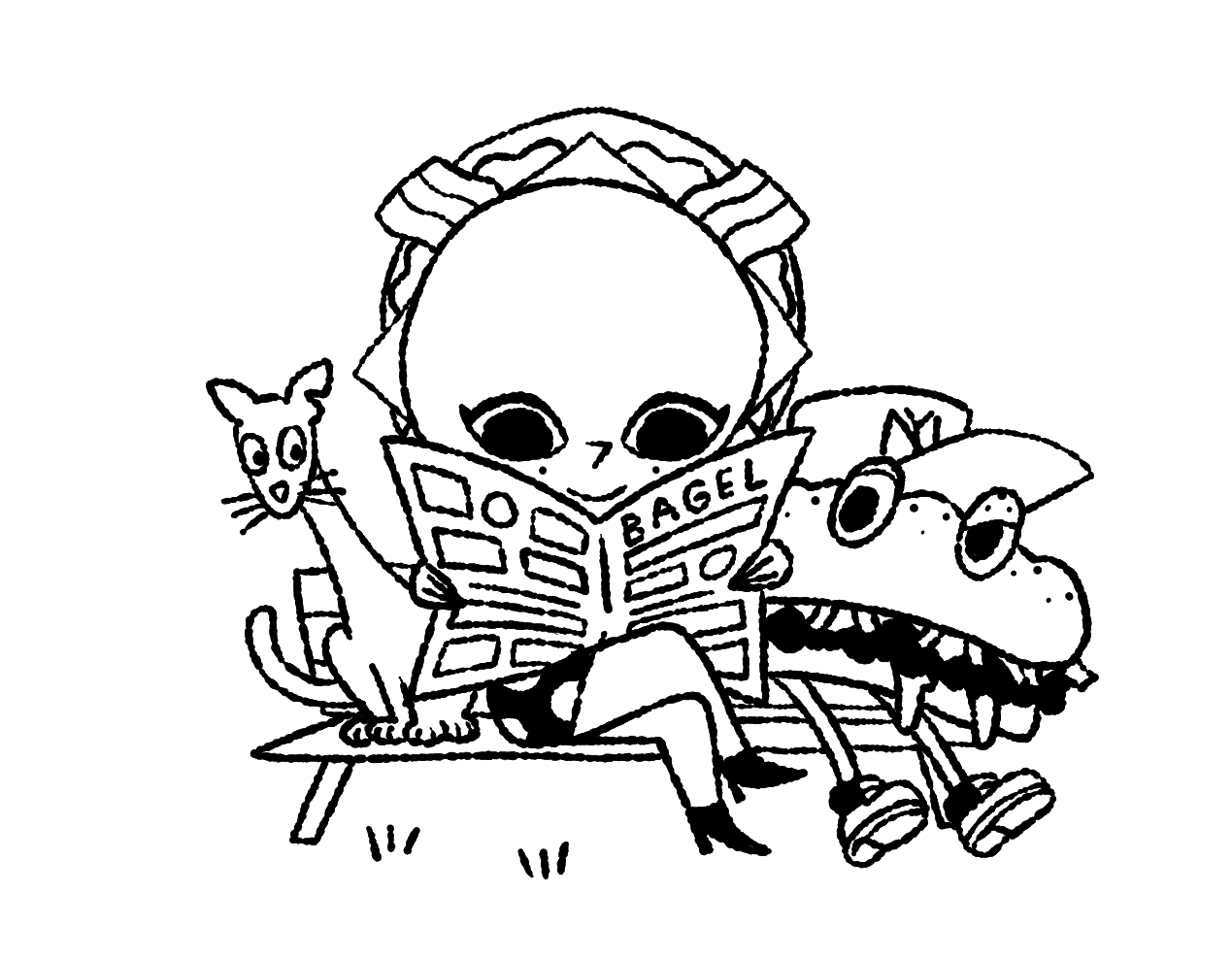
JAMES TYNION IV: It started with a walk down the street that Courtney Menard and I were having right before both of us had started my company, Tiny Onion. Courtney basically had a little moment where she was like, "I miss CAB, and I have an idea. I know what I would call it if I brought it back." And then she pitched me the Brooklyn Expo of Comics, or BEC. And it would have a little bagel sandwich person as the animated character at the heart of it. It was just a, "Oh, wouldn't it be nice if …" kind of thing.
But then we started talking about it with Bryce, and it started becoming like, "How do we practically build this?” And it was a multi-year process to get it together. Just getting the nonprofit recognition from the IRS took nine months.
Courtney, when did you first decide that you wanted to revive CAB?
COURTNEY MENARD: Man, I've been festering up here in Buffalo ever since I moved back from Brooklyn. And CAB ended in 2019, and didn't come back because of COVID, and for other logistical reasons. And it was just a show that I missed being a part of, even though I live far away, and that I knew other people missed. It must have been 2023 [that I brought up BEC with James]. And then within a few months, me, Bryce, and James were in a room together talking, big pie in the sky ideas about what the nonprofit could look like, and about what the show could look like.
So say a little bit more about what you felt was lacking in the convention space without CAB.
BRYCE GOLD: I used to table at all kinds of shows around the country with my small press. And I think there's been such a gap in the New York scene since CAB went away. I mean, part of that was just because of COVID, part of that was logistics. But I think overall, there's been a lack of what we call general curation. CAB was always a centerpiece of the fall convention circuit that really showcased all of the best cartoonists in the city and beyond to the city audience. Folks would come from far and wide to CAB. It was always a staple on the convention circuit. There wasn't any small press person, or company, or publisher that I knew that would miss coming to Brooklyn every November for a two-day show.
It was such a staple. And when it was gone, there was such a lack. There were so many up and coming smaller shows like PictoBeach, or Frog Farm Fair, or things that tried to fill the gap, but ... I feel like the level of curation, the level of trust, the level of the "festival" aspect of the show is what was missing. There was always just a two-day, “come for a Saturday, sell stuff, buy things” [spirit at these smaller conventions]. But there was never, “let's also have artist talks. Let's also have panels. Let's have the level of legitimacy that CAB once had.”
TYNION: The other big part of it was, CAB was done in partnership [with] and created by Gabe Fowler of Desert Island. There are only a handful of stores in the country that speak to this corner of the comics industry. And the direct tie to Desert Island was a huge aspect of what made CAB [what it was]. And that's why one of the first things that we said when bringing this back was that if Gabe wasn't on board with what we were doing, then we didn't have what we wanted this to be.
So to that extent, you wanted it to be, if not quite a successor organization, then at least the recognized heir of CAB.
MENARD: Yeah, the heir. And you can't have a show like this without involving Desert Island. It really is the centerpiece of the community there, and gave so much for the scene, and we were happy to have [Gabe’s] blessing and now his participation in the show. That really means a lot to us.
TYNION: Courtney, speak a little bit to your history with CAB and Desert Island.
MENARD: Oh yeah. I worked at the shop itself for a few years, and then started helping Gabe with CAB in a volunteer aspect. I was running pizzato exhibitors and stuff. And then in 2018, I ran the programming with Gabe, and in 2019 I was the co-curator and programming coordinator. So I ran all the panels, and got to help set the stage for what the show was going to be like. It was an invaluable experience, and I would not have been able to build a show without that experience. And it was cool to just be in the midst of the scene, and see how much the show meant to all these people. And the last couple years, CAB was only one day. So expanding it to two days with this new iteration of the show, I think, is going to be well received. I hope.
You talked about what differentiates this from some of the smaller festivals that have sprung up in Brooklyn and New York since CAB ended. What do you see as the distinction from MoCCA, which is the other really big, well-curated comics festival that's already here?
MENARD: The biggest thing for me is that the barrier to entry is much lower for us. I've tabled at MoCCA many times. I think it's a great show, especially for schools. Its connection to the Society of Illustrators is a great resource for people. But the table fees are high — we can't get away from that. It's a show in Manhattan. So it was really important to us to keep the table fees low and accessible. Having the show in Brooklyn also was the biggest differentiator for us. Again, MoCCA is a great show, but it's in Manhattan. We wanted to bring indie comics specifically back to the borough where we feel like it belongs, where all indie artists are living.
Talk a little bit more about that, because there does seem to be a real emphasis on Brooklyn identity with this organization. So what does that mean in the context of the show that you're doing?
GOLD: I think that what we saw when we were forming this organization was, [first of all], James and I both live in Brooklyn. Courtney used to live in Brooklyn. Beyond that, MoCCA and the Society of Illustrators exist in Manhattan because that's where the artists used to live. I can't point to one artist that still lives in Manhattan, and still goes to MoCCA and does all that stuff.
MoCCA, for better or worse, is kind of sequestered to a very small portion of the Society of Illustrators now. I don't know if you've been to that building, but it doesn't have the same dedication that I think cartoonists and comic artists deserve, and the community doesn't live in Manhattan. They live in Brooklyn. This is where the artists live and work now. So we wanted to offer something that was specific to the local community here, to support them and offer them resources, and build up what we feel is the new wave of comic artists to keep that alive in the city.
TYNION: New York City is one of the great art centers of the world. If you were to look at arts nonprofits in the United States, I bet there's an outsized portion of those nonprofits based in New York City. But there's room for more. And bluntly, I want comics to be a part of the conversation around arts philanthropy in New York. And the way to do that is to really recognize what our lane is. We want to be the voice of Brooklyn cartoonists in that larger conversation around arts philanthropy in the city, and our flagship festival will be the Brooklyn Expo of Comics, but we see that as only the beginning of what we can do with BODEGA. BODEGA is something that we want to be a resource for the cartoonists that live here in the city, and an entity that can partner with all of these other organizations.
What could an organization like BODEGA do in tandem with the Society of Illustrators? That would be incredible. So it's having that voice and it's having that voice directly reflective of our generation of creators and creators. One of the big things that I think COVID did to a lot of our peers is that it was a moment that a lot of us had the realization that we had to stop waiting for older organizations and older companies to make room for the next generation. If we want to build the resources and we want, if we want there to be a successor show to CAB, then we should go create the Successor Show to CAB. Stop waiting until it comes together of its own accord; we have to go out there and do it.
At what point did the concept for the organization branch out from just being a revived festival to being a kind of blanket organization for the support of New York comic artists?
GOLD: I think that certainly the conversation started on this show, but then I think we very quickly realized how much more we could offer for cartoonists. There are so many things that we are planning for grants, and artist talks, and building a platform for showcasing local talent. We really want to offer a whole suite of opportunities to folks. We want to focus on showing what the best of comics can be, both within the show and beyond. And we really want to find ways of continuing to offer resources to up and coming cartoonists, folks that are interested in learning outside of the educational institutions, which are sort of the only places that you can really gather that sort of knowledge. Between all of us in the board, we have so much institutional knowledge, but we want to bring something new to our community.
So what form are those offerings taking at this point? There's the festival itself, and then you mentioned grants that you want to give. Have you given any shape to how much you'd be able to give out in grants, and how you would award them?
TYNION: We have plans, and a lot of those plans do depend on the donor base that we're able to build up for our organization. Right now, bluntly, I am kind of standing up the organization myself in the first year, and I'm incredibly grateful to be in the position to do that, and put a lot of my own resources into this. But given my stature in the mainstream side of the comics industry, I also have access to people who may be interested in supporting a comics nonprofit. BEC will be at the end of this year, and if we hit our funding goals, the plan will be to roll out our first major grants next year.
The one grant that we will be giving this year as a part of the initial Brooklyn Expo of Comics Festival is the BODEGA CAT, which is the Comics Art Trophy, which is an award that we are going to be giving out annually at the festival.
You really put the time into these acronyms, huh.
TYNION: Yeah, we love an acronym. What can we say?
MENARD: We’re insufferable. It’s a gift.
TYNION: But there's a grant component to the awards that we'll be announcing over the summer. The money we raise, we want to put in the pockets of cartoonists. That is the goal.
GOLD: Not only do we want to offer financial support, but we also want to make Brooklyn seem like the hub of culture and comics that it is. We want to offer something that is special to the show. The coveted SPX brick for the Ignatz Awards is awesome, and we want to offer something similar that matches the feeling of making comics in New York.
TYNION: To distill that down, it's a very pretty award and we're excited to show it off.
MENARD: I think the goal with all of these things is to alleviate the burden of what it is to be a cartoonist in Brooklyn, and money is the ultimate burden. So anything we can do financially to help people create the work that we want to continue seeing and experiencing, that's what we're trying to do.
How much does that entail in terms of fundraising every year in order to be giving these support grants?
TYNION: Throwing a festival like this isn't cheap, but we're already in talks with a lot of storied players in the indie comic space who are very interested in supporting the festival and helping sponsor us. I think that we're going to find the partners that get us to that. But I do think for us to put more money in the hands of the cartoonists, we're going to be needing to raise six figures a year to continue moving this forward. But I'm confident in our ability to do so.
And there are other aspects to our plans that we haven't fully unveiled, and we'll be unveiling over the course of the year, including some things on the publishing side. And there will be a first publication that launches alongside Brooklyn Expo of Comics. All proceeds from that will go directly into support for BODEGA. That’s the benefit of being a nonprofit publisher: the more books we sell, the more books we can make.
I also think that there's a tremendous opportunity in partnerships on the publishing side with other New York organizations. I'm a fifth generation Brooklyn Irish-American community, and I would love to talk to one of the Irish historical societies of New York about doing a comics history of Irish Brooklyn. That would be incredible. There are so many opportunities out there in front of us, and so many people who love this city, that I think we're going to find lots of innovative ways to get away with making lots of cool shit.
A lot of this comes from a place of, what can we get away with? There's a lot that we can do just from what we've currently budgeted out and what we're confident we're going to be able to raise. And then if we raise more, then we're just going to figure out more fun ways to put that money back into the community.
Does that require you to build out more infrastructure as an organization than you have now? It's a lot of work for a few people.
GOLD: Yeah, totally. And in founding this organization, we talked about a five year plan. We thought about the future. We've thought about ways that we can level up every year. And I think the thing that we really want to focus on this year is not only the platform for cartoonists here in New York, but also finding ways of helping them share their stories either through video content or through the publications that we're making. There's so many pockets of stories in New York that we can tap into, that we can share, that we can highlight, that I think really open up the world of possibilities that we would like to explore through BODEGA.
It all sounds daunting to be convention organizers, and talent scouts, and fundraisers and grant makers at the same time that you're all holding day jobs.
MENARD: Yeah, yeah. But it's fun. I think we're all a little bit loopy in a good way.
GOLD: It is a labor of love, but it's also because we care so much that we want to make this thing happen.
TYNION: And beyond that, yes, we intend to build more infrastructure, and build out the capacities of what BODEGA can do. And that requires our first initiatives to be successful enough for people to trust us to follow through on future initiatives, and that's going to be a continuing challenge. But over the last three years, I've been building my for-profit company, Tiny Onion, which – spoilers – the four of us are all involved in.
This is my home. This is something that I really, really want to be able to do. But I also have the experience of growing a business: Tiny Union started with three employees, and now we have 16 employees. The priorities of an organization like BODEGA will be fundamentally different, because at every step of the way, we're going to have to make the decisions [like]: now we have a new pool of money. How much of that do we dedicate towards expanding our infrastructure, and how much do we put directly into the grants? The thing that I'm so excited about is being able to raise money that we can throw toward a creator who we just want to see an incredible work from, and not have any kind of IP stake, not have to worry about whether this is something that can get turned into a movie, yada, yada, yada.
Those are fun challenges. I love running Tiny Onion, but also the joy of what I'm doing over there being successful enough that then I can help make some pieces of art exist that would not exist if we could not offer financial support. If there end up being 10 Something is Killing the Children movies, I'm going to be funneling a lot of that money to indie cartoonists.
But this is the side of your work where you don’t have to worry about whether something is a marketable property.
TYNION: Yeah. It just has to be something that feels like a cool thing. We're not trying to take a stake in anything.The cool thing about Brooklyn is you can throw a rock and hit a creative person.
MENARD: And I recommend it.
TYNION: Removing that barrier to entry for people to create the things that they want to create, that's what I think we want to do. I think there are so many folks that are putting together so many cool things like shows, or talks, or live reading events. There are things that keep this city and the art space alive, but all of that comes out of labor of love. And if we can help keep that train going, there are cool things that are happening that could really benefit by just having somebody take away that barrier to entry.
What cartoonists you looking at, both for the attendees at the convention, and for the panels that you're putting together?
MENARD: The response has been blessedly stressful, I must say. We have almost 600 applications, which I don't know if we were anticipating.
How long did it take to get those?
GOLD: We opened applications April 2. They are open until May 17. But I think right now, I we're already at a pretty low acceptance rate based on the space.
MENDARD: Yeah, so that is something we want to be sensitive to for sure. There's definitely going to be more people that we would like to have than we're going to be able to have exhibit. We’re working out what that's going to look like for future years. We know that there's a lot of nostalgia around the [Our Lady of Mount Carmel] Church [also the former site of CAB]. It's reassuring. And it is a curated show. We want to make sure that it's showcasing the best of the local scene, as well as people from outside New York, who people in New York maybe wouldn't get to see as often. So we're excited to get into the curating process with the whole team.
Your marquee guest is Chris Ware, who as far as I know has nothing to do with New York. I think he’s Chicago, by way of Austin, by way of Omaha.
MENARD: But he’s a staple in the paneling circuit, and has been a staple at previous shows. He was at CAB a bunch. He and Gabe are close, I'd say. So having Gabe actually do the programming this year has been great for us. It was a nice little throughline from me helping him with panel coordination, to now him taking that role on for us. He has so many connections throughout his history of Desert Island and running CAB. It's been a really collaborative process. We are trying to find a good balance between some marquee names and more local talent. The library has reached out to us, and a bunch of schools and local publishers have reached out to us, to see how they can help. And it's just been really inspiring to see the community want to get involved.
Well, the First Lady of New York City is a cartoonist now.
MENARD: Yes, we actually went to the same MFA program. It's going to be a special show. I think people are clearly hungry for it, so I'm hoping we can do right by the scene and get the people out to see the comic books.
Gabe's not here to speak for himself, but who made the approach to him, and how did he respond to the notion of bringing back, in some form, his old festival?
MENARD: I reached out to him. We've still been in touch since I moved away. Me and my husband both worked at Desert Island before the pandemic, and then moved away because we just couldn't afford to live in Brooklyn anymore. But I had reached out to him because I had heard people were constantly asking him when CAB was coming back, and his response was always just like, “No, it's not coming back,” or, “Maybe it'll come back, but it's a big logistical nightmare to throw a show.” It's not an easy thing to do, especially when his core team of people were not around him anymore. Finding a space to throw a show of this capacity in New York is a huge financial and logistical problem.
So when I’d previously talked to him, he said he wasn’t doing CAB again. When James, Bryce, and I started talking about BEC, we wanted to reach out to him to make sure that was still the case, because we didn't want to start doing all this work only to find out that CAB was coming back. He, off the bat, just expressed excitement that we were trying to come up with this new show, and offered his support, which was really kind of him.
So we have a great working relationship, and it's been smooth sailing. Having him as a programming coordinator is like the perfect fit, just based on his connections in the industry and everything. And yeah, I think framing the show as the new CAB is inevitable. We're in the same place that [CAB was]. Gabe is coordinating this with us. But we really want this to be a new endeavor with slightly different goals than CAB had, but with some of the core teams still involved.
Can you talk at all about who some of the other people are going to be at the festival, and what some of the programming will look like?
MENARD: We're still firmly fleshing stuff out. Lisa Hanawalt's going to be there promoting her new book. We're very excited about that. We're hoping to have a Brooklyn indie comics spotlight. There's some local publishers we want to highlight, some kids programming we're trying to work out. But that's still a bit in the planning stages right now.
GOLD: Like we said before, our applications are open until May 17, so there is some time to figure it out. And every day we're getting more applications. So it's hard to say exactly who is going to exhibit at the show, especially as that exhibitor application list grows longer and longer.
Is there a sense at this point of what sort of artist, or what sort of comic, you want to focus on here? Because as a group, you come out of some quite different areas of comics.
TYNION: I mean, I'll be blunt: I'm not one of the people tabling at the Brooklyn Expo of Comics. This is not designed to tap into that kind of mainstream flair. New York has New York Comic-Con for that, a month before the Brooklyn Expo of Comics, where Tiny Onion will be making a lot of noise. I do think there are some incredible creators that kind of bridge the gap between the mainstream space and the indie alternative space. I share a studio with Trad Moore and Ian Bertram, and those are the sorts of things that could exist in a kind of adjacent space. But the focus isn't the folks who are from the direct market side of comics. That's not what the show is about.
GOLD: And that's also what we see as BICS’ [Brooklyn Independent Comics Showcase] role. BICS casts a very wide net, both for independent and mainstream work, and also smaller presses that are doing superhero work, or work that feels much more mainstream. I think that what we're offering is something that is focused in the small press space and zine space. We really want to focus on artists, writers, creators: folks that are really making the work themselves, that are really putting a lot of care and effort into what the work looks like and feels like. And much more focused on, in my opinion, the independent creator as a holistic practice.
TYNION: It's a corner of the industry that I've always deeply admired without participating in directly. And this feels like a fun way to participate in it. Socially, I hang out with more people from the indie/alt space than I do from the direct market side of the industry. And I think that's a product of being in Brooklyn and being surrounded by an incredible community of cartoonists.
Not to get too philosophical here, but what is a Brooklyn comic right now? What defines the scene to you?
TYNION: That's a really good question.
MENARD: It is a really good question.
Always good to get that answer on the record. Thank you.
TYNION: It's what the creators living in the space are driven to create on their own terms. That is the spirit of it. I love whenever one of our friends has had this itch in the back of their mind, and they're not going to wait until somebody lets them make it. They're just going to make it.
GOLD: I think what you're getting at, James, is the passion and the drive.That to me feels the most Brooklyn. You look at [the 2020 shutdown year of] Covid, and you see the onset of new small press zine festivals that are bringing people together because of that need, and that drive and that want, for putting the community together. I can't think of a place in the United States that has a stronger comics community than Brooklyn: of people coming together and making things. I think there are so many artists or publishers that you can tap into: Cram Books, Frog Farm. There's a number of other zinesters.
The cool thing about making things here is that there isn't just one pathway forward. You can find your own lane, you can make the work that you want to make, and you will find an audience for that. I think the thing that excites me most is the way that the scene changes and evolves, and the fact that you can still go to a space that is dedicated to comics and find new work that you've never seen before. That is what is so exciting about the opportunity that we're hoping to support through BODEGA.
So in your ideal scenario, if you look at the end of your first five-year plan, where does BODEGA stand?
TYNION: I want the Brooklyn Expo of Comics to have gone so well that people want it to be a part of the fabric of the indie festival circuit and the New York scene in the long run. And beyond that, we're also talking about what satellite programming is going to exist as a part of the broader festival concept. The other thing that we're really interested in exploring is showcases of original comic art. There are so many galleries here in the city, and I want to see indie comic art in beautiful frames on walls for people to look at and engage with, and hear about the people who made it. So those sorts of opportunities would be incredible.
GOLD: I think the cheeky answer is, we have a lot of acronyms that we've come up with, and I can't wait for people to see what they stand for. This is something that we are very serious about, and can offer opportunities to people through.
MENARD: I'm hoping that we can have some longevity in the scene. I think that's a thing that people get wary about with new endeavors like this: they burn out fast. But I've worked with this crew for a long time, and I feel like we have a really good sense of pie in the sky ambitions, while also being grounded and focused. And so at the end of our first five years, I want people to be able to trust that we're going to be around to help the community for as long as we can.
Brooklyn Expo of Comics applications will remain open through May 17. Comic creators are invited by the organizers to apply here.
The post ‘Make Room for the Next Generation’: How BODEGA wants to sell Brooklyn comics to the world appeared first on The Comics Journal.


 Hello, my name is Jack Sparrow. I'm a 50 year old self-employed Pirate from the Caribbean.
No comments:
Post a Comment