

Comics by people who aren’t “comics people” can result in fascinating work. Dino Buzzati, born in 1902, was a journalist, poet, playwright and novelist celebrated for his often-surreal evocations of place and mood. Poema a fumetti is unique in his bibliography; it shows this multi-talented creator as an adept graphic artist influenced by current cultural trends. His was a strong acumen to use cartoon art in a poetic manner–to suggest rather than depict; to state rather than overstate.
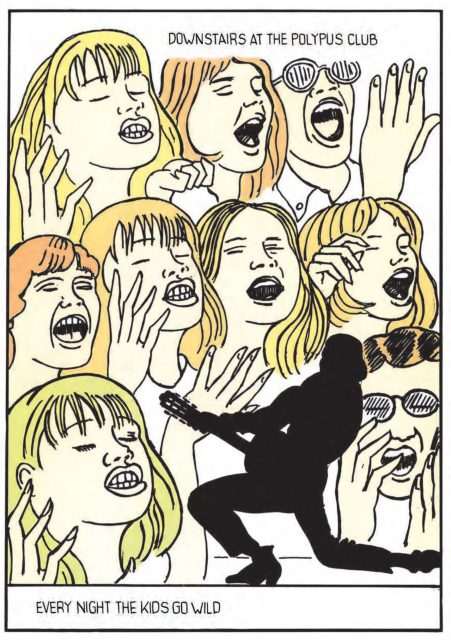
This retelling of the Orpheus myth–itself a lodestone of popular culture inspiration–takes place in a detached, barren mirror of the Swinging Sixties. The protagonist is long-haired, brooding rock ‘n’ roll singer Orfi, who comes across as a blend of Elvis, Dylan and Neil Diamond. Orfi knocks ‘em dead nightly at the Polypus Club. Mod dancers in mini-skirts frug into frenzy in his presence. He has acclaim, celebrity and sex appeal–yet life seems hollow.
He’s in love with Eura, who may or may not be aware of his affection. One rainy spring night, when the world (even telephones) seem defeated and deflated, Orfi sees his beloved enter a plain door on the bleak street below his window. Thus begins his descent into the underworld to bring her back–if possible.
This is one of fiction’s most familiar stories and is thus a fine canvas for a creative mind. Western civilization loves to hear a good story over and over, and playful twists (or rethinking) are always welcome. Buzzati favors poetry over narrative; the simple story often pauses for ruminations on life, death, witches, fans, and the bleak nature of the modern world. The author riffs on these themes for large sections of this graphic poem (one can’t call it a novel) to fine and thoughtful effect. His writing assumes the rhythm of rock ‘n’ roll lyrics; an early section details the many witches who live in Orfi’s hometown (which we might assume is Rome). “No joke, boys! The danger’s dire/two of them just stepped off the streetcar named Desire” one page warns. It’s such a phenomenon that Orfi sings “The witches yeah yeah yeah!” in a playful reference to a certain Liverpool rock group.
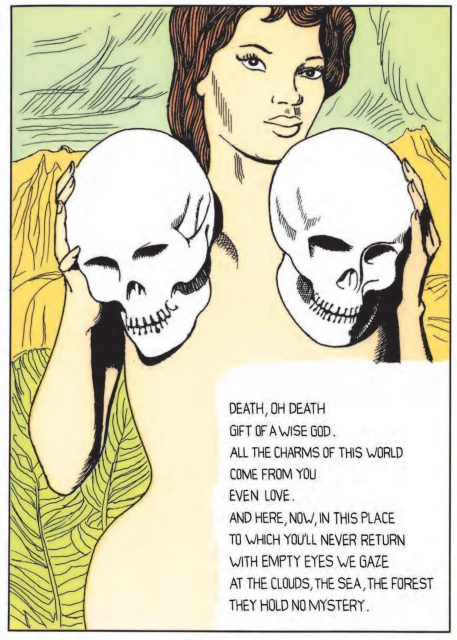
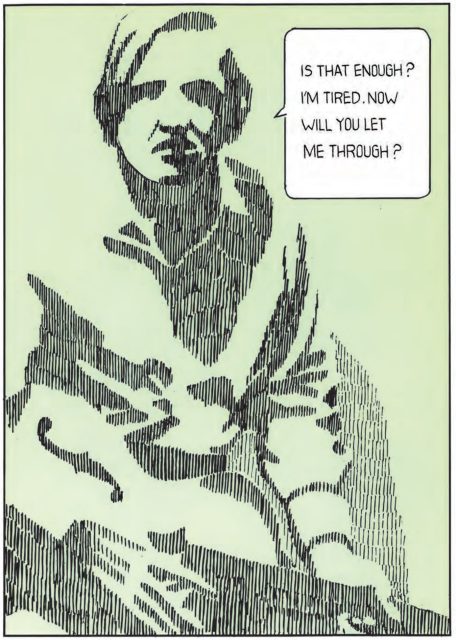
This section of several pages is a sidecar to the main narrative–a thought the author is compelled to detail, alongside drawings that distort, compress and upend figures, buildings and landscapes. Buzzati the artist is mercurial. We see obvious photo-referenced figures, rough sketches beside elegant, detailed work and a strong sense of graphic design. His human figures telescope, undulate, compress and mutate; there’s no standard of representation in his eye.
A simple palette of pastels act as accents on most pages. The images have the high-impact feel of posters: bold, direct lines augmented with flat hues. Much of Buzzati’s art feels freehand–drawn without the preliminary sketches the average cartoonist might employ. If a drawing goes out of whack, no problem–it suits the anguished mood of the words beside it.
There are some dialogue balloons, used with an awareness of the contemporary Pop Art movement. Buzzati is no fey ironist; his abiding wish is to dig deep into the dark layers of man’s subconscious.
The book’s centerpieces are back to back. “Explanation of The Afterlife” dispels the reader’s notion that this underworld is sinister in a dramatic way. Instead, the emptiness of this non-existence, which is compartmentalized and dogged with bureaucracy, is a quiet hell from which its inhabitants are too tired and depressed to transcend. In this section, Buzzati’s skill as a poet and observer is fascinating. This seems the most believable account of the afterlife I’ve encountered; it suggests that mankind is well-prepared for this phase while above ground.
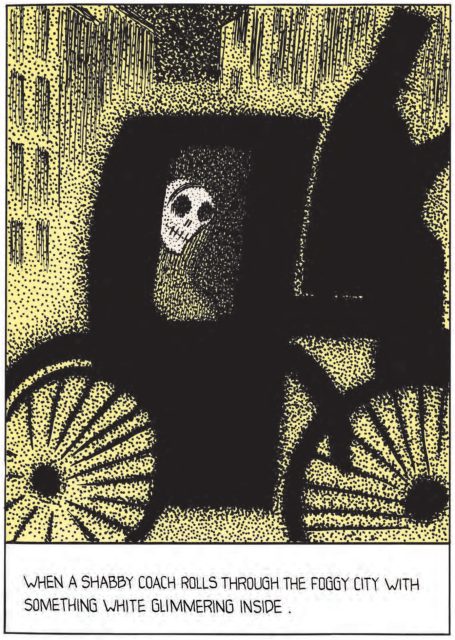
To find Eura, Orfi must sing to the dead. In “Orfi’s Songs”, the shadowy rockstar croons several songs that offer social commentary about the living world, with its constant blend of shortcomings and joys, and the deflated vibe he feels in this downer underworld. Buzzatti’s poetry is powerful here, and his drawings enter a baroque phase of distortion, Op art, Expressionism (Murnau’s Nosferatu is evoked in one page) and the blunt landscape of post-war Italy, with its sweeping plazas and stark structures.
“Orfi’s Songs” deserves to be part of the comics canon. Here, words and images work together to subsume the reader in their ominous/mundane vibe–a sort of horror to which we all relate.
The tragic finale is diffused by Orfi’s return to the world of the living, which he can never be a member of without a jaundiced, cautious eye. Again, melodrama is swapped for the quiet death of the heart, little by little, as life goes on without pause or reflection.
This vital work has received its first careful translation into English by Marina Harss. Her hand retains the feel of Buzzati’s POV; the words feel conversational and never forced.
An afterword about who Buzzati was and how this work fits into the rest of his oeuvre would have been welcome; in an unusual move for this imprint, there is no afterword. My one cavil with this sumptuous volume is that lack of context. Buzzati’s life story is fascinating; he worked in many styles and worlds, won several awards for his writing and was as compelled to create as Jack Kirby, who might have appreciated Poem Strip, had it crossed his path. (The book was translated to English in the late ‘60s; that version does Buzzati’s work no justice, according to reactions I’ve seen.)
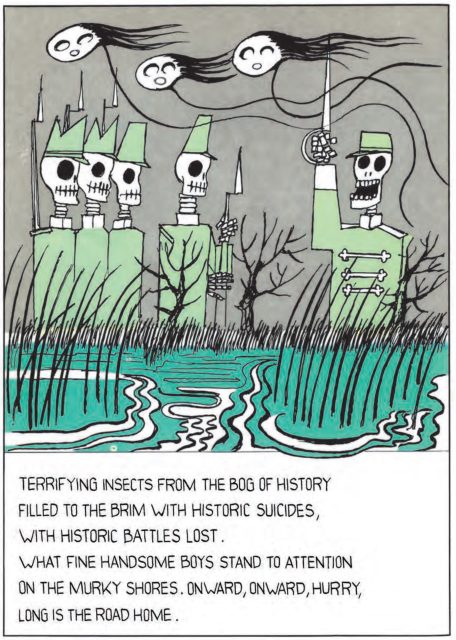
This isn’t a traditional page-turner. It works best read in sections, as the mood seems right. In those moments, this graphic poem is absorbing, thought-provoking and surprising. There’s a wit to Buzzati’s words and observations and his graphic eye is playful and unusual.
Poem Strip might inspire new artists to attempt this less traditional approach to graphic storytelling; I’d love to see any such results. Please, comics creators: have at it!
The post Poem Strip appeared first on The Comics Journal.


 Hello, my name is Jack Sparrow. I'm a 50 year old self-employed Pirate from the Caribbean.
No comments:
Post a Comment