

Laura is drifting through life.
She is in her early 30s yet she lives at home. Laura would prefer to have her own place but she doesn’t know how to change the status quo.
She has received a grant to write her debut novel, but she can’t find the time or the motivation to start writing.
She feels disconnected from her mother, who is continuously watching movies, yet she does not say anything.
Joana Mosi, a prolific Portuguese creator, is the author of physical education, an elliptical story of contemporary angst.
Fortunately for comic fans around the world, Mosi’s character is the antithesis of Laura. A combination of curiosity and moxy helped her to land her first English publisher at the Toronto Comic Arts Festival a couple of years ago. During a spontaneous portfolio review, Pow Pow was blown away by Mosi’s singular postmodern style. In May, this press will help bring her latest comic physical education to an international audience.
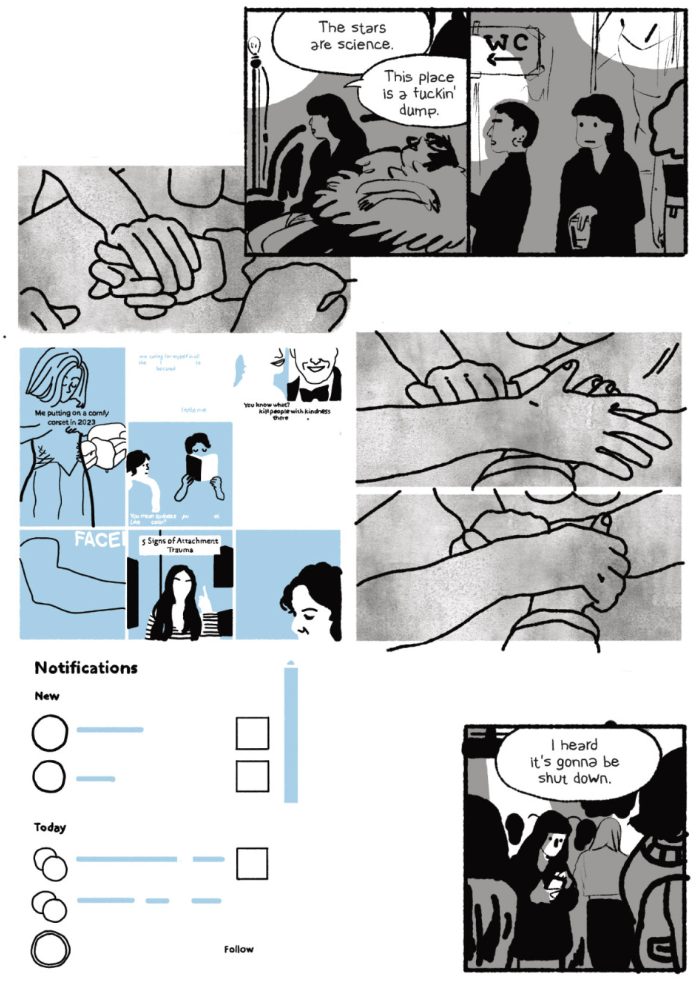
Digital overload is clearly part of Laura’s problem; she is besieged by social media notifications, listicles, playlists, celebrity gossip and horoscopes. As the “unread” messages start to pile up, we realize that Laura barely has enough energy to stay in touch with her friends. Similar to Boundless by Jillian Tamaki, the pressure of digital culture is an overwhelming emotional burden.
I sensed a real nostalgia for a pre-internet time—a time before never-ending choices and decisions. Initially, online quizzes seem like an entertaining way to help people choose which person to date, which cake to make or which sweater to wear, but ultimately this obsession with choice reduces everything to a trivial level. Or, on the other hand, does it satisfy our profound need for reassurance?
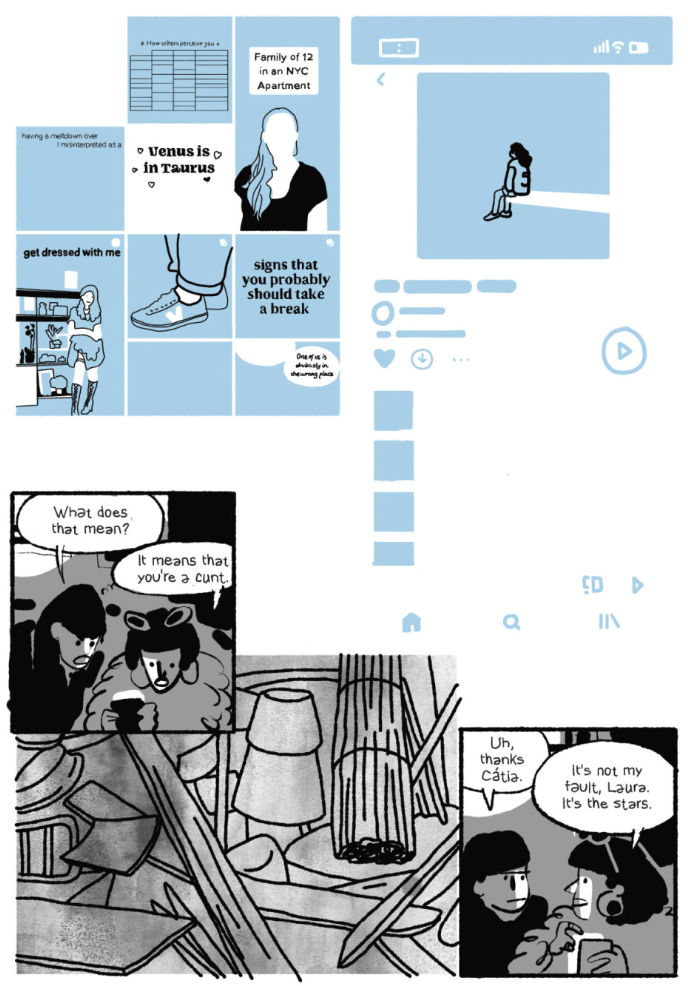
There is also a more insidious issue at play in physical education. An entire generation of young people has been paralyzed by housing crises (Lisbon is one of the worst in Europe) as well as the rising cost of living. Precarity is all they know.
Lisbon, Portugal’s largest city, where Mosi worked and studied, is central to physical education. From hipster dance clubs and businesses with trendy English names like “Dear Brunch”, there are constant references to Lisbon’s gentrification and trendiness quotient for foreign visitors. But for young Portuguese, the city has become alienating. Living in a city that feels hostile to you is really hard on your self-esteem and your self-confidence.
Laura lives with her mother in uncool Odivelas—on the outskirts of Lisbon. Although she's without any clear plans to leave home, Laura tells people that staying with her mother is “temporary.” When she is not avoiding working on her novel, Laura hangs out with her old schoolmates, leads a creative writing workshop with a group of disinterested teens and hooks up with a married man.
Most of Laura’s friends are grappling with the harsh reality of early adulthood, the time when you start to realize that many of your childhood dreams probably won’t come true. They are really surprised that Laura is not working on the novel. After all, she is so fortunate to have received a grant —what a privilege! Laura feels quite guilty about the fact that she is not writing. But this guilt doesn’t spur her to action, it simply makes her feel more guilty.
In one poignant scene, we glimpse of Laura’s mindset. While helping her mother to pack up objects in her grandfather’s house, Laura is drawn to a painting. She clearly sees two people teetering at the edge of a cliff. Even after her mother points out that the scene depicts two people looking out at a pond—and that you can see their reflection in the water—Laura still sees the cliff. Occasionally, Laura seems to break through her detached state via a hyper-awareness of physical experiences. A wine bottle is opened in excruciating detail over multiple panels. An entire two-page spread is devoted to rolling a cigarette.
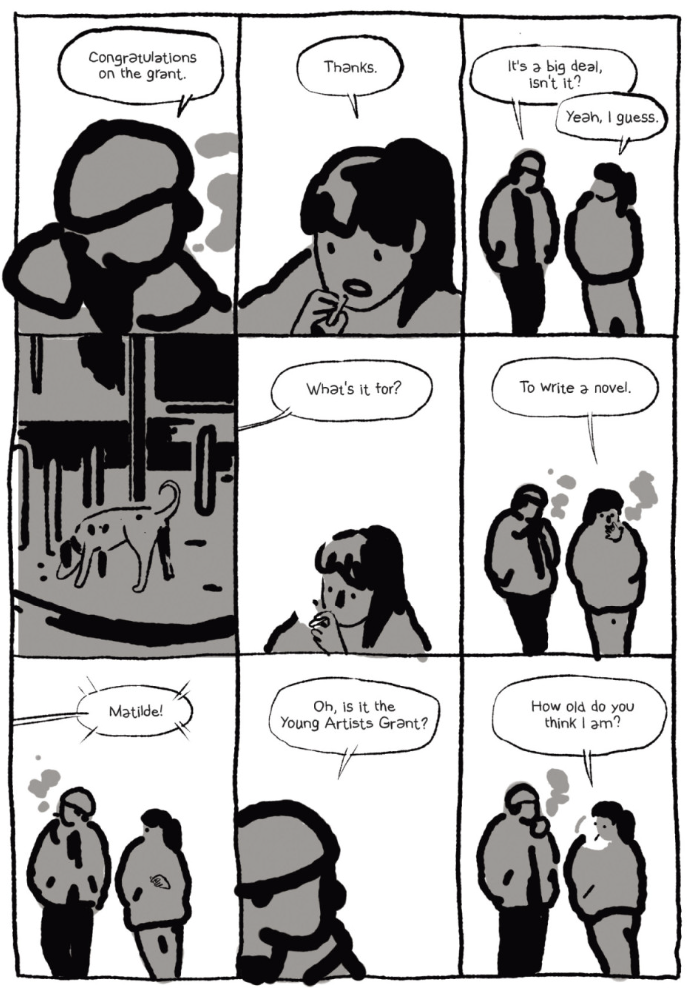
Laura and a few girlfriends regularly meet up at a downtown gym. Although the gym provides a brief respite from digital culture, Laura remains detached from her body and from her environment. She disliked physical education at school and still dislikes it now. But it is easier to just keep going to the gym— passively following her old friend group— than to express herself.
Fragmented pages convey Laura’s tenuous connection to her environment. Disconnected images appear like a stream of consciousness, untethered to a consistent grid. At times, we learn more about Laura’s state of mind from what is not said, than what is said. These fragmented pages, like dissonant musical phrases, add texture to the story’s rhythm. Mosi created these pages using a collage process. Working with several digital layers simultaneously, Mosi was able to rearrange individual elements to modify the structure and pacing, similar to a technique Chester Brown employed to create I Never Liked You (1994).
Wiry lines and broad strokes convey Laura’s friends, her mother, her students and other people in her entourage. After a few pages, it becomes evident that the level of detail in facial features is a clue to Laura’s level of emotional connection. Some characters, especially those that appear in her memories, have very recognizable features, others remain mere silhouettes. At one point, after Laura has injured herself, a gym employee is examining her ankle to determine whether it is sprained. This individual is a faceless voice. Although someone is manipulating Laura’s leg and foot, a relatively intimate act, she is barely cognizant.
physical education is not meant to be easy to read. The dialogue is quite sparse, and just like the urgent changes in direction and endless questioning in our own lives, the narrative arcs of this graphic novel can be hard to follow. Take your time; you need to pay close attention to the silences, interruptions and featureless faces to follow the story. Ideally physical education should be read at least twice.
Although many of the ragged lines and splotchy fills appear hand-drawn and the final cathartic pages of physical education truly look like they have been lavishly painted with a wide brush, physical education was a completely digital creation. A fact that Mosi now regrets. In order to save memory space on her computer, Mosi continuously deleted sketch files and replaced them with finished illustrations. Consequently, there is no physical record of her creative process. She actually has trouble remembering the evolution of this extraordinary artwork.
Joana Mosi is currently hard at work on her next graphic novel, by hand, on paper.
The post Physical Education appeared first on The Comics Journal.


 Hello, my name is Jack Sparrow. I'm a 50 year old self-employed Pirate from the Caribbean.
No comments:
Post a Comment