

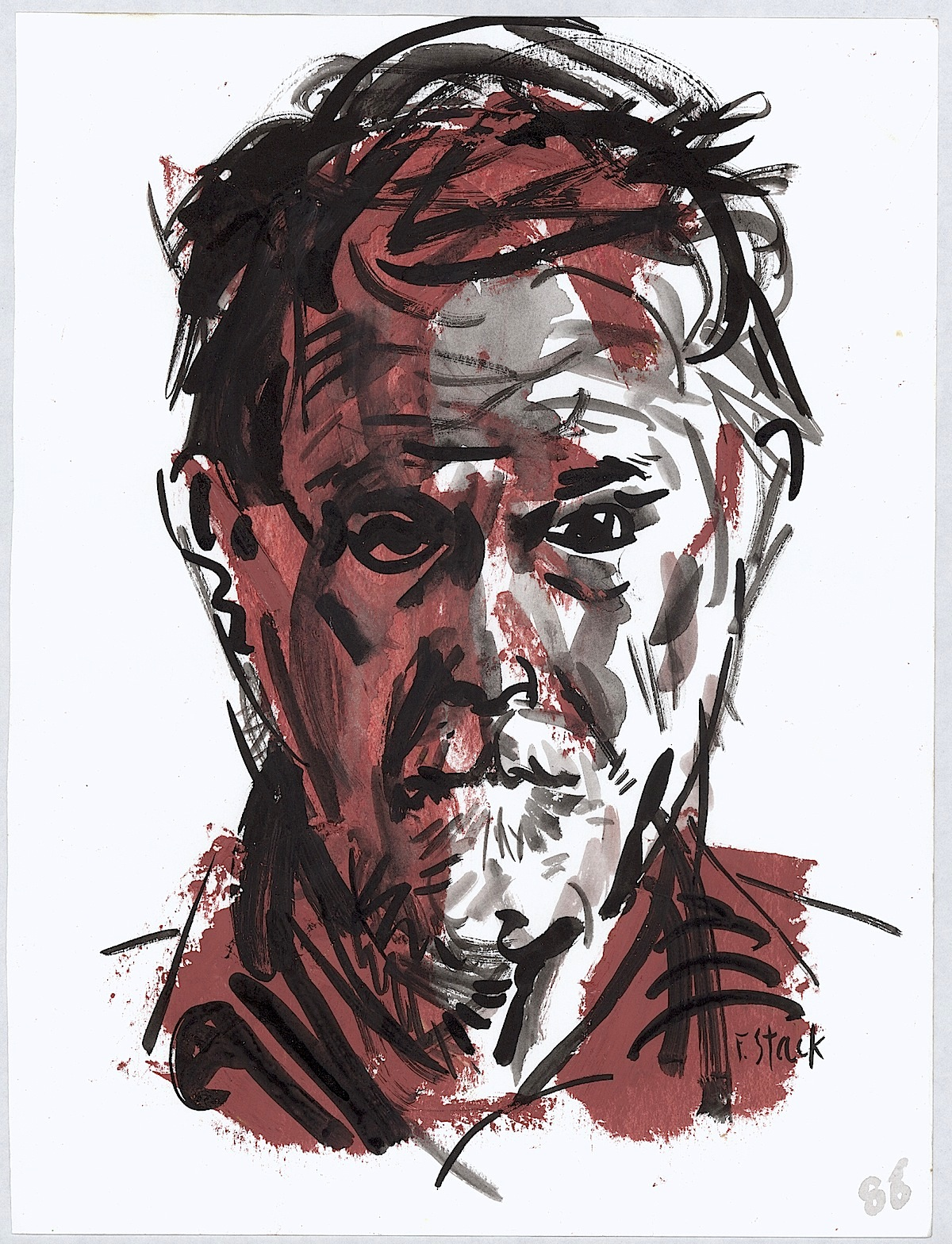
"Sometimes drawing cartoons is the only thing you can do. You can hope it might even have some civilizing effect on somebody, especially if you're not too cruel about it. It's better than taking a revenge that's really going to hurt somebody. Better to draw cartoons and let your anger out than insult people or go out and do self-destructive stuff like driving your car against a tree."
-- Frank Stack, 1996
Frank Stack, the cartoonist, painter and educator whose 1964 The Adventures of Jesus is considered by some historians to be the very first "underground comic book," died on April 12 at the University of Missouri's University Hospital. He was 88.
For decades Stack straddled the fences of academia, fine art and comics; he produced countless oil and watercolor paintings, etchings and prints, and taught generations of students at the University of Missouri, where he taught art and printmaking from 1963 until 2001 when he became professor emeritus. During those years, he also contributed many beautiful comic book pages to a number of publications, often going under the pseudonym "Foolbert Sturgeon."
"[He] is something of a schizophrenic artist," Denis Kitchen wrote in a biographical entry about Stack. "Part of him is an accomplished fine arts academic, while the other half is a disreputable underground cartoonist. ... Stack's status as one of the pioneer underground cartoonists is unquestioned."
###
Frank Huntington Stack was born on Oct. 31, 1937, in Houston, Texas, and grew up watching movie serials, Tarzan films and B-westerns. He was a fan of newspaper comic strips like Alley Oop, and was drawn to the work of Walt Kelly and Roy Crane. In Brian Doherty's 2022 book about underground comics, Dirty Pictures, Doherty said Stack "spent his teen years in Corpus Christie [Texas] winning prizes from the Texas High School Newspaper Association and started publishing cartoons in the ninth grade, drawing on Strathmore illustration board he would cut into the size of reproduced newspaper strips, not realizing the technical possibilities and artistic merits of image reduction."
Stack enrolled at the University of Texas at Austin and became the editor of the school's humor magazine, the Ranger, in 1957. During that time Stack consumed every conceivable type of humor magazine he could find, "almost doing research into the nature of humor," he told Doherty in Dirty Pictures. "And we recruited talent, didn't just sit there, went out looking for people who could draw." One of those people was Stack's classmate, Gilbert Shelton, who would go on to have a profound impact on Stack's comics career.
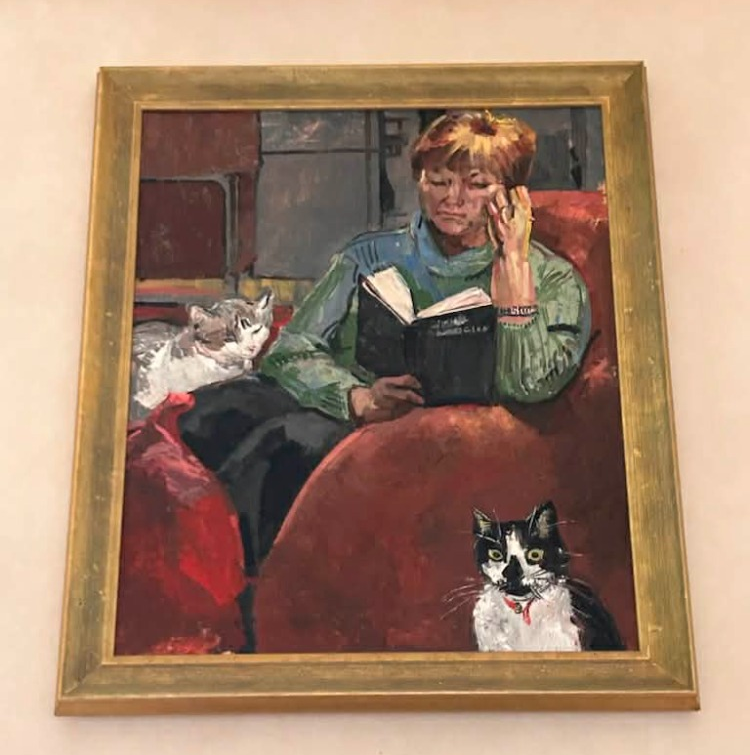
After graduating from the University of Texas in 1959, Stack first joined the staff of the Houston Chronicle, but then entered the Army Reserve as a way of avoiding the draft. He then enrolled in grad school at the University of Wyoming, but was called up for the Army Reserves in New York in 1961. It was there that he reunited with Shelton, who was working for some Peterson Publishing automotive magazines. Stack did data processing for the Army, making punch cards at the Governor's Island base. When he had time, he sought out, unsuccessfully, magazine illustration work. He also started drawing a series of Jesus cartoons which would later become an entry into comics history.
While Stack and his fellow reserves were on duty call in New York, the Army distributed a booklet called Why Me? on their cots. The pamphlets contained "bonehead stuff about needing to defend our country from creeping communism, some kind of shit like that," Stack told Doherty in Dirty Pictures. "We were all laughing about it. So I drew a cartoon on the back of an IBM card of Christians being guided into the Roman arena where lions are eating some of them and as they came through the gate the soldier is handing out Why Me? pamphlets to them."
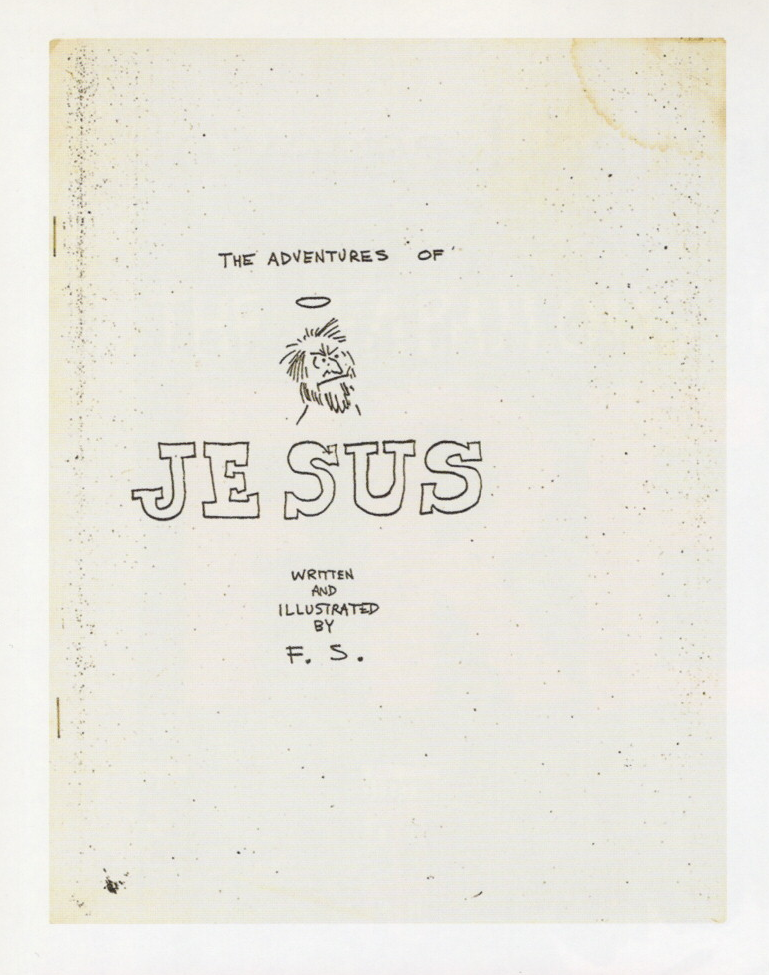
This led to Stack making his first The Adventures of Jesus comic strips, some of which he sent off to Shelton who had returned to Texas to attend grad school.
"I drew the first Jesus cartoon [in 1961] in the Army in New York," Stack told the comics historian Patrick Rosenkranz in a 1999 email exchange. "Gilbert saw them in the winter of 1961-62, when he was doing the first "Wonder Wart-Hog" stories. ... I sent him more when I was in Wyoming, and later in Missouri, which he published in The Austin Iconoclastic, and maybe in Bacchanal and the Ranger. I heard they got a pretty good distribution in various loser magazines between '62 and '64, but I wasn't seeing them much, being absolutely broke in Columbia [Missouri]."
Shelton collected a number of the Jesus strips and had a few dozen of them photocopied to be distributed among friends. The resulting publication became a part of underground comics history.
"Gilbert Shelton was living in Austin when he xeroxed the first collected The New Adventures of Jesus from the original artwork and copies he said I gave him," Stack told The Comics Journal in 1996 (issue 189). "I don't remember doing that, though. A friend of his named Brooks Alexander made copies on the [University of Texas] Law School Xerox machine. Shelton got 40 or 50 of each page, uncollated, and somehow ended up with 42 complete sets. He gave some of them to a friend named Bill Helmer, and some to me. So, probably only 35 or so circulated in Austin. I destroyed one one of them, cutting it up to rearrange panels in 1968. Gilbert thinks he might have drawn the cover himself. He must have, since I know I didn't. This was all in 1963, neither Gilbert nor I are 100% sure of the date. But [Jack] Jackson got one and said he saw it before he even started God Nose [another very early underground comic], which was published in 1964."
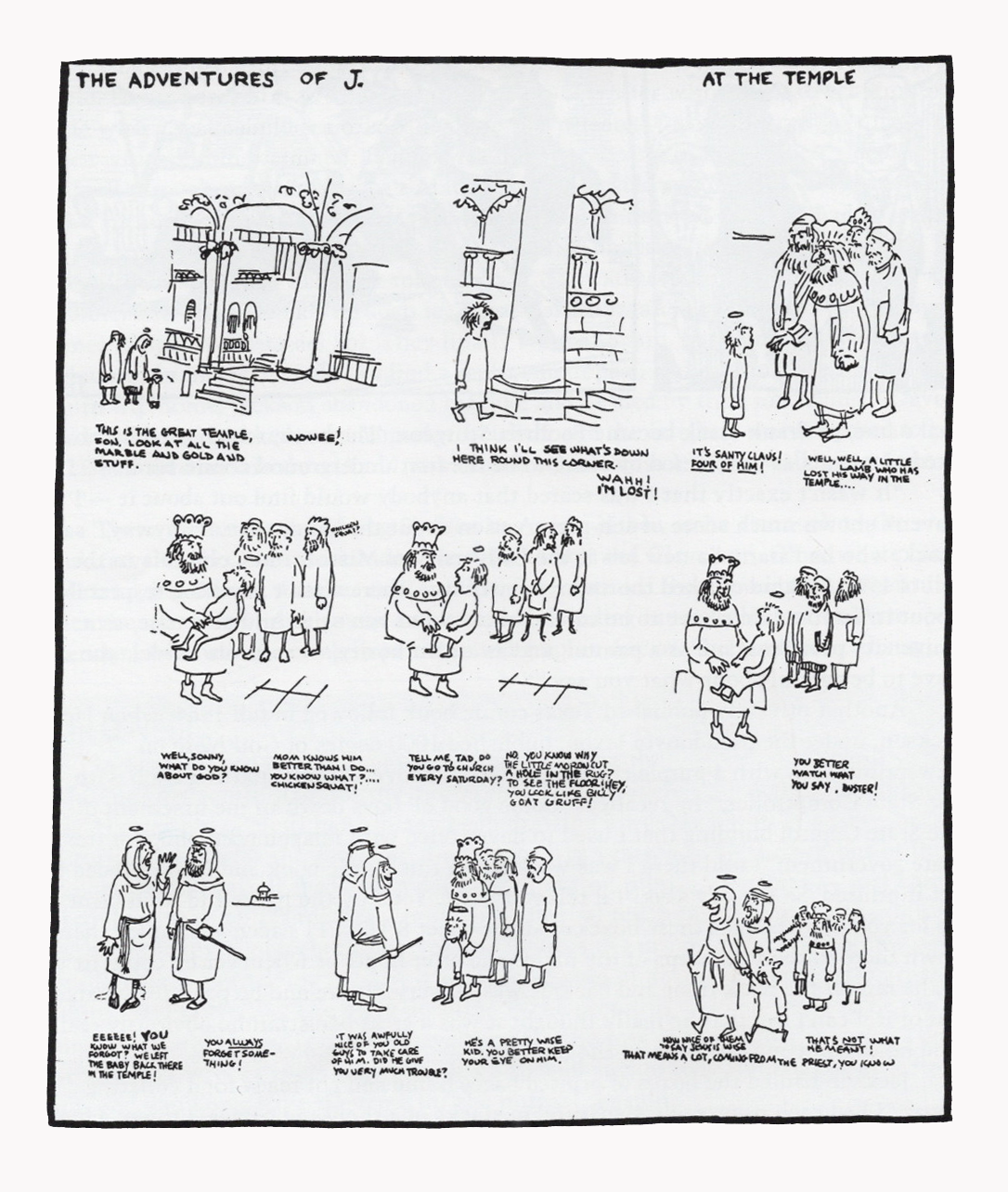
Stack's first edition of the Adventures of Jesus was photocopied and more closely resembled a zine rather than an actual comic book. It was attributed to F.S. on the cover. In 1969, by which time Stack was teaching art at the University of Missouri, Shelton's newly launched Rip Off Press publishing enterprise produced The New Adventures of Jesus, attributed to Foolbert Sturgeon in an attempt to shield Stack's identity from his Bible Belt academic employers.
"It wasn't exactly that I was scared that anybody would find out about it — I haven't shown much sense in self-preservation about that kind of stuff anyway," Stack said in Rebel Visions (Fantagraphics, 2002), Patrick Rosenkranz's definitive history of underground comics. "I kind of liked the anonymity of it — there wasn't anything respectable about it, so you didn't have to be careful about what you said. And of course, as a university professor, and as a painter, and as an 'authority' — as a role model, you do have to be careful about what you say."
Despite some public outcry at its blasphemous content, the book sold well and Stack/Sturgeon would go on to create several successful follow ups for Rip Off Press. Stack "repeatedly revisited the Jesus theme with comic stories that edged further away from religious satire and closer to social commentary," the website ComixJoint wrote. "The ongoing development of his relationship with Jesus as a character (and not as a savior, but as someone who 'plays a savior in real life') is a fascinating evolution. Each of the three books in this particular series is unique in its own way and offers Stack's genius in all its splendor."
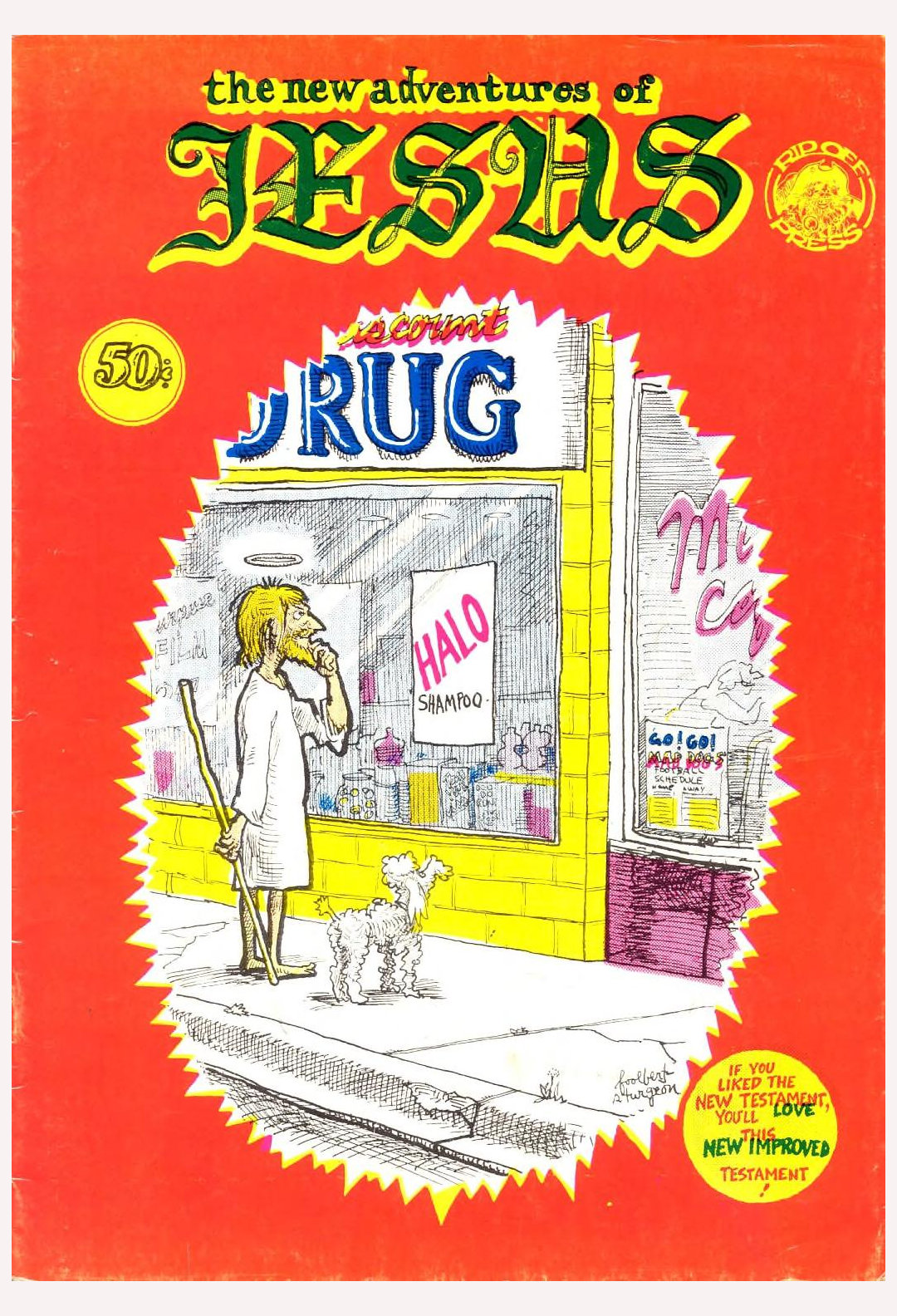
"When I first started drawing the Jesus cartoons, I was young and I guess I believed in the power of satire," Stack told the Comics Journal in 1996. "I wasn't necessarily trying to get people not to believe in a religion. It was alright with me if that happened, but that wasn't what I was trying to do. What I was trying to do was encourage people to question."
###
In addition to his Jesus comics, Stack produced or contributed to several other titles for Rip Off Press— Amazon Comics (1972) and Feelgood Funnies (1972) — and his work ran in a number of anthologies, including Zero Zero, BLAB!, Mineshaft, Snarf, National Lampoon and Weirdo. He was one of the many artists who regularly contributed to Harvey Pekar's American Splendor and illustrated Pekar and Joyce Brabner's acclaimed Our Cancer Year (1994), which chronicled Pekar's health struggle.
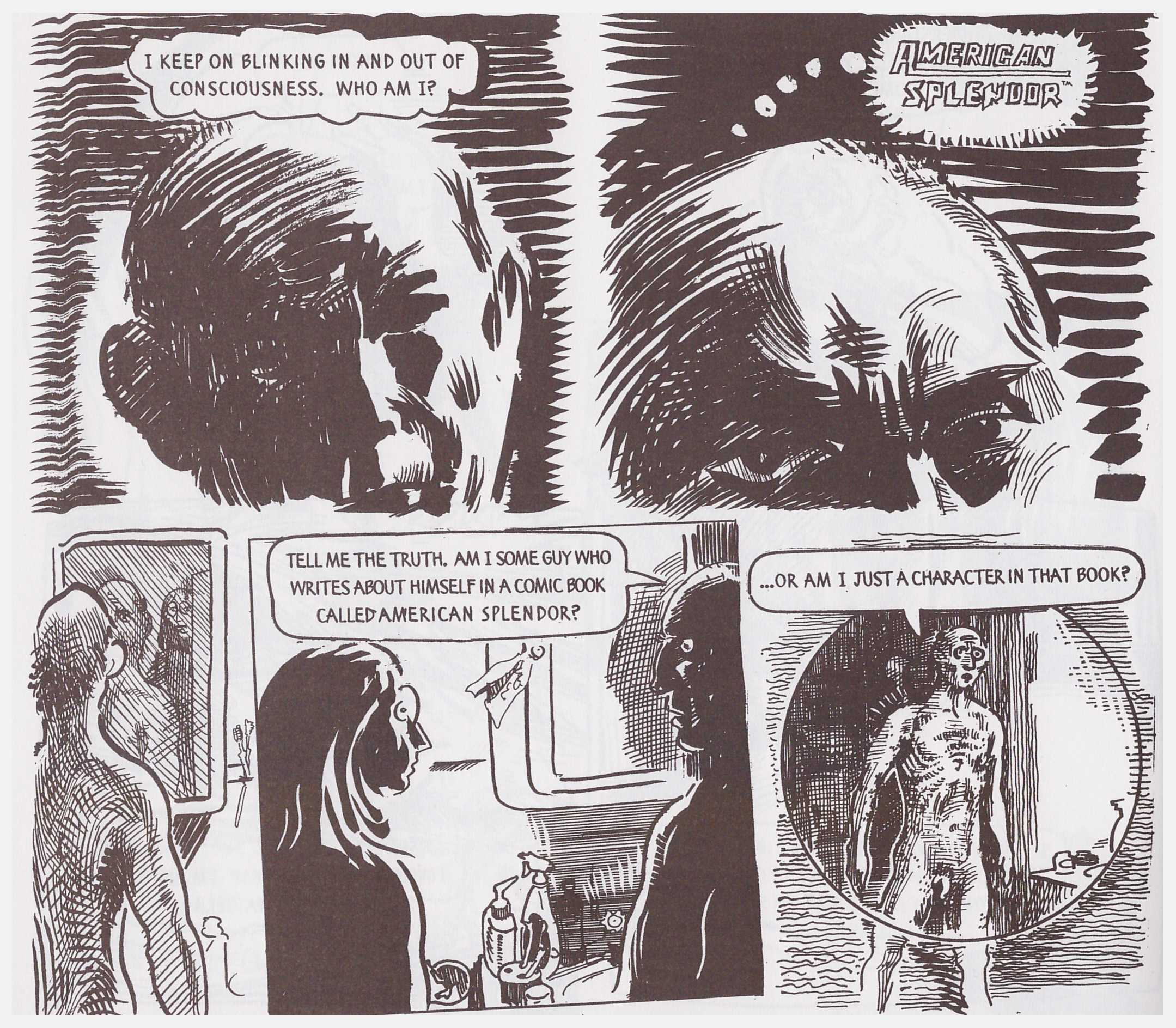
In order to complete the 3,000 illustrations needed for Our Cancer Year, Stack took a sabbatical from his teaching job and "chained myself to the drawing table for eight months," he told the Village Voice in 2003. "I thought Harvey might be dying, that it might be the last time I ever worked with him. If he wanted me to do it, I wanted to do it."
A review of Our Cancer Year in Publisher's Weekly said, "Stack's brisk and elegantly gestural black-and-white drawings wonderfully delineate this captivating story of love, community, recuperation and international friendship."
"I almost hate to say it, but I enjoyed drawing the parts where things got hairy between Harvey and Joyce," Stack told the Comics Journal in 1996. "Since it was their story and not mine, I enjoyed it most when I got to do some expressive drawings. My feeling about comics is always that it's a chance to let artists get a chance to do some of the things that writers get to do. Tell stories in pictures. In other people's work, I'm always interested in seeing some special thing that they'll do with the drawing. That's what I'm interested in about comics, both when I read 'em and draw 'em. I always try and make my own things somewhat interesting in terms of drawing. I think that's a problem with comics, that you still do have to tell a story, and it still does have to make sense. It means that you have to draw a lot of stuff that you wouldn't draw otherwise, that you wouldn't find interesting as a drawing problem."
When the film version of Pekar's American Splendor was released in 2003, part of the story focused on creation of the Our Cancer Years book; however, Stack's character was reimagined as a young, troubled illustrator named "Fred" who bore little resemblance to Stack. He learned of the dramatic fictionalization of his role from Joyce Brabner prior to the film's release.
“[She] called me up and said, 'I hate to tell you this, Frank, but in the screenplay, you turn out to be this fucked-up drug dealer father,’" he told the Village Voice. "I try not to let it annoy me, [but] I didn't drink, I didn't smoke — I did nothing. I drank coffee. It seems like dishonest art to me."
The low-budget film grossed $6 million domestically.
###
As a student at the University of Texas, Stack met Robbie Powell and they married in 1959. She died in 1998. He is survived by his brother Steve, sister-in-law Carolyn, daughter Joan and her husband Simon Slight, son Robert (Bob) and his wife Aine Francis Stack, and six grandchildren.
In the space below, some who worked with him share some thoughts and memories:
Gilbert Shelton
cartoonist/publisher Rip Off Press
I met Frank Stack in 1958 when we were both students at the University of Texas. Frank was a couple of years ahead of me and was the editor of the student humor magazine, The Texas Ranger, which was published monthly and had a circulation of about ten thousand. He started publishing my gag cartoons in the Ranger and working on the magazine was my real education, though I was supposed to be studying social sciences.
After he graduated from the University of Texas, Frank went off to graduate school at the University of Wyoming and after I graduated I went off to New York, where I found a job as an assistant editor for a couple of automotive magazines, Speed and Custom and Custom Rodder, whose editor had been recalled into the U.S. Army during the Berlin Wall crisis (or was it the Cuban missile crisis?). Frank Stack was recalled into the Army by the same crisis and was sent to serve in New York, where he lived on the upper west side of Manhattan with his wife, Robbie, only a couple of blocks away from me. He had to get up at four o'clock every weekday morning to go to Governor's Island, off the southern tip of Manhattan to work all day. Weekends we could tour Manhattan's numerous museums.
After New York, Frank found a job at the University of Missouri, and I went back to graduate school at the University of Texas, not because I wanted more education, but because I wanted to stay out of the Army. I became in turn the editor of the Ranger, where I published gag cartoons by Stack, thus reversing our previous roles. After my editorial ended in the school year '62-'63, I started my own publishing project in Austin, The Austin Iconoclast. Stack contributed his "The Adventures of Jesus" to this publication, though he used the nom de plume "Foolbert Sturgeon" because he was afraid he might lose his job at the University of Missouri because of this scandalous and blasphemous series, and because (obviously) people would think it was I who had drawn it. I later published a collection of these stories, printed on the University of Texas Xerox machine (a rare novelty at the time), at night secretly by a law student named Brooks Alexander. A copy of this publication, the very first underground comic, is worth over $10,000, according to the Underground Comic Price Guide.
The French edition of
I was in favor of including Stack's work in the notorious underground ZAP Comix, but the view of Victor Moscosco prevailed, that the ZAP contributors be limited to the original "magnificent seven" — Robert Crumb, Victor Moscosco, Rick Griffin, Spain Rodriguez, Gilbert Shelton, S. Clay Wilson and Robert Williams.
Frank Stack is one of those rare examples of a fine artist with a sense of humor (who else? Marcel Duchamp? Man Ray?). He was a big influence on my life and career and I am proud to have been one of his publishers.
Denis Kitchen
cartoonist/publisher Kitchen Sink Press
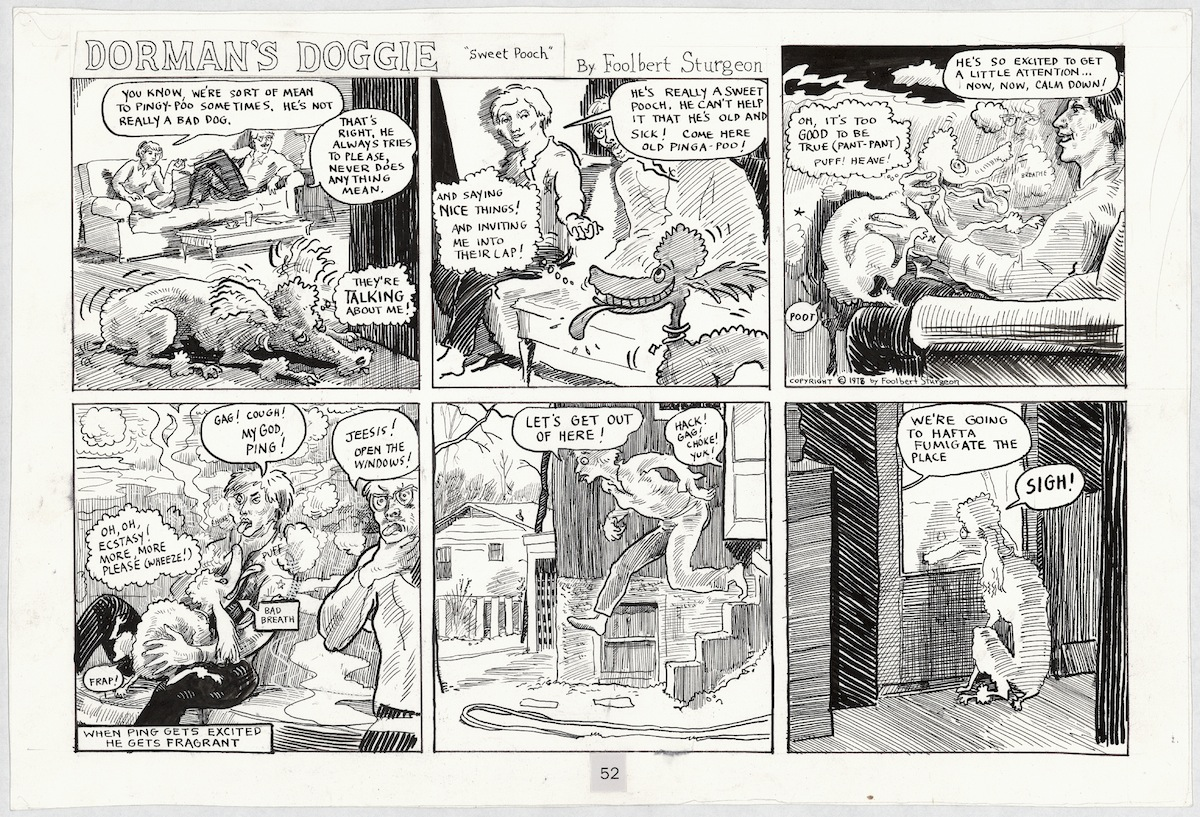
Frank Stack, the oldest of the underground cartoonist tribe that emerged in the late 1960s, was also one of the very funniest. His spot-on parodies of Jesus Christ returning to the present, only to be continually and severely disappointed, were both hilarious and politically poignant. Funnier still were Frank's "Dorman’s Doggie" strips, featuring the pitiful poodle Pingy-Poo and his equally neurotic owner. He was an unusually versatile artist who could swing easily and masterfully between pen and ink comix, vibrant watercolors, paintings, and stone lithographs.
Though he primarily worked for Rip Off Press, I was always delighted to publish Frank's work in Blab!, Snarf, and a Dorman's Doggie collection. I also enlisted Frank to oversee Kitchen Sink's Alley Oop series, where he was able to communicate directly with one of his cartooning heroes, V. T. Hamlin, during the last year of the Oop creator's life.
For decades Frank taught art at the University of Missouri in Columbia. Fearful of losing tenure, he signed his early underground comix work with the nom de plume Foolburt Sturgeon. That was the only instance I'm aware of when Frank gave a damn what anyone thought of him or his work. He was as outspoken as they came on any topic, and I loved hearing him bitch and opine about everything from the art world to Trump world in his soft but distinctive Missouri twang, with always a hint of his Texas origins. I seldom saw Frank in person because of geographical distance and his reluctance to attend comic conventions. I last saw him at a Detroit Fan Fair, or maybe it was when we were both in France visiting Robert Crumb quite some years back. But we talked often until his declining health in recent years. And Frank loved to talk. When the phone ID indicated he was calling, I knew anything I was in the middle of would have to be postponed at least an hour. But talking to him was always a pleasure, and I will deeply miss those conversations.
publisher via Fantagraphics
Monte Beauchamp
editor/publisher, BLAB!
"In my opinion, Crumb is the best comic book artist who ever lived — and Shelton is his best competition. The first several issues of ZAP, even as 'lowly comic books' compete with the best art and literature of the last couple decades. Crumb and Shelton are national treasures alongside James Thurber, Rockwell Kent, John Ford and Elzie Segar." — Frank Stack, "Comments on Crumb," BLAB! #3, 1988
A man of classic cartoons, literature, and art history, Frank Huntington Stack brought a unique slant to the medium of comix. His 1972 Amazon #1 being a prime example. Comixjoint.com recounts:
Amazon Comics is an under-appreciated masterpiece from the golden era of underground comics. Frank Stack begins the book with an epic battle-of-the-sexes tale with a feminist slant and ends it with an academic debate about the same story at a gathering of college professors and one notable graduate student. This is a terrific, funny and undervalued underground comic featuring remarkable art and insightful writing from Frank Stack.
Eighteen years later, I would find myself working with the master himself in the pages of a quasi-comics-comix anthology of my own making, BLAB!. I couldn’t believe it.
Beginning with issue #5, I started assigning a theme to each number. For the first go around the topic was crime. Thrilled by the outcome, I reached out to Frank to see if he’d like to imbibe in our alcohol-themed issue (#6). He was in like Flint.
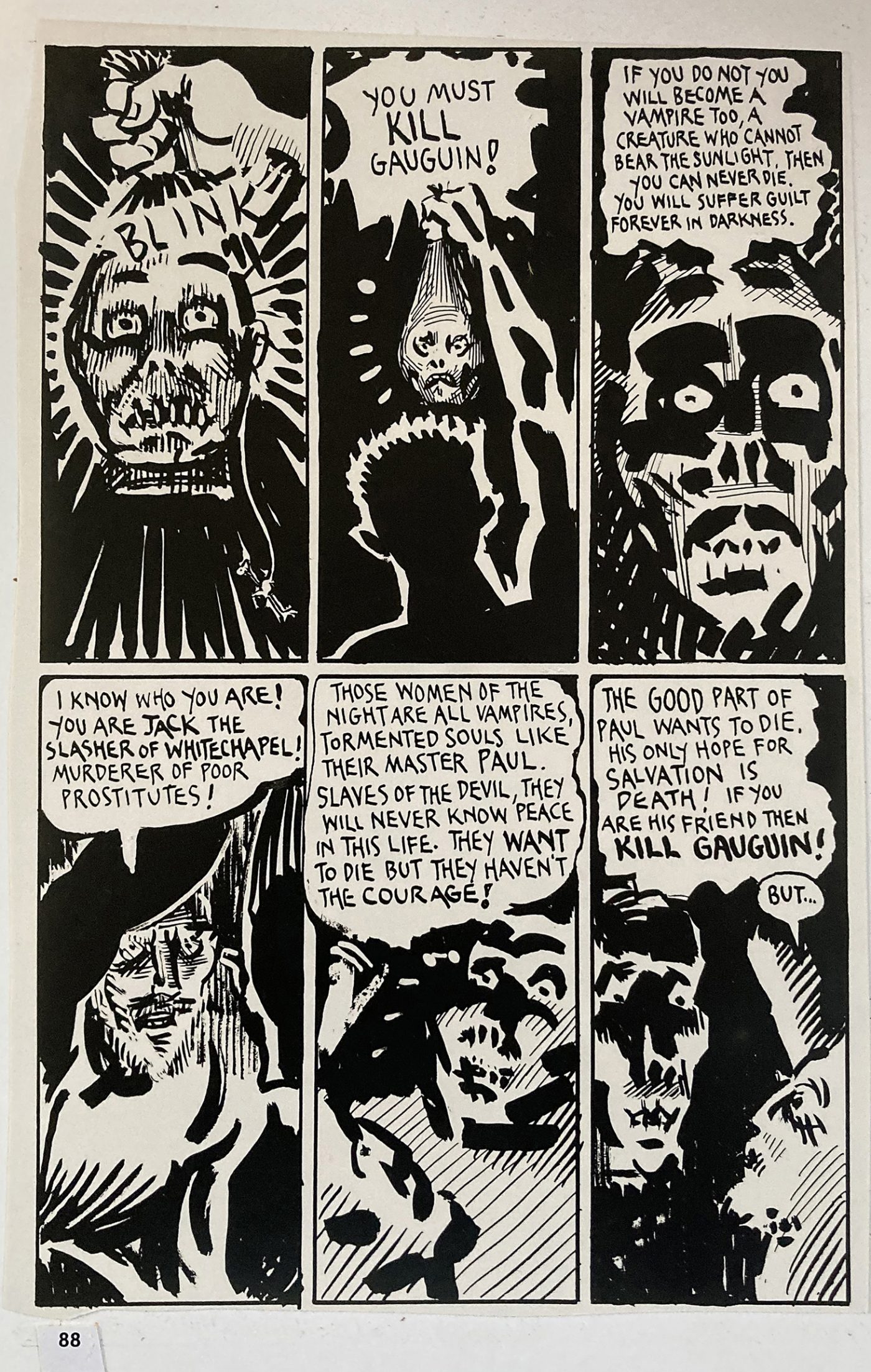
Proposing a biographical portrait about two Post-Impressionist painters, both noted drinkers: Vincent van Gogh and Paul Gauguin (during their time spent in Arles), I readily green-lighted it.
I knew BLAB! was in capable hands; on a personal, editorial level, I didn’t realize how capable. In his 19-page story "The Lying Ear," Frank delivered BIG TIME. He was firing on all cylinders.
Due to William Shakespeare's profound interest in human nature, and due to Frank's interest in literature, we settled on a story about the renowned English playwright, poet, and dramatist for the theme of the next BLAB! (#7) — psychology.
With "The Bard Must Die!," his thirty-six page fictive account about the death of Shakespeare, Frank created a very special story. How special? It was nominated by the Harvey Award committee as the Best Single Story of the Year. BLAB! itself would clench the spot for Best Anthology.
Though the digest-sized title was riding high, due to an upheaval in both my personal and professional life, I walked away from the series.
BLAB! would resurface down the road totally revamped, but that's another story.
Many years later Frank and I would reunite, and once again he would hit the bullseye for my book Masterful Marks: Cartoonists Who Changed the World.
[Frank's piece] "Rodolphe Töpffer. Inventor of the Comic Strip!" was a brilliant work from a brilliant talent whom, for myself, will forever remain a midwestern treasure.

The post R.I.P. underground comics pioneer Frank Stack, 1937-2026 appeared first on The Comics Journal.


 Hello, my name is Jack Sparrow. I'm a 50 year old self-employed Pirate from the Caribbean.
No comments:
Post a Comment